To Prevent the Extinction of Canada Lynx, the Forest Service Must Stop Clearcutting Lynx Habitat
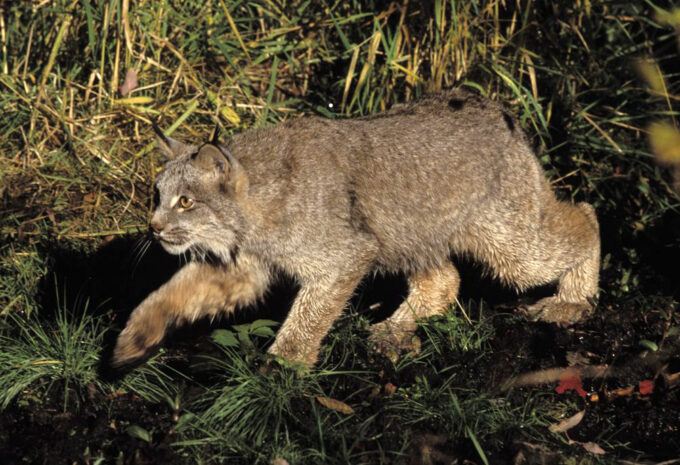
Canada Lynx stalking prey. Photo: Erwin and Peggy Bauer, U.S. Fish and Wildlife Service.
The U.S. Fish and Wildlife Service listed Canada lynx as “threatened” under the Endangered Species Act in 1999. Federal designation of “Lynx Critical Habitat” was intended to not only recover lynx but also recover the ecosystems upon which lynx depend for survival.
Canada lynx are comparable to the bobcat in size and particularly distinguished by its long legs and large paws, which make it well-adapted to hunting in deep snow. It is highly dependent on snow-covered acres due to its specialized predator-prey relationship with snowshoe hares, a species which, like lynx, evolved to survive in areas that receive deep snow.
Both lynx and snowshoe hare also need habitat with plenty of thick, mature, and old growth forests. Snowshoe hare need thick forests because they have to reach low-hanging branches above the snow and eat the twigs, bark, buds and pine needles they need to survive. Protecting lynx critical habitat is essential to recover and prevent lynx from going extinct, especially since studies show lynx avoid clearcuts for up to 50 years.
But the Forest Service does not have to follow the protections for lynx habitat in areas designated as the Wildland Urban Interface under the Healthy Forest Restoration Act.
Almost the entire Tally Lake Ranger District of the Flathead National Forest has been designated as lynx critical habitat. Yet, until Native Ecosystems Council, Alliance for the Wild Rockies, Council on Wildlife and Fish, and Yellowstone to Uintas Connection recently won in federal district court, the Forest Service continued to clearcut the forests there since the agency falsely claims that almost all of the Tally Lake Ranger District is in the Wildland Urban Interface, basically overriding the protection of lynx critical habitat.
The Healthy Forest Restoration Act defines the Wildland Urban Interface as being ½ mile from a community having at least 40 houses per square mile and having common community infrastructure such as sewage treatment. The Interface boundary can be extended out to a mile and half for a community if the areas have steep slopes of more than 30 degrees. But the Tally Lake Ranger District is generally rolling hills, not steep mountains.
Another serious problem with lynx management is a complete failure of the Forest Service and U.S. Fish and Wildlife Service to monitor population trends to determine if Forest Service projects are impacting populations. The problem is evident. The Forest Service and the U.S. Fish and Wildlife Service conveniently do not keep track of lynx population trends. So if the government never monitors them, no one can say that lynx are declining.
The Forest Service needs to amend the Revised Flathead Forest Plan direction for lynx and lynx critical habitat so that a valid conservation strategy based on the current best science is implemented to avoid extinction of the lynx in the Northern Rockies. That includes updating the definition of lynx critical habitat area in the Forest Plan to ensure recent clearcuts are not counted as lynx habitat, since lynx do not inhabit clearcuts.
No future logging projects should be allowed to go forward on the Flathead National Forest until the agency provides valid conservation strategies for old growth-associated wildlife, snag-associated species, various wildlife species, including the grizzly bear, and the Canada lynx and those species identified as Montana Species of Concern.
Without these valid conservation strategies for wildlife, any environmental analysis for logging will be invalid and likely illegal because adherence to the current Forest Plan direction will not ensure significant adverse impacts will not be avoided or that a diversity of wildlife will be preserved in the forest.

No comments:
Post a Comment