Energy as War: From Oil Fields to Cobalt Mines
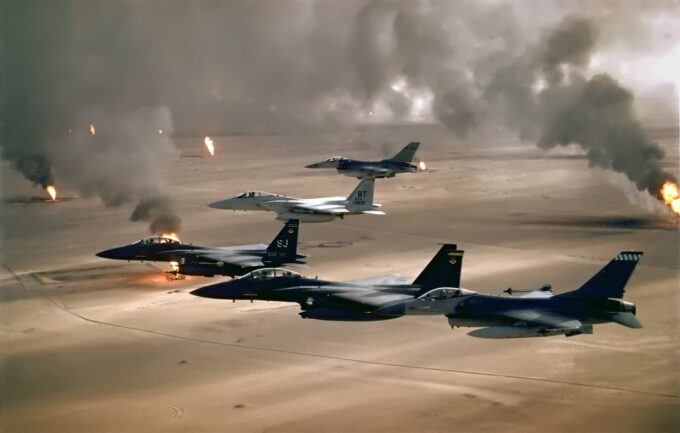
Photograph Source: US Air Force – Public Domain
The energy analyst known as Doomberg recently remarked on the Decouple podcast that ‘all wars are energy wars.’ From the decisive role energy access plays in combat itself (think oil in World War II), to its infrastructure being an inviting target, and its spillover effects for the global economy, it is hard to argue with that sentiment.
Since the U.S. and Israel began this war with Iran, there has been the Israeli attack on Iran’s piece of the South Pars natural gas field, Iran’s drone attack at the Ras Laffan Industrial City in Qatar- Qatar produces 20 percent of the world’s liquified natural gas (LNG) and the damage at Ras Laffan is expected to reduce production by 17 percent for five years. It was a $50,000 drone that hit the plant (back in 2019, it was another Iranian drone attack that hit the Saudi Aramco facility at Abqaiq, the largest oil processing facility in the world).
Lest the war happening in Europe be forgotten, the same week as the attack on Ras Laffan saw Ukrainian drones hit the Arctic Metagaz, a Russian LNG carrier transiting toward the Suez Canal. About a week ago, Reuters reported that at least 40 percent of Russia’s oil export capacity is at a halt. If the report calculations are correct, the shutdown is the most severe oil supply disruption in the modern history of Russia, the world’s second-largest oil exporter.
With the Strait of Hormuz tied up, the shifts in the price of oil have been daily headlines. The price at the gas pump is certainly one thing, yet much of Asia is dependent on LNG from the Middle East for its energy and the blockade is forcing many countries to consider further ramping up on coal and turning to Russian oil. Coal already accounts for over 40 percent of Asia’s energy. In the Philippines, more than 90 percent of energy imports come from the Middle East. President Ferdinand Marco Jr. recently declared a national emergency and for the first time in almost five years, Russian oil arrived in the country. South Korea, which relies almost totally on imported energy, lifted its 80 percent cap on coal installed capacity. In Japan, where bus and ferry services across the country have been curtailed, coal could offset up to 70 percent of gas-fired power generation. Taiwan normally gets 30 percent of its LNG from Qatar and, since it has retired many of its coal plants, may suffer worse.
Slowing imports have strained distribution systems, prompting governments to prioritize household supply and restrict commercial use. The New York Times reports that ‘In India and Pakistan, shortage of liquefied petroleum has left millions unable to cook daily meals, forcing the closing of thousands of small businesses and restaurants.’ When analyzing social unrest across developing countries between 2000 and 2020, researchers at the IMF found a clear association between fuel price increases and protests.
As is widely known by now, the Strait of Hormuz is also a critical transit point for fertilizer exports. Several fertilizer plants in Bangladesh and Pakistan have shut down or scaled back production just as the planting season is getting underway. Prices haven’t yet hit the peak of the aftermath of the Russian invasion of Ukraine, but if the blockage goes on, nothing is out of the question. As for the oil market, Saudi Arabia has been shipping about 5 million barrels of oil a day from the Red Sea port of Yanbu, bypassing Hormuz. With the Houthis claiming they are now in the war, there is concern that the Red Sea will become another front- or the Iranians themselves could attack the port or the East-West pipeline that supplies it.
On one hand, fossil fuel companies can enjoy the inflated prices; but on the other hand, if prices stay high long enough it could lead to a loss of demand. It was getting shut out of the LNG market after Russia invaded Ukraine (along with many years of endemic blackouts) that made people in Pakistan interested in solar panels. In 2021, solar power provided only 4 percent of Pakistan’s electricity; by 2025, it was 25 percent.
Many an environmentalist, including David Wallace-Wells in the New York Times, has quipped, “Nobody ever started a war over solar panels.” It is a nice thought but actually, it’s not at all difficult to imagine solar panels being targets in future conflicts. In the midst of al of the above, it is certainly understandable for anyone to have missed a small story in the Wall Street Journal on March 9th with the title ‘Cobalt Plant Sickened Congo Town.’ The story describes how health workers near CMOC Group’s plant, a Chinese-owned cobalt processing plant that produced 41 percent of the world’s supply in 2024, saw a surge of local townspeople coughing up blood, suffering recurring nosebleeds, and experiencing coughs and chest pain- symptoms toxicology experts associate with sulfur dioxide exposure. The company, of course, denies the evidence. Most of its cobalt, which is extracted during copper mining in two large mines in Congo’s copper belt (Kisanfu and Tenke Fungurume), goes to China and Europe for EV batteries, but lithium-ion batteries (cobalt is often included in their cathodes) are also a premier choice for solar storage.
The awful reality of cobalt mining in Congo has received attention (see Nicolas Niarchos’ informative new book Elements of Power or Siddharth Kara’s Cobalt Red: How the Blood of the Congo Powers Our Lives), but the geopolitics can’t be overlooked either. We have already seen China flex its muscles with rare earth metals a couple of times. With much of the material needed for the energy transition controlled by Chinese entities, in both mining and, especially, refining, the U.S. is desperately trying to break the stranglehold.
The Brazilian government is hesitating to sign a mineral agreement with the U.S. over issues of where processing will be done and Brazil’s trade relations with China. Brazil has the world’s second-largest rare earth reserves. This past December, a deal brokered by the Trump Administration between the DRC and Rwanda gave privileged access to U.S. mining companies. On March 31st, the Wall Street Journal reported that U.S.-based Virtus Minerals finalized a purchase of the assets of Congolese company Chemaf, which accounts for about 5 percent of global cobalt production. The U.S. also invested $553 million in the Lobito Corridor, a railway from Congo’s copper belt to Angola’s Atlantic coast for faster shipping to the U.S. In February, Orion CMC, a consortium that includes the U.S. government, signed a memorandum to take a 40 percent stake in Glencore’s DMC assets (Glencore is one of the world’s largest mining companies).
Mining can’t be turned on and off like a light switch. In fact, the lag between discovery and an operational mine has gotten longer, now averaging about 12.4 years across a wide range of sectors. Hence, when was the last time anyone heard of that rare earth deal with Ukraine or conquering Greenland? However, the firm Benchmark Mineral Intelligence estimates that between 336 and 384 new mines for minerals like lithium, cobalt, nickel, and graphite will be needed to meet demand by 2035. Is it really out of the question that all this scrambling could spill over into actual combat?
The point is this energy transition, if ‘transition’ is even the correct description, has many of the same features as previous ones. As activists push for greener energy, other standard fights aren’t going away. Workers’ rights need to be demanded and fought for throughout supply chains. The rights of local communities to both benefit from and resist resource extraction are vital. Public funding for scaling up battery recycling efforts and developing less resource-intensive materials will only get more important.
As another war rages in the Middle East, with a U.S. president blathering on about ‘taking oil’, such battles are more relevant than ever.

No comments:
Post a Comment