It’s possible that I shall make an ass of myself. But in that case one can always get out of it with a little dialectic. I have, of course, so worded my proposition as to be right either way (K.Marx, Letter to F.Engels on the Indian Mutiny)
Friday, April 17, 2026
‘This Is Not Self-Defense’: UN Experts Condemn Israel’s Criminal Assault on Lebanon
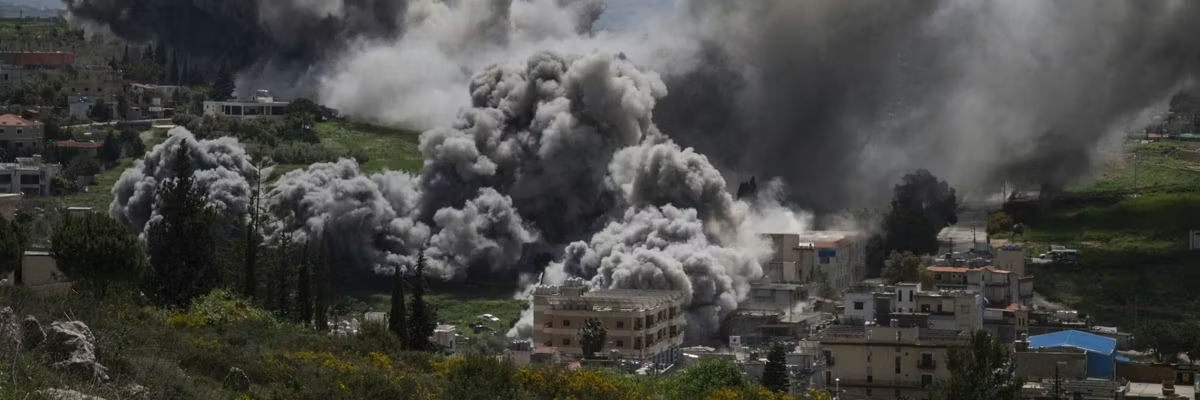
“We are witnessing the continuing utmost contempt for the international legal order,” said a group of two dozen United Nations special rapporteurs. An Israeli airstrike is seen on April 16, 2026 in Nabatieh, Lebanon. (Photo by Adri Salido/Getty Images)
A group of two dozen United Nations experts issued a scathing joint statement on Wednesday condemning Israel’s ongoing assault on Lebanon as “a blatant violation of the UN Charter, a deliberate destruction of prospects for peace, and an affront to multilateralism and the UN-based international order.”
“We are witnessing the continuing utmost contempt for the international legal order, for diplomacy, and above all for the lives of civilians and the environment in Lebanon,” the experts said. “Israel has chosen the very moment a ceasefire was announced—one that its Pakistani mediator stated included Lebanon—to unleash the largest coordinated wave of strikes on the country since 1980.”
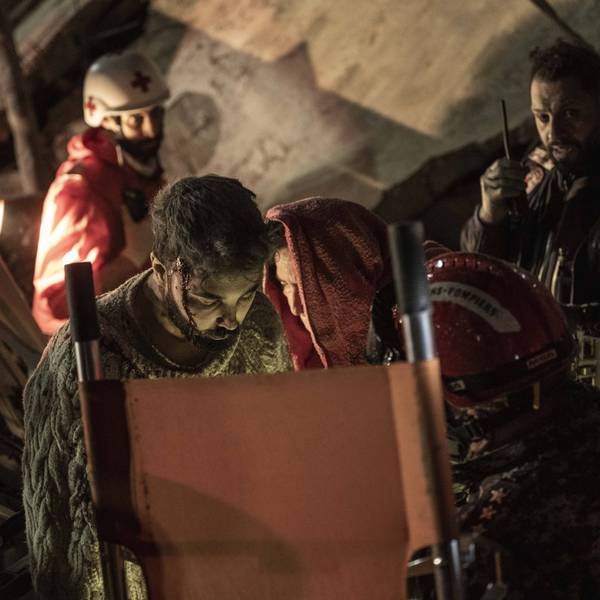
Despite signals in recent days that the Israeli and Lebanese governments are engaged in their highest level of diplomatic talks in decade, Israel’s military continues to ferociously bomb southern Lebanon, devastating entire towns—including homes and schools—and killing civilians. On Wednesday, according to Lebanese officials, Israeli forces killed three paramedics in a “triple-tap” airstrike on the town of Mayfadoun.
“This is not self-defense,” said the UN experts, including special rapporteur on the right to education Farida Shaheed, special rapporteur on the right to food Ben Saul, and special rapporteur on the occupied Palestinian territories Francesca Albanese.
“The issuance of blanket evacuation orders, combined with the destruction of urban and village housing that displaced persons would have returned to, is consistent with the pattern of domicide that was initiated during the genocide in Gaza,” the experts continued. “Forced displacement of a civilian population constitutes crimes against humanity and is a war crime under international law.”
More than a million people, over a fifth of Lebanon’s population, have been displaced since Israel ramped up its assault on the country in early March, claiming to target the political and militant group Hezbollah.
UNICEF USA said Thursday that at least 600 children have been killed or wounded by Israeli attacks on Lebanon since March 2, and more than 390,000 have been forced from their homes. Overall, Israel’s assault on Lebanon has killed more than 2,000 people since early march.
“Nowhere is safe for children in Lebanon,” the organization said.
In their statement on Wednesday, the UN experts demanded that Israel “immediately cease all military operations in Lebanon” and urged the United States—Israel’s leading ally and arms supplier—to “use its influence” to ensure Israel stops the bombing.
Lebanon Ceasefire Marks Historic Strategic Defeat... for the US and Israel
After failing to secure victory through overwhelming violence, Israel is increasingly relying on coercive diplomacy to impose political outcomes.
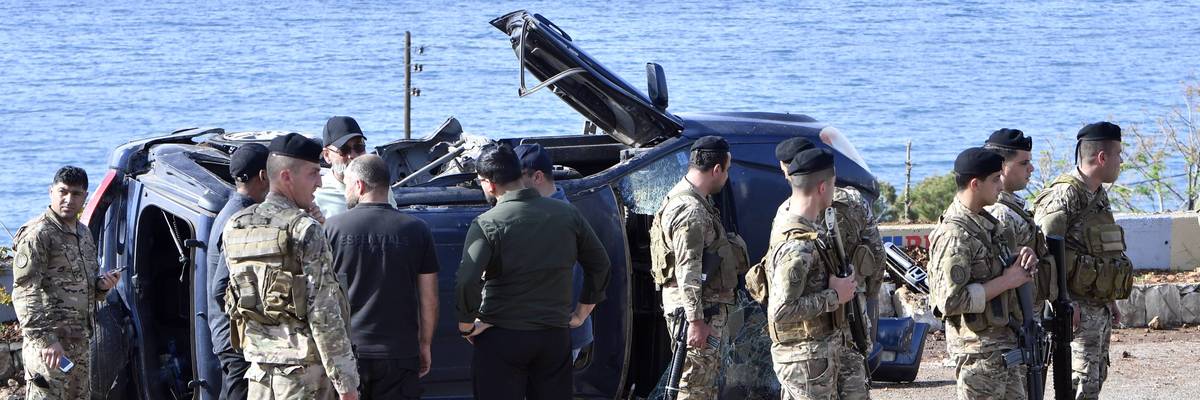
A view of the destruction after the Israeli army targeted a moving vehicle on Al-Saadiyat Street near the city of Sidon in southern Lebanon on April 16, 2026. (Photo by Houssam Shbaro/Anadolu via Getty Images)
A ceasefire in Lebanon was announced on Thursday by US President Donald Trump, but its reality tells a very different story. The ceasefire was not the product of American diplomacy, nor Israeli strategic calculation. It was imposed—largely as a result of sustained Iranian pressure.
Washington, Tel Aviv, and their allies—including some within Lebanon itself—will continue to deny this reality. Acknowledging Iran’s role would mean admitting that a historic precedent has been set: for the first time, forces opposing the United States and Israel have succeeded in imposing conditions on both.
This is not a minor development. It is a strategic rupture. But it is not the only fundamental shift now underway: Israel’s very approach to war and diplomacy is itself changing.
After failing to secure victory through overwhelming violence, Israel is increasingly relying on coercive diplomacy to impose political outcomes.
Over the past two to three decades, this Israeli strategy has become unmistakably clear: achieving through diplomacy what it has failed to impose on the battlefield.
‘Diplomacy’ as War
Israeli ‘diplomacy’ does not conform to the conventional meaning of the term. It is not negotiation between equals, nor a genuine pursuit of peace. Rather, it is diplomacy fused with violence: assassinations, sieges, blockades, political coercion, and the systematic manipulation of internal divisions within opposing societies. It is diplomacy as an extension of war by other means.
Likewise, Israel’s conception of the ‘battlefield’ is fundamentally different. The deliberate targeting of civilians and civilian infrastructure is not incidental, nor merely ‘collateral damage’; it is central to the strategy itself.
Nowhere is this clearer than in Gaza. Following the ongoing genocide, vast swathes of Gaza have been reduced to rubble, with estimates indicating that around 90 percent of the whole of Gaza has been destroyed. According to the Gaza Ministry of Health, women and children consistently account for roughly 70 percent of all of Gaza’s casualties.
This is not collateral damage. It is the deliberate destruction of a civilian population, an act of genocide that is designed to force mass displacement and remake the political and demographic reality in Israel’s favor.
The same logic extends beyond Gaza. It shapes Israel’s wars in Lebanon against Hezbollah and its broader confrontation with Iran.
The United States, Israel’s principal ally, has historically operated within a similar paradigm. From Vietnam to Iraq, civilian populations, infrastructure, and even the environment itself have borne the brunt of American warfare.
A Faltering Model
It is often argued that Israel turned to ‘diplomacy’ following its forced withdrawal from southern Lebanon in 2000 under resistance pressure. While this moment was pivotal, it was not the beginning.
Earlier precedents exist. The First Intifada (1987–1993) demonstrated that a sustained popular uprising could not be crushed through brute force alone. Despite Israel’s extensive repression, the revolt endured.
It was in this context that the Oslo Accords emerged—not as a genuine peace process, but as a strategic lifeline. Through Oslo, Israel achieved politically what it could not impose militarily: the pacification of the uprising, the institutionalization of Palestinian political fragmentation, and the transformation of the Palestinian Authority into a mechanism for internal control.
Meanwhile, settlement expansion accelerated, and Israel reaped the global legitimacy of appearing as a ‘peace-seeking’ state.
Yet the last two decades have exposed the limits of this model.
From Lebanon in 2006 to repeated wars on Gaza (2008–09, 2012, 2014, 2021, and the ongoing genocide since 2023), Israel has failed to secure decisive strategic victories. Its ongoing confrontations with Hezbollah and Iran further underscore this failure.
Not only has Israel been unable to achieve its stated military objectives, but it has also failed to translate overwhelming firepower—even genocide—into lasting political gains.
Some interpret this as a shift toward perpetual war under Prime Minister Benjamin Netanyahu. But this reading is incomplete.
Perpetual War?
Netanyahu understands that these wars cannot be sustained indefinitely. Yet ending them without victory would carry even greater consequences: the collapse of Israel’s deterrence doctrine and, potentially, the unraveling of its broader project of regional dominance.
This dilemma strikes at the heart of Zionist ideology, particularly Ze’ev Jabotinsky’s concept of the ‘Iron Wall’—the belief that overwhelming, unrelenting force would eventually compel indigenous resistance to surrender.
Today, that premise is being tested—and found wanting.
Netanyahu has repeatedly framed current wars as existential, comparable in significance to 1948—the war that resulted in the ethnic cleansing of Palestinians during the Nakba and the establishment of Israel.
Indeed, the parallels are unmistakable: mass displacement, civilian terror, systematic destruction, and unwavering Western backing—once from Britain, now from the United States.
But there is a critical difference: The 1948 war led to the creation of Israel; the current wars are about its survival as an exclusivist settler colonial project.
And herein lies the paradox: the longer these wars continue, the more they expose Israel’s inability to secure decisive outcomes. Yet ending them without victory risks a historic defeat—not only for Netanyahu, but for the ideological foundations of the Israeli state itself.
Israeli society appears to recognize the stakes. Polls throughout 2024 and 2025 have shown overwhelming support among Israeli Jews for continued military campaigns in Gaza and confrontations with Iran and Lebanon.
Public discourse frames this support in terms of ‘security’ and ‘deterrence’. But the underlying reality is deeper: a collective recognition that the long-standing project of military supremacy is faltering.
Having failed to subdue Gaza despite the genocide, Israel is now attempting to achieve through diplomatic maneuvering what it could not secure through war. Proposals for international oversight, stabilization forces, and externally imposed governance structures are all variations of this approach.
But these efforts are unlikely to succeed.
Gaza is no longer isolated. The regional dimension of the conflict has expanded, linking Lebanon, Iran, and other actors into a broader, interconnected front. Balance is Shifting
In Lebanon, Israel has been repeatedly forced toward ceasefire arrangements not out of choice, but because it failed to defeat Hezbollah or break the will of the Lebanese people.
This dynamic extends to Iran. Following the joint aggression on Iran starting February 28, both the United States and Israel were compelled to accept de-escalation frameworks after failing to achieve rapid or decisive outcomes.
The expectation that Iran could be quickly destabilized—replicating the models of Iraq or Libya—proved illusory. Instead, the confrontation revealed the limits of military escalation and forced a return to negotiations.
This is the essence of Israel’s current predicament.
Diplomacy, in this model, is not an alternative to war—it is a pause within it. A temporary tool used to regroup before the next phase of confrontation.
But in Israel’s case, this aggressive ‘diplomacy’ is increasingly becoming the only available tool, precisely because its military strategy has failed to deliver victory.
Lebanon was meant to be the exception—a theater where Israel could isolate and defeat Hezbollah. Instead, it became further evidence of strategic failure.
Efforts to separate the fronts—Gaza, Lebanon, Yemen, Iran—have collapsed. Iran has explicitly linked its diplomatic engagement to developments on other fronts, forcing Israel into a broader strategic entanglement it cannot control.
This marks a profound shift.
The foundational pillars of Israeli strategy—overwhelming force, fragmentation of adversaries, narrative control, and political engineering—are no longer functioning as they once did.
Yet Netanyahu continues to project victory, declaring success at regular intervals, invoking deterrence, and framing ongoing wars as strategic achievements.
But these narratives ring hollow.
The reality, increasingly evident to observers across the region and beyond, is that the balance is finally shifting.
For the first time in decades, the trajectory of history is no longer bending in Israel’s favor.
Our work is licensed under Creative Commons (CC BY-NC-ND 3.0). Feel free to republish and share widely.
Ramzy Baroud Ramzy Baroud is a journalist and the Editor of the Palestine Chronicle. He is the author of five books including: "These Chains Will Be Broken: Palestinian Stories of Struggle and Defiance in Israeli Prisons" (2019), "My Father Was a Freedom Fighter: Gaza's Untold Story" (2010) and "The Second Palestinian Intifada: A Chronicle of a People's Struggle" (2006). Dr. Baroud is a Non-resident Senior Research Fellow at the Center for Islam and Global Affairs (CIGA), Istanbul Zaim University (IZU). His website is www.ramzybaroud.net. Full Bio >
‘Time for Half Measures Is Over’: Study Warns of Terrifying Atlantic Ocean Current Collapse “We must avoid this collapse at all costs,” said a leading current researcher, who warned that “the stability of the entire planet” is at stake. Gentle waves are seen in the Atlantic Ocean near Spain on March 28, 2026. (Photo by S Pinter/Getty Images)
The global climate crisis is causing a critical Atlantic Ocean current system to weaken much sooner than previously predicted, according to a study published on Thursday. If it stops, scientists say it could pose catastrophic consequences for Europe, Africa, and the Americas.
The Atlantic Meridional Overturning Circulation (AMOC) is one of the most important current systems in the world for maintaining the delicate balance of the global climate. It helps to keep colder regions like Europe and the Arctic mild by moving warm water northward and pushes large amounts of carbon deep into the ocean, keeping it out of the atmosphere.
Scientists have feared AMOC’s decline for some time. Previous studies have shown it to be at its weakest point in 1,600 years. But research published this month suggests that a collapse may come much sooner than anticipated.
One study, published Thursday in the journal Science Advances, used climate models and current data to predict the decline in the coming decades.
Researchers found that the system is on course to slow by more than 50% by the end of the century and could pass a significant tipping point by mid-century, at which point its decline would become irreversible.
“We found that the AMOC is declining faster than predicted by the average of all climate models,” said lead researcher Valentin Portmann, of the Inria Research Center of Bordeaux South-West. “This means we are closer to a tipping point than previously thought.”
A major driver of its slowdown has been the rapid melting of Greenland’s freshwater ice sheet into the Atlantic, which has diluted denser saltwater, making it harder to transfer northward.
He explained: “The more rapidly Greenland melts, the more freshwater floods the North Atlantic. This disrupts the sinking process, effectively applying the brakes to the entire system.”
This research followed another study published last week by scientists at the University of Miami, which found that AMOC has been weakening at four latitudes in the Atlantic.
Professor Stefan Rahmstorf, a leading AMOC researcher at the Potsdam Institute for Climate Impact Research, who was not involved in either study, called it “an important and deeply concerning result” that “confirms that the ‘pessimistic’ climate models—those projecting a severe weakening of the AMOC by 2100—are the most accurate.”
“The most dramatic and drastic climate changes we see in the last 100,000 years of Earth history have been when the AMOC switched to a different state,” Rahmstorf explained.
A shutdown of the current system poses what Canadian climate activist and marine conservationist Paul Watson described as a “domino effect of climatic upheavals.”
Scientists have projected that temperatures in northern Europe could plummet dramatically, with winters in London sometimes reaching below -20°C (-4°F) and those in Norway reaching -48°C (-54°F). It also threatens to dramatically shorten growing seasons, putting food security in peril for hundreds of millions of people.
Tropical storms in the North Atlantic would also become more severe. As the current slows, sea levels are expected to rise, and the greater temperature difference between cooling Europe and the warming tropics can fuel more intense hurricanes and increase the risk of flooding in major coastal cities.
“We must avoid this collapse at all costs,” Rahmstorf said. “The stakes are too high; this isn’t just about Europe’s climate, but the stability of the entire planet.”
Such a dramatic change in the flow of global heat could scramble temperature and rainfall patterns worldwide, putting some areas at greater risk of drought and disrupting the monsoon season that fuels agriculture in many regions.
It also risks becoming self-perpetuating, as the large amounts of carbon released from the ocean could further accelerate AMOC’s collapse. Research published last week found that carbon emissions from the Southern Ocean alone could increase global temperature by about 0.2°C.
“The science is clear: The AMOC is teetering on the edge of collapse, and the window to act is closing,” Watson said. “Yet global leaders remain paralyzed by short-term politics and denial.”
The conclusion of the most recent United Nations climate summit, COP30, has been described as woefully insufficient to address the mounting climate emergency. The roadmap for action released by the host nation, Brazil, excluded any mention of the phrase “fossil fuels” after the conference was overrun by industry lobbyists.
“The time for half-measures is over,” Watson said. “The choices we make in the next decade will determine whether future generations inherit a manageable climate or a world plunged into chaos.”
‘Foreign Billionaires First, America Last’: Critics Slam GOP Over Mining Approval Near Minnesota Boundary Waters
“We don’t allow mining in Yellowstone, Yosemite, Zion, Acadia, Glacier, or any of our nation’s revered national parks—and we shouldn’t allow it in the watershed of the Boundary Waters, either,” said one congresswoman.
The Boundary Waters Canoe Area Wilderness in the Superior National Forest in Minnesota is seen on September 6, 2019. (Photo by Andrew Lichtenstein/Corbis via Getty Images)
Democratic lawmakers and environmental protection groups condemned Senate Republicans on Thursday for their “heartbreaking” passage of a House resolution to overturn a 20-year moratorium on mining in the watershed of Minnesota’s Boundary Waters Canoe Area Wilderness, the nation’s most visited wilderness area—a vote that critics said was the result of years of lobbying by a foreign-owned mining firm.
House Joint Resolution 140 now heads to President Donald Trump’s desk, nearly a decade after Chilean conglomerate Antofagasta, the owner of Twin Metals Minnesota, began discussing with Trump’s first administration its desire to build a copper mine over the pristine area.
“Because of this extremely short-sighted vote, our nation’s most-visited wilderness area faces the threat of permanent toxic pollution,” said Rep. Betty McCollum (D-Minn.). “Why? So Antofagasta, a Chilean corporation that owns Twin Metals, can mine American copper and ship it to China to be smelted and sold on the global market. Twin Metals has been lobbying President Trump and Republicans in Congress for over ten years to remove the protections from this watershed and renew their mine plans to extract American minerals at the expense of freshwater for future generations.”
The 50-49 vote in the Senate, said Environment America, puts the 1.1 million-acre wilderness area for heavy metals leaching into the soil and water through acid mine drainage.
Toxic runoff from copper mining, said the group, “ultimately poisons the land and water surrounding a mine, making the ecosystem unlivable for wildlife.”
Leda Huta, vice president of government relations for American Rivers, called the vote “a betrayal of the public trust.”
“We share in the deep disappointment of millions of Americans who expect our elected leaders to protect our clean water, our abundant wildlife, and access for all to unmatched outdoor recreation spaces,” said Huta. “This is a heartbreaking moment.”
Amanda Hefner, manager of Save the Boundary Waters Action Fund, wrote in a column in Minnesota Reformer last October that “in a water-rich environment like the Boundary Waters, with its low buffering capacity, pollution would spread quickly through interconnected lakes and streams.” She also wrote that it was “reckless” to risk the preserve’s 17,000 jobs and over $1 billion in annual revenue “for a foreign-owned mine that would pollute and leave toxic waste for generations.”
According to Jacobin, Antofagasta spent $200,000 on lobbying in the final quarter of 2024 and $230,000 in the first quarter of 2025 “on issues including federal leases for Twin Metals.” The Chilean company is owned by billionaire Andrónico Luksic, who rented out his $5.5 million mansion in Washington, DC to Trump’s daughter Ivanka and her husband, then-White House adviser Jared Kushner, from 2017-21.
The Sierra Clubnoted that to pass the mining ban reversal, Senate Republicans “utilized a baseless interpretation of the Congressional Review Act (CRA).”
“The CRA only allows Congress to disapprove of administrative rules,” said the group. “No previous administration has considered mineral withdrawals to be ‘rules’ that are subject to the CRA.”
Athan Manuel, director of the Sierra Club’s Lands Protection Program, said that “allowing a foreign company to open a toxic mine on its doorstep puts a fragile ecosystem at risk and shows the Trump Administration will always act to benefit corporations over the American people.”
“The Boundary Waters is one of the country’s most iconic wilderness areas, visited by thousands every year. It should be a place for recreation and conservation, not for pollution and exploitation,” said Manuel.
Despite Trump’s refrain, “America First,” Rep. Ilhan Omar (D-Minn.) said the vote made clear that “for the GOP, it’s foreign billionaires first, America last.”
McCollum warned that the mining moratorium was “the only way to protect this wilderness, which is home to some of the cleanest water in the entire world.
“We don’t allow mining in Yellowstone, Yosemite, Zion, Acadia, Glacier, or any of our nation’s revered national parks—and we shouldn’t allow it in the watershed of the Boundary Waters, either,” said the congresswoman. “One hundred percent of copper mines have failed, leading to polluted waters. This case will be no different.”
‘There Is Only One Majority in This Country, That’s the Working Class,’ Says Mamdani
“It’s time we have a politics that puts them at the heart of what it is that we’re pursuing and not as part of the appendix.” New York City Mayor Zohran Mamdani stands with delivery app drivers in Queens on January 30, 2026. (Photo: Mayor Zohran Kwame Mamdani/X)
As he has done numerous times before, New York City Mayor Zohran Mamdani on Thursday rejected the notion that democratic socialism has limited appeal outside of progressive urban centers by asserting that his worker-centered policies are aimed at uplifting the nation’s biggest demographic cohort—working people and their families.
Mamdani appeared on “CBS Mornings” and was asked what grade he’d give himself after 100 days leading the world’s most important city.
“You know, I’ll always leave it to New Yorkers to give me the grade but I will say that I’m proud of what the team has accomplished over the 100 days,” Mamdani told “CBS Mornings” hosts Gayle King and Vladimir Duthiers. “I mean, we saw $1.2 billion secured in a partnership with Gov. [Kathy] Hochul to deliver universal childcare in our city.”
“We held bad landlords accountable for $32 millon, fixed 6,070 apartments,” he added. “We filled 102,000 potholes and we did all of this while also returning $9.3 million back to workers and small businesses that have been ripped off by megacorporations.”
Duthiers asked whether “a democratic socialist platform can translate into something that’s electorally viable in a statewide election or a national election given that, according to Gallup, many older and rural voters still have issues with the term, with the label, socialist.”
Mamdani replied: “You know, what I find is that New Yorkers ask me less about how I describe my politics and more about whether my politics includes them, and I think what we can see is that a democratic socialist politics is one that should be judged on its delivery, like any ideology. And what we’re showing in this city is we can we can pursue the big things like universal childcare and do the pothole politics at the same time.”
“I think that this is a politics that can flourish anywhere,” he added, “because frankly there is only one majority in this country that’s the working class and it’s time we have a politics that puts them at the heart of what it is that we’re pursuing and not as part of the appendix.”
Turning to the illegal US-Israeli war of choice against Iran, Mamdani lamented that “we’re talking about spending close to $30 billion to kill thousands of people an ocean away while we’re told that we don’t have even an ounce of that money to help working-class Americans across this country.”
According to a Marist poll published earlier this month, 48% of New Yorkers approved of Mamdani’s overall performance, while 30% disapproved and 23% are unsure. A majority of respondents—55%—“have either a very favorable or somewhat favorable view of the mayor, and 33% have either a somewhat unfavorable or very unfavorable opinion.”
A majority of respondents also said the city is heading in the right direction under Mamdani, while nearly three-quarters believe the mayor is “working hard,” and 58% “have a great deal or a good amount of trust in Mayor Mamdani to make decisions that are in the best interest of New York City.”
Previous polling has also shown that Mamdani’s economic policies are popular across the country.
Responding to Mamdani’s “CBS Mornings” appearance, the Center for Economic and Policy Research (CEPR) shared its newly published “Majority Agenda,” a “roadmap” to passing policies that most Americans see as major priorities to improve their lives.
“The Majority Agenda is a collection of policy briefs on important issues where Americans generally have broad agreement across the political landscape,” CEPR explained. “The project organizes these reports into three main areas: good jobs, strong infrastructure, and fair play.”
“We’re not as divided as some media and politicians want us to believe,” CEPR contended.
Thursday, April 16, 2026
One 'festering' issue predicted to sink GOP as analyst flags problem 'bigger than Trump'
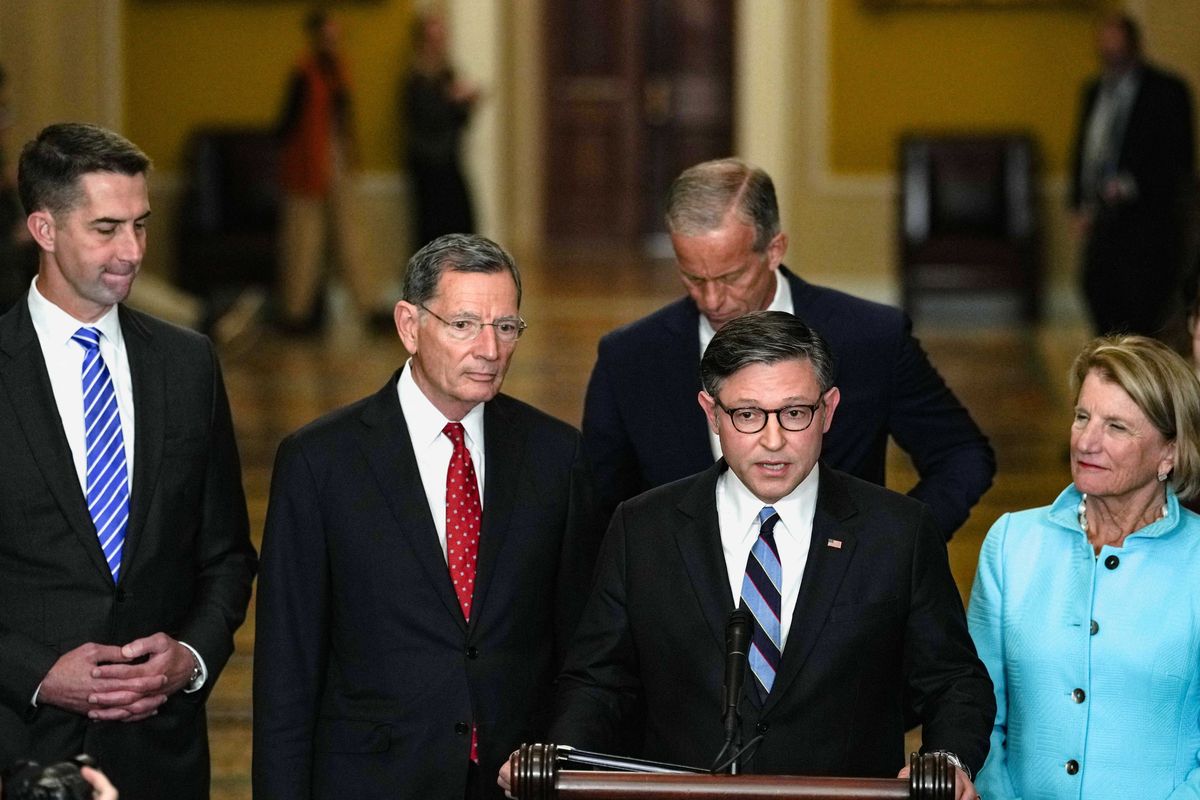
U.S. House Speaker Mike Johnson (R-LA), with U.S. Senate Majority Leader John Thune (R-SD), Senator John Barrasso (R-WY), Senator Shelley Moore Capito (R-WV), and Senator Tom Cotton (R-AR), speaks to reporters while Senate Republican leaders hold a press conference following their weekly policy lunch as the partial government shutdown continues, on Capitol Hill in Washington, D.C. on Oct. 7, 2025. REUTERS/Kent Nishimura
The Republican Party has a problem on its hands that is bigger than anything President Donald Trump is currently doing, a political analyst has claimed.
David Pakman believes recent comments from Marjorie Taylor Greene and former GOP representatives, including Liz Cheney and Adam Kinzinger, highlight the problem with current reps. Greene, a once-prominent ally of Trump and the MAGA movement, commented on the alleged cognitive decline of Trump in a recent interview.
In a clip shared by News 4 Tucson, Greene said, "I really think that his [Trump's] mental capacity needs to be examined. His rhetoric has been shocking to many Americans and people around the world."
A separate appearance on CNN earlier this week from Greene had the GOP ex-rep, who resigned from Georgia's 14th congressional district in 2026, criticize Trump for a Truth Social post.
Trump, referencing Iran in a post to Truth Social on April 7, wrote, "...a whole civilization will die tonight, never to be brought back again." Greene reposted the comment, adding, "25th AMENDMENT!!!"
The 25th Amendment provides a temporary transfer of the President's powers to the Vice President. This transfer can be made by the President or on the initiative of the Vice President, with the backing of a majority of the cabinet.
Greene added, "I think we have to truly question the mental stability of any President who threatens to wipe out an entire civilization of people. That would include all the innocent people in that country who have nothing to do with the war.
"Especially after President Trump said this was about freeing the Iranian people from the Iranian regime. For him to call to wipe out an entire civilization of people, it's absolutely wrong."
Pakman believes the change in rhetoric from one of "Trump's most ardent defenders" is a sign the GOP must be vocal about their opposition to the President.
He said, "This is way bigger than Trump. It exposes the Republican Party as happy with a system in which they know better, but they don't say a word. They just allow it to continue festering and perpetuate itself. Every once in a while, somebody like Marjorie Taylor Greene, Adam Kinzinger, or Liz Cheney, breaks rank and they say the quiet part out loud.
"Whether it's about Trump's authoritarianism or the cognitive stuff, they are seen as the exception. Now, they may not be the majority of Republicans, but there are a lot of Republicans who believe the exact same thing because they see the exact same thing."
ANTI-D.E.I.
MAGA backlash sees Army yank tribute to Purple Heart senator who lost both legs in Iraq
U.S. Senator Tammy Duckworth (D-IL) speaks to reporters following the Democrats weekly policy lunch on Capitol Hill in Washington, D.C., U.S., April 14, 2026. REUTERS/Evelyn Hockstein
The U.S. Army shut down an entire network of official social media accounts this week after a post celebrating Democratic Sen. Tammy Duckworth, a Purple Heart recipient who lost both legs in combat, drew backlash from a pro-Trump veteran online.
The "Soldier for Life" program, which connects veterans and their families to employment, healthcare and retirement resources, posted a tribute to Duckworth's military career as an Army lieutenant colonel and Iraq War veteran. Within 24 hours of a former Army paratrooper criticizing the post on X, it was deleted.
Chase Spears, a former Army paratrooper and veteran of the war in Afghanistan, criticized Duckworth, calling her 'one of the most brazenly hostile partisans to have worn the uniform,'" NOTUS reported Wednesday.
“There are so many warriors worthy of being praised, men and women who didn’t sell their souls along the way. But this is who @SecArmy Dan Driscoll’s Army continues going out of its way to pay homage to,” Spears wrote on X.'
Shortly after, the Soldier for Life Facebook page was locked down.
Driscoll, Trump's Army secretary, ordered all Soldier for Life accounts shuttered after the negative online reaction, a Department of Defense source familiar with the decision told The Hill. An Army spokesperson insisted the move was "simply a circumstance of the Army handling routine Army business," citing a December memo requiring accounts not managed by qualified personnel to be deactivated.
Duckworth, who served more than two decades in the Army Reserve and Illinois Army National Guard before retiring in 2014, lost both legs in 2004 when her Black Hawk helicopter was shot down over Iraq.
During Driscoll's confirmation hearing, Duckworth pressed him to pledge he would refuse illegal orders from the Trump administration and ultimately voted against confirming him. She has also called for Defense Secretary Pete Hegseth's resignation.
Pete Hegseth uses Bible story to whine about 'garbage' press coverage of his war
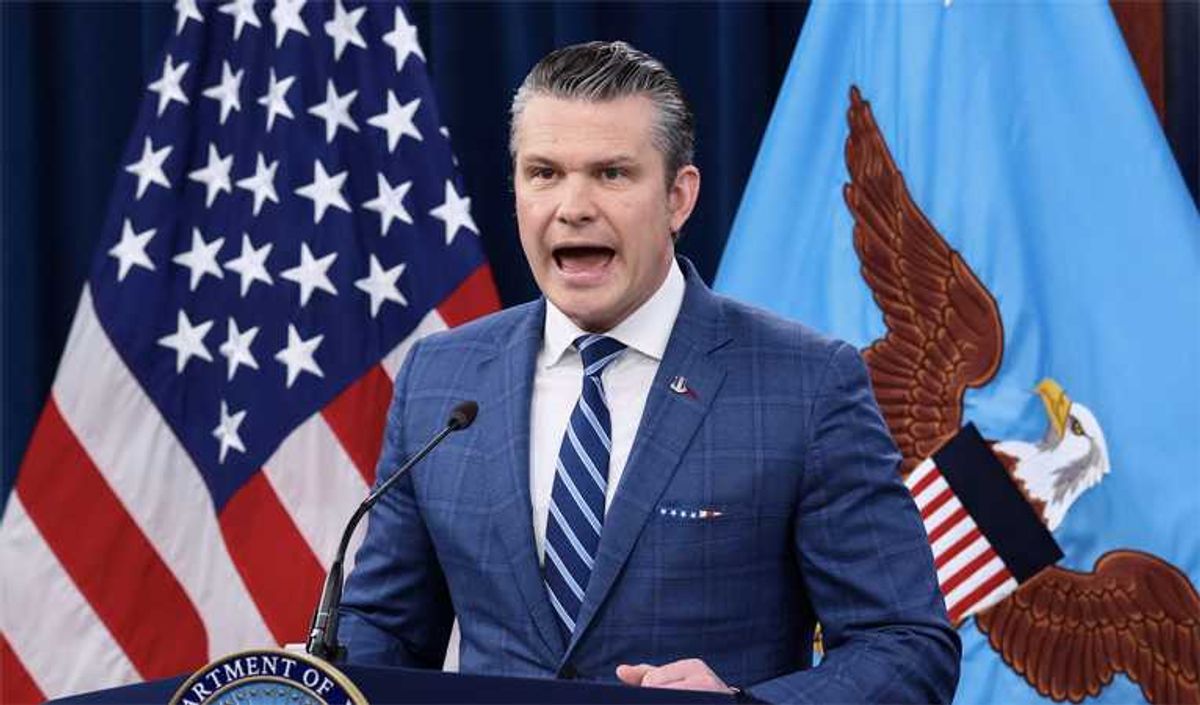
U.S. Secretary of Defense Pete Hegseth holds a press briefing in the Pentagon Press briefing room, following the announcement of a two-week ceasefire in the Iran war, at the Pentagon in Washington, D.C., U.S., April 8, 2026. REUTERS/Kevin Lamarque
Defense Secretary Pete Hegseth once again used a Pentagon press conference to complain about the reporting on the Iran war that is trapped in a stalemate, claiming the straight reporting on Donald Trump's attack on Iran has been “garbage.”
He then claimed he attended church last Sunday with his family and heard a sermon about the Pharisees that reminded him of the persecution of Jesus Christ –– then comparing them to the US press.
After boasting about the US efforts in the Middle East, the terse Hegseth pivoted to what has become a regular feature of his press availabilities.
“We urge this new [Iran] regime to choose wisely,” he stated before adding, “Speaking of choosing wisely, a note to the press, to the press corps. To the American media, I just can't help but notice the endless stream of garbage, the relentlessly negative coverage you cannot resist pedaling. Despite the historic and important success of this effort and the success of our troops, sometimes it's hard to figure out what side some of you are actually on. It's incredibly unpatriotic.”
“This past Sunday, I was sitting in church with my family, and our minister preached from the book of Mark, the third chapter,” he claimed. “And in the passage, Jesus entered a synagogue and healed a man with a withered hand. The Pharisees came to watch, and as the scripture reads, they came to see whether he, Jesus, would heal him or he would heal him on the Sabbath so that they might accuse him.”
“You see, the Pharisees, the so-called and self-appointed elites of their time, they were there to witness, to write everything down, to report,” he added. “But their hearts were hardened even though they witnessed a literal miracle. It didn't matter. They were only there to explain away the goodness in pursuit of their agenda. As the passage ends, the Pharisees went out and immediately held council against him how to destroy him.”
“I sat there in church and I thought, our press are just like these Pharisees,” he stated. “Not all of you, not all of you, but the legacy Trump-hating press, your politically motivated animus for President Trump nearly completely blinds you from the brilliance of our American warriors … The hardened hearts of our press are calibrated only to impugn. I would ask you to open your eyes to the goodness, the historic success of our troops, the courage of this president, and this historic moment for a deal that could end the Iranian nuclear threat.”
Pentagon 'preparing for something much bigger' after string of military conflicts: analyst
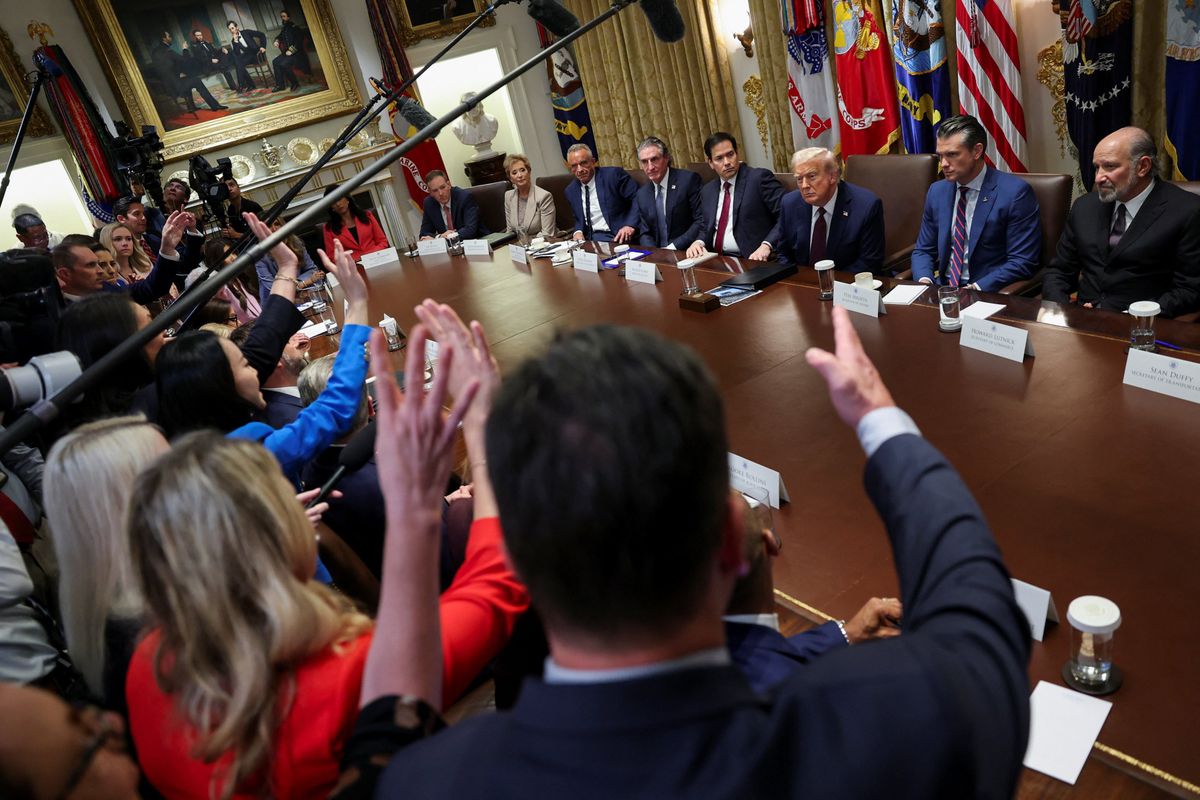
Members of the media raise hands to ask questions, as U.S. President Donald Trump holds a cabinet meeting REUTERS/Jonathan Ernst
President Donald Trump's administration may be preparing for further conflicts after the Pentagon received a briefing to boost weapons production, a political analyst has warned.
Pentagon officials were privately briefed by the Trump administration last month, according to Heather Delaney Reese. Further investigation from the Wall Street Journal found that admin heads had also approached US manufacturers about playing a larger role in weapons production.
The WSJ found that, "The Pentagon is interested in enlisting the companies to use their personnel and factory capacity to increase production of munitions and other equipment as the wars in Ukraine and Iran deplete stocks. Discussions started before the war in Iran, the people said."
This lines up with Reese's claim that the Trump admin has a much bigger plan that could potentially begin once the Iran war is deemed to be over. Reese wrote in her Substack, "By late March, the Pentagon had signed framework agreements with defense contractors to put the military on what it called a 'wartime footing.'
"And now it isn’t just pressuring defense contractors. It’s reaching beyond the defense industry entirely, asking the companies that build our cars to start building our bombs. That is not what a country does when a war is almost over. That is what a country does when it is preparing for something much bigger.
"The United States is deploying more than 10,000 additional troops to the Middle East before the end of April. Roughly 6,000 aboard the USS George H.W. Bush carrier group, and another 4,200 from the Boxer Amphibious Ready Group and the 11th Marine Expeditionary Unit.
"These reinforcements will join the approximately 50,000 U.S. personnel already operating in the region, bringing the total to roughly 60,000 American service members and giving U.S. Central Command three aircraft carriers in theater."
Reese went on to suggest that Trump is contemplating further conflicts to continue his image as a wartime president.
"Maybe he is manufacturing a global conflict so he can play wartime president, surround himself with generals, and demand the kind of loyalty and worship that only crisis can produce, like he saw in those old movies," Reese wrote. "Maybe he saw what war did for other leaders’ approval ratings and thought he could replicate it, only to find that it doesn’t work when you start the war yourself and the whole world knows it.
"Or maybe this was always the plan. The Heritage Foundation. The Project 2025 architects. The defense contractors who stood behind him at the White House. They didn’t build this infrastructure for a man who wanted peace. They built it for expansion. And Trump didn’t just go along with it. He reveled in it."
Congress could breach Trump's 'sad reality' if president issues pardons: analyst
Frank Bowman, a law professor at the University of Missouri and former federal prosecutor, believes Trump may dangle pardons in front of compliant officials, but proceeding with such pardons would open him to investigation.
Bowman explained to Slate's Shirin Ali that the promise itself could be a legally dubious position for Trump, let alone carrying out the pardon.
He said, "I mean, that’s a sad political reality, but it doesn’t change the constitutional law of impeachment. Is it an abuse of the pardon power to pardon the past conduct of your criminal co-conspirators or to promise pardons for the commission of future crimes? Is that impeachable? Of course it is.
"That being so, Congress certainly has the power to investigate, if that’s what the president’s doing. Congress today, if it wanted to, could investigate the uses and promises to use the pardon power of the president.
"Now they won’t do it, of course, because both chambers of Congress are controlled by Republicans. However, Democrats, if they gain a majority in either or both houses, I think it’s incumbent on them to investigate this pretty unapologetically. They should investigate these potential criminal misuses of pardon power as part of their oversight authority and through their power to inquire into impeachable conduct."
Administration insiders told Zeteo's Asawin Siebsaeng that officials such as Stephen Miller and Pete Hegseth fear the midterms will put them in grave danger of impeachment.
"Some of them have told me they’ve noticed a growing trend of Democratic politicians making public calls for aggressive prosecutions of Trumplanders in the future — a trend one Trump aide privately lamented as 'kind of worrisome,'" he wrote.
"And a significant number of senior appointees working in Pete Hegseth’s Pentagon, in Stephen Miller’s White House, and in so many other departments and crime-laboratories of the Trump-Vance administration do not think that federal pardons will be enough."
Strategic partner blows up Trump's claim about peace talks coming after 34 years
Counter-protesters hold a banner with an image of U.S. President Donald Trump on it, on the day of a rally marking Al-Quds Day and opposing the war on Iran and Lebanon outside the U.S. consulate in Toronto, Ontario, Canada, March 14, 2026. REUTERS/Laura Proctor
Lebanese officials directly contradicted President Donald Trump's breezy suggestion that its leader would speak with Israeli leadership.
The 79-year-old president announced on Truth Social that Lebanese President Joseph Aoun would speak Israeli Prime Minister Benjamin Netanyahu, saying they were "trying to get a little breathing room between Israel and Lebanon. It has been a long time since the two leaders have spoken, like 34 years," but Lebanese officials told Reuters that would not happen anytime soon.
"Lebanon's President Joseph Aoun will NOT hold a call with Israeli Prime Minister Benjamin Netanyahu in the near future, three Lebanese officials told Reuters on Thursday, after U.S. President Donald Trump said leaders of both countries would speak," reported Reuters correspondent Hümeyra Pamuk.
Two of the Lebanese officials said their embassy in Washington had notified the Trump administration before a call between Aoun and Secretary of State Marco Rubio that their president would speak to Netanyahu, according to Middle East Eye.