'Vladimir Putin absolutely nervous' about Hungary's election, expert says
Issued on: 06/04/2026 - FRANCE24
Speaking with FRANCE 24's Mark Owen, Dr Marc Roscoe Loustau, Affiliated Fellow at the Central European University, says that "next to Viktor Orban, the person who stands to lose the most in case of a Fidesz party loss is Vladimir Putin". According to press reports quoting intelligence officials, the powerful explosives found near a Serbian gas pipeline to Hungary may be part of a "false flag" operation to influence the upcoming election.
Video by: Mark OWEN
Video by: Mark OWEN
Pro-Orbán actors accuse Meta of interference in Hungarian elections, despite lack of evidence
Published on
Meta has found itself embroiled in Hungary's tense election campaign, after supporters of the ruling Fidesz party claimed their posts are being restricted to favour opposition parties. In reality, there is no weight to the allegations.
Social media accounts backing Hungary's ruling right-wing populist party Fidesz have accused tech giant Meta of political interference in the country's upcoming elections, alleging that the party and Prime Minister Viktor Orbán are being censored.
Fidesz campaign chief Balázs Orbán also threw his weight behind the allegations.
"We have received numerous reports that some users have been unable to like Fidesz-related content on Facebook for the past few days", he said on 29 March.
However, The Cube, Euronews' fact-checking team, was not able to gather any valid evidence to back these claims.
Social media accounts backing Hungary's ruling right-wing populist party Fidesz have accused tech giant Meta of political interference in the country's upcoming elections, alleging that the party and Prime Minister Viktor Orbán are being censored.
Fidesz campaign chief Balázs Orbán also threw his weight behind the allegations.
"We have received numerous reports that some users have been unable to like Fidesz-related content on Facebook for the past few days", he said on 29 March.
However, The Cube, Euronews' fact-checking team, was not able to gather any valid evidence to back these claims.
Claims of interference
The claims emerged in an X post shared by Lebanese-Australian political commentator Mario Nawfal, who tends to align with populist leanings.
"EXCLUSIVE BREAKING: FACEBOOK RESTRICTS ORBÁN POSTS WEEKS BEFORE HUNGARY’S ELECTION," he said on 18 March.
Nawfal — who interviewed Orbán seven days later — alleged that ahead of the "crucial" elections on 12 April, Facebook was "reportedly restricting posts from the country's Prime Minister."
He suggested that this was sparked by a call from a member of the opposition Tisza Party — the pro-European conservative political party, led by former Fidesz party member Péter Magyar — who allegedly urged "supporters to mass-report" Orbán's content.
These allegations were subsequently picked up by the Polish conservative news outlet, wPolityce.pl, as well Mandiner, a Hungarian Fidesz-aligned newspaper. The Mandiner identified the "opposition member" referred to by Nawfal as Tisza MEP Dóra Dávid, a former legal adviser to Meta.
The Cube contacted Nawfal for further information about his claims, but did not receive a response at the time of publication. Meanwhile, there is no publicly available evidence that Meta targeted or censored posts shared by Fidesz or Orbán.
A Meta spokesperson told us that there were "no restrictions on the [Hungarian] Prime Minister's accounts" and that none of his posts had been removed.
"Our Community Standards and policies apply equally to everybody, and we have systems in place to detect any coordinated efforts to abuse our reporting systems," added the spokesperson.
The claims emerged in an X post shared by Lebanese-Australian political commentator Mario Nawfal, who tends to align with populist leanings.
"EXCLUSIVE BREAKING: FACEBOOK RESTRICTS ORBÁN POSTS WEEKS BEFORE HUNGARY’S ELECTION," he said on 18 March.
Nawfal — who interviewed Orbán seven days later — alleged that ahead of the "crucial" elections on 12 April, Facebook was "reportedly restricting posts from the country's Prime Minister."
He suggested that this was sparked by a call from a member of the opposition Tisza Party — the pro-European conservative political party, led by former Fidesz party member Péter Magyar — who allegedly urged "supporters to mass-report" Orbán's content.
These allegations were subsequently picked up by the Polish conservative news outlet, wPolityce.pl, as well Mandiner, a Hungarian Fidesz-aligned newspaper. The Mandiner identified the "opposition member" referred to by Nawfal as Tisza MEP Dóra Dávid, a former legal adviser to Meta.
The Cube contacted Nawfal for further information about his claims, but did not receive a response at the time of publication. Meanwhile, there is no publicly available evidence that Meta targeted or censored posts shared by Fidesz or Orbán.
A Meta spokesperson told us that there were "no restrictions on the [Hungarian] Prime Minister's accounts" and that none of his posts had been removed.
"Our Community Standards and policies apply equally to everybody, and we have systems in place to detect any coordinated efforts to abuse our reporting systems," added the spokesperson.
A video taken out of context
The claims targeting Dávid appear to misleadingly take some of her prior claims out of context, including a video she published on her social media in November 2025.
In the video,Dávid told her followers that "propagandists and the 'Mi hazánk' group" — a far-right Hungarian political group — had accused her of "manipulating Meta's algorithms", which she said was "not true".
"You can do a lot to help ensure that the algorithm doesn't pick up on the lying, false, misleading, and hateful posts from Fidesz and those close to Fidesz", said Dávid in the video.
"How? Like this: report them and select the most appropriate category", she added, as video instructions detailing how to report content displayed on screen.
Users can flag content that violates Meta's community standards to the platform.
This includes "hateful content" which targets people for their "race, ethnicity, national origin, disability, religious affiliation, caste, sexual orientation, sex, gender identity and serious disease", according to Meta's guidelines.
Meanwhile, Meta labels misinformation as "different from other types of speech", arguing that there "is no way to articulate a comprehensive list of what is prohibited."
Users in Europe can flag content which they believe qualifies as fake news to Facebook, which is subsequently independently reviewed by fact-checkers.
However, things are different in the US: in early 2025, Meta announced that it would move away from professional fact-checkers to a "community notes" system similar to X, allowing users to write notes on posts deemed to be misleading.
Founder Mark Zuckerberg said at the time that, under the old system, it was moderating posts "too aggressively".
Nevertheless, such a move would be more complicated to implement across Europe, due to the Digital Services Act (DSA), which aims to combat the spread of disinformation by making sure online platforms tackle any risks to democratic processes. Any platform caught flouting the rules is subject to heavy fines.
Indeed, Meta's fact-checking process appears to have stayed the same on this side of the Atlantic, at least for now. A spokesperson for the company told us that "third-party fact-checking remains in place outside of the US. This includes Hungary, where we work with AFP, and the EU."
"We are beginning with rolling out Community Notes in the US, and will continue to improve it before expansion to other countries. Building a robust Community Notes ecosystem will take time", the spokesperson added.
Therefore, Dávid's call for users to flag "lying, false, misleading, and hateful posts" does not constitute a breach of guidelines, as they fall in line with the DSA's aim for companies to mitigate the spread of disinformation and harmful content.
The Cube contacted Dávid for comment, but she declined to respond to what content from Fidesz she was referring to.
The claim against her follows a number of other allegations that Fidesz is using underhanded tactics against its rivals.
In recent months, the party has been accused of running a smear campaign to target its political opponents by spreading AI-generated images of rivals, such as false footage of Tisza leader Péter Magyar and fake videos of Hungarian soldiers carried in caskets to discredit support for Ukraine against Russia.
While Meta stipulates that it removes "content that is likely to directly contribute to interference with the functioning of political processes", according to disinformation researchers, there are still flaws in the filtering process and some of this content is still making it online.
The claims targeting Dávid appear to misleadingly take some of her prior claims out of context, including a video she published on her social media in November 2025.
In the video,Dávid told her followers that "propagandists and the 'Mi hazánk' group" — a far-right Hungarian political group — had accused her of "manipulating Meta's algorithms", which she said was "not true".
"You can do a lot to help ensure that the algorithm doesn't pick up on the lying, false, misleading, and hateful posts from Fidesz and those close to Fidesz", said Dávid in the video.
"How? Like this: report them and select the most appropriate category", she added, as video instructions detailing how to report content displayed on screen.
Users can flag content that violates Meta's community standards to the platform.
This includes "hateful content" which targets people for their "race, ethnicity, national origin, disability, religious affiliation, caste, sexual orientation, sex, gender identity and serious disease", according to Meta's guidelines.
Meanwhile, Meta labels misinformation as "different from other types of speech", arguing that there "is no way to articulate a comprehensive list of what is prohibited."
Users in Europe can flag content which they believe qualifies as fake news to Facebook, which is subsequently independently reviewed by fact-checkers.
However, things are different in the US: in early 2025, Meta announced that it would move away from professional fact-checkers to a "community notes" system similar to X, allowing users to write notes on posts deemed to be misleading.
Founder Mark Zuckerberg said at the time that, under the old system, it was moderating posts "too aggressively".
Nevertheless, such a move would be more complicated to implement across Europe, due to the Digital Services Act (DSA), which aims to combat the spread of disinformation by making sure online platforms tackle any risks to democratic processes. Any platform caught flouting the rules is subject to heavy fines.
Indeed, Meta's fact-checking process appears to have stayed the same on this side of the Atlantic, at least for now. A spokesperson for the company told us that "third-party fact-checking remains in place outside of the US. This includes Hungary, where we work with AFP, and the EU."
"We are beginning with rolling out Community Notes in the US, and will continue to improve it before expansion to other countries. Building a robust Community Notes ecosystem will take time", the spokesperson added.
Therefore, Dávid's call for users to flag "lying, false, misleading, and hateful posts" does not constitute a breach of guidelines, as they fall in line with the DSA's aim for companies to mitigate the spread of disinformation and harmful content.
The Cube contacted Dávid for comment, but she declined to respond to what content from Fidesz she was referring to.
The claim against her follows a number of other allegations that Fidesz is using underhanded tactics against its rivals.
In recent months, the party has been accused of running a smear campaign to target its political opponents by spreading AI-generated images of rivals, such as false footage of Tisza leader Péter Magyar and fake videos of Hungarian soldiers carried in caskets to discredit support for Ukraine against Russia.
While Meta stipulates that it removes "content that is likely to directly contribute to interference with the functioning of political processes", according to disinformation researchers, there are still flaws in the filtering process and some of this content is still making it online.
Members of Meta’s team targeted by interference rumours
Dávid is not the only person who has been singled out and accused of driving a campaign against Fidesz via Meta.
A series of social media posts accused Meta's government and social impact partner for Central and Eastern Europe, Oskar Braszczyński, of spearheading a campaign against Hungary's ruling party.
On 18 March, Philip Pilkington, a conservative political commentator and visiting fellow at the Mathias Corvinus Collegium — a think tank and higher education institution with close ties to Prime Minister Viktor Orbán — shared an X post which he branded as "breaking news", alleging that Braszczyński was "suppressing" Orbán's social media.
None of the accounts that picked up these claims presented any tangible evidence to support the allegations.
Instead, X users described Braszczyński's outright support for Ukraine and LGBT rights on his Facebook account as the "classic hallmarks" of "progressive liberals who are tasked with election interference in Europe".
Philip Pilkington told The Cube that he could not provide further details about his claims, but that a "senior government source in Budapest" had provided him with the information.
Meanwhile, Braszczyński did not respond to our request for comment.
Meta did not provide a comment on allegations concerning Braszczyński and Dávid.
Dávid is not the only person who has been singled out and accused of driving a campaign against Fidesz via Meta.
A series of social media posts accused Meta's government and social impact partner for Central and Eastern Europe, Oskar Braszczyński, of spearheading a campaign against Hungary's ruling party.
On 18 March, Philip Pilkington, a conservative political commentator and visiting fellow at the Mathias Corvinus Collegium — a think tank and higher education institution with close ties to Prime Minister Viktor Orbán — shared an X post which he branded as "breaking news", alleging that Braszczyński was "suppressing" Orbán's social media.
None of the accounts that picked up these claims presented any tangible evidence to support the allegations.
Instead, X users described Braszczyński's outright support for Ukraine and LGBT rights on his Facebook account as the "classic hallmarks" of "progressive liberals who are tasked with election interference in Europe".
Philip Pilkington told The Cube that he could not provide further details about his claims, but that a "senior government source in Budapest" had provided him with the information.
Meanwhile, Braszczyński did not respond to our request for comment.
Meta did not provide a comment on allegations concerning Braszczyński and Dávid.
FASCISTS OF A FEATHER...
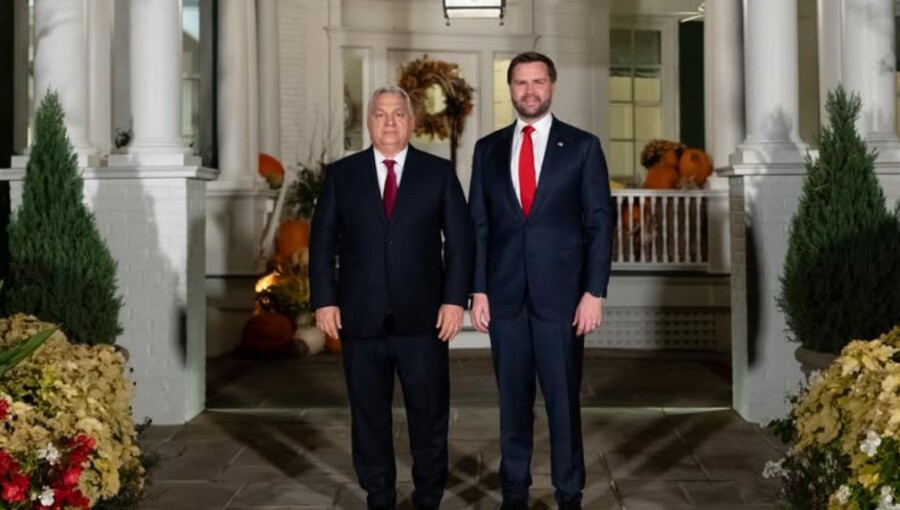
US Vice President JD Vance will visit Budapest on April 7 for a joint press conference and rally with Prime Minister Viktor Orban, state news agency MTI reported on April 6. The press conference is scheduled for 1:20 PM CET at Orban’s office in the Carmelite Monastery, followed by a rally a few hours later, dubbed the "Day of Hungarian-American Friendship".
The visit comes just days ahead of the pivotal April 12 election and is widely viewed as a demonstration of support for Orban and his Fidesz party, which is currently trailing the opposition Tisza Party.
Although polls show a substantial lead for Peter Magyar’s party, with Polymarket giving him a 70-30% chance of winning, analysts caution that it is too early to declare an opposition victory, given Fidesz’s strong mobilisation, well-organised party structure, and an election landscape that remains tilted in their favour.
Politico has dubbed the visit the "Save Viktor Orban" plan, highlighting the effort to support the US administration’s top ally in Europe. Analysts note that the campaign rally reflects Washington’s willingness to intervene in the Hungarian election. The visit comes seven weeks after US Secretary of State Marco Rubio's trip to Budapest in February.
The US secretary of state openly endorsed Orban and avoided confronting his host on sensitive issues, such as Hungary’s engagement with China or its reluctance to reduce its dependency on Russian energy.
Orban, 62, is the longest-serving prime minister in Europe and is widely regarded by radical-right figures in Washington as a model of nationalist-populist leadership. His potential defeat could deal a blow to the MAGA movement and other Eurosceptic forces, leftist daily Nepszava writes. Analysts suggest that, with Orban losing power, his vision of illiberal democracy could lose appeal elsewhere.
At the recent CPAC Hungary conference, radical right-wing leaders reaffirmed their support for Orbán, and one of the day’s highlights was a video message from US President Donald Trump, who described Orban as a strong leader.
Balázs Ablonczy, an analyst for the conservative weekly Valasz Online, called Orban’s close alignment with Trump potentially politically risky. To illustrate Hungary’s alignment with Washington, Ablonczy recalled that after the first strikes against Iran, the foreign ministry framed attacks as carried out by Israel, omitting US involvement. He noted that Hungary’s highly ideological foreign policy contrasts with its claims of pragmatism and national interest.
The government’s narrative has widely exaggerated the economic consequences of disruptions to the Druzhba pipeline while downplaying the broader geopolitical tensions and potential energy crisis stemming from the war in Iran.
Peter Magyar, in a recent interview with 444.hu, said he expects the vice president to clarify that the United States does not seek Hungary’s potential military involvement in the Iran war. Magyar referred to a comment by cabinet minister Gergely Gulyas last month, who said that the government would consider providing military assistance to the United States if formally requested. Magyar also called on the prime minister not to sign any agreements in the coming days that could compromise Hungary’s security or limit the next government’s authority.

No comments:
Post a Comment