Five Points for Peace: Why China’s Iran Initiative Missed the Headlines?
China’s conduct in the UN Security Council often disappoints those who expect it to openly confront what they see as an unrestrained American imperial machine. This expectation was especially evident in China’s abstentions on two key recent occasions: UNSC Resolution 2803 on Gaza, which effectively enabled Trump’s ‘Peace Board’ experiment and even hints at bypassing the UN, and the latest vote on Iran (Resolution 2817), which produced the distorted impression that Iran is the aggressor while the US and its Gulf allies appear as victims.
This text is not about dissecting Beijing’s long-term strategy. China does not rush; it plays a long game, guided by principles and a strategic horizon that resembles a global chessboard. One point, however, is worth stressing: China’s restraint in the UNSC is not weakness or moral ambiguity. It is a calculation in a system where rules are anything but neutral.
When resolutions are written to predetermine blame and erase origins of conflict, a ‘yes’ vote legitimizes power narratives, while a ‘no’ vote risks confrontation with the nuclear force: a US that is increasingly unpredictable and politically/militarily volatile. China, therefore, chooses a third path: neither endorsing imposed frames nor dismantling the UN order it still relies on. This is quiet resistance, an attempt to preserve space for mediation and multilateralism within an institution increasingly shaped by unipolar logic.
Yet China is not a passive bystander, as it is often portrayed. This perception reflects both Western frustration and expectations within parts of the Global South—and even segments of the left—that Beijing should act more decisively, even ‘revolutionarily.’ In the absence of alternatives, many search for a geopolitical savior. China appears as the only major power that is economically stable, globally embedded, and directly affected enough to act.
At least three initiatives illustrate this approach lately.
On the first anniversary of the Ukraine war, China issued a 12-point peace framework. It was normative, not operational: principles without enforcement. Beijing positioned itself as a neutral mediator, cautiously reopening space for dialogue between Russia and Ukraine. The West reacted sharply. The same West, it should be recalled, had already undermined the Istanbul peace process in March 2022. As Aaron Maté noted, in NATO-aligned media ‘there is nothing more controversial than a peace proposal.’ Since then, diplomacy has been recast as betrayal, while Ukraine is pushed toward attritional war to the last soldier—a proxy conflict serving external interests.
At the Valdai Conference in 2024, I experienced this climate directly. My attempt to introduce a human dimension—emphasizing that the ‘pieces on the board’ are living people on both sides—was met with irritation. Karaganov left the room immediately after posing a question he did not wish to hear answered. Only a Chinese colleague and I spoke explicitly in terms of peace. The war itself, meanwhile, has gradually faded from attention, even as its global consequences deepen.
That same year, China, together with Brazil, attempted another diplomatic opening. This marked a shift: from abstract principles to institutional architecture, and from unilateral framing to Global South participation. The proposal called for immediate de-escalation, an international peace conference with both parties present, prevention of escalation, and attention to global spillovers in food and energy security.
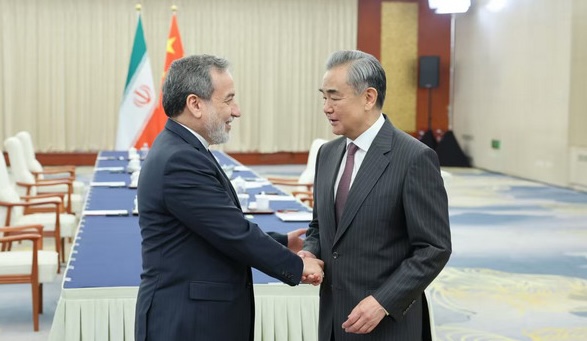
Then, at the end of March, before Trump’s latest escalation rhetoric about ‘returning enemies to the Stone Age’, a five-point peace plan emerged, backed by China and co-facilitated by Pakistan, with behind-the-scenes involvement of Turkey, Egypt, and Saudi Arabia.
It reads like common sense: immediate ceasefire and cessation of hostilities; launch of peace talks respecting sovereignty of Iran and Gulf states; protection of civilians and infrastructure, including energy systems; safeguarding maritime routes, especially the Strait of Hormuz, and a UN-led framework grounded in international law and multilateralism
Its authors were probably fully aware that this was symbolic diplomacy in a moment of near-total political deafness, where even extreme (‘stone age’) threats from Western capitals pass without consequence. It is less a roadmap than a gesture, a foot wedged in a door before it slams shut. Here it is important to emphasize an argument often made by my Chinese colleagues. In material terms, the asymmetry is obvious: the United States maintains more than 800 military bases across continents and possesses an unmatched capacity to project force into every corner of the globe. China, by contrast, does not—and indeed does not seek to—develop comparable instruments for extraterritorial military intervention.
But this is not a question of capability alone; it reflects fundamentally different logics of action. The United States tends to pursue influence through control—political, economic, and often military—over other states. China, by contrast, frames its international role around cooperation and shared development, privileging interdependence over coercion.
Within this framework, China’s restraint should not be misread as absence or passivity. Even in constrained circumstances, it preserves a narrow but persistent opening for peace. That opening—the refusal to abandon diplomacy even under escalation conditions—is arguably the core value running through its initiatives.
In the context of this article, the most striking element is not the plan itself, but its reception: silence. When it comes to the Iranian political sphere, as my Iranian friend elaborates, two contrasting reactions emerged. Some welcomed the statement, pointing to the embedded acknowledgment of Iran’s right to oversee the Strait of Hormuz as a source of cautious optimism. Others, however, argued that any effort to restore peace in the region that fails to name, condemn, and hold accountable those responsible for aggression is ultimately meaningless.
Western media, otherwise saturated with every provocation and insult from political elites, largely ignored it. At best, it appeared as a brief note in select outlets in West Asia, Turkey, India, Pakistan, etc. Even the Chinese media gave it limited prominence. This is not merely a matter of media oversight; it reflects a deeper hierarchy of narrative relevance.
Rational explanations point to structural issues. In mediation theory, there is a well-known ‘credibility dilemma’: effective mediation requires both neutrality and leverage. China has neutrality and economic leverage, but not security-enforcement power. Unlike Western actors, it does not impose outcomes through military means. This creates a gap: without coercive instruments, its initiatives appear symbolic rather than actionable.
The second constraint is political. Key actors are not aligned. Iran distrusts Pakistan, despite its role as co-sponsor and its dual orientation toward China and the US. Tehran also rejects direct negotiations with Washington, which at times even fabricates their existence. The timing is therefore unfavorable: both sides believe they can endure and avoid defeat. On the other hand, among the states that stand behind this proposal, there is a deep gap of distrust.
From a Western perspective, the silence is unsurprising. Narrative control matters more than factual reporting. The dominant frame continues to dehumanize Iran and rationalize escalation through familiar tropes. Peace initiatives disrupt this structure and are therefore marginalized.
Another layer is strategic: allowing a Chinese-led peace discourse to gain traction would undermine Western narrative monopoly at a moment when public fatigue with prolonged conflict is growing.
Is the Chinese initiative, therefore, irrelevant? That would be a mistake. China does not practice megaphone diplomacy. It waits, builds, and recalibrates. Its approach is often described as the ‘power not to use power’—prioritizing networks over coercion, and stability over spectacle.
In contrast, Western policy culture operates on speed: fast interventions, fast narratives, fast exits—and short memory.
One additional factor looms in the background: Trump’s expected visit to Beijing. This alone requires diplomatic restraint to avoid triggering wider systemic shocks.
Ultimately, the five-point plan should not be read as a failed initiative, but as a signal: that even in an environment saturated with escalation, alternative frameworks still exist. Sovereignty, multilateralism, civilian protection, and humanitarian restraint remain on the table – even if they are increasingly ignored.
China does not threaten war. It does not promise quick and worldwide salvation. But it continues to insist that even in an age of collapsing restraint, war is not the only script available.
And sometimes, that alone is the message. In due time, there is a hope that others will recognize its meaning. The very fact that, after a long time, China, Russia, and France stand on the same side at the UNSC may be just the beginning of the opposition to the US bullying and destruction.
Biljana Vankovska is a professor of political science and international relations at Ss. Cyril and Methodius University in Skopje, an associate of the Transnational Foundation of Peace and Future Research (TFF) in Lund, Sweden, and the most influential public intellectual in Macedonia. She is a member of the No Cold War collective.
This article was produced by Globetrotter.

No comments:
Post a Comment