All at Sea: The Gulf in China's Foreign Policy Position
China has always sought to be friends with countries on both sides of the Gulf, sufficiently engaged politically to gain economic benefits from trading with all. To achieve this has meant keeping a low profile on divisive political questions, such as the ownership of the disputed islands in the Gulf occupied by Iran but claimed by the United Arab Emirates, and support to the Axis of Resistance. But up until now, this approach has been largely successful, with all the Gulf countries professing to have good relations with China, underwritten by "strategic partnership agreements" signed for example with the UAE (2012), Saudi Arabia (2016), Oman (2018) and Iran (2021).
Aside from the high value of trade between China and the Gulf countries, military ties have been developed too. The Saudi Navy trains with the Chinese on the regular Blue Sword series of exercises. The UAE likewise has participated in the Falcon Shield exercise series in China and was believed to have offered China naval base facilities in the Khalifa Industrial Free Zone. The Djibouti-based Chinese Naval Escort Group has made frequent visits to all the GCC countries.
Part of the reason GCC countries have sought to develop good relations with China was the hope that China might act as a restraining influence over Iran. But recent events suggest that this was an injudicious hope.
Nearly two weeks after the beginning of the war, the Chinese Foreign Ministry got round to condemning "indiscriminate attacks on civilians and non-military targets" in Gulf states. It also called for an immediate cessation of hostilities, but appears to have done nothing more to restrain Iran. It went on to veto even the watered-down version of the Bahraini-sponsored UN Security Council resolution which captured the GCC approach to ending the war.
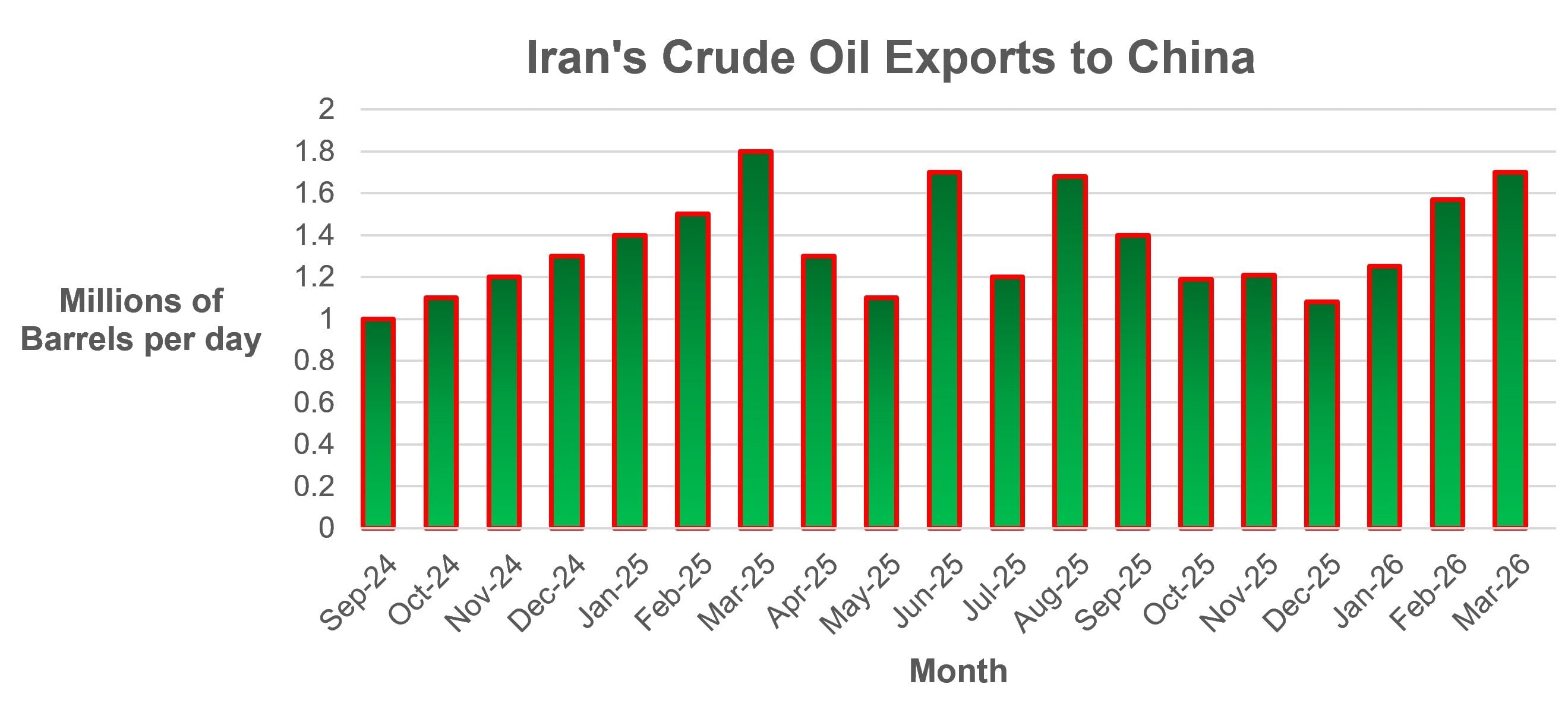
For many years China has bought 80-90% of Iran’s total oil exports, with monthly volumes shown based on Kpler and Vortexa analysis (CJRC)
The reality is that China has for years provided critical support to Iran, keeping the regime in place, by buying up to 90% of total Iranian oil exports. Iran has been shipping in sodium perchlorate sold by China, contrary to UN Security Resolution 1929, which is then refined to make solid fuel for the ballistic missiles used against Gulf states. Iranian arms shipments intercepted en route to the Houthis are packed with Chinese guidance and communications electronics for missiles used extensively against international shipping and targets in the Gulf countries. Most of the anti-shipping cruise missiles fired by Iran at ships in the Gulf are based on the Chinese C-801 and C-802 designs, supplemented by recently-delivered supersonic CM-302 missiles, to soon be supplemented (per CNN) with new shoulder-launched anti-aircraft systems. No mines have yet been recovered in the Strait of Hormuz; amongst them reportedly may be Chinese EM-52 rocket mines.
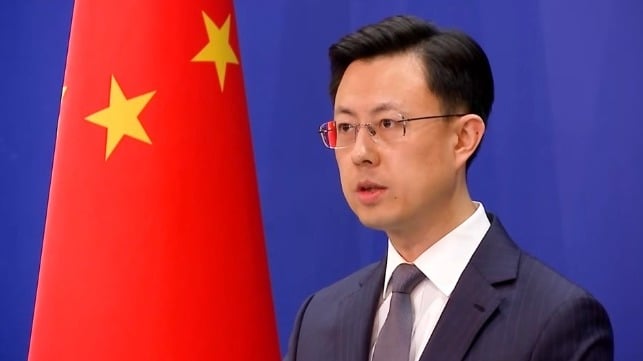
Now at the receiving end of Chinese weapon technology imported by Iran, Gulf countries might complain – had they not themselves also bought Chinese weaponry. But what will rankle is that China appears not to be exercising any restraint over Iran. Additionally, now that the war has been going on for 6 weeks, drawdown is beginning of the 1.2 billion barrels of oil that China holds in its vast reserves. So China, faced with an eventual shortage, is now calling for the US blockade on Iranian oil to be lifted – which seems at present the most likely stratagem for bringing effective pressure on Iran to return in a more conciliatory mood to the negotiating table. As well as calling for an end to the US blockade, in the Chinese Foreign Ministry spokesman Guo Jiakun’s press statement on April 14, he claimed that Chinese arms exports had been "prudent and responsible," dismissing evidence to the contrary as "fabricated."
Iran has caused massive damage to infrastructure, to oil facilities and to economic confidence in Gulf states, which in some cases will take years and huge expenditure to repair. So far, the victims - despite having the capability to do so - have shown extraordinary restraint in not retaliating in kind, seeking not to widen the war nor make a post-war reconciliation impossible. But it is now clear whose side China is on at a moment of political crisis, which threatens national survival in some cases. It would be surprising therefore if Sino-Gulf relations were not post-war to be consigned to the deep freeze, even if the UAE Crown Prince’s visit to China this week is seeking to repair the damage.
The opinions expressed herein are the author's and not necessarily those of The Maritime Executive.
Iran Using Chinese Satellite to Target US and GCC Countries
Further startling information has been unveiled in a Financial Times report on how Chinese technology and weapons systems have been aiding the Iranians in their missile and drone campaign against neighboring states and US military targets in the region. The FT report appears to be a product of its own investigations and analysis, rather than a leak from an intelligence agency seeking to influence.
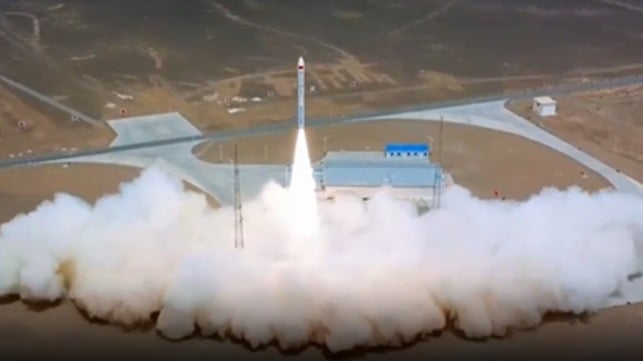
The FT report says that China supplied Iran with access to a TEE-01B imagery satellite built by Beijing-based The Earth Eye Co in March 2024, for which Iran paid $37m. The satellite, to which Iran’s IRGC Aerospace Force gained access, was already scheduled for launch in June 2024, and The Earth Eye Co was therefore recovering its sunk capital investment while also providing Iran with ongoing remote access to the satellite. This commercial arrangement with Iran is not advertised on the Earth Eye Co website, but similar deals appear to have been made with Malaysia and Oman. Under this system, the satellite’s coverage and imagery collection are controlled by a ground control station in China run by another Beijing-based company, Emposat, which Iran can access remotely—in effect from a laptop—without the need for any vulnerable infrastructure in Iran. Satellite ground control station infrastructure in Iran has been located previously and subsequently targeted. Both The Earth Eye Co and Emposat are commercial companies, albeit run by senior executives with close links to the Chinese political-military establishment; they are most unlikely to have made any deals that did not meet with the blessing of the Chinese Communist Party.
The TEE-01B satellite can capture imagery of “about 0.5m” resolution, at the top end of what is technically possible and broadly comparable to the very best commercial satellite imagery. Hitherto, early Iranian satellite efforts had been described by US Space Command General John Raymond as “tumbling webcams in space, unable to generate any useful intelligence.” More recently, the Iranians have worked with the Russians, launching their jointly built Khayyam satellite in August 2022 as part of the Russian Kanopus-V satellite constellation. Iran’s Khayyam, placed in a 500 km low Earth orbit, can probably capture 1 m resolution imagery—sufficiently accurate to target an area of a ship, but not necessarily a particular porthole. The Khayyam/Kanopus-V system is also handicapped by built-in delays in the transmission of data captured by the satellite back to its Earth station. However, from analysis of TEE-01B satellite passes and the timing of attacks, the Chinese system appears to offer not only higher-quality imagery necessary for precise targeting (such as hitting the radar dome of an AWACS aircraft or a key component in a refinery), but also better timeliness of delivery.
The analysis conducted by the FT linked passes of the TEE-01B imagery satellite to targets that were subsequently attacked by Iranian missiles and drones, as well as to further flyovers conducted to assess battle damage. Many of these flyovers were of US military targets that were accurately hit, including attacks on Prince Sultan Air Base in Saudi Arabia; Muwaffaq Salti Air Base in Jordan; the US Naval Support Activity in Bahrain; Ali Al Salem Air Base in Kuwait; and Erbil in Iraq. Civilian infrastructure attacked with similar cueing from passes of the TEE-01B imagery satellite includes the Duqm Special Economic Zone in Oman; the Alba aluminum plant in Bahrain; and the Khor Fakkan container port and Qidfa power/desalination plant in the UAE.
Perhaps aware of the forthcoming publication of the FT investigation report, Chinese Foreign Ministry spokesman Guo Jiakun made a press statement on April 14, claiming that Chinese arms exports had been “prudent and responsible,” and dismissing as “fabricated” incontrovertible evidence to the contrary.

No comments:
Post a Comment