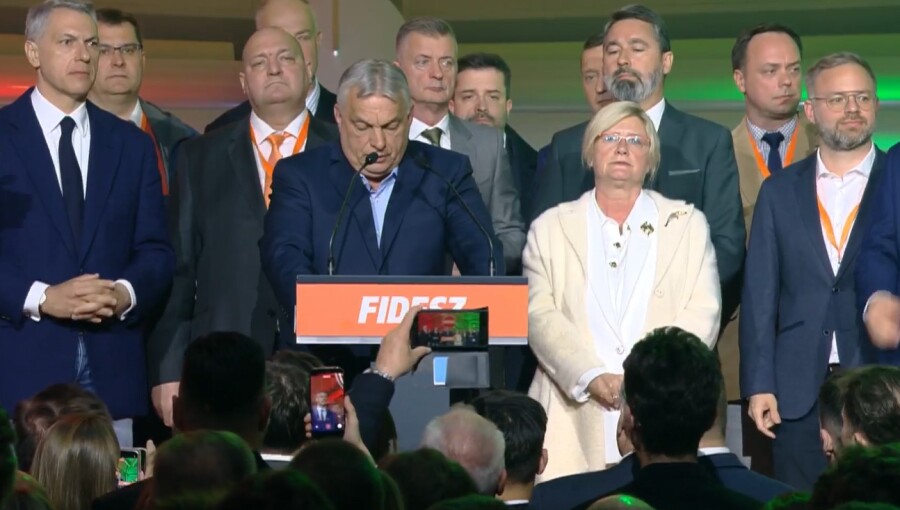
Hungarian Prime Minister Viktor Orbán has conceded defeat in the April 12 general election and congratulated the winner, according to statements made following the announcement of preliminary results.
Tisza leader Peter Magyar posted a short message on Facebook saying the prime minister had congratulated "our victory".
Orban, speaking to his supporters at the conference hall by the Danube, acknowledged what he described as a "painful and clear" election result, but he did not name either Magyar or the Tisza party in his concession speech.
The outgoing prime minister told supporters that, regardless of the outcome, he would continue to serve the nation from the opposition, adding that his party would not abandon its voters.
Orban told supporters that the coming period would focus on recovery and rebuilding the political community, emphasising that Fidesz would continue its work in opposition and would not abandon its supporters. Orban specifically thanked ethnic Hungarians from across the border and said that Fidesz would continue to support them.
At 53.45% of votes processed, projections indicated that the Tisza Party could win 136 seats, three seats over the supermajority, compared to 56 for the ruling Fidesz. Radical right-wing Our Homeland could also pass the 5% threshold and send 7 MPs to Parliament.
On the national list vote at 39.30% of the votes processed, Tisza stood at 52.49%, while Fidesz was at 38.83%, Our Homeland at 6.08%, the Democratic Coalition at 1.19%, and the Two-Tailed Dog Party at 0.78%.
The Tisza Party is holding its election campaign event across from parliament on the Buda side, where tens of thousands of supporters have filled the riverbank. The atmosphere is carnival-like, with people singing and waving flags.
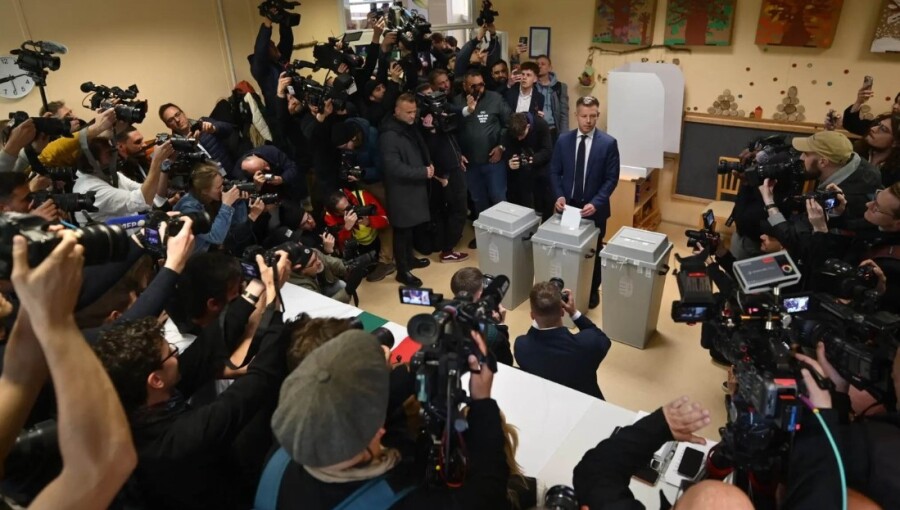
Polling data from the three most reliable pollsters conducted in the last days of the Hungarian election campaign indicate a decisive victory for the opposition Tisza Party, with projections at or close to a two-thirds majority.
According to Median, which conducted surveys over five days last week, the Tisza Party is projected to receive 55% of the vote, compared to 37% for the ruling Fidesz. This would give 135 seats for Tisza of the 199 total and 63 seats for the ruling party.
Our Homeland is estimated at 3.9%, below the parliamentary threshold, as are two other parties fielding a national list, the Democratic Coalition and the Two-Tailed Dog party.
Similar findings were reported by the 21 Institute, which recorded a 55-38% lead for Tisza, indicating a result close to a two-thirds majority, and projected that Our Homeland could pass the 5% threshold.
Meanwhile, Zavecz Research published estimates showing a 54-40% result in favour of Tisza, with radical right Our Homeland falling short of parliamentary entry.
Government-leaning institutions did not release their forecast.
Voter turnout reached a record level, with 77.8% of eligible voters having cast their ballots by 6:30 p.m., 30 minutes before the polls closed. Turnout in Budapest, the stronghold for Tisza exceeded 81%.
Head of the Prime Minister's Office, Gergely Gulyas, held a brief briefing for the press, thanking voters and saying the high voter turnout represents an unprecedented public mandate. He expressed hope that Fidesz would receive a strong authorisation to govern.
Tisza leader Péter Magyar described the April 12 vote as historic, saying that Hungary and millions of its citizens had "written history again." He said more than 6mn people cast their ballots in what he called a symbolic election, held 23 years after Hungary’s referendum on joining the EU.
He stated that the Tisza Party had received thousands of reports of alleged electoral irregularities, including claims of direct payments to voters.
Magyar said that anyone involved in unlawful activity would face legal consequences. He also thanked around 50,000 volunteers for their role in monitoring the election and helping to prevent irregularities.
From insider to rival: how Magyar became Orbán's most serious challenger in 16 years

Just a few years ago, Péter Magyar was an insider within the ruling Fidesz elite in Hungary. This Sunday, he goes into an election that could see him oust Orbán after 16 years of uninterrupted rule in a spectacular shift.
In just two years, Péter Magyar has grown from a virtually unknown figure in Hungarian politics to becoming the biggest threat to the Fidesz Party - his former political home - and its 16-year uninterrupted stretch in government.
Magyar burst into prominence in 2024 as the government faced a presidential pardon scandal that involved a child abuser's accomplice. Prior to that, he was raised in a conservative family and was anything but an outsider when it came to the politics of of Fidesz.
Born into a family of conservatives
Born into a family of prominent conservatives, his grandfather was well-known TV personality and lawyer Pál Erőss, while his godfather Ferenc Mádl was the President of Hungary. Magyar received his degree from the law faculty of Pázmány Péter Catholic University in 2004.
While at university, he befriended Gergely Gulyás, now Minister of Prime Minister Viktor Orbán's office. Gulyás introduced Magyar to Judit Varga, with whom he had three children after marrying her in 2006. Varga later became the country's justice minister under Orbán.

After being sent to Brussels by the Orbán government to serve as a diplomat dealing with EU affairs, the family moved back to Hungary in 2018. Magyar was appointed to the board of directors of state-owned road operation and maintenance company Magyar Közút ZRT. He later became head of of the government's student loan provider and was on the board of several other state companies.
He and Judit Varga, who became justice minister during that period, divorced in 2023.
It all started with an interview
Magyar was largely unknown to the public until a scandal broke out in early 2024, where the pardoning of a convicted child abuser's accomplice led to the resignation of the president as well as Varga's retirement from politics.
The Fidesz Party blamed Varga, who signed the pardon decision in her capacity as justice minister.
Péter Magyar was so outraged that he took to Facebook within hours and spoke out against the Orbán government. From that moment onwards, his relationship with the party was turned on its head.
His post accused the government of widespread corruption and outlined abuses which he had personally witnessed, such as being forced to favour people close to Orbán during his time as head of the national student loan provider.
He subsequently did an interview with online channel Partizán, an event which is credited with playing a major role in his fast-growing popularity.
Péter Magyar became so popular, in fact, that within a matter of days he organised a rally in Budapest on Andrássy Avenue which attracted tens of thousands.

Capitalising on his newfound support, he took over the previously unknown Tisza Party and ran as a candidate in the 2024 European Parliament elections. He won a seat as MEP, with Tisza finishing second behind the ruling coalition.
The result of that election showed that Hungarian voters appeared to have become increasingly disillusioned with other opposition parties, which Magyar referred to as "old opposition".
Scandals and accusations did little to hurt Magyar's rise
A number of allegations have been made against at him since then, including accusations of domestic abuse from his former wife, spying and drug consumption. A document was recently posted by media online, claiming to be the Tisza Party's tax programme, but its authenticity was never confirmed.
In a bizarre incident that took place in February this year, Magyar said he was blackmailed by government figures with a sex tape showing him and his former partner, secretly recorded in a Budapest flat in 2024. Fidesz representatives denied the claim.
Nevertheless, polls indicate that Magyar's popularity has been largely unaffected.

The Tisza president has made a point of travelling extensively to meet voters, positioning himself as different to out-of-touch opponents. Towards the end of the election campaign, he spoke in seven cities within a single day.
Magyar has promised to improve public services in the country, and undertake reforms that will unfreeze billions of Euros that the EU had allocated for Hungary.
His position on LGBTQ issues is vague, while his views on immigration are even stricter than Orban's as he has said he would end the government's guest worker programme. He is generally distrustful of the media, and often clashes with them.
Overall, his promise to voters is simple: a functioning country with a Western identity and Christian-conservative politics, but without what he calls the corruption of Fidesz.
Viktor Orbán: From student dissident to Europe's most polarising leader
By Gábor Tanács & Euronews
Published on 11/04/2026 -
Viktor Orbán rose from liberal student activist to a self-professed illiberal, reshaping Hungary’s rule, foreign policy and relations with the EU and Russia.
Prime Minister Viktor Orbán has governed Hungary for nearly 16 years, reshaping its institutions, challenging EU norms and positioning himself as the leading voice of nationalist conservatism on the continent.
His trajectory from liberal student activist to self-described champion of "illiberal democracy," is one of the most striking — and polarising — political reinventions in post-communist central and eastern Europe.
Orbán first came to public attention in June 1989, when as a 26-year-old student he addressed the crowd at the state reburial of Imre Nagy and other victims of the 1956 anti-Soviet uprising.
His call for the withdrawal of Soviet troops — delivered at a moment when many opposition figures remained cautious — made him a voice of a new political generation.
The party he helped lead, Fidesz, began as a liberal youth movement. Over the following decade, Orbán transformed it into a centre-right nationalist force, as post-communist Hungary made its shift from a planned to a market economy.
Sharpening his message
Orbán first became premier in 1998 at the age of 35, making him one of the youngest leaders to hold the office in central Europe at the time.
His first government oversaw Hungary's accession to NATO in March 1999 and advanced the country's EU membership path, completed under a subsequent administration in 2004.
But then, Fidesz lost both the 2002 and 2006 elections to the Hungarian Socialist Party. During his years in opposition, Orbán sharpened a political argument focused on national sovereignty, arguing that liberal dominance in media and public institutions constrained Hungary's self-determination.
Critics describe that framing as the precursor to a systematic challenge to democratic checks and balances.
Orbán won the 2010 election with a two-thirds supermajority, giving Fidesz the parliamentary votes to amend the constitution.
His government introduced a new Fundamental Law — Hungary's replacement constitution — along with a series of electoral and institutional reforms.
Supporters argued these measures restored political stability and asserted national sovereignty; opponents said they concentrated power in the executive and weakened judicial and media independence.
Fidesz has won every parliamentary election since. The government has faced repeated legal challenges from EU institutions over the rule of law, press freedom and judicial independence. Budapest has consistently rejected those characterisations.
'Illiberal state' shift
In a July 2014 speech at Băile Tușnad in Romania, Orbán set out his governing philosophy explicitly, arguing that Hungary should move beyond liberal democratic frameworks while preserving core freedoms. He described his model as an "illiberal state."
The term drew criticism from Western governments and EU institutions but became a favourite among nationalist movements across Europe and beyond.
Orbán has since promoted Hungary as a model for right-wing and far-right parties in France, Italy, Spain, the US and elsewhere. His annual speech at Băile Tușnad draws European conservatives every summer.
Hungary under Orbán has maintained membership of NATO and the EU while simultaneously cultivating relationships with Russia, China and Turkey that have repeatedly brought it into conflict with partners in both blocs.
Orbán met Russian President Vladimir Putin on multiple occasions before the full-scale invasion of Ukraine in February 2022 and has maintained economic ties — including a major gas supply contract and a nuclear energy agreement with the Russian state company Rosatom — since then.
Since 2022, Hungary has been the most prominent EU member state to resist the 27-member bloc's consensus on military support for Ukraine as it continues to defend itself from Russia's all-out war.
Orbán has argued that arms transfers prolong the war and that Hungary's priority is keeping the country out of the war.
Other EU governments and NATO allies have described that position as effectively providing diplomatic cover for Moscow, a charge Budapest rejects.
Support from US, trouble with EU
Meanwhile, Orbán's governance has drawn sustained interest from the American right.
US Vice President JD Vance travelled to Budapest earlier this week and addressed a rally days before the Hungarian parliamentary election, urging voters, "we have got to get Viktor Orbán re-elected as prime minister of Hungary."
US President Donald Trump, whom Vance called by phone during the event, told the crowd that Orbán "kept your country good" and that the US was "with him all the way."
Vance had previously said in 2024 that Orbán "made some smart decisions that we could learn from in the United States."
Other prominent US conservatives, like Marco Rubio, Steve Bannon and CPAC chairman Matt Schlapp have all visited Budapest.
Former Fox News host and influential right-wing commentator Tucker Carlson devoted a week of broadcasts from Budapest, and Orbán keynoted the Conservative Political Action Conference (CPAC) in 2023, while Hungary hosts its European spinoff.
The Heritage Foundation described Hungary's institutional model as a governing template, and analysts have documented links between architects of the Project 2025 policy blueprint and Fidesz-aligned think tanks.
As his star power grew in the US, Orbán and his policies were met with significant pushback from Europe and its leadership.
The European Parliament triggered the Article 7 rule of law procedure against Hungary in 2018 — the mechanism that can strip a member state of voting rights, although the European Council never brought it to a vote.
The European Commission has frozen around €18 billion in EU funds over rule of law concerns, and Hungary forfeited more than €1 billion in cohesion funding at the end of 2025 after failing to implement required anti-corruption reforms by the deadline.
Fidesz left the centre-right European People's Party (EPP) grouping in 2021.
The tensions came to a head in October 2024, when European Commission President Ursula von der Leyen confronted Orbán directly at the European Parliament in Strasbourg, asking whether he would "blame the Hungarians for the Soviet invasion of 1956" — drawing a parallel to his position on Ukraine.
Orbán called the comparison "a humiliation" and rejected it outright.
What comes next
Orbán, now 62, wants to extend a political dominance that has lasted more than a quarter century.
After more than 15 years of continuous government, Fidesz faces a domestic political challenge that analysts and opposition figures say is more competitive than at any point since 2010, among economic pressures and the emergence of a more consolidated opposition embodied in the Tisza Party.
Yet Orbán remains one of the most influential figures in European conservative politics — and one of the most contested.

No comments:
Post a Comment