Saturday, April 18, 2026

Civilians count costs of war as they return to southern Lebanon

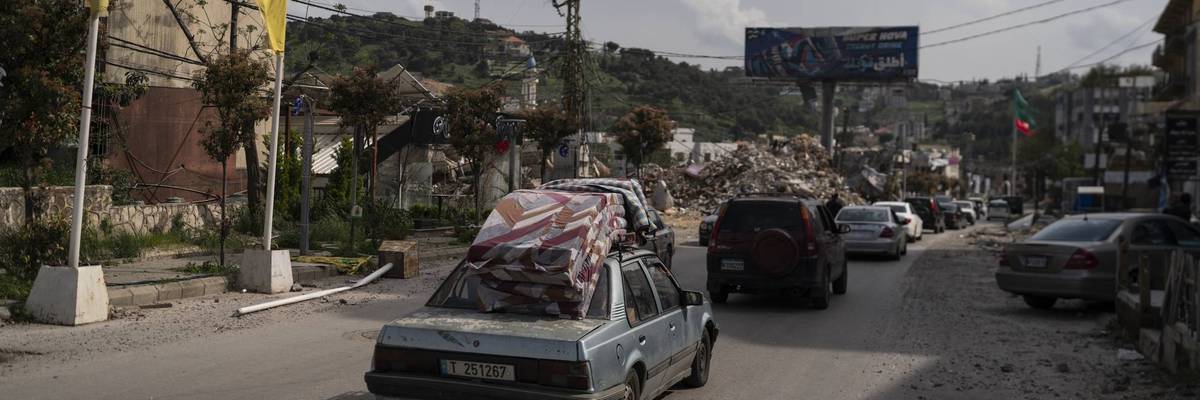
People displaced by weeks of airstrikes have begun returning to Beirut and southern Lebanon as a 10-day ceasefire between Israel and Hezbollah took hold on Friday. Residents described scenes of destruction and fears of further conflict as they arrived home.


Issued on: 18/04/2026 - RFI

People drive past the rubble of destroyed buildings in Dahiyeh, a southern suburb of Beirut, Lebanon, on 17 April 2026, following a ceasefire between Israel and Hezbollah. © AP - Bilal Hussein

“Thank God, we’re happy, of course! It’s a victory, even though we know our three-story house has collapsed. It’s still something to be proud of,” one man told RFI as he made his way to the village of Kharayeb in southern Lebanon, which has been heavily bombarded by Israeli missiles.

“We’re returning with our heads held high,” his wife added. “And we’re not afraid of anyone, even if Israel bombs us, because we have our heroes on the front lines everywhere, and we’re proud of them.”

More than 2,000 people have been killed in Israeli airstrikes in Lebanon since early March, according to UN figures. Over 1.2 million people have been displaced, the equivalent of one in five of the population.

Israeli ground forces have invaded the country's south, a Hezbollah stronghold. Prime Minister Benjamin Netanyahu has said the troops will not withdraw during the truce, and has warned civilians not to return.


People sit at a site of an Israeli strike in Tyre carried out just before the 10-day ceasefire between Lebanon and Israel went into effect, on 18 April 2026. © Louisa Gouliamaki / Reuters


Many ignored the warning and came home on Friday, even if just to assess the damage.

“It’s sad to see my house in this state. The doors and windows have blown out,” said Nour, a woman returning to the town of Nabatieh. “But it’s good to be back. I wish it weren’t just temporary.”

In the town centre, Hassan was busy repairing his bakery. “We’ve seen much worse. Now we’re going to clean up. I have to fix the door myself. And tomorrow, we’ll open, God willing.”


'People need to go home'


In the southern suburbs of Beirut, another area that Hezbollah's strong influence has made a target for Israeli strikes, returning residents found similar scenes.

“I lost my home and all my furniture. But what matters most is our dignity,” local man Hassan Dib told RFI. “When Hezbollah says we can go back, we’ll go back. That’s why so few people have returned yet.”

Hezbollah has instructed residents not to return to affected areas until a formal and final ceasefire is declared.

Ali Mrad had just arrived from the city of Tripoli in northern Lebanon, where he had been staying with relatives. “I came to check on my house, to see if it’s still standing or not. The situation is good now... I can’t describe how I feel. It’s like emerging from a very serious crisis.”

Others remained wary. “We’re in the process of returning home, but I expect the Israelis to break the truce and bomb us,” said Zahra ChehadĂ©, displaced from her house in southern Beirut.

“I don’t feel safe. But people need to go home. Buildings can be rebuilt. The most important thing is that Israel doesn’t occupy Lebanon.”

This article has been adapted from original reporting in French by RFI's correspondents in southern Lebanon, Aabla Jounaidi and Jad el-Khoury, and Beirut correspondent Sophie Guignon.

France's Macron says fragile Lebanon ceasefire 'may already be undermined'

A 10-day ceasefire between Israel and Hezbollah – which took effect at midnight on Thursday after weeks of escalating cross-border fighting – risks collapsing, French President Emmanuel Macron warned, after reports of violations in southern Lebanon.


Issued on: 17/04/2026 - RFI

Displaced residents return to Dahiyeh, in Beirut's southern suburbs, on 17 April 2026, following a ceasefire between Israel and Hezbollah. © AP/Bilal Hussein

The ceasefire agreed between Israel and militant group Hezbollah took effect at midnight local time, after almost seven weeks of war.

Israel's Prime Minister Benjamin Netanyahu said he agreed “to advance” peace efforts with Lebanon, but said Israeli troops would not withdraw.

The ceasefire appeared to be holding across most of Lebanon early Friday, but within hours, the Lebanese army accused Israel of “a number of violations" in the south of the country.

Macron on Friday said he fully supported the ceasefire, brokered by the United States and announced by President Donald Trump, but was concerned that it "may already be undermined by ongoing military operations".

"I call for the safety of civilians on both sides of the border between Lebanon and Israel," he said on X, formerly Twitter. "Hezbollah must lay down its arms. Israel must respect Lebanese sovereignty and end the war."

Deadly airstrikes


Israel has been fighting Hezbollah since the militant group launched rocket attacks in support of Iran last month, following the killing by Israel of Iran's supreme leader Ayatollah Ali Khamenei.

Hezbollah has not officially said if it will recognise the ceasefire, but one of its lawmakers told France's AFP news agency on Thursday that the group would respect it if Israel stopped its attacks on its militants.

More than 2,000 people have been killed in Israeli airstrikes in Lebanon since early March – including health workers and journalists, according to Lebanese authorities. Over 1.2 million people have been displaced, or one in five of the population, most of them from Shia Muslim communities.

Israel halted strikes in capital city Beirut on 8 April after a deadly bombardment that hit several crowded commercial and residential areas and killed more than 350 people in one day.


France-Lebanon bond


"We must do everything possible to ensure the ceasefire is respected," Defence Minister Catherine Vautrin told French television channel TF1, calling the situation in Lebanon "absolutely dire".

Responding to comments by the Israeli ambassador to the United States, who claimed that Paris had no business interfering in negotiations between Israel and Lebanon, the minister stated that "no one can call into question the relations between France and Lebanon".

She said: "We have a permanent presence alongside the Lebanese [...]. France and Lebanon share a common history and a bond that nothing can break."

(with newswires)


French soldier killed in Lebanon in attack on UN peacekeepers

A French soldier was killed and three others were wounded in an attack on UN peacekeepers on Saturday, President Emmanuel Macron announced, saying that the evidence suggested Hezbollah was responsible. The militant group has denied involvement.


Issued on: 18/04/2026 -  RFI

UN peacekeepers stand guard in in Qasmiyeh, Lebanon, as displaced people return home after the ceasefire between Israel and Hezbollah, on 18 April 2026. © Louisa Gouliamaki / Reuters


Macron named the soldier as Florian Montorio, a staff sergeant in the 17th Parachute Engineer Regiment of Montauban serving with Unifil, the United Nations' peacekeeping mission in Lebanon.

He was killed on Saturday morning in southern Lebanon, the president said in a post on X. The three soldiers wounded in the same attack were evacuated, he added.

"Everything suggests that Hezbollah is responsible for this attack," Macron said. "France demands that the Lebanese authorities immediately arrest the perpetrators and assume their responsibilities alongside Unifil."

But Hezbollah denied any connection to the attack. In a statement, the group urged "caution in making judgments and assigning responsibilities" pending the results of an investigation by the Lebanese army.

The attack came on the second full day of a 10-day ceasefire, agreed between Israel and Hezbollah on Thursday in order to negotiate an end to six weeks of war.

Macron's office said he held calls with Lebanon's President Joseph Aoun and Lebanese Prime Minister Nawaf Salam to urge them to guarantee the security of Unifil soldiers.

Both Aoun and Salam condemned the attack. The prime minister said he had ordered an "immediate investigation".

Ambush

Montorio is the second French soldier to die since the start of the war in the Middle East, after an Iranian-designed drone killed Arnaud Frion last month in Iraq's Kurdistan region.

Montorio was "ambushed by an armed group at very close range", according to French Defence Minister Catherine Vautrin.

She said he had been on a mission to clear a route to a Unifil post Deir-Kifa region that had been cut off for several days by fighting. He was struck by direct fire, Vautrin said, paying tribute to his 18 years of military service.

In a statement, Unifil said the peacekeepers "came under small-arms fire from non-state-actors" as they were clearing ordnance from a road in the village of Ghanduriyah.

Its initial assessment indicates the incoming fire was "allegedly Hezbollah", it said, adding that it had launched its own investigation into what "may amount to war crimes".

Peacekeepers from the United Nations Interim Force In Lebanon (Unifil) patrol near the southern Lebanese border village of Sarada on 24 February 2026. AFP - RABIH DAHER

The fighting in Lebanon has seen Unifil repeatedly targeted, by both Israeli and Hezbollah forces.

Unifil patrols in southern Lebanon, near the Israeli border where Israel and Hezbollah have been fighting since last month. The militant group drew Lebanon into the Middle East war with rocket fire at Israel in support of its backer, Iran.

Three Indonesian peacekeepers were killed last month, with a preliminary UN investigation finding one was killed by Israeli tank fire, while the two others were killed by an improvised explosive device likely planted by Hezbollah.

Other Unifil peacekeepers have also been wounded since the war broke out.

In April, Israeli soldiers destroyed surveillance cameras in Unifil's headquarters, the peacekeeping body said, and last week an Israeli tank twice rammed peacekeeping vehicles, causing damage but no injuries.

UN peacekeepers have served as a buffer between Lebanon and Israel since 1978, but their mandate expires at the end of this year.

(with AFP)
TRUMP'S IMPOTENT

Israel Strikes Lebanon Less Than an Hour After Trump Says It’s ‘PROHIBITED’ From More Attacks

“This fragile truce must not be undermined,” said the secretary general of the Norwegian Refugee Council.


Residents return to check the aftermath of their businesses and houses on the first day of a ceasefire agreement on April 17, 2026, north of Saida in Nabatieh, Lebanon.
(Photo by Adri Salido/Getty Images)

Stephen Prager
Apr 17, 2026
COMMON DREAMS

Less than an hour after US President Donald Trump announced that Israel was “PROHIBITED” from attacking Lebanon under a 10-day ceasefire reached Friday, an Israeli drone strike reportedly killed at least one person in southern Lebanon.

Citing Lebanese media, The Times of Israel reported that an Israeli drone targeted a motorcycle between the southern towns of Khounine and Beit Yahoun. The Israel Defense Forces have not commented on the attack.

It was the latest in what the Lebanese Army said on Friday morning were “a number of violations” of the ceasefire within hours of it going into effect at midnight local time on Friday, as well as “intermittent shelling targeting a number of villages.”

Lebanon’s National News Agency reported that hours after the ceasefire went into effect, Israel struck an ambulance in the town of Khounine, near the Israeli border, which resulted in multiple casualties among the medical workers.

Israeli attacks on Lebanon since early March have killed nearly 2,300 people, according to Lebanese health officials and forced evacuation orders from Israel have resulted in the displacement of more than 1.2 million.

Trump said in a Friday social media post that under the framework reached Friday, “Israel will not be bombing Lebanon any longer. They are PROHIBITED from doing so by the U.S.A. Enough is enough!!!”

The US president has insisted that any agreement between Israel and Lebanon is separate from his ongoing two-week truce with Iran. Although Iran also announced on Friday that, following the Lebanon agreement, it stopped blocking travel through the Strait of Hormuz.

Iranian Foreign Minister Abbas Aragchi has specified that “the passage for all commercial vessels through the Strait of Hormuz is declared completely open for the remaining period of the ceasefire” between Israel and Lebanon.

Trump has claimed that the Iranian government “agreed to never close the Strait of Hormuz again,” and that the US will maintain its naval blockade of Iran.


Israel’s continued attacks on Lebanon have already put the peace deal between the US and Iran in jeopardy. After Iran briefly reopened the strait in response to the two-week ceasefire earlier this month, it began blocking travel again after Israel launched its most devastating attacks on Lebanon of the entire war, which killed hundreds of civilians.

Israel launched the attacks despite Lebanon having initially been announced as a party to the ceasefire, which Israeli Prime Minister Benjamin Netanyahu and then Trump quickly rejected.

After another agreement with Israel was reached on Friday, Lebanese President Joseph Aoun urged that the opportunity “must not be squandered because it may not come again.”

According to the US State Department, the agreement reached Friday still grants Israel the “right to take all necessary measures in self-defense, at any time, against planned, imminent, or ongoing attacks.” However, it is not clear at this time what imminent attack Friday’s strikes were intended to prevent.

Israel routinely violated its previous ceasefire with Lebanon that began in November 2024, with more than 10,000 air and land attacks over the first year, which the United Nations Interim Force in Lebanon (UNIFIL) said demonstrated a “total disregard of the ceasefire agreement.” It has done the same in Gaza, where hundreds of Palestinians have been killed since a ceasefire began in October 2025.

Netanyahu said on Friday that despite the ceasefire, Israel will continue its occupation of Southern Lebanon, where satellite images show the military has totally razed several towns and villages in what Israeli Defense Minister Israel Katz has described as a continuation of the “Gaza model,” which left most buildings in the strip totally destroyed.

Israel’s military spokesperson Avichay Adraee issued an “urgent message” to displaced Lebanese civilians following the ceasefire, urging them not to return to their homes south of the Litani River “until further notice.”

According to The Associated Press, thousands have begun heading home regardless to find their villages reduced to rubble.

“Across the country, roads are already congested with hopeful families trying to return to their homes. That alone shows how deeply people want this war to end,” said Jan Egeland, the Norwegian Refugee Council’s secretary general.

“This fragile truce must not be undermined. We cannot afford a repeat of the ineffective 2024 ceasefire, which saw countless violations. Worryingly, there are already reports of violations by the Israeli army, which also issued a warning against civilians returning to their homes south of the Litani river, home to hundreds of thousands of people,” Egeland said. “For this ceasefire to be meaningful for civilians, it must lead to a real and durable halt in hostilities.”
New Hungarian PM's campaign silence on gay rights worries activists

In his winning campaign, Peter Magyar focused on corruption, the cost of living and Hungary’s place in Europe – but stayed silent on LGBTQI+ rights, which were chipped away under former prime minister Viktor Orban. For Tamas Dombos, a Budapest-based gay rights activist, Magyar’s caution is both understandable and unsettling.


Issued on: 15/04/2026 - RFI

Demonstrators protest against former Hungarian prime minister Viktor Orban in Budapest, 14 June, 2021. REUTERS - MARTON MONUS

By: Jan van der Made

“They very strategically and tactically avoided discussing this topic,” says Dombos, director of the Hatter Society.

"They did not want this topic to dominate the election campaign, they avoided it as much as possible. They focus on issues that are not divisive, such as healthcare or corruption."

The concern, he says, is that Magyar “failed to make very clear commitments to LGBTQI+ rights” – even as he promised to end the erosion of rights seen throughout the Orban years.


A series of laws

Orban came to power in 2010, and what followed was not a dramatic crackdown but rather, according to Dombos, “a series of [pieces of] legislation being adopted that curtailed the rights of LGBTQI+ people”.

Dombos says the state pushed through laws banning legal gender recognition, restricting adoption, removing gender identity from anti-discrimination rules, limiting minors’ access to LGBTQI+ content and banning Pride-related activities.

“So our work got more difficult, but not to the level of making it impossible,” he says. “The difficulties here came more from banning certain types of activities.”

Tamas Dombos, director of the Hatter Society, in Budapest, 9 April. © RFI/Jan van der Made

The impact was especially severe on transgender people and young LGBTQI+ Hungarians.

“Many people decided to leave the country or were considering it,” said Dombos.

Others, he says, stayed and responded by mobilising. “They stood up for their own rights. They started volunteering in organisations.”


How Hungary eroded LGBTQI+ rights under Orban
May 2020: Ban of legal recognition for trans and intersex people
December 2020: Amendment to the constitution to include the phrases "father is male, mother is female” and "children’s right to identity based on sex at birth"
December 2020: Restriction of adoption by unmarried people
December 2020: Abolishment of the Equal Treatment Authority
June 2021: Ban on promotion or portrayal of homosexuality, transgender identity and gender reassignment for minors
August 2021: Amendment of commerce decree to ban the display and sale of products with LGBT content within 200 metres of schools and churches, and to require such products are packaged and displayed separately
March 2025: Ban of LGBT-themed assemblies, and introduction of facial recognition to monitor participants
April 2025: Amendment to the constitution to include the phrase "human is male or female”, and to say children's rights trump all other rights but the right to life
April 2025: Removal of gender identity as a protected characteristic from the Equal Treatment Act

While Hungary never reached the level of open repression seen in Russia, Dombos says the Orban government helped normalise hostility.

“I don’t think it fundamentally changed how people think about the LGBTQI+ question,” he says, “but they did encourage the expression of hatred and negative feelings.”

He recalls one case in which a man threatened a lesbian couple on a tram with a knife, later claiming he was only enforcing the prime minister’s message that homosexuality did not belong in public life.

Protesters face off with police as they demonstrate against a constitutional amendment in Budapest, 14 April, 2025. AFP - PETER KOHALMI

Shifting public opinion


Hatter, which he describes as “the oldest and largest LGBTQI+ organisation in the country,” responded through legal action, public education and training.

“We have taken dozens and dozens of cases [to] domestic courts,” he said, adding that some are already before European courts.

However, Dombos says the picture was not uniformly bleak: “The political climate was terrible, but the social climate was slowly but increasingly more welcoming."

One campaign on same-sex parenting helped shift public opinion significantly.

“In 2019, only 17 percent of people agreed fully that a same-sex couple can also be good parents. Now over 60 percent of people agree with this statement.”


A protester holds a placard depicting Hungary's former prime minister Viktor Orban, after parliament passed a law banning LGBTQI+ communities from holding the annual Pride march, 25 March 25. © Marton Monus / Reuters

For now, the question remains what a new government will do with the legacy activists such as Dombos have been gradually building.

“Our first hope is that after 16 years, there will be change,” he said – but added that the country’s new leadership will have to do more than just stop attacking LGBTQI+ people.

“It’s not enough to just say, OK, we’re no longer targeting the LGBTQI+ community,” he said. “The legislation that has been adopted in the past six or seven years has to be revoked.”


EU rushes to unlock billions for Hungary as Magyar prepares for power

European Union officials are meeting Hungarian prime minister-elect Peter Magyar's team in Budapest on Friday, hoping to fast-track cooperation and work towards unblocking billions in funding before he takes office next month.


Issued on: 17/04/2026 - RFI

Celebrations in front of the Hungarian parliament on 13 April 2026, after Peter Magyar defeated Prime Minister Viktor Orban in elections and ended his 16 years in power. © AP - Sam McNeil


The talks will cover several urgent issues, including a massive loan for Ukraine and roughly €17 billion in EU funds frozen during Viktor Orban's 16-year rule.

Magyar's party, Tisza, won a sweeping victory in the 12 April elections.

One of Tisza's campaign pledges was to restore Hungary's ties with the EU and convince it to unblock the funding, which has been withheld since 2022 over concerns about corruption and rule of law.

Brussels accused Orban's government of dismantling judicial independence, restricting media freedom and infringing on minority rights.

Of the €27 billion earmarked for Hungary, €17 billion remains frozen.

"The clock is ticking for a number of topics," European Commission spokesperson Paula Pinho said in Brussels on Thursday. Officials want to ensure that "once the government is in place, action can be taken" without delay, she said.

Commission President Ursula von der Leyen urged swift action to "restore the rule of law, realign with shared European values, and reform" Hungary's policies.

'Difficult financial situation'


Magyar has pledged to prioritise judicial independence, academic and media freedom, and anti-corruption measures to unlock the money.

"Hungary is in a very difficult financial situation," Magyar said on Monday, adding that his government's task would be "to bring home the money that is hers".

The frozen funds comprise €10 billion in Covid recovery money and €6.3 billion in cohesion funds. The deadline to claim the pandemic funds expires at the end of August.

Hungary has already lost around €2 billion due to the two-year suspension. It has also been paying €1 million a day since June 2024, plus a €200 million fine, over Orban's refusal to align asylum processing with EU standards.

Magyar has also confirmed he would honour a December deal to support a €90 billion loan for Ukraine, which Orban consistently vetoed.

Beyond frozen funds, Hungary could access up to €16 billion to invest in defence through the EU's new SAFE security initiative. Combined with the other tranches, total available funds could represent roughly 15 percent of the country's GDP.


EU rushes to Budapest talks with Magyar team to unlock frozen funds amid Ukraine tensions

A man wrapped in the European Union flag waves a Hungarian flag, backdropped by the parliament building, early Monday April 13, 2026 as people celebrate Peter Magyar ousting
Copyright AP Photo

By Sandor Zsiros
Published on 

European Commission officials are due to meet the team of Hungary’s prime minister-designate, PĂ©ter Magyar, in Budapest on Friday, just five days after his election victory, to begin the process of unfreezing €17 billion in EU funds, with Ukraine-related disputes also on the agenda.

European Commission officials will meet PĂ©ter Magyar’s incoming team on Friday, as Brussels races against time to release EU funds that have been frozen during the current Orbán administration.

Magyar secured a sweeping victory in last Sunday's election, ending Viktor Orbán's 16-year rule. A key campaign pledge was to restore Hungary's ties with the EU and unblock billions in funding that had been withheld over rule-of-law and corruption concerns. Of the €27bn earmarked for Hungary, €17bn remains frozen.

"The clock is ticking for several topics, whether we're talking about the Ukraine loan, whether we're talking about Next Generation EU funds. It is in the interest of Hungary, it is in the interests of the EU, that we make progress as soon as possible," Commission Spokesperson Paula Pinho said.

Euronews understands that the EU delegation will include experts from the budget and the Recovery and Resilience Facility (RRF) — the EU’s post-Covid recovery fund. They are expected to provide technical assistance to Magyar’s team to help amend legislation in Hungary.

"There's a big menu from which to choose, and these are first talks. Not sure we'll be able to cover everything" Pinho added.

The recovery funds question is particularly urgent: Hungary stands to lose nearly €10bn if payments are not disbursed before the end of August.

On Monday, Magyar outlined a four-step plan to meet the conditions for accessing the funds, including joining the European Public Prosecutor's Office, restoring judicial independence, and safeguarding academic freedom.

Magyar has already spoken twice with European Commission President Ursula von der Leyen, who pledged her support. The decision by Brussels to send a delegation just five days after the vote is widely viewed as a political signal in its own right.

"There is swift work to be done to restore, realign, and reform" Ursula von der Leyen said in a post on social media following her call with Magyar on Wednesday.

Ukraine-related disputes also on the agenda

Unblocking EU funds will not be the only item on Friday's agenda. Hungary has a raft of outstanding disputes with Brussels, particularly over Ukraine. The country is currently withholding the EU's €90bn aid package to Ukraine, after Orbán blocked a previously agreed decision at the March EU summit.

Hungary has also held up the opening of negotiating chapters in Ukraine's EU accession process and withheld payments through the Ukraine Peace Facility.

It remains unclear whether an agreement on EU funds and Ukraine-related issues will be bundled together. Brussels has stressed that it is not imposing any new conditions for releasing the funds and that its stance on the Ukraine loan remains unchanged.

For Magyar’s incoming government, moving quickly to endorse Ukraine-related commitments upon taking office carries political risks. During the campaign, Orbán repeatedly cast Tisza as a puppet of Ukraine and Brussels. On Wednesday, Magyar urged Orbán to lift his veto before leaving office.

Hungary blocked the Ukraine loan partly over a longstanding dispute concerning the Druzhba oil pipeline, a key artery of Hungary's energy supply that was damaged in a Russian strike in late January.

"In the next 30 days, the Orbán government is still operating as an executive government. So I think, if Druzhba restarts, Viktor Orbán will release his technical veto" Péter Magyar said in an interview with the Hungarian public broadcaster on Wednesday.

Ukraine had been reluctant to carry out repairs, citing technical difficulties and security concerns. However, days after the Hungarian election, President Volodymyr Zelenskyy announced plans to restore the pipeline by the end of April.


Where is Szijjártó? Hungarian minister to skip EU meeting after vanishing from public view

Hungarian Foreign Minister Peter Szijjarto talks to media after casting his vote during the general election in Dunakeszi, Hungary, Sunday, April 12, 2026. (Zoltan Kocsis/MTI
Copyright AP Photo

By Sandor Zsiros
Published on 

Szijjártó will miss next week's EU Foreign Affairs Council after the Orbán government's election loss. He faces accusations of sharing classified information with Russia and destroying sensitive documents.

Hungary’s outgoing foreign minister, PĂ©ter SzijjártĂł, will skip next week’s foreign affairs meeting in Luxembourg following the defeat of Viktor Orbán’s government, EU diplomats told Euronews. His office did not respond to a request for comment.

Yesterday, diplomats confirmed that outgoing Prime Minister Viktor Orbán will skip next week's informal European Summit in Cyprus.

Szijjártó was at the centre of controversy during the campaign over his close ties to Russian Foreign Minister Sergey Lavrov.

Leaked phone calls suggested he had offered to help remove Russian businessmen from the EU sanctions list and had contacted Russian counterparts during a key European summit in 2023, when Ukraine’s accession talks were under discussion.

Following Sunday’s elections resulting in a landslide with Tisza, SzijjártĂł has largely disappeared from public view, including social media where he used to be very active.

On Monday, Hungary’s prime minister-elect, PĂ©ter Magyar, accused SzijjártĂł of shredding sensitive documents related to Russia sanctions at the foreign ministry.

Magyar and his foreign affairs adviser, Anita Orbán, urged ministry staff to preserve all relevant files. The ministry rejected the claims on Wednesday, saying only paper copies of electronic files had been destroyed and no data was lost.

Szijjártó faces scrutiny over secret calls to Moscow

PĂ©ter SzijjártĂł’s close ties to Moscow became a major campaign issue after leaked transcripts and recorded phone calls emerged.

In March, The Washington Post reported that Szijjártó had called Russian officials during breaks in EU meetings in Brussels. He disputed the timing, saying the calls took place before and after the meetings, and denied breaching any rules calling it diplomatic engagement. Russia is the most sanctioned country under EU rules.

Later that month, a group of investigative journalists published a recording of a call between SzijjártĂł and his Russian counterpart, Sergey Lavrov, in which the Hungarian minister offered to help secure the removal of a Russian businessman's sister from EU sanctions lists — at Lavrov's request.

In April, ahead of the general election, a further leak alleged that SzijjártĂł had briefed Lavrov during a break at a key EU summit in Brussels in December 2023, at which leaders were discussing the launch of Ukraine's accession talks. According to the recording, Lavrov proposed that SzijjártĂł use the occasion to apply pressure on the EU.

Szijjártó dismissed the leaks as the work of foreign intelligence services, accusing them of targeting then Prime Minister Viktor Orbán's government ahead of the vote.

Will Hungary's new leader restore media freedom after years of Orban propaganda?

As Peter Magyar prepares to take over as Hungary's new prime minister, one of his first priorities is to dismantle a media system established by his predecessor, Viktor Orban, that served to limit scrutiny and amplify the ruling party's narrative. But experts question whether the new government wants a truly independent press, and what it will take to restore the public's trust.


Issued on: 16/04/2026 - RFI

An employee of the opposition radio-station Klubradio works at its headquarters in Budapest, Hungary, February 9, 2021. REUTERS/Bernadett Szabo REUTERS - BERNADETT SZABO

By: Jan van der Made|RFI

During its 16 years in power, Orban's government was accused of turning public media into a political instrument, with critics saying it offered little room for opposition voices.

"What we experienced was more subtle curbing of freedoms, which does have an impact on everyday life," says media specialist Eva Bognar of the Central European University's Democracy Institute in Budapest. She says Hungary's current public service media offer "disinformation" and "a lot of Russian propaganda".

Magyar's decisive victory in elections last weekend suggest that voters have had enough of that system.

The incoming prime minister has said Hungary "needs a new media law and a new media authority", and promised his government would suspend state media's news departments until they truly serve the public.

Media mistrust


According to the manifesto that Magyar's centre-right Tisza party campaigned on, the new government will "immediately seize the operations of the news segment of the public service media" until they can "set up a proper public media where the free flow of information is possible".

"We don't know if this will be the case or there's a chance that public service media and the media in general would just serve a different government," says Bognar.

"It would be hugely problematic if it were the narrative that changed but not the structure."

Bognar doesn’t rule out this possibility. "Magyar has been highly critical of independent outlets and made some quite problematic remarks when it came to independent media and independent journalists, calling them propagandists when they criticised him," she says.

Eva Bognar, media researcher at the Central European University's Democracy Institute, in Budapest on 10 April 2026. © RFI/Jan van der Made

Apart from that, she notes that the Orban government has "politicised the media landscape to the extent that it is by many seen as a political actor".

The Orban system first used "legal means" and then "economic means" such as state advertising to reward friendly outlets and weaken critical ones, says Bognar, while also buying up independent media and folding many outlets into the pro-government KESMA conglomerate.

Such interference has left Hungary with widespread scepticism of the media. The 2025 Digital News Report by Oxford University’s Reuters Institute found only 22 percent of respondents in Hungary said they trusted the news most of the time – one of the lowest levels of any country surveyed.

"Journalism, journalists are not trusted, journalism in general is not trusted," Bognar says.

"It will be extremely important for [the new government] to start mending this social fabric that's been so torn apart."

Reform drive

Magyar has pledged to protect media freedom as part of a broader reform drive intended to reset Hungary's relations with the European Union, which suspended billions of euros of funding in objection to democratic backsliding under Orban.

Hungary risks losing out on some €10 billion of EU pandemic recovery funds if it fails to implement reforms to strengthen judicial independence and tackle corruption by the end of August.

In a phone call with European Commission President Ursula von der Leyen on Monday, Magyar promised to work to restore Hungary's democratic institutions, including by protecting the freedom of the media and academia, Politico reported.

The incoming PM said on Wednesday that his new cabinet could be sworn in by mid-May.
The Paris movement that planted the seeds of Algerian independence, a century on

In 1926, migrant workers in Paris formed a small political group named North African Star, the first movement to call for Algerian independence and freedom from French rule – decades before decolonisation became a reality.


Issued on: 17/04/2026 - 

Algeria’s national flag, featuring a red star, originated with the North African Star movement. AFP - FAYEZ NURELDINE

At the time the group came together, Algeria was part of France, while Morocco and Tunisia were French protectorates. Political and trade union activity was banned in the colonies, forcing activists to mobilise in mainland France instead.

North African Star was created by workers, mainly from Algeria, who had migrated to France, beginning as a mutual aid association defending social rights before gradually becoming political.

Abdelkader Hadj Ali led the organisation, alongside Messali Hadj, who would later become its central figure. Its structure followed labour movement models, with committees and cells, and it maintained close ties with Communist circles active in anti-colonial struggles.

The French Communist Party had created the Union Intercoloniale, a network bringing together activists from the colonies to demand political and social equality. Among them was Nguyen Ai Quoc – later known as Ho Chi Minh.

North African Star grew out of this environment.

“The idea was to say: since every path is closed to us in our country, we will form a first core in mainland France,” historian Alain Ruscio told RFI.

Under France’s admittedly limited democratic freedoms, trade union activity could not be fully banned – allowing North African workers to band together.

The rise of Messali Hadj

By 1927, the movement had adopted a clear political aim. Its programme, presented in Brussels, called for a struggle “all the way to independence”.

Relations with the Communist Party, however, soon became strained.

“They were in the same bed, but did not have the same dreams,” Ruscio said, with the Communists seeing colonial workers as a potential militant force.

French authorities too quickly saw the group as a threat. It was dissolved in 1929 for posing a danger to the state, and its members closely monitored.

Hadj, who had become the movement’s leading figure, spent 22 years under house arrest or in prison.

Born in 1898 in Tlemcen, he had served in the French army during the First World War and joined the Communist Party in his twenties, while remaining a practising Muslim.

“In Algeria, the idea that religious faith and Communist commitment were compatible was deeply rooted,” Ruscio said. Cell meetings would pause for prayer before resuming.

Hadj stood apart from other Algerian political currents, which focused on gaining equal rights within the French system. His aim was independence, led by Algerians themselves.

His influence first grew among migrants in France before reaching Algeria. In 1936, speaking in Algiers, he urged supporters to mobilise and make their voices heard across the Mediterranean.

Algerian Messali Hadj, leader of the MNA (Algerian National Movement) held under house arrest, gives a press conference 4 May 1962, in the courtyard of the Toutevoie castle in Gouvieux, near Chantilly, north of Paris. AFP

Building resistance in Paris


France's Popular Front government again dissolved North African Star on 26 January, 1937. Around 5,000 members were affected and several leaders, including Hadj, were arrested.

The Communist Party supported the decision, marking a clear break with the movement.

During the Second World War, Nazi Germany sought to court nationalist movements in the colonies, but Hadj refused any agreement with the Axis powers.

Although the organisation initially aimed to unite North Africa, it remained largely Algerian in character.

After its dissolution, it reformed under new names, including the Algerian People’s Party and later the Movement for the Triumph of Democratic Liberties.

But divisions emerged over armed struggle. Hadj rejected that path and warned it would lead to heavy losses and ultimately delay independence, Ruscio said.

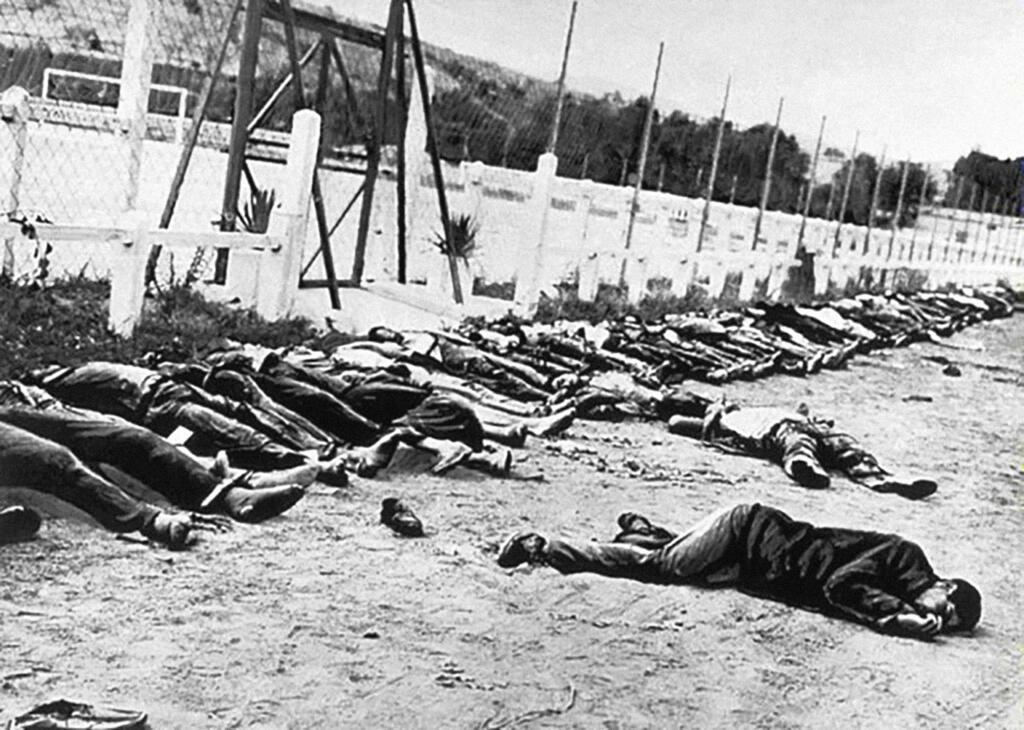
When younger militants pushed towards armed action, Hadj warned them they were heading towards “a massacre, a bloodbath” and risked repeating the violence of May 1945 in eastern Algeria.

French authorities chose to violently repress the demonstration on 8 May 1945 in Setif, Algeria. © INA

Rival groups later took up arms, including the FLN, the National Liberation Front, leading to violent clashes. Nearly 4,000 deaths were recorded among Algerians in France during the war of independence.

A century after its creation, North African Star has largely faded from public memory – although its legacy remains visible in Algeria’s national flag, which originated with the movement.

This story was adapted from the original version in French by Anne Bernas.


SOUNDTRACK