“This economy could be delivering lower inflation, more jobs, and stronger growth, but instead, it’s being dragged in the wrong direction by this president’s policy choices.”
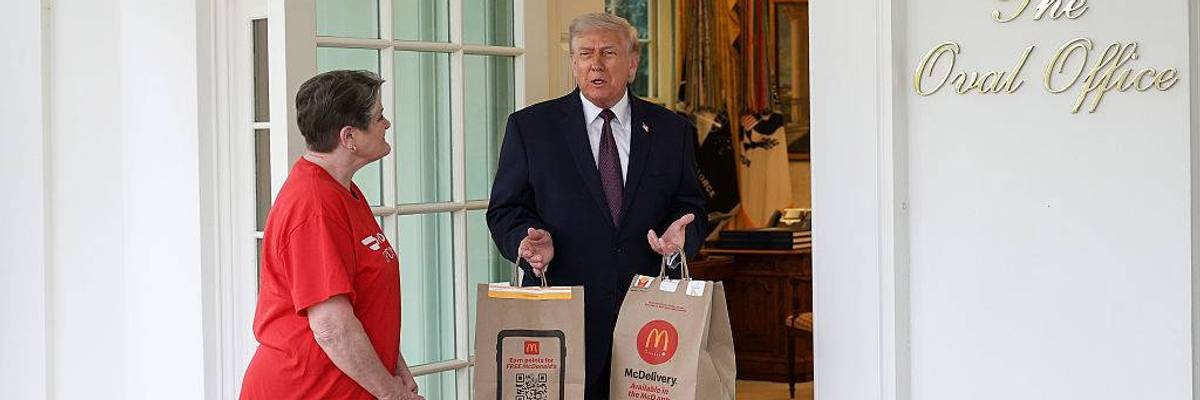
President Donald Trump receives a DoorDash delivery of McDonald’s from Sharon Simmons outside the Oval Office of the White House on April 13, 2026 in Washington, DC.
(Photo by Win McNamee/Getty Images)
Brad Reed
Apr 15, 2026
COMMON DREAMS
With US consumer sentiment hitting an all-time low, the Center for American Progress on Wednesday released a report pinning the blame for Americans’ economic gloom on President Donald Trump.
In total, the CAP analysis projects that by the fourth quarter of 2026, Trump’s policies will lower real GDP by 1.3% while adding 1.39% to personal consumption expenditures (PCE) inflation.
No, Says Economist, March US Jobs Report ‘Is Not Good’
‘This Is a Hiring Recession’: Economists Raise Red Flags at Latest Gloomy Data in Trump Economy
The report also estimates that the economy would have created an additional 2 million jobs 2026 were it not for the Trump’s tariffs, mass deportations, and war of choice with Iran.
Although the unemployment rate at the moment is low, the report explains, US employers are also hiring far fewer people, as “both labor demand and labor supply have fallen, leaving a job market with fewer opportunities and less resilience against downturns.”
Trump’s policies have also made borrowing more expensive, and CAP says that interest rates are now 60 basis points higher than they otherwise would have been without the president’s policies.
Jared Bernstein, senior fellow at CAP and former chair of the Council of Economic Advisers under President Joe Biden, said the analysis shows “this economy could be delivering lower inflation, more jobs, and stronger growth, but instead, it’s being dragged in the wrong direction by this president’s policy choices.”
Bernstein said Trump’s tariffs were the primary culprit for higher-than-expected inflation in 2025, while the oil supply shock that came after Trump launched a war with Iran is expected to add even more inflation throughout 2026.
The end result, said Bernstein, is a kind of “stagflation,” with low economic growth and higher-than-average inflation. He also warned that “longer-term costs from reduced investment in both people and public goods will also take a toll on future growth.”
Job growth in the US has largely stalled ever since Trump announced his “liberation day” tariffs more than a year ago, and a CAP analysis published earlier this month found that the economy has created an average of fewer than 22,000 jobs per month over the last year.
The latest Consumer Price Index report released by the US Bureau of Labor Statistics found that prices in March rose by 3.3% from the previous year—the highest annual inflation rate since April 2024.
Despite this, Trump has continued to insist that he has created the “greatest” economy in the history of the world.
Inflation is a Process
Goldman Sachs HQ, NYC.
My friend Jared Bernstein calls our attention to the rebirth of the inflation hawks. Apparently, there is a new craze among economists to say that we are in a period of structurally higher inflation. The basis for this is that we are looking at consistently higher inflation in the 20s than we saw in the quarter-century from 1995 to 2020. So, the question is whether there is a structural break or just a series of bad breaks for the economy and the country.
Put me firmly in the series of bad breaks camp. First, the bad breaks were not exactly a secret. The pandemic disrupted economies throughout the world. When people could no longer spend money on services like restaurants, gyms, and travel, we saw a massive shift in demand to goods like cars, refrigerators, and clothes. The world economy could not quickly shift production to keep up, so we got inflation.
There’s nothing surprising there. Also, the inflation lasted longer than I and my Team Transitory teammates expected, in large part because the pandemic lasted longer. The vaccines proved to be much less effective in preventing infections (still very effective in preventing hospitalization and death) with later strains than with original strain. As a result, people were not going back into restaurants and engaging in more normal life until well into 2022, long after most of the population was vaccinated.
However, even though the pandemic inflation lasted longer than anticipated, it did fall sharply in 2023 and 2024. It was generally expected to get back to the Fed’s 2.0% target in 2025.
But then Trump happened. There again is no mystery here. Durable goods prices had been falling through 2023 and 2024, but then they stopped falling and started rising when Donald Trump’s tariffs appeared on the horizon after the election. This pretty well explains the rise in inflation last year.
And now with the war with Iran. Again, we don’t have to look far for explanations here. Cut off 20% of the world’s oil, along with hits to natural gas and fertilizer production, and inflation rises.
I’m not sure what the structural story here would be. If we get an incompetent jerk in the White House, they will do things that mess up the economy and send inflation higher? I suppose that is true, but I’m not sure that is a structural story.
But there is another part to this story that is my main reason for rejecting the structural break story. Inflation is a process. If prices are rising more rapidly, who gets the money? In the 1970s, that was an easy question to answer.
We had a wage-price spiral. There was little change in the profit share over the course of the decade. Workers’ wages more or less kept up with prices (higher prices for imported oil complicate the picture), so we had a clearly explicable inflationary process.
But what would be the process today? Wage growth has actually slowed in the last year and a half from a bit over 4.0% to around 3.5%. That’s not huge, but it goes the wrong way for a persistent inflation story. Also, it appears that productivity growth is picking up, or at least not slowing down, as it did in the 1970s.
So again, who gets the money? If wages rise 3.5% a year, and productivity grows at a 1.5% rate, we’re looking at 2.0% inflation. If those numbers are right, or in the ballpark, the only way that we can have 3.0% inflation or higher, is if the profit share continually rises.
That is always a possibility, especially when we have politics that seem to be focused on giving as much money as possible to corporate America. But if that is the story, we are missing the point in saying that we have a problem with inflation. The problem is a rising profit share. That is a big deal, but we need to keep our eye on the ball. Calling this an inflation problem misrepresents the issue at hand.
This first appeared on Dean Baker’s Beat the Press blog.

No comments:
Post a Comment