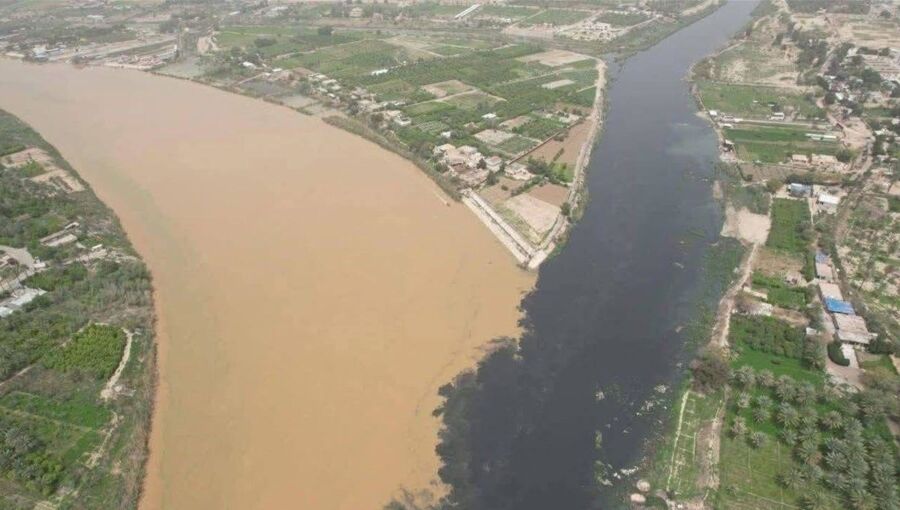
Iraq's Environment Minister Hallo Askari has announced that authorities have contained a pollution crisis in the Tigris river caused by sediment dislodged by water releases from rivers and dams, Al Sumaria News reported on April 14, citing the Iraqi state news agency WAA.
Askari said the contamination began at the confluence of the Tigris and Diyala rivers and spread downstream to Iraq's southern provinces. Sediment deposits in the riverbed were swept up by water flows, polluting the supply.
"The ministries of environment and water resources, together with municipal authorities in the affected provinces, have managed to contain the phenomenon," al-Askari said. "We are working to prevent the pollution of river water from recurring in the future."
He added that the government was using equipment available through municipal and ministry resources to improve river conditions and enforce existing environmental regulations.
The announcement comes days after a mass fish die-off in Wasit province, where an estimated 1,000 to 1,200 tonnes of fish were lost after a surge of heavily polluted water moved downstream from the Diyala river.
According to the Iraqi Association of Fish Producers, the polluted water had accumulated over an extended period and carried concentrated waste and sediment into the Tigris, raising pollution to what it described as record levels.
Iraq's Ministry of Water Resources said on April 3 that inflows to the Tigris, Euphrates and Diyala had increased following recent rainfall and floods, raising storage levels in dams and reservoirs. The higher water volumes appear to have dislodged accumulated pollutants in the river system.
In February, the independent Green Iraq Observatory issued an urgent warning that the Tigris contained hazardous organic pollutants including polychlorinated biphenyls and volatile organic compounds, posing a direct threat to the health of millions of residents in Baghdad and several southern provinces.
Iraq's water reserves hit 80-year lows in August 2025, and the country's Ministry of Water Resources has warned the river could effectively run dry by 2040 under the combined pressure of upstream dams, climate change and pollution.
Iraq ranks as the fifth most affected country globally by climate change, with rising temperatures, falling rainfall and water shortages compounding economic, social and security risks, a senior environment official said in January.
Deputy Environment Minister Jassim Al-Falahi said at an energy conference in Baghdad that Iraq has recorded unprecedented temperature increases over the past two decades, outpacing global climate scenarios that assume a one-degree rise every 100 years.
"Iraq has effectively outpaced the world in the rate of temperature increase," Al-Falahi said, adding that even a single degree rise sharply increases demand for energy and water, with far-reaching health, social, economic and environmental consequences.
Al-Falahi said climate change has been directly linked to worsening drought, noting that rainfall has fallen by 35% over the past 30 years, based on data from international research centres. Iraq is now experiencing its fourth consecutive year of drought.
Water stress along the Euphrates River, a key lifeline for Iraq, has become a major point of tension with Turkey, which controls upstream flows. Iraqi officials say reduced releases from Turkish dams have sharply curtailed water reaching the country, worsening drought conditions and driving river levels to historic lows.
Environmental observers note that Iraq is now receiving only a fraction of its traditional share from the Tigris-Euphrates system, heightening pressure on shared water resources and prolonging negotiations over water management and cooperation.
Outgoing Prime Minister Mohammed Shia al-Sudani oversaw the signing of the executive mechanism for the framework water cooperation with Turkey in November, but officials say the country faces its worst water crisis this year amid climate change and upstream water use.

No comments:
Post a Comment