ByAFP
April 12, 2026

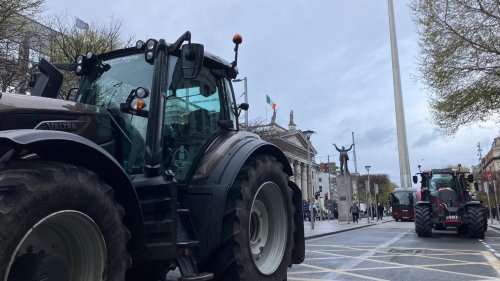
Last week's protests started with go-slow convoys on motorways - Copyright AFP Paul Faith
Ireland’s government announced fresh tax cuts on petrol and diesel at an emergency cabinet meeting Sunday after fuel cost protests that had threatened the functioning of the country’s emergency services.
Since Tuesday, hauliers and agricultural contractors have launched a series of protests over spiralling petrol and diesel prices in the wake of the Middle East war.
“As a Government, we hear you,” Finance Minister Simon Harris said at a news conference. “We have acted and we are taking further action today,” he added.
The cuts announced include a 10-cent reduction per litre on both diesel and petrol — and a planned increase on carbon tax will be postponed from May until the Budget in October.
Last week’s protests grew from slow-moving convoys on motorways and restricted access to Dublin’s busiest streets, to a part blockade of Ireland’s only oil refinery and restricted access to at least two other fuel depots.
Some protests were still going for sixth day Sunday.
Earlier, the government had urged the public not to panic-buy as pumps at many fuel stations ran dry.
Police on Saturday with the support of the armed forces deployed public order units to clear the blockade at Whitegate Refinery in southern Ireland.
Irish police chief Justin Kelly said the action was taken as a last resort.
He condemned the refinery blockade as “illegal activity” by people determined to “hold the country to ransom”.
The blockading of “critical national infrastructure” had “resulted in fuel shortages that are directly impacting on emergency services such as hospitals, the ambulance service, and the fire service”, he said.
Elsewhere, police dismantled a makeshift barrier erected by protesters blockading western Galway docks.
A late-night operation also targeted the blockade of the capital Dublin’s main thoroughfare O’Connell Street after multiple vehicles including tractors and lorries were removed.
Justice Minister Jim O’Callaghan warned earlier that the continued protests were “unacceptable”.
“While we all acknowledge the impact of higher fuel prices, and seek to minimise that impact, no groups are entitled in our republic to hold our people to ransom in such a manner,” he said.
In March, Dublin announced a 250 million-euro package to reduce fuel costs, notably including a diesel rebate for road haulier.
The Fuel Protests: Blame The Government Not the Protesters
Monday 13 April 2026, by People Before Profit
Back the basic demands. Defend the right to protest. Oppose the frauds on the far-right and discuss the protest leaders, but let’s keep coming back to the real issue of unbearable price increases and where they come from. Workers, unions- let’s deepen the movement for a country we can all live in. [1]
The basic demand is right!
For several days Ireland has seen some of the most militant protests in years: roads blocked, fuel depots and the Whitegate refinery targeted, fuel supplies thrown into chaos. The government is under real pressure because the core demand is right and massively popular: price caps on fuel during a cost-of-living crisis that is crushing ordinary people. We have been calling for such caps for years.
Because the government has failed to act we have a cost of living crisis on top of a cost of living crisis. Since Covid prices have gone up by 25% but basics such as food and energy by a lot more. Wages have been cut in real terms. In the last budget the government gave massive tax breaks to developers and fast food chains and took support away from households.
Around 320,000 households are in arrears on electricity and gas bills. Barnardos say that two in five parents had reduced portion sizes, skipped meals or gone without food to feed their children. No wonder people are angry.
The government’s cuts to excise duty three weeks ago were tokenistic, wiped out almost immediately by the scale of the global commodity crisis. People were told to be grateful for scraps while costs kept rising. In many working class communities, these protests are popular for exactly that reason.
Defend the right to protest
The government’s decision to call in the army to Whitegate today is an attack on the right to protest, and we condemn it without reservation. At Whitegate, protesters were pepper sprayed and the Defense Forces were deployed to clear vehicles. This is the state using force against people exercising a democratic right. Protest to be effective must be disruptive and polarising but as James Connolly surmised, it is the “incarnation of progress” - strikes, protest and civil disobedience have been central to every social advance we have ever made, from the right to vote to rights in the workplace.
This repression cannot be allowed to stand as a precedent. Repressive powers used here will be used again: against workers taking industrial action, against housing movements, against Palestine solidarity protesters, against anyone who seriously challenges the interests this government protects. The right to protest is not a privilege the state grants when it is comfortable. It is a right that must be defended regardless of whether you agree with the demands of those on the streets.
Who is in this movement and why
We also have to be honest about the class character of these protests. This movement is led by people who own companies, employ workers and have access to expensive machinery. Though workers and farmers are present in numbers, they are not dictating the pace or demands at this stage.
Some of the most visible leaders have made racist, misogynistic and homophobic statements publicly.
But that is not the whole story. There is a real mix of people in and around this movement, including many working class people looking on sympathetically, in some cases inspired by the militancy of the protests. This has happened because the movement of organised workers, the trade union movement, has completely failed to give any lead on the cost-of-living crisis. In that vacuum, people will turn to whoever appears willing to fight.
Where soaring costs actually come from
Soaring fuel costs are driven by energy company profiteering, but also by Trump and Israel’s war on Iran. The Irish government refuses to act. It still allows the United States to use Shannon Airport like a military airfield, waving US warplanes through even as some NATO allies have refused. That is cowardice from Micheál Martin and this government, and it directly feeds the crisis hitting people at the pumps and on their bills. It is impossible to detach the fight for peace and justice in the world from the fight for dignity and social justice at home.
The far right are frauds on this issue
Some of the loudest figures attaching themselves to these protests are cheerleaders for Trump, for racism, and in some cases for Israel. They want to blame migrants, LGBT people or whoever else is convenient, instead of the profiteers, war-makers and politicians actually responsible. The people who gave Paul Murphy and People Before Profit hassle on O’Connell bridge this week were not farmers defending their livelihoods. They were political grifters trying to drag this movement in a poisonous direction. To anyone attacking us for standing with LGBT people or Palestine: it was not a trans person or a migrant who started bombing Iran. Working class power comes from working class unity and militancy - if we allow racism or homophobia room to breathe, we turn our backs on some of the most militant people in Irish society and we divide the working class as a whole.
A bigger movement is needed
This crisis also exposes something deeper. Fossil fuel dependence leaves workers exposed every time there is a global shock. We need a just transition, but one that lifts workers up rather than punishing them. The government and the Greens have tried to make ordinary people carry the burden through carbon taxes and higher bills, while corporations keep polluting and data centres consume electricity at cheaper rates than households. Those data centres are on course to consume 30% of all electricity in Ireland by 2030. Homes and businesses are being squeezed while a handful of tech giants are handed cheap power at scale. That has to end.
Time for workers and unions to act!
The anger on the streets is real and justified. But a movement dominated by small business owners and owner-drivers, with far-right figures hovering at its edges, cannot win the demands that working people actually need.
We must demand that our unions enter the fight. Workers did not cause this crisis. Energy companies, war-makers and a government that serves corporate interests did. The unions have the membership, the resources and the leverage to force real change on the cost of living. It is time to use them. Every trade union branch, every shop steward, every community organisation should be discussing what action can be taken and building for it now.
Our demands
While we support the demand for price caps we also want to go further. People Before Profit is calling for immediate action on the cost-of-living crisis:
- mmediate price caps on fuel and energy
- Windfall taxes on energy companies making record profits from this crisis
- €500 energy credit for all households, with €400 cost of disability payment
- Double payments for those on social welfare
- Free public transport to reduce costs for commuters and demand for fuel
- Ramp up retrofitting to reduce energy costs
- End the sweetheart electricity deals for data centres; make them pay household rates
- Ban the construction of new data centres
- US military out of Irish Airports and skies - Defend our neutrality.
- No carbon taxes on ordinary households - make the real polluters pay!
Our position
The central lesson here is simple. When workers are hit by a cost-of-living crisis and unions fail to lead, people look to whoever is willing to fight. The answer is not to sneer at that militancy. It is to deepen it, broaden it, root it in working class demands, defend it from repression, and stop reactionaries from hijacking it. We should take inspiration from the fact that the current disruption is forcing the government to act.
People Before Profit supports these protests, defends the right to protest, and is committed to building a deeper movement for a country we can all live in. We initiated the Affordable Ireland Campaign and will be talking to others in the Campaign about the steps necessary to build that movement now.
We will be on the streets next Saturday opposing Trump’s and Israel’s war, the main cause of the current crisis, and demanding an end to our government’s complicity with the war. We need a huge turnout to send a message that ordinary people want an end to the war and cost of living crisis that it has caused.
12 April 2026
Source: People Before Profit.
Footnotes
[1] Photo: Tractors on a quiet O’Connell Street Saturday 11 April with the Jim Larkin Statue GPO and Spire in the background.

No comments:
Post a Comment