We Need ‘More Muckrakers and Fewer Buck-
Takers’
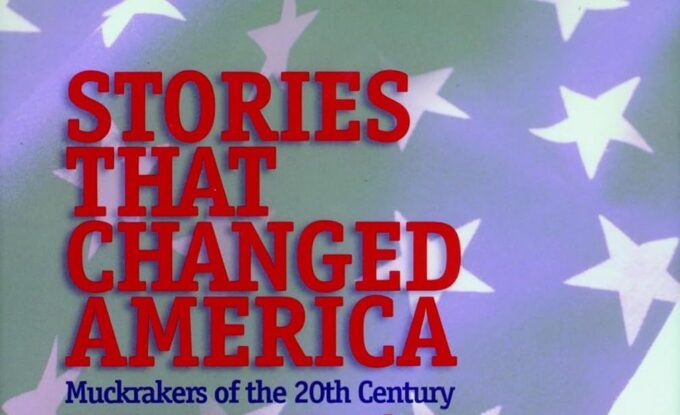
Cover art for the book Stories that Changed America: Muckrakers of the 20th Century by Carl Jensen
Fifty years ago, Carl Jensen founded Project Censored because he knew that journalism was the lifeblood of democracy. He argued that the news media, despite its increasingly corporate and commercial nature, can have a positive influence on the world, especially when it operates ethically and independently in the public interest. He encouraged journalism programs at colleges across the country to turn out “more muckrakers and fewer buck-takers.”
Jensen championed the independent reporting of his contemporaries in his work with Project Censored, earning him accolades from luminaries such as I.F. Stone and Walter Cronkite. After his retirement, Jensen published what might be one of his most important and enduring works, Stories That Changed America: Muckrakers of the 20th Century. This book centers on and celebrates the kind of journalism from past eras that truly made a difference. Today, the news media broadly suffer from a cratering of public trust, but there is much we can learn from history. There are independent journalists among us today who are inspiring a much-needed renaissance in public-interest journalism that can help restore public faith in the Fourth Estate.
In the early 1900s, the United States experienced what historians refer to as a Golden Age of muckraking journalism. It was President Teddy Roosevelt who popularized the term in a 1906 speech, where he extolled the virtues of the press holding those in power to account, but also warned that it sometimes went too far, creating scandals where he thought none existed. He likened such behavior to the “Man With the Muck Rake” described in John Bunyan’s 1678 work Pilgrim’s Progress, “Who could look no way but downward, with the muck rake in his hand; who was offered a celestial crown for his muck rake, but who would neither look up nor regard the crown he was offered, but continued to rake to himself the filth of the floor.” While some subsequently reclaimed the term “muckraker,” Roosevelt’s original use was not necessarily affirmative.
Some, like Ida Tarbell—who took on monopolies like John D. Rockefeller’s Standard Oil in the pages of McClure’s Magazine—rejected the label as an insult. Others, like Lincoln Steffens and Upton Sinclair, wore it as a badge of honor, with Steffens’s The Shame of the Cities exposing municipal corruption and Sinclair’s The Jungle uncovering the public health hazards of the meatpacking industry. Tarbell’s work led to the Supreme Court’s trust-busting of Standard Oil in 1911, Steffens’s series led to urban political reforms, and Sinclair’s work helped persuade Roosevelt to support the Pure Food and Drug Act of 1906. As time went on, Roosevelt’s enthusiasm waned when it came to Steffens, and particularly David Graham Phillips for his Cosmopolitan series “The Treason of the Senate.” The president increasingly opposed such reporting as it criticized his close political allies, whom he needed to support his political aspirations and programs. Regardless, reporting about rampant, unchecked corporate corruption, political conflicts of interest, and widespread social injustices resonated with the public in meaningful ways, often leading to civic reforms, some of which we still benefit from today.
Past as prologue
The twentieth century began with a series of significant changes in the relationship between the US government and its citizens. The public began to demand government interventions, including regulation of food safety and child labor, women’s suffrage, and other significant reforms. However, there was no guarantee such improvements would be permanent. While the history of muckraking journalism has always ebbed and flowed, seeing reprises in the 1960s and 1970s, Jensen noted that, ironically, it receded after the Watergate scandal toppled the Nixon presidency, as the press became subject to increasing commercial pressures and consolidation of ownership. There were some significant breakthroughs, including Robert Parry’s intrepid reporting on the October Surprise in the 1980s or the dismantling of habeas corpus during the so-called “War on Terror.” There was also Gary Webb’s groundbreaking exposé of the CIA’s crack cocaine connections in Los Angeles in the 1990s. While Project Censored recognized these as important underreported stories at the time, these bombshell revelations did not have the societal impact of previous muckraking generations that took down Standard Oil or led to regulating industry for the public good.
Further, through a series of political developments during the presidencies of Ronald Reagan and Bill Clinton, bipartisan efforts led to the repeal of the Fairness Doctrine in 1987 and the passage of the Telecommunications Act of 1996, undermining the ability of the press to report robustly about a wide range of topics in the public interest. As the axiom goes, the price of freedom is eternal vigilance, and freedom of the press is paramount for the protection of all the other civil rights enshrined in the Constitution. It is the press that is supposed to lead the charge in informing citizens about key issues of the day, unencumbered by government or corporate owners, in turn generating more informed civic engagement that leads to sustained positive changes for society.
Unfortunately, in the 21st century, much of the establishment media—increasingly operated for profit by fewer and fewer corporate owners and wealthy elites—has instead flooded the public with junk food news, tabloidized coverage of important events, endless distractions, and pernicious propaganda. But the muckraking spirit we saw more than a century ago still exists in the world of independent media, and another Golden Age can return if “We the People” support it. This requires more than passive spectatorship; it calls for a public, informed by critical thinking and media literacy, to demand and create it.
Cause for celebration in challenging times
Although we are in the midst of an unprecedented series of attacks on journalism, from the Federal Communications Commission to the White House, extending such hostilities to many of our epistemic institutions, many in the independent press are doing incredibly important work. As much as we need to push back and defend against such onslaughts, we also should recognize and support those doing the kind of muckraking journalism that we’ve seen in the past from intrepid truthtellers like Tarbell, Steffens, Sinclair, and later by trailblazers like I.F. “Izzy” Stone, who once noted, “All governments lie.”
In fact, the spirit of legendary muckraker “Izzy” Stone is alive and thriving in the independent press as evidenced by the coming Izzy Awards, named in Stone’s honor and presented by the Park Center for Independent Media at Ithaca College. This is one of many celebratory occasions that also serve to broaden and diversify the public’s media habits. Like Project Censored, which amplifies independent media reporting either ignored or censored by the corporate press, the Izzys have highlighted the most significant independent journalism in the country for nearly two decades.
This year’s winners, to be celebrated at the newly expanded Izzy Fest 2026 on April 21–22 at Ithaca College, include the Texas Observer for its reporting on failed drug policies and a rash of overdoses and an ICE prosecutor running a white supremacist account on X; journalists Gywnne Hogan and Haidee Chu of The City in New York, who broke the story of ICE detention tactics at 26 Federal Plaza, which led to more widespread reporting and meaningful court reforms; and documentarian Abby Martin of the Empire Files whose new film Earth’s Greatest Enemy calls public attention to the Pentagon as the planet’s greatest polluter. This year, the Izzy judges also awarded honorable mentions to 404 Media, Prism, and Drop Site News. These independent journalists and outlets are not only inspiring but also necessary if we are to maintain a functioning republic responsive to its members’ needs. The Park Center received more than one hundred nominations for this year’s Izzys, which is double the number received only a few years ago. This is a sign of a robust scene in the independent press, one that could grow and spread with increased public awareness and support.
As twentieth-century media critic George Seldes once noted, the job of journalism is not impartial, balanced reporting; it is to tell the public what is really going on. What we need today is nothing short of an all-hands-on-deck moment in the Fourth Estate. We not only need to support and spread the word about the best investigative journalism from the independent press, but we need to encourage, indeed demand, that the establishment media, with their massive resources, return to a focus on what the public needs to know, what’s really going on as Seldes said—not what elite billionaire owners or an increasingly bewildered populace might like. As Movement Media Alliance journalists Maya Schenwar and Lara Witt put it in the Project Censored’s fiftieth anniversary yearbook, “There’s no power for the people without journalism by and for the people.” Let us bring back the Golden Age of muckrakers in the present. Our future, and the future of the planet, depend upon it.
This was first published by Project Censored.

No comments:
Post a Comment