The Trump administration naval blockade of the Strait of Hormuz failed after at least 34 tankers with links to Iran passed through the narrow waterway and exited the Persian Gulf in defiance of the US warships attempts to halt Iran’s oil exports.
US President Donald Trump imposed a naval blockade on any ship leaving the Gulf carrying Iranian oil last week, but has been unable to enforce the order. The two-week ceasefire was supposed to end on April 21, but at the eleventh hour the White House extended it indefinitely as the US failed to impose its will on Iran, which remains firmly in control of the strategic chokepoint.
According to cargo tracking group Vortexa, the vessels departing were confirmed to be carrying Iranian crude oil, the Financial Times reports — a finding that sits awkwardly alongside Donald Trump's assertion that the blockade has been a "tremendous success."
The data, which covers the period since the blockade came into force at 10am Eastern time on April 13, reveals the scale of the enforcement failure.
At least 19 tankers with links to Iran have passed through the blockade to exit the Gulf, while at least 15 have entered, heading toward Iran from the Arabian Sea. Six of those that departed were confirmed as carrying Iranian crude, in the volume of 10.7mn barrels. Assuming a $10 discount to Brent crude — typical for sanctioned Iranian oil — that volume represents revenues of approximately $910mn flowing to Tehran despite the blockade, the FT estimated.
"The blockade has been a tremendous success," Trump told CNBC on April 21, adding that he would not lift the US embargo on the Strait of Hormuz until Washington reached a "final deal" with Iran.
A fresh round of talks was slated to take place on April 22, led by US Vice President JD Vance and Special Envoy Steve Witkoff, however, the plane due to ferry them to Islamabad failed to leave and no talks are scheduled.
The FT report contradicts White House claims that US forces ordered 28 vessels to turn back to Iranian ports since the embargo began — a figure US Central Command appeared to present as evidence of effectiveness of the blockade, though the Vortexa data suggests the overall picture is considerably more mixed.
Ships under fire
Not all ships headed towards the strait are leaving. In a separate report, one tanker headed to India was reportedly duped by cryptocurrency scammers who were paid the $2mn transit fee imposed by Tehran. However, the Iranian Revolutionary Guard Corps (IRGC) fired on the ship as it entered the straits. Recording of the conversation between the capital and the IRGC administration in charge of the strait detail pleas to halt the attacks on the ship as the IRGC explained it had not received the required funds. The tanker eventually turned back.
On April 18, Iranian troops fired on a French container ship and an Indian tanker attempting to cross the waterway, Al Jazeera reports. No tankers passed through the strait on April 19, according to tracking data.
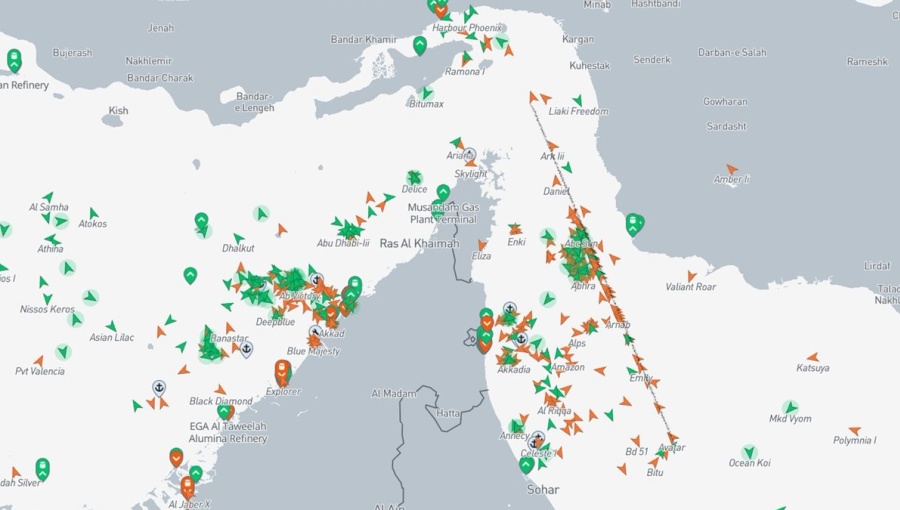
Most of the approximately 30 vessels that attempted to pass on April 17 have since reversed course and are now at anchor at the southern end of the Gulf, awaiting clarity that maritime officials say may not come soon.
The shadow fleet in action
Some of the ships are sneaking past the US warships posted in the Indian Ocean at the exit of the straits. The Dorena, an Iranian-flagged supertanker, snuck past the US forces with its Automatic Identification System (AIS) transponder switched off. Satellite imagery analysed by the FT shows the Dorena off the coast of Malaysia engaged in a ship-to-ship transfer — a common dodge to avoid sanctions on arrival at its destination to mask the origin of cargo.
Oil export figures for Malaysia have soared since the conflict began, despite the fact that Malaysia has no oil fields of its own. The Dorena last signalled its position off the southern coast of India on April 18, and according to Indian and Iranian media reports, arrived carrying approximately 2mn barrels of crude as part of a broader 6mn barrel Iranian delivery to Indian refiners completed under the final days of a 30-day sanctions waiver.
The US also temporarily suspended sanctions on the purchase of Russian oil trapped on tankers at sea. Those sanctions were initially reimposed last week, almost immediately to be removed again on April 17 by the US Treasury Secretary Scott Bessent in an effort to push oil prices down.
US gas prices reached a national average of $4.05 a gallon on April 19. Energy Secretary Chris Wright told CNN they may not return to under $3 a gallon until "next year," while not ruling out the possibility of reaching that level "later this year." High prices of petrol at the pump are a political problem for Trump and his Republican party that face midterm elections in November.
The Treasury Department's waiver lets countries purchase Russian oil and petroleum products loaded on vessels as of April 17 through May 16. It replaces a 30-day waiver that expired on April 11 and excludes transactions involving Iran, Cuba and North Korea.
"As negotiations (with Iran) accelerate, Treasury wants to ensure oil is available to those who need it," a Treasury Department spokesperson said at the time of the announcement, Reuters reported.
Global prices for Brent have fallen from recent highs to around $100 a barrel as of the time of writing after Iran temporarily reopened the Strait of Hormuz at the weekend, before almost immediately closing it again due to the US naval blockade.
As of April 17, there were 177 tankers carrying Iranian cargo on the water globally, according to Windward Maritime AI the FT reported, with maritime traffic mostly headed toward Asia and the Middle East — China, the UAE, Oman, India and Singapore among the primary destinations. A further 163 of those vessels were operating under what analysts describe as fraudulent flags.
Alongside the Dorena, several other sanctioned tankers have re-entered the Gulf, including the Murlikishan and the Alicia — both sanctioned by the US Treasury last year — which transited the strait on the night of April 14 before sailing north toward Iran.
The Touska seizure
The limits of enforcement were demonstrated on April 19 when the US escalated its blockade operations dramatically. The guided-missile destroyer USS Spruance intercepted the Iranian-flagged cargo ship Touska in the Gulf of Oman as it transited the north Arabian Sea at 17 knots en route to Bandar Abbas, Iran's main commercial port.
After the Touska's crew failed to comply with repeated warnings over a six-hour period, Spruance directed the vessel to evacuate its engine room and fired several rounds from its 5-inch MK 45 gun, disabling the ship's propulsion, NS Energy reports. US Marines from the 31st Marine Expeditionary Unit, flying from the amphibious assault ship USS Tripoli, then rappelled onto the vessel and took control.
Trump announced the seizure on Truth Social in characteristically blunt terms. "The US Navy Guided Missile Destroyer USS Spruance intercepted the Touska in the Gulf of Oman and gave them fair warning to stop. The Iranian crew refused to listen, so our Navy ship stopped them right in their tracks by blowing a hole in the engine room. Right now, US Marines have custody of the vessel," he wrote.
The Touska had last docked in Port Klang, Malaysia, on April 12 and was under US Treasury sanctions due to its prior history of illegal activity, according to a US official. Iran's military described the operation as "maritime highway robbery" and an act of piracy, vowing retaliation.
The upshot of the seizure was Tehran suspended its participation in the second round of peace talks due on April 21 in Islamabad.
Iran's parliamentary speaker Mohammad-Bagher Ghalibaf was unequivocal in response: "It is impossible for others to pass through the Strait of Hormuz," he said on state television Al Jazeera reported.
The double blockade
The result of the competing claims of authority over the waterway has created what the shipping industry has taken to calling a "double blockade" — a situation with no modern precedent.
On one side, Washington is attempting to prevent vessels from calling at Iranian ports or carrying goods that could assist Iran in the conflict. On the other hand, Tehran insists all transits of the Strait of Hormuz must follow routes prescribed by the IRGC and receive prior permission from Tehran, in effect also blocking passage through the strait.
Far from forcing Tehran to reopen the Strait of Hormuz, the US naval blockade has double locked it closed. After briefly declaring the strait "completely open" on April 17, Iran clarified that it was only open to vessels with prior permission from Tehran.
The combination of a shadow fleet that has already moved nearly 11mn barrels of Iranian crude past the blockade, an Iranian military with its finger on the trigger in the strait's chokepoint, and a diplomatic process now in renewed jeopardy following the Touska seizure presents Washington with a problem that brute naval force alone is unable to resolve.
Rumours are circulating that the US has used the brief ceasefire to ferry fresh equipment and supplies to the Middle East in a convoy of planes visible on aviation flight tracking sites. At the same time the IRGC has been digging out mountainous caches of drones and missiles that have been targeted by the US-Israeli coalition, significantly increasing the amount of weaponry available to the IRGC should hostilities resume.
Most worryingly, Tehran issued an official warning for the Gulf states to evacuate immediately over the weekend, in an implicit threat of widespread drone and missile attacks on neighbouring cities should the US launch a mooted major ground and bombing assault on Iran.


.jpg)
.jpg)