Gulf war poses major threat to global fertiliser markets and food security, IFPRI warns
The ongoing Iran war is disrupting global fertiliser markets with sustained impacts likely on food production, particularly in Africa and South Asia, the International Food Policy Research Institute (IFPRI) said on April 1.
Shipping restrictions in the Strait of Hormuz have already driven sharp increases in fertiliser and energy prices, with the disruption threatening agricultural output if prolonged. Up to 30% of global fertiliser trade passed through the Strait of Hormuz from the Persian Gulf to export markets in 2024, alongside 20% of liquefied natural gas (LNG) supplies and 27% of globally traded oil.
Attacks by both sides in the conflict have damaged production sites and export hubs, including Ras Laffan Industrial City in Qatar, the largest LNG facility in the world, and Iran's Kharg Island oil terminal. Further attacks would reduce supplies further, IFPRI said.
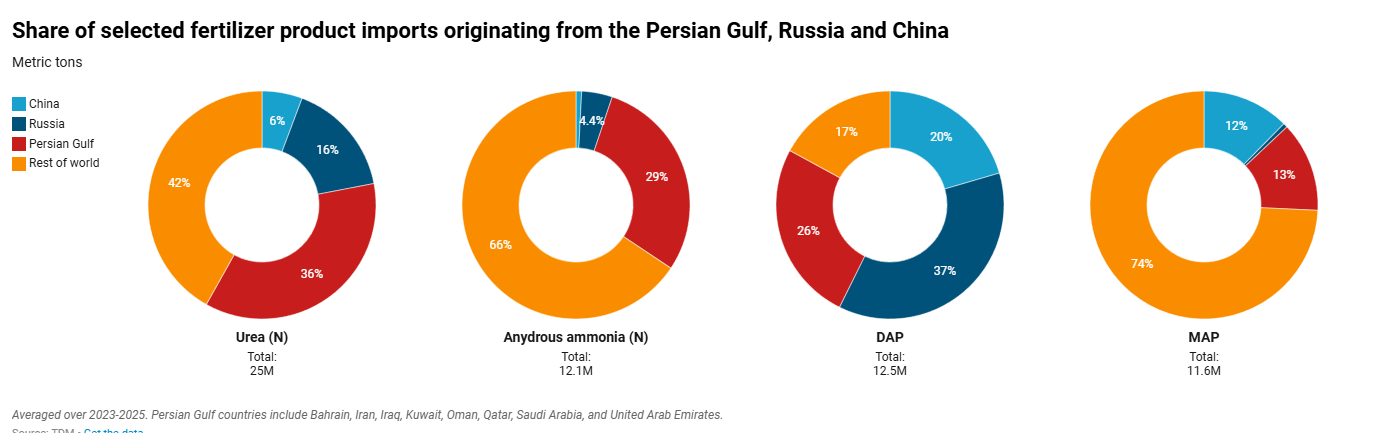
Gulf countries were the single biggest regional exporter of urea and ammonia, both nitrogen-based products, and the second largest regional exporter of diammonium phosphate (DAP) and monoammonium phosphate (MAP) fertilisers between 2023 and 2025. Qatar supplies around 10% of globally traded natural gas, with LNG exports vital for fertiliser production in India, Pakistan, Bangladesh and Turkey.
The Gulf region accounted for 36% of global urea exports from 2023 to 2025, with Iran and Qatar the largest exporters, followed by Saudi Arabia. Iran itself is a major urea producer, with the International Fertiliser Association (IFA) estimating Tehran as the largest urea exporter in the Gulf region despite minimal official export data.
On phosphate, the Gulf region accounts for 26% of DAP and 13% of MAP global exports, with Saudi Arabia the largest producer and exporter. The region also provides close to 50% of globally traded sulphur, a byproduct of oil and gas refining that is critical for phosphate fertiliser production.
European fertiliser producers have requested government support amid steep rises in natural gas prices. US President Donald Trump has issued a 60-day suspension of the Jones Act for fertiliser transportation, offered support for cargo and hull insurance and lifted sanctions on three Belarusian potash producers. The US also suspended sanctions on Russian oil to stem conflict-related price increases.
India has sufficient fertiliser inventory for the Kharif rainy season starting in June, according to the Fertiliser Association of India. The organisation has called on the government to factor raw material price spikes into producer subsidy rates and prioritise fertiliser in natural gas allocation.
African countries are particularly vulnerable, IFPRI warned, given the region's heavy dependence on imports. Fertiliser use in Africa fell 25% in 2022 following the Russian invasion of Ukraine. Low-income countries may find it harder to finance subsidies, given existing fiscal constraints and declining overseas development assistance.
The International Rice Research Institute has warned that if Strait of Hormuz shipping disruptions continue, energy and fertiliser channels could become more consequential short and medium-term risks than initial logistic shocks for Asia's next crop cycle.
Global average yields did not decline following the 2022 fertiliser price spikes, IFPRI noted, as some nutrients remain in soils for multiple years and farmers can shift towards less fertiliser-intensive crops.
A sustained crisis could also increase the use of coal to maintain energy supplies and produce fertiliser, worsening climate change. Chinese fertiliser production already relies on coal for 70% to 80% of ammonia production.
The IFA November 2025 outlook suggested 2026 nitrogen capacity would increase 4% over 2024, with phosphate and potash capacity up 5% each.
"Stabilising fertiliser markets will depend on reducing hostilities and ending the Iran war," IFPRI said.

No comments:
Post a Comment