It’s possible that I shall make an ass of myself. But in that case one can always get out of it with a little dialectic. I have, of course, so worded my proposition as to be right either way (K.Marx, Letter to F.Engels on the Indian Mutiny)
Saturday, February 05, 2022
ALBERTA
Protest continues at Coutts on 7th day as traffic flows slowly to U.S. border
Social Sharing
Facebook
Twitter
Email
Reddit
LinkedIn
Mayor Willett says protesters have made their point and
need to leave his village soon
CBC News ·
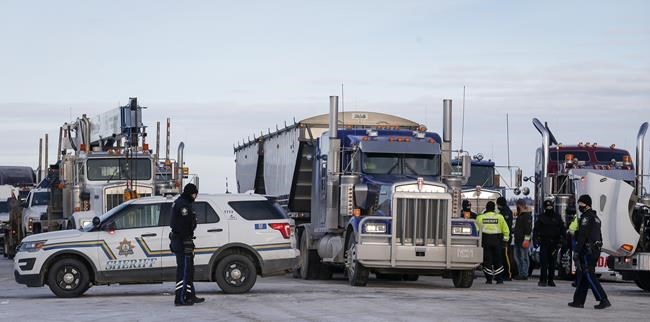
Members of a protest impeding travel to the U.S. border moved in to block southbound traffic on Highway 4 early Friday afternoon. The protest near Coutts, Alta., has been going on since last Saturday. 0:40
Lanes to the U.S. border near Coutts, Alta., opened and closed intermittently Friday as an ongoing protest continued to affect traffic in the area.
Early Friday afternoon, protesters moved in to block southbound traffic on Highway 4 leading to the border. One protester at the blockade told CBC News that the latest move was a result of not enough progress being made on the group's goal to lift pandemic mandates.
RCMP previously confirmed the blockade on one side of the highway. For a while, traffic was being stopped at Milk River, Alta.
On Thursday, protesters had said they planned to vacate the border and move north to Edmonton, but that night they reversed the decision and stayed put.
The demonstration is tied to an ongoing protest over federal rules for unvaccinated or partially vaccinated truckers, which took effect Jan. 15.
The Alberta blockade is being held in solidarity with similar protests in Ottawa and other locations.
RIGHT WING DEMANDS
Protesters have been on-site near the village of Coutts since Jan. 29, protesting federal rules for unvaccinated or partially vaccinated truckers.
Jim Willett, the mayor of Coutts, said he has met with truckers who have been there for almost a week.
He said he paid a visit Thursday — and again Friday — to a former saloon in the village where protest leaders have gathered.
He said he expected to find a room of angry people but instead found they were just waiting.
He said protesters have made their point and need to leave his village soon.
Premier's Facebook live
Speaking during a Facebook live broadcast held late Thursday, Premier Jason Kenney said he did not say that truckers assaulted RCMP officers during a news conference held earlier in the week.
The premier added he had received a situation report from the Alberta Ministry of Justice and Solicitor General on Tuesday afternoon, produced by RCMP officers in the field, who testified to being swarmed by protest sympathizers.
Those officers, the premier said, had threats made against them by protesters and had their barricades charged by vehicles. There was also an attempt to ram officers on the scene, which was narrowly avoided.
In addition, the same protesters collided with other motorists on the highway, with assault ensuing from that, Kenney said.
"I absolutely characterized what happened there, at that barricade, accurately," Kenney said. "All I can say is, shame on those responsible. You shouldn't blame me, or the RCMP, or anyone else, for the dangerous and unlawful conduct of these individuals."
Speaking during a Facebook live stream held Thursday night, Premier Jason Kenney said it was unacceptable for people to make threats, swarm or attempt to ram police vehicles as part of a protest. (Facebook)
During Tuesday's press conference, Kenney did refer to an instance of assault of an RCMP officer alongside the attempted ramming of a police vehicle and the collision with a civilian vehicle.
"I have also received reports in the last hour of people allied with the protesters assaulting RCMP officers," he said at the time.
Meanwhile, Alberta NDP justice critic Irfan Sabirattacked the premier Friday and said he appears to be pandering to the protesters by saying he has a plan to ease restrictions to be announced next week.
"There was no action taken by this government … go to the court, get the injunction and let RCMP do their thing," Sabir said.
With files from Carolyn Dunn, Colleen Underwood and The Canadian Press
Mystery shrouds ‘backchannel’ discussions with MLAs over blockade in Alberta near US border
04/02/2022
Anti-mandate demonstrators gather as a truck convoy blocks the highway the busy US border crossing in Coutts, Alta., on Jan. 31, 2022.Jeff McIntosh/The Canadian Press
Inside the Smugglers Saloon, a roadside tavern around the bend from the US-Canada border, blocking Alberta’s Highway 4 thought they had a deal with provincial legislators representing rural areas.
The group, who were assembled on Wednesday afternoon, voted by a show of hands to move their campers, tractors, semis and other vehicles so traffic could flow in one lane in each direction. The group had been blocking north and southbound traffic at Coutts, a village of about 250 people, since last Saturday, shuttering an important Alberta border crossing.
“They said, if we open that lane of traffic, they will drop … the [vaccination passport system],” one of the protesters said in a video posted online from inside the bar. “If they do not meet our requests, that border is shut again immediately.”
The group’s lawyer Martin Rejman told The Globe and Mail that there were “backchannel” discussions with members of the legislature, but would not reveal who was involved.
The protesters scurried about in -20 weather to clear the way, with some leaving the protest entirely.
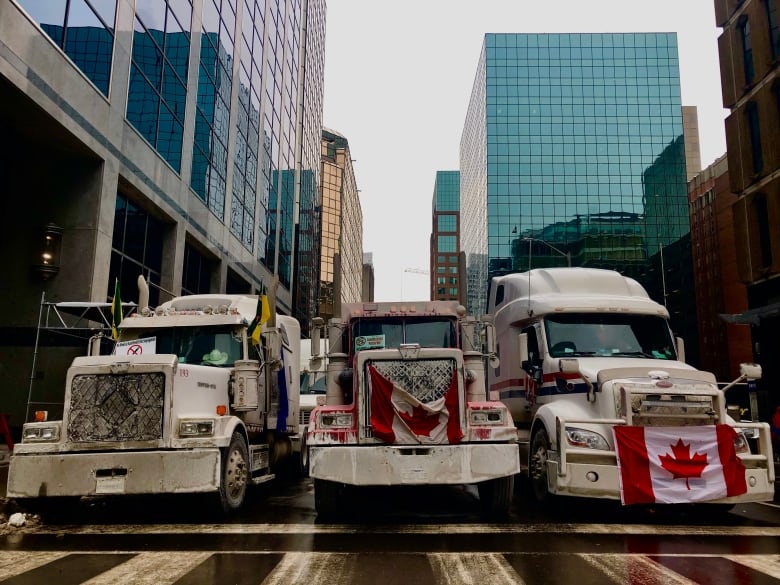
In Ottawa, site of the original protest, trucks remain parked across from Parliament Hill, without any hint the impasse may soon end.
There was, however, no deal in Alberta – at least not with anyone who had the power to authorize the province to drop its coronavirus restrictions to appease a group of disgruntled citizens protesting illegally. Once that was clear, a secondary protest, clogging but not blocking the highway, popped up at a police barricade 14 kilometers north of the original Coutts camp.
Jason Kenney says truckers’ Coutts border blockade violates traffic laws and must end
But a day after the phantom deal, Premier Jason Kenney accelerated the timeline for lifting Alberta’s COVID-19 protocols. Meanwhile, scores of United Conservative Party caucus members issued statements denouncing the pandemic policies.
In an unannounced Facebook Live broadcast on Thursday evening, Mr. Kenney said that, because of widespread vaccination rates and protection from prior COVID-19 infections, the rationale for Alberta’s restrictions exemption program (REP) – code for a vaccination passport system – is not as strong as it was when it was introduced in September.
“That is why, early next week, Alberta will announce a firm date to end the REP and do so in the very near future,” he said. “We will also lay out a simple, phased plan to remove almost all public-health restrictions later this month, as long as we see a trend of decreasing pressure on our hospitals.”
But no downward trend in hospital admissions has started. Alberta counted 1,584 people with COVID-19 in hospital when Mr. Kenny made his comments on Thursday. On Jan. 27 – as a convoy of truckers and motorists was converging on Ottawa, but before the protest emerged at Coutts – Alberta’s hospitals had 1,570 people with COVID-19.
“We are continuing to see upward movement in our inpatient beds, hospitalization pressure, from COVID-19, and we’re at, in fact, the highest point in the two years in terms of people in hospital with COVID,” Mr. Kenny said at the Jan. 27 media conference. “Now is not the right time to be relaxing measures when the hospitals are under so much pressure.”
If Alberta moved too quickly, Mr. Kenny warned, the situation could get worse.
“Let’s just keep our eye on the ball, have the backs of the people in our hospitals. Let’s not start removing measures that could trip us back into higher transmissions and hospitalizations when the hospitals are already under so much pressure,” he said. “That day … is coming. I’m pretty confident it will come before the end of March.”
A record 1,648 COVID-19 patients were in hospital as of Feb. 1, the day before demonstrators in Coutts dismantled their blockade. However, the protest is not over.
Disaffected Albertans remain parked on the sides of the highway in Coutts. The allied protest at the police barricade to the north continues. That crowd is likely to swell with supporters over the weekend as protests spread across Southern Alberta.
Jarrad McCoy, a carpenter from the town of Milk River, was among those inside Smugglers Saloon when some in the group believed they had a deal with the government. He said he is protesting not because of his family’s circumstances, but to alleviate the suffering of others and to build a better future for his six kids.
“Every generation has a fight or a battle, or has to be courageous in some way. And I think this is a moment of courage and love for these guys,” Mr. McCoy said on Wednesday, noting that many of the participants are “men of faith.”
While his own contracting business has prospered through the pandemic, he said he’s seen provincial health restrictions hit the finances of neighbors and friends. “I’ve seen God provide for my family through all of this. But I’ve seen other people suffer. And it’s broken my heart.”
Mr. McCoy said the clearing of one lane in each direction so that the flow of cross-border traffic and trade could resume was a good thing.
“None of the guys here want to be affecting anyone’s livelihood either,” he said. “We don’t want anyone suffering.”
With a report from Kelly Cryderman
Paul Brandt issues statement
on Coutts convoy
Feb 4, 2022 | 5:09 PM
LETHBRIDGE, AB. — In the entertainment industry, the music, lyrics and voice of famous musicians can hold sway over a myriad of issues.
In Alberta, one of the most loved of musicians is Paul Brandt. He was born in Calgary, and attended Mount Royal College (University) where he studied nursing and worked as a pediatric nurse at the Alberta Children’s Hospital. In the fall of 2009, he was conferred the degree of Doctor of Fine Arts, by the University of Lethbridge.
Brandt has won a raft of music awards, and loaned his support to various causes, from Samaritan’s Purse to World Vision. In May of 2020, the Alberta government introduced a newly appointed Human Trafficking Task Force, to find ways to prevent human trafficking and protect and empower survivors. The man chosen to chair the task force was Paul Brandt, who also voiced his opposition to a proposed coal mine on the eastern slopes of the rockies.
Late Friday afternoon, Brandt issued a statement on his Instagram account regarding the situation at the Coutts border crossing.
Paul Brandt statement from his Instagram account
Two days ago, those involved in the Coutts trucker convoy had posted photos of a helicopter which they indicated Brandt had used to fly provisions to the trucker group in Coutts.
LNN reached out to Brandt’s publicist for confirmation about the helicopter flight. However, we have not heard back.
'It feels great': Trucks heading to U.S. get through Alberta blockades
COUTTS, Alta. — Gurdeep Chumbur says he sympathizes with fellow truckers concerned about cross-border COVID-19 vaccine mandates who have taken drastic action to make their views known.
But he was relieved Thursday when a second illegal blockade on a highway leading to the main border crossing in southern Alberta opened to traffic and RCMP ushered through some trucks heading to the United States.
"It feels great, yeah, because I need to work. I've got bills to pay," said Chumbur, after getting the green light from police to proceed down Highway 4 to the crossing at Coutts, Alta.
"I understand, you guys are protesting, that's great. Just stick to a side and let us go for it."
Chumbur said he was stuck in Montana for four days last weekend and eventually rerouted to the Roosville crossing in British Columbia before heading back to Calgary for another load. He was next on his way to Utah.
"There's no hard feelings. I'm with them. I understand, but unfortunately, I can't stand and protest," Chumbur said.
Demonstrators started the main blockade at Coutts on Saturday in solidarity with similar events in Ottawa and countrywide to protest vaccine mandates and broader public health measures.
The impasse stranded travellers and cross-border truckers, compromised millions of dollars in trade and impeded access to basic goods and medical services for area residents
On Tuesday, some demonstrators left that main blockade after Mounties announced negotiations to end the standoff had failed and they were prepared to make arrests and tow vehicles. However, other vehicles, including tractors, breached a police barrier and joined the stoppage.
Protesters at the blockade agreed Wednesday to open a lane on each side of the highway.
Early Thursday, the RCMP warned there was a second blockade of protesters north of Coutts, closer to the town of Milk River, and asked the public to avoid the area.
Hundreds of vehicles, including trucks, tractors and cars, had blocked the road there in solidarity with the main blockade.
Later in the day, traffic was allowed through and many sounded horns as they headed down the highway.
Officers stopped and checked with truckers to make sure they were making deliveries across the border and with area residents trying to get home.
Vehicles then weaved slowly through a narrow phalanx lined by protesters parked along the highway.
RCMP Cpl. Curtis Peters said the situation is anything but ideal.
"It's very slow moving and we have to be very cautious," he said.
"There has been conflicts flare up here. We've had people just trying to get through, who've had some confrontations with protesters.
"The fact that we're allowing traffic to flow through is a positive step in the right direction but it's still an unlawful protest."
More protesters arrived at the site during the day. Some tractors and SUVs parked in a ditch. Two people showed up on horses and there an impromptu stage was set up for singing and a prayer service.
Ryan Kenney said he drove down Wednesday to participate in the latest blockade.
"Slept here overnight and I'm planning to stay until I have to. I'll be here for days," he said.
"I'm here to support the protest against mandates. They need to negotiate with the truckers down at the border."
Sean Alexander of Calgary was also part of the protest.
"We've got truckers down here, you got farmers down here … you've got oil and gas workers down here," he said. "Eighty guys maybe slept on the highway last night.
"None of us are getting paid."
This report by The Canadian Press was first published Feb. 3, 2022.
Bill Graveland, The Canadian Press
Premier Kenney holds Facebook Q-and-A to discuss police “assault” issue and lifting mandates
Feb 4, 2022
EDMONTON, AB. — As vehicle convoys continue to impede traffic in Southern Alberta (the LNN newsroom was notified of four Thursday afternoon alone), the level of frustration from the public is beginning to grow.
LNN took a litany of calls from travellers who wanted to know why police were not putting a stop “to this nonsense”, which brought traffic to a crawl in various locations, as people were attempting to make it to appointments, to care for elderly relatives or pickup children from school.
The organizers of the convoys repeatedly decline to speak to LNN and other media. However, a rural school bus driver who would speak to us when we asked if he had been caught in any of the convoys, said he had been able to escape them but, he was shocked by the fact that parents were pulling their children out of school classes to take part in the convoys.
Complaints about the convoys, border blockade and COVID-19 mandates have not escaped the ears of Premier Jason Kenney. On Thursday evening, Kenney held an hour-long question-and-answer segment on his Facebook site and announced the government would be announcing, next week, the path laid out to lift public health measures.
Kenney noted that governments should not be swayed by protesters.
“No responsible government makes policy by negotiating with people engaged in such unlawful conduct. Period. Full stop. We fully expect our law enforcement agencies to restore and maintain public safety and law and order.”
After a meeting with his COVID-19 cabinet committee next week, Kenney said there is a plan to end Alberta’s vaccine passport program. A few days ago, Kenney said he hoped the passport could be eliminated by the end of March and he hopes most other public health measures can be ended by the end of this month, if the pressure on the health-care system adequately declines.
The Premier understands the frustrations of those protesting health restrictions but, pleads with them to find legal ways of protesting.
“While I sympathize with and agree with many of the messages being sent by convoy protests over the past week, let me just underscore that a society built on the rule of law cannot accept protests that block critical infrastructure, that disrupts communities and countless law-abiding citizens.”
“I hear you loud and clear. You are right to point to the damaging impact of restrictions.”
Kenney said part of the reason he feels restrictions can be lifted is because so many Albertans have gained some immunity from COVID-19, both from getting vaccinated and from being infected with the virus.
In regard to inaccurate information about police officers being assaulted at the Coutts blockade, Kenney claimed to not have used the word assault and read a situation report he received from the Alberta Department of Justice and the Solicitor General on Tuesday (Feb 1) afternoon.
“A group of motorists (protest sympathizers) attempting to travel south to Coutts became increasingly hostile and made threats against the RCMP members at the checkpoint, to the point where they surrounded (police) members. A team of Alberta Sheriffs and RCMP members manning a checkpoint on highway-4 and highway-501 were surrounded by protesters in commercial and private vehicles. Protesters breached the barricades and attempted to ram officers at the scene. No staff were injured but narrowly escaped injury as the protesters collided with other motorists on the highway. Assaults between protestors and motorists ensued requiring (police) intervention.”
Kenney noted the incident report was filed by RCMP members on the scene, who testified they were swarmed, threatened and had their barricades rammed by vehicles which also attempted to ram the officers who narrowly escaped injury.
While the officers were not injured in the incident, it should be noted that in Canadian law, assault is defined as intentionally putting another person in apprehension of imminent harm or offensive contact. Physical injury is not required. The fact that the protesters swarmed the officers, the barricades were rammed and attempts to ram the officers is defined as assault.
The Premier stated that he, the RCMP or anyone else, “should not be blamed for the dangerous and unlawful conduct of these individuals – it is totally, totally unacceptable for people to make threats against the police, swarm the police, attempt to ram officers with their vehicles, causing them to narrowly escape injury and then to ultimately cause a collision with law abiding motorists and engage in the assault of those law abiding civilians.”
GoFundMe for Canada’s trucker convoy removed for violating ‘terms of service’
GoFundMe has announced the fundraiser for Canada’s trucker convoy has now been removed from the platform.
This news comes after the company previously stated it was suspended and under review after more than $10 million was raised.
In a statement posted to the website, GoFundMe said it “supports peaceful protests and we believe that was the intention of the Freedom Convoy 2022 fundraiser when it was first created.
“We now have evidence from law enforcement that the previously peaceful demonstration has become an occupation, with police reports of violence and other unlawful activity.”
Ottawa Mayor Jim Watson thanked GoFundMe on Friday for “listening to the plea” made by the City and Ottawa Police to no longer provide funds to the convoy organizers.
“In light of the unlawful behaviour that has transpired in the last few days, they have come to the right decision in support of our city and our residents,” he said in a tweet.
He said that he is hopeful that limiting their access to funds will “restrict their ability to remain in Ottawa,” and encouraged other crowdfunding platforms to block fundraising efforts as well to help end the protest.
Nevertheless, a new “official donation site” was set up on Friday on GiveSendGo, according to lawyer Keith Wilson, who represents the protest.
The GoFundMe fundraiser, which listed Tamara Lich as an organizer and B.J. Dichter as a “team member,” was created to support the truckers that have travelled across Canada to Ottawa to participate in a protest against COVID-19 restrictions.
The company said it works with local authorities to ensure it has an understanding of what is taking place in connection with any fundraiser.
“Following a review of relevant facts and multiple discussions with local law enforcement and city officials, this fundraiser is now in violation of our Terms of Service (Term 8, which prohibits the promotion of violence and harassment) and has been removed from the platform,” the company said.
Originally, $1 million was released to the organizers, which GoFundMe said was due to a clear distribution plan being provided and funds would be used only for participants who travelled to Ottawa to participate in a peaceful protest.
“Given how this situation has evolved, no further funds will be directly distributed to the Freedom Convoy organizers — we will work with organizers to send all remaining funds to credible and established charities verified by GoFundMe,” the company said.
GoFundMe pulls 'Freedom Convoy' fundraiser, will release no more money to protest organizers
Convoy fundraiser pulled
Colin Dacre - Feb 4, 2022 / 3:35 pm | Story: 359111
Photo: Ottawalks / YouTube live
The Freedom Convoy downtown Ottawa on Thursday
GoFundMe has removed the Freedom Convoy fundraiser from its platform and announced it will release no additional money to protest organizers.
In a statement Friday, GoFundMe says they support peaceful protest and believe that was the intention of the fundraiser when it was created.
The campaign had raised more than $10 million prior to being frozen earlier this week.
“We now have evidence from law enforcement that the previously peaceful demonstration has become an occupation, with police reports of violence and other unlawful activity,” GoFundMe’s statement said.
The company says it now considers the fundraiser in violation of its terms of service prohibiting “the promotion of violence and harassment.”
GoFundMe released $1 million to the Freedom Convoy organizers earlier this week and confirmed the funds would only be for participants who traveled to Ottawa for peaceful protest.
“Given how this situation has evolved, no further funds will be directly distributed to the Freedom Convoy organizers — we will work with organizers to send all remaining funds to credible and established charities verified by GoFundMe,” the company said.
Donors are able to request a refund until Feb. 19 here. The fundraiser was the second-biggest in Canada before it was taken offline.
A proposed class-action lawsuit was filed Friday against protest organizers Chris Barber, Benjamin Ditcher, Tamara Lich and Patrick King seeking $9.8M in damages over relentless horn noise, filed on behalf of downtown residents.
On Thursday, a parliamentary committee unanimously voted to invite GoFundMe to explain its role in the protests.
Ottawa police, who have repeatedly called the occupation of the city's downtown "unlawful," said Friday they are deploying a "surge" of about 150 extra police officers to central areas of the city to deal with the protest.
"We're absolutely committed to bringing this demonstration to an end," said police chief Peter Sloly.
GoFundMe ends payments to convoy protest, citing reports of violence and harassment
Social Sha
Facebo
Twitter
Ema
Organizers had raised more than $10M through the online
GoFundMe will not disperse any more money from a fundraising campaign for the protest convoy, saying the money will be refunded or donated to charity. Meanwhile, Ottawa police are changing tactics ahead of what's expected to be another weekend of noisy protests. 2:40
The crowdfunding platform GoFundMe says it will stop payments to the organizers of Freedom Convoy 2022 because the protest violates its rules on violence and harassment .
The company announced its decision in a blog post Friday evening, just two days after it froze disbursements of the fund.
"GoFundMe supports peaceful protests and we believe that was the intention of the Freedom Convoy 2022 fundraiser when it was first created," the company said in the post.
"We now have evidence from law enforcement that the previously peaceful demonstration has become an occupation, with police reports of violence and other unlawful activity."
The company said the protest violates a rule in its terms of service that prohibits the promotion of violence and harassment. The fundraising page for the convoy has been deleted from GoFundMe's website.
Participants in the demonstration have displayed symbols of hate including the Confederate flag and swastikas while protesting. Truckers parked in downtown Ottawa have also made residents miserable by blaring their horns at all hours.
Organizers have said they will stay in Ottawa until the federal government lifts all pandemic restrictions. Canada Unity, the group claiming responsibility for organizing the protest, has published a document which calls for the resignation of Canada's senators and the Governor General if its demands are not met.
WATCH | Ottawa police will send more officers to protest areas:
About 150 additional police officers will be on patrol in Ottawa as the city braces for another weekend of protest against COVID-19 mandates. Officers will be addressing 'unlawful threatening conduct' in the most affected neighbourhoods, says the city's police Chief Peter Sloly 1:56
Tamara Lich, one of the organizers of the protest's GoFundMe page, posted a video message on Friday evening directing supporters to a new online fundraiser hosted by GiveSendGo, a Christian fundraising site that was blocked by PayPal last year after it was used to raise funds for people who attended the Jan. 6 Capitol riot.
"Please, if you can donate and help us keep these truckers going, we plan to be here for the long haul," she said. "As long as it takes to make sure that your rights and freedoms are restored."
More than 120,000 donors contributed nearly $10.1 million to the fund. A CBC News analysis found that about one-third of donors were anonymous or used aliases, and that many of the donations were made from outside Canada.
The company now says it will "work with organizers to send all remaining funds to credible and established charities verified by GoFundMe." People who donated to the fund can also ask for a refund until February 19.
GoFundMe released $1 million to the organizers earlier this week before it froze the payments. It said organizers were able to prove that money would be used for participants involved in peaceful protest.
Premier says protest has become an 'occupation'
Ottawa Mayor Jim Watson thanked GoFundMe for freezing the fund shortly after the decision was announced.
"These protesters have been holding our city hostage for a week now, and I'm hopeful that limiting their access to funding and resources will restrict their ability to remain in Ottawa," Watson wrote.
Trucks and protesters are entering their second week of demonstations in downtown Ottawa. (Christian Milette/CBC/Radio-Canada)
Ontario Premier Doug Ford said on Friday that he believes the protest has become "an occupation" and urged participants to leave.
"It's time for this to come to an end," he said.
Other elected officials — primarily Conservative MPs — expressed their support for the protest as recently as Wednesday of this week.
Paloma Raggo, a Carleton University professor specializing in nonprofits and philanthropy, said she was surprised that GoFundMe did not block the fund sooner, since it never appeared to be a legitimate charity.
Raggo said the federal government should explore regulating crowdfunding sites like GoFundMe to prevent future misuses of its services.
"This is not the first time that this has happened. Should it be the last? Maybe. And maybe it's time we have laws on the books for that," she said.
WATCH | NDP MP says GoFundMe should testify at Parliament:
B.C. New Democratic Party MP Alistair MacGregor joins Power & Politics to discuss GoFundMe's decision and why he thinks the company should still be made to testify before a parliamentary committee. 2:47
A parliamentary committee has called on GoFundMe executives to testify about the company's operations, including its measures to prevent the funding of extremism and hate.
Organizers facing possible class action lawsuit
Organizers of the protest were dealt another blow on Friday evening in the form of a class-action lawsuit filed on behalf of Ottawa residents who live near the protest.
The statement of claim accuses the organizers of the protest of causing significant harm to residents due to their use of loud truck horns for "12 to 16 hours" daily.
The lawsuit notes that people who live near Parliament Hill are accustomed to protests, "but they have never experienced anything like the constant and excruciatingly loud horns of the Defendants' Freedom Convoy."
It is seeking $5 million in "punitive damages" and another $4.8 million in "private nuisance" damages. The lawsuit has been filed to the Ontario Superior Court of Justice.
"The Freedom Convoy horn protest organized by the defendants has caused significant mental distress, suffering and torment," the document says.
GoFundMe pulls plug on fundraiser for Ottawa convoy protesters
Jim Bronskill and Erika Ibrahim, The Canadian Press Published Friday, February 4, 2022 9:42AM EST Last Updated Friday, February 4, 2022 11:14PM EST
OTTAWA - Crowdfunding site GoFundMe will reimburse or redirect to charities the vast majority of the more than $10 million raised by demonstrators protesting COVID-19 measures in Ottawa, saying the event has become an occupation.
The move could deny participants a vital source of money as Ottawa braces for a new wave of protesters slated to arrive in the national capital this weekend.
GoFundMe said late Friday it supports peaceful protest and that it believes this was the initial intention of the Ottawa event.
The crowdfunding site said it now has evidence from law enforcement that the demonstration “has become an occupation, with police reports of violence and other unlawful activity.”
GoFundMe said the fundraiser has been removed from its platform because it violates the site's terms of service, which prohibit the promotion of violence and harassment.
An initial $1 million was released to organizers earlier this week but, given how things have evolved, GoFundMe will issue refunds to donors and work with organizers to send remaining funds to “credible and established charities.”
The Ottawa Police Service thanked GoFundMe for its decision.
“We want to thank ↕gofundme for listening to our concerns as a City and a police service,” it said on Twitter. “The decision to withhold funding for these unlawful demonstrations is an important step and we call on all crowdfunding sites to follow.”
Mayor Jim Watson also expressed his gratitude. Watson said in light of the unlawful behaviour that has transpired in the last few days, GoFundMe came to the right decision in support of the city and its residents.
“These protesters have been holding our city hostage for a week now, and I'm hopeful that limiting their access to funding and resources will restrict their ability to remain in Ottawa,” Watson said on Twitter.
“I am imploring similar crowdfunding platforms to take the same position and not enable the group in its fundraising efforts, which would deal a blow to our efforts to put an end to this occupation.”
Tamara Lich, one of the protest organizers, said in a video Friday that they have a new official donation site, the U.S.-based GiveSendGo, which calls itself a “Free Christian Crowdfunding” website.
The GiveSendGo website lists “Freedom Convoy 2022” as one of its trending campaigns.
Ottawa police are putting more officers on the street and trying to seal off the city's downtown core in anticipation of another influx of protesters this weekend.
Downtown residents have endured a week of blaring truck horns, blocked streets and racial taunts from aggressive participants. Many city-dwellers have expressed frustration with the fact little has changed days into the protest, branding it an occupation.
Ottawa lawyer Paul Champ has filed a proposed class-action lawsuit on behalf of thousands of residents seeking millions of dollars in damages and an injunction “prohibiting the continuation of the nuisance.”
Court documents name Lich and other protest organizers as defendants and say the proposed members of the action are all people who reside in Ottawa from Bay Street to Elgin Street and Lisgar Street to Wellington Street.
“The incessant blaring of the high decibel air horns and train horns substantially interferes with the private use and enjoyment of the Class Members' homes,” reads the statement of claim. “The conduct is totally unreasonable and unjustified.”
It says people have suffered injury and damages for emotional and mental distress; difficulty concentrating; interference with quiet enjoyment of home; headaches; and difficulty sleeping. It is seeking $100 per day for each person that has suffered from the protesters' horn tactics.
The statement of claim contains allegations that have not been proven in court.
Residents were bewildered Thursday that demonstrators had constructed a wood building and fuel storage pen in Confederation Park, just southeast of Parliament Hill.
The National Capital Commission, responsible for the park, is working with Ottawa police on “addressing the next steps on site,” said commission spokeswoman Valerie Dufour, who could provide no details.
City solicitor David White said Ottawa had not filed for a court injunction to curb the actions of protesters. He added the city continues to work with other agencies “so that we are prepared and in a position to act quickly” in the event one is deemed necessary to support police plans.
Policy Chief Peter Sloly announced a “surge” of about 150 extra police officers to central areas of the city paralyzed by the protest that has been going on for a week.
Sloly said the patrolling officers will focus on mischief, hate, harassment, threats and other intimidating behaviour to send a clear message: “The lawlessness must end.”
The protest against vaccine mandates and other pandemic measures, which has immobilized the city's downtown with scores of large trucks, is an “increasingly volatile and increasingly dangerous demonstration,” Sloly told a news conference Friday.
“We're absolutely committed to bringing this demonstration to an end.”
However, Sloly warned that demonstrators near Parliament Hill remain highly organized, well-funded and extremely committed to resisting attempts to end the demonstration safely.
Police plan to contain the demonstration in the area immediately south of the Hill through concrete barriers and large machinery to control roadways throughout the downtown core.
They are also looking at closing bridges and highway off-ramps, while incoming protest trucks will be directed to designated parking zones outside the core, Sloly said. Illegal parking by demonstrators could result in bylaw enforcement, removal and impound.
Fencing has been placed around the Tomb of the Unknown Soldier near the Hill. A woman was photographed jumping on the tomb last weekend, sparking a police probe.
Police expect as many as 400 more trucks and up to 2,000 people on foot will arrive this weekend for the protest. In addition, as many as 1,000 people could join counter-demonstrations downtown.
Plans for demonstrations to oppose the protesters were in flux Friday amid concerns such actions might not be safe.
Sloly had blunt words for anyone intent on causing trouble: “Do not bring weapons, do not bring firearms, do not come here to cause harm. Do not come here to break the law. You will be held to account.”
A few dozen downtown residents gathered Friday for a community safety walk, a daily event co-ordinated by concerned city councillors.
“For the last week, we've been held hostage, we haven't felt safe,” said resident Sarah Duff. “And there have been extremists that have been allowed to roam our streets. Enough is enough.”
Sloly acknowledged residents' concerns but said police had done “absolutely the best we can to keep this city safe.”
“We need to do better. We're committed to doing better. We now have more intelligence and allies to do better.”
The Ottawa chief said his empathy for citizens was rooted in personal experience, noting police were investigating death threats that he and other city officials had received this week.
Public Safety Minister Marco Mendicino said late Thursday the RCMP had approved Watson's request for Mounties to support city police.
The minister made it clear Friday that Ottawa police remain the force of jurisdiction and called Sloly's new plan reassuring.
“No one is above the law,” Mendicino said. “And I think that the many reports that we're hearing in Ottawa from people who live here, who work here, who are trying to raise their families, who are trying to get around, is that they can't enjoy those freedoms.”
Sloly said local, provincial and national intelligence personnel were working together to analyze information.
“We have increased ability to identify and target protesters, and supporters of protesters, who were funding and enabling unlawful and harmful activity,” he said.
Teams are gathering details including vehicle registration, driver identification, insurance status and other related evidence that will be used in prosecutions.
Every unlawful act, including traffic and insurance violations, “will be fully pursued,” Sloly said.
Prime Minister Justin Trudeau has been harshly critical of the protesters, calling on them to leave town and allow residents to resume their daily lives.
Lich, a protest organizer, told a Thursday news conference the departure of the demonstrators would “be based on the prime minister doing what is right: ending all mandates and restrictions on our freedoms.”
This report by The Canadian Press was first published Feb. 4, 2022.
- With files from Laura Osman and Mia Rabson
Trucker convoy in Ottawa faces lawsuit worth $10M: ‘excruciatingly loud’
An Ottawa citizen has filed a lawsuit claiming up to $10 million in damages against the organizers of the trucker convoy that has parked itself in the city for over a week.
The lawsuit, filed by lawyer Paul Champ on behalf of resident Zexi Li, claims damages of $4.8 million for "private nuisance" and $5 million for "punitive damages."
It is against organizers Chris Barber, Benjamin Dichter, Tamara Lich, Patrick King and up to 60 semi-truck drivers who have honked their horns in protest but whose names are unknown.
The lawsuit claims that for protesters to make their voices heard to politicians, the organizers made a plan to "make as much noise as possible" to cause discomfort to political leaders, and encouraged participants to "blast the horns on their vehicles, nonstop, for several hours."
It claims that the honking has been co-ordinated and celebrated on social media, is in violation of an Ottawa noise bylaw, and is an act of mischief and disturbance.
The lawsuit says that air horns and train horns on trucks can reach up to 150 decibels and are only meant to be used for seconds at a time but have been used continuously for 12 to 16 hours a day.
This creates a "dangerous" sound level that can cause permanent damage to ears, the lawsuit states.
It says the noise has been "constant and excruciatingly loud" for the 6,000 residents that live nearby the protests and has caused "significant" mental stress and suffering.
"The non-stop blaring horns have caused unbearable torment in the sanctity of their own homes," the lawsuit reads.
Li, the Plaintiff, is a 21-year-old public servant who lives within five blocks of Parliament Hill.
The lawsuit comes after Ottawa Police Chief Peter Sloly on Friday defined the protest now as an "occupation." GoFundMe did the same after consulting authorities, effectively ending the fundraiser that raised over $10 million due to a violation of the terms of service.
Brain injury endemic among homeless populations: Vancouver research
VANCOUVER — Traumatic brain injury is so common among the homeless that prevention should be prioritized for people facing multiple challenges and worse outcomes compared with "affluent populations," says the lead author of a study in Vancouver that monitored participants for symptoms every month for a year.
Tiffany O'Connor said rates of brain injury are endemic among the homeless and precariously housed so health-care professionals and service providers need standardized training to screen for symptoms of even mild injury involving people often struggling with challenges like mental illness and cognitive impairment.
"Substance use is pretty ubiquitous. Almost all people in this population that we studied have reported some sort of alcohol or drug use. Major mental illness was very common, neurological illness was very common," said O'Connor, a recent PhD graduate in Simon Fraser University's psychology department.
The study, published this week in the journal EClinicalMedicine-Lancet, included 326 participants recruited from Vancouver's low-income Downtown Eastside, a community court and the emergency department of a nearby hospital.
Researchers who were also from the University of British Columbia found 31 per cent of those they interviewed between December 2016 and May 2018 reported at least one traumatic brain injury during that time.
Nearly 10 per cent of brain injuries were related to substance use among people who could have fallen and hit their head or been assaulted afterwards, O'Connor said.
More than half of the participants reported a history of brain injury, leading to greater challenges, including for those with a physical disability and lack of resources to adequately recover, she said.
Falls accounted for 45 per cent of the brain injuries, mostly among homeless females, followed by assaults at 25 per cent, especially for men.
"It's now known to be essentially the population with the highest known incidence of traumatic brain injury, even above when we consider athlete populations and other known populations like veterans," said O'Connor, now a clinical neuropsychologist in the acquired brain injury program at Hamilton Health Sciences.
The study was more rigorous than others that have assessed the rate of traumatic brain injury among the homeless because participants were educated about symptoms and met with researchers regularly, resulting in better estimates, she said.
"With the methodology improvements on the rate of traumatic brain injury, what we found from this study was a more than 10 per cent higher rate than that's ever been found in this population," O'Connor said of other comparable studies in Canada.
For example, a University of B.C.-led study of the homeless in Vancouver, Toronto and Ottawa found between 17 and 19 per cent of participants reported suffering a brain injury. But the research published in 2017 included followups every 12 months for nearly 1,000 participants in each of the three years of the research.
O'Connor said findings from the latest study have prompted researchers to get information on brain injury to the homeless so they access health care and to health-care providers who should lower the threshold for screening them.
Other issues these people have often become the focus when they interact with the health-care system or service providers, without the possible underlying link of a brain injury being recognized and addressed, she added.
More research is needed on concussion and brain injury among the homeless, compared with "affluent populations" like athletes, O'Connor said.
"For sports-related concussions there have been policies made across the country. That's what needs to happen on this level for precariously housed people," she said.
"With this knowledge it's really about us reaching out to other researchers, reaching out to policy-makers to try to do something where we can have a big change across the country."
Geoff Sing, president of the British Columbia Brain Injury Association, said the organization has reached out to the provincial Mental Health and Addictions Ministry to provide early interventions like housing and training for agencies providing services for them.
"These impairments lead to poor decisions, which lead to say, not paying your rent and being evicted and forced to be homeless and vulnerable," Sing said.
The ministry said it has recently provided a total of 103 housing spaces in Vancouver, Surrey and Abbotsford for those with complex health and mental health challenges, some resulting from brain injury.
However, Sing said that leaves people in most of the province, including Vancouver Island where he lives, in dire need of housing.
"In the last year, they've lost eight to 10 beds in Nanaimo and have not been able to replace them. So, we'd like the ministry supporting brain injury by providing more housing options because people are getting lost. They are becoming the homeless population."
Melissa Vigar, executive director of the Brain Injury Society of Toronto, said a homeless prevention co-ordinator provides training for shelter employees so they recognize signs of brain injury.
"Our funding is only for one person and their plate is very full. But we have started doing more training with the City of Toronto staff," she said, adding homeless people with a brain injury need to be accommodated just like anyone else with a disability.
"It's an invisible injury. It gets seen as they're lazy, they don't care, they're not putting in the effort."
This report by The Canadian Press was first published Feb. 5, 2022.
Camille Bains, The Canadian Press
Canadians believe in the clean energy economy, poll says
Most Canadians think clean energy is critical for Canada’s economy and its importance will only grow over time while the significance of oil and gas will recede, according to a poll released Thursday.
The survey, done by Abacus Data and Clean Energy Canada, polled 1,500 Canadians between Jan. 20 and Jan. 25 to gauge their attitudes on the two sectors.
“In every single province, with the exception of Alberta, Canadians say the clean energy sector is more important to the economy than oil and gas,” said Trevor Melanson, communications director for Clean Energy Canada.
The results also showed a significant increase in the number of people who said the clean energy sector would be very important to our economy in 10 years. In 2020, only 40 per cent of Canadians surveyed thought clean energy would be “very important.” In this recent survey, that figure jumped to 59 per cent.
One reason for this attitude shift is quite simple: “People are dying because of the climate crisis,” said Green Party parliamentary leader Elizabeth May, referring to recent climate disasters like wildfires, extreme flooding and B.C.’s heat dome.
On a more hopeful note, she said the demand for renewable energy is growing because it is cheaper than coal, and options like using solar panels to power homes are becoming increasingly attractive to Canadians.
“It's very frustrating when the public wants clean energy. They really would rather not be tied to an energy source that is killing us,” but the federal government and B.C.’s provincial government continue subsidizing fossil fuels, said May.
B.C. and Quebec were most supportive of clean energy. Almost 50 per cent of B.C. respondents and 55 per cent from Quebec said clean energy was “very important” to provincial economies.
Only six per cent and nine per cent of respondents from B.C. and Quebec, respectively, did not feel the sector was important to their provincial economy.
These two provinces are consistently ahead of the rest on clean energy policy, Melanson said, citing strong electric vehicle mandates and a penchant for hydroelectricity as two examples.
B.C. and Quebec also had the most respondents say the oil and gas industry is not important to the provincial economy, though a majority still thought the sector was “very” or “pretty” important.
The survey results are hardly surprising, said Laurel Collins, the NDP’s environment and climate change critic.
“Here in B.C., we have experienced atmospheric rivers, extreme flooding, climate fires … people are really experiencing first-hand the impacts of the climate crisis and I think more and more Canadians are recognizing the need to transition to a low-carbon economy,” said Collins.
The Victoria MP said constituents tell her they are disappointed and upset the government is still subsidizing fossil fuels because they know that money could be invested in renewable energy instead.
“We've been hearing a lot from energy workers who see where the markets are going and are worried that this government is going to leave them behind,” said Collins.
Last summer, an Abacus Data poll found a majority of Canadians working in fossil fuels are interested in switching to jobs in the net-zero economy, but are worried about being left behind.
May says Canada needs just transition legislation quickly and to set end dates for fracking and bitumen production — but right now, the Canada Energy Regulator forecasts oil and gas production to peak in 2040 and 2050, respectively.
This forecast is incompatible with reaching net-zero by 2050, and as May points out, first Canada has to reduce emissions 60 per cent below 2005 levels by 2030 to have any hope of limiting global warming to 1.5 C.
Natasha Bulowski, Local Journalism Initiative Reporter, Canada's National Observer
Cosmic Water Cloud From Dawn of Universe Helps Unravel Dark Energy Mystery
Scientists have taken another step toward understanding dark energy by peering through a cosmic cloud of water vapor billions of light-years away from Earth.
A portion of the Hubble Ultra Deep Field from 2003 and 2004—one of the most comprehensive images of galaxies ever taken. Dark energy drives the expansion of space and the universe, but scientists aren't sure what it is.
Ed Browne 22 hrs ago
Dark energy is the name given to the mysterious force that appears to be driving the universe's accelerating expansion. Scientists know that space appears to be getting bigger at an increasingly fast rate, they just aren't sure why.
With this expansion, the universe gets cooler. It stands to reason that in the universe's earlier stages, things were warmer. In a study released this week, researchers outlined exactly how much warmer the universe was by measuring something called the cosmic microwave background (CMB) radiation—faint, leftover radiation from the Big Bang.
To work out how much warmer the CMB used to be, scientists peered at the distant galaxy HFLS3, known for the high number of new stars being born there. Due to the galaxy being so far away—around 13 billion light-years—its light takes 13 billion years to reach us.
In other words, when we observe that galaxy, we are observing the universe as it was just 880 million years after the Big Bang, around 13 billion years ago. The universe is thought to be nearly 14 billion years old.
In between that galaxy and Earth is a large cloud of water vapor near to HFLS3, which is cooler than the surrounding CMB. The temperature difference between the CMB and this cloud creates what are called absorption lines, which are produced when photons from a comparatively warm spectrum pass through a cooler material. The light emitted by the stars within the galaxy HFLS3 aided in these observations.
By studying the absorption lines, the scientists were able to measure the temperature of the CMB as it was back then, and found that its temperature was in the range of 16.4 and 30.2 Kelvin, which is -430 and -405 degrees Fahrenheit, respectively.
This certainly doesn't sound warm, but it is warmer than the CMB temperature of today, which is just 2.7 Kelvin or -454 Fahrenheit. Trying to Understand Dark Energy
Dominik Riechers, professor of observational and experimental astronomy and astrophysics at the University of Cologne and an author of the study, told Newsweek that the findings could shed some light on dark matter.
"The temperature of the CMB at different times in the Universe's history encodes how the Universe expanded since the Big Bang," he said. "Dark energy is one of the key factors driving the expansion of the Universe. Hence, a deviation from the expected temperature trends would reveal deviations in the way that the Universe expands, which then would confirm or refute different properties of dark energy."
Riechers said that more observations of different types of dark energy and measurements from different locations and periods of the universe's history would be needed to verify their findings and confirm or rule out alternative theories about dark energy.
The study: "Microwave background temperature at a redshift of 6.34 from H2O absorption," was published in the journal Nature on February 2.
New fossil site featuring at least three types of dinosaurs found near Grande Prairie
At least three different types of dinosaurs walked at a site near Grande Prairie, researchers said after a new fossil site was located on Redwillow River.
A group of researchers from Australia, Italy and Canada recently described the footprints found at Tyrants Aisle, a name referring to the tyrannosaurus, a dinosaur that historically roamed the area, in the journal PLOS One, the Philip J. Currie Dinosaur Museum said in a news release.
The group was led by PhD student Nathan Enriquez and the journal entry was co-authored by Corwin Sullivan, a University of Alberta professor and curator with the museum.
Grande Prairie Regional College provided logistical support for the team during its fieldwork at the site, most of which was conducted in 2018. The museum said the water level in the area has been too high in recent years to continue the work.
Enriquez said the dinosaur tracks at the site are from at least three different dinosaurs and the most common prints are from duck-billed dinosaurs, which were up to 12 metres in length, stood over two metres at the hip and could weigh as much as four tonnes.
The tracks were formed when the area around Grande Prairie was a large floodplain.
The museum said there are at least two types of carnivorous dinosaurs which frequented the site too. The authors wrote footprints at the site with three toes are from a tyrannosaur, possibly an Albertosaurus sarcophagus, a smaller descendent of the T. rex. Fossil footprints with two toes are from deinonychosaurs, a raptor-like dinosaur.
The footprints are submerged in the river for most of the year, said the museum, and the museum’s paleontology team is getting set to start exploring and excavating this spring.
OUTSOURCING POSTSECONDARY ED
Saskatchewan signs education MOU with Republic of Philippines
On Thursday, the Government of Saskatchewan announced the signing of Canada’s first provincial Memorandum of Understanding (MOU) with the Republic of the Philippines.
The government said the goal is to strengthen ties between post-secondary education institutions in the two countries, while also creating more chances for research partnerships and education exchanges.
"We are proud to be the first provincial government to enter an academic partnership with the Republic of the Philippines," Advanced Education Minister Gene Makowsky said in a press release. "This MOU will strengthen our current relationship, bring recognition to Saskatchewan on a global platform and build further opportunities for students, faculty and researchers."
Makowsky said the MOU is a key component of Saskatchewan's new International Education Strategy, which encourages access and collaboration between post-secondary institutions. He said strengthening these partnerships helps the province's economic recovery and population growth goals outlined in Saskatchewan's Growth Plan.
“This agreement heralds the dynamic partnership between the Philippines and Canada in higher education,” Dr. J. Prospero E. de Vera III, Chairperson, Commission on Higher Education, Republic of the Philippines said. “Furthermore, it will pave the way for strengthening the relationship and the shared vision of the Philippines and Canada in developing global human resources.”
University of Saskatchewan president and vice-chancellor Peter Stoicheff also welcomed the news. He said the strengthened relationship would lead to an increase in mobility programs, such as student and faculty exchanges, along with the innovation and research benefits.
"Strengthening connections between our province's higher learning institutions and international partners in the Philippines offers great mutual benefit to students and researchers," Stoicheff said.
"Education and research are enhanced with diverse perspectives, and the collaboration between our university, established partners and the Commission on Higher Education in the Republic of the Philippines will be leveraged and furthered by this MOU."
University of Regina president and vice-chancellor Jeff Keshen echoed those remarks. Keshen said the agreement would strengthen the U of R by bringing more worldviews and perspectives to the campus.
"The University of Regina … is committed to providing a safe, welcoming environment in which international students can learn, work and grow," Keshen said. "We support the signing of the MOU between the Province of Saskatchewan and the Republic of the Philippines as a great opportunity to build mutually beneficial relationships with post-secondary institutions in the Philippines."
Saskatchewan Polytechnic president and CEO Larry Rosia said the agreement paves the way for a number of important opportunities for students and faculty.
"Saskatchewan Polytechnic believes in the value of international collaboration and partnership," Saskatchewan Polytechnic President and CEO Dr. Larry Rosia said.
"International partnerships and exchanges help students develop a wide range of skills, including problem solving, adaptability, resilience, and intercultural competency.”
"Saskatchewan Regional Colleges are pleased to acknowledge this agreement between Saskatchewan and the Philippines," Cumberland and Parkland College President and CEO Dr. Mark Hoddenbagh added.
"Agreements such as these are beneficial for our province, given the important contributions to economic growth in rural regions provided by the Filipino community. This agreement will only serve to strengthen the relationship between the province and the Philippines resulting in mutually beneficial projects for students and institutions alike."
The Commission on Higher Education with the Republic of the Philippines is committed to promoting equitable access and ensure quality and relevance of higher education institutions and their programs.
michael.oleksyn@paherald.sk.ca
Michael Oleksyn, Local Journalism Initiative Reporter, Prince Albert Daily Herald


 Paul Brandt statement from his Instagram account