Showing posts sorted by relevance for query KOBANE. Sort by date Show all posts

Monday, January 13, 2025

SYRIAN-KURDISTAN:

 ‘We cannot hand over our weapons while attacks on women and our territories continue’ — An interview with YPJ Commander-in-Chief Rohilat Afrin
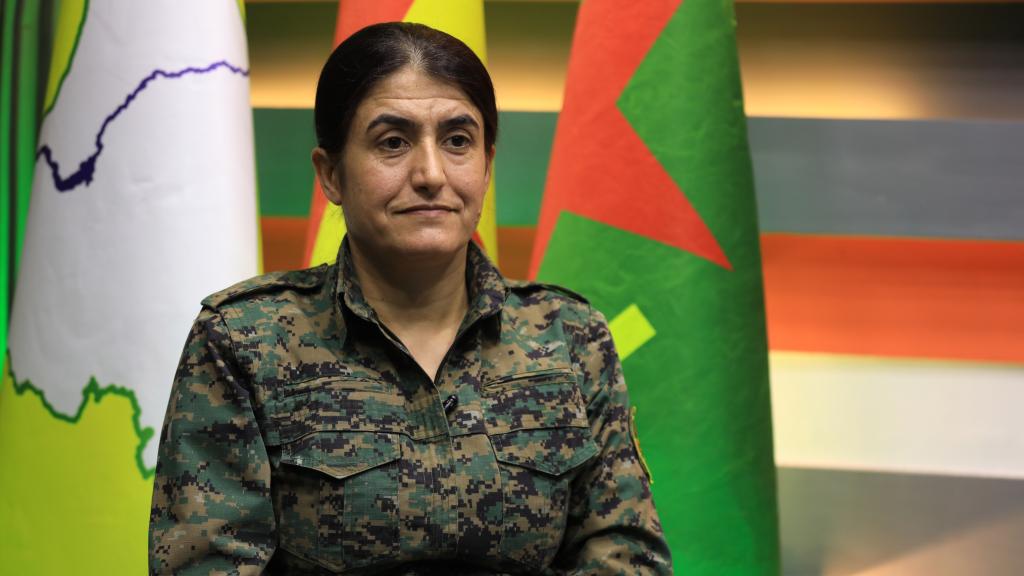

First published at Rojava Information Center.

As all eyes were on the Hayʼat Tahrir al-Sham (HTS)-led forces sweeping across Syria with Assad crumbling, the Turkish-backed Syrian National Army (SNA) launched an attack on North and East Syria (NES), seizing Shehba and Manbij from the Syrian Democratic Forces (SDF). Now, Turkey is threatening an invasion into the Kurdish city of Kobane. The SNA meanwhile, is attempting to cross the Euphrates River and further encroach into NES, with fierce clashes underway in the Manbij countryside. The all-female YPJ units – that shot to prominence during their fight against ISIS in Kobane in 2014 — are on the frontlines as part of the SDF.

YPJ Commander-in-Chief, Rohilat Afrin, talked to RIC about the state of the war in Manbij, the ceasefire that never was, the possibility of a Turkish invasion in Kobane, HTS-SDF relations and the potential for the YPJ to be integrated into the Syrian army.

The current situation on the frontlines seems to have been more or less unchanging in recent days. Can you shortly explain the state of the fighting?

It is evident that there is a war being waged against our region — this is in the context of the ongoing fighting here, particularly at the Tishreen Dam and Qereqozak Bridge. This situation of war has been a constant since the collapse of the Baath regime and subsequent rise of the al-Jolani government. Turkey and the Turkish-backed SNA have sought to exploit a power vacuum and initiate an attack on our region. This is in staunch opposition to our achievements here. These attacks are not simply military actions — they are a deliberate attempt to destroy what we have built up here. Turkey and its mercenaries are pursuing a policy of destruction and subjugation through these attacks.

Tishreen and Qereqozak are the two main gateways to enter NES. They are strategically important to protect Kobane, Tabqa, Raqqa and the rest of NES in general. Targeting these gateways is connected to Turkey’s aim of targeting our achievements in the region. In our region, people have been brought together. A collective mentality has united its populace. Years of work have been invested in building this mentality amongst people. They are determined to wipe it out. This war aims to dismantle the values established in this region.

Our fighters are currently engaged in combat with the SNA, fighting strongly. What people really should notice is that Turkey has been using drones and warplanes unceasingly, encouraging the SNA to attack. Our fighters’ resilience has not been deterred. If it wasn’t for Turkey’s aerial power, the SNA would be easily defeated. Actually, the number of fatalities and injuries within their ranks is already high. They have withdrawn from certain points. In these circumstances, a major confrontation is underway.

Supposedly, a ceasefire was called in Manbij some weeks ago. Everyday there is fighting however – so was there never any ceasefire?

We cannot call it a ceasefire. In talk there was a ceasefire. In practice we witnessed nothing like this. When the ceasefire was announced in Manbij it was on the basis that we evacuate people wishing to flee, the bodies of our fallen fighters and our wounded who were in their hands. However no such ceasefire materialized due to the attacks the SNA launched. The ceasefire was nothing on the ground. It was just talk.

Then, as the YPJ, YPG and SDF, we wanted to move forwards from the Tishreen Dam and Qereqozak, to advance a bit, because we were under heavy fire. There were a lot of attacks both on the Tishreen and from the Deir Hafir axis. So we took back some villages. This was because we wanted to protect the Dam and the Bridge. With this as our situation, a ceasefire cannot be spoken of.

The SNA were drunk from success in Syria, as they participated in the advance from Idlib to Damascus. City after city was falling. They thought it would be the same with Qereqozak Bridge and the Tishreen Dam. Now they are both psychologically and materially facing losses having been confronted with the resistance of our fighters. On both fronts, our fighters have been steadfast.

And what is the current threat to Kobane?

What I said before connects to the issue of Kobane. There are a lot of threats against Kobane. As a city, Kobane does not just concern NES. It is the world’s city, as expressed by the establishment of ‘World Kobane Day’ in solidarity. The struggle that took place in Kobane saw a force like ISIS defeated. It has been around 10 years since this massive victory. At the time, Erdogan was observing the situation day after day, saying ‘Kobane will fall today’ or ‘Kobane will fall tomorrow’. But Kobane was liberated, through will, resistance and determination. Through this, Kobane became globally famous.

The danger Kobane is facing is serious. When we say this, it means that there is a danger to the whole of NES. Turkey sees that Kobane was a reason behind what has been achieved in NES. Turkey wants to spread its influence in Syria. In this context it threatens the city and wants to occupy it. Actually the danger posed to Kobane never ended. There have always been threats. These threats in turn were met by responses of solidarity — politicians, human rights activists and the global public, even the Coalition, made statements opposing war against the city.

If Turkey were to take over the Tishreen Dam and Qereqozak bridge, Tabqa, Raqqa, Kobane, and all regions of NES would be threatened. The politics — war and victory — in Kobane concern the whole world, not just NES. We are confident that Kobane will receive external support and solidarity. We will be able to protect it. But Turkey is determined to realize its goals. Against this stands the SDF and YPJ. The fight they waged in Kobane [in 2014] shocked the world. In the current period, we will show the same stance against Turkey and the SNA.

How do you see the diplomatic flurry around Damascus, with many delegations coming to meet al-Jolani, including from Turkey?

Many states have been seeking to establish relations with HTS now al-Jolani’s new government has emerged. Turkish officials have also come to Damascus, such as Hakan Fidan. He demonstrates a certain mentality — in which the primary aim is to wipe out the Autonomous Administration. Turkey wants to organize Syria as its own province; to control it, to have influence on Syria. Hakan Fidan’s arrival in Damascus made this clear. He wants to influence HTS.

Are the Americans still in Kobane? And if Turkey attacks Kobane do you expect American assistance?

Throughout the last phase until the latest developments began, the Russians were present in Manbij, Ayn Issa and Kobane. The Americans were not present there. With the recent withdrawal of the Russians, American patrols started to take place, but there are no bases there. Through these patrols, America was saying ‘we are here, we will help protect the city’, sending a message that they are present. Our cooperation with the Coalition began with the fight against ISIS. If the US-led Coalition don’t fulfil their role, they will face accusations of double-standards. If Turkey attacks Kobane, do we expect that the US will help? Materially, no. But in general, with the support they exhibit and through them meeting with Turkey, they have shown that their position is that the issue must be peacefully resolved.

Even if they are purely following their own interests, it has prevented the doors to a Turkish invasion into Kobane from being opened. It is evident from certain things within their diplomatic efforts that they have attempted to help us. However, we see that the Coalition has a responsibility to put a halt to the current fighting and aerial attacks. So in general, we do not expect that there will be any type of concrete blocking of a ground invasion, but in the diplomatic context there are efforts to prevent this, even if they are not enough.

What about international assistance more generally, aside from America? The last time Kobane saw war was in 2014 when ISIS attacked. At that time, the international solidarity was significant. This time the threat is from Turkey rather than ISIS. Do you expect similar global support?

During ISIS’ siege on Kobane, the actions of YPJ as a women’s force resonated globally. Through Kobane — and with the July 19 Revolution here — silent and defenceless women found their voice, their strength and came to the forefront as leaders. The attitude of the YPJ in 2014 made them an example to follow in the world. We have learned from all the experiences and challenges we have gone through for years, in terms of strengthening tactics and methods. We have confidence that the YPJ — and YPG and SDF — will be able to stand strong against whatever may come. As women’s units, we have faith in this. We were victorious in Kobane. This also demonstrated to women worldwide that a women’s army is a necessity to protect women. Through this protection, we are able to organize ourselves. Fighting to protect our territories has continued like this. As I already stated, we believe that the war in Kobane was a war for humanity; a war to protect all women and land. We are confident that a state of public alert on a global scale will be raised and solidarity will be provided should Kobane be attacked again.

There are some now saying the SDF should surrender its weapons to a central Syrian army and integrate. What does this mean for the YPJ?

The new government’s intention — I am not speaking of the general populace, but specifically the government — to do this is shown through the content of its approach towards the SDF. They want a centralized state based on the unification of the army, institutions and also mentality. What they circulate to the press and media as well as the interviews they make, suggests that the SDF will not be accepted in its current form and as it is.

We are under attack. This makes it impossible for us to lay down our arms. The SDF is a force with ten years of experience fighting ISIS. At the international level, it is supported by the Coalition.

Turkey refuses to accept the Autonomous Administration as a model and idea. Turkey also does not accept the SDF as an army. It is imposing this on the new government. This also means the YPJ is not accepted — the YPJ, which fought against ISIS, achieved significant gains, and is at the core of the Autonomous Administration.

With the incoming government, women will have to heighten their struggle in order to defend themselves. We cannot hand over our weapons while attacks on us and our territories continue. Such a thing can only occur through agreements and talks that formalize a democratic Syria in which the rights of all women, nationalities and peoples are guaranteed and realized. If these conditions are met, then we can discuss the issue of weapons.

The mindset entrenched within the new government makes it clear that there is no place for women there — or only a place where women must accept to cover their heads and adopt a patriarchal mindset. Avoiding the above will require a great deal of organization and struggle. This is a serious danger that we need to recognize. The new government’s standards for women are a threat to the existence, role and culture of women.

On a global level, we have women forming an army, protecting themselves and fighting, for the first time. This independent, armed force has inspired many women — Arab, Kurd, Assyrian and international.

Would the YPJ accept being part of the Syrian army?

As this juncture, it remains unclear what the eventual outcome of the situation will be. There are a multitude of factors that are as of yet unclear. The situation is complex. The new government is in serious chaos, both in terms of its institutions and its ability to govern the entire country. The future remains uncertain. If — as the population wishes for and as we wish for — Syria truly becomes a democratic Syria, politically, socially, legally; if all the effort given and achievements gained in NES through the past 12 years are recognized, then of course YPJ can become a part of this army [the Syrian army]. In fact, YPJ can serve as a model for Syrian women, setting an example of women’s autonomy and self-defence. However, as previously stated, the precise nature of the situation remains uncertain. It is imperative to comprehend that the scope of this matter is wide. Our objectives, positions and approach will be formulated on this foundation I have explained. Not following the current way of thinking exhibited by HTS — that everything must be centralized. If an approach is adopted that embraces diversity and is democratic, then the role of YPJ can be discussed. The composition of a Syrian women’s army can be shaped by the YPJ. This is what I can say at this point.


Saturday, May 06, 2023

Syria’s Kurds turn to UAE to ease tensions with Assad


2023-05-05 

Shafaq News/ The Kurdish-led administration in northeast Syria is seeking the United Arab Emirates’ help to broker a deal with the Syrian regime amid fading confidence in the United States and Arab outreach to Damascus, Al-Monitor has learned.

Mazlum Kobane, commander in chief of the Syrian Democratic Forces (SDF), the United States’ premier ally in the fight against the Islamic State (IS), recently traveled to the UAE, four well-informed sources and officials in the region speaking on condition of strict anonymity told Al-Monitor. Kobane met with UAE officials, two of the sources said, in order to seek Abu Dhabi’s help to press the Syrian Kurds’ case with the Assad regime. One of the regional sources said that Kobane met with the UAE’s national security adviser Tahnoun bin Zayed al Nahyan, who was named deputy ruler of Abu Dhabi on March 29.

The UAE denied that any such meeting had occurred.

"The claims referenced in your email are false and unfounded,” a UAE official said in an emailed response to Al-Monitor’s request for comment on the UAE's alleged mediation effort between the SDF and the regime.

The officials briefing Al-Monitor insisted that Kobane had indeed gone to the UAE between late March and early April. None provided specific dates. “It is one hundred percent true,” one of the officials said. Two of the officials briefing Al-Monitor said that Bafel Talabani, leader of the Patriotic Union of Kurdistan (PUK), the second largest party in the Kurdistan Region of Iraq that shares power in the Kurdistan Regional Government, had traveled with him.

Talabani’s office did not respond to Al-Monitor’s request for comment.

Badran Ciya Kurd, the de facto foreign minister of the Kurdish-led Autonomous Administration in Northeast Syria, confirmed that the UAE had expressed interest in helping the Syrian Kurds strike an agreement with the Assad regime. “They said they are ready to help, but so far we do not have a program (roadmap) for this,” Kurd told Al-Monitor in an April 28 interview in Qamishli. "We want them to play a role in the talks with Damascus, Kurd added. He declined to comment on whether Kobane had recently traveled to the UAE.

Ankara strikes

Kobane’s alleged trip to the UAE capital came before he was targeted by a Turkish drone as he was traveling in a convoy from the PUK’s intelligence headquarters known as the Counter Terrorism Group, or CTG, in Sulaimaniyah on April 7. The officials briefing Al-Monitor said the drone strike took place following Kobane’s return from the UAE.

The convoy was headed toward Sulaimaniyah International Airport. Kobane was to fly back to northeast Syria on a plane operated by the US-led coalition against IS. The CTG chief, Wahab Halabji, and three US military personnel were in the motorcade, as was Ilham Ahmed, a top Syrian Kurdish official. The Turkish drone is widely believed to have deliberately missed the target, and Kobane made it home. The goal was to telegraph Ankara’s fury over the shuttling of Kobane by the PUK leader to the UAE, one of the officials briefing Al-Monitor speculated.

On April 5, Turkey announced that it had sealed its airspace to planes taking off from and landing at the Sulaimaniyah airport, ostensibly after hearing of Kobane's assignation in Abu Dhabi, the sources said. The Turkish Foreign Ministry said the measure stemmed from an alleged “intensification of the PKK terrorist organization’s activities in Sulaimaniyah [and] infiltration by the terrorist organization into the airport.” The PKK is the acronym for the Kurdistan Workers’ Party, the outlawed militant group that has been waging an armed campaign for Kurdish autonomy against the Turkish state since 1984. Ankara insists that the SDF and Kobane, who also goes by the surname “Abdi,” are all PKK “terrorists” because of his previous role in the PKK.

Turkey said it would reassess its decision on the airport on July 3 based on measures the PUK takes to curb the PKK’s activities in Sulaimaniyah. Turkey is the Kurdistan Region’s main gateway to Europe.

The PKK was instrumental in the early days of the US-led coalition’s battle against IS, wresting thousands of Yazidis from the jihadis’ jaws in Iraq’s Sinjar region and training fighters for the SDF. However, it was listed as a terrorist entity by the State Department in 1997, hence Ankara’s ire over Washington’s effective collaboration with the group.

Washington insists that the SDF and the PKK are different and says some 900 US special forces stationed in northeast Syria as part of the anti-IS campaign will not be withdrawn. However, confidence in the United States is waning.

The first big shock came in 2019 when the Trump administration greenlighted a Turkish invasion of large swathes of Kurdish-controlled territory, including the key towns of Tell Abyad and Rais al-Ain, also known as Serekaniye. The US withdrawal from Afghanistan was another wake-up call, said Fawza al-Yusuf, a leading official in northeast Syria. “Our relations with the United States have been in decline since 2019. Serekaniye and Afghanistan provided lessons,” she told Al-Monitor in an April 27 interview in Hasakah.

Yusuf acknowledged that while the United States' presence gave the Syrian Kurds leverage in their relations with Damascus, there was also a flip side. The Syrian regime insists that the Kurds sever ties with Washington and tell the Americans to leave as a prerequisite to any deal.

“Thus, the presence of the US forces provides the regime with an excuse to not engage with us,” Yusuf explained.

She added that trust in the Russians, the regime’s main ally alongside Iran, was diminishing in parallel with the Kremlin’s deepening ties with Ankara. The Kurds needed to take matters into their own hands and not be reduced to “objects” in regional power games. Diversifying their partners is part of that strategy.

Bridge building

The UAE has taken a lead role in building bridges between the Assad regime and fellow Arab states in recent years after reopening its own embassy in Damascus in December 2018, part of a race for regional influence aimed in part at thinning Turkey's and Iran’s grips over Syria. Engagement with the Syrian Kurds is part of that calculus.

“The anti-Iran and the anti-Islamist agenda have been the driving force for Emirati normalization with Assad,” said Dareen Khalifa, a senior analyst at the International Crisis Group who follows Syria. The UAE justifies the outreach on the grounds that “Assad isn’t going anywhere and we are going to have to deal with him in one way or another if we want to preserve our interests in Syria,” Khalifa told Al-Monitor.

Charles Lister, a senior fellow at the Middle East Institute and director of its Syria program, contended that the UAE is "trying to be ‘friends’ with everyone, playing mediator everywhere possible and getting into the door of troubling places before anyone else to secure the competitive advantage."

“Ultimately, the UAE’s forward-leaning role in normalizing Assad was initially promoted by a desire to counter Turkish influence, but it’s now principally about securing a competitive advantage — being the Sunni Arab actor with Assad's regime in its pocket and, it no doubt hopes, the first to win large-scale economic contracts if and when Western sanctions are dropped or fail to have their deterrent effect,” Lister told Al-Monitor.

While the UAE may justify its rapprochement with Damascus on the grounds that this will help counter Iranian influence in Syria, the two are top trading partners and Abu Dhabi has hosted top Iranian officials, including Iranian National Security Advisor Ali Shamkani in March.

It remains unclear whether the UAE's efforts to secure approval for Syria’s return to the Arab League during a May 19 summit in Riyadh will succeed. But the UAE is unlikely to give up the push to legitimize Bashar al-Assad. Moreover, it is also believed to be involved in back-channel diplomacy between Ankara and Damascus. UAE meddling apparently angered Tehran, which reportedly leaned on Russia and Turkey to drop the Emiratis from an April 4 meeting with Syrian officials that was held in Moscow. The Iranians took part instead.

In 2018, around the same time the Emiratis reopened its embassy in Damascus, the Syrian Kurds began seeking engagement with the Assad regime. The Russian-induced effort has proved fruitless so far. The regime has rebuffed all of the Kurds' demands for linguistic and political rights. The most the regime offered according to sources familiar with the talks was two hours of Kurdish-language instruction per week.

A fresh sense of urgency appears to have set in as Arab governments, including heavyweight Saudi Arabia, weigh normalization with the Assad regime. Worse, Assad’s longtime nemesis Turkey is also courting Damascus in the hope of reviving a security alliance targeting the Kurds.

On April 18, the Kurdish-led self-administration issued a nine-point declaration reiterating its intention to reach an agreement with the regime. This included an offer to host millions of Syrian refugees currently residing in neighboring Jordan, Lebanon and Turkey. “We need to reach out to the Syrian people wherever they are to erase negative feelings about our administration. This includes members of the Syrian opposition. We can build a new democratic Syria only if we are united,” a senior figure in the Kurdish movement told Al-Monitor on condition that he not be identified by name.

Kurd, the de facto foreign minister, said the Syrian Kurds would not compromise on two things. One was the administrative model that they had set up. “The regime has to recognize the self-administration,” he said. The second is the status of the SDF. While the Kurds are willing to fall under the overall command of the Syrian army, they insist on keeping their forces in their own region.

Seeds of an alliance

The UAE is part of the 85-member Global Coalition against IS. The sources briefing Al-Monitor said that formal contacts between the Kurdish-led self-administration and the UAE started in 2018 when Emirati officials traveled to northeast Syria to interrogate imprisoned UAE nationals who had joined IS. The ties were brokered in part by former PUK intelligence supremo Lahur Talabani, who was ousted in 2021 by his cousin, PUK leader Bafel, in a bloodless coup. Talabani lobbied the Emiratis to invest in Syria’s battered oil infrastructure that lies mainly in the Kurdish-controlled northeast, where most of the country’s oil is located. The top ask was an oil refinery. Talabani traveled to Abu Dhabi with Kobane a number of times to push his cause, sources familiar with the outreach said.

But the Emiratis were wary of upsetting Assad, the sources said. They would have been even more concerned about violating US sanctions on Syria.

The moves coincided with spiraling tensions between Turkey and the UAE over the conflict in Libya where they backed opposing sides. These have since subsided, and it remains unclear whether the Emiratis would be willing to support the Syrian Kurds at the expense of their newly repaired ties with Ankara. The stiff Emirati rebuttal over Kobane’s trip suggests they are not.

Syrian Kurdish officials, however, remain upbeat about the relationship. Yusuf praised the UAE for its “constructive and positive approach." “We have good cooperation with them in intelligence sharing, in combating drug trafficking,” she said.

She noted that the UAE was the Arab country with the fewest nationals to have joined IS. “There were only 15 of them, and the Emiratis were very helpful in the fight against DAESH,” she said, using the Arabic language acronym for the jihadis.

Yusuf added that the UAE’s own system of seven separate monarchies united under the same flag bore some resemblance to the decentralized model the Kurds are seeking for Syria. “We have some common traits,” she said.

Source: Al-Monitor

Saturday, July 20, 2024

12 years ago, the Rojava Revolution

Today marks the 12th anniversary of the Rojava Revolution.


ANF
NEWS DESK
Friday, 19 July 2024

On 19 July 2012, the Kurds found their own “Freedom Day” when the people of Kobane took control of their own destiny, repelling Assad’s Syrian forces and embarked on establishing their own self-government. On the following day, 20 July, the people in Afrin joined them in this endeavour, setting off a wave of successful resistance in the coming days and months across the region that emerged as Rojava. The heroic resistance of these embattled Kurdish men and women immediately inspired solidarity from onlookers around the world and peoples of all nations rallied to the defence of Kobane.

What has become known as the Rojava Revolution drew its direct inspiration from the leadership and writings of Abdullah Ă–calan; it was a practical implementation of his core political ideas and unique contribution to the politics of Kurdistan and the broader Middle East region, with global implications and valuable lessons for the entire peoples of the world."

Women were in the lead and continue to play a crucial role in the new model of society implemented. All the different nations and beliefs in Rojava and Northern Syria joined the 19 July Revolution with their own features and identities.

They started to work together to build a new democratic system on the road to democratization.

In the developed democratic system, democratic solutions to issues related to women as the oppressed gender were elaborated, and a political and social system started to take shape as an alternative to the global capital and capitalist system.

The so-called Arab Spring began in Tunisia in 2010 and spread to other Arab and Northern African countries. It also reached Syria.

As the popular movement took its first steps in Syria, the Baath regime responded with even stricter oppressive methods in place since 1963 to protect its power.

With the beginning of the Syrian Revolution on 15 March 2011, the peoples of Rojava and northern Syria called for freedom, democracy and equality, organising many demonstrations.

Peoples living in northern Syria also demanded an end of the policy of denial imposed by the Baath regime.

Rojava and Northern Syrian women with their various features began to take the lead in the struggle that developed. The essence of the work carried out in the struggle in Northern Syria and Rojava was a struggle for democracy of the peoples, but it was women who added their particular flavour to this.


Ă–calan’s ideas formed the basis of the organization

In Rojava and Northern Syria women had the lead of the demonstrations and there is no doubt that the ideological and practical perspective of the struggle was taken from the philosophy of the PKK (Kurdistan Worker’s Party) leader Abdullah Ă–calan. They were against the regional and international conspiracy.

In Rojava and Northern Syria, women set up their own organization in 2005 and called it Yekitiya Star.

Yekitiya Star, the first step in the struggle for women’s liberation, gradually reached a new level of organization in political, military, social, diplomatic and cultural fields with the beginning of the revolution.

Although in the region it was above all Kurdish women who were involved in the freedom struggle and organization, soon other women from the whole region were incorporated and joined both the struggle and the organisation.

In this way, the women’s organization that started as Yekitiya Star soon widened to include various ethnic and religious structures and went on to cover various fields such as political, military and social.

Women strengthened their solidarity in the Syrian revolution


Following the slogan of strengthening the solidarity of women in the Syrian revolution, Yekitiya Star founded the Syrian Women’s Initiative that carried out many different works.

The preparatory meeting of the Syrian Women’s Initiative under the leadership of Yekitiya Star was organized in the Cizire region with the slogan “Whatever their nation, belief and society, the women of Cizire are one”.

The Syrian Women’s Initiative foundation conference was held in Qamishlo on 28 March and the first office was opened in the same Qamishlo on 17 November.

Training programs were organized for women in different parts of Rojava and Northern Syria. In the last period, trainings were held in the new liberated areas. In Afrin, Kobane and Cizire, Mala Jin (Women’s House) were opened.

The understanding was that women should be able to solve their problems, to implement social justice principles, to provide social development against reactionary minds, to participate in all spheres of society for an ecological, democratic and free society.

On 21 January 2014, the Democratic Autonomous Administration and the Women’s Council were established. This enhanced the opportunities and projects for women to be carried out in the fields of administration, diplomacy and economy.

From Zehra Penaber to Raqqa: Liberation Operations

Kobane city has witnessed many historical and heroic epics.

Women’s Defense Units (YPJ), in this city, have resisted the patriarchal system in the name of all women and received support from women all over the world.

After ISIS attacked Kobane on 15 September 2014, women got actively involved in defending the city against the mercenaries that threatened the world and imposed slavery on women.

Women fighters took their place in the front lines throughout the resistance, and carried out many actions.

Arin Mirkan became a symbol of the fight with the action she carried out on 5 October 2014.

Zehra Penaber, Hebun Derik and Evindar, are among the legendary commanders whose names will go down in history. They showed the whole world that women can defend themselves and defeat the ISIS mercenaries.


Avesta and Barin, symbols of Afrin resistance

Women have gained historical achievements against the invading Turkish army and its mercenary allies through the legendary resistance carried out in the Afrin mountains.

Like Arin Mirkan, Avesta Xabur has become a legendary symbol in the struggle for liberty of all women of the world thanks to her resistance in Afrin.

Barin Kobane is another woman whose name has been written in the history of women’s resistance.

Barin Kobane, like Arin and Avesta, have opened the way to many more Barins, Arins, and Avestas who are ready to fight against ISIS and against fascism in the Resistance of the Age.


YPG General Command celebrates 12th anniversary of the Rojava Revolution

The YPG said in a statement that "the Rojava Revolution is not solely for Kurds but for all humanity striving for freedom, equality and justice."


ANF
NEWS DESK
Friday, 19 July 2024

The General Command of the People’s Defense Units (YPG) "proudly and joyfully celebrate the 12th anniversary of the Rojava Revolution with our people, the families of our martyrs, and the global community. This day, July 19th, symbolizes not only our people’s independence and resistance but also the dawn of a new era in the history of Kurdistan and the broader Middle East."

In a statement the YPG said: "We solemnly honor all the martyrs who sacrificed their lives to protect this revolution. Their resistance against ISIS, the occupying Turkish state, and other hostile forces led to the liberation of the peoples of Syria and western Kurdistan and significantly impacted global security. Their heroism was pivotal in thwarting the extremist ideologies that threatened humanity.

The Rojava Revolution, which commenced on 19 July 2012, demonstrated that no armed or reactionary force can withstand the will of a determined and resilient people. This revolution has become a beacon of hope for freedom, not only for the Kurdish people but for all the peoples of the Middle East.

Today, our revolution influences a vast region, from establishing an egalitarian and just society in Syria to transforming the political paradigm of the Middle East and developing new models of democracy worldwide. This movement has paved the way for a new governance model based on direct democracy, gender equality, and ecological sustainability. Amid regional turmoil, Rojava has become a living example of the peaceful coexistence of diverse peoples and cultures."

The statement continued: "One of the revolution’s most significant achievements is the creation of a multicultural and multilingual society where Kurds, Arabs, Assyrians, Syriacs, Armenians, and other groups coexist harmoniously. Simultaneously, the empowerment of women in society and politics, a cornerstone of our revolution, has inspired the entire region. The women of Rojava, with their achievements in both the battlefield and societal development, have redefined traditional perceptions of women’s roles and have become pioneers of social change throughout the Middle East.

We have demonstrated that in the Middle East, often characterized by ethnic conflicts and disputes, peaceful coexistence is not only possible but can form the foundation of a robust and progressive society. Furthermore, our revolution has shown that despite all internal and external assaults, the will of the people to resist can prevail. The defeat of terrorist groups such as al-Nusra and ISIS since 2012, and the successful defense against the attacks by the occupying Turkish state since 2016, attest to this. The resolve for coexistence and the capacity to protect it have thwarted these aggressions."

The statement added: "Let this day be a testament to our ongoing struggle for peace, equality, and justice in our region and across the globe. We call upon all peace-loving and democratic forces worldwide to continue supporting this unique endeavor. The Rojava Revolution is not solely for Kurds but for all humanity striving for freedom, equality, and justice.

On this occasion, we once again gratefully remember all our immortal martyrs who gave their lives for the cause of building and safeguarding this revolution. We pledge to continue this march to realize their dreams and persist in our struggle to protect our people and our revolution."

Friday, December 13, 2024

 TURKIYE'S IMPERIALIST WAR ON KURDISTAN

Syria: Rojava is under fire

Published 
Refugees escaping the area around Tal Rifaat, fleeing towards Raqqa, 2 December 2024.

First published at Rosa-Luxemburg-Stiftung.

Early on Sunday morning, I received numerous messages with pictures and videos from the northern Syrian city of Qamishli. They showed dancing and singing people who had just toppled the larger-than-life statue of Hafiz al-Assad.

The Syrian dictatorship ended on 8 December, after over 50 years of brutal oppression by the Assad family. Bashar al-Assad fled to Russia, which granted him asylum on “humanitarian grounds”. He is responsible for numerous crimes, such as the use of barrel bombs and chemical weapons, ethnic cleansing, systematic torture, and state murder.

Many in Syria celebrated after the dictator’s fall, including in the Kurdish north-east of the country. But the war there continues, as Islamists with Turkish support attack the Autonomous Administration of North and East Syria, also known as Rojava. Tens of thousands of people are fleeing and a humanitarian catastrophe looms.

The people of the Autonomous Administration have been organizing themselves — independently of the Syrian state — for over ten years. The Kurdish-dominated regions of the country declared their independence from the regime in 2012 during the civil war, proclaiming the first three cantons of Cizire, Kobane, and Afrin in 2014. Rojava became a global symbol for the fight against the “Islamic State” (IS) and the establishment of grassroots democratic structures. Until the fall of Assad, this self-governance expanded and eventually encompassed around one third of the country. It was home to an estimated 4 million people, including Arabs, Kurds, Yazidis, and Christians. The entire region is administered by councils and committees in which the population can participate directly in local politics.

Turkish interests

Rojava is now facing an existential threat from attacks by the Islamist Syrian National Army (SNA), supported by Turkey. Ankara is using the state’s collapse to achieve goals it has been pursuing for years in northern Syria. The Turkish government views Rojava as little more than an extension of the Kurdistan Workers’ Party (PKK), which is banned in the country. In recent years, President Recep Tayyip ErdoÄŸan has therefore repeatedly announced his intention to establish a 30-kilometre-wide security buffer along the southern border in Syria, which would mean the end of self-governance. Current developments indicate that he now wants to realize this plan.

Following Turkey’s repeated invasions of northern Syria in violation of international law — such as Afrin in 2018 and Tel Abyad and Sere Kaniye in 2019, of which it has occupied large parts ever since — SNA militias recently captured the city of Tall Rifaat north of Aleppo, and have been advancing on the city of Manbij west of the Euphrates since the beginning of the week. Both Arab-dominated areas had been under self-administration since liberation from IS. After several days of bloody fighting, the SNA captured Manbij on the morning of 10 December 2024.

The Syrian Democratic Forces (SDF), the region’s multi-ethnic military alliance, had previously managed to fend off several attempted attacks, according to its own statements. SDF General Commander Mazlum Abdi finally declared that he had agreed to a US-brokered ceasefire on Wednesday morning. “The fighters of the Manbij Military Council will withdraw from the area as soon as possible”, said Abdi. The agreement was concluded in order to guarantee the safety of the civilian population: “Our goal is a ceasefire throughout Syria and the initiation of a political process for the future of the country.”

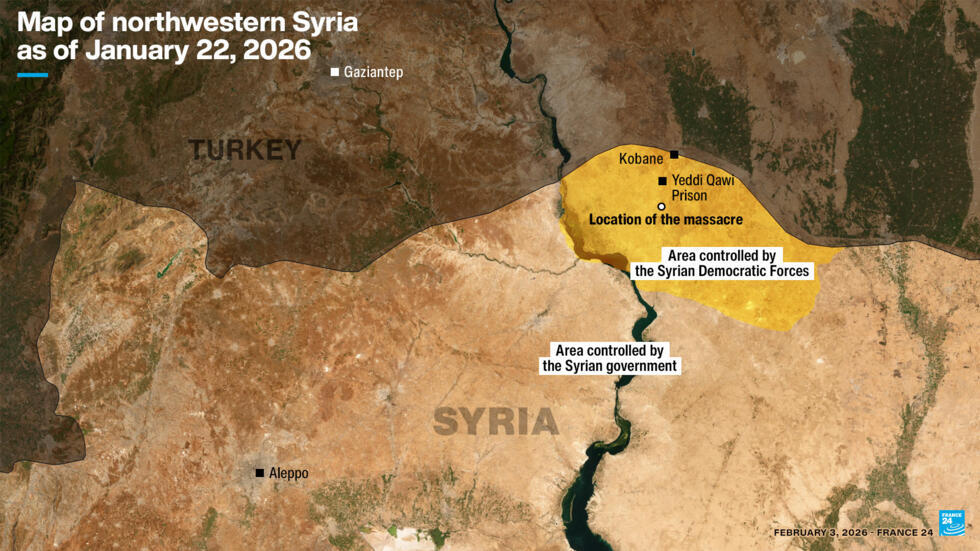
Nevertheless, the fighting continues further east and is currently centred on the Qara-Qozak bridge over the Euphrates. At the same time, Turkey is attacking the northern Syrian city of Kobane with air strikes. It is only 30 kilometres from the bridge to Kobane.

The city of Kobane became a symbol of the fight against IS in 2015 after Kurdish defence units — with the support of the US-led international anti-IS coalition — were able to push back the radical Islamists for the first time. Now the city is under threat of a renewed Islamist siege. “Syria must be prevented from relapsing into the bloodiest days of the civil war. Only if Turkey stops its escalation can we utilize the historic opportunity for a peaceful solution to the conflict”, explained Khaled Davrisch, representative of the Autonomous Administration of North and East Syria in Germany. “Just as the whole world feared for Kobane in 2015, the future of Syria could now once again be decided in Kobane”, Davrisch continued.

Flight and expulsion

So far, however, there are few signs of a political solution, although the self-administration and the SDF have repeatedly called for one since the fall of Assad. The humanitarian consequences of the SNA’s attacks, on the other hand, are devastating. The London-based Syrian Observatory for Human Rights reports serious human rights violations by the invading troops following the battles for Manbij. SNA militiamen are said to have executed wounded SDF fighters in a hospital. Looting against the Kurdish population in the multi-ethnic city is also said to have taken place.

In addition, many people had to flee from the areas occupied by the Islamists. According to the aid organizations medico international and the Kurdish Red Crescent, over 120,000 people have been displaced from the region around Aleppo and Tall Rifaat. Those who fled from the Kurdish canton of Afrin had been living in informal settlements and refugee camps since 2018. Now they must flee again, amidst reports of torture and killings.

In the meantime, the people have arrived in the self-administered area east of the Euphrates and the first reception centres have been set up in the cities of Tabqa and Raqqa. However, the conditions are disastrous and everything is lacking: medicine, food, tents. Several children have already died of hypothermia. Hygienic conditions are poor and diseases are spreading.

What can the international community do?

The repeated expulsions illustrate how ethnic and religious minorities are becoming the target of geopolitical interests in the Syrian conflict. The international community has so far largely ignored the escalation of violence in northern Syria. Turkey’s NATO membership and the EU’s “refugee deal” with Ankara in particular make it difficult to clearly condemn the Turkish attacks. Moreover, Western countries’ focus on the war in Ukraine means that the humanitarian catastrophe in Syria receives little attention.

Now is the time to send clear signals — supplying the displaced people in Rojava and other parts of Syria must be a priority. This includes the provision of food, tents, and medicines, as well as the creation of safe escape corridors.

The Autonomous Administration has proven that it can be a stabilizing factor in the region. Recognizing it as a political actor would not only strengthen its position, but also increase the pressure on Turkey to end the offensive. The Autonomous Administration’s call for a UN-brokered ceasefire should therefore also be supported, as only through comprehensive dialogue can the course be set for a sustainable, peaceful order in Syria. This would also mean the international community holding Turkey accountable for its repeated violations of international law and the war crimes committed by SNA militias with Ankara’s knowledge and approval.

Assad’s end means that Rojava’s future is at stake. The achievements of self-administration risk being destroyed in the midst of geopolitical power games and regional interests. Absent decisive action by the international community, the humanitarian catastrophe in Syria will continue to escalate. The struggle for Rojava is not only a struggle for territorial control of individual areas, but also for the future of freedom, equality, and self-determination in Syria and the Middle East as a whole.

Translated by Loren Balhorn. Christopher Wimmer is a sociologist and author from Berlin.


Salih Muslim (Democratic Unity Party) on dialogue with HTS and Turkey, and Rojava’s example for a democratic and inclusive Syria

Published 

Here is our conversation with Salih Muslim, veteran voice in the pursuit of peace and democracy for a new democratic future Syria, lightly edited for clarity.

The transitional government led by HTS marks a significant shift in Syria’s political landscape. How does the AANES view dialogue or coexistence with such groups, particularly given HTS’s history? Is there room for negotiation to achieve a peaceful and inclusive future for Syria?

Yes. First of all I congratulate all the Syrian people for this victory. They have been able to get rid of the despotic regime that has controlled Syria for [nearly] 60 years. And in particular, this HTS that has taken power in Damascus. They are now governing, they are talking about coexistence with all the components of Syria.

The Kurds, the Syriacs and the other communities — and also from a religious point of view with the Yazidis, Christians, Alawites and Shiites — everybody can live together in a democratic Syria. So this is a big step towards the democratic Syria that we are fighting for. As for the dialogue, I think it’s too early to talk about it now, because we still [need] two or three days. But we are looking for ways to contact them. Maybe we can go to Damascus and they can come to us. We’re trying and we’re looking for the ways.

And now maybe we have some contacts through mediators like the International Coalition [to Defeat ISIS], but I think we have to do it face-to-face, or get together, to discuss the problems of the Syrians. For their past, of course, everybody knows that HTS has a history. There was al-Nusra Front, and there were jihadists and so on in the beginning. But now they are trying to change. So we will try to be helpful and we will try to help them to succeed in this change, to be able to deal with all Syrians, I mean, the different components. 

But the problem is not them, the problem is the other group that they are coordinating with, the SNA. This group is completely different. This group [SNA] are mercenaries used by Turkey, and Turkey has used them in many places. They have used them in Libya, in Somalia, in Kenya, in Azerbaijan and now they are using them here. Turkey are pushing the SNA against us and still there are some clashes in our areas, I mean between the administration, the Syrian Democratic Forces, and these groups in Manbij (MinbĂ®c) and elsewhere. And their attacks haven’t stopped yet. Even the Turkish government [itself], they are still attacking through the border using drones, shelling and so on, still continuing.

But we are trying to achieve a good deal with HTS in Damascus.

The recent US-brokered ceasefire and reports of a dialogue process involving the AANES are pivotal. Can you elaborate on the conditions and objectives of this dialogue? How does the AANES plan to ensure the protection and representation of Kurdish-led regions in the new political framework?

We are trying to have all the components of the democratic self-administration in our areas, in the northeast of Syria, especially with the Kurdish parties, to have a joint delegation for this dialogue with the new authorities in Damascus. We are looking forward to that. 

And from the other side, we have our forces, the self-defence forces. If there is an attack in our areas, we will try to protect our areas. We defend ourselves. So that is what we are doing. But it’s too early now to talk about ongoing negotiations. We hope that in the near future we will be able to make contact and make some agreements with them.

Turkey’s actions, including their backing of the SNA and their reported crimes in areas like Tel Rifaat and Manbij, remain a major challenge. In light of these developments, do you believe a sustainable peace with Turkey is achievable? What are the main prerequisites for such a dialogue?

Turkey is looking for a new Ottoman Empire. I mean, they are trying to… they have been involved in the Syrian crisis from the beginning until now. So they have expectations. I mean, they are trying to do it. And what is wrong is, they see the Kurds as their enemies. I mean, they don’t accept Kurdish existence anywhere, not only in Turkey. So that is the reason why they are attacking us. 

And they may now be sending these groups, the SNA, into our areas to attack. So, if they give this up, if they hold back their hand from Syria, I think it will be okay. It will be okay. We can make peace and a sustainable, peaceful Syria. But because Turkey is involved, it is difficult to do that.

They should give up these expansionist tendencies towards a new Ottoman Empire. And they should look for peace, I think. But these conditions after, these fights in Manbij and the other [places], it seems Turkey does not accept them yet. I mean, they haven’t changed their mind and their policy towards Syria, which makes things very difficult now.

The collapse of the Assad regime opens the door for a re-imagined Syria. What role does the AANES envision for itself in building a democratic and inclusive Syria? How can minority rights and governance structures be integrated into this vision?

Well, we are looking for the unity of Syria and we would like to build a decentralised Syria, maybe the democratic way. Some of them, they call it federalism. Some of them, the original autonomous areas. But anyway, what we are doing now in our areas, we have all these components. The Kurds, the Syriacs and all the components, are living together.

And we have a social contract, which is like a constitution for our area. And we believe that what we are doing here in the administration, and this social contract would be very comfortable for all Syrians. So it could be expanded.

And of course we have to, if there are things that we can maybe improve in this contract with the other partners in the future Syria, even hold discussions with the other parties and the governing… I mean the authorities in Damascus. So we have to reach an agreement for all Syrians. 

And I think Syria cannot go back to before 2011. It should be a new Syria. The new Syria should recognise the rights of all the components living in Syria. So I think we will be able to do it if we are serious about peace and stability in Syria.

You have personally endured immense loss during the liberation of Kobani, a city symbolic of resistance against ISIS. How does your experience during those times shape your current vision for peace and reconciliation in Syria? What message do you have for the people of Kobani and the broader Kurdish population amid these uncertain times?

We as Kurdish people have been ignored by war for 100 years, a century. And everybody wanted to destroy us, the Kurdish people. They didn’t accept our existence. And of course, this struggle, and now everybody knows the Kurds and the Kurdish people and that they have their democratic rights and so on.

Of course, the price was very high, I mean with the blood of the young people, of the Syrians, of the Kurdish people. And of course our family was one of the families that paid the price of this struggle. And if we are not looking for more sacrifices and more victims, we have to find an end to that, which is peace, to live in peace.

The others, I mean the Syrians, accept to live together, there will be no problem. And I think we have paid the price, what we have paid is enough to have freedom and democracy in Syria. And I hope that we will be able to do it in these days.