Showing posts sorted by date for query KARABAKH. Sort by relevance Show all posts

Sunday, December 28, 2025

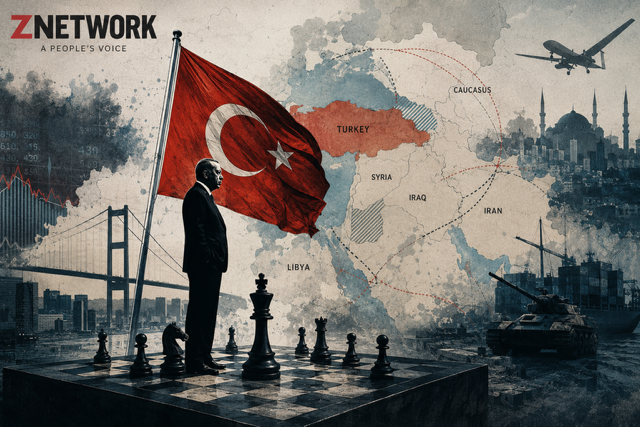
Drone Power And Political Islam: How Turkey’s Military-Tech Complex Fuels Interventionism – Analysis

LONG READ

This paper explores the intersection of drone warfare and political Islam in contemporary Turkish foreign policy, arguing that Turkey’s burgeoning military-tech complex—anchored by companies like Baykar—has enabled a new form of interventionism across West Asia, North Africa, and the Caucasus. By examining Turkey’s drone deployments in Libya, Syria, Nagorno-Karabakh, and beyond, the study highlights how unmanned aerial systems (UAS) have become instruments not just of hard power but also of ideological projection aligned with Ankara’s vision of neo-Ottomanism and Islamist solidarity. The analysis situates Turkey’s drone diplomacy within broader geopolitical ambitions where the fusion of defense-industrial innovation and political Islam under Erdoğan’s leadership enables a unique form of assertive, technologically driven interventionism. This paper also interrogates how Turkey’s use of drones blurs the lines between state security interests and transnational religious-political networks, reshaping conventional paradigms of regional influence, alliance making, and sovereignty.

Turkey’s sudden emergence as an emerging drone power has fundamentally reconfigured its foreign engagements. In the last decade, Ankara has constructed an indigenous unmanned aviation sector—headed by Baykar’s Bayraktar TB2 combat drones—that has become both a strategic instrument and a source of national pride. These drones have allowed Ankara to project military power cheaply in Libya, Syria, Nagorno-Karabakh, and elsewhere, reshaping regional battlefields and projecting Ankara’s power. Domestically, the triumph of Turkey’s drone industry under President Recep Tayyip Erdoğan has been spun into an ideological mythology about a rising Turkey restoring its Ottoman-era glories and dominating the Muslim world. This fusion of Islamist-guided ideology and military technology is remaking the Middle East and threatening US interests.

The analysis below describes Turkey’s drone revolution, its battlefield uses, its ideological sources, and its larger strategic implications, with clear takeaways and policy recommendations for US policymakers.[1] Turkey’s defense industry has made the transition from foreign dependency to assertive domestic production, led by drones. The Bayraktar TB2, a medium-altitude, long-endurance UAV produced by private company Baykar, is a prime example. Once a modest aviation venture, co-owned by President Erdoğan’s family (Baykar’s founder, Selçuk Bayraktar, is Erdoğan’s son-in-law), the firm became internationally renowned by the late 2010s. The TB2 is comparably inexpensive (in the range of a few million dollars per vehicle) but can carry precision-guided munitions and last more than twenty-four hours. It was decisive in initial use against insurgents in Syria and, subsequently, in intense conflicts with conventional forces. Turkey has since added to its unmanned aerial vehicle (UAV) arsenal the more heavy-duty Bayraktar Akıncı UCAV (a large-scale combat drone) and the short-takeoff TB3 for its forthcoming aircraft carrier. Other Turkish companies—particularly state-owned Turkish Aerospace Industries (TAI)—have also created drones (such as, the Anka series), but Baykar’s offerings have been the showpiece success.[2]

This indigenous drone boom has been spurred on by enormous state investment and political favor. Turkey’s Presidency of Defense Industries (SSB) has channeled funds into private companies to bypass import controls and sanctions, resulting in a healthy supply chain. By 2024 alone, Baykar earned more than $1.8 billion in exports (approximately 90 percent of its turnover), selling drones to dozens of nations. Turkey has allegedly taken about 65 percent of the world’s export market for medium-altitude weapons drones. Baykar has already secured contracts for its TB2 variant, which it has sold to over thirty governments, and another ten for the Akıncı, as well as establishing production joint ventures internationally (e.g., in Ukraine). Scale-up has been spectacular: by the early months of 2025, Bayraktar systems had accumulated more than 400,000 flight hours globally, and Turkish sales of Baykar’s drones surpassed those of the United States, Israel, and China. Erdoğan’s government touts these records loudly as proof of Turkey’s technological independence, and the drone sector becomes an issue of national prestige.


This reshaping of Turkey’s defense industry coincided with political purges of the traditional military leadership. Post-2016, Erdoğan and the AKP marginalized the secularist generals who had controlled national security for years, further entrenching presidential authority in procurement.[3] Today, these new generation factories run with little interference or pushback: Baykar, the drone program, is officially taboo to criticize in Turkish media. In Erdoğan’s account, the drone program is not merely a source of income but a validation of Turkey’s “indigenous” and “Muslim-rooted” science. Baykar’s factories and proving grounds have become national icons, covered by the media and even celebrated in textbooks. The proliferation of drone production in Turkey—frequently through family-linked conglomerates—highlights how the military-tech complex has been intertwined with the political regime.


Drones on the Battlefield: Intervention in Practice


Turkey’s military UAVs have not stayed limited to domestic symbol status. Beginning in the mid-2010s, Bayraktar TB2 drones and their relatives have been rolled out in several theaters actively, frequently changing conflict dynamics for Turkey. Turkish drones have been employed in remote theaters, but some of the most significant use cases have been the government’s interventions and proxy wars in Libya, Syria, and the Caucasus. In Libya, Turkey militarily intervened in 2019–2020 on behalf of the UN-recognized Government of National Accord (GNA) of Tripoli against rival Libyan National Army (LNA) leader Khalifa Haftar. Erdoğan sent a combination of Turkish soldiers, Syrian militia fighters, and advanced weapons—preeminently Bayraktar drones and air defense missiles. The TB2 played a decisive role: it destroyed LNA artillery and tanks with missile attacks, breaking Haftar’s siege of Tripoli. Turkish drones gained time for the GNA to regroup until a UN ceasefire was negotiated. Mid-2020 saw Turkey’s intervention reverse Haftar’s advances and victories for the GNA that ultimately compelled a politically negotiated resolution. In Libya, Bayraktar drones thus effectively became Ankara’s spearpoint, allowing a modest Turkish military deployment to exert disproportionate influence.[4]

In Syria and northern Iraq, Turkey has used its UAVs in a series of cross-border strikes against the Kurdistan Workers’ Party (PKK) and allied forces (the Syrian Kurdish YPG/SDF) and, to a lesser degree, surviving ISIS fighters. Starting from about 2016, Turkish drones mounted intensive surveillance and strike flights along the Iraqi border and in northeast Syria. In 2019–2020, Turkey conducted mass incursions (Operations Olive Branch, Peace Spring, Spring Shield, etc.) to drive Syrian Kurdish elements from the Turkish border and to create “safe zones.” Bayraktar drones attacked Kurdish outposts, entrenched defensive positions, and even hit IS cells. These attacks demoralized Kurdish militia forces and aided in the advance of Turkish-backed rebel forces. In 2020, Turkey also used drones to protect its interests in Idlib province: when a spring Syrian regime (Russia-backed) offensive was launched, Turkish TB2s strafed advancing columns and missile batteries, blunting the assault. Turkish drones in Syria also made US plans difficult, as Washington’s primary local ally (the SDF/YPG) was attacked. Overall, Turkey’s drones were central to its sustained effort to remake northern Syria and prevent any Kurdish-controlled enclave on its frontier.

Another exemplar of drone diplomacy by Turkey was the 2020 war between Armenia and Azerbaijan over Nagorno-Karabakh. Turkey supported Baku vigorously, furnishing its ally with hundreds of Bayraktar TB2s and training Azerbaijani pilots. The outcome was a complete Azerbaijani military triumph. Turkish drones pursued Armenian armored forces, anti-aircraft defenses, and troop densities throughout the disputed territory. Footage and testimony depicted Armenian tanks and rocket launchers destroyed from the air. This aerial domination by unmanned aircraft so conclusively altered modern warfare in the region that analysts said it radically shifted the face of war. The conflict concluded with a new truce significantly tilting in Azerbaijan’s favor, allowing it to reoccupy most disputed land. Bayraktar TB2s thereby provided Turkey with a force multiplier that enabled it to reshape the South Caucasus—a region long rooted in Ottoman historic ties—on Ankara’s own terms.[5]

Outside of these flagship conflicts, Turkey’s drones have also appeared in other wars. They have assisted Turkish-backed militias in Libya and Somalia and have been exported to Algeria, Tunisia, and North African nations. Bayraktar drones were used by the military of Ukraine to some success in countering the Russian invasion, and in 2024, Turkey even contracted to build a drone assembly facility in Ukraine. In 2021–2022, Ethiopia imported TB2s for use in its civil war. Reuters and others reported that Pakistani forces employed Turkish drones in a skirmish with India (the first use of Turkish UAVs in South Asia). In every case, TB2s and similar drones impressed by striking targets at standoff range and operating for long hours. A notable feature is that Bayraktar drones can loiter over battlegrounds for a day or more, relaying real-time imagery to commanders and independently dropping guided munitions.

Turkish politicians commemorate these victories. As Erdoğan frequently reminds everyone, Bayraktar drones are a “national weapon” capable of blasting missile defenses and aircraft from the air.[6] At home, the story is that a humble Turkish drone with its “white flag” (the logo of Baykar) killed tanks and helicopters in enemy bases, something even America would struggle with. Indeed, during the Ukraine conflict, even governments and foreign volunteers have crowdfunded to purchase Bayraktar drones for Ukraine for about $5 million each. Such tales buttress the way Ankara markets the drone program as evidence of how “Muslim minds” can out-innovate conventional great powers.

Islamist Ideology and Neo-Ottoman Ambitions


Turkey’s drone capabilities are not an isolated phenomenon; they are part of a wider strategy on the part of President Erdoğan to combine nationalism, political Islam, and Ottoman nostalgia. Erdoğan’s foreign policy has moved emphatically away from secular Kemalism toward an “ambitious Islamist and neo-Ottoman vision,” according to analysts. Erdoğan invokes symbols and memories of the Ottoman era in speeches and in rhetoric in order to mobilize a pan-Turkish, pan-Islamic constituency. He famously alluded in a 2011 election victory speech to cities formerly subject to Ottoman dominance—Sarajevo, Beirut, Damascus, Ramallah, Jerusalem—assuring that “they would benefit” from Turkey’s ascendance. This sort of rhetoric is not merely verbiage. It outlines an ideological agenda of reinvigorating Turkey as a regional hegemon of the Muslim world and an emancipator from Western patronage.[7]

Erdoğan himself comes from Islamist politics (the AKP has its roots in the Islamist Welfare Party), and, during his tenure, Turkish identity has become more intertwined with Islamic and Ottoman themes. He has reopened the historically closed Hagia Sophia museum as a mosque, promoted Turkey as the guardian of Palestinians and other Muslims, and fostered alliances with Sunni Islamist forces globally. The Jerusalem Post’s recent commentary refers to Erdoğan’s group as a “Turkish version of the Muslim Brotherhood, a radical anti-Western movement,” highlighting how profound are these currents. This translates into foreign policy as support for fellow Islamist-led governments or movements, opposition to secular military governments (e.g., Egypt post-2013), and brazenly forging independent trajectories even when in opposition to NATO or EU allies. For instance, Turkey’s agreement with Libya’s GNA was couched as standing in favor of a “legitimate” Muslim-led regime against a secular Western-backed warlord.

Drones comfortably fit this blend by performing both instrumental and propagandistic purposes. Instrumentally, UAVs enable Turkey to intervene in Muslim-majority nations with few “boots on the ground,” reducing casualties among religious or ethnic kin. The digital warfare approach can be marketed domestically as a contemporary tool for protecting Muslim interests. Ideologically, UAV success nourishes Turkish domestic pride: every success is framed as a victory of Turkish creativity and an Islamic identity. Erdoğan and his supporters tend to stress that these weapons are “made in Turkey” by Muslim engineers—a subtle comparison with Western-made weapons. Effectively, the drone revolution is part of Erdoğan’s rhetoric of a “national technology leap” (milli teknoloji hamlesi) that will bring Turkey to its rightful place in the Islamic world.[8]

This neo-Ottoman shift has regional aspirations as well. Turkish naval strategy now openly conceives of dominance of the Aegean and Eastern Mediterranean (the Mavi Vatan or “Blue Homeland” idea). Exercise of control over energy and sea lanes goes with military activism in former Ottoman domains: the Levant, Caucasus, North Africa. Drones also make such ambitions affordable: a dozen TB2s and a few consultants can replace a big ground army or fleet. In Libya, Turkey even invoked history by giving its Libyan expeditionary force the name of Omar al-Mukhtar (the Libyan anti-colonial warrior), framing its intervention as anti-imperialist solidarity rather than conquest. Such ideological presentation—connecting Ottoman heritage to current Islamist solidarity—is a recurring motif. Briefly, Erdoğan’s Turkey sees contemporary military technology such as drones as facilitators of a grand strategy inspired by Islamism.

Alliances in Arms: Islamist Networks and Strategic Partnerships

Turkey’s drone capability is not apolitical; it is matched by an equally ideological tradition of alliance and proxies. Erdoğan’s administration has established a strategic alliance between its military establishment and a constellation of similarly like-minded Islamist forces. The most well-known ally is Qatar. Doha’s ruling family, which funded Erdoğan’s ascent amid his economic tribulations in the 2010s, has a common soft power policy with Ankara of backing the Muslim Brotherhood and Islamist forces at the regional level. Qatar became one of Baykar’s very first international customers; its affluent military bought Bayraktar TB2s and training packages. In return, Turkey granted Doha military training facilities and logistical assistance. Together, they provided backing to friends. Turkey shielded Qatar in the 2017 Gulf crisis, and Qatar invested funds into Gaza and Syria via Turkish conduits. This Turkish–Qatari “Sunni alliance” supported Hamas, Muslim Brotherhood franchises in Libya and Tunisia, and Syrian Islamist elements. The Jerusalem Post mentions that Qatar “is a long-time supporter of Muslim Brotherhood activities across the globe” and that Turkey’s motives are “augmented by the economic generosity of Qatar.” In reality, Baykar drones and Qatari petrodollars have turned into twin levers, driving Islamist agendas.

Turkey also openly aligned with some militants beyond traditional Middle Eastern monarchies. Erdoğan invited Hamas leaders to Turkey for years, giving them political cover and a home base. Hamas officials have established Istanbul as a second headquarters, hosting press conferences and raising money with no Israeli pressure. Turkey’s military and intelligence officials had contact with the Gaza group for years. In turn, Turkish NGOs have cooperated with Brotherhood-affiliated parties in Egypt (prior to the Sisi crackdown) and Tunisia’s Ennahda (particularly in the Arab Spring aftermath). In Libya, Turkey became patron to the GNA militias, most of which were derived from or based on the Libyan Muslim Brotherhood. As a report by an Israeli think tank (Dado Center) remarks, Ankara’s Libyan strategy was positively carried out “under the cloak of Ankara’s relation with the Muslim Brotherhood.” This involved supplying arms (including drones) and combatants to GNA-aligned militias, while Western powers called out all foreign fighters to leave. During the Syrian civil war, there were some indications that Turkish-backed rebels had included hard-line Islamists (from Ahrar al-Sham to HTS) that coexisted with one another in operations. Turkey’s patronage had helped such groups to endure as a buffer against Assad and Kurdish forces.[9]

Ankara has, according to reports, facilitated networks that transfer money from Iran to Hezbollah-held Lebanese operations, and some Turkish NGOs maintain contacts in Iran for commercial purposes. Ankara’s collaboration with Iran (for instance, concerning airspace or proxy coordination in Iraq and Syria) has been identified as concerning in capitals such as Riyadh and Tel Aviv. One of the senior Israeli officials warned that Turkey’s combination of Islamist and Turkish nationalism renders it “a greater threat than Iran” since it can walk across Sunni–Shia fault lines and organize Islamist solidarity. In reality, Turkey has already sold drones to a variety of non-western states —Algeria, Pakistan, Malaysia—expanding the circle of influence of its military-tech exports. With these alliances, Turkish drones have even marched in parades and air shows from Islamabad to Tripoli, broadcasting a clear message: Turkish military capabilities are for lease to those who can match its strategic or ideological affinity.

The Erdoğan period has witnessed the convergence of Turkey’s defense industry and Islamist foreign policy. High-tech drones are at once a diplomatic bargaining chip and a force multiplier for Islamist-linked proxies. We observe this in synergistic arms contracts (e.g., Baykar securing deals from Pakistan and Qatar), in mercenary groups (Syrian militants transited through Turkey to Libya), and in technology trade (even talks started about co-manufacturing TB2s with Egypt after ties were normalized).[10] For anti-Western and Islamist movements, Turkish drones provide cutting-edge support; for Baykar and its sponsors, providing these customers secures additional global market presence and strategic depth. This strategic partnership complicates regional order: it empowers militias in Libya, supports Hamas in Gaza, and even connects Turkey to Islamist groups in Europe through diaspora networks. And always at its center is the notion that drones, invented by “Muslim engineers” as Turkish propaganda insists, empower a sort of pan-Islamic resistance to Western hegemony.

Regional Impact and Challenges to the United States


Turkey’s interventionist approach—mixing Islamist ideology with advanced drones—is redefining regional dynamics that directly impinge on US interests.

Turkey is still a member of NATO, with the organization’s second-largest military, but its actions frequently conflict with other allies and with the US strategic agenda. Turkish drones and military deployments have emerged as a wild card in theaters where the United States has long been the security guarantor.[11] In the Eastern Mediterranean, Turkish assertiveness endangers a precarious regional balance. Ankara’s exploration endeavors and sea claims (accompanied by military actions) provoke Greece, Cyprus, and Israel, all of them US allies. The 2019 naval agreement with Tripoli effectively created a vast sea zone that disregarded Greek and Cypriot interests and outraged EU allies. Turkish drones have been used to patrol and exercise in Cypriot airspace, increasing the risk of collisions with EU-backed naval patrols. This undermines US leverage: Washington has fostered alliances with Greece, Cyprus, Israel, and Egypt to secure Eastern Mediterranean hydrocarbons and push back against Iran and Russia. Turkey’s drone-backed provocations in these waters put new stress on NATO cohesion, forcing Washington to repeatedly mediate between Athens and Ankara to avoid a crisis.[12]

In the Middle East, Ankara’s moves balance out US and regional interests. The United States long sought stable relations with Egypt, the UAE, Saudi Arabia, and Israel as a counter to Iran and jihadist extremism. Turkey’s support for Qatar and the Muslim Brotherhood set up a parallel Sunni axis that often thwarted those aims. Even as Egypt drifted closer to Greece and Israel against Turkey’s regional designs, Ankara has retaliated by backing Islamist blocs and safe havens that resist Egyptian and Emirati agendas (for example, having Muslim Brotherhood ideologues on its territory). In Syria, US policy too frequently has been to shore up areas controlled by Kurdish-led SDF troops, but Turkey regards those troops as terrorists and made repeated attacks upon them, even pushing the United States out of certain border zones.[13] The net impact is that an ally of the United States—Turkey—utilizes cutting-edge equipment in a manner that makes the US struggle more difficult against extremism. Likewise, in Libya, Turkey’s backing for one set of forces effectively guaranteed the survival of a government many Gulf Arab powers had opposed (and some Western interests did not actively support either).

Turkey’s orientation towards Russia and other non-Western nations also makes Washington nervous. Turkey’s acquisition of the Russian S-400 missile defense system resulted in its removal from the F-35 program and strained relations with the Pentagon. But while Ankara claims autonomy, it continues to use membership in NATO—hosting American troops at Incirlik Air Base and allegedly on board to sanction Iran—even as it pursues policies the Pentagon abhors (such as letting Iran-backed militias into Syria to battle American forces). Erdoğan’s tightrope act— courting China’s Belt-and-Road and joining the Moscow-sponsored Shanghai Cooperation Organization as a dialogue partner—warns US policymakers that Turkey may be drifting out of the West. In the Black Sea and wider world, Turkey’s expanding arms exports assist it in making new friends (Ukraine, Pakistan) at the expense of the United States.[14]

The test for the United States is how to react without weakening NATO and alliance institutions. US troops in Europe and the Mediterranean now have to factor Turkish drones into considerations that would previously have been deemed unlikely. Middle Eastern allies observe how US focus on Iran and Russia increases the leeway for Ankara. Domestically, Washington policymakers are under pressure from constituencies alarmed at Turkey’s Islamist shift. Congressional hearings have brought Turkey’s support for Hamas and Hezbollah to the fore, triggering proposals to sanction the Turkish parties involved. The picture is one of a nation that is no longer simply a “good ally” in the US-led system but neither is it absolutely an enemy. It is a rather mercurial ally—powerful militarily, volatile politically—equipped with drones that lend its foreign policy a cutting edge.[15]


Key Takeaways


•Turkey’s drone surge is real and significant: Over a few years, Turkey has constructed a globally competitive UAV sector. Bayraktar TB2 attack drones and more advanced variants have provided Ankara with the capacity to strike well beyond its borders at relatively low expense.[16] Turkey now sells this technology extensively and dominates the international market for armed drones.

•Turkey has facilitated military adventurism: Turkish drones played a significant role in altering the dynamics of wars from Libya to Nagorno-Karabakh. They multiply Turkish firepower wherever Ankara has intervened, destroying hostile defenses, cutting supply lines, and backing friendly proxies. In all instances, drone attacks have been a force multiplier that enhances Turkey’s leverage without necessitating massive troop deployments.

•The importance of ideological and identity factors: Erdoğan’s administration attributes its drone victories to an overarching story of Islamic unity and Ottoman revival. Sophisticated UAVs are hailed as “Muslim technology” products capable of holding their own against conventional Western weaponry. This serves to reinforce Ankara’s outreach to Islamist forces beyond its borders and prop up propaganda domestically. [17] The drone initiative is as much about pride and identity as it is about military strength.

•Turkish defense exports stream to Islamist-aligned forces: Turkish drones and weaponry consistently wind up in the hands of governments and forces with Ankara’s political perspective. Allies like Qatar and Pakistan, partners in fights such as Libya’s GNA or Palestinian Hamas, and even missions in locations like Syria’s Islamist fronts have been assisted by Turkish weapons.[18] Turkey has also been accused of supporting Hezbollah financing and cooperating with Iran on certain security matters, demonstrating that its arrangements extend to openly anti-Western circles.

•American interests are confronted with strategic headwinds: Turkey’s belligerent employment of drones makes the United States more complicated to defend. It increases tensions in NATO, strains diplomacy with essential Mideast allies, and empowers militaries and militias that are sometimes in opposition to US objectives. Turkish drones have been directed against Western-backed fighters and have taken out targets intended to restrict ISIS or Iran.[19] Without restraint, Turkey’s new model—marrying Islamist politics to military high-tech—threatens to change balances in the Levant, the Eastern Mediterranean, and North Africa in ways that run counter to US policy.
Policy Recommendations

•Enhance assistance for regional allies: Reinforce security cooperation with the most endangered US allies threatened by Turkish behavior. This involves augmenting the military capabilities of Greece, Cyprus, Israel, and Egypt through exercises and arms transfers (e.g., Patriot missile batteries or Western drones). Augment naval and air presence in the Eastern Mediterranean to counter Turkish intimidation.[20] Make sure that Gulf Arab allies have alternatives to Turkish weaponry—for instance, provide US or European drone technology to nations such as Saudi Arabia and the UAE to balance Bayraktar sales.

•Regulate drone proliferation and countermeasures: Coordinate with NATO and export-control regimes to limit the spread of sensitive drone technology to conflict areas and potential competitors. Promote anti-drone defenses (such as electronic warfare and kinetic interceptors) to US and allied forces. Invest in next-generation US UAV development[21] (loitering munitions, long-range drones) to sustain technological advantage. Promote intelligence sharing regarding Turkish UAV deployments to enhance situational awareness among partners.

• Leverage alliance avenues and sanctions where viable: Utilize NATO platforms to criticize Turkey’s differences publicly (e.g., protest unmanned attacks that thwart coalition objectives). Link US military aid or sales (such as F-16 modernization) to advancement on common aims; demand Turkish efforts against Hamas, Hezbollah, or other listed groups; or condition future arms collaboration on conformance with NATO policy.[22] Where violations occur (such as financing of Iranian proxies), consider targeted sanctions on the facilitating entities to impose a real cost on Ankara’s dubious transactions.

• Engage Turkey diplomatically, but guard principles: Continue dialogue with Ankara on areas of common interest (counterterrorism against ISIS, economic ties, NATO modernization) to keep Turkey anchored in the West’s orbit. Simultaneously, reaffirm publicly US positions on global law to balance Turkey’s one-sided actions (e.g., patrols off Cyprus, contended maritime boundaries). Invite EU allies to include human rights and rule of law issues in EU–Turkey relations so that Turkey’s drift is not unremarked.[23] Offer support to civil society and moderate forces within Turkey by way of cultural and educational exchanges, making clear that US engagement honors Turkey’s prosperity as a stable democracy.

•The coordination of like-minded countries: Form alliances within the region against the destabilizing influence of unilateral drone warfare. For instance, join forces with Egypt, France, and others on diplomatic efforts to contain foreign fighters in Libya. Coordinate with the Gulf Cooperation Council to align their security planning and cut reliance on any one supplier.[24] Also, involve major players such as Russia and China to communicate that Turkey’s deployment of sophisticated UAVs can fuel wars (e.g., in Syria and Libya) and ought to be regulated collaboratively.

•Promote non-military options where possible: Because Turkey’s model is premised on the rhetoric of being the defender of Muslim causes, the United States can respond to bad-faith ideology with open-ended assistance. Ratchet up assistance for reconstruction and governance initiatives in post-conflict areas (Libya, Syria, Gaza), emphasizing pluralistic institutions.[25] Demonstrate that Muslim-majority nations can thrive with inclusive, non-ideological politics and thereby diminish the attractiveness of Turkey as the only protector of Muslim interests.

By blending these strategies of security guarantees to friends, export restrictions, principled statecraft, and ideational counterbalances, Washington can start to counterbalance Turkey’s rising power. Turkey’s drone complex and Islamist-tainted activism cannot be reversed, but the United States can frame the context so that they do not single-handedly upset regional order. The age of interventionism by drones requires a candid policy reaction: one that dissects both the hard technology on the battlefield and the soft ideology behind it to safeguard US and allied interests.


1 Sibel Düz, “The Ascension of Turkey as a Drone Power: History, Strategy, and Geopolitical Implications,” SETA Analysis, July 3, 2020, https://www.setav.org/en/the-ascension-of-turkey-as-a-drone-power/

2 Can Kasapoğlu, “Techno‑Geopolitics and the Turkish Way of Drone Warfare,” Atlantic Council Issue Brief, March 2022.

3 Çağlar Kurç, “Between Defence Autarky and Dependency: The Dynamics of Turkish Defence Industrialization,” Defence Studies 17, no. 3 (2017): 260–81.

4 Hüseyin Bağcı and Çağlar Kurç, “Turkey’s Strategic Choice: Buy or Make Weapons?,” Defence Studies 17, no. 1 (2017): 38–62.

5 Brendon J. Cannon, “Turkey’s Military Strategy in Africa,” in Turkey in Africa: A New Emerging Power?, eds. Elem Eyrice Tepeciklioğlu and Ali Onur Tepeciklioğlu (Routledge, 2021).

6 Kareem Fahim, “Turkey’s Military Campaign Beyond Its Borders Is Powered by Homemade Armed Drones,” Washington Post, Nov. 30, 2020.

7 Laura Pitel, “Turkey’s Armed Drones Bolster Erdogan’s Hard‑Power Tactics,” Financial Times, Oct. 8, 2020.

8 Raphael D. Marcus, “Learning ‘Under Fire’: Israel’s Improvised Military Adaptation to Hamas Tunnel Warfare,” Journal of Strategic Studies 42, nos. 3–4 (2019): 344–370.

9 Edward J. Erickson, “Turkey as Regional Hegemon—2014: Strategic Implications for the United States,” Turkish Studies 5, no. 3 (2004): 25–45.

10 E. C. Hay Yanarocak, “Turkey’s Giant Leap: Unmanned Aerial Vehicles,” Turkey Scope 4, no. 6 (2020): 1–12.

11 Nargorno-Karabakh conflict referenced in Alex Gatopoulos, “The Nagorno‑Karabakh Conflict Is Ushering in a New Age of Warfare,” Al Jazeera, Oct. 11, 2020.

12 Glenn D. Hook, Militarization and Demilitarization in Contemporary Japan (Routledge, 2003).

13 Ash Rossiter, “Turkey’s Path to Drone Power,” TRENDS Research & Advisory, Dec. 8, 2021,

14 Özgür Özdamar and Devlen Balkan, “Man vs. the System: Turkish Foreign Policy After the Arab Uprisings,” in Fear and Uncertainty in Europe: The Return to Realism?, eds. Roberto Belloni, Vincent Della Sala, and Paul Viotti (Springer, 2019).

15 Ash Rossiter and Brendon J. Cannon, “Turkey’s Rise as a Drone Power: Trial by Fire,” Defence & Security Analysis (2022): 1–20.

16 Diğdem Soyaltin‑Collela and Tolga Demiryol, “Unusual Middle‑Power Activism and Regime Survival: Turkey’s Drone Warfare and Its Regime‑Boosting Effects,” Third World Quarterly 43, no. 8 (2022): 1542–1560.

17 Bruno Oliveira Martins, Pinar Tank, and Beste Işleyen, “Drone Diplomacy: How Turkish Military‑Tech Exports Shape Islamist Soft Power,” Globalizations 20, no. 4 (2023): 587–606.

18 Binnaz Toprak, “Islam and the Secular State in Turkey,” in Turkey: Political, Social, and Economic Challenges in the 1990s, eds. Çiğdem Balım et al. (Brill, 1995).

19 Soyaltin‑Collela and Demiryol, “Unusual Middle‑Power Activism.”

20 Martins, Tank, and Işleyen, “Drone Diplomacy.”

21 Dominika Kunertova, “Drones Have Boots: Learning from Russia’s War in Ukraine,” Security Dialogue 54, no. 3 (2023): 225–244.

22 Cihan Tuğal, “Islamism as Religio‑Moral Populism in Turkey,” Comparative Studies in Society and History 44, no. 4 (2002): 693–722.

23 Aslı Ege, “Foreign Policy as a Means of the AKP’s Struggle with Kemalism in Relation to Domestic Variables,” Turkish Studies 23, no. 4 (2022): 554–575.

24 Kurç, “Between Defence, Autarky, and Dependency.”

25 Cihan Tuğal, “Islamism in Turkey: Beyond Instrument and Meaning,” Sociological Theory 21, no. 4 (2003): 406–436.

About the author: Mohammad Taha Ali is a researcher with an MA in Conflict Analysis and Peace Building. His work examines the intersection of ideology and strategy in the Middle East, with a focus on the evolving strategic autonomy of regional states. He writes on security issues, regional rivalries, and the influence of clerical authority in shaping state policy.

Source: This article was published at the Middle East Quarterly

Middle East Quarterly

Middle East Quarterly, published since 1994 and edited by Efraim Karsh, it is the only scholarly journal on the Middle East consistent with mainstream American views. Delivering timely analyses, cutting-edge information, and sound policy initiatives, it serves as a valuable resource for policymakers and opinion-shapers.

Thursday, December 11, 2025


If Trump Is Serious About Peace, Marco Rubio Has to Go


Donald Trump campaigned on ending endless wars and now boasts that he has resolved eight wars. In reality, this claim is delusional, and his foreign policy is a disaster. The United States remains mired in ongoing wars in the Middle East and Ukraine, and now Trump is careening blindly into new wars in Latin America.

The dangerous disconnect between Trump’s delusions and the real-world impacts of his policies is on full display in his new National Security Strategy document. But this schism has been exacerbated by putting U.S. foreign policy in the hands of Secretary of State Marco Rubio, whose neocon worldview and behind-the-scenes maneuvering has consistently undercut Trump’s professed goals of diplomacy, negotiated settlements and “America First” priorities.

The eight wars Trump claims he has ended include non-existent wars between Egypt and Ethiopia, and Serbia and Kosovo, and the war between Armenia and Azerbaijan that ended in 2023, after Azerbaijan invaded and ethnically cleansed the ancient Armenian community of Nagorno-Karabakh. Trump stole credit for peace between Thailand and Cambodia, which was actually mediated by Malaysia, while India insists that it ended its war with Pakistan without help from Trump.

Trump recently invited the presidents of Rwanda and the DRC to Washington to sign a peace deal, but it’s only the latest of many agreements that have failed to end decades of war and proxy war that rage on in the eastern Congo.

Trump even claims to have brought peace to Iran, which was not at war until he and Netanyahu plotted to attack it. Now diplomacy with Iran is dead—torpedoed by Trump’s treacherous use of negotiations as cover for the U.S.-Israeli surprise attack in June, an illegal war right out of Rubio’s neocon playbook.

Rubio has undermined diplomacy with Iran for years. As a senator, he worked to kill the JCPOA nuclear agreement, framed negotiations as appeasement, and repeatedly demanded harsher sanctions or military action. He defended the U.S. and Israeli attacks in June, which confirmed the claims of Iranian hardliners that the United States cannot be trusted. He makes meaningful talks with Iran impossible by insisting that Iran cease all nuclear enrichment and long-range missile development.  By aligning U.S. policy with Israel’s, Rubio closed off the only path that has ever reduced tensions with Iran: sustained, good-faith diplomacy.

Trump’s eighth claimed peace agreement was his Gaza “peace plan,” under which Israel still kills and maims Palestinians every day and allows only 200 truckloads per day of food, water, medicine, and relief supplies into Gaza. With Israeli forces still occupying most of Gaza, no country is sending troops to join Trump’s “stabilization force,” nor will Hamas disarm and leave its people defenseless. Israel still calls the shots, and will only allow rebuilding in Israeli-occupied areas.

As secretary of state, it was Marco Rubio’s job to negotiate peace and an end to the occupation of Palestine. But Rubio’s entire political career has been defined by unwavering support for Israel and corrupted by over a million dollars from pro-Israel donor groups like AIPAC. He refuses to speak to Hamas, insisting on its total isolation and destruction.

Rubio even refuses to negotiate with the weakest, most compromised, but still internationally recognized, Palestinian Authority. In the Senate, he worked to defund and delegitimize the PA, and now he insists it should play no role in Gaza’s future, but he offers no alternative. Contrast this with China, which recently convened fourteen Palestinian factions for dialogue. With a U.S. secretary of state who won’t talk to any Palestinian actors, the United States is only supporting endless war and occupation.

Ukraine is not on Trump’s list of “eight wars,” but it is the conflict he most loudly promised to end on day one. Trump took his first steps to resolve the crisis in Ukraine with phone calls with Putin and Zelenskyy on February 12, 2025. War Secretary Pete Hegseth told a meeting of America’s NATO allies in Brussels that the U.S. was taking Ukraine’s long-promised NATO membership off the table, and that “we must start by recognizing that returning to Ukraine’s pre-2014 borders is an unrealistic objective. Chasing this illusionary goal will only prolong the war and cause more suffering.”

Zelenskyy and his European backers are still trying to persuade Trump that, with his support, they can win back at the negotiating table what Ukraine and its western allies lost by their tragic decision to reject a negotiated peace in April 2022. Russia was ready to withdraw from all the land it had just occupied, but the U.S. and U.K. persuaded NATO and Ukraine to instead embark on this long war of attrition, in which their negotiating position only grows weaker as Ukraine’s losses mount.

On November 21st, Trump unveiled a 28-point peace plan for Ukraine that was built around the policy Trump and Hegseth had announced in February: no NATO membership, and no return to pre-2014 borders. But once Rubio arrived to lead the U.S. negotiating team in talks in Geneva, he let Zelenskyy’s chief of staff, Andriy Yermak, and the Europeans put NATO membership and Ukraine’s pre-2014 borders back on the table.

This was a poison pill to deliberately undermine the basic concept of Ukrainian neutrality that Russia insists is the only way to resolve the security dilemma facing both NATO and Russia and ensure a stable and lasting peace. As a European official crowed to Politico, “Things went in the right direction in Geneva. Still a work in progress, but looking much better now… Rubio is a pro who knows his stuff.”

Andriy Yermak, who led Ukraine’s negotiating team in Geneva, has now been fired in a corruption scandal, reportedly at Trump’s behest, as has Trump’s envoy to Kyiv, Keith Kellogg, who apparently leaked Trump’s plan to the press.

Trump is facing a schism in his foreign policy team that echoes his first term, when he appointed a revolving door of neocons, retired generals and arms industry insiders to top jobs. This time, he has already fired his first National Security Advisor, Mike Waltz, several NSC staff, and now General Kellogg,

Trump’s team on Ukraine now includes Vice President J.D. Vance, Steve Witkoff, Jared Kushner, Deputy National Security Advisor Andy Baker and Army Secretary Dan Driscoll, who all seem to be on board with the basic policy that Trump and Hegseth announced in February.

  But Rubio is keeping alive European hopes of a ceasefire that postpones negotiations over NATO membership and Ukraine’s borders for a later date, to allow NATO to once again build, arm and train Ukrainian forces to retake its lost territories by force, as it did from 2015 to 2022 under cover of the MInsk Accords.

This raises the questions: Does Rubio, like the Europeans and the neocons in Congress, still back the Biden-era strategy of fighting a long proxy war to the last Ukrainian? And if so, is he now in fact working to undermine Trump’s peace efforts?

Ray McGovern, the founder of Veteran Intelligence Professionals for Sanity, thinks so, writing “…we are at the threshold on Ukraine, at the beginning of a consequential battle between the neocons and Europeans on one side, and Donald Trump and the realists on the other. Will Trump show the fortitude to see this through and overcome his secretary of state?”

But it’s perhaps in Latin America where Rubio is playing the most aggressive role. Rubio has always promoted regime-change policies, economic strangulation, and U.S. interference targeting left-leaning governments in Latin America. Coming from a conservative Cuban familiy, he has long been one of the most hard-line voices in Washington on Cuba, championing sanctions, opposing any easing of the embargo, and working to reverse Obama-era diplomatic openings.

His position on Venezuela is similar. He was a leading architect of the Trump administration’s failed “maximum pressure” campaign against Venezuela, promoting crippling sanctions that devastated civilians, while openly endorsing failed coups and military threats.

Now Rubio is pushing Trump into a catastrophic, criminal war with Venezuela. In early 2025, Trump’s administration briefly pursued a diplomatic track with Venezuelan President Nicolás Maduro, spearheaded by envoy Richard Grenell. But Marco Rubio’s hard-line, pressure-first approach gradually overtook the negotiation channel: Trump suspended talks in October 2025, and U.S. policy shifted toward intensified sanctions and military posturing.

Rubio’s hostility extends across the region: he has attacked progressive leaders in Colombia, Chile, Bolivia, Honduras, and Brazil, while supporting authoritarians aligned with U.S. and Israeli interests. While Trump has warmed to Brazil’s president Lula and craves access to its reserves of rare earth elements, the second largest after China’s, Lula has no illusions about Rubio’s hostility and has refused to even meet with him.

Rubio’s approach is the opposite of diplomacy. He refuses engagement with governments he dislikes, undermines regional institutions, and encourages Washington to isolate and punish rather than negotiate. Instead of supporting peace agreements—such as Colombia’s fragile accords or regional efforts to stabilize Haiti—he treats Latin America as a battleground for ideological crusades.

Rubio’s influence has helped block humanitarian relief, deepen polarization, and shatter openings for regional dialogue. A Secretary of State committed to peace would work with Latin American partners to resolve conflicts, strengthen democracy, and reduce U.S. militarization in the hemisphere. Rubio does the reverse: he inflames tensions, sabotages diplomacy, and pushes U.S. policy back toward the dark era of coups, blockades, proxy wars and death squads.

So why is Trump betraying his most loyal MAGA supporters, who take his promises to “end the era of endless wars” at face value? Why is his administration supporting the same out-of-control American war machine that has run rampant around the world since the rise of neocons like Dick Cheney and Hillary Clinton in the 1990s?

Is Trump simply unable to resist the lure of destructive military power that seduces every American president? Trump’s MAGA true believers would like to think that he and they represent a rejection of American imperialism and a new “America First” policy that prioritizes national sovereignty and shared domestic prosperity. But MAGA leaders like Marjorie Taylor Green can see that is not what Trump is delivering.

U.S. secretaries of state wield considerable power, and Trump is not the first president to be led astray by his secretary of state. President Eisenhower is remembered as a champion of peace, for quickly ending the Korean War – then slashing the military budget – and for two defining speeches at the beginning and end of his presidency: his “Chance for Peace” speech after the death of Soviet premier Josef Stalin in 1953; and his Farewell Address in 1960, in which he warned Americans against the “unwarranted influence” of the “military-industrial complex.”

For most of his presidency though, Eisenhower gave his Secretary of State, John Foster Dulles, free rein to manage U.S. foreign policy. By the time Eisenhower fully grasped the dangers of Dulles’ brinksmanship with the U.S.S.R. and China, the Cold War arms race was running wild. Then Eisenhower’s belated outreach to the Soviets was interrupted by his own ill-health and the U-2 crisis. Hillary Clinton had a similarly destructive and destabilizing impact on Obama’s first-term foreign policy, in Afghanistan, Iran, Libya, Syria and Honduras.

These should be cautionary tales for Trump. If he really wants to be remembered as a peacemaker, not a warmonger, he had better make the necessary personnel changes to his inner circle before it is too late. War with Venezuela is easily avoidable, since the whole world already knows the U.S. pretexts for war are fabricated and false. Rubio has stoked the underlying tensions and led this escalating campaign of lies, threats and murders, so Trump would be wise to replace him before his march to war crosses the point of no return.

This would allow Trump and Rubio’s successor to start rebuilding relations with our neighbors in Latin America and the Caribbean, and to finally change longstanding U.S. policies that keep the Middle East, and now Ukraine, trapped in endless war.

Medea Benjamin and Nicolas J.S. Davies are the authors of War in Ukraine: Making Sense of a Senseless Conflict, published by OR Books, November 2022.  Medea Benjamin is the cofounder of CODEPINK for PEACE, and the author of several books, including Inside Iran:  The Real History and Politics of the Islamic Republic of Iran. Nicolas J.S. Davies is an independent journalist, a researcher for CODEPINK and the author of Blood on our Hands:  The American Invasion and Destruction of IraqRead other articles by Medea Benjamin and Nicolas J.S. Davies.

Friday, December 05, 2025

CU

Glencore cuts 2026 copper target but sets up for long-term surge


MARA links the Agua Rica deposit with Alumbrera’s idle infrastructure in an integrated copper project. (Image courtesy of Minera Agua Rica–Alumbrera | MARA.)

Mining and commodities giant Glencore (LON: GLEN) plans to expand annual copper production to about 1.6 million tonnes by 2035 as it seeks to reverse a multi-year slump in output.

Chief executive Gary Nagle told investors in London that the company expects its base copper business to exceed 1 million tonnes a year by the end of 2028, positioning Glencore among the world’s five largest producers. 

The push comes as global miners race to increase supply, even as Glencore’s own copper output is set to fall for a fourth straight year and sit about 40% below 2018 levels.

The Swiss miner has faced pressure after its shares hit their lowest since 2020 and investors complained about repeated production cuts and operational underperformance. In response, Glencore has launched a sweeping operational review, which will see it cut about 1,000 jobs. It targets roughly $1 billion in recurring cost savings by the end of 2025, the miner announced at its first investor day in London in three years.

Copper prices hit a fresh record above $11,400 a tonne on Wednesday, extending a 30% gain this year on the back of supply disruptions and strong investor demand tied to electrification and the energy transition.

Eyes in South America

Despite outlining long-term growth plans, Glencore cut its 2026 copper guidance to 810,000–870,000 tonnes from a previous 930,000-tonne target after setbacks at Chile’s Collahuasi mine, which it jointly owns with Anglo American (LON: AAL). The company also lowered its zinc and cobalt forecasts for next year.

Glencore cuts 2026 copper target but sets long-term surge
Source: Glencore’s Capital Markets Day.

The Swiss firm reiterated that copper output should reach 1 million tonnes by 2028 and said the restart of its Alumbrera mine, in the Catamarca Province of Argentina, will support that ramp-up.

The operation is expected to restart in Q4 2026, with first production in the first half of 2028. Once fully operational, it is expected to produce about 75,000 tonnes of copper, 317,000 ounces of gold and 1,000 tonnes of molybdenum over four years.

“These projects are mostly brownfield and expected to be highly capital efficient,” Nagle said. He added that Glencore would be looking for partnerships to “reduce financial and operations risks” in certain projects.

Glencore noted the restart offers strong stand-alone economics and serves as a natural enabler for the Minera Agua Rica–Alumbrera (MARA) project by reducing ramp-up risk for the concentrator and downstream logistics, maintaining and retraining the workforce ahead of first ore, and keeping critical infrastructure active for shared use, generating operational synergies.

Keeping Chile footprint

In neighbouring Chile, Glencore plans to keep an equal share in its copper joint venture with Anglo American should the partners eventually merge the Collahuasi operation with Teck Resources’ (TSX: TECK.A TECK.B, NYSE: TECK) nearby Quebrada Blanca mine once Anglo acquires Teck. “We won’t be a junior partner,” Nagle said, adding Glencore could inject cash to keep its stake level in any future combination.

Teck and Anglo shareholders will vote next week on the deal to create a copper-rich mining giant, with the two Chilean assets seen as a central motivation. The expectation that Collahuasi and Quebrada Blanca could be integrated to unlock major cost savings has circulated for years.

Nagle said any combination must reflect Collahuasi’s improved relative value after recent setbacks at Quebrada Blanca. “We’re not ignorant to some adjacent potential synergies,” he said. “At a minimum, the value attributed to the two properties, the value has materially moved towards Collahuasi.”


Rio Tinto’s Nuton tech makes first-ever copper cathode at Gunnison mine


The open pit at Gunnison Copper’s Johnson Camp Mine in Arizona. Credit: Blair McBride

Rio Tinto (NYSE, LSE, ASX: RIO) venture partner Nuton has produced the first copper using new technology at Gunnison Copper’s (TSX: GCU) Johnson Camp Mine (JCM) in Arizona.

The Nuton-made copper cathode, produced last month with a unique sulphide bioleaching technology, is part of a four-year demonstration period at JCM using its heap leach pad for the production of about 30,000 tonnes of refined copper, Gunnison said Thursday. JCM is about 105 km east of Tucson.

“This is a breakthrough achievement for our Nuton technology, which is proving that cleaner, faster, and more efficient copper production is possible at an industrial scale,” Rio Tinto Copper CEO Katie Jackson said in a release. “In an industry where projects typically take about 18 years to move from concept to production, Nuton has now proven its ability to do this in just 18 months.”

Trio of milestones

The milestone comes three months after Gunnison produced its first copper cathode at JCM, making the mine the United States’ newest red metal producer. The first Nuton-produced cathode is the result of more than 30 years of research and development, Gunnison said. Nuton began its collaboration with Gunnison’s predecessor Excelsior Mining at the site in 2023.

Gunnison shares gained 2.7% to C$0.38 apiece on Thursday morning in Toronto for a market capitalization of C$146.4 million ($105 million).

Microbes aid processing

The technology uses natural microorganisms grown in Nuton’s proprietary bioreactors to extract copper from sulphide ores, which tend to be difficult to process. The microbes speed up the oxidation of minerals in the heap leach pad, generating heat and allowing the red metal to dissolve into a leach solution. It’s then processed into 99.99% pure cathode.

Nuton achieves recovery rates of up to 85% and cuts out milling, tailings, smelting and refining, thus shortening supply chains and delivering copper cathode right at the mine, Gunnison said. The technology could reduce water usage by up to 80% and carbon emissions by as much as 60% compared to traditional copper concentration. It can also extend mine life by extracting metals from waste material.

‘Low-carbon copper’

The achievement at JCM in such a short time frame shows the possibilities of innovation, strong operational performance and a shared vision coming together, Gunnison CEO Stephen Twyerould said.

“With Nuton copper now entering the US supply chain, this milestone underscores the critical role we can play in strengthening domestic access to cleaner, low-carbon copper,” he said.

The next stage at JCM is to focus on validating Nuton’s long-term technical performance, Gunnison said. That would comprise multi-year testing, independent third-party verification and an internal review by Rio Tinto to ensure recovery consistency and environmental performance.

Nuton has invested $100 million in technology deployment and construction at JCM, while Gunnison holds ownership and operational control. The two-stage partnership is to last for four or five years during which copper output would pay down Nuton’s investment.

In the second stage, and after full-scale commercial production using Nuton technology is underway, the companies would form a joint venture, with Gunnison holding 51% and Nuton 49%.

15-to-20-year life

The JCM open pit and heap leach mine has an annual capacity of 25 million lb. of copper over a 15 to 20-year life, according to a 2023 preliminary economic assessment prepared for Excelsior.

It hosts about 108 million measured and indicated tons grading 0.31% copper and 51 million inferred tons at 0.32% copper.

In a base case, JCM has a post-tax internal rate of return of 30% with a payback period of about four years, and a net present value of $180 million, at a 7.5% discount rate. Initial capital costs are pegged at $58.9 million.

Anglo Asian completes first copper concentrate sale to Trafigura

Demirli mine, Anglo Asian’s newest producing asset. Image supplied by Anglo Asian Mining.

Anglo Asian Mining (LON: AAZ) has begun copper concentrate sales from its new Demirli mine as part of a recently signed agreement with commodities trading group Trafigura.

On Nov. 3, the London-listed miner, which operates mines in Azerbaijan, contracted to sell copper concentrates produced at Demirli in Karabakh to Trafigura, with the latter agreeing to a $25 million prepayment.

In the second half of November, Anglo Asian made its first sale to Trafigura — totalling 2,055 wet tonnes of copper concentrate containing 351 tonnes of metal. This is expected to generate a revenue (before the government of Azerbaijan’s share) of $3.6 million, it said.

To facilitate the shipment, the company said it established a dedicated logistics centre for storage and delivery near Ganja, close to the main highway between Azerbaijan and Georgia. The location would allow Trafigura trucks to receive concentrates without obtaining permission to enter Karabakh, which has restricted access.

“We are continuing to make great progress at the Demirli mine, which was brought into production on time and on budget, and we have now completed our first copper concentrate sales to Trafigura,” Reza Vaziri, CEO of Anglo Asian, stated in a press release.

“We continue to invest in this relationship, which is strategically important for Anglo Asian, by establishing our new logistics centre which will drive significant efficiencies.”

In July, the company announced the successful commissioning of the Demirli mine. According to its forecasts, the operation is expected to deliver 4,000 tonnes of copper concentrates this year, then rising to 15,000 tonnes from 2026 onwards.


A new kind of copper from the research reactor


Cu-64 is a copper isotope needed for medical applications — but it is very difficult to produce. At TU Wien, researchers have now developed an alternative production method.


Vienna University of Technology

Veronika Rosecker 

image: 

Veronika Rosecker in the reactor hall at TU Wien

view more 

Credit: TU Wien


The copper isotope Cu-64 plays an important role in medicine: it is used in imaging processes and also shows potential for cancer therapy. However, it does not occur naturally and must be produced artificially — a complex and costly process. Until now, Cu-64 has been generated by bombarding nickel atoms with protons. When a nickel nucleus absorbs a proton, it is transformed into copper. At TU Wien, however, a different pathway has now been demonstrated: Cu-63 can be converted into Cu-64 by neutron irradiation in a research reactor. This works thanks to a special trick — so-called “recoil chemistry.”

From Nickel to Copper

Copper atoms contain 29 protons, while the number of neutrons can vary. The most common naturally occurring variant is Cu-63, which has 34 neutrons and is stable. Cu-64, by contrast, contains one additional neutron and is radioactive, decaying with a half-life of about 13 hours. This makes Cu-64 attractive for medical use: it remains stable long enough to be transported to its target location inside the body, but decays quickly enough to keep the patient’s radiation exposure low.

“Today, Cu-64 is typically produced in a cyclotron,” explains Veronika Rosecker of TU Wien. “You can produce Cu-64 by taking Ni-64 and bombarding it with protons. The nickel nucleus absorbs the proton, ejects a neutron, and is thereby transformed into copper-64.” This method works very well, but it is expensive — and it requires access to both a cyclotron and enriched Ni-64, itself a rare isotope.

Copper with One Extra Neutron

It is therefore natural to consider a simpler alternative: producing Cu-64 from Cu-63 directly. All that is needed is to add a single neutron — something a research reactor can provide. But this approach comes with a challenge: “When Cu-63 is irradiated with neutrons, Cu-64 nuclei are indeed produced, but it is almost impossible to separate them chemically from the ordinary copper atoms,” says Martin Pressler. “You end up with a mixture that consists mostly of ordinary copper, with only tiny traces of the desired Cu-64.”

Now, however, this problem has been solved using recoil chemistry. This effect has been known for nearly a century, but has not previously been used for the production of medically relevant radioisotopes. Before irradiation, the copper atoms are built into specially designed molecules. “When a Cu-63 atom within such a molecule absorbs a neutron and becomes Cu-64, it briefly holds a large amount of excess energy, which it releases as gamma radiation,” says Veronika Rosecker. The emission of this high-energy photon gives the atom a recoil — much like a rocket recoils when expelling exhaust. This recoil is strong enough to eject the copper atom from the molecule.

“This means that Cu-63 and Cu-64 can now be cleanly separated,” says Veronika Rosecker. “The Cu-63 atoms remain bound within the molecules, while the newly formed Cu-64 atoms are released. This makes it easy to separate the two isotopes chemically.”

Finding the Right Molecule

A key challenge was identifying a suitable molecule. It needed to be stable enough to withstand conditions inside a nuclear reactor, yet soluble enough to allow efficient chemical processing afterward.

“We achieved this using a metal–organic complex that resembles heme — the molecule found in human blood,” explains Martin Pressler. Similar substances had been studied before, but were not soluble. The new complex was chemically modified to make it soluble, enabling straightforward recovery of the Cu-64 after neutron irradiation.

The method can be automated, the molecules can be reused without loss, and — instead of requiring a cyclotron — it only needs a research reactor such as the one at TU Wien.