Neo-tribalism and “bak sahbî” clientelism in the Moroccan political system
An analysis of the Moroccan political system reveals the complex coexistence of modern institutions and practices inherited from ancient social structures. Among these, neo-tribalism (Chtatou, 2021, July 9), encapsulated in the popular expression “bak sahbî” (“your father is my friend”), constitutes a central sociopolitical mechanism.
Far from being a mere remnant of a bygone tribal past, it is a reconfigured and updated dynamic that permeates the political, economic, and social life of contemporary Morocco. Neo-tribalism is embodied in clientelism, favoritism, and differentiated access to public resources based on networks of belonging and loyalty (Tozy, 1999). This reality profoundly structures the relationship between the state and its citizens and partly explains the rise of protests by younger generations, notably the GENZ212 movement.
Contemporary Morocco illustrates the tension between a modern state with centralized institutions and the persistence of social logic inherited from tribal structures. Neo-tribalism (Chtatou, 2021, July 9), often summarized by the popular expression “bak sahbî,” refers to practices of patronage, favoritism, and interpersonal networks that shape the political and economic landscape. Although these mechanisms operate within a modern state framework, they reproduce dynamics of primary solidarity inherited from the tribal past (Tozy, 1999). They partly explain the decline in institutional legitimacy and the rise of protests, particularly among young people grouped together in movements such as GENZ212, who demand transparency, meritocracy, and social justice.
This essay offers a critical analysis of aspects of neo-tribal clientelism in the Moroccan political system, its prevalence in institutional and social functioning, and the protests it provokes, particularly among urban and connected youth, who demand more transparent and meritocratic governance.
Conceptual framework: tribalism, neo-tribalism, and clientelism
Tribalism, in its anthropological sense, refers to a social organization based on lineage solidarity and collective affiliations structured by kinship, custom, and traditional authority (Gellner, 1969). Pre-colonial Morocco was marked by this dual structure between the “Bled al-Makhzen,” under central government control, and the “Bled as-Siba,” where tribes enjoyed relative autonomy, negotiating their allegiance to the central power according to logic of protection and redistribution. Neo-tribalism (Chtatou, 2021, July 9), on the other hand, does not refer to a simple return to this ancient model, but to its reinvention in the context of a modern, centralized, and bureaucratic state. It is an adaptation of the logic of primary solidarity to the contemporary institutional framework, where tribal, family, or regional networks interact with political and economic institutions to shape access to resources (Médard, 1991).
Clientelism is the political manifestation of neo-tribalism. It is defined as an unequal exchange between a patron who provides protection, opportunities, or favors and clients who offer loyalty, votes, or services in return (Catusse, 2008). In popular Moroccan parlance, this practice is embodied by the popular concept of “bak sahbî,” which conveys the idea that relational belonging takes precedence over formal rules and that access to a right or opportunity depends on the social capital mobilized. Thus, far from being simple individual corruption, clientelism appears to be a genuine informal governance structure, parallel to the official rule of law.
Moroccan clientelism is based on the exchange of services, protection, and resources for political loyalty. The term “bak sahbî” reflects this reality, where personal relationships take precedence over formal rules, establishing a differentiated mode of access to rights and opportunities (Catusse, 2008). These practices are an extension of the neo-patrimonial logic described by Médard (1991), where the state becomes a space for distributing privileges to networks linked to the elites. Neo-tribalism does not mean a simple return to old structures, but rather their reinvention in a context of political modernity, particularly around parties, local authorities, and public procurement (Tozy, 1999).
Tribalism, neo-tribalism, and “bak sahbî” clientelism: community organization
In social sciences, the concept of tribalism refers to community organization based on lineage solidarity and segmentary structures specific to traditional Amazigh and Arab societies in the Maghreb (Gellner, 1969). In the case of Morocco, tribal structures formed the basis of social and political regulation before the establishment of the modern state. These structures, characterized by bonds of solidarity and loyalty, did not disappear with monarchical and colonial centralization, but were transformed into forms of neo-tribalism (Chtatou, 2021, July 9), i.e., mechanisms of particularistic solidarity and loyalty reinvesting modern institutions (Waterbury, 1970).
Clientelism (patron-client system), defined as the exchange of material or symbolic resources between patrons and clients in return for political loyalty (Eisenstadt & Roniger, 1984), fits into this framework. In Morocco, it takes on a particular flavor summarized in the popular expression “bak sahbî,” which conveys the idea that opportunities (employment, scholarships, promotions, access to public services) are conditioned not by merit or legality, but by personal relationships, proximity to influential networks, or membership in tribal, family, or political circles. This system creates a moral economy where loyalty to the group takes precedence over universal rules (Hibou, 1999).
Thus, far from being a mere remnant of the past, clientelist neo-tribalism has become integrated into modern governance mechanisms. Political parties, local associations, municipal elected officials, and even certain administrative bodies function as relays for these networks, distributing resources in exchange for electoral support or political loyalty (Catusse, 2008).
Historical roots of clientelism in Morocco
Morocco’s political history explains the resilience of neo-tribalism (Chtatou, 2021, July 9). In the pre-colonial system, relations between the sultan and the tribes were based on a logic of negotiated allegiance. Central authority was not absolute, and legitimacy was based on the ability of those in power to redistribute privileges, tax exemptions, or protections in exchange for loyalty. This configuration has permanently established the idea that the relationship with power is above all personal and transactional.
The colonial period (1912-1956) accentuated this logic by institutionalizing tribal fragmentation. The French protectorate, notably through the Berber Dahir of 1930, sought to administer the country by relying on local elites and reinforcing particularisms. The colonial authorities encouraged patronage practices by co-opting tribal leaders, entrusting them with the management of collective lands (soulaliyates) and integrating them into the indirect administration (Burke, 1976). This strategy reinforced clientelist logic as an instrument of political control and mediation between the colonial state and the population.
After independence in 1956, the new regime inherited these structures and reinvested them in the process of state-building. The Moroccan monarchy sought to centralize its authority while relying on the clientelist networks inherited from the past. King Hassan II perfected the art of co-opting local notables, entrusting them with elected or administrative positions in exchange for political loyalty. This strategy made it possible to integrate tribal and regional elites into the national system, but it also reproduced the logic of “bak sahbî” by embedding it in modern institutions (Tozy, 1999).
The role of notables in neo-tribalism
Notables play a central role in the functioning of neo-tribalism in Morocco. They are both local relays of central power and mediators between the state and citizens. Their power is based on their ability to mobilize electoral constituencies in exchange for favors and interventions with the administration. Notables are not only political actors, but also social entrepreneurs who capitalize on their tribal, economic, and relational networks to secure their influence (Catusse, 2008).
The Moroccan electoral system reinforces this dynamic by favoring local constituencies where ties of proximity and personal loyalty take precedence over political programs. Election campaigns often become competitions for the distribution of favors, jobs, or services. Thanks to their networks, local leaders are able to buy or negotiate votes by mobilizing the logic of bak sahbî. In doing so, they reduce representative democracy to an arena of clientelist transactions, where citizens are clients rather than autonomous voters (Desrues, 2013).
The consolidation of bak sahbî has a dual effect. On the one hand, it stabilizes a system based on allegiance and the integration of various local clienteles, reinforcing the centrality of monarchical power. On the other hand, it undermines citizens’ trust in institutions by reducing the perception of equality and justice (Sater, 2010). The legitimacy of the state is eroded when younger generations see that success depends less on merit than on belonging to social networks. “Electoral democracy” becomes limited, as elections themselves reproduce clientelist logic where votes are exchanged for local favors (Saadi, 2012).
Political parties and the institutionalization of clientelism
Far from challenging these practices, Moroccan political parties have often been integrated into this clientelist logic. Rather than functioning as channels for ideological socialization or programmatic representation, they frequently transform themselves into electoral machines built around local notables (Sater, 2010). Party financing, electoral lists, and the distribution of candidacies reinforce the weight of personal networks and the personalization of political life.
This phenomenon is accentuated by the proportional multi-member voting system, which fragments political representation and prevents the emergence of stable majorities. In this context, negotiation and clientelist bargaining become the norm, transforming institutions into spaces for transaction rather than places for democratic debate. The parties themselves find themselves trapped in the “bak sahbî” system, as their survival depends on their ability to maintain clientelist networks and satisfy local demands in exchange for electoral support (Catusse, 2009).
The centrality of neo-tribalism in the Moroccan political system
The Moroccan political system, characterized by a strong executive monarchy, has successfully integrated and utilized neo-tribalism as a tool for managing social and political balances. By positioning itself as the guarantor of national unity, the monarchy has historically sought to neutralize tribal opposition by co-opting it and then integrating it into a centralized framework (Rhani, Ferrié, Boutaleb, & Dupret, 2016). However, this integration has not eliminated particularist logics; it has transformed them into modern clientelist networks.
Moroccan political parties, particularly those described as “administrative parties,” are often constructed as coalitions of local notables, whose legitimacy rests on their ability to mobilize electoral clienteles through family and tribal networks (Storm, 2007). In this context, voters do not vote on the basis of a political program, but on the basis of close ties and the implicit promise of material or symbolic rewards. This logic undermines the development of a democratic culture based on programmatic competition and political accountability.
Furthermore, administrative and economic functioning reflect the same logic. Access to public employment, subsidies, public contracts, and career promotions is often conditional on belonging to a network. This situation perpetuates the perception of systemic corruption, even when legal rules are apparently respected.
In other words, clientelist neo-tribalism is both a mechanism of social reproduction and a mode of political regulation. It ensures loyalty to the ruling elites, but at the cost of a loss of trust in institutions, as it undermines the principles of transparency, equality, and merit (Tozy, 1999).
Socio-economic dimensions of clientelism, protests, and perspectives
GENZ212 and protest
The GENZ212 group embodies a hyperconnected generation that is aware of the gap between institutional discourse and everyday reality. This movement, which emerged in the wake of the post-2011 social protests, criticizes the hold that neo-tribalism and clientelism have on the economy and politics (Ben Hadou, 2023). GENZ212 denounces social reproduction that excludes young graduates and hinders innovation, while calling for governance based on transparency, competence, and inclusive participation. Their implicit slogan contrasts the “Morocco of bak sahbî” with that of equal citizenship, highlighting the gap between the constitutional ideal and political practice (Desrues, 2013).
The GENZ212 protest movement: expression of a new generation
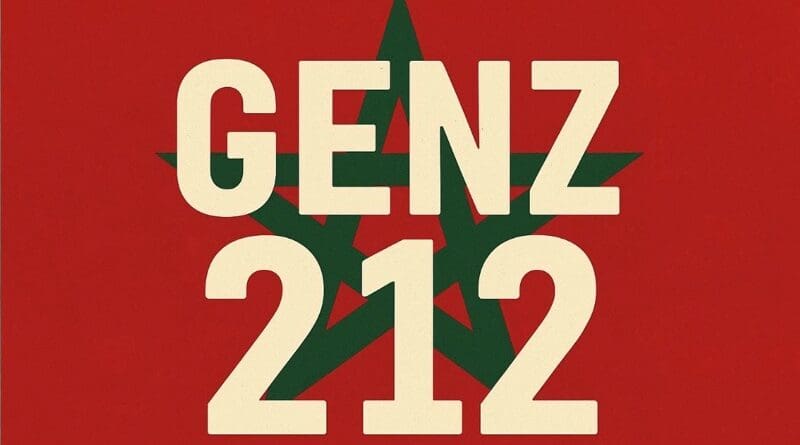
It is in this context that the GENZ212 protest movement has emerged, expressing a new generation (often called Generation Z) born after 2000, connected to social media and exposed to more transparent and inclusive models of governance on a global scale. The number 212, Morocco’s telephone code, symbolizes national roots, but also a desire to rebuild the social contract on new foundations.
GENZ212 challenges the “bak sahbî” system, denouncing it as one of the main obstacles to social justice, equal opportunities, and the emergence of a modern state. Their slogans, publications, and mobilizations highlight the need to break with clientelism and promote a model based on meritocracy, transparency, and the rule of law.
The protest led by GENZ212 is not only political, but also cultural and generational. It represents a break with the resignation accepted by previous generations. Thanks to social media, this group can publicly denounce injustices, document abuses, and mobilize horizontal solidarity that escapes the control of traditional clientelist networks (Yachoulti & Bailla, 2021).
GENZ212 thus illustrates a crisis of legitimacy: while the political system continues to operate on neo-tribal logic, a section of young people aspire to universal citizenship, free from inherited particularities and privileges. This contradiction is at the heart of the current tensions in Morocco.
Youth protest: GENZ212
In this context, the GENZ212 movement’s protest appears to be a significant generational break. Heirs to a society marked by “bak sahbî,” these young people, who are mostly urban and connected, reject neo-tribal logic as a mode of political and social organization (Chtatou, 2017, June 11) (. GENZ212 embodies a generation disillusioned by the unfulfilled promises of democratization and by the growing gap between official discourse and everyday realities (Bennani-Chraïbi & Jeghllaly, 2012).
GENZ212’s demands focus on three areas. First, denouncing favoritism that blocks social mobility. Second, demanding transparency in public administration, made possible by the use of social media and digital tools that allow corruption and clientelism to be documented and exposed. Third, the demand for egalitarian citizenship where merit and competence replace relational belonging as criteria for success (Aidi, 2020).
This movement reflects a profound change in cultural norms: young people reject the reinvented tribal logic and aspire to a political order aligned with universal standards of democratic governance. Unlike previous, more accommodating generations, GENZ212 rejects the neo-tribal compromise and poses a structural challenge to the political system.
GENZ212 and the continuity of social mobilization
GENZ212 is part of the continuity of Moroccan mobilization, particularly that of the February 20 Movement (Chapouly, 2011). However, its specificity lies in its place in the digital age. The use of digital communication tools allows for the rapid and horizontal dissemination of ideas, bypassing traditional channels of control (Desrues, 2013). This horizontality contrasts with the verticality of clientelist networks and introduces a new political culture where information and transparency become weapons of protest.
This movement is not limited to a rejection of the concept of “bak sahbî”; it implicitly proposes a new model of society where governance is based on competence, transparency, and equality. Although its demands have not yet led to major institutional changes, GENZ212 is helping to undermine the legitimacy of a political system based on neo-tribalism.
A structural challenge
Contemporary Morocco, while presenting itself as a modern state with constitutional institutions, remains permeated by social logics inherited from ancient structures, foremost among which is tribalism and its metamorphoses in the current context. The phenomenon of neo-tribalism (Chtatou, 2021, July 9), and more specifically clientelism, summed up in the popular expression “bak sahbî,” is a structuring element of the Moroccan political system and helps shape power relations, forms of loyalty, and mechanisms of social integration and exclusion (Chtatou, 2024, April 24). This system of personal relationships and particularistic solidarity networks has its origins in tribal and segmentary structures (Hart, 1976), but it has been reinvented within the framework of the modern state, notably by becoming institutionalized through political parties, the administration, and economic practices. The persistence of this neo-tribalism and its corollary clientelism largely explains the mistrust of younger generations, particularly the GENZ212 group, a symbol of a new rebellious civic consciousness that rejects the reproduction of inequalities and privileges through this mechanism.
The revolt against neo-tribalism (Chtatou, 2021, July 9) is not limited to a generational crisis, but challenges the Moroccan political economy as a whole. Clientelist mechanisms hinder social mobility, limit the equitable redistribution of resources, and fuel frustration in the face of massive youth unemployment (Bergh & Rossi-Doria, 2017). GENZ212, as an expression of an urban and connected youth, challenges not only corrupt individuals but also a global system of neo-tribal management. Their demands echo calls for the strengthening of the rule of law, already present in the mobilizations of the February 20 Movement (Chapouly, 2011), but with a digital and globalized language.
Neo-tribalism, embodied by the popular expression “bak sahbî,” is not simply a practice of favoritism or special privileges; it has become a veritable social infrastructure that permeates economic, cultural, and political relations. Its socio-economic and cultural dimensions, and its impact on democracy and governance, have resulted in emerging protests, notably those embodied by the GENZ212 group, which embodies a profound generational and ideological rupture in Moroccan society.
Economic dimensions of “bak sahbî”
Economically speaking, clientelism acts as a filter for access to resources. Positions in public administration, business licenses, land concessions, and even public contracts are often distributed based on relationships rather than principles of transparency or merit (Catusse, 2008). This creates a system in which the economy is heavily dependent on patronage networks (patron-client system), establishing a form of crony capitalism that limits competition and hinders innovation.
The consequences are manifold. First, young graduates who do not have strong connections find themselves marginalized. The unemployment of highly qualified urban youth is evidence of this systemic exclusion (Chtatou, 2018, October 15; Chtatou, 2024, April 24). Second, social inequalities are exacerbated because public resources are not redistributed according to collective needs, but rather to the benefit of loyal clienteles. Finally, foreign or entrepreneurial investment is hampered by the opacity of the system, discouraging independent initiatives that do not align with the dominant networks (Sater, 2010).
Social and cultural aspects of neotribalism
On a social level, the “bak sahbî” normalizes the idea that rules are negotiable and that universal rights do not apply equally. In the collective mindset, access to healthcare, employment, or quality education is often perceived as dependent on personal intervention (piston, wastâh) rather than a right guaranteed by the state (El Ayadi, Rachik & Tozy, 2007). This culture of personal mediation undermines modern citizenship, based on equality before the law, and reinforces an implicit hierarchy between those who “know someone” and those who remain isolated.
This situation also produces a culture of political cynicism. Citizens develop mistrust of institutions, which are perceived as corrupt or ineffective, and take refuge in informal strategies for social survival. This lack of trust fuels apparent depoliticization, but also latent frustration that can explode in times of crisis, as was the case with the February 20 Movement (Chapouly, 2011) in 2011 (Desrues, 2013) and the Hirak du Rif (Chtatou, 2017, June 11).
Clientelism and political governance
The “bak sahbî” directly influences the quality of governance. By favoring personal loyalties over competence, it reduces the effectiveness of public policies. Local infrastructure, natural resource management, and urban planning are often affected by choices motivated by the preservation of clienteles rather than the general interest (Saadi, 2012).
Furthermore, clientelism reduces political accountability. Once elected officials have come to power through their networks, they have little incentive to be accountable to citizens, since their legitimacy is based more on clientelist exchanges than on meeting collective needs. Democratic accountability is thus replaced by a logic of private distribution of public goods. This situation perpetuates a vicious circle in which citizens view voting not as a civic act, but as a transaction to obtain immediate benefits.
“Bak sahbî” as a political and social culture
The expression “bak sahbî” refers not only to a practice, but to a genuine political culture internalized by large segments of Moroccan society. It reflects a shared perception that “everything is about relationships” and that equality before the law is only an abstract ideal. This internalization produces a vicious circle: citizens, convinced that the rules are biased, seek to integrate themselves into clientelist networks in order to access their rights (Bennani-Chraïbi, 1994).
This culture has an impact on political sociability: it weakens modern citizenship, based on the individual and their rights, in favor of relational belonging. Far from fighting this logic head-on, the state uses it as a tool of control, rewarding loyalty and marginalizing opposition (Vermeren, 2016).
Furthermore, “bak sahbî” is not limited to the political sphere. It permeates the economic, educational, and social spheres. Access to prestigious universities, positions of responsibility, and even certain essential services (health, justice) may depend on the intercession of a relative or well-placed acquaintance. This fuels a sense of injustice and reinforces mistrust of the rule of law.
The consequences of neo-tribal clientelism
The consequences of neo-tribal clientelism are numerous and profound. On the one hand, it perpetuates inequalities. Those with connections are at an advantage, while others remain excluded, even if they have the skills or formal rights. On the other hand, it weakens institutional trust: citizens perceive institutions as empty shells, incapable of enforcing equal opportunities. This mistrust partly explains low voter turnout and citizens’ disengagement from formal political structures (Sater, 2010).
Furthermore, clientelism undermines meritocracy and promotes institutional mediocrity. Key positions are often assigned on the basis of networks rather than skills, which reduces the effectiveness of public policies and perpetuates a cycle of poor governance. Finally, this system has an impact on Moroccan youth, who feel excluded and without prospects, fueling frustration, illegal emigration, and protest movements.
The scourge of clientelism in Morocco
Clientelism in Morocco, although long-standing, continues to profoundly shape political and social relations, to the point of becoming a structuring mechanism of power and social hierarchies. It is not just an exchange of favors or a network of patronage, but a genuine political culture that influences perceptions of the state, citizen participation, and social organization (Catusse, 2008). In Moroccan society, this phenomenon takes several forms: from seeking the intermediation of a local notable to access a public service, to voting for a particular candidate in elections in exchange for promises or material benefits (Tozy, 1999). Thus, clientelism cannot be reduced to simple corruption; it is a deeply rooted social logic based on neo-tribal practices and the system of “bak sahbî,” or “it is thanks to my connections that I obtain my rights.”
The prevalence of clientelism can be explained by the intersection of social traditions and institutional modernity. Although committed to reform, the Moroccan state still relies on networks of notables, tribal leaders, and local elites to ensure its legitimacy and maintain social order (Chtatou, 2018, October 15). In this sense, the persistence of clientelism is an expression of “political hybridity” where the modern state coexists with ancient social logics, thus reinforcing the weight of personal relationships and social mediation over official institutions (Hibou, 2012).
The perverse effects of this system are manifold. On the one hand, clientelism weakens the rule of law by undermining the principles of equality before the law and equitable access to public services. Citizens find themselves obliged to go through intermediaries to obtain what should be a fundamental right, which fuels a sense of injustice and social frustration (Vermeren, 2011). On the other hand, it reinforces social inequality, as only those with strong networks can access benefits, while the most marginalized remain excluded. The phenomenon thus takes on a systemic dimension, fueling a vicious circle in which political loyalty is exchanged for material benefits, thereby consolidating the positions of local elites (Sater, 2010).
In the Moroccan context, clientelism is strongly linked to neo-tribalism. Traditional allegiances, where the tribe served as a framework for social and political organization, have adapted to political modernity by transforming themselves into networks of solidarity and electoral loyalty (Tozy, 1999). This system, often referred to as “bak sahbî,” is informal but unavoidable: to find a job, resolve an administrative issue, or access an economic opportunity, it is often more effective to mobilize one’s personal network than to resort to official institutions. This phenomenon reflects an “informalization of the state” where personal relationships take precedence over bureaucratic rules (Hibou, 2012).
Consequences for political dynamics
This clientelism also has consequences for political dynamics. Instead of promoting citizen participation based on democratic debate, it reduces citizens to passive actors who vote according to their immediate interests. Elections thus become a marketplace where votes are traded for individual or collective favors, which hinders the development of a true democratic culture (Storm, 2007). Far from strengthening representative institutions, this system consolidates the power of local elites and weakens accountability mechanisms.
Social unrest and the rise of protests, particularly those led by the younger generations grouped around the GENZ212 movement, can be explained in part by this rejection of the clientelist system. These young people, who are hyperconnected and aware of structural dysfunctions, perceive clientelism as an obstacle to social justice and equal opportunities (Catusse & Zaki, 2009). Their mobilization is based on a radical critique of neo-tribal and clientelist logic, which they consider responsible for the reproduction of inequalities and political immobility. In this sense, contemporary protest expresses a desire to break with old practices and a willingness to establish governance based on transparency, competence, and merit.
Thus, clientelism, far from being a mere relic of the past, is a living system, rooted in Moroccan social and political practices. Its deleterious effects on democracy and social justice largely explain the current tensions between a youth seeking change and a political system attached to its logic of reproduction. Understanding the ravages of clientelism in Morocco is therefore key to grasping one of the fundamental issues at the heart of the country’s governance crisis.
Critical conclusion: Towards political reform?
Analysis of clientelism and neo-tribalism (Chtatou, 2021, July 9) in Morocco shows that the concept of “bak sahbî” is not a simple marginal abuse, but a structural component of the system. It ensures a certain stability through the integration of local elites and the management of allegiances, but it profoundly undermines the legitimacy of the modern state and citizen equality. This paradox—stability through clientelist reproduction and instability through the erosion of trust—is one of the main challenges facing contemporary Morocco (Tozy, 1999; Sater, 2010).
The GENZ212 movement illustrates the crystallization of this contradiction. By rejecting the logic of neo-tribalism (Azim, 2024, July 2), these young people are expressing their desire to break with a system they perceive as stuck. Their emergence reflects a new process of politicization, rooted in digital tools and based on a more demanding conception of citizenship.
Ultimately, two scenarios seem possible. Either the Moroccan political system succeeds in integrating demands for transparency and merit by reforming its institutions and reducing the influence of clientelism. Or it persists in the logic of “bak sahbî,” at the risk of widening the gap between the rulers and the ruled and fueling increasingly radical forms of protest. In both cases, the confrontation between neo-tribalism (Chtatou, 2021, July 9) and universal citizenship appears to be a decisive issue for Morocco’s future.
Neo-tribalism and clientelism, condensed in the practice of “bak sahbî,” structure the Moroccan political system by combining stability and deadlock. While they ensure a certain continuity of power through the co-optation and integration of local elites, they also fuel citizen mistrust. The GENZ212 group embodies a generational and structural protest, calling for a transition from a system based on personal loyalties to a meritocratic and transparent institutional order. The confrontation between these two logics—neo-tribalism and universal citizenship—is one of the major challenges for Morocco’s political future (Chtatou, July 9, 2021).
Analysis of aspects of neo-tribal clientelism in the Moroccan political system reveals the depth of a phenomenon that cannot be reduced to simple corruption, but constitutes a genuine social and political infrastructure inherited from tribalism and reinvested in the modern state. The “bak sahbî,” as a culture and practice, structures power relations and conditions access to resources, while undermining trust in institutions and perpetuating inequalities.
However, this system is now facing growing resistance, embodied by a protesting and connected youth, of which the GENZ212 group is the most visible expression. This protest reflects a desire to rebuild the social contract on meritocratic and universal foundations, breaking with neo-tribal clientelism. Morocco’s future will depend on the ability of its institutions to respond to these aspirations, reform practices, and establish governance based on transparency and equal opportunity.
Ultimately, clientelist neo-tribalism (Chtatou, 2021, July 9) appears to be at once a historical legacy, a strategy for political control, and an obstacle to modernization. Overcoming it is a necessary condition for the emergence of effective democracy and for the reconciliation of younger generations with the state.
You can follow Professor Mohamed Chtatou on X: @Ayurinu
References :
- Aidi, H. (2020). Defining the Nation: Protest and National Identity in North Africa (Policy Brief PB-20/48). Policy Center for the New South. https://www.policycenter.ma/sites/default/files/PB_20-48_Aidi.pdf
- Azim, S. (2024, 2 juillet). La radicalité violente des jeunes à l’ère du numérique dans le contexte marocain. CAREP Paris. https://carep-paris.org/recherche/etat-societe-religion/la-radicalite-violente-des-jeunes-a-lere-du-numerique-dans-le-contexte-marocain/
- Ben Hadou, J. (2023). Social media and shaping public opinion in Morocco. Moroccan Journal for Research in the Humanities and Social Sciences, 2(2), 226–251. https://doi.org/10.34874/PRSM.mjrhss-vol2.iss2.43945
- Bennani-Chraïbi, M. (1994). Soumis et rebelles : les jeunes au Maroc. CNRS Éditions.
- Bennani-Chraïbi, M. (2013). L’espace partisan marocain : un microcosme polarisé ? Revue française de science politique, 63(6), 1163-1192. https://doi.org/10.3917/rfsp.636.1163.
- Bennani-Chraïbi, M., & Jeghllaly, M. (2012). La dynamique protestataire du Mouvement du 20 février à Casablanca. Revue française de science politique, 62(5), 867–894.
- Bergh, S. I., & Rossi-Doria, D. (2017). Politiser le regard sur les marges. Le cas du mouvement « sur la voie 96 » d’Imider au Maroc. L’Année du Maghreb, (23), 195–227. https://journals.openedition.org/anneemaghreb/5555?lang=en
- Burke, E. (1976). Prelude to protectorate in Morocco: Precolonial protest and resistance, 1860–1912. University of Chicago Press. https://archive.org/details/preludetoprotect0000burk
- Catusse, M. (2008). Le temps des entrepreneurs ? Politique et transformations du capitalisme au Maroc. Maisonneuve & Larose.
- Catusse, M. (2008). Le temps des entrepreneurs ? (1). Institut de recherche sur le Maghreb contemporain. https://doi.org/10.4000/books.irmc.525
- Catusse, M., & Zaki, L. (2009). Gestion communale et clientélisme moral au Maroc : les politiques du Parti de la justice et du développement. Critique internationale, 42(1), 73-91. https://doi.org/10.3917/crii.042.0073.
- Chapouly, R. (2011). Le “Mouvement du 20 février” au Maroc, une étude de cas de la coordination locale de Rabat [Mémoire de Master non publié]. Institut d’Études Politiques de Lyon.
- Chtatou, M. (2017, June 11). The reasons for the Rif revolt – Analysis. Eurasia Review. https://www.eurasiareview.com/11062017-the-reasons-for-the-rif-revolt-analysis/
- Chtatou, M. (2018, octobre 15). Le « Jurassic Park » politique du Maroc. Amadalamazigh. https://amadalamazigh.press.ma/fr/le-jurassic-park-politique-du-maroc/
- Chtatou, M. (2021, July 9). Tribalism and neo-tribalism in the Maghreb – Analysis. Eurasia Review. https://www.eurasiareview.com/09072021-tribalism-and-neo-tribalism-in-the-maghreb-analysis/
- Chtatou, M. (2024, April 24). Reflections on social exclusion and radicalization in the Arab World – Analysis. Eurasia Review. https://www.eurasiareview.com/24042024-reflections-on-social-exclusion-and-radicalization-in-the-arab-world-analysis/
- Desrues, T. (2013). Mobilizations in a hybrid regime: The 20th February Movement and the Moroccan regime. Current Sociology, 61(4), 409–423. https://doi.org/10.1177/0011392113479742
- Eisenstadt, S. N., & Roniger, L. (1984). Patrons, clients and friends: Interpersonal relations and the structure of trust in society. Cambridge University Press.
- Gellner, E. (1969). Saints of the Atlas. University of Chicago Press. https://archive.org/details/saintsofatlas0000gell
- Hart, D. M. (1976). The Aith Waryaghar of the Moroccan Rif: An ethnography and history. Tucson, AZ: University of Arizona Press.
- Hibou, B. (1999). La privatisation des États. Karthala.
- Hibou, B. (2012). Maroc : D’un conservatisme à l’autre. Sociétés politiques comparées, (36). https://fasopo.org/sites/default/files/legscolonial2_bh_1206.pdf
- Médard, J.-F. (1991). L’État néo-patrimonial en Afrique noire. In J.-F. Médard (Ed.), États d’Afrique noire: Formations, mécanismes et crise (pp. 323–353). Karthala.
- Rhani, Z., Ferrié, J.-N., Boutaleb, A., & Dupret, B. (Eds.). (2016). Le Maroc au présent : D’une époque à l’autre, une société en mutation. Centre Jacques Berque pour les Études en Sciences Humaines et Sociales; Fondation du Roi Abdul-Aziz.
- Saadi, M. S. (2016). Moroccan cronyism: Facts, mechanisms and impact (Working Paper No. 1063). Economic Research Forum. https://erf.org.eg/publications/moroccan-cronyism-facts-mechanisms-and-impact/
- Sater, J. N. (2016). Morocco: Challenges to tradition and modernity. Routledge.
- Storm, L. (2007). Democratization in Morocco: The political elite and struggles for power in the post-independence state. Routledge.
- Tozy, M. (1999). Monarchie et islam politique au Maroc. Presses de Sciences Po.
- Vermeren, P. (2011). Le Maroc de Mohammed VI : La transition inachevée. La Découverte.
- Vermeren, P. (2016). Histoire du Maroc depuis l’indépendance. La Découverte.
- Waterbury, J. (1970). The commander of the faithful: The Moroccan political elite—a study in segmented politics. Columbia University Press. https://archive.org/details/commanderoffaith0000wate
- Yachoulti, M., & Bailla, H. (2021). Youth virtual activism in Morocco: The case fact-checkers. In C. A. Breidlid & A. Breidlid (Eds.), Youth civic engagement and local peacebuilding in the Middle East and North Africa (1st ed., pp. 57–67). Routledge. https://doi.org/10.4324/9781003183747-4