Wednesday, June 25, 2025

At least 16 people dead as anti-government protests grip Kenya

At least 16 people died Wednesday in a fresh wave of anti-government protests that have swept across Kenya in the wake of the unexplained death of a popular blogger in police custody, the head of Amnesty Kenya said. The demonstrations also coincide with the one-year anniversary of last year's mass protests against President William Ruto's proposed tax hikes.


Issued on: 25/06/2025 
By: FRANCE 24

Protesters scatter as police fire teargas at them during a demonstration on the one-year anniversary of deadly anti-tax demonstrations in downtown Nairobi, Kenya, Wednesday, June 25, 2025. © Brian Inganga, AP

Sixteen people died during nationwide anti-government protests in Kenya on Wednesday, most of them killed by police, the head of Amnesty Kenya said, a year after deadly demonstrations against a tax bill culminated in the storming of parliament.

Youth-led protests against police brutality and poor governance have erupted across Kenya again, with thousands making their way to the central business district in the capital, Nairobi.

Some protesters clashed with police, and 16 people were "verified dead as of 8:30", Amnesty Kenya's executive director Irungu Houghton told Reuters, adding that the figures were verified by the global rights watchdog and the Kenya National Commission on Human Rights (KNCHR).

"Most were killed by police," Houghton said, adding that at least five of the victims had been shot dead.

The protests, which coincided with the first anniversary of demonstrations opposing tax hikes that left 60 people dead and 20 others missing, followed last week's rallies that demanded answers for the unexplained death of a Kenyan blogger while in police custody.

Read more  Kenya's deputy police chief steps aside as blogger's death investigated

Kenyan police spokesperson Muchiri Nyaga declined to comment on the statements by Amnesty Kenya or KNCHR.

State-funded body Independent Policing Oversight Authority (IPOA) said in a statement at least 61 people were arrested during the protests.

An official at the capital's main Kenyatta National Hospital said the facility had received dozens of wounded people.

"107 admitted, most with gunshot injuries," the source said, referring to rubber bullets and live rounds. He added that no deaths had been reported at KNH.

The Communications Authority of Kenya has directed local media to stop all live broadcasts of the protests halfway through the day as President William Ruto warned that violence wouldn’t be tolerated.

Many turned to social media to share updates and remember slain protesters. Others posted anti-government messages and memes. On the streets, some could be seen offering protesters water.


'Too many Kenyans are losing their lives'


Calls for accountability have grown louder in Kenya after a street hawker was killed during last week's protests. A Kenyan court has given detectives 15 days to complete investigations into two police officers suspected of the shooting.

This came as young people flooded social media platforms throughout the week with commemorations of protesters killed last year. At the time, Ruto apologised and vowed to end police brutality as the top police chief resigned.

“Not a single officer has been held to account,” said Hussein Khaled, a human rights activist, adding that people took to the streets “to demand justice in terms of compensation ... arrest of those officers who were involved ... police reforms because too many Kenyans are losing their lives” to police brutality.

Last year’s deadly protests strongly opposed a finance bill that raised taxes significantly to address debt, putting an undue burden on young, educated people struggling with unemployment and a rising cost of living. Ruto later scrapped the bill.

Some tax proposals were reintroduced later, drawing widespread criticism and calls for Ruto's resignation, following the appointment of a new but widely criticised cabinet. A revamped healthcare levy also changed standard premiums to a progressive tax, based on income.

Kenyan court declares Nairobi protest ban illegal

14:25
EYE ON AFRICA © FRANCE 24


United Nations' data shows that 70 percent of sub-Saharan Africa is under the age of 30, with 67 percent of Kenya's young people unemployed.

“Both the health and the education sectors, which greatly affect the youth, are seemingly sinking due to misguided policies and failure to provide needed resources. At the same time, there appears to be unlimited funds for ‘aristocratic’ luxuries,” said Macharia Munene, professor of history and international relations at United States International University Africa in Nairobi, referring to some state people’s spending that has been strongly condemned.

Ruto has been accused of misappropriating taxpayer money on lavish trips, most notably the use of a private jet on his trip to the United States right before last year’s protests. He apologised and dismissed ministers accused of incompetence, corruption and displays of opulence amid complaints about the high cost of living.

Meanwhile, Kenya's opposition received its share of criticism, with many saying it avoided challenging the status quo after some of its members were appointed in Ruto's new cabinet

“Enough is enough ... We are here for change, it is time for us to get our nation (back),” said protestor Sevelina Mwihaki. “The blood that we have shed is enough."

(FRANCE 24 with AP and Reuters)


Thousands of Kenyans stage street protests one year after storming parliament

Thousands of protesters have taken to Kenya's streets to mark a year since people stormed parliament at the peak of anti-government demonstrations, despite fears that they would be met by state-backed gangs and police violence. Sixty people were killed during last year's protests and 20 others remain missing.


Issued on: 25/06/2025 - RFI

A protestor in a protective mask participates in a demonstration to mark the first anniversary of the 2024 anti-government protests that left more than 60 people dead and drew widespread condemnation over the use of force by security agencies, in Nairobi June 25, 2025. REUTERS - Monicah Mwangi

Activists and families of victims have called for peaceful demonstrations to mark a year since the deadliest day of the unrest when parliament was invaded.

But some have called to "OccupyStateHouse" – referring to the Nairobi office of President William Ruto – and many schools and businesses are closed for fear of unrest.

Early on Wednesday, police blocked major roads leading into the capitals central business district, while government buildings were barricaded with razor wire.

At least 10 people have been admitted to Kenyatta National Hospital in Nairobi with gunshot wounds, a hospital source and Kenya's Citizen Television said.

Thousands of mainly young male protesters waved Kenyan flags and placards with pictures of some of the 60 demonstrators killed last year and chanted "Ruto must go".

"I've come here as a Kenyan youth to protest, it is our right for the sake of our fellow Kenyans who were killed last year. The police are here... they are supposed to protect us but they kill us," Eve, a 24-year-old unemployed woman told France's AFP news agency.

"It is extremely important that the young people mark June 25th because they lost people who look like them, who speak like them... who are fighting for good governance," said Angel Mbuthia, chair of the youth league for the opposition Jubilee Party.


'Goons'

As well as marking the anniversary, anger has flared over police brutality, particularly after a teacher was killed in custody earlier this month following his arrest for criticising a senior officer.

Police said protests are permitted as long as they are "peaceful and unarmed".

Police officers walk during a demonstration to mark the first anniversary of the 2024 anti-government protests that left more than 60 people dead and drew widespread condemnation over the use of force by security agencies, in Nairobi, Kenya June 25, 2025. REUTERS - Thomas Mukoya

But a group of peaceful protesters last week was attacked by a large gang of motorbike-riding "goons", as they are known in Kenya, armed with whips and clubs and working in tandem with the police.

Western embassies in Kenya, including those of Britain, Germany and the United States, criticised in a joint statement "the use of hired 'goons' to infiltrate or disrupt peaceful gatherings".


Threatening the nation

There is deep resentment against Ruto, who came to power in 2022 promising rapid economic progress.

Many have been disillusioned by continued stagnation, corruption and high taxes, even after last year's protests forced Ruto to cancel the unpopular finance bill.

While his government has been at pains to avoid direct tax rises this year, the frequent disappearances of government critics – rights groups have counted more than 80 since last year's protests, with dozens still missing – have led many to accuse Ruto of returning Kenya to the dark days of its dictatorship in the 1980s and 1990s.

Ruto has previously promised an end to abductions but was unapologetic in a speech on Tuesday, vowing to "stand by" the police. "You cannot use force against the police or insult or threaten the police. You are threatening our nation," he warned protesters.

(with newswires)


Can Kenyan youth protests spark real police reform one year on?


One year after major protests against corruption, Kenyans are holding remembrance marches for victims of police violence. Renewed demonstrations follow the death of a teacher in custody. RFI spoke to a policy analyst on whether youth protests can drive real reform.


Young activists react as a protester interrupts a sermon during an interdenominational service held to honour victims of Kenya's historic June 2024 protests as activists called for a symbolic presence in churches nationwide ahead of the first anniversary of the Gen Z-led uprising at All Saints Cathedral in Nairobi, on 22 June 2025. AFP - LUIS TATO


By: Melissa Chemam
Issued on: 25/06/2025 
RFI


In 2024, widespread protests erupted across Kenya in response to a proposed bill that sought a significant increase in taxes, culminating on 25 June. These demonstrations were met with a forceful and violent response from the police.

At least 60 people were killed during protests in June and July 2024, and dozens more were illegally detained by security forces in the aftermath.

This year, the country's youth are back on the streets protesting against that violence.

Although the government had called for calm since last summer, the death of Albert Ojwang in police custody - arrested for publishing a blog post criticising a police officer - sparked a new wave of protests in early June this year.


Civil society activists hold placards as they demonstrate against the death of Kenyan blogger Albert Ojwang in police custody, in the city of Mombasa, Kenya, on 17 June 2025. REUTERS - Laban Walloga

Douglas Kivoi, a policy analyst at the Kenya Institute for Public Policy Research and Analysis (KIPPRA), told RFI that he was not surprised by the events, as they reflect the typical conduct of police officers in the country.

Kivoi has been studying the role and behaviour of the police in Kenya for many years.

"They are used in settling political scores and silencing any dissent that the powers are not comfortable with. So that is just one of the few that made it to the public domain. Many of those cases hardly make it to the media. If the family keeps quiet or is threatened with dire consequences," he told RFI.

"We have a progressive constitution but our police officers have refused to change and transform themselves and align themselves with best international practices," Kivoi added.

Pro-government counter-protesters and riot police officers disperse people protesting over the death of Kenyan blogger Albert Ojwang in police custody, in downtown Nairobi, Kenya, on 17 June 2025. REUTERS - Thomas Mukoya


Protesters and counter-protesters

Counter-protesters are also marching and supporting the police, raising fears of new violence, especially in Nairobi.

Addressing the crisis last Tuesday, Kenya's President William Ruto promised to put an end to abductions, but was unapologetic in his latest speech, vowing to "stand by" the police.

"You cannot use force against the police or insult or threaten the police. You are threatening our nation," he warned protesters.

Kivoi, however, points out that shooting someone at point-blank range, as has happened in a recent incident, cannot be justified in any circumstances.

"Someone who is just selling masks in the streets and then is shot at point blank range - I mean, how on earth would anybody do that knowing that the institution that they work for is under scrutiny for another murder of an individual who was arrested for a misdemeanour offense and then tortured to death in the police detention facilities?," he asks

He believes this demonstrates that impunity within the police service and related policing agencies runs deeper than is apparent to the public.

Problems in police agencies

Kivoi believes that violence within Kenya’s police force has been an issue since before the country’s independence.

He points out that even the most well-considered recommendations from police reviews and his own research have yet to be implemented.

"We take one step forward and then we take five steps backwards," Kivoi told RFI.

"Since independence in 1963, the first president, Jomo Kenyatta, used police to silence any dissent. And when the second president (Daniel arap Moi) took over, it was the same story," he said. "Assassinations, torture, detention."

Later, when Mwai Kibaki assumed the presidency in 2002, he attempted to reform the police. However, the post-election violence of 2007-2008 marked a turning point, with numerous accusations directed at police officers for their actions. Many victims lost their lives either due to police gunfire or the failure of the police to act.

In 2010, Kenya drew-up and implemented a new constitution, which is progressive according to many including Kivoi.

The country also put in place institutions like the Independent Policing Oversight Authority, in an attempt to delink police from the office of the president.

"I believe the problem lies in our policing agencies. It's not the resources," he said. "So, if you carry out reforms in the name of changing institutions' names and changing uniforms from the Kenya Police Force to National Police Service, that doesn't change the attitude of these officers as they approach their work and in the way they interact with communities."

To solve this problem he argues that the training of police officer must change.

"We need to change the way our officers are trained, then to depoliticise the policing, because police officers, since independence, have been used by the government of the day to settle political scores, arrest people without any justifiable reason, like Ojwang, who was tortured and killed in a police facility."


System change


Kenya's Office of the Director of Public Prosecutions said on Monday said it would press murder charges against six people, including three police officers, for their role in killing Ojwang. The six suspects were arraigned on Tuesday.

Kivoi thinks that it is still difficult to highlight issues of police excesses and punitive actions because the media in Kenya "sometimes goes to bed with the government", and doesn't denounce police brutality.

"But the fact that we have got social media, and then we have got a young population that has embraced technology, makes it more difficult for police to think that they will behave the way they have been behaving and get away with it."

The protests, and the technology helping reporting them, are playing a critical role in highlighting cases of police excesses when they are interacting with the civilians.

Kenya rights groups have counted more than 80 disappearances of government critics since last year's protests, with dozens still missing.


PODCAST
Play - 34:10

Justice and art: Kenya’s fight against police brutality; Africa’s bold new art fair in Basel


Issued on: 24/06/2025 - 

In this episode, Spotlight on Africa reviews the origins of protests in Kenya against police brutality. And you'll also hear from the co-founders of the Africa Basel contemporary art fair, in Switzerland, the newest event of its kind.

Kenyan police officers guard the entrance to Central Police Station following a protest over the death of blogger Albert Ojwang, who died in police custody under disputed circumstances, in Nairobi, on 9 June 2025. AFP - LUIS TATO

This week, we go to East Africa where Kenyans are protesting to denounce police brutality, exactly a year after a wave of protests organised against an unjust tax, that led to police violence.


Protesters hold banners and chant slogans demanding the resignation of Eliud Lagat, Deputy Inspector General of the Kenya Police Service, during a demonstration over the death of Kenyan blogger Albert Ojwang, who died in police custody, in downtown Nairobi, on 12 June 2025. © Luis Tato / AFP

This year's protests were triggered by the killing by the police of a teacher and blogger in his cell. Albert Ojwang, 31, had been arrested for criticising a policeman online.

On Monday (23 June), Kenyan prosecutors said they were charging six people, including three police officers, with murder over his death.

To better understand the issues surrounding this incident, Spotlight on Africa podcast spoke to Douglas Lucas Kivoi, Principal Policy Analyst, Governance Department, Kenya Institute for Public Policy Research and Analysis (KIPPRA).

Africa Basel

Africa Basel launched this year in June 2025. © Africa Basel

We also head to Switzerland for a new artistic event known as Africa Basel.

This first edition of a contemporary African art fair was created to coincide with the largest fair in the world, Art Basel, in Switzerland. It was held from 17 to 22 June, with over 30 galleries and dozens of artists.


Togolese and Nigeria artists Clément Gbegno and Helen Nzete with the two co-founders of Africa Basel, Ben Füglister and Sarah Hachi-Duchêne, in Basel, Switzerland mid-June 2025. © Africa Basel

Spotlight on Africa spoke with the two co-founders of the event, as they opened the first days of the event in Basel: Benjamin Füglister, artist and cultural entrepreneur born in Switzerland, and now the director of the Africa Basel and Sarah Hachi-Duchêne, curator at unx.art.

Episode mixed by Melissa Chemam and Cecile Pompeani.

Spotlight on Africa is produced by Radio France Internationale's English language service.

By: Melissa Chemam


Kenya police officers charged with murder over death in custody


Kenyan prosecutors said Monday they were charging six people, including three police officers, with murder over the death of a teacher while in custody that has triggered protests. Albert Ojwang, 31, was found dead in a police cell in Nairobi earlier this month.


Issued on: 23/06/2025 - RFI

Demonstrators react to the death of Kenyan blogger Albert Ojwang, who died while in police custody, in Nairobi, Monday, 9 June, 2025. AP - Andrew Kasuk


Police initially claimed he had taken his own life until government pathologists found he had been killed.

The case sparked rallies against police brutality – a long-running complaint in the east African country – which were met with tear gas and a mob of violent paid "goons" last week.

There was also outrage after an incident, witnessed by reporters from French news agency AFP and widely shared on social media, in which a police officer shot a bystander to the protests at point-blank range. He remains in critical condition in hospital.

Ojwang was initially arrested over allegedly criticising deputy police chief Eliud Lagat in online posts.

Lagat has "stepped aside" during the investigation into Ojwang's death, but protesters have called for his full resignation and charges against him.

The Office of the Director of Public Prosecutions (DPP) said on social media platform X that it had "approved murder charges against six individuals", including three officers and three other suspects, who were presented at Nairobi's Kibera High Court on Monday.
Anniversary of protests

Earlier this month, the Independent Policing Oversight Authority said 18 people had died in police custody in the past four months.

Ojwang's death comes at a sensitive time as Kenya marks the anniversary on Wednesday of massive Gen Z-led demonstrations against President William Ruto's government last year

On Monday, a government spokesperson said there would be "no protests" on 25 June, instead asking people to commemorate at home.

But last week, Nairobi Regional Police Commander George Seda told reporters his officers were prepared for protests, urging people to restrict themselves to "peaceful demonstrations".

(with AFP)
Thai cannabis stores fret as government moves to tighten rules on sales

Bangkok (AFP) – Thai cannabis store owners and activists on Thursday hit out at new government plans to tighten the rules on selling the drug by requiring a doctor's approval, three years after it was decriminalised.


Issued on: 26/06/2025 -


Thailand's government has announced a plan to tighten rules on selling cannabis, the kingdom's latest attempt to restrict the drug, three years after it was decriminalised © Chanakarn Laosarakham / AFP/File


The kingdom was the first country in Southeast Asia to decriminalise the drug when it removed cannabis from the list of banned narcotics in June 2022.

The intention was to allow sales for medical rather than recreational use, but the move led to hundreds of cannabis "dispensaries" springing up around the country, particularly in Bangkok.

While the relaxation has proved popular with some tourists, there are concerns that the trade is under-regulated.

Health Minister Somsak Thepsuthin signed an order late on Tuesday requiring an on-site doctor to approve sales for medical reasons.

The rule would only come into force once it is published in the official Royal Gazette. It is not clear when this would happen.

Thanatat Chotiwong, a long-time cannabis activist and store owner, said it was "not fair" to suddenly change the rules on a sector that was now well established.

"This is a fully-fledged industry -- not just growers selling flowers. There are lighting suppliers, construction crews, farmers, soil and fertiliser developers, and serious R&D," he told AFP.

"Some of us have invested tens of millions of baht in greenhouses and infrastructure. Then suddenly, the government steps in to shut it all down."

Thanatat urged the government instead to "implement proper taxation and regulation -- so this revenue can be returned to society in a meaningful way."

- 'Too few doctors' -

The government has made several previous announcements of plans to restrict cannabis, including legislation moved in February last year, but none has come to fruition.

The new rules would mean cannabis could only be sold to customers for medical reasons, under the supervision of licensed professionals such as medical doctors, traditional Thai medicine doctors, folk healers or dentists.

"It's going to work like this: customers come in, say what symptoms they have, and the doctor decides how many grams of cannabis is appropriate and which strain to prescribe," Kajkanit Sakdisubha, owner of The Dispensary cannabis shop in Bangkok, told AFP.

"The choice is no longer up to the customer -- it's not like going to a restaurant and pick your favorite dish from a menu anymore."

And he warned that many of the shops that had sprouted since decriminalisation would not be able to adapt to the changes.

"The reality is there are too few doctors available. I believe that many entrepreneurs knew regulations were coming, but no one knew when," he said.

While waiting for the rules to come into force, The Dispensary is halting cannabis sales as a precaution, store manager Bukoree Make said.

"Customers themselves are unsure whether what they're doing is legal. I've been receiving a lot of calls," Poramat Jaikla, the lead seller or "budtender", told AFP.

The cannabis move comes as the government led by Prime Minister Paetongtarn Shinawatra's Pheu Thai party is hanging by a thread after losing its main coalition partner, Bhumjaithai.

Though conservative, the Bhumjaithai party has long supported more liberal laws on cannabis.

The party quit the coalition this month in a row over a leaked phone call between Paetongtarn and former Cambodian leader Hun Sen.

© 2025 AFP


Thailand decriminalised cannabis 3 years ago. Now it’s banning sales without a prescription

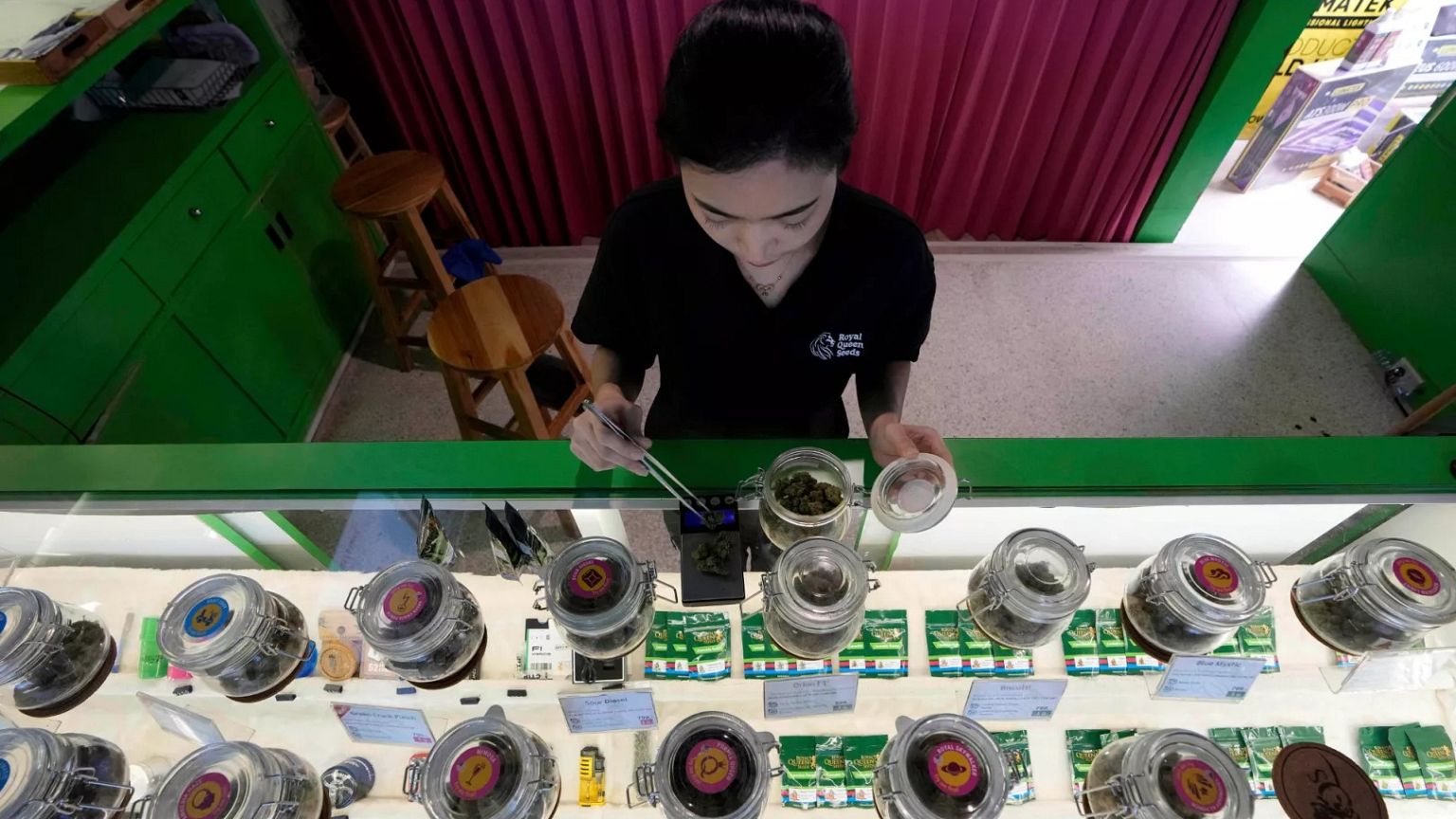
A staff prepares flower bud of cannabis for a customer at cannabis shop in Bangkok, Thailand, July 18, 2024.
Copyright Sakchai Lalit/AP Photo

By Euronews with AP
Published on 

The shift comes amid a rift between former coalition partners in the Thai government.

Thailand is further tightening control of cannabis by banning sales of the plant to those without prescriptions.

Thailand became the first country in Asia to decriminalise cannabis in 2022, in a move that boosted Thailand’s tourism and farming, and spawned thousands of shops.

But the country has faced public backlash over allegations that under-regulation has made the drug available to children and caused addiction.

Health Minister Somsak Thepsutin signed an order this week that bans shops from selling cannabis to customers without a prescription. It also seeks to reclassify cannabis buds as a controlled herb.

Phanurat Lukboon, secretary-general of the Office of the Narcotics Control Board, said Wednesday that his agency is ready to study and implement the change in regulations.

The order did not detail any punishment for the violation. It will take effect when it is published in the Royal Gazette, although it was unclear when that would happen.

The ruling Pheu Thai Party previously promised to criminalise the drug again, but faced strong resistance from its former partner in the coalition government, the Bhumjaithai Party, which supported decriminalisation.

Somsak told reporters that he would like to relist cannabis as a narcotic in the future. The move came after officials last month revealed that cannabis smuggling cases involving tourists had soared in recent months.

Phanurat said that a study done by his agency last year found the number of people addicted to cannabis had spiked significantly after it was decriminalised.

A group of cannabis advocates said Wednesday that the change in regulations was politically motivated. The group said they will rally at the Health Ministry next month to oppose the change and the attempt to make it a criminal offence again to consume or sell cannabis.


Embattled Thai PM reshuffles cabinet as crisis rages

Bangkok (AFP) – Thai Prime Minister Paetongtarn Shinawatra began a cabinet reshuffle on Monday as a political and judicial crisis sparked by a leaked phone call threatens to sink her government.


Issued on: 23/06/2025 - RFI

Paetongtarn Shinawatra is battling a political crisis © Handout / ROYAL THAI GOVERNMENT/AFP

The 38-year-old daughter of controversial former premier Thaksin Shinawatra began handing out ministerial posts vacated when her main coalition partner quit last week -- a move that nearly took her government down.

Paetongtarn, in office for less than a year, is hanging on by a thread, and on top of the party horse-trading she now faces a Constitutional Court case that could see her barred from office.

She faced calls to quit or call an election last week as critics accused her of undermining the country and insulting the army during the leaked call with former Cambodian leader Hun Sen, which focused on a festering border dispute.

The conservative Bhumjaithai party quit the governing coalition led by Paetongtarn's Pheu Thai party over the call, leaving it with a wafer-thin majority.

But the crisis stabilised as other coalition partners said they would stay, and Pheu Thai secretary general Sorawong Thienthong told AFP on Monday that all 10 remaining parties were sticking with the government.

"None of the other parties are pulling out -- the remaining parties are staying united with the government," Sorawong said.

"The prime minister has discussed the reshuffle with other political leaders."

The new cabinet line-up will be finalised by Friday but sources said changes are expected in key positions including the defence ministry as the border row with Cambodia rumbles on.

The long-running dispute over several small stretches of the frontier in northeast Thailand flared into military clashes last month that left one Cambodian soldier dead.

The standoff has shown little sign of going away and on Monday the Thai army closed border crossings in six provinces to all vehicles and foot passengers except students and people seeking medical treatment.

The latest border restrictions apply to foreigners as well as Thais, and mean that tourists cannot enter Cambodia via the popular Aranyaprathet-Poipet crossing point.

The move came a day after Cambodian Prime Minister Hun Manet ordered a halt to fuel and gas imports from Thailand.

He visited troops on the border on Monday and an evacuation centre housing some 3,850 people moved from their homes near the border as a precaution.

Hun Manet said Monday that the "key" to normalising relations again lay with Thailand, blaming "Thai nationalism and internal politics" for the dispute.
Court case looms

With the loss of Bhumjaithai, the government can command only a handful more than the 248 votes needed for a majority in parliament, making it deeply vulnerable.

A group of political activists involved in huge demonstrations that helped sink previous leaders linked to the Shinawatras has pledged to hold a major rally on Saturday calling for Paetongtarn to quit.

Even if Paetongtarn rides out the parliamentary crisis, a potentially bigger threat is looming in the Constitutional Court.

A group of conservative senators has submitted a petition asking the court to throw Paetongtarn out of office over her conduct in the call with Hun Sen.

The same court sacked Paetongtarn's predecessor, Srettha Thavisin, in an ethics case in August last year.

Srettha was the latest in a long line of Thai prime ministers from parties linked to Thaksin to be kicked out of office by court orders or military coups -- including Thaksin himself and his sister Yingluck Shinawatra.

Thai politics has endured two decades of chronic instability fuelled by a long-running battle between the military, pro-royalist establishment and parties linked to Thaksin.

While Thaksin, 75, remains popular with his rural base, he is deeply disliked and distrusted by Thailand's powerful elite.

In another headache for the Shinawatras, Thaksin faces a criminal trial next week for insulting the monarchy in an interview with South Korean media a decade ago.

Under Thailand's strict lese-majeste laws, insulting King Maha Vajiralongkorn or his close family is punishable by up to 15 years in jail for each offence.


burs-pdw/dhw

© 2025 AFP


RFI investigation

Libya's Al-Khadim airbase becomes a hub for Russian arms in the Sahel


Amid renewed relations with Libya, Russia is relying on the Al-Khadim base near Benghazi to strengthen its military presence in the Sahel region of Africa. RFI journalists were able to trace the itinerary of a Russian cargo plane from Syria to Libya, one of many flights operating on this route.


Issued on: 23/06/2025 -

A Russian-made Antonov-124 pictured at the Al-Khadim base in Libya on 18 May, 2025. © Satellite image - 2025 Maxar Technologies.

LONG READ

The airbase in Hmeimin in the Latakia province of Syria, along with the naval base in Tartus are key military outposts for Russia. The overthrow of longtime Syrian ruler and Russian ally Bashar al-Assad in December cast the future of these bases into doubt, with Western countries hoping to pressure Damascus into closing them.

Russia, whose military backing helped Assad cling to power, has sought to retain the two bases and has begun discussions with the new interim leadership under former rebel leader Ahmed al-Sharaa.

In the meantime, reports show that Russia has begun shifting some of its equipment to other bases – notably in Libya.

Using satellite imagery and flight radar information, RFI’s investigative unit Info Vérif was able to trace last month's voyage of a Russian Antonov-124 plane, which took off from the Hmeimin base and arrived at the Al-Khadim base in Libya.

The Russian Hmeimin Air Base in the Latakia province of Syria, on 8 January, 2025. © Espérance Nbolima/RFI

The Antonov-124 is designed to carry heavy, bulky loads (up to 100 tonnes), but it requires long, concrete runways for lift-off. In total, there are an estimated 20 aircraft of this type still in service worldwide, mostly used by Ukraine and Russia.

RFI journalists focused on an Antonov-124 (RA-82030) operated by a logistics company known as 224 Flight Unit, a subsidiary of the Russian Ministry of Defence.

Numerous clients, both private and state-owned (including the French army), used its services for special air transport missions, before the unit's fleet was placed under international sanctions. Their website's mission history has not been updated since 2014.

Wagner replaced in Mali by Africa Corps, another Russian military group
10,000km round trip

Among the aircraft in its fleet is the aircraft coded RA-82030, registered as a civil aircraft.

At the end of May, as indicated by data from the tracking website Flight Radar 24, it completed a journey of nearly 10,000km between Syria and sub-Saharan Africa.

Its first stop was the Libyan base of Al-Khadim, located around 100km east of Benghazi, the capital of Cyrenaica – a region in the hands of Marshal Khalifa Haftar, who is backed by Russia.

The Russian cargo plane initially appeared on screens on 16 May, 2025, at 3:17pm, a few dozen kilometres from the Russian base in Syria.

The speed and altitude at the time the data was transmitted to online open-source tracking sites confirmed that the plane took off from the Hmeimin base. But less than an hour later, the sites lost track of it before it reappeared north of Egypt, heading southwest.

An aeronautical engineer who wished to remain anonymous told RFI that it is not unusual in some cases for location data to suddenly disappear.

The Russian Antonov-124 (RA-82030) after its departure from Hmeimim air base(Syria), bound for the Al-Khadim base, in Libya. © FlightRadar24

"The transponder's Automatic Dependent Surveillance-Broadcast [AIS] function can be cut off, which isn't very prudent if the crew is flying in the United States, the European Union, and a few other countries. But it's not illegal as long as the transponder's Mode S [aircraft communication mode] is maintained," he explained.

"It could also be that the plane is simply flying through dead zones in terms of ADS-B receivers connected to tracking platforms. In this case, it looks very much like an intentional disconnection. It's quite typical. Moreover, the plane is over the Mediterranean and the airspace is not congested, so no one is going to come and protest," the expert added.

Sahel ministers in Russia for talks after breaking with western allies

To confirm the exact whereabouts of the Antonov 124 plane, RFI contacted Maxar, a North American company specialising in satellite images and Earth observation.

On 18 May, two days after leaving Syria, the aircraft was found parked on the Al-Khadim runway. No other aircraft of the same type had been reported in the area at the same time.

According to flight logs, the aircraft continued its journey, stopping in the Malian capital Bamako and Ouagadougou in Burkina Faso between 20 and 26 May, before finally heading back to Russia.

The Russian Antonov-124 (RA-82030) at the Al-Khadim Air Base, located about 100km east of Benghazi, Libya on 18 May, 2025. © Satellite image - 2025 Maxar Technologies.

It is not clear what type of equipment was unloaded or loaded on this particular flight, but the aircraft's cargo bay is large enough to carry several aircraft or armoured vehicles without having to completely dismantle them.

In the past, these large carriers have delivered aircraft, helicopters, radars and surface-to-air systems to countries in the Alliance of Sahel States.

RFI’s investigative unit analysed the records of previous flights to get an idea of the scale of Russian activity in the region. They found that the same plane took off from Syria on 4 May, departing from Syria and reappearing later in the vicinity of the Al-Khadim base.

Several open-source reports suggest that similar activities have been happening at this base in recent months.


Telegram messages


Earlier this year, French newspaper Le Monde documented eight flights between December 2024 and January 2025 between Hmeimin and Al-Khadim.

RFI reviewed several Telegram channels close to the paramilitary Wagner Group and the Kremlin-controlled Africa Corps, and found references to Russian weapons deliveries to Al-Khadim – including heavy weapons and armoured vehicles of the same type as those used by Russia in Syria.

One Telegram post reads: "New organisations. New technology. Old places. Remember your roots!" The author is likely referring to Wagner's first deployments in Libya in 2018, or to the Cold War era in which the Libyan army fielded Soviet equipment.

RFI was able to geolocate this video, which was filmed in front of the hangars at the Al-Khadim base.

Another video broadcast on Telegram, taken from the cockpit of a transport aircraft, confirms the use of this area by Russian cargo planes.

RFI geolocalised a photo showing Russian weapons deliveries to Al-Khadim air base in Libya, including heavy weapons and armoured vehicles of the same type as those used by Russia in Syria. © Screengrab/ montage RFI


Diplomatic moves


For Lou Osborn, of the All Eyes On Wagner collective, this presence can be explained by a rapprochement between Moscow and Benghazi. This became more apparent following the death of Wagner leader Yevgeny Prigozhin, whose plane crashed in August 2023 shortly after he led a rebellion against Russian President Vladimir Putin.

The fall of Bashar al-Assad’s regime in Syria also sped up a push for stronger diplomatic ties elsewhere, Osborn said. "We saw a kind of logistical ballet of Russian planes towards Libya. There is a fairly strong rapprochement, political and military, between Haftar's Libya and the Kremlin."

Moscow has also tried to forge ties with the officially recognised government in Tripoli, through the opening of embassies, Osborn added, saying that there have also been overtures in Algeria and Tunisia – "countries that are very aware of what is happening in the region, with military attachés, particularly in Algeria, who travel back and forth to Libya".

The flight of the RA-82030, which was also tracked in early June, is one of many signs that Russia appears to have successfully restructured its overseas presence, and is able to rely on a network of bases in Africa – ensuring the growth of the Africa Corps, and broader support for Moscow's regional allies.

This article is based on an original report in French by Olivier Fourt and Grégory Genevrier and has been edited for clarity.
French court orders state to compensate family of jogger killed by toxic algae

around 90 percent of Brittany's algae blooms are caused by agriculture

A French court on Tuesday ordered the state to compensate the family of a 50-year-old man who died in 2016 during a run after inhaling poisonous gas emitted by rotting green algae piled along the country's western coast. This decision marks the first time France has been held liable for the health risks posed by deadly green algae blooms along its coast.


Issued on: 25/06/2025 - RFI

Green algae in Plonevez-Porzay in Brittany, western France. 
(File photo/2010) © AFP - Fred Tanneau

The Nantes appeals court found France liable for the death of Jean-René Auffray, citing its "negligence" in enforcing environmental regulations to protect its waters and prevent toxic green algae blooms.

For more than five decades, tons of green algae have washed up annually on Brittany's beaches in western France, releasing hydrogen sulphide gas as it rots - a toxin that can prove deadly in high concentrations.

Auffray, a keen trail runner, died of sudden respiratory failure while jogging in the algae-choked Gouessant estuary near the city of Saint-Brieuc.


Toxic algae

His family sued over his death, but in 2022 a court rejected the claim, ruling there was insufficient evidence to link the toxic algae to Auffray's death.

Tuesday's decision reversed that ruling, marking the first time France has been held liable for the health risks posed by deadly green algae blooms along its coast.

The court "holds the State liable for negligence due to its failure to implement European and national regulations designed to protect waters from agricultural pollution", which is "the main cause of the proliferation of green algae in Brittany", it explained in a statement.

Green algae: French government blamed for water pollution

The court found Auffray's death was caused by a rapid pulmonary oedema – a condition in which there is too much fluid in the lungs – which could only be explained by fatal poisoning from inhaling hydrogen sulphide at very high concentrations.

"For the first time, a French court has recognised the link between a person's death and the state's negligence in these green algae cases," said the family's lawyer, Francois Lafforgue.

The deceased's family will receive partial compensation, as the court found the state 60 percent liable, noting that he had taken a personal risk by jogging in the estuary.

The state has been ordered to pay 277,343 euros to the jogger's wife, 15,000 euros to each of his three children, and 9,000 euros to his brother.

Raising pork in Brittany the eco-friendly way


Nitrate pollution

According to a 2021 report from France's top audit court, around 90 percent of Brittany's algae blooms are caused by agriculture, where the use of nitrogen fertilisers has increased significantly since the 1960s.

Intensive farming - especially pig farming - and the resulting nitrate pollution have been linked to the spread of green algae in the western Cotes-d'Armor region.

(with newswires)
Saudi Arabia drops France’s EDF from desert megacity project

French energy giant EDF has been dropped from Saudi Arabia's troubled Neom megaproject as the kingdom scales back its futuristic desert city amid safety concerns, technical challenges and ballooning costs.

The Line – a 500m high, 200m wide, 170km long city is housed in a mirror glass façade. 
© NEOM


By:Alison Hird
Issued on: 25/06/2025 - RFI

EDF, a leader in hydro-electric technology, won the tender in January 2024 to carry out preliminary studies on the conception and construction of a hydroelectric power plant in Saudi Arabia's futuristic megacity in the desert, known as Neom.

But the Saudi authorities have quietly cancelled the contract, an investigation by Radio France revealed on Tuesday.

The kingdom informed EDF in March that they no longer required the hydroelectric plant. Instead, Neom officials said that "a mix of photovoltaic panels, wind power and batteries should suffice" to power the reduced development.

Launched in 2017 as part of Crown Prince Mohammed bin Salman's flagship Vision 2030 project, Neom is set to include a 170-kilometre linear city called The Line, a luxury island resort on the Red Sea (Sindalah) and a ski resort to host the 2029 Asian Winter Games.

As the original anticipated cost of $500bn exploded to an estimated $8.8 trillion, Bloomberg reports that The Line has now been reduced to just 2.4 kilometres.

'Good' or 'depressing' news

At EDF's hydraulic engineering centre in La Motte-Servolex, Savoie – where 30 to 40 employees had worked on the project for several years – staff expressed mixed feelings. "This abandonment is good news because employees will no longer be at odds with this project," said Florian Chollet, a CGT union rep at EDF Hydro.

Some EDF employees had already expressed discomfort over the Neom project. "You play golf and organise Winter Games in the middle of the desert" they told Radio France in 2024, viewing the project as contrary to the company's commitments to promoting sustainablity.

However, certain engineers regretted losing the technical challenge of building a hydroelectric plant in the Saudi desert – pumping seawater, desalinating it, and transporting it via a pipeline to the desert location.

"Some staff spent three or four years on this project. Overnight, it stops without warning. That can be violent and depressing," Stéphane Bon-Mardion, another CGT representative at EDF Hydro, told Radio France.

EDF's management has yet to officially comment on the loss of the contract, but it was seen as providing the renationalised utility giant – saddled with a €47bn debt – a welcome boost.


Safety issues

Neom is being built on the Red Sea in the Tabuk region in northeast Saudi Arabia on some 26,000km2 of land. The decision to scale it down reflects broader challenges.

With over 100,000 workers mobilised across an area the size of Belgium, the project has struggled with overcrowded camps, inadequate infrastructure, and multiple safety incidents, according to reports in The Wall Street Journal, which has described the megaproject as a "dystopia" in the desert.

In November 2024 five fatal accidents occurred at work sites and on roads within the project area. Independent reports commissioned by Neom in 2022 highlighted the absence of a comprehensive emergency plan and insufficient resources to handle the scale of the project.

According to the Financial Times, Neom’s new acting CEO, Aiman al-Mudaifer, appointed in November following the departure of his predecessor, has launched a "comprehensive review" of the project’s scope and priorities. The review is taking place "in an environment of limited resources," as Saudi Arabia recalibrates its spending amid falling oil prices and the vast scale of Vision 2030 commitments.

Despite such setbacks, Crown Prince Mohammed bin Salman appears determined to continue with a scaled-down version of Neom. The project, owned by the kingdom's $940-billion sovereign wealth fund, remains central to Saudi efforts to diversify away from its dependency on oil.
CITIZENS PAYES FOR ARISTOCRATS SPORT CONTEST

Paris Olympics and Paralympics cost taxpayer nearly €6bn

The 2024 Paris Summer Olympics and Paralympics cost the French state just under €6 billion ($6.9 billion), the national audit body announced in an "initial estimate" on Monday.


Issued on: 24/06/2025 - 

The Eiffel Tower during the opening ceremony of the 2024 Summer Olympics, in Paris, France, 26 July, 2024. AP - David J. Phillip

The organisation of the two sporting extravaganzas last summer cost €2.77 billion, which included €1.4 billion for security.

A further €3.19 billion was spent on work linked to infrastructure projects.

The Olympics ran from July 26 to August 11, while the Paralympics took place from August 28 to September 8, with organisers making the most of historic sites in central Paris, either as venues or the backdrop to the events.

The Games were widely hailed as highly successful.

The national audit body said there would be a "heightened interest" in the figures because France is also preparing to host the 2030 Winter Olympics in the French Alps.

It is the first time actual figures have been announced, although the president of the national audit body, Pierre Moscovici, had in 2024 said they would cost the state "three, maybe four, five billion euros".

Moscovici, a former French finance minister and European Union Commissioner, added that the real costs would only be known at the end of the Games.
A 'success' with the public, media

Until now only the costs of the local organising committee (COJO) of €4.4 billion, which represented a surplus of €76 million, have been made public.

That figure came almost exclusively from private financing and from Solideo, the body responsible for delivering Olympic construction projects, which was in part publicly financed.

Lavish Paris Olympics river ceremony cost €100m, finance report reveals

A more detailled report will be published in October as other costs are not yet known.

The body added that because of a lack of concrete information the figures did not include "the positive and negative impact the Games had on economic activity".

It said however that the Games were "indisputably a success with the public and the media".

Another report on the legacy of the Games will be published in 2026.

(with AFP)
France's Socialists file no-confidence bill against PM after pensions talks fail

France's Socialists have filed a no-confidence measure against Prime Minister Francois Bayrou after pension talks collapsed, a senior party lawmaker said on Tuesday, but it has little chance of passing without the support of the far-right National Rally which for the moment has suggested it will not follow suit.


Issued on: 25/06/2025 - RFI

François Bayrou has managed to stay in office more than six months, partly thanks to support from the Socialists, but that backing has crumbled over the pensions issue. © Thibault Camus / AP

Months-long talks between French trade unions and employers over reforms to the pension system crumbled late on Monday, prompting Bayrou to summon both sides for talks to find a way forward.

In parliament on Tuesday, Bayrou said he was still convinced that there was "a path, albeit a very difficult one, that can lead us out of this impasse".

But in what were billed as last-chance talks, pension negotiators failed to agree on how to amend the unpopular 2023 overhaul of the pension system that will gradually raise the retirement age to 64 from 62.

Unions wanted to allow workers with physically taxing jobs to retire earlier, and to give more weight to maternity leave, while employers were wary of concessions that could weigh on the system's finances.

Up until now, centrist Bayrou has managed to stay afloat despite a deeply divided lower assembly, thanks to the support of the Socialists.

But Boris Vallaud, leader of the Socialists in the lower house, told parliament Tuesday evening that Bayrou had not kept his promise to put a new pension reform bill to parliament.

"This compels us to file a motion of censure," Vallaud said.

Weakened position

Bayrou is already in a weak position. His centrist government – which brings together President Emmanuel Macron's Ensemble alliance and the conservative Republicans – could fall anytime if left-wing and far-right parties band together to back the no-confidence motion.

The hard-left France Unbowed has previously supported the idea of a confidence vote, but even with the support of the Socialists, it would be unlikely to fell the government unless it gets the backing of Marine Le Pen's far-right National Rally (RN).

RN lawmaker Gaëtan Dussausaye said his party was not looking to topple Bayrou's government, and Le Pen did not mention such a move when she addressed parliament.

Bayrou finds himself in a similar situation to his predecessor Michel Barnier, whose three-month-long administration was propped up by the RN until it backed a no-confidence measure in December over his belt-tightening 2025 budget bill.

The prospect of a no-confidence vote also augurs badly for Bayrou in the lead up to even tougher talks over the 2026 budget bill, with the government seeking to push through 40 billion euros in spending cuts.

(with newswires)
Fearful Syrian Christians demand justice, protection after church bombing

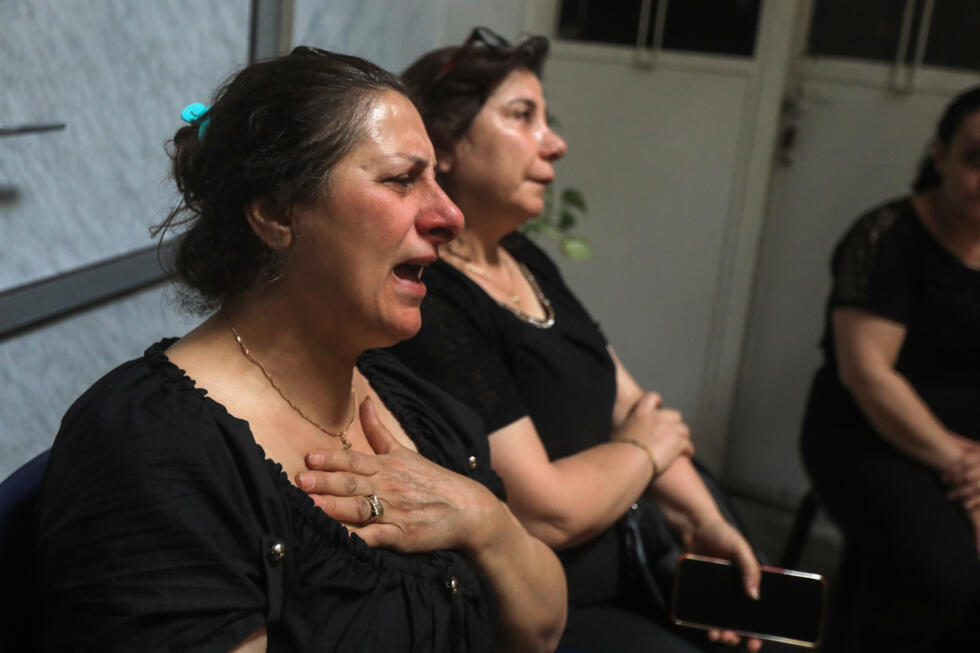
Damascus (AFP) – After eight members of her family, including her husband, were killed in a suicide bombing in a Damascus church, Laure Nasr demanded justice while Syria's minority communities worried about their future.


Issued on: 23/06/2025

The attack on Sunday killed 25 people, according to Syrian authorities, and has spread fear among minorities © Bakr ALKASEM / AFP

"I want (Syrian interim President) Ahmed al-Sharaa to personally bring me justice," a distraught Nasr said on Monday as she received mourners at her home.

"Isn't he the president? Are we not a democratic state now?" she said, after Sunday's attack, which came more than six months after Islamist-led forces ousted longtime ruler Bashar al-Assad.

Authorities said at least 25 people were killed and more than 60 others wounded in the shooting and suicide bombing in the Saint Elias church in the Syrian capital's Dwelaa district.

They blamed the Islamic State group, which has not yet claimed the attack.

The attacker "entered the house of God and opened fire on us", Nasr, 35, told AFP.

If her husband and brother-in-law had not stopped the man from going deeper into the church, "we would have all died", she said.

President Sharaa has pledged to bring all those involved to justice, emphasising "the importance of solidarity and unity... in facing all that threatens our nation's security and stability".

"Let him investigate the case and not allow anyone else to die because of these terrorist acts," said Nasr.

"Let Daesh be eliminated from Syria," she said, using an Arabic acronym for IS.

Holding her husband's phone, belt and the remnants of his blood-stained clothes, she decried the suffering inflicted on her extended family.

"Eight of us have died, including my husband, my brother-in-law and their sister," she said.
'Our turn was coming'
Relatives and friends mourn with members of the Bechara family who lost several members in the attack © Bakr ALKASEM / AFP

Elsewhere in Dwelaa, 21-year-old worker Jenny al-Haddad was mourning her father.

"My father didn't do anything wrong -- he was praying in church. He never carried a weapon against anyone or ever fought anyone," she said from her family home.

"His fault was that he was praying. No one there did anything wrong, they were all good people," she added.

In a corner, Haddad placed pictures of her father, a 50-year-old government worker who attended mass twice a week.

"Nothing is harder than living in a place where you do not feel safe," she said.

"I no longer want to stay here. I want to leave because death has encircled us from all sides."

Since Assad's December overthrow, the new Islamist authorities have faced pressure from the international community to protect minorities and include them in the country's transition.

Sectarian massacres in March that killed over 1,700 mostly Alawite civilians, according to the Syrian Observatory for Human Rights monitor, and deadly clashes involving the Druze community the following month increased concerns about the safety of minorities.

Christians "knew our turn was coming", Haddad said, urging the authorities to hold those behind the church attack responsible and to protect minority groups.


Restrictions, fears

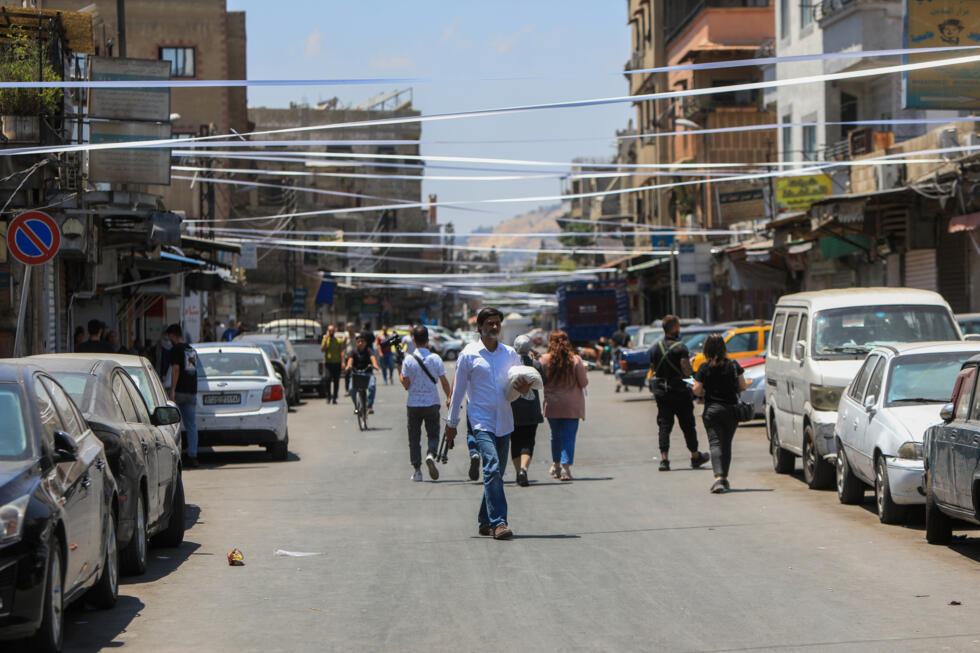
People walk beneath white ribbons stretched across the street in sign of mourning, near the Saint Elias church © Bakr ALKASEM / AFP

"I am a Syrian Christian, I want to live in Syria whether people like it or not. What have I done to become a widow? Was it our fault to pray?" Nasr said, surrounded by relatives who had not yet buried their dead, while others remained in hospital.

Shops were closed in Dwelaa, while in the church, civil defence personnel collected scattered human remains after removing most of the rubble and cleaning the churchyard.

Around a million Christians lived in Syria before the civil war in 2011, but experts believe their numbers have dwindled to around 300,000.

Syria's new authorities have not officially imposed restrictions on freedoms, but several violent incidents characterised as "individual acts" by officials and measures including mandating full-body swimwear at public beaches have raised concerns.

In March, a dispute took place in front of the Saint Elias church, as residents expressed opposition to Islamic chants being played on loudspeakers from a car.

Nebras Yusef, 35, who survived Sunday's attack but lost six of his friends and neighbours, said that "today, you can no longer protect yourself or feel safe when entering a church".

He said there had been an "accumulation" of violations in the months before the attack without intervention from the authorities.

"When you don't feel safe in your belief, religion and ritual practices, you are a fourth-class citizen -- not even a second-class citizen," he said.

"What we want from the authorities is security and a livelihood."

© 2025 AFP
From cans to cartons: how Trump’s metals duties affect packages on shelves

By Reuters
Published: June 24, 2025 

Cans of Coca-Cola on display at a grocery store, on April 24, 2022. (Gene J. Puskar / AP)

NEW YORK/LONDON — Andy Russick, who sells canned fruit and tomatoes to top U.S. grocers like Kroger, hospitals and schools, shares the stated aim behind U.S. President Donald Trump‘s trade war - fighting cheap Chinese imports.

Yet when U.S. tariffs on imported steel and aluminum doubled to 50 per cent on June 4, his company, canned-food maker Pacific Coast Producers, became collateral damage in the crossfire of Trump’s erratic trade policies.

The problem is that since 2017, Chinese fruit cocktails, vegetables and similar canned-food imports from across Southeast Asia and Europe have been flooding the shelves of U.S. supermarkets, undercutting the price of comparable products from the United States.

That trend is now set to accelerate as the cost of the specialty steel used to preserve food jumps by about six per cent for Lodi, California-based Pacific Coast, due to the latest round of tariffs on the metal, Russick said.

“We’re getting caught up in that brush fire,” said Russick, vice president of sales and marketing at Pacific Coast, a significant supplier of white label long-life products in the U.S.


The new duties on steel and aluminum, metals used in the packaging of food, beverages and personal care products like shaving cream, are sparking a reckoning for companies, who are now facing higher costs, forcing them to look at alternatives like glass, plastic or fiber-based containers.

The makers of alternative packaging, at the same time, see a new opportunity to gain more business.

Russick expects in the next few years to shift some packaging to aseptic cartons, like those produced by Swedish Swiss Tetra Pak and Swiss-listed SIG Group, or to sell more tomato sauce in cheaper foil pouches to restaurants to save on costs.

Coca-Cola CEO James Quincey told investors in February, when tariffs on aluminum and steel were set to rise to 25 per cent, that the soft-drinks maker could put more emphasis on plastic if cans became more expensive.

“The trade war is fueling the conversation that we need to get rid of aluminum in beverage packages,” said SIG Group CEO Samuel Sigrist, whose company offers aluminum-free aseptic cartons.

Campbell Co., whose soup cans became famous artworks, said in a statement that it was working to mitigate cost increases from tariffs and will continue to rely on steel cans for packaging.

Glass bottle makers are also hoping to win market share from aluminum cans used for beers due to the tariffs, said Scott DeFife, head of the U.S. Glass Packaging Institute, which represents the manufacturers.

“If these tariffs persist, tighter margins will eventually force a response,” said Zak Stambor, an analyst with eMarketer. “In the longer term, companies may have to rethink their packaging strategies.”

Pacific Coast’s Russick is currently looking to pass along US$8 million to $10 million in new costs stemming from tariffs on the specialty steel used for cans to his customers, a figure the company projects to jump to $40 million next year.

By next spring, the cost of cans delivered to Pacific Coast for the upcoming harvest may have a 24 per cent tariff-induced cost increase, Russick said.

Hurdles


But those possible shifts from aluminum and steel to aseptic cartons or glass come with logistical and cost hurdles.

Most glass bottles are still costlier than aluminum because they are heavier to ship.

Aluminum cans also already have a stronghold in some U.S. beverages: about 64 per cent of beer sold in 2023 was in aluminum cans, according to the Beer Institute. Such cans are also common in fast-growing beverage categories: energy drinks like Molson Coors’ Zoa, still-water brands including wildly popular Liquid Death and pre-mixed cocktails.

Much of the aluminum used to make those cans is recycled and not subject to tariffs, said Jack Buffington, director of supply chain and sustainability at First Key consulting, which advises the brewing and beverage industries.

The average U.S. beverage can already contain about 71 per cent recycled content, according to the Aluminum Association. The figure could climb higher if U.S. consumers practiced recycling more diligently.

Anheuser-Busch InBev’s chief financial officer, Fernando Tennenbaum, told Reuters in May, before aluminum tariffs doubled, that the financial impact of levies affecting cans was “not relevant” for the company.

AB InBev, which sources the vast majority of its cans in the U.S., had no plans to make changes to its packaging, he said. The company declined to comment for this story.

Companies like Coke that already use a variety of packaging may have an easier time responding to aluminum tariffs. By contrast, brewers that have been closing bottling lines to focus on cans would have to make hefty investments to retool their operations, Buffington said.

Plastic already makes up nearly 50 per cent of Coca-Cola’s packaging globally, according to the company’s 2023 environmental report, against 26 per cent for aluminum and steel. Only eight per cent of rival PepsiCo’s products were packaged in aluminum, in 2023, the company said.

Coca-Cola and PepsiCo did not respond to requests for comment.

Top packaging technology company Krones of Germany, whose products include glass bottling lines, said so far it has not seen any significant shift toward glass.

A fast, widespread move to other forms of packaging is unlikely during heightened uncertainty, with companies hesitant to make significant financial or strategic decisions based on policies they think could change, the U.S. Glass Packaging Institute’s DeFife said.

“I think some people are really waiting to see what sticks, what doesn’t stick,” he said. “A 30-day thing is not a threat to your supply chain immediately.”

(Reporting by Emma Rumney in London and Jessica DiNapoli in New York; Additional reporting by Lisa Jucca in Milan and Anuja Bharat Mistry in Bengaluru; Editing by Lisa Jucca and Matthew Lewis)
CANADA

Lobster industry continues to navigate tariff threats

By Paul Hollingsworth
Published: June 22, 2025 

Fishing boats on Grand Manan island New Brunswick on Thursday, May 8, 2025. THE CANADIAN PRESS/Graham Hughes (Graham Hughes/The Canadian Press)

Dave Hennerbichler is visiting Nova Scotia from British Columbia, and picking up a load of lobster before he returns home is a “must do” on his shopping list.

“It’s just a specialty, and believe it or not, we can come here and get lobster cheaper than we can buy steak,” said Hennerbichler.

That is likely music to the ears for Lobster Processors Association executive director Nat Richard, who began the recent spring lobster season managing high levels of fear and concern.

“If we had spoken in January, there was a real possibility that we would be hit directly with significant tariffs on our two largest markets — those being the U.S. and China,” said Richard.

The 25 per cent China tariff remains in place. So far, U.S. President Donald Trump has not delivered on his threat to impose additional tariffs on Canadian seafood products, which means, for now, the lobster industry is keeping its head above water. But there are warning signs that overall business is not as strong as last year.


“We’ve seen a fairly sharp pullback by American consumers. Certainly, the consumer confidence numbers in April and May were quite scary — quite a drop,” said Richard, adding 80 per cent of Canada’s lobster exports go to the U.S.

If fewer Americans are buying lobster, and the industry continues to navigate tariffs, it amounts to another troubling and unstable chapter for lobster fisherman Carl Allen.

“I operate in an industry that has an extreme amount of uncertainty built into it by nature,” said Allen, who also captains a boat. “I leave the wharf in the morning not knowing how many pounds I’m going to catch.”

Overall, volatility is nothing new in the lobster industry. It experienced record lows during COVID-19, but domestic revenues and overseas markets rebounded within two years.

“How we factor in that kind of volatility and that kind of uncertainty and do business planning is a challenge,” said Richard. “But we are used to it.”

Allen has concerns that go beyond just tariffs.

“The fear is always, does the U.S. go into recession, and then does consumer spending in general drop?” said Allen.

If that were to happen, Allen said the lobster industry would then be in the crosshairs of global financial uncertainty, combined with ongoing tariff threats — which could lead to major financial setbacks for those who make their living at sea.


Paul Hollingsworth

Journalist, 
CTV National News