It’s possible that I shall make an ass of myself. But in that case one can always get out of it with a little dialectic. I have, of course, so worded my proposition as to be right either way (K.Marx, Letter to F.Engels on the Indian Mutiny)
Friday, December 05, 2025
‘A Human Rights Disaster’: Report Details Torture and Chaos at ‘Alligator Alcatraz’
Conditions at Florida detention facilities “represent a deliberate system of cruelty designed to punish people seeking to build a new life in the US,” said an official at Amnesty International.
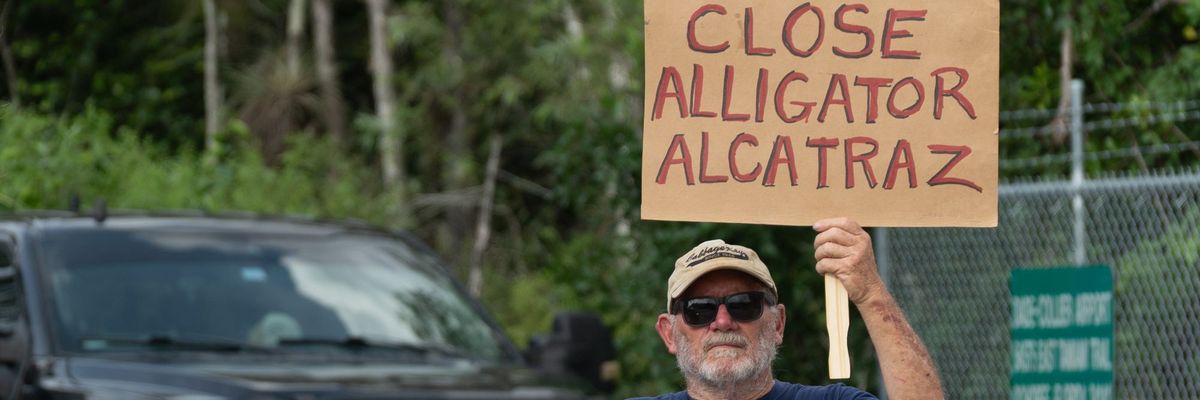
A protester holds a sign against “Alligator Alcatraz” during a rally at the entrance to the detention center in the Everglades, Florida, United States, on August 24, 2025. (Photo by Jesus Olarte/Anadolu via Getty Images)
Two immigration detention centers in Florida have gained notoriety for inhumane conditions since Republican Gov. Ron DeSantis, in close alignment with President Donald Trump’s anti-immigrant agenda, has rapidly scaled up mass detention in the state, and a report released Thursday detailed how human rights violations at the two facilities amount to torture in some cases.
As Common Dreams has reported, many of the people detained at the facilities have been arbitrarily rounded up by immigration agents, with a majority of the roughly 1,000 people being held at Alligator Alcatraz having been convicted of no criminal offense as of July.
Amnesty’s report described unsanitary conditions, with fecal matter overflowing from toilets in detainees’ sleeping areas, authorities granting only limited access to showers, and poor quality food and water.
Some of the treatment amounts to torture, the report says, including Alligator Alcatraz’s use of “the box”—a 2x2 foot “cage-like structure people are put in as punishment—which inmates have been placed in for hours at a time with their hands and feet attached to restraints on the ground.
“These despicable and nauseating conditions at Alligator Alcatraz reflect a pattern of deliberate neglect designed to dehumanize and punish those detained there,” said Amy Fischer, director of refugee and migrant rights with Amnesty International USA. “This is unreal—where’s the oversight?”
At Krome, detainees have been arbitrarily placed in prolonged solitary confinement—defined as lasting longer than 15 days—which is prohibited under international law.
“The use of prolonged solitary confinement at Krome and the use of the ‘box’ at ‘Alligator Alcatraz’ amount to torture or other ill-treatment,” said Amnesty.
The report elevates concerns raised in September by immigrant rights advocates regarding the lack of federal oversight at Alligator Alcatraz, with nearly 1,000 men detained at the prison having been “administratively disappeared”—their names absent from US Immigration and Customs Enforcement’s detainee locator system.
“The absence of registration or tracking mechanisms for those detained at Alligator Alcatraz facilitates incommunicado detention and constitutes enforced disappearances when the whereabouts of a person being detained there is denied to their family, and they are not allowed to contact their lawyer,” said Amnesty.
The state of Florida has not publicly confirmed the number of people detained at Alligator Alcatraz.
One man told Amnesty, “My lawyers tried to visit me, but they weren’t let in. They were told that they had to fill out a form, which they did, but nothing happened. I was never able to speak with them confidentially.”
At Krome, detainees described overcrowding, medical neglect, and abuse by guards when Amnesty researchers visited in September. ICE has constructed tents and other semi-permanent structures to hold more people than the facility is designed to detain.
The Amnesty researchers were given a tour of relatively extensive medical facilities at Krome, including a dialysis clinic, dental clinic, and a “state-of-the-art” mental health facility—but despite these resources, detainees described officials’ failure to provide medical treatment and delays in health assessments. Four people—Ramesh Amechand, Genry Ruiz Guillen, Maksym Chernyak, and Isidro Pérez—have died this year while detained at Krome.
“It’s a disaster if you want to see the doctor,” one man told Amnesty. “I once asked to see the doctor, and it took two weeks for me to finally see him. It’s very slow.”
Researchers with the organization witnessed “a guard violently slam a metal flap of a door to a solitary confinement room against a man’s injured hand,” and people reported being “hit and punched” by officials at Krome.
In line with the Trump administration, DeSantis and Republican state lawmakers have sought to make Florida “a testing ground for abusive immigration enforcement policies,” said Amnesty, with the state deputizing local law enforcement to make immigration arrests and issuing 34 no-bid contracts totaling more than $360 million for the operation of Alligator Alcatraz—while slashing spending on healthcare, food assistance, and disaster relief. Florida has increased the number of people in immigration detention by more than 50% since Trump took office in January.
The organization called on Florida to redirect detention funding toward healthcare, housing, and other public spending, and to ban “shackling, solitary confinement, and punitive outdoor confinement” in line with international standards.
“At the federal level, the US government must end its cruel mass immigration detention machine, stop the criminalization of migration, and bar the use of state-owned facilities for federal immigration custody,” said Amnesty.
Fischer emphasized that the chaotic and abusive conditions Amnesty observed at Alligator Alcatraz and Krome “are not isolated.”
“They represent a deliberate system of cruelty designed to punish people seeking to build a new life in the US,” said Fischer. “We must stop detaining our immigrant community members and people seeking safety and instead work toward humane, rights-respecting migration policies.”
‘Intellexa Leaks’ Reveal Wider Reach of Predator Spyware
“This investigation provides one of the clearest and most damning views yet into Intellexa’s internal operations and technology,” said Amnesty International Security Lab technologist Jurre van Bergen.
A digital eye spies on a device’s user in this stylized stock image. (Image by Sean Gladwell/Getty Images)
Highly invasive spyware from consortium led by a former senior Israeli intelligence official and sanctioned by the US government is still being used to target people in multiple countries, a joint investigation published Thursday revealed.
Inside Story in Greece, Haaretz in Israel, Swiss-based WAV Research Collective, and Amnesty International collaborated on the investigation into Intellexa Consortium, maker of Predator commercial spyware. The “Intellexa Leaks” show that clients in Pakistan—and likely also in other countries—are using Predator to spy on people, including a featured Pakistani human rights lawyer.
“This investigation provides one of the clearest and most damning views yet into Intellexa’s internal operations and technology,” said Amnesty International Security Lab technologist Jurre van Bergen.
Predator works by sending malicious links to a targeted phone or other hardware. When the victim clicks the link, the spyware infects and provide access to the targeted device, including its encrypted instant messages on applications such as Signal and WhatsApp, as well as stored passwords, emails, contact lists, call logs, microphones, audio recordings, and more. The spyware then uploads gleaned data to a Predator back-end server.
The new investigation also revealed that in addition to the aforementioned “one-click” attacks, Intellexa has developed “zero-click” capabilities in which devices are infected via malicious advertising.
In March 2024, the US Treasury Department sanctioned two people and five entities associated with Intellexa for their alleged role “in developing, operating, and distributing commercial spyware technology used to target Americans, including US government officials, journalists, and policy experts.”
“The proliferation of commercial spyware poses distinct and growing security risks to the United States and has been misused by foreign actors to enable human rights abuses and the targeting of dissidents around the world for repression and reprisal,” the department said at the time.
Those sanctioned include Intellexa, its founder Tal Jonathan Dilian—a former chief commander of the Israel Defense Forces’ top-secret Technological Unit—his wife and business partner Sara Aleksandra Fayssal Hamou; and three companies within the Intellexa Consortium based in North Macedonia, Hungary, and Ireland.
In September 2024, Treasury sanctioned five more people and one more entity associated with the Intellexa Consortium, including Felix Bitzios, owner of an Intellexa consortium company accused of selling Predator to an unnamed foreign government, for alleged activities likely posing “a significant threat to the national security, foreign policy, or economic health or financial stability of the United States.”
The Intellexa Leaks reveal that new consortium employees were trained using a video demonstrating Predator capabilities on live clients. raising serious questions regarding clients’ understanding of or consent to such access.
“The fact that, at least in some cases, Intellexa appears to have retained the capability to remotely access Predator customer logs—allowing company staff to see details of surveillance operations and targeted individuals raises questions about its own human rights due diligence processes,” said van Bergen.
“If a mercenary spyware company is found to be directly involved in the operation of its product, then by human rights standards, it could potentially leave them open to claims of liability in cases of misuse and if any human rights abuses are caused by the use of spyware,” he added.
Dilian, Hamou, Bitzios, and Giannis Lavranos—whose company Krikel purchased Predator spyware—are currently on trial in Greece for allegedly violating the privacy of Greek journalist Thanasis Koukakis and Artemis Seaford, a Greek-American woman who worked for tech giant Meta. Dilian denies any wrongdoing or involvement in the case.
Earlier this week, former Intellexa pre-sale engineer Panagiotis Koutsios testified about traveling to countries including Colombia, Kazakhstan, Kenya, Mexico, Mongolia, the United Kingdom, and Uzbekistan, where he pitched Predator to public, intelligence, and state security agencies.
The new joint investigation follows Amnesty International’s “Predator Files,” a 2023 report detailing “how a suite of highly invasive surveillance technologies supplied by the Intellexa alliance is being sold and transferred around the world with impunity.”
The Predator case has drawn comparisons with Pegasus, the zero-click spyware made by the Israeli firm NSO Group that has been used by governments, spy agencies, and others to invade the privacy of targeted world leaders, political opponents, dissidents, journalists, and others.
America Needs To Tax Its Own ‘Second Estate’: Billionaires
The United States has no nobility, according to our Constitution. But our tax code does protect the very rich.
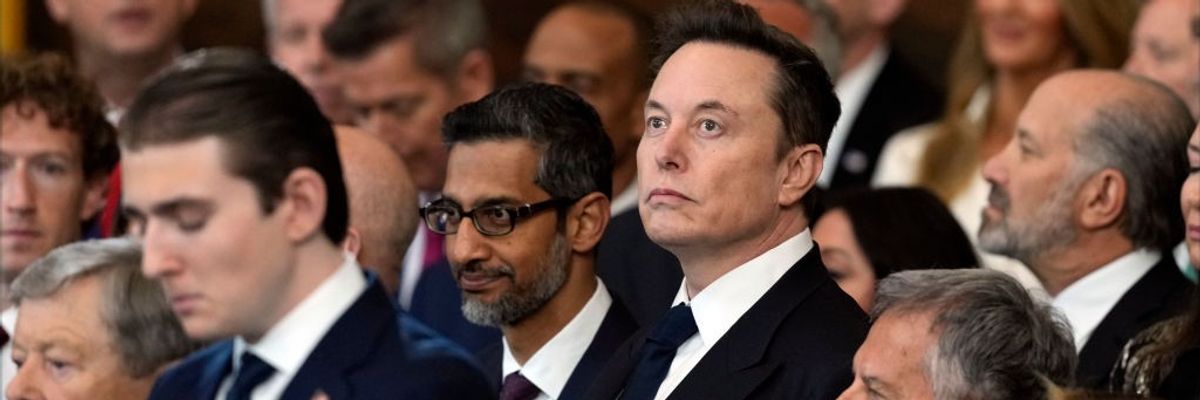
Google CEO Sundar Pichai and Elon Musk attend the inauguration of Donald Trump at the US Capitol Rotunda on January 20, 2025 in Washington, DC. (Photo by Julia Demaree Nikhinson - Pool/Getty Images)
Pre-revolutionary French aristocrats—the “Second Estate”—didn’t pay taxes. Amazingly, America too has a second estate, billionaires who pay virtually no taxes. In her very outstanding recent book, law professor Ray D. Madoff shows how they get away with this.
The United States has no nobility, according to our Constitution. But our tax code does protect the very rich.
Federal taxes on income and estates—intended to fund government and prevent development of a hereditary financial aristocracy—were enacted early in the 20th century and originally worked well.
But since about 1980, the estate tax—infested with loopholes—has been nearly abolished for practical purposes and now produces trivial income.
Madoff wants to get rid of the ability of ultra-rich people—billionaires—to avoid having any taxable income in the first place.
Madoff suggests that the estate tax should be completely eliminated because its existence deceives the public about what is really going on. People falsely think that billionaires who pay no federal income tax will at least pay the estate tax when they die. In fact, they are paying neither kind of tax.
Billionaires avoid the income tax by arranging to have no taxable income.
Before 1982 ultra-rich people could not avoid paying income tax. Their income consisted of dividends and capital gains harvested by selling shares of stock, the price of which had increased. Dividends and capital gains are taxable income.
But in 1982 federal regulators weakened a rule prohibiting corporations from buying back their own stock. Since then, many corporations have used profits to buy back stock shares instead of issuing dividends. With fewer shares of stock outstanding and the value of the corporation increasing, the value of each share of stock began increasing dramatically.
What used to be taxable dividends turned into large capital gains benefiting the stock owners, including very rich ones. If shareholders need cash and sell appreciated stock, of course they would owe income taxes on the capital gains (selling price of the stock minus how much the shares cost them). But capital gains are taxed at a much lower rate than normal income like salaries, bank interest, and returns on bonds.
As Madoff points out, however, billionaires need not sell any stock to get cash to live on. Instead, they can borrow the money, using their stock as collateral. Borrowed money is not taxable income, so they owe no tax while living extravagantly.
And when they die, the stock they bequest to their heirs gets a stepped up “basis,” so if their heirs sell the stock they will owe no taxes because the stepped up basis leaves no taxable capital gains.
And inherited money is not considered taxable income. Someone who earns $50,000 pays significant income (and payroll) taxes on it, while someone who inherits $1 billion pays no income or payroll tax on it.
Madoff rightly objects to this situation, but she is not arguing that we should “soak the rich” with higher income tax rates at the top. She points out that there are two kinds of “rich” people. One is the working rich, skilled professionals earning high salaries and, usually, already paying very high taxes. A high percentage of all income tax receipts come from these people.
Increasing the high tax rates these “rich” people are already paying would produce insignificant extra revenue for the government.
Instead, Madoff wants to get rid of the ability of ultra-rich people—billionaires—to avoid having any taxable income in the first place. She wouldn’t tax them while they are alive, but would tax whoever inherits from them.
Rather than trying to fix the estate tax, Madoff would abolish it, eliminate the stepped up basis for inherited stock, and make inherited money and other gifts received taxable income for the recipients.
Assuming an exemption for small gifts (to allow birthday presents and the like), this could be a reasonable reform. It would bring in very large amounts of taxes while reducing today’s extreme economic inequality.
Let’s Be Very Clear: There’s No Legal Basis for Trump to Attack Venezeula
Regardless of the reasons, the US has no right to intervene.
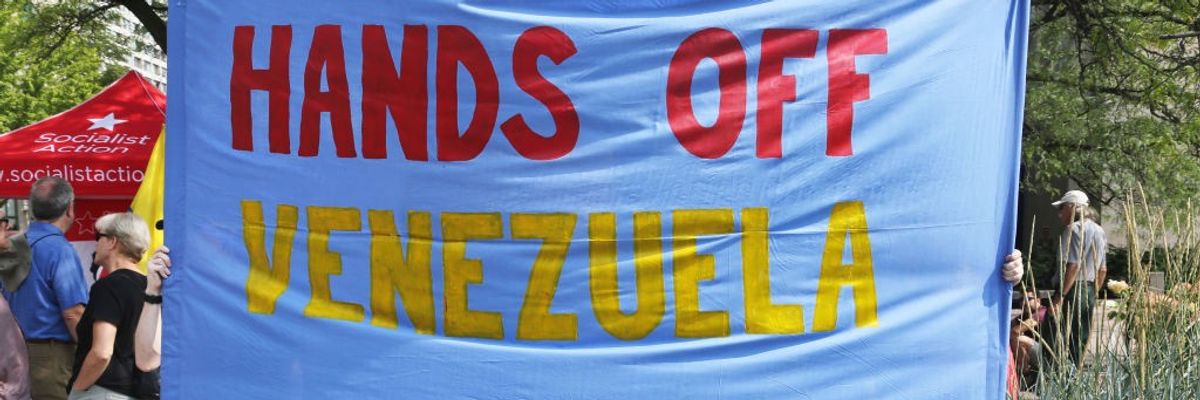
Canadians rally to demand an end to American attempts at a “regime change” in Venezuela and to denounce Canada’s complicity to overthrow the government of Venezuela in Toronto, Canada, on September 16, 2017. (Photo by Creative Touch Imaging Ltd./NurPhoto via Getty Images)
President Donald Trump promised “no new wars,” but his aggression against Venezuela is the exact opposite.
The US military has been blowing up alleged “drug boats” near Venezuela that have killed at least 83 people. The United Nations has condemned these unprovoked strikes as unlawful extrajudicial executions. Yet President Trump has said the US may “very soon” expand this campaign to Venezuelan territory.
It’s unclear if that means Trump plans to impose a no-fly zone on Venezuela. But if so, that would be an act of war—and under the Constitution, illegal without congressional authorization.
Trump’s pressure campaign against Venezuela isn’t about countering traffickers or “bringing democracy” to Venezuela.
We saw this playbook before the 2003 invasion of Iraq. President George W. Bush lied about Iraq’s possession of weapons of destruction and its ties to al-Qaeda in order to sell his regime change war to the American public.
Similarly, the Trump administration is relying on unsupported allegations against Venezuela. Only this time, the allegations are even more bogus and easily disproven.
The US has claimed that it attacked the small boats because they were carrying drugs, despite offering no proof. Even if the boats did carry drugs, the appropriate response would be to lawfully intercept and detain the suspects and afford them due process of law.
Under international law, force is only permitted in self-defense from an armed attack or if authorized by the UN Security Council, neither of which applies here. Congress hasn’t approved military force against alleged traffickers either.
A secret Department of Justice memo has gone so far as to name fentanyl as a “chemical weapon threat” from these “drug boats.” But neither US nor international assessments have found that Venezuela is a primary producer or international shipment point of narcotics, including fentanyl.
Trump has also accused Venezuelan President Nicolás Maduro of controlling the Tren de Aragua criminal gang, a claim contradicted by a US intelligence memo, as well as the “Cartel of the Suns”—an organization many experts doubt even exists but which Trump’s State Department now lists as a “terrorist organization.”
And while Trump alleges that Maduro is flooding the US with drugs, he just pardoned one of the biggest cocaine traffickers—former Honduran president Juan Orlando Hernández, who was sentenced to 45 years last year for creating “a cocaine superhighway to the United States.”
Trump’s pressure campaign against Venezuela isn’t about countering traffickers or “bringing democracy” to Venezuela.
Instead, it’s a continuation of treating Latin America as part of the US “sphere of influence” to justify interventions, as seen with past CIA-orchestrated coups in Guatemala and Chile that ousted democratically elected governments in favor of more US-compliant authoritarian regimes.
The US has been waging economic warfare since 2005 by imposing a range of sanctions on Venezuela under the guise of “promoting democracy.” But far from resolving the country’s political crisis, these sanctions have devastated the economy and increased the suffering of ordinary Venezuelans, forcing nearly 8 million to flee since 2014.
Venezuela also has the world’s largest proven oil reserves—something Trump knows well. “When I left” office in 2021, “Venezuela was ready to collapse,” Trump said in 2023. “We would have taken it over—we would have gotten all that oil.”
Regardless of the reasons, the US has no right to intervene in Venezuela. A war would unleash untold suffering on the Venezuelan people. It’s also the last thing Americans want, as several polls have shown. A November CBS/YouGov poll found that 70% of Americans across party lines oppose the US taking military action against Venezuela.
The evidence is clear. There’s no legal basis for a war and the majority of Americans don’t want it.
This column was distributed by OtherWords.
Farrah Hassen Farrah Hassen, J.D., is a writer, policy analyst, and adjunct professor in the Department of Political Science at Cal Poly Pomona Full Bio >
Anatomy of Murder on the High Seas
Long before September 2, Pete Hegseth had systematically dismantled the guardrails that prevented him and his subordinates from committing war crimes.
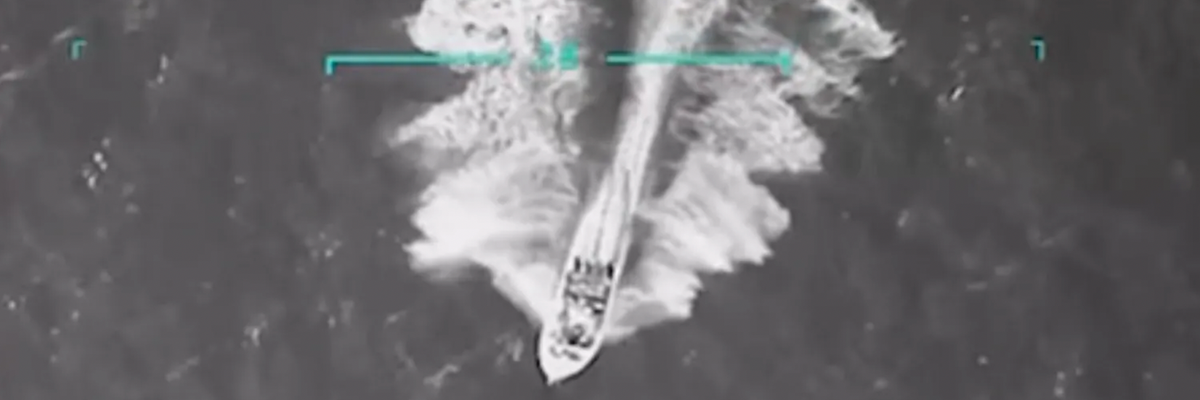
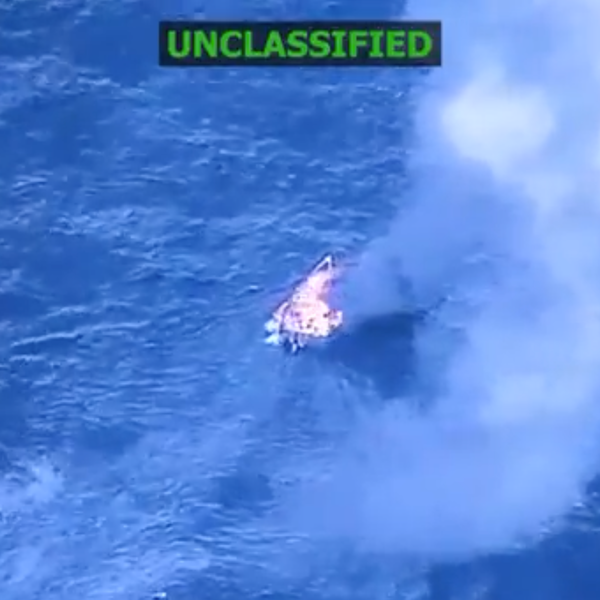
This image was posted on social media by President Donald Trump and shows a boat that was allegedly transporting cocaine off the coast of Venezuela when it was destroyed by US forces on September 2, 2025. (Photo by President Donald Trump/Truth Social)
On Friday, November 28, the Washington Postreported that when the US military began attacking small boats in the Caribbean, Defense Secretary Pete Hegseth had issued a verbal order that it should “kill everybody.”
When the first attack occurred on September 2, the initial missile strike destroyed the boat but left two survivors clinging to the wreckage. To comply with Hegseth’s order, Admiral Frank M. “Mitch” Bradley authorized a second strike that killed them.
Hegseth called the Post‘s reporting “fabricated, inflammatory, and derogatory,” claiming that the drug-smuggling operations were “lawful under both US and international law.”
Then the doubletalk began.
Story #1: “That Didn’t Happen”
On November 30, President Donald Trump weighed in.
“He did not say that,” Trump said of Hegseth’s reported order, “and I believe him 100%.”
Perhaps sensing a war crime when he sees one, Trump added, “I wouldn’t have wanted that. Not a second strike. The first strike was very lethal. It was fine, and if there were two people around, but Pete said that didn’t happen.”
Hegseth should know. The day after the attack, he told Fox & Friends that he’d watched the operation live.
Story #2: “There Was No Specific Order to Kill Survivors”
On Monday, December 1, White House spokesperson, Karoline Leavitt, admitted that the second strike occurred, but denied that Hegseth said “kill everybody.” She identified Admiral Bradley as the trigger man for the second strike.
That evening, the New York Timesreported that five US officials speaking anonymously said that Hegseth “ahead of the September 2 attack, ordered a strike that would kill people on the boat and destroy the vessel and its purported cargo of drugs.” But, the Times continued, “Hegseth’s directive did not specifically address what should happen if a first missile turned out not to fully accomplish all of those things. And, the officials said, his order was not a response to surveillance footage showing that at least two people on the boat survived the first blast.”
Story #3: Hegseth Didn’t See the Second Strike After All
During Trump’s appearance with the cabinet on December 2, Hegseth asserted that he actually hadn’t watched the second strike and wasn’t even in the room when Bradley ordered it. After throwing the distinguished admiral under the bus, Hegseth said that Bradley had adhered to the laws of war.
Story #4: Trump Has a License to Kill
In the end, Trump and Hegseth reverted to their original justification for the entire boat-bombing operation: The drug smugglers are “narco-terrorists” engaged in armed combat with the United States and its allies. According to this unsupported claim, the cartels aren’t smuggling drugs just to make money. They’re in business to finance terrorism aimed at US allies.
Mostlegal scholars don’t buy it. Even drug runners are civilians and therefore not appropriate military targets. But Trump claims the right to order the summary executions without providing evidence of their crimes or the pretense of due process. In his view, civilians are “collateral damage” as the nation exercises its right of self-defense. But even under Trump’s strained reasoning, strike survivors would be prisoners of war.
The Real Story
The controversy over who ordered what misses a fundamental point: Hegseth’s incompetence is the real story. The second attack resulted from either his direct order (“kill everybody”) or ambiguity in whatever order he gave.
Hegseth’s prior actions created the environment for disaster. Long before September 2, he had systematically dismantled the guardrails that prevented him and his subordinates from committing war crimes.
Beginning in February 2025: Over the next 10 months, Hegseth purged or sidelined two dozen of the nation’s most experienced generals and admirals.
February 2025: Hegseth fired the top lawyers for the Army, Navy, and Air Force. These senior judge advocates general (“JAGs”) provide independent legal advice to top military officers so that they do not run afoul of US law or the laws of armed conflict. At the time, Hegseth said that he was removing “roadblocks to orders that are given by a commander in chief.”
August 2025: According to NBC News, the senior judge advocate general for the US Southern Command overseeing the strikes on alleged drug-smuggling boats disagreed with Trump’s position that the operations were lawful. A Pentagon spokesperson denied the report.
September 2: The US conducted its first attack.
September 16: Increasingly, legal experts questioned the justification for Trump’s boat attacks. For example, John Yoo, former deputy attorney general under President George W. Bush and author of the legal rationale for enhanced interrogation techniques against suspected al Qaeda terrorists, said, “[T]he administration needs to make a stronger case than it’s been making so far about why the law should consider cartels to be enemies of war.”
October 16: US military forces attacked another small boat in the Caribbean, but this time two survivors were taken into custody and repatriated to their respective countries, Colombia and Ecuador.
The same day and only a year into his three-year appointment as head of the US Southern Command overseeing all operations in Central and South America, Admiral Alvin Holsey stepped down from his position. Holsey reportedly expressed concerns about the escalating boat attacks.
Trump Undermined His Own Rationale
While seeking to justify lethal attacks on small boats in the Caribbean as a war on narco-terrorists, on December 1, Trump pardoned one of the most prominent narcotics smugglers in the world—former Honduras President Juan Orlando Hernández. He had been serving a 45-year sentence for drug trafficking and weapons charges. According to court documents, from at least in or about 2004, up to and including in or about 2022, Hernández was at the center of one of the largest and most violent drug-trafficking conspiracies in the world.
Trump claimed that Hernández was the victim of political persecution. If so, Trump’s first administration was among the persecutors. In 2013, the Justice Department began an investigation into Hernández that continued during Trump’s entire first term. One of the prosecutors was Emil Bove III, who went on to become Trump’s Justice Department hatchet man in the second Trump administration before his lifetime appointment as a federal appellate judge.
Hernández was engaged in the very activities that Trump now uses to justify killing suspected drug smugglers. But Hernández got due process, a trial, and a sentence that would have put him in prison for the rest of his life—until Trump pardoned him.
Trump in a Nutshell
Contrast Hernández freedom with the fate of Any Lucía López Belloza, a 19-year-old Babson College student. Twelve years ago, her family fled the violence, crime, and economic stagnation of Honduras under Hernández’s rule. On November 20, 2025, while preparing to board a plane in Boston to go home for Thanksgiving, Immigration and Customs Enforcement agents arrested her.
Belloza’s lawyer said that on November 21, a federal judge ordered that she could not be deported while her case was pending. But after spending the night in a Texas detention center, on November 22 agents shackled her wrist, waist, and ankles and put her on a flight to Honduras.
She doesn’t know if or when she will return to the United States.
Our work is licensed under Creative Commons (CC BY-NC-ND 3.0). Feel free to republish and share widely.
Steven Harper Steven J. Harper is an attorney, adjunct professor at Northwestern University Law School, and author of several books, including Crossing Hoffa -- A Teamster's Story and The Lawyer Bubble -- A Profession in Crisis. He has been a regular columnist for Moyers on Democracy, Dan Rather's News and Guts, and The American Lawyer. Follow him at https://thelawyerbubble.com. Full Bio >
Unpacking the Dangerous Myth of ‘Narco-Terrorism’ Framing “Operation Southern Spear” as a battle against “narco-terrorists” is a desperate attempt to commit new violence using old excuses, one which ignores the security state’s history of creating its own enemies.
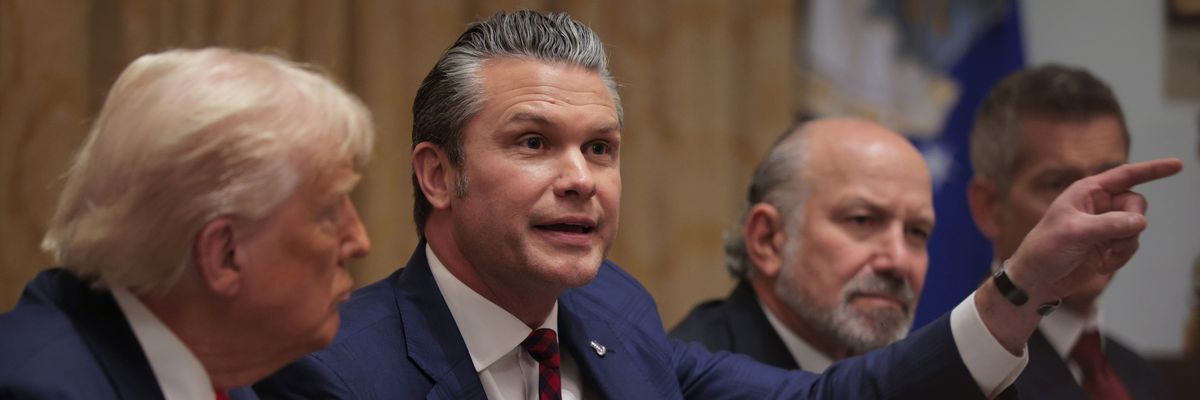
US Secretary of War Pete Hegseth (C) speaks during a Cabinet meeting alongside (L-R) US President Donald Trump, US Secretary of Commerce Howard Lutnick, and US Secretary of Transportation Sean Duffy in the Cabinet Room of the White House on December 2, 2025 in Washington, DC. (Photo by Chip Somodevilla/Getty Images)
Between the War on Drugs and the War on Terror, the US government has a long history of waging bloody and unsuccessful wars against broad concepts that can not be meaningfully defeated. What makes the government’s latest “armed conflict” unique is not just its combination of these two failures, but also that its target—“narco-terrorism”—is largely a myth.
Under the title “Operation Southern Spear,” the Trump administration has launched a campaign intended to target the drug cartels that it designated as terrorist organizations earlier this year. So far, this has involved at least 21 airstrikes, killing upwards of 83 people on small boats in the Caribbean and the Pacific; a military buildup involving 15,000 troops; and covert operations by the CIA in Venezuela. Though President Donald Trumplacks the legal authority for these activities, the Senate’s latest attempt to restrain military action failed in a narrow vote of 49-51.
Key to the White House’s case is the idea of “narco-terrorism,” a label they have applied to both the airstrike victims and Venezuelan President Nicolas Maduro. The US claims that Maduro is closely connected to the Tren de Aragua cartel (despite a National Intelligence Council analysis suggesting otherwise) and that he is the leader of the supposed “Cartel of the Suns” (which, despite its terrorist designation, does not exist as an organization). The specter of “narco-terrorism” has also been invoked to bash the progressive governments of Colombia and Honduras.
To say that “narco-terrorism” is a myth is not to deny the obvious violence associated with the black market drug trade, but to acknowledge that the term does more to confuse than to clarify. The idea does not accurately explain the complex dynamics of the global drug trade; instead, it radically oversimplifies the problem. By portraying military intervention as a response to drug trafficking, the “narco-terrorism” myth allows politicians to ignore all of the ways in which military intervention is a cause of drug trafficking. Strange Origins
“Narco-terrorism” has its origins in the early 1980s, when US Ambassador to ColombiaLewis Tambs began referring to leftist rebel groups like FARC and ELN as “narco-guerillas.” Some of his specific claims were fabricated: After Colombian police completed what was then the largest drug bust in history, Tambs falsely claimed that communist rebels were involved in the operation, prompting another State Department official to admit that “Tambs got ahead of the evidence.” Regardless, the idea quickly gained acceptance as a justification for military intervention in Latin America, suggesting that the only way to reduce drug abuse at home was to wage war against foreign suppliers. By 1985, the Reagan administration was alleging an “emerging alliance between drug smugglers and arms dealers in support of terrorists and guerrillas.”
Ironically, Tambs himself later played a role in the Iran-Contra scandal, helping to traffic drugs and guns for the violent anti-communist Contras in Nicaragua. The full scope of the CIA’s involvement in bringing the Contra’s drugs into the US remains unclear, but at the very least it is obvious that officials like Tambs helped support the group. Thus, the idea of “narco-terrorism” was created by someone who participated in it.
The “narco-terrorism” label has always been controversial. Drug traffickers are motivated solely by profit, while “terrorists” and “guerillas” are motivated by goals like ideology and territory. Though some armed groups in Latin America engaged directly in the drug trade, many others either had no involvement or were involved only by “taxing” traffickers for revenue. “Narco-terrorism” misrepresents this extortion racket between two opposed groups as an alliance of like-minded organizations. By “combining two threats that have traditionally been treated separately,” critics argue that the term can “complicate rather than facilitate discussions on the two concepts…”
Many of the largest foreign interventions in US history created new pathways for drugs to reach the country while also generating new demand among traumatized veterans.
Far from being allies, rebels and drug traffickers often fought one another. Most rebels were communist outsiders, while many traffickers hoped to build ties with Colombia’s elite. The rebels sometimes imposed wage and price controls in coca-growing communities in hopes of building popular support, rules which ate into the traffickers’ profits. These tensions eventually escalated into violent conflict, and it was later revealed that dozens of officers from the US-backed Colombian military had collaborated with the traffickers in a campaign to crush the rebels. The rebels and traffickers were “staunchly opposed social forces” in the words of journalist Collet Merrill, meaning that “narco-guerilla” was “less an analytical model than a political slogan.”
The Trump administration’s definition of “narco-terrorism” seems even less useful than its original meaning. Speaking to the United Nations, a US delegate commented on the recent terrorist designations of cartels to say: “When you flood American streets with drugs, you are terrorizing America...” Similarly, the White Houseclaims that drug imports “constitute an armed attack” all by themselves. In other words, traffickers no longer need to have any “terrorist” connections to be considered “narco-terrorists,” because all drug trafficking is now considered “terrorism.”
The language used in our debates about drug trafficking is poisoned by this type of imprecision. Even the concept of a “cartel” is suspect, as it often portrays loose networks of organized criminals cooperating with state authorities as well-coordinated paramilitaries that lack government connections. This sort of terminology survives because of its usefulness to government officials in search of ready-made explanations, officials who did not want to draw attention to their own role in the global drug trade. Stop Hitting Yourself
Many of the largest foreign interventions in US history created new pathways for drugs to reach the country while also generating new demand among traumatized veterans, leading some scholars to conclude that “every major foreign war of the past century produced a domestic drug crisis.” At times, the US government has even purposefullysupported drug traffickers to advance its short-term objectives.
During the Vietnam War, the CIA allegedly facilitated drug trafficking in Southeast Asia to help fund anti-communist organizations, helping to turn the region into the source of the majority of the world’s heroin by the early 1970s. Much of this heroin made its way to US soldiers stationed overseas and, through the trafficking efforts of troops like Army Master Sergeant Ike Atkinson, to the United States itself. The subsequent rise in drug addiction helped inspire the original “War on Drugs,” a war which the US fought on both sides of.
The pressures of the Drug War helped bring Mexican “cartels” into existence. One of the first such organizations—the “Guadalajara Cartel”—emerged as an organized effort to survive the joint US-Mexican attempts at destroying the then-disorganized drug trade. Later efforts to support foreign security forces backfired when some of the Mexican soldiers who received special forces training in the US defected to form their own cartel: “Los Zetas,” which carried out a wave of extreme violence in Mexico in the 2000s-2010s.
With our focus exclusively on military efforts to disrupt the supply of drugs, little time is spent on the real solution: reducing demand.
Similarly to Vietnam, the War in Afghanistan created new channels for heroin trafficking. After the Taliban lost control of the country, a US government report noted that Afghanistan saw “increased poppy cultivation and drug production as farmers and traffickers took advantage of the power vacuum…” The growing opium trade corrupted the highest levels of US-backed leadership in Afghanistan. As a result, US-occupied Afghanistan was “producing nine times more heroin than the rest of the world combined,” according to journalist Seth Harp.
Sensing a profitable opportunity to connect this supply of heroin with the demand at home, a group of current and former US troops began smuggling the opium into the world’s largest military base, Fort Bragg. These smugglers then moved the drugs around the country by plugging into the distribution network of the Los Zetas cartel (whose founders had coincidentally received training at Fort Bragg decades earlier). US military interventions thus produced all of the necessary ingredients to inflame the opioid crisis: a flood of new heroin production abroad, flights to smuggle it into the US, and a cartel with the skills to distribute it.
These are just a few of the moments throughout history when the US government facilitated drug trafficking all over the world. More recently, the US provided extensive support to Honduran President Juan Orlando Hernández despite widespread allegations that he was connected to cocaine trafficking. Only after he left office did the US government bother to indict him for “protect[ing] some of the largest drug traffickers in the world,” helping to bring more than 400 tons of cocaine into the country. In an absurd act of hypocrisy, President Trump recently pardoned Hernández on the grounds that the convicted drug trafficker was “treated very harshly and unfairly.”
Believe it or not, this was not even the first time that something like this had happened. In the 1980s, the Reagan administration tolerated the obvious drug trafficking of Panamanian dictator Manuel Noriega because of his cooperation with their geopolitical priorities. As with Hernández, the government even provided cover for Noriega by claiming that he helped fight against drug trafficking. But when US officials finally lost patience with him near the end of the decade, a Panamanian official predicted that “suppressing drug trafficking might be the Reagan administration’s excuse for an invasion.”
Though George H.W. Bush claimed that the 1989 invasion of Panama was intended in part “to combat drug trafficking,” others were skeptical. The Academy Award-winning documentary The Panama Deception argued that the true purpose of the invasion was to reinforce US dominance over the Panama Canal (a topic which is now an obsession of President Trump’s). Though this regime change operation against a former ally serves as a classic example of how military interventionism creates its own villains, it is now often remembered as a success, even earning praise from Republicans arguing in favor of Trump’s airstrikes. Panamanian diplomat Carlos Ruiz-Hernández recently criticized this comparison as a “fundamentally flawed” analogy which “persists because it’s emotionally satisfying for US hawks.” Get Real
By misunderstanding and overemphasizing a select few of the groups involved in the drug trade, the “narco-terrorism” myth redirects our attention away from more significant causes of drug trafficking. First, the focus on supply distracts us from the far more important question of demand—so long as drug addiction remains a major problem in this country, the drugs will always find a way in. Additionally, the exclusive focus on non-state actors distracts us from the role that our own government plays in facilitating the global drug trade.
Framing “Operation Southern Spear” as a battle against “narco-terrorists” is a desperate attempt to commit new violence using old excuses, one which ignores the security state’s history of creating its own enemies. In truth, this is a domestic problem as much as a foreign one. Of those convicted of drug trafficking in the US, 80% are citizens. MS-13, now designated as a foreign terrorist organization, was founded in Los Angeles and spread abroad by the US government’s deportation practices. More than two-thirds of the Mexican cartels’ guns come from the US, and US military weaponry regularly shows up in the hands of cartel members.
With our focus exclusively on military efforts to disrupt the supply of drugs, little time is spent on the real solution: reducing demand. In fact, the Trump administration has undermined real public health solutions by repeatedlyfiring employees at the Substance Abuse and Mental Health Services Administration, discouraging lifesaving harm reduction efforts, and proposing massive cuts to drug abuse services. No amount of immoral and illegal airstrikes will ever save even a fraction of the lives lost by these decisions.
Perhaps the greatest flaw of “narco-terrorism” is that it encourages us to believe that complex human problems have simple military solutions. Sociologist C. Wright Mills once astutely criticized US elites for accepting a “military definition of reality,” a distorted perspective which prevents them from imagining policy solutions that do not involve military intervention. So long as the government insists upon seeing non-military problems through a military lens, they will never be solved.
Our work is licensed under Creative Commons (CC BY-NC-ND 3.0). Feel free to republish and share widely.
Brett Heinz Brett Heinz is a political researcher and writer currently based in Washington, D.C., with a focus on economic justice, political inequality, and U.S. foreign policy. He currently works as a National Security/Foreign Influence intern at the Quincy Institute for Responsible Statecraft, and previously analyzed U.S. relations with Latin America at the Center for Economic and Policy Research. Brett was born and raised in North Carolina, holds a Bachelor's degree from UNC Chapel Hill, and is now working on his MPP at American University. Full Bio >
UN Experts Say Those Ordering and Carrying Out US Boat Strikes Should Be ‘Prosecuted for Homicide’ “US military attacks on alleged drug traffickers at sea,” said two human rights experts, “are grave violations of the right to life and the international law of the sea.”
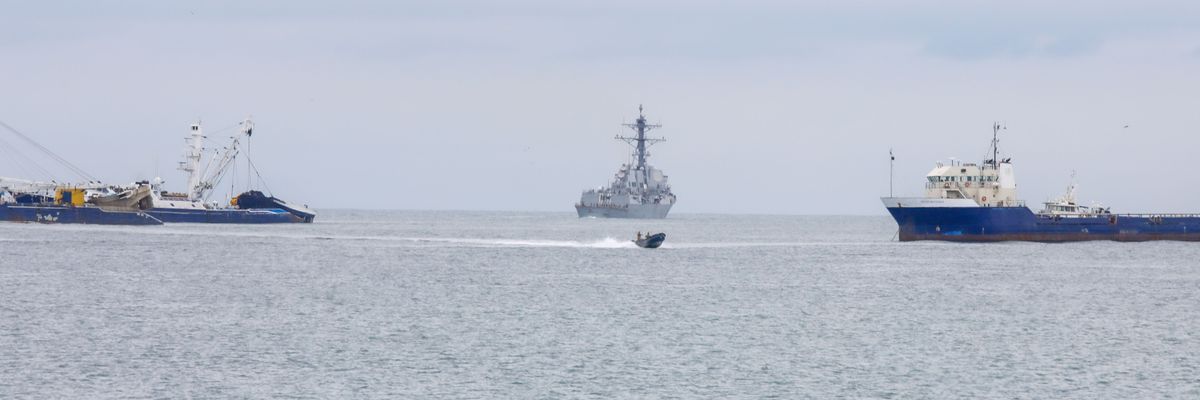
A small boat is seen near the USS Sampson, a US Navy missile destroyer, off the coast of Panama City, Panama, on September 2, 2025. (Photo by Daniel Gonzalez/Anadolu via Getty Images)
Two United Nations rights experts warned that in numerous ways in recent weeks, the Trump administration’s escalation toward Venezuela has violated international law—most recently when President Donald Trumpsaid he had ordered the South American country’s airspace closed following a military buildup in the Caribbean Sea.
But the two officials, independent expert on democratic and international order George Katrougalos and Ben Saul, the UN special rapporteur on protecting human rights while countering terrorism, reserved their strongest condemnation and warning to the US for the administration’s repeated bombings of boats in the Caribbean and the Pacific, which have targeted at least 22 boats and killed 83 people since September as the White House has claimed without evidence it is combating drug traffickers.
The strikes, said Katrougalos and Saul, “are grave violations of the right to life and the international law of the sea. Those involved in ordering and carrying out these extrajudicial killings must be investigated and prosecuted for homicide.”
Human rights advocates have warned for months that the strikes are extrajudicial killings. Trump has claimed the US is in an “armed conflict” with drug cartels in Venezuela—even though the country is not significantly involved in drug trafficking—but Congress has not authorized any military action in the Caribbean.
Typically, the US has approached drug trafficking in the region as a criminal issue, with the Coast Guard and other agencies intercepting boats suspected of carrying illegal substances, arresting those on board, and ensuring they receive due process in accordance with the Constitution.
The Trump administration instead has bombed the boats, with the first operation on September 2 recently the subject of particular concern due to reports that Defense Secretary Pete Hegseth issued an order for military officers to “kill everybody” on board a vessel, leading a commander to direct a second “double-tap” strike to kill two survivors of the initial blast.
Hegseth and Trump have sought to shift responsibility for the second strike onto Adm. Frank “Mitch” Bradley, the commander who oversaw the attack under Hegseth’s orders. Bradley was scheduled to brief lawmakers Thursday on the incident.
The White House has maintained Bradley had the authority to kill the survivors of the strike and to carry out all the other bombings of boats, even as reporting on the identities of the victims has shown the US has killed civilians including an out-of-work bus driver and a fisherman, and the family of one Colombian man killed in a strike filed a formal complaint accusing Hegseth himself of murder.
The UN experts suggested that everyone involved in ordering the nearly two dozen boat strikes, from Trump and Hegseth to any of the service members who have helped carry out the operations, should be investigated for alleged murder.
After Hegseth defended the September 2 strike earlier this week, Saul emphasized in a social media post that contrary to the defense secretary’s rhetoric about how the boat attacks are “protecting” Americans, he is carrying out “state murder of civilians in peacetime, like executing alleged drug traffickers on the streets of New York or DC.”
As Common Dreams reported last month, a top military lawyer advised the White House against beginning the boat bombings weeks before the September 2 attack, saying they could expose service members involved in the strikes to legal challenges.
Katrougalos and Saul urged the administration to “refrain from actions that could further aggravate the situation and ensure that any measures taken fully comply with the UN Charter, the Chicago Convention, and relevant rules of customary international law.”
They also emphasized that Trump had no authority to declare that Venezuela’s airspace was closed last week—an action that many experts feared could portend imminent US strikes in the South American country.
“International law is clear: States have complete and exclusive sovereignty over the airspace above their territory. Any measures that seek to regulate, restrict, or ‘close’ another state’s airspace are in blatant violation of the Chicago Convention,” said the experts. “Unilateral measures that interfere with a state’s territorial domain, including its airspace, risk fully undermining the stability of the region and are seriously undermining Venezuela’s economy.”
Saul and Katrougalos further called on the White House not to repeat “the long history of external interventions in Latin America.”
“Respect for sovereignty, nonintervention, and the peaceful settlement of disputes,” they said, “are essential to preserving international stability and preventing further deterioration of the situation.”
Top Dem Says Video of Military ‘Attacking Shipwrecked Sailors’ Among ‘Most Troubling Things’ He Has Ever Seen
“Two individuals in clear distress, without any means of locomotion, with a destroyed vessel, were killed by the United States.” US Rep. Jim Himes (D-Conn.) speaks to members of the press after a briefing at the US Capitol on February 14, 2024 in Washington, DC. (Photo by Alex Wong/Getty Images)
US Rep. Jim Himes, the ranking member of the House Permanent Select Committee on Intelligence, expressed horror on Thursday after watching a video of the September 2 double-tap strike on a suspected drug trafficking vessel off the coast of Trinidad and Tobago.
Speaking to reporters after a briefing on the strike delivered by Adm. Frank Bradley, Himes (D-Conn.) called the video he saw of the attack “one of the most troubling things I’ve seen in my time in public service.”
Himes proceeded to describe the video, which showed the US military firing missiles at two men who had survived an initial attack on their vessel and who were floating in the water while clinging to debris.
“You have two individuals in clear distress, without any means of locomotion, with a destroyed vessel, [who] were killed by the United States,” he said.
Himes then started to walk away before a reporter asked him to describe more of what he saw in the video. The Connecticut Democrat then said the video showed a clear “impermissible action,” according to the laws of armed conflict.
“Any American who sees the video that I saw will see its military attacking shipwrecked sailors,” he said. “Now, there’s a whole set of contextual items that the admiral explained. Yes, they were carrying drugs. They were not in position to continue their mission in any way... People will someday see this video and they will see that that video shows, if you don’t have the broader context, an attack on shipwrecked sailors.”
Himes finished his talk with reporters by saying that Bradley told lawmakers there had not been a “kill them all” or “no quarter” order given to him by higher-ups. Asked by a reporter if he thought the full video should be released to the public, Himes said, “I do.”
Himes’ reaction to the video stood in stark contrast to the reaction of Sen. Tom Cotton (R-Ark.), the chairman of the Senate Intelligence Committee, who praised the military for its actions.
According to HuffPost reporter Jen Bendery, Cotton described the strikes on the two survivors as “righteous strikes” that were “entirely lawful.”
Cotton also claimed that the video showed “two survivors trying to flip a boat, loaded with drugs, bound for the United States, back over, so they could stay in the fight.”
Reports from the US government and the United Nations have not identified Venezuela as a significant source of drugs that enter the United States, and the country plays virtually no role in the trafficking of fentanyl, the primary cause of drug overdoses in the US.
Additionally, many legal scholars have said that a strike on the two men who survived the initial attack on the boat is very likely either an act of murder or a war crime, regardless of whether they were intending to traffic illegal drugs in the US.
Human Rights Group Warns US Gaza Plan Will Impose ‘Unlawful Collective Imprisonment’ of Palestinians as New Details Emerge
“The design of these proposed cities mirrors the historical model of ghettos,” said the Euro-Mediterranean Human Rights Monitor, which said the US plans to cram 25,000 people into areas smaller than a square kilometer.
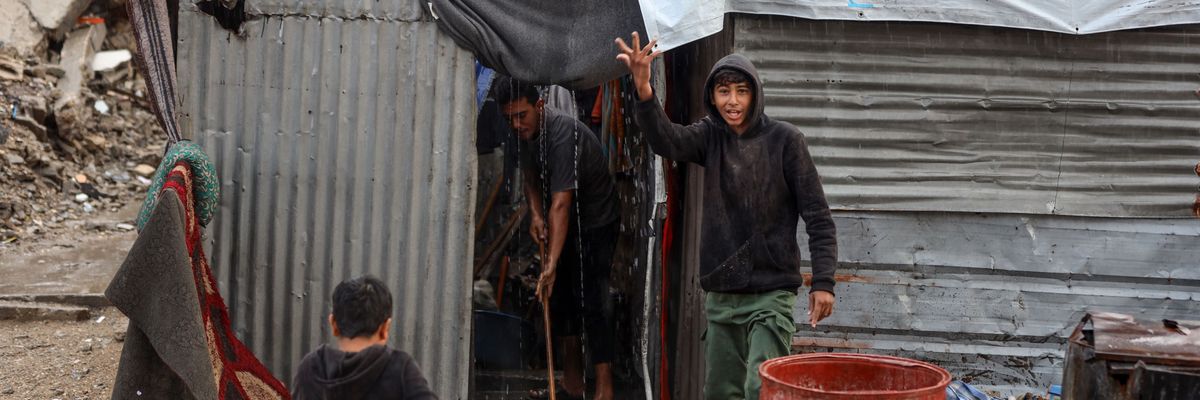
Young Palestinian men create channels in the sand to direct the rain at a makeshift camp housing displaced Palestinians in Gaza City, Palestine, on November 25, 2025. (Photo by Majdi Fathi/NurPhoto via Getty Images)
A prominent international human rights organization is warning that the United States’ plan for postwar Gaza will impose “unlawful collective imprisonment” on the Palestinian civilians who have survived two years of genocide.
In November, several news outlets reported on the Trump administration’s plan to carve Gaza in two: a so-called “green zone” controlled by Israel and a “red zone” controlled by the militant group Hamas.
The US would construct what it called “Alternative Safe Communities” for Palestinians to live in the Israeli-controlled portion of Gaza, which is over half of the territory under the current “ceasefire” agreement.
The New York Timesdescribed these communities as “compounds” of 20,000 to 25,000 people, where Israeli officials reportedly argued they should not be allowed to leave.
The initial reporting raised fears that the US and Israel were constructing what would amount to a “concentration camp,” where Palestinians would be forced to live in squalid conditions without freedom of movement.
On Wednesday, the Euro-Mediterranean Human Rights Monitor released new details on how Palestinians, currently facing mass displacement from their homes in the portion of the strip not occupied by Israel, would be corralled into the green zone under the US proposal.
The Geneva-based group issued a stark warning about the plan, which it said carried “grave risks, including the effective displacement of Palestinians from their homes and the transformation of large parts of Gaza into closed military zones under the direct control of the Israeli army.”
“Entry and exit would be permitted only through security screening, effectively converting these sites into overcrowded detention camps that impose severe restrictions on residents’ freedom of movement and daily life.”
Euro-Med’s report explains that the transfer of Palestinians would be carried out using “various pressure tactics.”
“This is done by creating a coercive environment in the red zone and making access to relative protection and basic services conditional on relocating to designated areas within the green zone, following extensive security screening and vetting,” the report says. “This removes any genuine element of consent and places the process squarely within the scope of forced displacement prohibited under international humanitarian law.”
It also provides new details on the conditions Palestinians would be subject to once they’ve arrived: “The plan includes the establishment of ‘cities’ of prefabricated container homes (caravans) in the green zone, each housing around 25,000 people within an area of no more than one square kilometer and enclosed by walls and checkpoints.”
This means these Palestinian cantons would be over three times as densely populated as the Tel Aviv District, the most crowded in Israel, which has about 8,130 people per square kilometer.
“Entry and exit would be permitted only through security screening, effectively converting these sites into overcrowded detention camps that impose severe restrictions on residents’ freedom of movement and daily life,” the report continues.
This is not the first proposal to use the promise of safety to lure Palestinians into an enclosed space without the right to leave.
Earlier this year, following US President Donald Trump’s call for the people of Palestine to be forcibly removed from the Gaza Strip, Israeli Defense Minister Israel Katz proposed the creation of a massive “humanitarian city” built on the ruins of Rafah that would be used as part of an “emigration plan” for hundreds of thousands of displaced people.
Under that plan, Palestinians would have been given “security screenings” and once inside would not be allowed to leave. Humanitarian organizations, including those inside Israel, roundly condemned the plan as essentially a “concentration camp.”
Euro-Med said that the design laid out in the new US plan “mirrors the historical model of ghettos, in which colonial and racist regimes confined specific groups to sealed areas surrounded by walls and guard posts, with movement and resources controlled externally, as seen in Europe during World War II and in other colonial contexts.”
Medicare for All Sees Key Polling Shift as Americans Fume Over Surging For-Profit Insurance Premiums “Everybody recognizes that our current healthcare system is broken,” said Sen. Bernie Sanders. “That’s why over 60% of the American people support Medicare for All.”
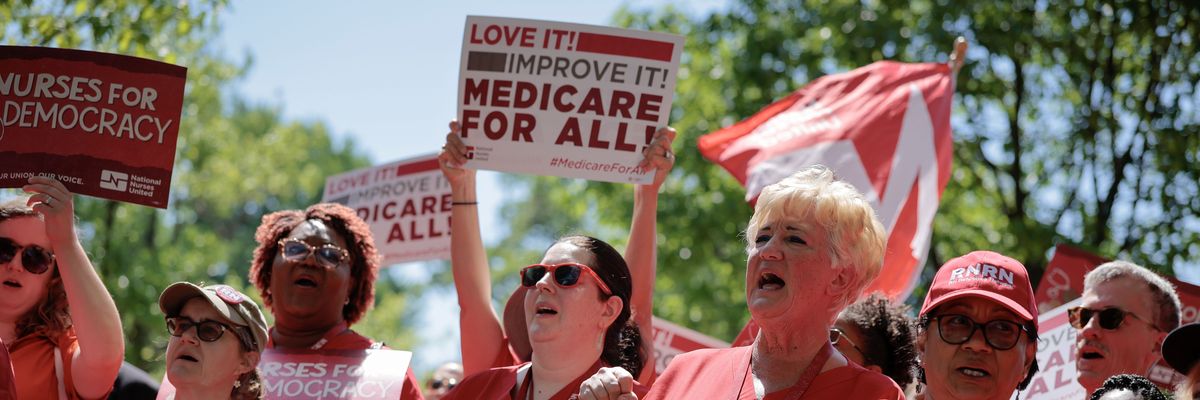
Members of National Nurses United rally with lawmakers to show their support for the Medicare For All Act on April 29, 2025. (Photo by Chip Somodevilla/Getty Images)
With Affordable Care Act premiums surging and lawmakers on both sides of the political aisle scrambling to cobble together a last-minute fix, recent polling data shows that a strong majority of the American public supports a transformative proposal that few members of Congress are vocally advocating.
Data for Progress released survey results late last month showing that 65% of likely US voters—including 78% of Democrats, 71% of Independents, and 49% of Republicans—either strongly or somewhat support “creating a national health insurance program, sometimes called ‘Medicare for All,’ that would cover all Americans and replace most private health insurance plans.” RECOMMENDED...
Overall support for such a system dropped just two percentage points when survey respondents were informed that Medicare for All would replace insurance premiums with higher taxes, abolish most private insurance, and eliminate copays and deductibles. In an analysis posted last week, The Lever‘s David Sirota observed that those results are a shift from earlier polling showing a sharp decline in support for Medicare for All once respondents were told the proposal would wipe out private insurance.
“That might have been the end of Medicare for All for another generation—except now the ACA is epically and undeniably failing to guarantee ‘affordable’ healthcare,” Sirota wrote. “As private health insurers are now jacking up premiums for tens of millions of Americans, a new poll shows a huge majority of Americans now want Medicare for All—even if it entails eliminating private insurers and raising taxes.”
The Data for Progress survey came as Republican and Democratic lawmakers continued floating temporary, Band-Aid solutions to avert catastrophic premium increases stemming in large part from the looming expiration of enhanced ACA tax credits, which lapse at the end of the year.
A new poll released Thursday by KFF found that “six in ten adults (61%) who buy their health coverage on the ACA marketplace say it is very or somewhat difficult to afford their deductibles and out-of-pocket costs for medical care.”
“When asked what they would do if the amount they pay for health insurance each month doubled, one in three enrollees (32%) say they are very likely to shop for a lower-premium plan (with higher deductibles and out-of-pocket costs), and one in four (25%) say they would be very likely to go uninsured,” KFF noted.
Senate Majority Leader Chuck Schumer (D-NY) on Thursday pitched a three-year extension of the ACA subsidies ahead of a planned vote next week—a proposal that Republicans are certain to oppose.
On the Republican side, Sen. Rick Scott (R-Fla.)—who is linked to the largest Medicare fraud case in US history—is convening a group of Republican lawmakers to craft a likely dead-on-arrival ACA alternative that would implement some proposals floated by President Donald Trump, including new savings accounts that critics say would further enrich banks and insurance giants.
Scott warned in a statement to Axios earlier this week that “the more Republicans refuse to engage on this issue, the more we allow radical Democrats to lead our country on a slow creep towards the Socialist single-payer healthcare system they’ve always wanted.”
House Speaker Mike Johnson (R-La.), meanwhile, is reportedly planning to finalize a healthcare bill early next week, though no details were immediately available.
There’s also a bipartisan framework led by Reps. Josh Gottheimer (D-NJ) and Jen Kiggans (R-Va.), which calls for a one-year extension of the enhanced ACA tax credits “with targeted modifications,” including intensified means-testing that would phase out the subsidies for those with incomes between 600% and 1,000% of the federal poverty level.
The Medicare for All Act, led by Sen. Bernie Sanders (I-Vt.) in the Senate and Reps. Pramila Jayapal (D-Wash.) and Debbie Dingell (D-Mich.) in the House, would have no such means-testing, guaranteeing comprehensive coverage to all for free at the point of service.
“Everybody recognizes that our current healthcare system is broken. That’s why over 60% of the American people support Medicare for All,” Sanders said at a rally with nurses in the nation’s capital on Wednesday. “The day will come when working-class Americans will be able to go to the doctor, dentist, or a nursing home without having to worry about the cost. We’re going to win this fight.”