The Death Of Rural Russia Reflects Both Natural Shifts And Political Decisions – OpEd

By Paul Goble
Over the last 30 years, more than 34,000 villages have disappeared from the map of Russia; and more are doing so at the rate of approximately one ever day. Since 2000, 28,000 schools of have closed, many in rural areas, leaving the country with only 40,000 a trend that has accelerated this process, according to government data.
Of course, Dmitry Trifonov of the Versiya news portal says, this process began long ago in Soviet times and is not uniquely the produce of post-Soviet rule. But it has been exacerbated since then, especially as there is now more support for having villages disappear (versia.ru/po-kakim-prichinam-proisxodit-depopulyaciya-rossijskix-dereven-i-chto-zhdet-rossiyu-bez-sela).
In the 1960s and 1970s, Soviet officials identified “villages without prospects” and planned of their closure. But the policy was unpopular and in 1980, it was officially suspended. But Trifonov says, there are still many officials who are promoting that idea to improve efficiency and save money.
“Certain experts consider that behind the withering away of villages stand not only objective causes but definite interests,” he continues. Among the most prominent of these are agro-industrial concerns which want to do away with the villages so that they can farm regions without any restrictions the population may require.
That combing villages and moving people into larger district centers is more economically efficient, Trifonov says, is beyond question more efficient. But it ignores the feelings of the populations involved and even if looked at more generally the broader interests of the state as a whole.
Supporters of consolidation argue that a village is like an organism and say that “sometimes amputation of a gangrenous extremity will save the rest of the body.” But, and this is critical, the journalist continues, “behind each such ‘amputated’ settlement are people who live on the land of the ancestors” and are deeply attached to it.
To move them is to “destroy part of their identity. Besides, a massive resettlement into cities intensifies the burden on the infrastructure of the latter” and may end by costing more than any of the much-ballyhooed savings from taking that step. Moreover, doing it in some places will alienate Russians in other places where this process has not yet occurred.
Trifonov is clearly an opponent of untrammeled consolidation. And he suggests there are compelling reasons for viewing any such plans with skepticism. They may lead to a reduction of agricultural production and make Russia more dependent on imports, they may cost the country the unique culture villages provide, and they put the people involved at risk.
If this process takes place gradually and with the full consultation of all involved, then it is probably inevitable and can be a positive thing. But if it is pushed through by officials in Moscow who don’t understand what is at stake in the regions, then there is a high probability of disaster, he suggests.
Central Asian Migrants A Problem For Their Homelands Now And When They Return – Analysis
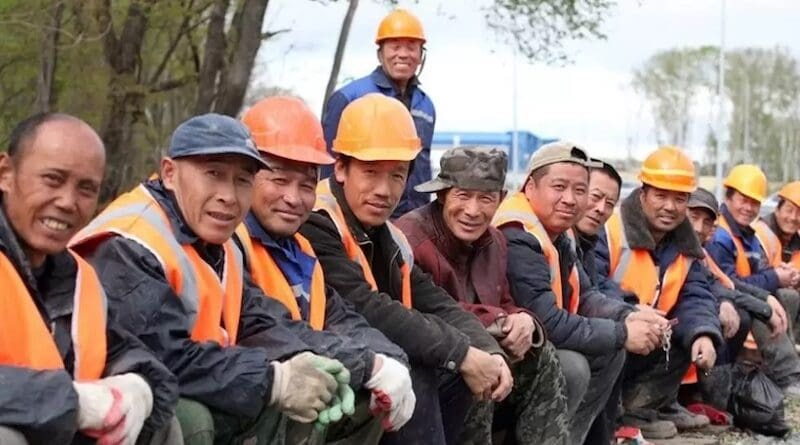
Central Asian migrant workers in Russia. Photo Credit: Komsomolskaya Pravda
By Paul Goble
The problems Central Asian migrant workers pose for Russia have long caused many in Russia to want them to leave, but the challenges these same people represent for their own countries have not drawn the same attention.
Many assume that payments sent home by migrant workers and the positive effects of emigration on Central Asian overpopulation and unemployment make migrant work overwhelmingly positive for Central Asians and their governments (see EDM, May 15, 2024). Even though migrant labor has real mutual benefits for both Russia and Central Asian governments, outmigration also causes serious problems in Central Asia. The loss of large numbers of young men in Central Asia removes fathers and socializers of the younger generation (see EDM, May 9, 2024.
As a significant share of these young men return home, in large part due to rising xenophobia in Russia, they will be faced with a changed social landscape and lower incomes (Window on Eurasia, April 3, 2024; see EDM, May 15, 2024). What began as a pressure valve for overpopulation and unemployment in Central Asia may trigger social unrest as migrants return home.
Central Asia has remained almost the only region of the world where population growth continues to exceed replacement levels (Window on Eurasia, December 22, 2024, February 18). Countries in the region have viewed outmigration as a solution and have been more or less pleased that the Russian Federation has been willing to take so many of them in (see EDM, February 28, 2017).
Outmigration not only reduces unemployment and social pressures in Central Asia but also provides additional cash flow for the population and government through payments sent home by those working abroad (see EDM, February 28, 2017; RITM Evrazii, May 13). Because Central Asia reaps these benefits, relatively little attention has been given to the problems created by outmigration, and even less to how those problems will be exacerbated if and when Central Asians working in the Russian Federation return home.
Central Asian governments are paying more attention to the negative consequences of outmigration as workers return home in large numbers. Researchers in Central Asia are focusing their attention on how outmigration has “changed the social and economic structure of the region” through the removal of young men aged 18 to 35 who would otherwise help raise children (Bugin Info, May 14). These men left both because unemployment in their home countries was so high and because pay in the Russian Federation was much higher (Bugin Info, May 14). The exodus of young men from Central Asia has become so severe that locals speak of “cities without men” and the resulting societal changes (Bugin Info, May 16).
The scale of outmigration is massive. In 2023, the last year for which there is comparable data for all five countries in the region, there were approximately 10 million Central Asian laborers working abroad. In Tajikistan, this was a quarter of the working population; in Kyrgyzstan, about 20 percent; and in Uzbekistan, 10 percent. In 2022, migrant workers sent home $14 billion in transfer payments, which constituted 30 percent of Tajikistan’s gross domestic product, 25 percent of Kyrgyzstan’s, and 10 percent of Uzbekistan’s (Bugin Info, May 14).
For a time, the influx of money and the role of jobs abroad in driving down unemployment at home obscured the problems of massive outmigration. As more Central Asian migrants return home rather than moving abroad and transfer payments are dropping, however, the social problems caused by outmigration are becoming ever more obvious.
In rural districts of Central Asia, “the share of men aged 18 to 35 has fallen 20 to 30 percent over the last 15 years,” and in some of parts of Tajikistan and Kyrgyzstan “up to 80 percent of the adult male population is absent for a large part of the year,” according to data compiled by the information portal Bugin Info (Bugin Info, May 16).
That means that in Tajikistan, an unprecedented 40 percent of the households are now headed by women. The situation in the other four countries is somewhat less extreme, but an increase in female-headed households is now characteristic of the region as a whole. Regional experts argue that “the lengthy absence of men is destroying family structures,” as evidenced by the collapse of traditional gender roles within families and dramatic increases in divorce (Bugin Info, May 16). When migrant workers return home, many find it hard to cope with the new dynamics, resulting in an increase in familial conflict and domestic violence (Bugin Info, May 16).
Fewer young men in rural regions reduces the “potential for social change,” as they typically drive protests and reform (Bugin Info, May 16). Outmigration of large swaths of young men thereby contributes to political stagnation and, upon their return, sets the stage for conflict between those who want patriarchal social structures to prevail and those who want women to continue in leadership roles adopted during the absence of their families’ patriarch. Without “systematic reforms in the economy, education, and social policies” of Central Asia, the loss of young men to migrant labor and separate problems created by their return will “threaten the stability of the region” (Bugin Info, May 16).
Addressing the challenges that cause outmigration would be difficult for any government, particularly so for the hard-pressed and resource-short governments of Central Asia. Migrant workers returning home will collapse payments sent to Central Asia from abroad and increase domestic unemployment rates, meaning that governments are unlikely to have the capital to make necessary reforms in a timely fashion. If that proves to be the case, then the problem of “cities without men,” which for many outsiders may appear to be a sociological curiosity, is likely to take center stage in the near future and become the source of challenges far greater than other developments which regularly attract more attention.
- This article was published by The Jamestown Foundation’s Eurasia Daily Monitor Volume: 22 Issue

Paul Goble
Paul Goble is a longtime specialist on ethnic and religious questions in Eurasia. Most recently, he was director of research and publications at the Azerbaijan Diplomatic Academy. Earlier, he served as vice dean for the social sciences and humanities at Audentes University in Tallinn and a senior research associate at the EuroCollege of the University of Tartu in Estonia. He has served in various capacities in the U.S. State Department, the Central Intelligence Agency and the International Broadcasting Bureau as well as at the Voice of America and Radio Free Europe/Radio Liberty and at the Carnegie Endowment for International Peace. Mr. Goble maintains the Window on Eurasia blog and can be contacted directly at paul.goble@gmail.com .

No comments:
Post a Comment