BAE Systems Ordered to Improve Fire Safety at Nuclear-Sub Shipyard
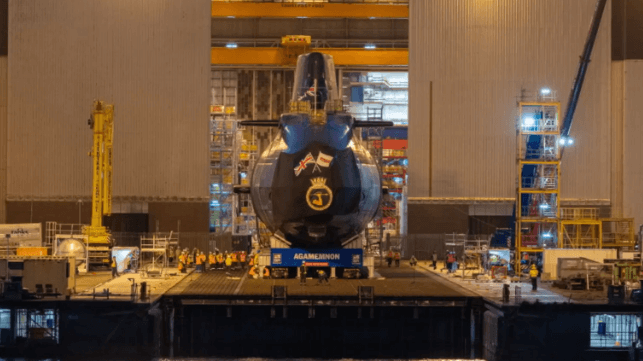
The defense and security contractor building the next-generation nuclear submarines for the Royal Navy has been ordered to improve its safety measures after a fire broke out at its Barrow-in-Furness shipyard in October last year.
BAE Systems Marine, which is building the UK’s largest and most powerful fleet of attack submarines, has been served with an enforcement notice demanding improvements on its safety practices. The notice, served by the Office for Nuclear Regulation (ONR), gives BAE Systems until September 12 to put in place measures that “ensure the protection of workers in the event of a fire."
The notice follows a fire that broke at the company’s Barrow-in-Furness site in Cumbria, where the Astute- and Dreadnought-class boats are being built. ONR found that five employees entered an area in the Devonshire Dock Hall facility when the fire was still raging in the early hours of October 30. As a result, two employees were taken to hospital for treatment, though they were discharged and returned to work on the same day.
Inquiries concluded that BAE Systems' arrangements for ensuring workers did not enter places of danger without the appropriate safety instructions were inadequate. In essence, the company lacked guidance to inform staff on the required actions in the event of a fire.
The UK nuclear industry regulator has gone ahead to serve BAE Systems with an enforcement notice under the Regulatory Reform (Fire Safety) Order 2005. “We will continue to engage with BAE Systems Marine during the period of the enforcement notice to ensure positive progress is made to address this shortfall,” said Bruce Archer, ONR’s Head of Propulsion Sites Regulation, Operating Facilities Directorate.
UK’s Demonstrator Project for Dismantling Nuclear Subs Moves Forward
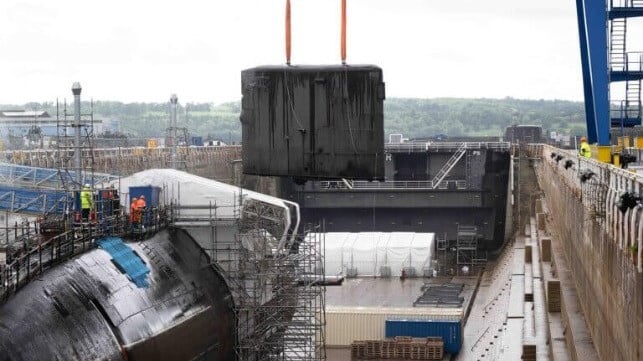
The UK marked a milestone early in June in its efforts to develop a program for dismantling and recycling its fleet of decommissioned nuclear submarines. The first large section was cut from the former HMS Swiftsure as the final stage of the first dismantling project for a British nuclear sub moves forward.
The first major cut on HMS Swiftsure was the removal of the sub’s fin (sail or tower section) of the nearly 5,000-tonne submarine. The large structure was removed from the hull and lowered to the dry dock. Cutters have been working on the submarine since late 2024 after she entered a dry dock in Rosyth, Scotland at the Babcock facility. While they have begun removing smaller elements within the hull, this was the first exterior cut into the vessel.
The project is scheduled to be completed by the end of 2026, and they estimate as much as 90 percent of Swiftsure’s total weight will be recycled. Some of the high-quality steel will be repurposed into components for future Royal Navy submarines.
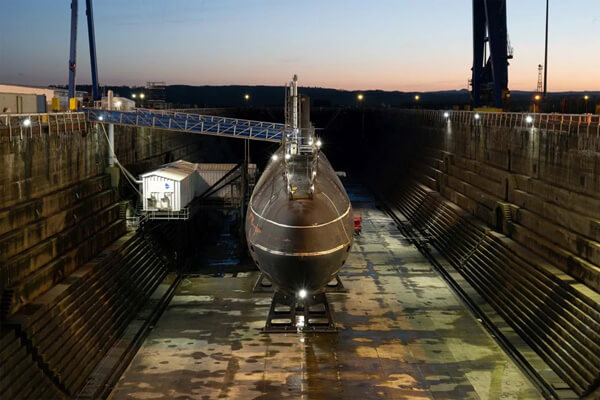
Swiftsure is being dismantled in a dry dock in Scotland (Royal Navy)
The UK has been working to develop a process for the recycling of the submarines for nearly a decade with critics pointing out they are dramatically behind schedule. The country currently has a total of 23 decommissioned nuclear submarines stored between Rosyth and Devonport in England and many still have their nuclear fuel on board. They require regular maintenance and surveys.
Critics point out the UK moved to rapidly decommission nuclear submarines at the end of the Cold War with no plan for how to address the ships. One proposal called for scuttling the vessels in deep water. By comparison, the United States has a well-developed process undertaken at the yard in Bremerton, Washington which completes the recycling of a Los Angeles class attack submarine in less than two years.
The UK established the Submarine Delivery Agency in 2013 with the objective of developing a dismantling and disposal solution for 27 decommissioned nuclear submarines. The plan calls for a multi-stage approach starting with the removal of radioactive parts that contain low-level radioactive waste. The second stage is the removal of the Reactor Pressure Vessel and that is followed by the clearing of all radioactive materials.
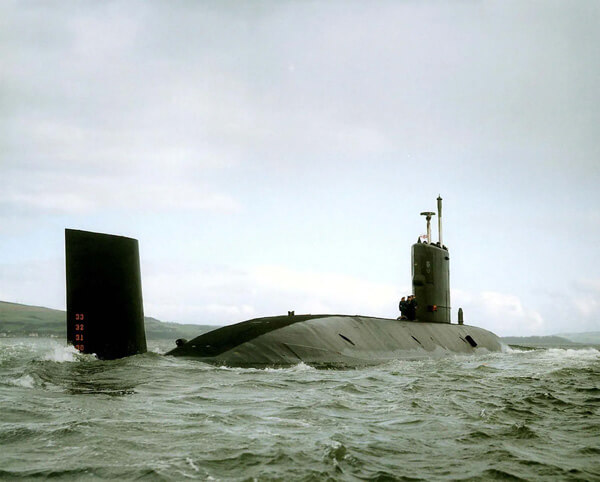
Swiftsure was operational from 1972 to 1991 (Royal Navy)
Swiftsure was ordered in 1967 and built by Vickers-Armstrongs Barrow-in-Furness shipyard. She was 83 meters (272 feet) in length and commissioned as the first of her class in April 1972. She was active for 19 years but retired after they reportedly found cracks in the structure as she was prepared for her second life-extension overhaul. There were five other vessels in the class with the final one decommissioned in 2010.
Swiftsure is designed as a demonstrator project for dismantling. She was moved to a dock at Rosyth on July 27, 2023. In the first phase, they worked to identify and remove any remaining classified items and check that she was free of any radioactive material.
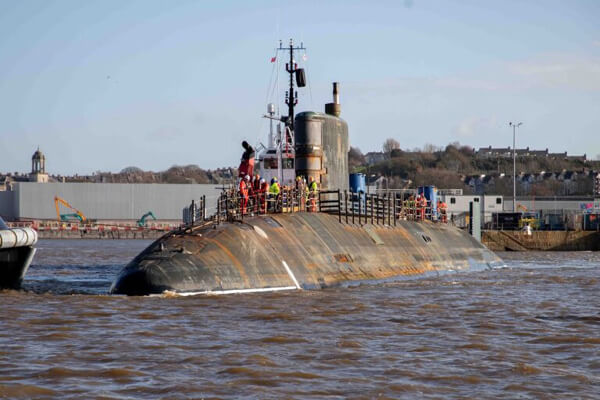
UK looks to accelerate the disposals to deal with the backlog of laid up nuclear submarines (Babcock)
The Submarine Delivery Agency highlights that with subsequent vessels they have been able to move at a faster pace and lower cost. HMS Resolution which has 50 percent greater tonnage completed her first stage cleaning in three-quarters of the time of Swiftsure.
Babcock announced at the beginning of June that it had been awarded a three-year contract to prepare for the first nuclear defueling of a decommissioned Trafalgar Class submarine in over 20 years. The £114 million ($155 million) contract from the Ministry of Defence will see the defueling process begin for four decommissioned submarines, with activities getting underway starting in 2026.
BAE Systems is tasked with building the next generation submarines for the Royal Navy and has since handed over five of the Astute class boats. A further two boats named Agamemnon and Agincourt are currently under construction. The company is also building the Dreadnought class submarines that will replace the Vanguard class when they enter service in the early 2030s. Work on the first two boats is underway in Barrow.
Covering about six acres, the Devonshire Dock Hall facility is the second-largest indoor shipbuilding complex of its kind in Europe and is critical in the delivery of the boats. The facility was opened about four decades ago.
BAE Systems reckons it has invested more than £1 billion ($1.3 billion) in advanced technology and upgraded infrastructure at the shipyard to enable it to deliver Dreadnought. The company also intends to invest a further £450 million ($605.6 million) over the life of the program. Approximately 10,000 people work on the Dreadnought and Astute submarine program at the Barrow site.

No comments:
Post a Comment