Sacred Forest Management

Off of Hyde Park Road, Santa Fe, NM Photo: Lura Brookins.
Ecological science is essential for understanding forests at a functional level, and The Forest Advocate supports ecological research in every way it can. In addition to advocating for conservation and rational environmental analysis, we reflect on the deeper meaning and importance of forests. Science must be infused with an acknowledgment of the sacred, which is the vital force of all living things. Science and the sacred are not separate – and any effort to separate them promotes a disconnection with the natural world. The natural world does not know separation.
Forest ecosystems are increasingly degraded and out of balance due to human interventions – most of which have been short-sighted and lacking in respect for the natural world. Sometimes I wonder whether our collective efforts to protect forests will ultimately succeed. It truly feels like David vs. Goliath – Goliath being the forces that consider forests to be virtually inanimate, resources to be used and extracted from in whatever ways we humans choose. Not long ago, President Trump called our forests “vast timber fields.” This suggests that forests exist primarily to be logged for profit. But many of us understand that there is no real separation between “forests” and “we humans.” Forests and humans are so interconnected that any actions that damage forests will also harm humans. Such actions reverberate endlessly.
When reading U.S. Forest Service project planning and analysis documents, it becomes apparent how reductionist the approach is. To some extent, a reductionist approach is required. In order to understand, grapple with, and affect a “whole,” it is necessary to break the whole down into its component elements. But if such reductionist analysis is carried out at the expense of a comprehensive and holistic perspective on forests, then the most critical essence is missed. That essence is that forests are alive and deeply interconnected – they are aspects of vital systems that extend far beyond forests – and that essence can be called “sacred.” The sacredness of forests is that they are essential to all life, including to our psychological and spiritual well-being.
Ancient and Indigenous cultures have tended to maintain that awareness and sacred intent towards the natural world. Modern cultures have largely let go of this awareness and intent, and instead approach forest management in a more mechanistic manner. This has culminated in a misguided belief that we can redesign natural ecosystems through scientific perspectives rooted in dominance over nature, and thereby repair the past damage we have caused to forests through overconsumption and aggressive management. We can help to restore forests, but only if we approach forest restoration in a sacred manner, understanding and acknowledging the profoundly interconnected life of forests that is far beyond our limited knowledge and understanding.
The Society for Ecological Restoration (SER), an international body that includes the U.S. Forest Service, states as one of its eight core principles, “The practice of ecological restoration benefits from a combination of acquired practitioner knowledge, Traditional Ecological Knowledge, Local Ecological Knowledge, and scientific discovery.” Traditional Ecological Knowledge is known as TEK. A SER document that outlines its principles and standards for ecological restoration states that “TEK involves reciprocity – sharing and restraint sustained by spiritual beliefs that regard plants and animals as human kin.” TEK is simply human knowledge and experience from times when societies were much more aligned with the natural world. This knowledge still exists in all of us. However, utilizing this experience and knowledge requires much more than adding a smattering of TEK strategies to forest management and restoration project design and planning. It’s a realignment between humans and the rest of the natural world that has its foundation in abiding respect and humility.
We are moving inexorably forward into a time of massive forest degradation due to federal forest management policies such as the “Fix Our Forests Act,” which will result in greatly increased extraction from our forests, and more human-conceived ecosystem redesign without reasonable analysis or a holistic understanding of natural processes. We have to decide if it’s worthwhile to spend our valuable time opposing it. I ask myself that often. Recently, a friend of The Forest Advocate wrote to me: “You are indomitable and correctly righteous, and you never seem to let yourself surrender.” That is true for all of us who are still advocating for forests, even during the worst of times for environmental issues. Surrender is to give up on life itself, and on the sacred spark that is in all things. So no, we can’t surrender. We must leave as much intact forest as possible for the upcoming generations.
A more sacred perspective naturally brings forth a shift in forest policy – from managing forests primarily as human resources to honoring them as living systems. This perspective directs forest project planning towards conservation, reciprocity, long-term ecological integrity, and a focus on balancing the increasing heat and dryness in forested ecosystems with coolness and moisture. Abundant tree canopy and understory must be retained, and we can assist forests in retaining moisture through conservation strategies such as protecting and restoring soils, promoting beaver habitation, decommissioning unneeded forest roads, and replanting degraded riparian areas.
Recently, I came across a beautiful and uplifting essay about trees and forests by a spiritual teacher in the Hindu tradition named GurujiMa. Her words express the sorrow of losing our natural forests through human shortsightedness, along with the hope of the inevitable recovery that will occur when enough humans comprehend what we have done to our forests, and truly understand that we are part of the natural world and cannot be separate.
The Spiritual Nature of Trees
by GurujiMa
Unfailing in their ability to stand tall and proud over years, decades, and even centuries, trees demonstrate their capacity to join earth and sky through their own bodies and to transmit the energies of both.
Rooted in the deep earth, they absorb from the earth all that is needed in order to maintain their form and life. This life-force moves through them with a gentle murmur, like the hum of a distant plane. At the same time, the tree receives from the sky the light it needs to nourish its foliage, to convert carbon dioxide to oxygen, and to replenish the earth’s supply of atmospheric nutrients.
The inner being of a tree is both a part of the earth and an individualized life-form – not a physical spirit in the sense of one that could independently move, speak, or think on its own, but a spirit with feeling, consciousness, and a capacity to remain in continual communion with the state of the earth and with its own participation in that state.
When man, through greed, indifference, selfishness, and a departure from the sacred, assumes that the life of a tree can be used indiscriminately for his own purposes, this assumption is a violation against the law of life which grants to all beings, whether human or non-human, the respect accorded to those possessing the essence of the One divine Spirit that pervades all. Not only do trees feel and respond when they are indiscriminately cut down, but the earth feels this as well, and where such wanton or indifferent action takes place without reverence for the needs of the earth, there, a wound grows that is often very difficult to heal.
The spirit of each tree can speak to those who listen, sometimes with words, but often in the hum of its existence — the vibration of its life-force which connects its roots with the tips of its branches. These giant beings are willing communicators as friends of the earth, friends of souls, and guardians of the planetary atmosphere. If they were given more in the way of respect and appreciation, they would be able to produce more replenishment for the earth’s atmosphere than what is currently thought of as possible.
Today, by contrast, trees in many places of the world are in a sad state. Their spiritual vitality has been diminished by wanton logging practices and their strength and beauty have been affected. Ultimately, when the earth’s cries can be heard by a sufficiently awakened humanity, trees, as well as the earth herself, will be found to have suffered through a great ordeal at the hands of men and of human greed, and a way will be sought to correct the balance with which we relate to the natural world. At that time, the spiritual nature of trees will shine once again, and we will return to a more authentic way of respecting the earth and all that she contains than has been possible since the departure from the sacred that took place long ago. In the meantime, it is possible to act in recognition of the sacred life of trees, and to begin the process of restoring to nature the gifts that have been given so abundantly to mankind over the years, centuries, and millennia of human history.”
It just rained, and the raindrops are glistening on the conifer needles. You can feel the trees drinking the moisture in, and becoming rejuvenated. It’s impossible not to see that the trees are alive. The forest is life. Life is sacred.
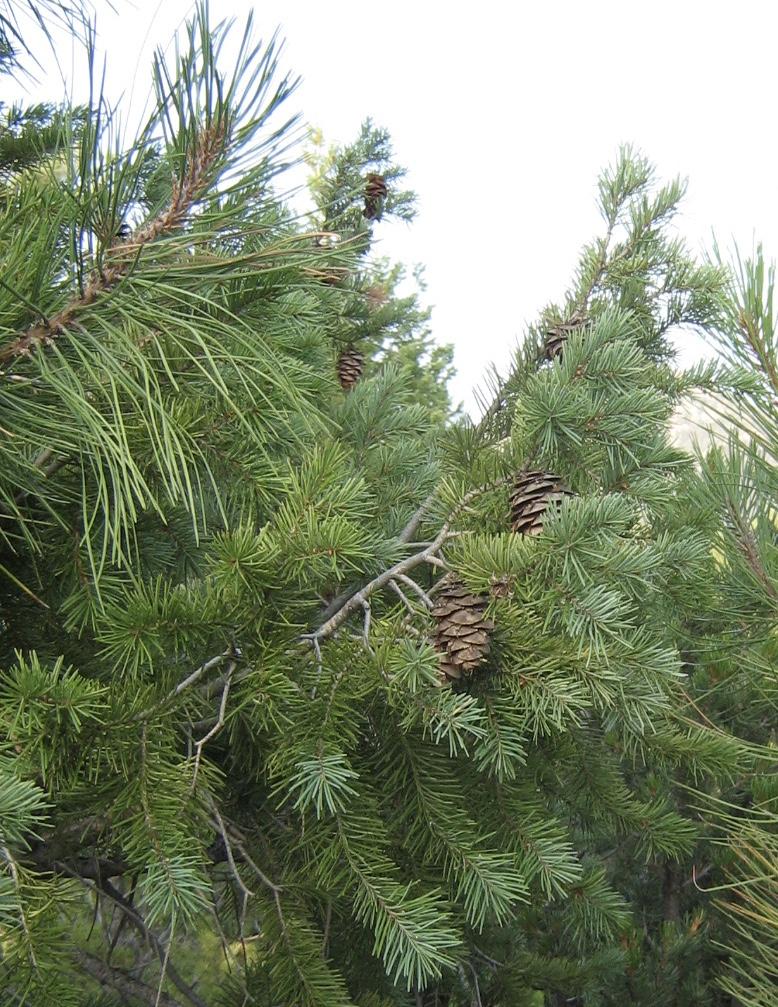
Photo: The Forest Advocate.
June 6, 2025
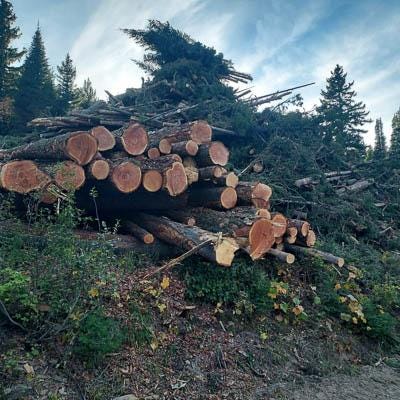
Logs cut for “Hazardous Fuel Reduction” on the Custer Gallatin National Forest in Montana. Photo by George Wuerthner
A recent article in the Daily Montanan “State wildfire briefing indicates fire season ‘could be significant” promotes misguided information about wildfire.

Most fire ignitions burn less than a few acres and usually self-extinguish. Photo by George Wuerthner.
It starts with Montana Governor Greg Gianforte’s claim that the state firefighters have been able to keep “95% of wildfire starts to 10 acres or fewer since 2021.
”What is missing from such a claim is that 99% of all wildfire starts tend to burn 10 acres or fewer, even if you do nothing. Most fire ignitions self-extinguish or are easily suppressed if you have low to moderate fire weather.
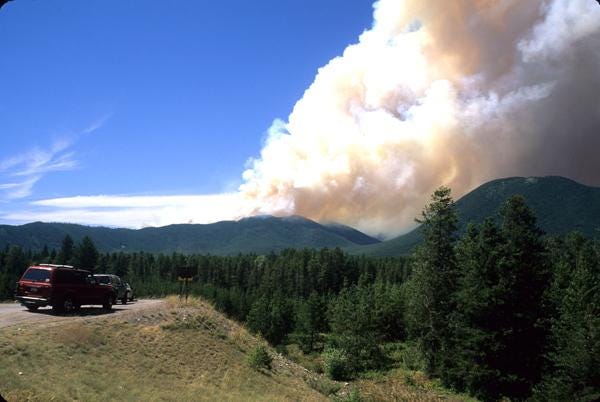
Large wildfires are driven by drought, low humidity and high winds. Under such climate/weather conditions, fires are nearly impossible to suppress. Photo by George Wuerthner
The state and federal governments continue to promote the concept that fuels control large blazes. However, it is the climate that promotes large blazes.
If you have extreme fire weather, it is virtually impossible to stop a blaze. The only significant fires are those burning under such climate/weather conditions. These conditions include drought, high temperatures, low humidity, and, most importantly, high winds. Fires created under extreme fire weather conditions make up less than 1% of all wildfires but account for most acreage burned annually.
For instance, the 1910 Big Burn that charred more than 3.5 million acres of western Montana and northern Idaho occurred over two days due to high winds and extreme drought.
The multi-year moisture deficits and predicted warm, dry summer will likely create the ideal conditions for major wildfires.

Wildfire on the outskirts of Helena, Montana. More than half of Montana’s homes are at high risk of ignition from wildfire. Photo by George Wuerthner
The problem for Montana is Wildfire Risk.org, which suggests that more than half of Montana’s homes are at high risk of ignition from wildfire. The best way to reduce fire risk is by home hardening and construction with non-flammable materials.
Despite research that shows that home hardening in the home ignition zone is the most effective and efficient means of reducing wildfire risk, government agencies continue to promote fuel reductions as their solution. The Forest Service’s “Confronting the Wildfire Crisis” program is focused on reducing fuels in forests rather than directly protecting communities.
For instance, the Forest Service implemented “hazardous fuel reductions” on 200,000 acres in Montana. Beyond the fact that the term “hazardous fuel reductions” is misleading, because these practices increase fire hazards in many instances.
For example, thinning opens the forest to significant solar radiation, dries the soil, and increases the vapor pressure deficit, making trees and shrubs more flammable. Thinning also promotes higher wind penetration, and wind is the primary factor in the spread of embers that boost large wildfires.
The other problem with promoting fuel treatments is that one can’t predict where a fire will ignite and burn. Less than 1-2% of wildfires encounter fuel treatment.
So, the public gets the costs and damage resulting from active forest management but with little benefit.

Fuel reduction on the Wallowa Whitman National Forest. Photo by George Wuerthner.
Fuel treatments are not benign. They remove biomass and carbon from the forest. They kill many trees (usually not counted as “mortality”), and the disturbance they cause can promote the spread of weeds, displacement of wildlife, and harm to scenic values.
A review of 1500 wildfires in dry forests around the West found that woodlands under “active forest management,” such as thinning or prescribed burning, were more likely to burn at higher severity than landscapes protected from logging, such as parks and wilderness, even though they presumably have more “fuels” than treated landscapes.

A medical clinic in Paradise, California was destroyed by the Camp Fire. Note the green trees in background. This building burnt down due to embers. Photo by George Wuerthner
A far more effective fire strategy is to reduce community vulnerability by decreasing fuels near buildings and infrastructure. This also has the positive outcome of enabling wildfires to be restored to their natural functions in nearby wildlands vegetation.
George Wuerthner has published 36 books including Wildfire: A Century of Failed Forest Policy.

No comments:
Post a Comment