It’s possible that I shall make an ass of myself. But in that case one can always get out of it with a little dialectic. I have, of course, so worded my proposition as to be right either way (K.Marx, Letter to F.Engels on the Indian Mutiny)
Tuesday, June 10, 2025
SPACE/COSMOS
Supernovae may have kicked off abrupt climate shifts in the past, and they could again
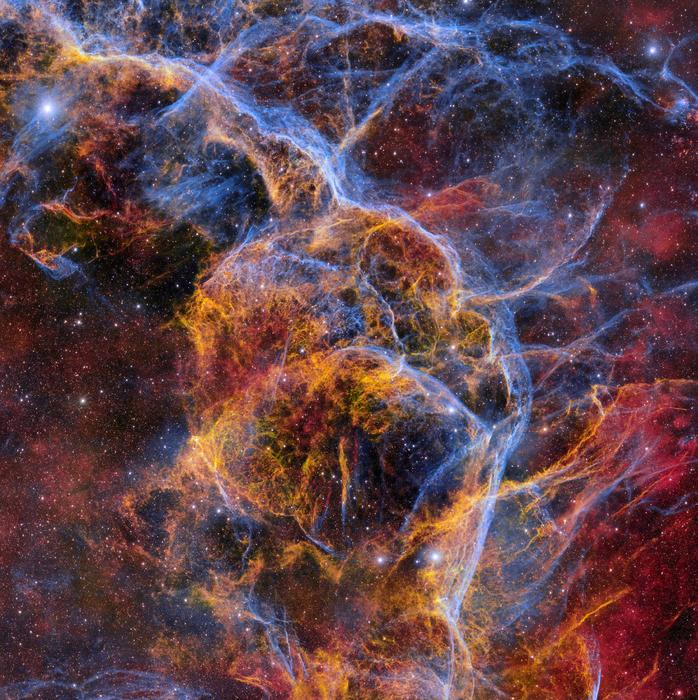
The Vela supernova remnant, the remains of a supernova explosion 800 light-years from Earth in the southern constellation Vela, as seen from the Dark Energy Camera on the Víctor M. Blanco Telescope at Cerro Tololo Inter-American Observatory.
When a star explodes, it sends high-energy particles out in all directions. This burst of energy can travel through space for thousands of light-years, traversing solar systems and even galaxies.
In a recent paper, published in the Monthly Notices of the Royal Astronomical Society, INSTAAR senior research associate Robert Brakenridge argues that supernovae may be the key to understanding a series of abrupt climate shifts in recent geologic history. The analysis models how such radiation could collide with Earth’s atmosphere, changing its composition. Brakenridge also matches a number of known supernovae to climate shifts preserved in geologic records.
“We have abrupt environmental changes in Earth’s history. That’s solid, we see these changes,” Brakenridge said. “So, what caused them?”
Brakenridge says that, if nearby supernovae caused such changes, further research could help scientists predict similar events in the future and prepare accordingly.
“When nearby supernovae occur in the future, the radiation could have a pretty dramatic effect on human society,” he said. “We have to find out if indeed they caused environmental changes in the past.”
Brakenridge’s recent paper is actually one of many he and others have published on the topic since the 1980s. But, in the past, the idea has rested mainly in the realm of theoretical physics. Brakenridge’s new publication is an effort to link the theory to empirical observations, both in space and here on Earth.
Telescopes and tree rings
In recent years, high-powered, orbital telescopes have offered unprecedented information about the contents and character of supernova radiation. Using these observations, Brakenridge created a more precise model of how this radiation might interact with Earth’s atmosphere than previously possible.
According to the model, a sudden influx of high energy photons from a supernova would thin the ozone layer, which shields the Earth from the Sun’s rays. Simultaneously, the radiation would degrade methane in the stratosphere, a major contributor to the greenhouse effect that keeps the Earth warm. Put together, these interactions would dampen greenhouse warming and increase the amount of ultraviolet radiation that reaches Earth from the sun. Brakenridge predicts that knock-on effects could include selective animal extinctions, increased wildfires and global cooling.
Since supernova radiation isn’t arriving on Earth today, the model can’t yet be tested in situ. Instead, Brakenridge looked to records of the past for further evidence. Specifically, he looked at tree rings. Because trees incorporate atmospheric carbon into their trunks as they grow, scientists can look to these records for a glimpse into ancient atmospheric conditions.
In the new paper, Brakenridge parses tree ring records spanning 15,000 years and identifies 11 spikes in radioactive carbon. He argues that these spikes may have been caused by 11 corresponding supernovae.
“The events that we know of, here on earth, are at the right time and the right intensity,” Brakenridge said.
For now, supernovae are just one possible explanation for these phenomena — solar flares are the most prominent alternative. But, Brakenridge says the evidence is mounting behind his argument. He hopes that further efforts can refine models of environmental effects and correlate them with geologic records — from ice cores to marine sediment to tree rings.
A better understanding of supernova radiation could do more than just satiate curiosity, it could help humans prepare for abrupt climate shifts that could arrive any day. For example, astronomers predict that Betelgeuse, a nearby red supergiant star perched on the shoulder of the Orion constellation, will meet its end in a supernova explosion sometime soon — it could be tomorrow, or any time in the next 100,000 years.
“As we learn more about our nearby neighboring stars, the capability for prediction is actually there,” Brakenridge said. “It will take more modeling and observation from astrophysicists to fully understand Earth’s exposure to such events.”
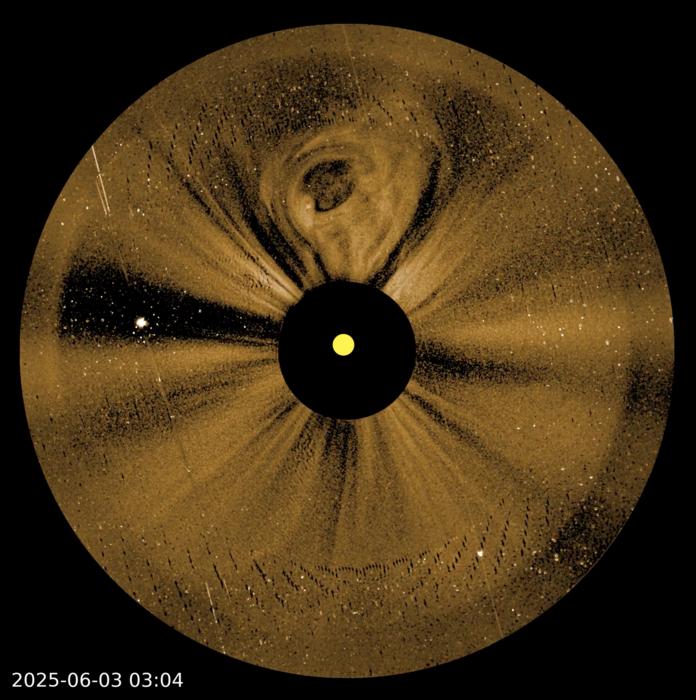
NASA’s PUNCH mission, led by SwRI, used its Narrow Field Imager to collectimages of solar activity. By blocking the Sun’s bright face, NFI captures the Sun’s atmosphere in unprecedented detail. The June 3 CME shown at the top of the image grew to enormous size, 100 times that of the Sun, as it traveled across the solar system.
SAN ANTONIO — June 10, 2025 — Southwest Research Institute’s Dr. Craig DeForest discussed the latest accomplishments of NASA’s PUNCH (Polarimeter to Unify the Corona and Heliosphere) mission during a media event at the 246th American Astronomical Society meeting in Anchorage, Alaska. As the spacecraft constellation completes commissioning, early PUNCH data showed coronal mass ejections, or CMEs, as they erupted from the Sun and traveled across the inner solar system.
“These preliminary movies show that PUNCH can actually track space weather across the solar system and view the corona and solar wind as a single system,” said DeForest, PUNCH principal investigator from SwRI’s Space Science and Exploration Division in Boulder, Colorado. “This big-picture view is essential to helping scientists better understand and predict space weather driven by CMEs, which can disrupt communications, endanger satellites and create auroras at Earth.”
PUNCH’s four small suitcase-sized spacecraft act as a single virtual instrument 8,000 miles across to image the solar corona, the Sun’s outer atmosphere, as it transitions into the solar wind that fills and defines our solar system.
“These first integrated images of our home in space are astonishing, but the best is yet to come,” DeForest said. “Once the spacecraft are in their final formation and the ground processing is fully sighted over the next few months, we’ll be able to track the solar wind and space weather in 3D throughout our neighborhood in space.”
The SwRI-developed and -led Wide Field Imagers aboard three of the four PUNCH spacecraft collected high-resolution images of entire CMEs in greater detail than previously possible. These instruments are designed to observe the faint, outermost portion of the Sun’s atmosphere and solar wind.
Images of a June CME from PUNCH’s coronagraph, the Narrow Field Imager, aboard the fourth spacecraft allow scientists to see the details of the Sun’s atmosphere by blocking the Sun’s bright face.
On March 11, PUNCH launched into polar orbit to make global, 3D observations of the Sun’s outer atmosphere and the inner solar system to help understand how material released from the Sun becomes the solar wind. The mission will also provide scientists with new data about how potentially disruptive events from the Sun, like solar flares and CMEs, form and evolve. This information could lead to more accurate predictions about the arrival of space weather at Earth and how it impacts assets and explorers in space.
Southwest Research Institute, based in San Antonio, Texas, leads the PUNCH mission and operates the four spacecraft from its facilities in Boulder, Colorado. The mission is managed by the Explorers Program Office at NASA Goddard Space Flight Center in Greenbelt, Maryland, for the Science Mission Directorate at NASA Headquarters in Washington.
A new study broadens the horizon of knowledge about how matter behaves under extreme conditions and helps to solve some great unknowns about the origin of the universe.
An international team of scientists has published a new report that moves towards a better understanding of the behaviour of some of the heaviest particles in the universe under extreme conditions, which are similar to those just after the big bang. The paper, published in the journal Physics Reports, is signed by physicists Juan M. Torres-Rincón, from the Institute of Cosmos Sciences at the University of Barcelona (ICCUB), Santosh K. Das, from the Indian Institute of Technology Goa (India), and Ralf Rapp, from Texas A&M University (United States).
The authors have published a comprehensive review that explores how particles containing heavy quarks (known as charm and bottom hadrons) interact in a hot, dense environment called hadronic matter. This environment is created in the last phase of high-energy collisions of atomic nuclei, such as those taking place at the Large Hadron Collider (LHC) and the Relativistic Heavy Ion Collider (RHIC). The new study highlights the importance of including hadronic interactions in simulations to accurately interpret data from experiments at these large scientific infrastructures.
The study broadens the perspective on how matter behaves under extreme conditions and helps to solve some great unknowns about the origin of the universe.
Reproducing the primordial universe
When two atomic nuclei collide at near-light speeds, they generate temperatures more than a 1,000 times higher than those at the centre of the Sun. These collisions briefly produce a state of matter called a quark-gluon plasma (QGP), a soup of fundamental particles that existed microseconds after the big bang. As this plasma cools, it transforms into hadronic matter, a phase composed of particles such as protons and neutrons, as well as other baryons and mesons.
The study focuses on what happens to heavy-flavour hadrons (particles containing charmed or background quarks, such as D and B mesons) during this transition and the hadronic phase expansion that follows it.
Heavy particles as probes
Heavy quarks are like tiny sensors. Being so massive, they are produced just after the initial nuclear collision and move more slowly, thus interacting differently with the surrounding matter. Knowing how they scatter and spread is key to learning about the properties of the medium through which they travel.
Researchers have reviewed a wide range of theoretical models and experimental data to understand how heavy hadrons, such as D and B mesons, interact with light particles in the hadronic phase. They have also examined how these interactions affect observable quantities such as particle flux and momentum loss.
“To really understand what we see in the experiments, it is crucial to observe how the heavy particles move and interact also during the later stages of these nuclear collisions”, says Juan M. Torres-Rincón, member of the Department of Quantum Physics and Astrophysics and ICCUB.
“This phase, when the system has already cooled down, still plays an important role in how the particles lose energy and flow together. It is also necessary to address the microscopic and transport properties of these heavy systems right at the transition point to the quark-gluon plasma”, he continues. “This is the only way to achieve the degree of precision required by current experiments and simulations”.
A simple analogy can be used to better understand these results: when we drop a heavy ball into a crowded pool, even after the biggest waves have dissipated, the ball continues to move and collide with people. Similarly, heavy particles created in nuclear collisions continue to interact with other particles around them, even after the hottest and most chaotic phase. These continuous interactions subtly modify the motion of particles, and studying these changes helps scientists to better understand the conditions of the early universe. Ignoring this phase would therefore mean missing an important part of the story.
Looking to the future
Understanding how heavy particles behave in hot matter is fundamental to mapping the properties of the early universe and the fundamental forces that rule it. The findings also pave the way for future experiments at lower energies, such as those planned at CERN’s Super Proton Super Synchrotron (SPS) and the future FAIR facility in Darmstadt, Germany.
Astrophysicists have gained precious new insights into how distant “exoplanets” form and what their atmospheres can look like, after using the James Webb Telescope to image two young exoplanets in extraordinary detail. Among the headline findings were the presence of silicate clouds in one of the planet’s atmospheres, and a circumplanetary disk thought to feed material that can form moons around the other.
In broader terms, understanding how the “YSES-1” super-solar system formed offers further insight into the origins of our own solar system, and gives us the opportunity to watch and learn as a planet similar to Jupiter forms in real time.
“Directly imaged exoplanets—planets outside our own Solar System—are the only exoplanets that we can truly take photos of,” said Dr Evert Nasedkin, a Postdoctoral Fellow in Trinity College Dublin’s School of Physics, who is a co-author of the research article just published in leading international journal, Nature.“These exoplanets are typically still young enough that they are still hot from their formation and it is this warmth, seen in the thermal infrared, that we as astronomers observe.”
Using spectroscopic instruments on board the James Webb Space Telescope (JWST), Dr Kielan Hoch and a large international team, including astronomers at Trinity College Dublin, obtained broad spectra of two young, giant exoplanets which orbit a sun-like star, YSES-1. These planets are several times larger than Jupiter, and orbit far from their host star, highlighting the diversity of exoplanet systems even around stars like our own sun.
The main goal of measuring the spectra of these exoplanets was to understand their atmospheres. Different molecules and cloud particles all absorb different wavelengths of light, imparting a characteristic fingerprint onto the emission spectrum from the planets.
Dr Nasedkin said: “When we looked at the smaller, farther-out companion, known as YSES 1-c, we found the tell-tale signature of silicate clouds in the mid-infrared. Essentially made of sand-like particles, this is the strongest silicate absorption feature observed in an exoplanet yet.”
“We believe this is linked to the relative youth of the planets: younger planets are slightly larger in radius, and this extended atmosphere may allow the cloud to absorb more of the light emitted by the planet. Using detailed modelling, we were able to identify the chemical composition of these clouds, as well as details about the shapes and sizes of the cloud particles.”
The inner planet, YSES-1b offered up other surprises: while the whole planetary system is young, at 16.7 million years old, it is too old to find signs of the planet-forming disk around the host star. But around YSES-1b the team observed a disk around the planet itself, thought to feed material onto the planet and serve as the birthplace of moons – similar to those seen around Jupiter. Only three other such disks have been identified to date, both around objects significantly younger than YSES-1b, raising new questions as to how this disk could be so long-lived.
Dr Nasedkin added: “Overall, this work highlights the incredible abilities of JWST to characterise exoplanet atmospheres. With only a handful of exoplanets that can be directly imaged, the YSES-1 system offers unique insights into the atmospheric physics and formation processes of these distant giants.”
In broad terms, understanding how this super-solar system formed offers further insight into the origins of our own solar system, giving us an opportunity to watch as a planet similar to Jupiter forms in real time. Understanding how long it takes to form planets, and the chemical makeup at the end of formation is important to learn what the building blocks of our own solar system looked like. Scientists can compare these young systems to our own, which provides hints of how our own planets have changed over time.
Dr Kielan Hoch, Giacconi Fellow at the Space Telescope Science Institute, said: “This program was proposed before the launch of JWST. It was unique, as we hypothesised that the NIRSpec instrument on the future telescope should be able to observe both planets in its field of view in a single exposure, essentially, giving us two for the price of one. Our simulations ended up being correct post-launch, providing the most detailed dataset of a multi-planet system to-date.”
“The YSES-1 system planets are also too widely separated to be explained through current formation theories, so the additional discoveries of distinct silicate clouds around YSES-1 c and small hot dusty material around YSES-1 b leads to more mysteries and complexities for determining how planets form and evolve.”
“This research was also led by a team of early career researchers such as postdocs and graduate students who make up the first five authors of the paper. This work would not have been possible without their creativity and hard work, which is what aided in making these incredible multidisciplinary discoveries.”

No comments:
Post a Comment