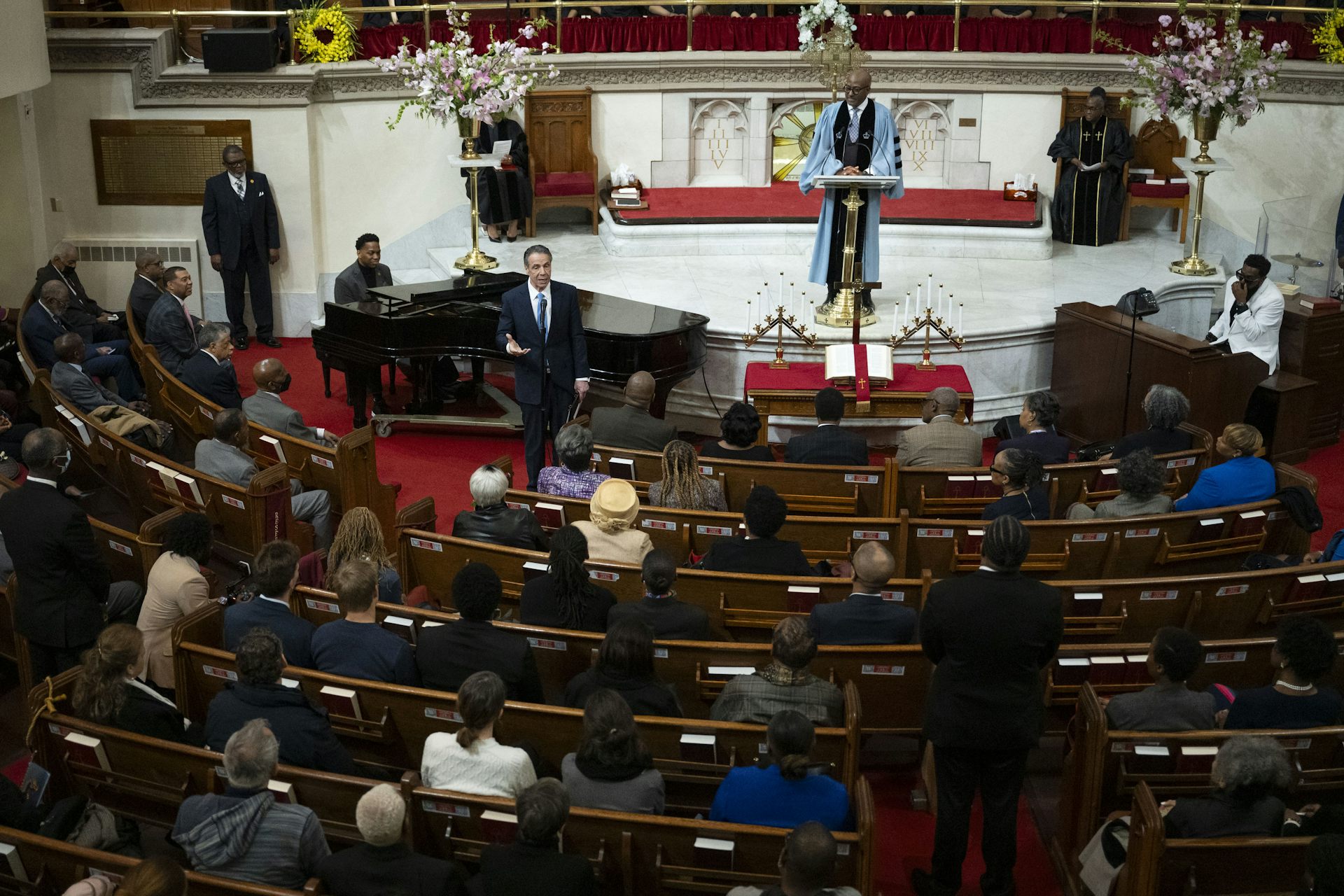
(The Conversation) — Churches and other houses of worship can endorse political candidates without risking the loss of their tax-exempt status, the Internal Revenue Service said in a legal document the tax-collection agency filed on July 7, 2025. This guidance is at odds with a law Congress passed more than 70 years ago that’s known as the Johnson Amendment and applies to all charitable nonprofits, whether they are secular or religious.
The Conversation U.S. asked Lloyd Hitoshi Mayer, a law professor who has studied the regulation of churches’ political activities, to explain what this statute is, how the IRS seeks to change its purview and why this matters.
What’s the Johnson Amendment?
The Johnson Amendment is a provision that Lyndon B. Johnson added to a tax bill passed by Congress in 1954, when he was a senator. It says that any charity that wants to be tax-exempt under section 501(c)(3) of the Internal Revenue Code cannot “participate in, or intervene in … any political campaign on behalf of … any candidate for public office.” In the U.S., all houses of worship are designated as charities by the IRS.
The IRS has interpreted the Johnson Amendment for more than 70 years to mean that charities cannot speak in favor of political candidates or take any other action that supports or opposes them.
The IRS is prohibited from publicly disclosing audits of specific tax-exempt nonprofits under taxpayer privacy laws, so there’s no way to know the extent to which the law has been enforced. The public only learns about audits tied to possible Johnson Amendment violations if the nonprofit discloses that information or the IRS revoked their tax-exempt status.
However, the IRS did conduct a broad enforcement campaign in the 2000s known as the Political Activity Compliance Initiative. The reports it issued for 2004 and 2006 stated that it had audited hundreds of charities, including churches, for possible Johnson Amendment violations. The IRS generally found that most violations were minor and often inadvertent – warranting no more than a warning letter.
It’s unknown whether any nonprofits lost their tax-exempt status as a result of this initiative, which the IRS appears to have ended in 2008.
There’s only one known instance of a church losing its tax-exempt status because it violated the Johnson Amendment. In that case, a church in Binghamton, New York, published full-page newspaper ads criticizing Bill Clinton during his 1992 presidential campaign.
Why does the Trump administration want to change its enforcement?
The National Religious Broadcasters, two churches and another religious nonprofit sued the IRS in 2024, challenging the constitutionality of the Johnson Amendment on First Amendment free speech and free exercise of religion grounds and on Fifth Amendment due process grounds. The plaintiffs also argued that applying the Johnson Amendment to religious nonprofits violated the federal Religious Freedom Restoration Act.
The plaintiffs and the IRS filed a joint motion on July 7 to settle the case. They asked the U.S. District Court for the Eastern District of Texas to order the IRS not to enforce the Johnson Amendment against the two church plaintiffs. They also asked the court to incorporate in its order a statement that the Johnson Amendment does not apply to “speech by a house of worship to its congregation, in connection with religious services through its customary channels of communication on matters of faith, concerning electoral politics viewed through the lens of religious faith.”
This represents the first time the IRS has said there’s an exception to the Johnson Amendment for houses of worship. While lawmakers have periodically sought to repeal or modify the statute, neither chamber of Congress has ever passed such legislation.
President Donald Trump asserted during his first term that he had “gotten rid of” the Johnson Amendment. But that referred to his 2017 executive order that directed the Treasury Department – to which the IRS belongs – to respect freedom of religion with respect to religious organizations speaking about political issues as “consistent with law.”
Under the IRS interpretation of the Johnson Amendment at the time, it would not have been consistent with law for churches or other religious nonprofits to support or oppose candidates for elected public office.
How might the IRS treat religious political activity differently?
If the court approves this new joint motion, that order will only apply to the two churches that are plaintiffs in the case – not other religious nonprofits or the National Religious Broadcasters that joined them in suing the IRS. But the filing tells other houses of worship that the IRS will not enforce the Johnson Amendment against them for speech to their congregations, at least not during the Trump administration.
I think that the government may have a hard time applying this exception for several reasons.
The IRS will have to determine when a charity is a “church,” the term the IRS uses for a house of worship of any faith. That has become increasingly difficult in recent years, as some organizations that stretch the conventional definition of a church have won IRS recognition as such.
The IRS will also have to clarify what constitutes speech made “in connection with religious services” and what are “customary channels of communication.” For example, it’s unclear whether inviting a political candidate to address the congregation about how their religious faith relates to their candidacy falls within the exception.
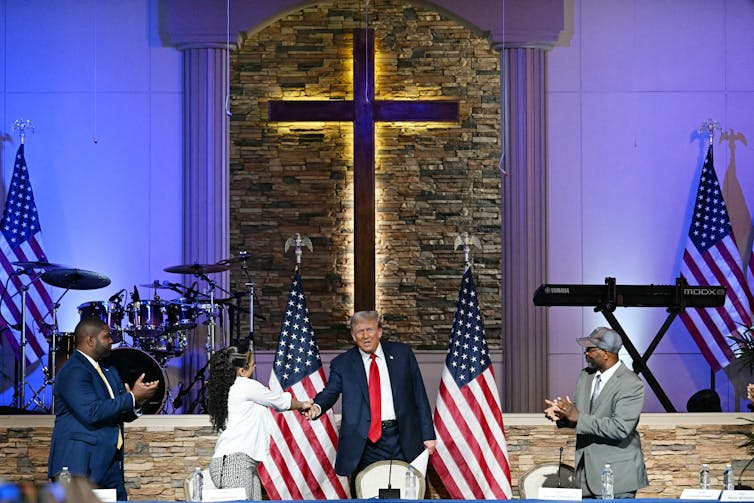
Donald Trump participates in a community roundtable at a church
in Detroit during his successful 2024 presidential campaign.
Will only conservative politicians benefit?
Establishing this exception does not necessarily give conservative politicians any advantages.
It is true that recent attempts to repeal or modify the Johnson Amendment are associated with conservative Christian groups such as the Alliance Defending Freedom, which represented the plaintiffs in this lawsuit.
But historically, many progressive houses of worship have also pushed against the Johnson Amendment, including Black churches that often serve as political as well as religious centers for their communities.
A Texas Tribune and ProPublica investigation documented apparent violations of the Johnson Amendment in the 2022 midterm elections by almost 20 churches in Texas from across the political spectrum. Interestingly, most of the church leaders involved were aware of the amendment.
Many said they were not violating it because they avoided explicitly endorsing candidates, while at the same time clearly expressing their support for specific candidates by, for example, praying for an individual who was identified to the congregation as a candidate.
How could this new guidance change political campaigning?
Americans generally don’t want to see churches get involved in politics, including majorities in most denominations. Nonetheless, church leaders of all stripes who were already inclined to support particular candidates will probably feel emboldened to explicitly endorse candidates when preaching to their congregations.
There are two ways that this new exception could do more than that.
First, it isn’t limited to sermons by pastors, priests, rabbis, imams and other religious leaders. It extends to any speech to a house of worship’s congregation “in connection with religious services through its customary channels of communication on matters of faith.” It therefore almost certainly includes church bulletins and other written materials distributed as part of a religious service.
What’s less clear is whether “customary channels of communication” includes people who watch religious services streamed over the internet or on TV, rather than just those who attend services in person.
Second, the change will increase pressure on church leaders to support candidates.
For example, George W. Bush’s 2004 campaign reportedly sought to recruit thousands of congregations to distribute campaign information. It’s natural to expect such efforts to multiply and become more direct for both Democratic and Republican candidates from now on.
And church leaders will also likely face pressure from politically active congregants to endorse candidates, and have a harder time resisting it.
(Lloyd Hitoshi Mayer, Professor of Law, University of Notre Dame. The views expressed in this commentary do not necessarily reflect those of Religion News Service.)
(RNS) — Now that churches have won the right to endorse political candidates, it’s fair to ask why churches would want to do that in the first place.
The religious right has hoped for the repeal of the Johnson Amendment since at least 2007, but for practical purposes the measure has only been truly endangered since the 2017 National Prayer Breakfast, when, in characteristic and less-than-redolently religious language, President Donald Trump pledged to “totally destroy” it.
Proposed by then-Senator Lyndon Johnson, the amendment entered the Internal Revenue Code as a provision of law in 1954. It says that charitable organizations may be exempt from federal taxes if they do “not participate in, or intervene in (including the publishing or distributing of statements), any political campaign on behalf of (or in opposition to) any candidate for public office.”
In their book “Politics, Taxes, and the Pulpit,” Nina J. Crimm and Laurence H. Winer conclude on the basis of Robert Caro’s magisterial biography of Johnson and the wider historical record that Johnson was thinking less about limiting the political interventions of churches than worrying that charitable organizations would be used to support the red-baiting Sen. Joseph McCarthy and his GOP allies.
In other words, he was seeking to forestall the forerunners of today’s dark money organizations that funnel untraceable money into political campaigns. The amendment’s limitation on religious organizations, which were also granted tax-exempt charitable status, was an unintended byproduct.
Still, the Johnson Amendment corresponds well with the intent of the authors of the Constitution. James Madison warned against the fallout if “our laws (were) to intermeddle with Religion.” Thomas Jefferson famously wrote of “a wall of separation between Church & State,” and included in the Virginia Statute for Religious Freedom — an inspiration for the First Amendment, guided through the Virginia Legislature by Madison — the idea “that our civil rights have no dependance on our religious opinions.”
It has been unusual in the intervening centuries for religious groups to seek influence or power directly through the U.S. political process. Exceptions are notable. The abolition movement of the 19th century and the temperance movement of the 20th come immediately to mind. Both sought to mobilize believers to achieve a religiously motivated objective.
The more recent Civil Rights Movement and the anti-abortion movement, which both fall within the lifespan of the Johnson Amendment, also sought to mobilize believers and leverage the political process. Martin Luther King Jr. and other civil rights leaders never focused much attention on repealing the Johnson Amendment. The anti-abortion movement certainly did and largely achieved its primary objective in 2022’s Supreme Court decision in Dobbs v. Jackson, but its preachers never much scrupled over endorsing the Republican Party, if not candidates by name.
It’s difficult, then, to imagine who would be freed now by repealing the Johnson Amendment now.
Or, it’s difficult to imagine who would be freed to pursue primarily religious goals. The Pew Research Center has found that support for Trump among those who frequently attend religious services grew from 2016 to 2020 to 2024. The president has done particularly well among white evangelicals, the voters most engaged with Christian nationalism, which unabashedly hopes to transform the U.S. into a “Christian nation,” collapsing the distinction between church and state.
For these reasons, it is not difficult to discern the outline of what’s at work here. Trump seeks to reward and encourage those supporters, and those believers see in Trump a “modern-day Cyrus” — a figure who stands outside the community but through whom God has chosen to act. He has now delivered on a promise to free those who want to enact their version of Christianity, enlisting the power of government without fear of consequences if they endorse candidates.
The political activities of evangelical churches and religious organizations are bound to become more aggressively partisan. We shouldn’t be surprised if they begin to seem less religious.
Edmund Burke, the 18th-century Anglo-Irish parliamentarian and political philosopher who is considered “the founder of modern conservatism,” wrote in 1790, “No sound ought to be heard in the church but the healing voice of Christian charity,” calling it a “confusion of duties” to preach politics from the pulpit. He added, “Surely the church is a place where one day’s truce ought to be allowed to the dissensions and animosities of mankind.”
There will be no such luck anymore, not now that spiritual leaders will have freedom to turn their sanctuaries into political meetings. The new post-Johnson Amendment regime is bound to be helpful to Republicans but unlikely to advance the cause of religion.
It would be interesting to see what would happen if spiritual leaders begin to endorse candidates from their pulpits who oppose Trump and the Republicans, perhaps standing on the scriptural ground of the Book of Exodus, which instructs Christians, “You must not oppress the foreigner.”
Strangely, I cannot help thinking that the Johnson Amendment would be quickly raised back to life.
(Steven P. Millies is professor of public theology and director of the Bernardin Center at Catholic Theological Union. The views expressed in this commentary do not necessarily reflect those of Religion News Service.)

No comments:
Post a Comment