(RNS) — Protesters led by the Rev. Al Sharpton descended on Manhattan’s financial district to decry efforts by the Trump administration and corporations to abandon diversity, equity and inclusion initiatives.
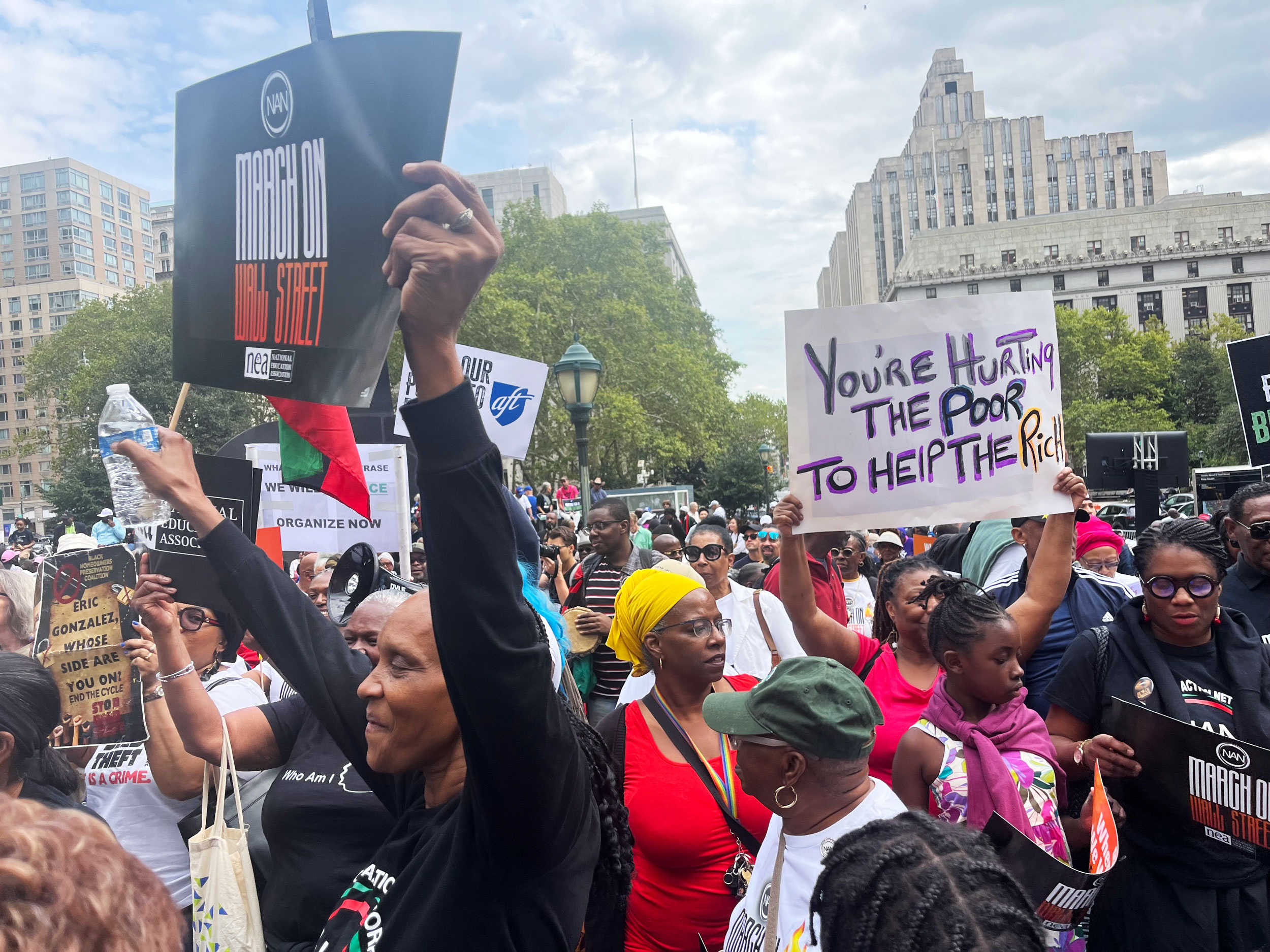
Protesters join the March on Wall Street on Aug. 28, 2025.
RNS Photo by Fiona André
Fiona André
August 28, 2025
RNS
NEW YORK (RNS) — On Thursday (Aug. 28), Black faith leaders, activists and protesters descended on Manhattan’s financial district to denounce efforts by the Trump administration and some private companies to abandon diversity, equity and inclusion initiatives, known as DEI.
The demonstration, organized by the Rev. Al Sharpton’s National Action Network, also marked the 62nd anniversary of the Rev. Martin Luther King Jr.’s March on Washington.
“DEI is the civil rights fight of our generation, and will make the difference in what the future of America looks like. … On August 28th, as we commemorate the March on Washington, we will continue the fight by taking it to Wall Street,” read an announcement for the event.
As Sharpton took to the stage on Whitehall Street, near the end of Broadway in Lower Manhattan, he addressed companies that have abandoned their long-standing DEI initiatives in the wake of White House pressure, urging Black Americans to fight back.
August 28, 2025
RNS
NEW YORK (RNS) — On Thursday (Aug. 28), Black faith leaders, activists and protesters descended on Manhattan’s financial district to denounce efforts by the Trump administration and some private companies to abandon diversity, equity and inclusion initiatives, known as DEI.
The demonstration, organized by the Rev. Al Sharpton’s National Action Network, also marked the 62nd anniversary of the Rev. Martin Luther King Jr.’s March on Washington.
“DEI is the civil rights fight of our generation, and will make the difference in what the future of America looks like. … On August 28th, as we commemorate the March on Washington, we will continue the fight by taking it to Wall Street,” read an announcement for the event.
As Sharpton took to the stage on Whitehall Street, near the end of Broadway in Lower Manhattan, he addressed companies that have abandoned their long-standing DEI initiatives in the wake of White House pressure, urging Black Americans to fight back.

The Rev. Al Sharpton leads the March on Wall Street on Aug. 28, 2025, alongside Martin Luther King III; King’s wife, Arndrea Waters King; and New York mayoral candidate Zohran Mamdani.
RNS Photo by Fiona André
“We marched for your offices because we know your address, and we will march and keep coming to you until we turn the economic inequality in this country around. We’re not going back,” said Sharpton.
The rally cemented a monthlong boycott campaign, promoted by Black church leaders across the country, to denounce private companies abandoning DEI policies.
RELATED: At King Day rally, Sharpton leads oath to support DEI as Trump opposes it
Thousands of protesters had flocked to Lower Manhattan early Thursday morning, many traveling from out of state by bus for the occasion. They gathered at the African Burial Ground National Monument on Foley Square, heading toward Wall Street shortly after 10 a.m.
As they walked downtown, protesters held signs reading “What Trump will erase, we will replace” and chanted: “No DEI, no dollars. No justice, no peace.” During the hourlong march, some protesters hummed the gospel anthem “We Shall Overcome.”
“We marched for your offices because we know your address, and we will march and keep coming to you until we turn the economic inequality in this country around. We’re not going back,” said Sharpton.
The rally cemented a monthlong boycott campaign, promoted by Black church leaders across the country, to denounce private companies abandoning DEI policies.
RELATED: At King Day rally, Sharpton leads oath to support DEI as Trump opposes it
Thousands of protesters had flocked to Lower Manhattan early Thursday morning, many traveling from out of state by bus for the occasion. They gathered at the African Burial Ground National Monument on Foley Square, heading toward Wall Street shortly after 10 a.m.
As they walked downtown, protesters held signs reading “What Trump will erase, we will replace” and chanted: “No DEI, no dollars. No justice, no peace.” During the hourlong march, some protesters hummed the gospel anthem “We Shall Overcome.”

The Rev. Al Sharpton speaks during the March on Wall Street on Aug. 28, 2025.
RNS Photo by Fiona André
Halfway through the march, the procession halted in front of the Charging Bull, a bronze sculpture that symbolizes Manhattan’s financial power. During the procession, mayoral candidate Zohran Mamdani joined the marchers at the head of the procession alongside Sharpton and members of Martin Luther King Jr.’s family.
Tying the day to their father’s legacy, Martin Luther King Jr. III opened the rally when it reached Whitehall Street, standing with his wife, Arndrea Waters King. “Something is wrong with this nation, all right? My father would say that something is wrong,” said the civil rights icon’s son. “We must create the climate where people can raise themselves by their own bootstraps. … We must create a climate where housing is affordable. Where health care is available.”
Though all the major candidates in New York’s November mayoral election were invited, noted Sharpton, only Mamdani attended the event. In his address, the 33-year-old democratic socialist candidate pledged to keep King’s legacy alive by fighting for an affordable New York for all.
“How is it that we have still yet to answer the question that Dr. King posed all those decades ago? ‘What good is it to have the right to sit at the lunch counter if you can’t afford a hamburger?’ Our freedom is only as good as our ability to exercise it. … I tell you that every day I will wake up with Dr. King’s dream at the forefront of my mind.”
The speakers who followed, who included the Rev. Samuel Tolbert Jr., president of the National Baptist Convention of America International, and the Rev. David Peoples, president of the Progressive National Baptist Convention, encouraged protesters to stay firm in their boycott of companies that abandoned DEI initiatives after the Trump administration took office.
In February, Black faith leaders joined a boycott movement begun by the Rev. Jamal Bryant, pastor of New Birth Missionary Baptist Church in Atlanta, prompted by discount chain Target abandoning its DEI initiatives. Bryant challenged his peers to lead their congregations in abstaining from buying from Target during Lent, the 40-day period that leads to Easter.
RELATED: Boycotts accompany prayer as faith leaders prepare for a Lent of protest
In recent months, the chain has experienced weak sales and declining stock levels. Last week, Target’s CEO, Brian Cornell, stepped down.
Halfway through the march, the procession halted in front of the Charging Bull, a bronze sculpture that symbolizes Manhattan’s financial power. During the procession, mayoral candidate Zohran Mamdani joined the marchers at the head of the procession alongside Sharpton and members of Martin Luther King Jr.’s family.
Tying the day to their father’s legacy, Martin Luther King Jr. III opened the rally when it reached Whitehall Street, standing with his wife, Arndrea Waters King. “Something is wrong with this nation, all right? My father would say that something is wrong,” said the civil rights icon’s son. “We must create the climate where people can raise themselves by their own bootstraps. … We must create a climate where housing is affordable. Where health care is available.”
Though all the major candidates in New York’s November mayoral election were invited, noted Sharpton, only Mamdani attended the event. In his address, the 33-year-old democratic socialist candidate pledged to keep King’s legacy alive by fighting for an affordable New York for all.
“How is it that we have still yet to answer the question that Dr. King posed all those decades ago? ‘What good is it to have the right to sit at the lunch counter if you can’t afford a hamburger?’ Our freedom is only as good as our ability to exercise it. … I tell you that every day I will wake up with Dr. King’s dream at the forefront of my mind.”
The speakers who followed, who included the Rev. Samuel Tolbert Jr., president of the National Baptist Convention of America International, and the Rev. David Peoples, president of the Progressive National Baptist Convention, encouraged protesters to stay firm in their boycott of companies that abandoned DEI initiatives after the Trump administration took office.
In February, Black faith leaders joined a boycott movement begun by the Rev. Jamal Bryant, pastor of New Birth Missionary Baptist Church in Atlanta, prompted by discount chain Target abandoning its DEI initiatives. Bryant challenged his peers to lead their congregations in abstaining from buying from Target during Lent, the 40-day period that leads to Easter.
RELATED: Boycotts accompany prayer as faith leaders prepare for a Lent of protest
In recent months, the chain has experienced weak sales and declining stock levels. Last week, Target’s CEO, Brian Cornell, stepped down.

Marchers walked by the fenced-off bronze bull in front of the New York Film Academy on Aug. 28, 2025. RNS Photo by Fiona André
“We will take our dollars where we’re respected, and we will close down where we’re rejected. … We will shop with who does business with us. We will walk with who walks with us. We will stand with who stands with us. And we are not afraid of Trump. We’ve been beaten giants since David,” said Sharpton
Sharpton called on protesters to show resilience in the months to come, as he pointed out they stood on the very place where African slaves used to be sold. “We’ve come back, the children of our ancestors. We’ve come back ready. Ready to spend our dollars. We’re not slaves anymore. We’re not going back on the slave market. Donald Trump, get ready for the fight of your life,” he said.

The Rev. Michael Jordan spoke during the march on Aug. 28, 2025, on Wall Street.
RNS Photo by Fiona André
Many speakers noted how the recent abandonment of DEI initiatives disproportionately affected Black women. Nearly 300,000 Black women have been pushed out of the workforce within three months, partly due to the policies, according to the Bureau of Labor Statistics.
“We have been pushed out of the workforce, but we are strong people. We are faith people,” said Stacie NC Grant, president of Zeta Phi Beta Sorority.
As the march ended, the Rev. Boise Kimber, president of the National Baptist Convention USA, prayed over the crowd. The administration’s first months, he said, though challenging, shouldn’t discourage attendees.
“Lord, we pray for the healing of the soul of our nation from the disease of human exploitation and its root cause, the love of money,” said Kimber, as attendees bowed their heads and closed their eyes. Americans, said Kimber, must repent for “making profits be more important than people, and for making the accumulation of wealth be more important than the well-being of those made in God’s image.”
The Rev. Michael Jordan of New Era Baptist Church in Birmingham, Alabama, who attended the rally, said recent hits at DEI initiatives are setting Black Americans decades behind. “I’m a preacher of social justice, I preach against social injustice. The Trump administration has made them bamboozled, not just Black folks, but also poor white folks,” he said.
Many speakers noted how the recent abandonment of DEI initiatives disproportionately affected Black women. Nearly 300,000 Black women have been pushed out of the workforce within three months, partly due to the policies, according to the Bureau of Labor Statistics.
“We have been pushed out of the workforce, but we are strong people. We are faith people,” said Stacie NC Grant, president of Zeta Phi Beta Sorority.
As the march ended, the Rev. Boise Kimber, president of the National Baptist Convention USA, prayed over the crowd. The administration’s first months, he said, though challenging, shouldn’t discourage attendees.
“Lord, we pray for the healing of the soul of our nation from the disease of human exploitation and its root cause, the love of money,” said Kimber, as attendees bowed their heads and closed their eyes. Americans, said Kimber, must repent for “making profits be more important than people, and for making the accumulation of wealth be more important than the well-being of those made in God’s image.”
The Rev. Michael Jordan of New Era Baptist Church in Birmingham, Alabama, who attended the rally, said recent hits at DEI initiatives are setting Black Americans decades behind. “I’m a preacher of social justice, I preach against social injustice. The Trump administration has made them bamboozled, not just Black folks, but also poor white folks,” he said.
(The Conversation) — Faculty members represent a university’s core identity and mission. But no one had systematically studied faculty opinions on matters related to spirituality and religion − until now.

University faculty are the most important people influencing student learning, development, persistence and degree attainment. (Maskot/Getty Images)
Matthew J. Mayhew
August 27, 2025
(The Conversation) — Universities, often perceived as bastions of progressive thought, are increasingly reflecting the broader political polarization gripping the nation.
Faculty members represent a university’s core identity and mission. They express the values of the institution in numerous ways, including teaching, mentoring, advising and researching.
In my research into the impact of college on student development and learning, I – and others – have found that faculty are the most important people influencing student learning, development, persistence and degree attainment.
However, no systematic efforts have ever been undertaken to find out how faculty’s work is influenced by their understanding of university life and religion – until now.
The Templeton Religion Trust, a charity focused on improving societal well-being through understanding individual well-being, funded a recent national survey my team and I administered to 1,000 faculty members. The survey asked faculty about their perceptions of university life, including free speech and diversity, equity and inclusion initiatives, often shortened to simply DEI.
The survey results reveal a striking divergence in perspectives on the often divisive issues of free speech and DEI among faculty. Those differences showed up particularly along the red state and blue state divide.
Yet, amid these deep disagreements, a surprising point of bipartisan consensus emerges: faculty members’ belief in the importance of religious, spiritual and secular inclusion in diversity efforts.
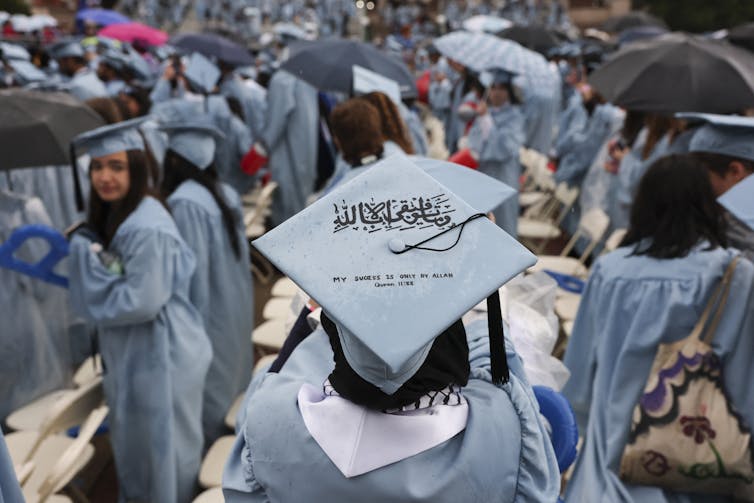
Faculty agreed on the importance of religious, spiritual and secular inclusion in diversity efforts. Here, a student graduating from Columbia University in New York on May 21, 2025, wears a graduation cap with a verse from the Quran written on it.
Jeenah Moon/POOL/AFP via Getty Images, CC BY
State political leaning is key
Survey responses represented national trends across various factors, including region, institutional control, institutional type and academic discipline.
In part of the analysis, we uncovered that the political leanings of a state – how a state voted in the presidential election of 2024 – play a significant role in what faculty perceive about free speech and DEI programming.
Even more compelling, significant differences reported by faculty from red versus blue states showed up consistently across gender, race, religion, academic discipline, faculty rank and whether the faculty member was employed at a private or public institution.
In other words, political leanings of a state were strongly associated with faculty perceptions regardless of these other factors.
Measuring the right to free speech
We asked faculty four questions related to their First Amendment rights, which we presented as: “The First Amendment protects freedom of speech, freedom of religion, freedom of the press, freedom of assembly, and freedom to petition.”
Working closely with experts in legal epidemiology, we asked faculty the extent to which they agreed with the following statements: a) the First Amendment is relevant to my job as a faculty member; b) the First Amendment is relevant to my research engagement; c) my institution provides me with my constitutionally mandated First Amendment rights; and d) I am aware of my rights and responsibilities as they relate to the First Amendment of the U.S. Constitution.
While awareness of First Amendment rights appears consistent across the board, a notable difference arises in faculty members’ perception of institutional protection of those rights.
Faculty in blue states are significantly more likely than those in red states to report that their institutions uphold their constitutionally mandated First Amendment rights. This implies a potential disconnect in how freedoms are experienced and protected, depending on the political leanings of the state where an institution is located.
Measuring attitudes about DEI
The divide deepens when it comes to DEI, defined in the survey as “campus diversity programs” in some instances and “diversity, equity, and inclusion” in others.
When compared with faculty in blue states, those in red states are far more inclined to view DEI efforts as “overreach,” agreeing with the statements that “diversity programs generally do more harm than good on college and university campuses” and “the promotion of diversity, equity, and inclusion on college and university campuses has gone too far.”
Conversely, blue state faculty largely disagree with these assertions. When compared with faculty in red states, those in blue states were more likely to agree that “campus diversity programs support student success,” demonstrating a stark ideological chasm on the value and impact of DEI.
The divide deepens when it comes to DEI, defined in the survey as “campus diversity programs” in some instances and “diversity, equity, and inclusion” in others.
When compared with faculty in blue states, those in red states are far more inclined to view DEI efforts as “overreach,” agreeing with the statements that “diversity programs generally do more harm than good on college and university campuses” and “the promotion of diversity, equity, and inclusion on college and university campuses has gone too far.”
Conversely, blue state faculty largely disagree with these assertions. When compared with faculty in red states, those in blue states were more likely to agree that “campus diversity programs support student success,” demonstrating a stark ideological chasm on the value and impact of DEI.
This partisan disagreement extends to the very concept of banning DEI programs.
Red state faculty show moderate support for banning DEI, suggesting a belief that current efforts to curtail campus diversity initiatives are, according to survey response options, “well justified.”
Blue state faculty overwhelmingly support the continuation of these programs. They gave strong endorsement to the idea that “colleges and universities should continue to offer identity-specific organizations and programming.”
This schism reflects the ongoing national debate about the role and scope of DEI in higher education. Faculty perspectives mirror the political sentiments of their respective regions.
Amid this significant polarization, a crucial area of common ground emerges: what we call religious, spiritual and secular inclusion.
That’s the idea that DEI efforts should include programming and activities designed to help students from all religious, spiritual and secular backgrounds belong and succeed.
Religious, secular and spiritual diversity
Despite their sharp disagreements on other aspects of DEI, both red state and blue state faculty overwhelmingly agree that “colleges and universities should provide support for students of all religious, secular, and spiritual identities and backgrounds.”
And both groups similarly reject the notion that “campuses should not concern themselves with religious, secular and spiritual diversity.”
The findings from this survey highlight the complex landscape of faculty opinion in higher education. While significant difficulties remain in reconciling differing views on free speech and DEI, the shared commitment to religious, spiritual and secular inclusion offers a potential path to agreement.
By focusing on areas of consensus, institutions can begin to foster more inclusive environments to serve the needs of all students, regardless of their background or beliefs. Understanding these nuanced perspectives is the first step toward building more cohesive, pluralistic and intellectually vibrant academic communities across the nation’s varied political terrain.
(Matthew J. Mayhew, Professor of Higher Education, The Ohio State University. The views expressed in this commentary do not necessarily reflect those of Religion News Service.)

The Conversation religion coverage receives support through the AP’s collaboration with The Conversation US, with funding from Lilly Endowment Inc. The Conversation is solely responsible for this content.
Red state faculty show moderate support for banning DEI, suggesting a belief that current efforts to curtail campus diversity initiatives are, according to survey response options, “well justified.”
Blue state faculty overwhelmingly support the continuation of these programs. They gave strong endorsement to the idea that “colleges and universities should continue to offer identity-specific organizations and programming.”
This schism reflects the ongoing national debate about the role and scope of DEI in higher education. Faculty perspectives mirror the political sentiments of their respective regions.
Amid this significant polarization, a crucial area of common ground emerges: what we call religious, spiritual and secular inclusion.
That’s the idea that DEI efforts should include programming and activities designed to help students from all religious, spiritual and secular backgrounds belong and succeed.
Religious, secular and spiritual diversity
Despite their sharp disagreements on other aspects of DEI, both red state and blue state faculty overwhelmingly agree that “colleges and universities should provide support for students of all religious, secular, and spiritual identities and backgrounds.”
And both groups similarly reject the notion that “campuses should not concern themselves with religious, secular and spiritual diversity.”
The findings from this survey highlight the complex landscape of faculty opinion in higher education. While significant difficulties remain in reconciling differing views on free speech and DEI, the shared commitment to religious, spiritual and secular inclusion offers a potential path to agreement.
By focusing on areas of consensus, institutions can begin to foster more inclusive environments to serve the needs of all students, regardless of their background or beliefs. Understanding these nuanced perspectives is the first step toward building more cohesive, pluralistic and intellectually vibrant academic communities across the nation’s varied political terrain.
(Matthew J. Mayhew, Professor of Higher Education, The Ohio State University. The views expressed in this commentary do not necessarily reflect those of Religion News Service.)
The Conversation religion coverage receives support through the AP’s collaboration with The Conversation US, with funding from Lilly Endowment Inc. The Conversation is solely responsible for this content.

No comments:
Post a Comment