"This militarized spending comes at the expense of federal programs—like public housing—that actually do prevent crime and improve health and education outcomes," said researcher Hanna Homestead.
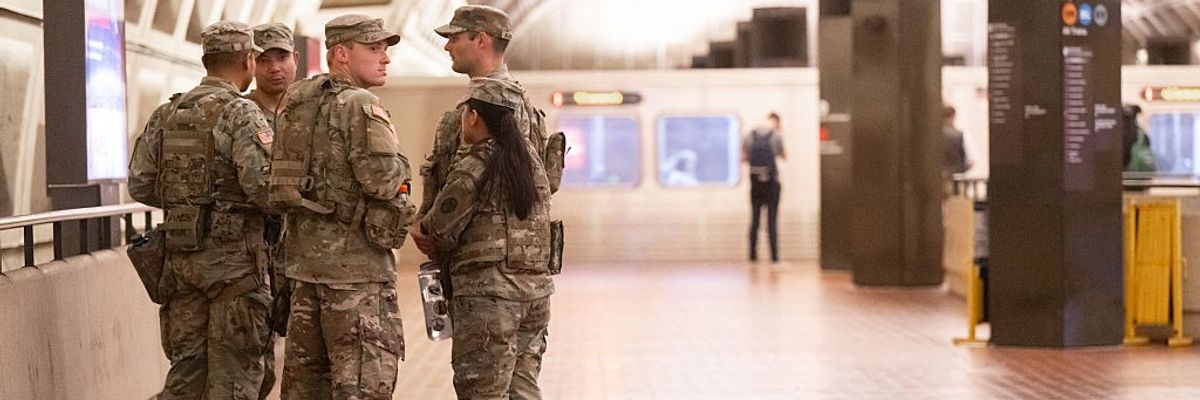
Members of the National Guard patrol inside the Metro Center Metrorail Station in Washington, DC, on August 21, 2025.
(Photo by Saul Loeb/AFP)
Stephen Prager
Aug 22, 2025
COMMON DREAMS
Last week, when Trump federalized Washington, DC's police force and deployed the National Guard to occupy its streets, one of his main orders was to "end vagrancy" by destroying homeless encampments and arresting and forcibly relocating the people taking shelter there.
But according to an investigation published on Wednesday by Hanna Homestead of the National Priorities Project, in collaboration with The Intercept, deploying the National Guard and "getting rid of the slums" is costing far more than it would cost to simply provide housing to every homeless person in the city.
Governors from six US states have sent troops to Washington to help Trump's effort, swelling the ranks to nearly 2,100 who will soon be on patrol.
According to previous reporting, National Guard deployments cost the US government $530 per guard member each day. Using that figure, Homestead estimated that it would cost just over $1.1 million.
She added that "the number of troops will likely continue to grow. And with no deadline for the DC deployment, those costs could add up for months or even years."
According to the most recent data from the Department of Housing and Urban Development (HUD), there are about 5,600 people experiencing either sheltered and unsheltered homelessness in DC on a given night. Operating an affordable housing unit for each one of them, the data shows, costs about $45.44 per person, per day, on average in DC.
Providing affordable housing to every homeless person in DC would cost an estimated $255,166, which is 4.3 times less than the cost of Trump's military deployment.
"Taxpayers like you and me bear the cost of this cruel power grab," Homestead said. "This militarized spending comes at the expense of federal programs—like public housing—that actually do prevent crime and improve health and education outcomes."
Last week, White House Press Secretary Karoline Leavitt told reporters that over 70 encampments had been cleared since Trump's order to federalize the police. She also said that over 600 people had been arrested, though it was not specified how many of them were homeless.
Trump has sought to conflate homelessness with criminality, suggesting that the nation's capital had been "overtaken by violent gangs and bloodthirsty criminals, roving mobs of wild youth, drugged-out maniacs, and homeless people."
While his solution has been a show of military force against people with nowhere to go, a large body of research suggests that the approach of providing "Housing First"—meaning a stable place to stay with no preconditions for sobriety or treatment—reduces crime.
A 2021 study from UCLA found that providing homeless people with targeted housing assistance reduced the probability of committing a crime by 80%.
"Arresting or ticketing people for sleeping outside makes homelessness worse, wastes taxpayer money, and simply does not work," said Jesse Rabinowitz of the National Homelessness Law Center. "The solution to homelessness is housing and supports, not handcuffs and jails."
But in addition to a crackdown on the homeless, the Trump administration is also pushing to eliminate funds for public housing. The White House's proposed budget for fiscal year 2026 slashes funding for HUD's Continuum of Care program, which provided cities with funding for initiatives to house the homeless.
According to the National Alliance to End Homelessness, the proposal would effectively end funding of permanent supportive housing for 170,000 residents and potentially increase the number of homeless people in the US by 36%.
"Arresting people for no reason other than the fact that they have no home is inhumane and unjust," said Amber W. Harding, executive director of the Washington Legal Clinic for the Homeless. "It is particularly cruel to do so knowing that federal and local housing programs have been slashed and that DC does not have enough shelter beds."
"Fines, arrests, and encampment evictions make homelessness worse, further traumatize our homeless neighbors while disconnecting them from community and support," said Dana White, Director of Advocacy at Miriam's Kitchen, a DC-based homeless services organization. "If policing resolved homelessness, we wouldn't have homelessness here in DC or anywhere else in this country."
Trump’s Test Case: Deploying the Military to Washington, DC
Saturday 23 August 2025, by Malik Miah
IN A LONG rant of over 70 minutes at an August 10 news conference, Trump claimed that the nation’s capital, Washington, D.C., “has been overtaken by violent gangs and bloodthirsty criminals, roving mobs of wild youth, drugged-out maniacs, and homeless people. And we are not going to take it anymore.”
Everyone knows that when he singles out “wild youth” he means Black youth. By “high crimes areas” he means the Black community.
Trump then ordered an extraordinary exertion of federal power over an American city with the deportment of National Guard troops to the capital. He put the city police under federal control, and deployed 500 federal law enforcement officials, including 120 FBI agents, 50 deputy U.S. marshals, as well as agents from the Drug Enforcement Agency and the Bureau of Alcohol, Tobacco, Firearms and Explosives.
Some will be on patrol duty and others will be visible in “high crime” or high traffic areas. The first night they picked up 23 residents, on that Saturday night they arrested 68.
Since under federal law, this action can only last 30 days without Congress’s approval, Trump boasted that if Congress doesn’t extend it, he will declare a national emergency.
Trump described the deployment as part of a broader effort to “liberate” the city and make it “great again.” In fact, he claims he will remake the city “beautiful” again.
Unsurprisingly, he promised to send troops to other cities, specifically mentioning Chicago, New York, Baltimore and Oakland, California. All of these cities have elected Black mayors and large African American communities.
Washington, DC, once known as “Chocolate City,” has been run by Black politicians for decades. With a population of 290,772, African Americans are the largest racial group, standing at 43%, about four percent more that the city’s white population. (Another 15% are people of color from a variety of ethnicities.)
The DC Mayor, Muriel Bowser, and other local officials hadn’t been told about the takeover; they heard and watched it announced on television.
Speaking during a live town hall on social media, Mayor Bowser urged community members to “protect our city, to protect our autonomy, to protect our home rule and get to the other side of this guy and make sure we elect a Democratic House so that we have a backstop to this authoritarian push.”
“We are not 700,000 scumbags and punks,” she added. “We don’t have neighborhoods that should be bulldozed. We must be clear about our story, who we are and what we want for our city.”
U.S. Attorney General Pam Bondi plowed ahead and installed Drug Enforcement Administrator Terry Cole the “emergency police commissioner.” The city sued. District Court Judge Ana Reyes ordered the parties — which included Trump, Bondi and the Department of Justice — to work out a plan with DC officials. Subsequently the Trump administration rescinded Bondi’s directive.
Need for Self-Rule
This is the first time a president has ever used Section 740 of the Home Rule Act — DC is not a state — to federalize the metro police,” said Dr. Heidi Bonner, chair of the Department of Criminal Justice and Criminology at East Carolina University.
Although DC residents elect their own politicians and raise their own money, Congress still has power over the city’s policies, which it frequently uses. (The people of DC have a nonvoting representative in the House and no voice in the Senate.)
The D.C. situation is unique because the city — lacking statehood – is uniquely vulnerable to federal intervention. But it provides Trump with a test case on the road toward authoritarianism. And Democratic mayors across the country have warned Trump against expanding his law-and-order power grab.
Brandon Johnson, Chicago’s mayor said in a statement, “Sending in the national guard would only serve to destabilize our city and undermine our public safety efforts.”
Brandon Scott, the mayor of Baltimore, shot back, “When it comes to public safety in Baltimore, he should turn off the rightwing propaganda and look at the facts. Baltimore is the safest it’s been in over 50 years.”
Barbara Lee, the former longtime African American Congresswoman and newly elected mayor of Oakland, wrote on X: “President Trump’s characterization of Oakland is wrong and based in fear mongering in an attempt to score cheap political points.”
Stephen Miller, an influential White House deputy chief of staff, a well-known white supremacist, stepped up the rhetoric on April 11, tweeting without evidence: “Crime stats in big blue cities are fake. The real rates of crime, chaos & dysfunction are higher orders of magnitude. Everyone who lives in these areas knows this. They program their entire lives around it. Democrats are trying to unravel civilization. President Trump will save it.”
What Next
Critics call Trump’s move a “brazen power grab,” especially since there is no emergency. In fact, D.C. crime is declining.
Trump maintains the executive branch has the right to do as the president pleases because of national security concerns and attacks judges who rule against him.
Previously Trump deployed the California National Guard in Los Angeles over the objection of the governor. Governor Newsom has challenged the order, arguing it violated both the Tenth Amendment and federal law. The Posse Comitatus Act, adopted in 1878, restricts military involvement in civilian law enforcement. A San Francisco Federal court is now hearing the case.
This growing pattern of federal override could permanently reshape the balance of powers between the executive, legislative and judicial branches. It also sets a dangerous precedent for federal control of local law enforcement.
The reality is that Trump is a white supremacist racist and nationalist. He seeks a return to a White Republic where Blacks and other oppressed national minorities and women are subordinate. That’s his meaning of Make America Great Again.
The DC takeover, like Trump’s attack on gerrymandering and diversity, equity and inclusion (DEI) is aimed at wiping out the representation of Blacks and other racial minorities as citizens and residents of the country. When he says the country must go back to 1776, when Indians were slaughtered and Blacks were slaves, he means there should be no positive mention of them in schools, universities, or museums.
Grassroot Organizing
In Los Angeles after Trump sent in the National Guard, community groups led by immigrant rights activists, started to organize a fightback and continue to do so.
They are using varied tactics including confronting masked ICE immigration cops and their buddies, videoing them and having lawyers help immigrants who are disappeared. They are not relying on the Democratic Party establishment or elected officials.
African Americans understand how to do this better than any other segment of the population. It took a mass civil rights movement years of protests to win the right to vote.
The Los Angeles model shows us the way. Organized nonviolent mass protest, including use of civil disobedience, must be planned.
19 August 2025
Source Solidarity.
Attached documentstrump-s-test-case-deploying-the-military-to-washington-dc_a9140.pdf (PDF - 911.4 KiB)
Extraction PDF [->article9140]
Malik Miah is a retired aviation mechanic, union and antiracist activist. He is an advisory editor of Against the Current.
International Viewpoint is published under the responsibility of the Bureau of the Fourth International. Signed articles do not necessarily reflect editorial policy. Articles can be reprinted with acknowledgement, and a live link if possible.
'Spin': Red state cities exposed for sending troops to DC while having higher crime rates
Matthew Chapman
August 22, 2025
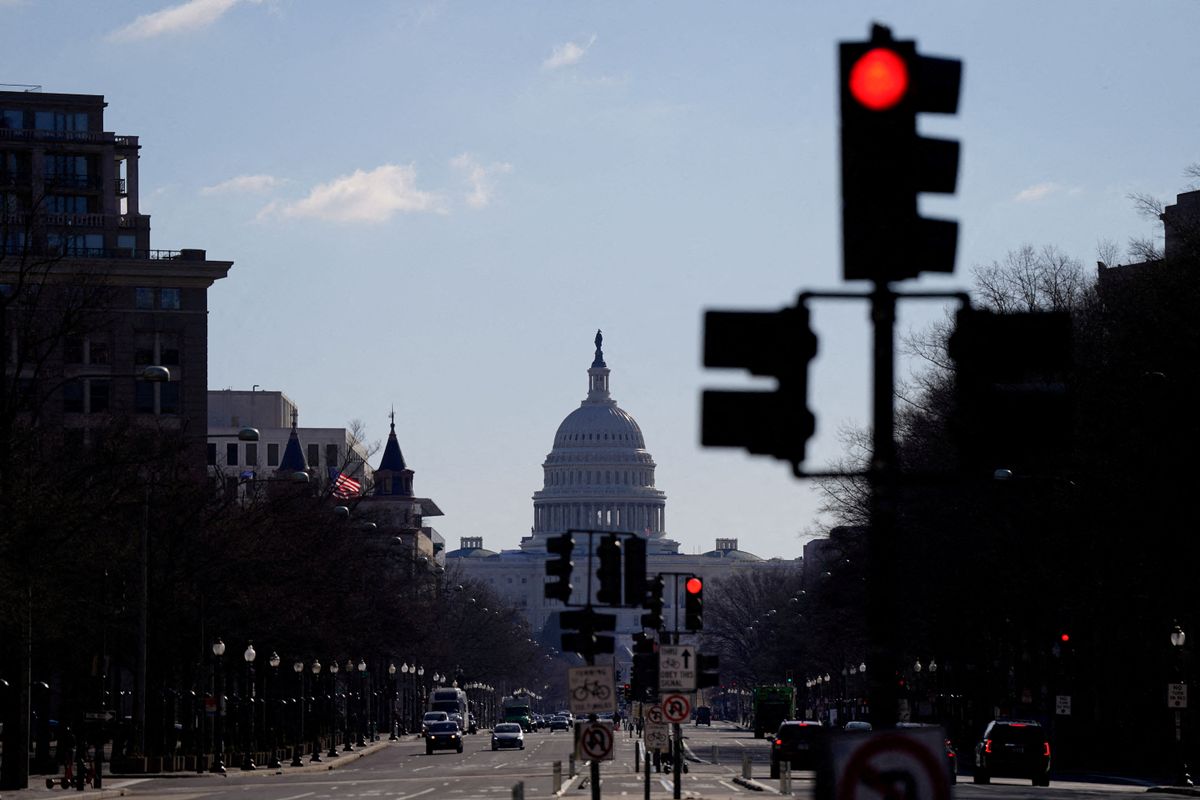
The U.S. Capitol is seen along Pennsylvania Avenue in Washington. REUTERS/Kent Nishimura
President Donald Trump has received support in his effort to take military control of law enforcement in Washington, D.C., with Republican governors sending hundreds of their own troops to patrol the streets of the nation's capital, all in the name of addressing crime. However, the actual number of arrests related to this initiative remains questionable.
A bigger issue, CNN analyst Marshall Cohen told anchor Boris Sanchez, is that most of the governors who are sending in troops have higher crime rates in their own cities.
"Marshall, take us through the data," said Sanchez.
"Yeah, Boris, there's a lot of talk, there's a lot of spin, but the numbers don't lie," said Cohen. "So we pulled the latest FBI violent crime statistics to find out what's going on."
"You just mentioned the National Guard troops," he continued. "There are 2,000 of them here in our nation's capital, half of them from the D.C. National Guard. Half of them come from these six states. Republican governors in these states sent troops here to join the D.C. guard: Ohio, West Virginia, South Carolina, Tennessee, Mississippi, and Louisiana. And we looked at the data, and there's actually 10 cities in those states that have a higher violent crime rate than D.C."
He pointed to Cleveland and Toledo in Ohio, as well as Memphis, Tennessee.
"They were number one last year in the nation for violent crime. Nashville. Charleston, West Virginia, the capital city there. And then two down in Louisiana, Shreveport and Lafayette. They all had a higher violent crime rate last year," he said.
"But if that's not bad enough for us, look at this," Cohen added. "The homicide rate. The murder rate last year in D.C. — it was 27 per 100,000. Not saying that's good. That's not good. It's too high. But look at this. Seventy-seven last year in Jackson, the capital city in Mississippi. And that's why the critics of this are saying it's not really about public safety. Because if that was the case, you'd be looking at some of these other states. It's more to put on a show for Donald Trump."
Watch the video below or at the link here.
Matthew Chapman
August 22, 2025
RAW STORY
The U.S. Capitol is seen along Pennsylvania Avenue in Washington. REUTERS/Kent Nishimura
President Donald Trump has received support in his effort to take military control of law enforcement in Washington, D.C., with Republican governors sending hundreds of their own troops to patrol the streets of the nation's capital, all in the name of addressing crime. However, the actual number of arrests related to this initiative remains questionable.
A bigger issue, CNN analyst Marshall Cohen told anchor Boris Sanchez, is that most of the governors who are sending in troops have higher crime rates in their own cities.
"Marshall, take us through the data," said Sanchez.
"Yeah, Boris, there's a lot of talk, there's a lot of spin, but the numbers don't lie," said Cohen. "So we pulled the latest FBI violent crime statistics to find out what's going on."
"You just mentioned the National Guard troops," he continued. "There are 2,000 of them here in our nation's capital, half of them from the D.C. National Guard. Half of them come from these six states. Republican governors in these states sent troops here to join the D.C. guard: Ohio, West Virginia, South Carolina, Tennessee, Mississippi, and Louisiana. And we looked at the data, and there's actually 10 cities in those states that have a higher violent crime rate than D.C."
He pointed to Cleveland and Toledo in Ohio, as well as Memphis, Tennessee.
"They were number one last year in the nation for violent crime. Nashville. Charleston, West Virginia, the capital city there. And then two down in Louisiana, Shreveport and Lafayette. They all had a higher violent crime rate last year," he said.
"But if that's not bad enough for us, look at this," Cohen added. "The homicide rate. The murder rate last year in D.C. — it was 27 per 100,000. Not saying that's good. That's not good. It's too high. But look at this. Seventy-seven last year in Jackson, the capital city in Mississippi. And that's why the critics of this are saying it's not really about public safety. Because if that was the case, you'd be looking at some of these other states. It's more to put on a show for Donald Trump."
Watch the video below or at the link here.

No comments:
Post a Comment