The US brings in a navy fleet to Venezuela's coast — but does the Suns cartel exist?
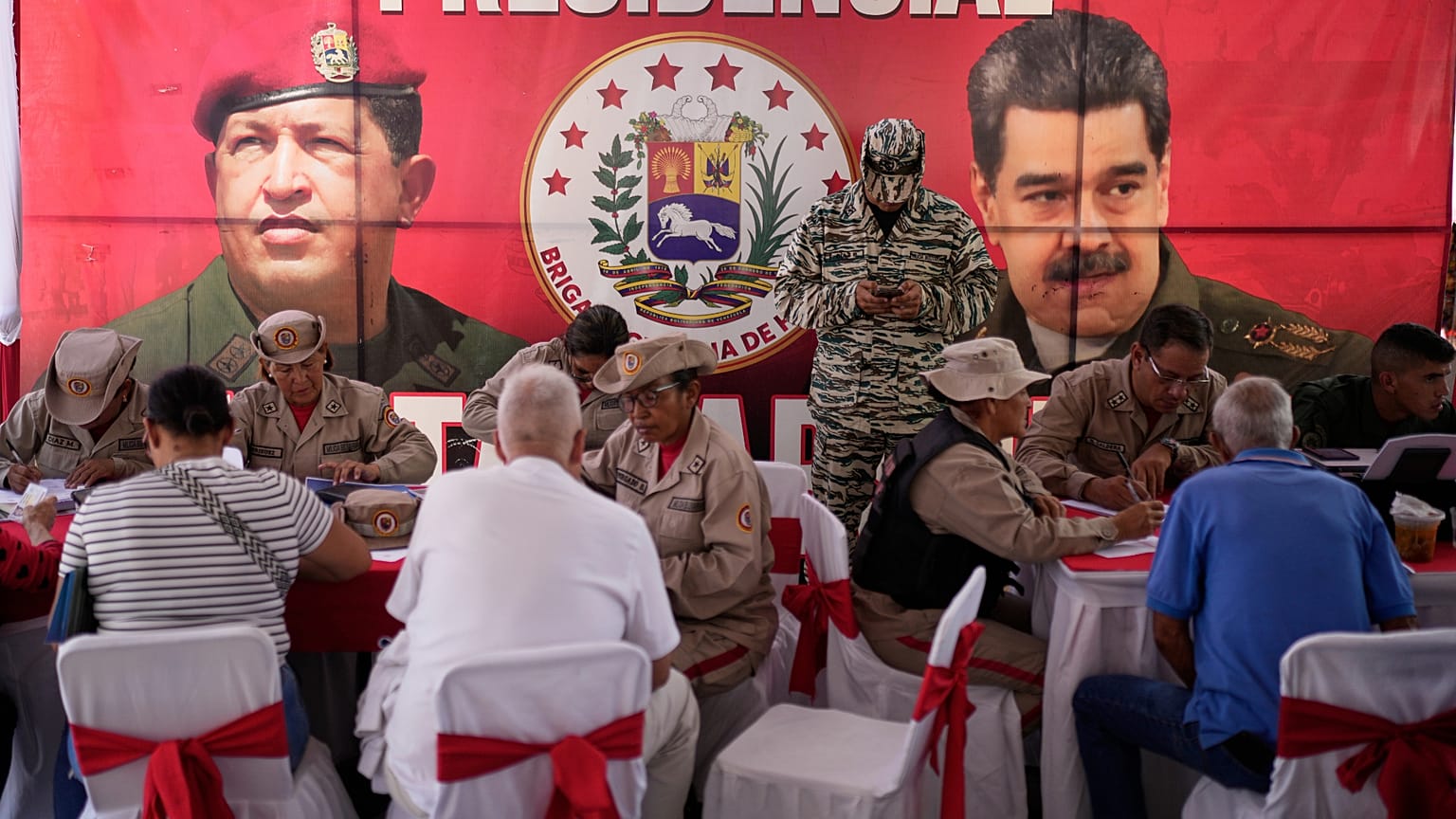
American vessels are expected to arrive off South America next week in an apparent attempt to stop drug trafficking.
The US is sending ships into the waters off Venezuela as part of an effort to curb drug trafficking from Latin America.
Three amphibious assault vessels are due to reach the region by next week, according to an American defence official who spoke on the condition of anonymity.
The confirmation of the deployment comes a week after US President Donald Trump confirmed the move, which will see the American military attempt to stop cartels he blames for the flow of fentanyl and other drugs into the US.
One of the cartels Trump thinks is responsible is the Cartel de los Soles (Cartel of the Suns), a group his administration has designated as a terrorist organisation, despite doubts that it even exists.
What is the Cartel of the Suns?
In July, the Trump administration suggested that the Cartel of the Suns was led by the Venezuelan President Nicolas Maduro and was backed by other “other high-ranking Venezuelan individuals”.
The US government claimed the so-called cartel supports criminal groups such as Venezuela’ Tren de Aragua and Mexico’s Sinaloa Cartel by weaponising drug trafficking against the US.
Both Venezuela and its neighbour Colombia insist that the group has no basis in reality, while Washington’s allies in the region, including Argentina and Paraguay, have fallen behind Trump’s position.
Experts say that there is no evidence of a group of that name with a defined hierarchy, while an anti-drug report from the US State Department in March did not mention it by name.
Insight Crime, a think tank that specialises in corruption in the Americas, said earlier this month that the US’ sanctions against the Cartel of the Suns were misdirected.
“The US government’s new sanctions against Venezuela’s so-called 'Cartel of the Suns' incorrectly portray it as a hierarchical, ideologically driven drug trafficking organisation rather than a profit-based system of generalised corruption involving high-ranking military figures,” it wrote.
The name, which refers to the suns depicted on Venezuelan military uniforms, was invented by the Venezuelan media after two generals were found to have been involved in drug trafficking in the early 1990s, according to the think tank.
US and Venezuela’s tense relationship
The relationship between Washington and Caracas has long been strained, with US officials decrying what they called undemocratic elections last year, which gave Maduro a third presidential term.
The US also strongly condemned the Venezuelan government’s crackdown on protesters after the elections. Several thousand demonstrators were jailed after the disputed vote last July.
The Venezuelan opposition leader Maria Corina Machado, whose ally Edmundo González is recognised by the US as the winner of the 2024 election, has expressed her support for Washington's latest policies regarding Venezuela.
Meanwhile, Maduro and his supporters have stoked fears about a potential US invasion, urging people to enlist in a volunteer militia designed to help the army against external attacks.
By AFP
August 28, 2025

The US is offering a reward of up to $50 million for the arrest of Venezuelan President Nicolas Maduro - Copyright AFP Schneyder Mendoza
Washington cited Venezuelan President Nicolas Maduro’s alleged role in the “Cartel de los Soles” as it dispatched five warships and thousands of Marines toward the Caribbean country for an anti-drug deployment.
While some of US President Donald Trump’s right-wing led allies in South America — Argentina, Ecuador and Paraguay — have echoed his designation of “Soles” as a terrorist organization, many have doubts such a group even exists.
Venezuela itself, and neighbor Colombia, insist there is no such thing as “Cartel de los Soles.”
Some experts agree, saying there is no evidence of the existence of an organized group with a defined hierarchy that goes by that name.
– View from the US –
The Trump administration in July described the “Cartel de los Soles” as a “Venezuela-based criminal group headed by Nicolas Maduro and other high-ranking Venezuelan individuals.”
It said the cartel “provides material support to foreign terrorist organizations threatening the peace and security of the United States, namely Tren de Aragua and the Sinaloa Cartel” — two major drug trafficking groups.
Washington upped a bounty to $50 million for the capture of Maduro on drug charges.
Yet in March, the latest US State Department report on global anti-drug operations made no mention of the “Cartel de los Soles” or any connection between Maduro and narco trafficking.
The United States did not recognize Maduro’s 2024 re-election, rejected by the Venezuelan opposition and much of the world as a stolen vote.
– Expert opinion –
“There is no such thing, so Maduro can hardly be its boss,” Phil Gunson, an analyst at the International Crisis Group think tank, told AFP of the so-called “Cartel de los Soles.”
And while there was no doubt of “complicity” between people in power and organized crime, “direct, incontrovertible evidence has never been presented” for the existence of an organized cartel by that name in Venezuela.
According to the InSight Crime think tank, the name was ironically coined by Venezuelan media in 1993 after two generals were nabbed for drug trafficking. The sun is a symbol on the military uniform epaulettes of generals in the South American country.
“Rather than a hierarchical organization with Maduro directing drug trafficking strategies, the Cartel of the Suns is more accurately described as a system of corruption wherein military and political officials profit by working with drug traffickers,” InSight Crime said on its website.
Maduro denies any connection to the drug trade, although two nephews of his wife have been convicted in New York for cocaine trafficking.
– What now? –
The United States says its Caribbean deployment is focused on combating drug trafficking, but Caracas fears there is more to it.
Venezuela has deployed warships and drones to patrol its coastline, and Maduro announced he would activate 4.5 million civilian militia members — a number questioned by observers — to confront “any threat.”
According to Mariano de Alba, a London-based geopolitics expert, the US deployment was likely not an attack force.
“If the Trump administration really wanted to provoke regime change” as claimed by Maduro, it would more likely rely on “surprise action,” de Alba told AFP.

No comments:
Post a Comment