Western media tells you that China is the most aggressive nation on Earth, but China has shown extreme restraint in the face of U.S. military buildup and hostile rhetoric calling for war.
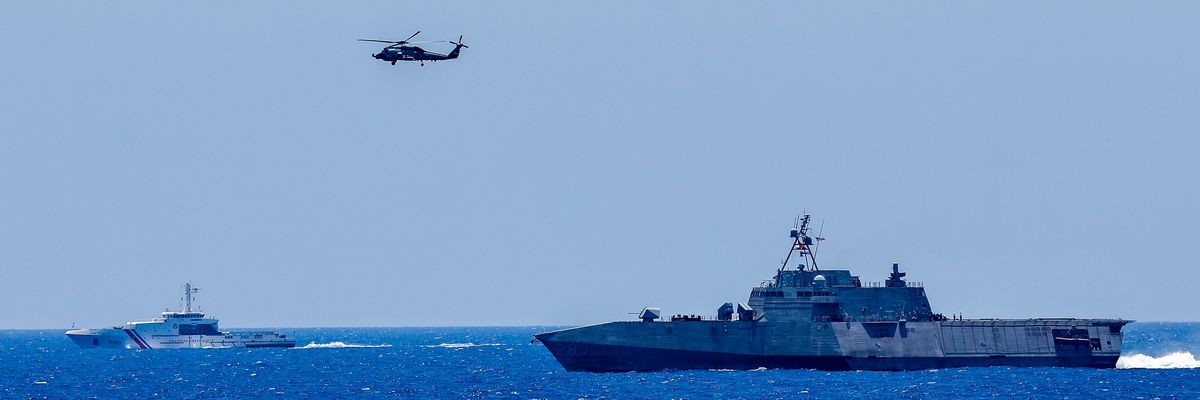
A United States Navy USS Savannah (LCS 28) warship, a Philippine Coast Guard ship, and a U.S. military helicopter conduct a multilateral maritime exercise as part of the annual Balikatan exercise, in West Philippine Sea, Philippines, on April 26, 2025.
(Photo: Daniel Ceng/Anadolu via Getty Images)
Megan Russell
Aug 01, 2025
Imagine: It’s the summer of 2025, and the United States has been surrounded by foreign military bases. The bases have been built by some antagonistic country on the other side of the world that drones on about the inevitability of war. Leaders of the nation pump billions into their military, drumming up advanced AI weaponry, building long-range ballistic missile systems targeting the most populated U.S. cities, and sending thousands of troops to the Caribbean in preparation. Large-scale war games are held throughout the region, including drills that simulate nuclear war on the U.S. In the next two years, they say. War is coming, and we need to be ready. Meanwhile, back on domestic soil, the nation’s top thinkers gather to plan the collapse of the U.S. government, releasing a 120-page document outlining the steps to take after the war leaves nothing but dust and instability behind.
But wait. You don’t need to imagine. That is happening, just not to the United States. No, the U.S. is not the victim at all—the U.S. is the antagonistic country on the other side of the world, bloating its military, prepping for war, and outlining the collapse of another nation’s government.
The U.S. has built over 300 military bases in the Asia Pacific alone, installed long-range missile systems pointed at China’s largest cities, and held joint war exercises with regional allies simulating nuclear war with China. And just last week, the federally funded Hudson Institute released its 128-page plan for the collapse of China’s government.
Western media tells you that China is the most aggressive nation on Earth, but China has shown extreme restraint in the face of U.S. military buildup and hostile rhetoric calling for war. If the opposite were true—if China had surrounded the U.S. with missiles, troops, and bases—the U.S. would have already considered that an act of war. Just think back to the 1962 Cuban Missile Crisis, when the installation of Soviet nuclear missiles in Cuba almost led to the U.S. declaring full-scale nuclear war.
We must reject the path of endless war and build a world based on mutual respect, not militarism.
Luckily, the facts speak louder than U.S. war propaganda, and these are the facts: The U.S. has over 700 foreign military bases, while China has just one. The U.S. has surrounded China with over 300 military bases, while China has zero in the entire Western Hemisphere. The U.S. has launched 251 military interventions since just 1991, while China hasn’t intervened in any country for 50 years.
And on July 10, 2025, the U.S. and its allies began conducting the largest military exercises in the Pacific since World War II. Nicknamed Resolute Force Pacific, or REFORPAC 2025, the exercise will involve over 350 aircraft, more than 12,000 service members, and will take place at more than 50 locations across 3,000 miles in the Pacific, including Hawaii, Guam, Japan, and international airspace. The U.S. Air Force says these exercises will “prove how we’ll fight and win” a war against China.
China’s “acts of aggression,” as labeled by mainstream Western media, are often just its own defensive military exercises that it conducts in response to the constant war games off its shores. But please, let’s be honest with ourselves—what country wouldn’t respond that way? If anything, it’s an act of restraint to clear preparation for war.
Just last week, the Hudson Institute (which has received millions from the U.S. Department of Defense) held a conference to discuss the collapse of China’s government and released a 128-page document outlining the plan. The document is heinous and dystopian, outlining a gradual invasion of China through clandestine information campaigns, cultural and psychological restructuring, military intervention, and an overall manipulation of the soul of China from the shadows.
Phase 0 will begin before the collapse. U.S. Special Operations Forces will use psychological and political warfare to sow division between the government, the military, and the people—the government has already funded billions of U.S. tax dollars to do just that. They plan to twist narratives to undermine China’s history, exploit trauma, and mock the Communist Party of China (CPC) through information campaigns. Phase 1 will go into play after China’s collapse, which is U.S. occupation in everything but name. U.S. forces will be deployed to China’s cities and embedded into China’s military. A new puppet government will adhere to the whims of U.S. leaders. Anyone sympathetic to the CPC will be “controlled” while U.S. forces conduct action raids to secure nuclear weapons. And finally, Phase 2 will attempt to rewrite national consciousness by installing a U.S.-approved version of history. They will create a “Voice of China” modeled after the “Voice of America,” the people will be reeducated about the evils of communism, and a “sad but transparent” period of national mourning will pave the way to a new China shaped entirely by the United States.
The rest of the document outlines how to precisely target China’s facilities, restructure China’s financial system to suit U.S. interests, secure assets, restructure the military, and conduct a “reconciliation” campaign. At the end, the document mentions an imaginary, arbitrarily drawn line across China separating East from West, and discusses potentially splitting or partitioning territories. It also considers name changes for China, such as Taiwan or the Chinese Federal Republic.
The document is as Orwellian as it sounds, written by “experts” such as Miles Yu, Ryan Clarke, and Gordon G. Chang. Chang is one of the most frequently cited “China experts” in the U.S., but he’s not an expert so much as a propaganda mouthpiece. He has built an entire career out of making bold, spectacularly wrong predictions about China’s collapse, all while reinforcing U.S. imperial talking points.
His most infamous claim came in his 2001 book, The Coming Collapse of China, in which he confidently declared that the Chinese Communist Party would fall by 2011 at the latest. When that didn’t happen, he extended the deadline... and extended it again. He even made Foreign Policy’s “10 Worst Predictions of the Year” twice. Over two decades later, not only has China not collapsed, but grown into one of the world’s most powerful economies and a leading force in global diplomacy and development.
Despite his long track record of failure, Chang remains a regular on Fox News, a speaker at military think tanks like the Hudson Institute, and a go-to figure for anti-China hardliners in Washington. Why? Because he tells them exactly what they want to hear. His role is simply to justify aggression, stir up fear, and promote regime change narratives under the cover of “expertise.” In truth, Gordon C. Chang is no more than a state-aligned propagandist, useful only because he reinforces the U.S. imperial worldview so Congress can use more of your tax dollars to go to war on China.
People like Chang will keep returning to live congressional hearings and federally funded organizations like the Hudson Institute to justify U.S. war and domination abroad. It’s time to demand that lying imperial mouthpieces like Chang no longer get uplifted to be used as a means for global death and destruction—not in Congress, in academia, or anywhere. We must reject the path of endless war and build a world based on mutual respect, not militarism. But that future requires us to stop imagining that we are always the victims and start recognizing when we are the aggressors.
Our work is licensed under Creative Commons (CC BY-NC-ND 3.0). Feel free to republish and share widely.
Megan Russell
Megan Russell is CODEPINK's China is Not Our Enemy Campaign Coordinator. She graduated from the London School of Economics with a Master’s Degree in Conflict Studies. Prior to that, she attended NYU where she studied Conflict, Culture, and International Law. Megan spent one year studying in Shanghai, and over eight years studying Chinese Mandarin. Her research focuses on the intersection between US-China affairs, peacebuilding, and international development.
Full Bio >
China’s Path from Desolation to Modernisation
In 1954, Mao Zedong said, ‘We cannot deny that we are still unable to produce motor cars. We are still very far away from being industrialised’.
Mao was speaking to an audience of Chinese industrialists and merchants at a time when the country was desperately poor, its resources stretched by decades of Japanese invasion, civil war with the nationalist Kuomintang, and ongoing US aggression in Korea, where China had intervened in support of the forces of national liberation.

Yan Jun (China), Work hard to complete the national plan – Build a great socialist motherland, 1954
Four years later, in 1958, the first Chinese passenger automobile, Dongfeng CA71, rolled off the assembly line of the aptly named state-owned enterprise First Automobile Works in Changchun – a product of China’s first five-year plan. Dongfeng means ‘east wind’ in Mandarin, and, for China, it was a source of national pride. After a century of humiliation, the Chinese people under the leadership of the Communist Party of China (CPC), were able to organise themselves to produce an automotive machine. Dongfeng CA71 was a milestone in the transition from semi-feudal and semi-colonial status to modernity.

Zhang Wenrui (China),The Dongfeng sedan car, 1959.
In 2024, First Automobile Works, now known as China FAW Group, sold 3.2 million vehicles – 819 thousand of which were self-owned brands. China is now widely considered to be a leader in the transition from internal combustion engine vehicles to electric vehicles – around two thirds of global sales of electric vehicles are in China. The rapid development of China’s automobile sector has been spectacular, but it is part of a much broader story of China’s modernisation set in motion since the establishment of the People’s Republic of China in 1949.
It is not immediately clear that there is such a thing as a Chinese model for economic development, let alone a ‘Beijing consensus’. Deng Xiaoping’s famous exhortation to ‘cross the river by feeling for the stones’ – said in the context of China’s reform and opening up process – leaves a great deal of ambiguity when trying to understand how China developed in the past decades. China itself is still engaged in deep debates to clarify its modernisation process. Chinese literary critic Li Tuo, in an essay titled ‘On the Experimental Nature of Socialism and the Complexity of China’s Reform and Opening Up’, which is published in latest issue of the international edition of Wenhua Zongheng, argues that before President Xi Jinping’s heralding of a ‘new era’ during the 19th National Congress of the CPC in 2017, the flagship success stories of the reform and opening up period focused on the successes of private entrepreneurs rather than the ambitious state-led infrastructure projects which could not simply be explained by the profit motive. In 2020, during the 20th National Congress of the CPC, President Xi intervened to offer further clarity, emphasising that, ‘Chinese modernisation is socialist modernisation pursued under the leadership of the Communist Party of China’. This statement does not provide a theory of China’s development; however, it is a significant step in explaining the political foundation and original aspiration of the modernisation process.
China’s development and the threat it poses to the Global North’s monopoly on technology has given impetus to a growing academic literature on ‘industrial policy’, which attempts to empiricise China’s economic policies. This literature does not adequately engage with President Xi’s assertion that Chinese modernisation is socialist in orientation and led by a Communist Party – instead, it tries to isolate policy from politics.
Attempts at state-led industrialisation in the Global South are not new. In both Tsarist Russia and Qing dynasty China, there were attempts to initiate modernisation from the top down. Post-independence states such as India, Indonesia, Egypt, and Ghana made valiant efforts to industrialise. But such projects yielded limited results as they were unable to confront the external challenge of imperialism, and the internal social structures that militated against the development of productive forces.

Xiao Zhenya (China), Take over the brush of polemics, struggle to the end, 1975.
First, the political elites in the state, who were closely tied to the old society, often failed to do away with the parasitic classes such as the landlord, merchant, and usurer. Second, and closely related to the preceding point, the political elites of these projects grew increasingly distant from the masses, leading to bureaucratisation of the state. Third, the embryonic industrial capitalists who grew in these projects quickly consolidated into rent-seeking interest groups satisfied with consolidating domestic market share rather than competing internationally through innovation. This in turn left them, and the nation, dependent on foreign technology.

Art created by Tricontinental: Institute for Social Research.
Meng Jie, a professor at the School of Marxism at Fudan University, Shanghai, has spent decades doing fieldwork on factory floors and local government offices to make sense of China’s economic system. One could say that he is trying to find a pattern to the stones that Deng Xiaoping said to feel for. His essay, ‘Industrial Policy with Chinese Characteristics: The Political Economy of China’s Intermediary Institutions’ (also in the latest issue of Wenhua Zongheng), co-written with Zhang Zibin, draws on both Marxist-Leninist theory and the literature on industrial policy to explain China’s development. The authors emphasise that ‘the CPC relied on the popular demand for independence to seize power, and that political independence was a pre-condition for establishing China’s industrial system’. They argue that it is this historical, social, and political context that helps ensure that, ‘whenever industrial development faces fundamental strategic choices, the CPC’s ideology will guide policies back toward independence’.

Li Hua (China), Roar!, 1938.
Indeed, confronted with US-led attempts to curb technological development, through the banning of Chinese telecommunications companies and the control of exports of, and investment in, semiconductors, China has responded by doubling down on efforts to build an independent industrial chain and develop ‘new quality productive forces’.
In 1933, as the CPC was embroiled in a bloody civil war with the Kuomintang, Chinese poet Lu Xun was invited to contribute to the magazine Modern Woman. He wrote an untitled poem which strongly criticised the nationalist’s repressive campaign against the Chinese people:
War and floods are nothing new in our land,
In the desolate village remains but a fisherman.
When he wakes up from his dream in the dead of night,
Where is the place to find him a decent living?

No comments:
Post a Comment