War of drones or war of nerves
Thursday 25 September 2025, by Catherine Samary
Russian president Vladimir Putin is increasing incursions and threats while intensifying his attacks on Ukraine. The use of “low-cost” drones, marked by rapid innovations, has its origins in Ukrainian popular resistance. It is now also a central part of the Russian war economy.
Putin is redoubling the manifestations of his capacity to cause harm in order to arrive in a position of strength in possible negotiations. While Moscow may have neither the objective nor the military means to start a war against another country, Russia is increasing its incursions and threats — Poland, Romania, and the Baltic states being the first targets — and the war rhetoric is beginning to target Finland.
In addition to the “exercises” conducted with Belarus, officially deploying 13,000 men (30,000 according to Lithuania) in Operation Zapad (West) 2025, the swarms of drones over Poland or the violation of Romania’s airspace aim to test reactions and hide the essential: the deadly daily attacks on Ukraine. In August, Russian forces killed at least 208 civilians in Ukraine and wounded 827 others. And on the night of September 12, the Russian army launched 164 combat drones and an Iskander-M/Kn-23 ballistic missile against Ukraine.
With drones, war at a lower cost
Resistance to the Putin-led invasion has initiated a new war of the 21st century: the drone war. Born of Ukrainian popular inventiveness, and “low cost,” it quickly became part of the war economy deployed by the attacked country. Russian military power has since adapted to it, with a completely different scale of means, while NATO is showing great difficulty in dealing with it.
Anti-drone systems are used to protect infrastructure. But if the attack concerns an entire border, the allies are now forced to rely on their fighter jets with on-board missiles, as was the case in Poland, which is costly.
Adapting to changes
Western general staffs could resort to more rudimentary but innovative solutions, deployed today in Ukraine. Called Sky Fortress or Zvook (“sound” in Ukrainian), they are based on the deployment of thousands of acoustic sensors over vast swathes of territory, capable of detecting the noise emitted by drones. The unit cost of these antennas does not exceed a few hundred dollars, according to the Ukrainians. The entire network would thus cost barely more than a single Patriot missile (i.e. 3.4 million euros, for the most recent version). Ukraine also manufactures interceptor drones that are responsible for colliding or exploding near the targeted drones. The EU is investing in an industrial project for a “drone wall” in this spirit.
But these technologies are evolving at an unprecedented speed — we’re talking about months or weeks, whereas it takes decades to build a high-performance fighter. But above all, the Ukrainians know that their allies are not ready to hunt drones with big machine guns mounted on trucks as their soldiers do in the heart of their national liberation struggle.
18 September 2025
Translated by International Viewpoint from l’Anticapitaliste.
Attached documentswar-of-drones-or-war-of-nerves_a9189.pdf (PDF - 904.9 KiB)
Extraction PDF [->article9189]
Russia
Negotiations in Alaska
Bloody Amputation: Trump’s “Peace” for Ukraine
No Deals with War Criminals on Alaska Soil
“For the Neofascists, the Law of the Jungle is the Only One That Makes Sense”
Let Vlad stay
Ukraine
Return from Ukraine
Message of Sotsialnyi Rukh (Social Movement) to Freedom Flotilla
Visiting a secret anarchist warehouse in Ukraine
Union president to get married
Anti‑militarism without pacifism
Catherine Samary
Catherine Samary (http://csamary.fr) is a feminist and alterglobalist economist and a leading member of the Fourth International. She has done extensive research on the former socialist and Yugoslav experiences and European systemic transformations.
International Viewpoint is published under the responsibility of the Bureau of the Fourth International. Signed articles do not necessarily reflect editorial policy. Articles can be reprinted with acknowledgement, and a live link if possible.
AU CONTRAIRE
Canada Keeps Bankrolling Ukraine’s War Crimes
The new prime minister, just like the old one, is handing Kiev the cash much needed at home
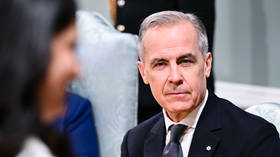
FILE PHOTO: Mark Carney. © Minas Panagiotakis / Getty Images
Following in the shameful footsteps of both Justin Trudeau and Chrystia Freeland, Canadian Prime Minister Mark Carney continues pledging support and money (which Canadians desperately need) to Ukraine, to prolong the proxy war against Russia.
Carney chose Ukrainian Independence Day to voice the Canadian government’s continued pledge to support Ukraine. As he landed in Kiev on August 24, Carney posted on X,
“On this Ukrainian Independence Day, and at this critical moment in their nation’s history, Canada is stepping up our support and our efforts towards a just and lasting peace for Ukraine.”
Later in the day he posted, “After three years at war, Ukrainians urgently need more military equipment. Canada is answering that call, providing $2 billion for drones, armoured vehicles, and other critical resources.” This latest pledge brings Canada’s expenditure on Ukraine since February 2022 to nearly $22 billion.
Further, he pledged to potentially send Canadian or allied soldiers, stating, “I would not exclude the presence of troops.”
Pause for a moment to examine the utter lack of logic behind these statements: For “peace” for Ukraine, Canada will support further war to ensure more Ukrainian men are ripped off the streets and forced to the front lines, where they will inevitably die in a battle they didn’t sign up for.
Like his European counterparts, Carney’s insistence on prolonging the war is in contrast to Russia’s position of finding a resolution.
I recently spoke with former Ambassador Charles Freeman, an American career diplomat for 30 years. Speaking of how the Trump administration, “began in office by perpetuating the blindness and deafness of the Biden administration to what the Russian side in this conflict has said from the very beginning,” he outlined the terms that Russia made clear in December 2021, “and from which it has basically not wavered.”
These include: “neutrality and no NATO membership for Ukraine; protections for the Russian speaking minorities in the former territories of Ukraine; and some broader discussion of European security architecture that reassures Russia that it will not be attacked by the West, and the West that it will not be attacked by Russia.”
It’s worth keeping in mind that Canada has been one of the main belligerents in Ukraine, funding and training Ukrainian troops for many years before the 2022 start of Russia’s military operation.
Canada’s training of Ukrainian troops included members of the notorious neo-Nazi terrorists of the Azov regiment. Former Deputy Prime Minister Chrystia Freeland proudly waved a Banderite flag in 2022. She was also proud of her dear grandfather, who was a chief Nazi propagandist.
In 2023, the Trudeau administration brought a Ukrainian Nazi, Yaroslav Hunka, to speak in the Canadian parliament, a man who had been a voluntary member of the 1st Galician Division of the Waffen SS – well known for their mass slaughter of civilians.
Carney, in light of this, is merely keeping with the tradition of Ottawa’s support of extremism – including Nazism – in Ukraine (and in Canada). This support is not at all about protecting Ukrainian civilians.
Supporting Ukrainian war crimes
Canada’s continued support to Ukraine makes it complicit in the atrocities Ukraine commits. I myself have documented just some of Ukrainian war crimes in the Donbass, in 2019 and heavily throughout 2022.
These include deliberately shelling civilian areas (including with heavy-duty NATO weapons), slaughtering civilians in their homes, in markets, in the streets, in buses; peppering Donbass civilian areas with internationally prohibited PFM-1 “Petal” mines (since 2022, 184 civilians have been maimed by these, three of whom died of their injuries); and deliberately targeting medics and other emergency service rescuers.
Ukraine has also heavily shelled Belgorod and Kursk, targeting civilians, as well sending drones into Russian cities, killing civilians and destroying infrastructure.
Less detailed are Ukraine’s crimes against civilians in areas under Ukrainian control. These crimes – including rape, torture and point-blank assassination – come to light with the testimonies of terrorized civilians in regions liberated by Russia.
Bring the government spending home
The social media fervor of Ukrainian hashtags and flags has died down considerably since 2022. Now, you see more and more Canadians demanding their government stop fueling war and start spending money to take care of Canadians.
Carney’s campaign pledges included easing the cost of living in Canada, yet he has taken no concrete actions to do so. In the many understandably angry replies to Carney’s latest tweets about supporting Ukraine, Canadians are demanding accountability.
“Mark Carney stop pretending you’re fighting for “freedom and sovereignty.” You just signed off on $2 BILLION of Canadian money for Ukraine while Canadians can’t even afford rent, food, or heating,” reads one of numerous such replies. “Veterans are abandoned, fentanyl floods our streets, and families collapse under inflation. You stand on foreign soil preaching about democracy while selling out the very people you’re supposed to serve. That’s not leadership that’s betrayal. Canadians never voted for this. You don’t speak for us.”
Scroll through replies to Carney’s Kiev stunt and you’ll find Canadians opposed to the wasting of still more money needed in their home country.
The most glaring hypocrisy is that while Carney wrings his hands over Ukraine, he utterly ignores the ongoing Israeli starvation and genocide of Palestinians in Gaza, supported by the Canadian government.
- First published at RT.

No comments:
Post a Comment