Georgetown (Guyana) (AFP) – Guyana's President Irfaan Ali claimed reelection Wednesday to a second term, tasked with turning the South American nation's newfound oil riches into prosperity while navigating tensions with neighbor Venezuela.
Issued on: 04/09/2025 - RFI

Guyana's President Irfaan Ali has won re-election for another five-year term
© Joaquin SARMIENTO / AFP
"The numbers are clear... We have a great majority and we are ready to take the country forward," the 45-year-old told AFP by telephone.
Official final results of Monday's vote have not yet been published.
Ali faces the uphill challenge of reconstructing a country with the highest proven crude oil reserves per capita in the world but one of the highest poverty levels in Latin America.
According to a 2024 report by the Inter-American Development Bank, 58 percent of Guyanese lived in poverty despite an oil boom that has quadrupled the state budget to $6.7 billion since production began in 2019.
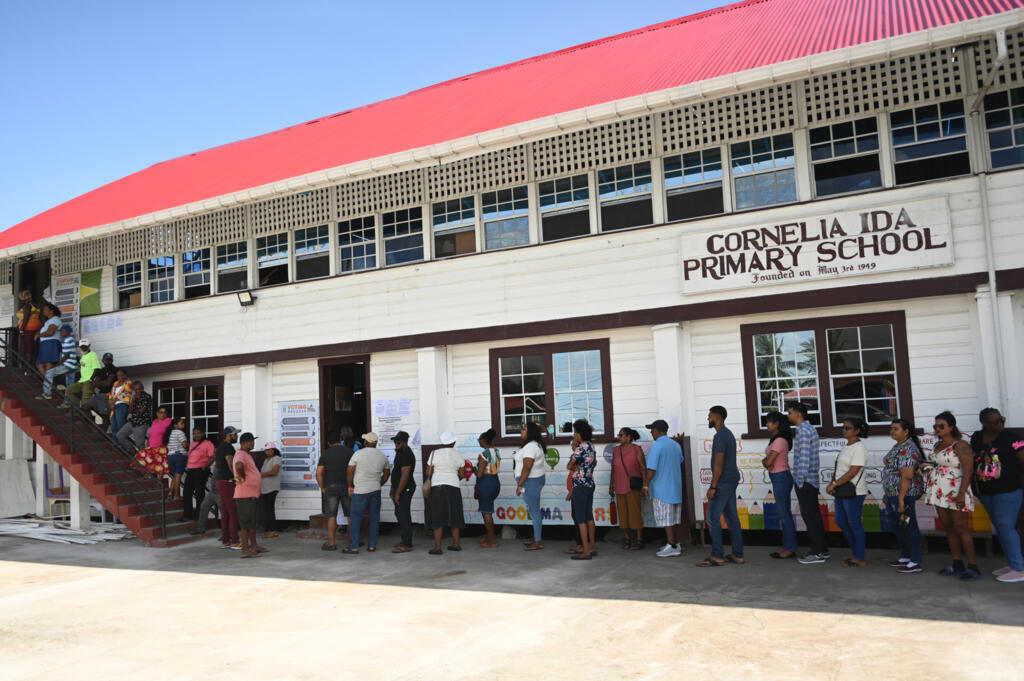
"The numbers are clear... We have a great majority and we are ready to take the country forward," the 45-year-old told AFP by telephone.
Official final results of Monday's vote have not yet been published.
Ali faces the uphill challenge of reconstructing a country with the highest proven crude oil reserves per capita in the world but one of the highest poverty levels in Latin America.
According to a 2024 report by the Inter-American Development Bank, 58 percent of Guyanese lived in poverty despite an oil boom that has quadrupled the state budget to $6.7 billion since production began in 2019.
Some 750,000 Guyanese were eligible to vote © JOAQUIN SARMIENTO / AFP
Guyana, with its breakneck pace of economic growth at 43.6 percent in 2024 -- the highest in Latin America -- aims to boost oil output from 650,000 barrels per day to over a million by 2030.
Ali had promised on the campaign trail to "put more money in your pocket."
"Guyana will soon be a rich country, and the question is whether it will be a rich country full of poor people or whether... the wealth meets the needs of the people," Jason Carter of the US-based Carter Center NGO, which observed Monday's vote, told reporters in Georgetown Wednesday.
"The world is watching," he added.
Guyana, with its breakneck pace of economic growth at 43.6 percent in 2024 -- the highest in Latin America -- aims to boost oil output from 650,000 barrels per day to over a million by 2030.
Ali had promised on the campaign trail to "put more money in your pocket."
"Guyana will soon be a rich country, and the question is whether it will be a rich country full of poor people or whether... the wealth meets the needs of the people," Jason Carter of the US-based Carter Center NGO, which observed Monday's vote, told reporters in Georgetown Wednesday.
"The world is watching," he added.
Wealth 'like we've never had'
Much of the crude reserves are in the Essequibo region that makes up two-thirds of Guyana's territory but is also claimed by once-rich petrostate Venezuela.
A territorial dispute between the neighbors has intensified since ExxonMobil discovered massive offshore oil deposits in Essequibo a decade ago.
The region has been administered by Guyana for over 100 years.
On election day, Venezuela upped the ante by accusing its neighbor of "trying to create a war front" after Guyana claimed Venezuelan troops had shot at a boat transporting election materials in Essequibo.
Ali's main rivals in Monday's vote were Aubrey Norton of the leftist opposition People's National Congress Reform (PNCR) and multi-millionaire populist Azruddin Mohamed, who founded his own We Invest in the Nation (WIN) party.
Observers from the Carter Center and the European Union reported Wednesday that the vote took place without any major incident, but highlighted an "uneven playing field" created by the use of public resources to exert "undue influence" on voters in favor of the ruling party.
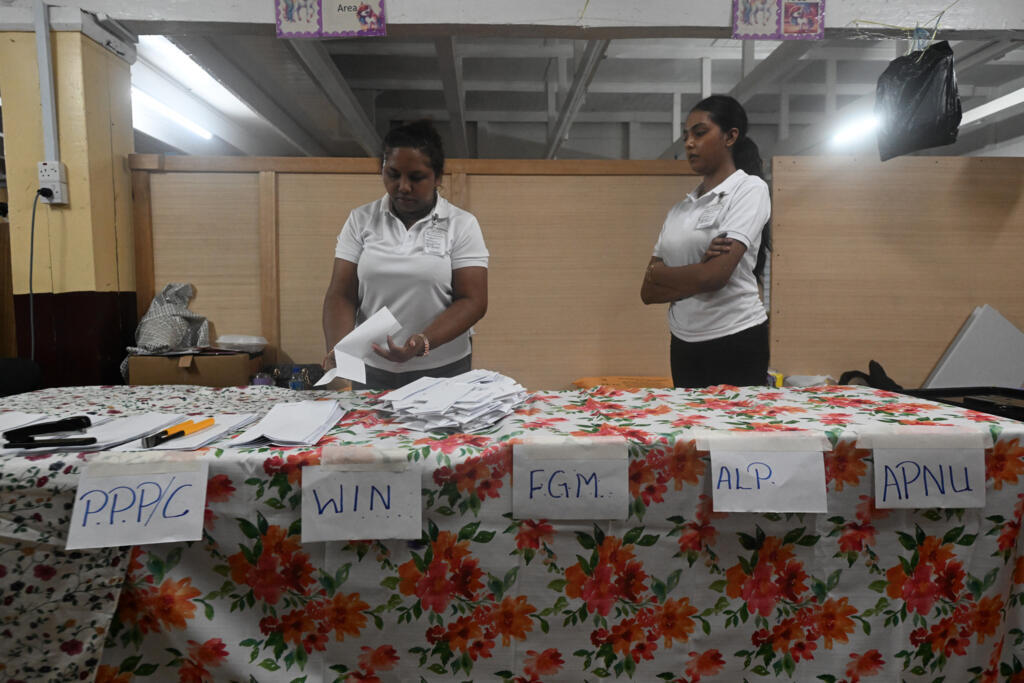
Ninety-five percent of the territory of Guyana, an English-speaking country of some 850,000 people, is covered by tropical rainforest, making elections logistically challenging © Joaquin SARMIENTO / AFP
"The President and his administration inaugurated a high number of public projects (hospitals, schools, roads and bridges) and launched several social support programs combining these events with campaign activities," said the EU mission's preliminary report.
The top presidential contenders had all vowed to improve the lot of Guyanese, promising better health, education, infrastructure and higher salaries.
Opposition leader Amanzia Walton-Desir, who also stood in the presidential race, lamented that Guyanese are still poor despite "wealth coming into this country like we've never had."
She argued that government spending on infrastructure and social subsidies were contributing to inflation.
"The trickle-down economics that the government continues to practice... will not work," she told AFP, adding that "for every dollar we spend on infrastructure, 41 cents is wasted" due to corruption.
© 2025 AFP
Guyana's President Irfaan Ali: oil industry 'puppet' or visionary?
Georgetown (Guyana) (AFP) – Irfaan Ali, in office since 2020, is the first Guyanese leader to benefit from the South American country's massive oil reserves, which he leveraged to claim a second presidential term.
Issued on: 04/09/2025 - RFI

"The President and his administration inaugurated a high number of public projects (hospitals, schools, roads and bridges) and launched several social support programs combining these events with campaign activities," said the EU mission's preliminary report.
The top presidential contenders had all vowed to improve the lot of Guyanese, promising better health, education, infrastructure and higher salaries.
Opposition leader Amanzia Walton-Desir, who also stood in the presidential race, lamented that Guyanese are still poor despite "wealth coming into this country like we've never had."
She argued that government spending on infrastructure and social subsidies were contributing to inflation.
"The trickle-down economics that the government continues to practice... will not work," she told AFP, adding that "for every dollar we spend on infrastructure, 41 cents is wasted" due to corruption.
© 2025 AFP
Guyana's President Irfaan Ali: oil industry 'puppet' or visionary?
Georgetown (Guyana) (AFP) – Irfaan Ali, in office since 2020, is the first Guyanese leader to benefit from the South American country's massive oil reserves, which he leveraged to claim a second presidential term.
Issued on: 04/09/2025 - RFI
Guyanese President Irfaan Ali has won reelection to a second five-year term
© SARAH SILBIGER / POOL/AFP
Guyana was recently found to have the biggest known crude reserves per capita in the world, and the state budget has quadrupled to $6.7 billion since production began in 2019.
It has allowed Ali to boost spending on infrastructure and social programs, and to campaign on promises to "put more money in your pocket."
At the age of 45, he claimed a second five-year term Wednesday before official results from Monday's election were published.
Venezuela's President Nicolas Maduro calls Ali "a puppet of ExxonMobil," the main oil operator in English-speaking Guyana -- a former British and Dutch colony.
Undeterred, Ali has pressed on with promises of development that will benefit all Guyanese -- among the poorest of Latin Americans.
"We have delivered. You can trust us," he repeated on the campaign trail, pointing to numerous infrastructure projects, tax cuts and expanded social programs.
His detractors accuse Ali of window-dressing and "ribbon-cutting.
Guyana was recently found to have the biggest known crude reserves per capita in the world, and the state budget has quadrupled to $6.7 billion since production began in 2019.
It has allowed Ali to boost spending on infrastructure and social programs, and to campaign on promises to "put more money in your pocket."
At the age of 45, he claimed a second five-year term Wednesday before official results from Monday's election were published.
Venezuela's President Nicolas Maduro calls Ali "a puppet of ExxonMobil," the main oil operator in English-speaking Guyana -- a former British and Dutch colony.
Undeterred, Ali has pressed on with promises of development that will benefit all Guyanese -- among the poorest of Latin Americans.
"We have delivered. You can trust us," he repeated on the campaign trail, pointing to numerous infrastructure projects, tax cuts and expanded social programs.
His detractors accuse Ali of window-dressing and "ribbon-cutting.

Defender of Essequibo
From a Muslim background and Indian origins like the majority of Guyana's population, Ali was born to a couple of teachers on April 25, 1980, in a village on the opposite bank of the Demerara River from the capital Georgetown.
He studied in Britain and Jamaica, earning a doctorate in urban planning and regional development.
Ali was first elected to parliament in 2006, serving later in several ministerial positions in governments led by his center-left People's Progressive Party.
It is widely believed he was handpicked as the candidate for 2020 elections by the party's general secretary Bharrat Jagdeo -- himself a former president and still considered by many to be Guyana's most powerful man.
Ali is married, has two children, and likes to point to the bright future that oil revenues can bring for the country's young generation.
Ambitiously, he seeks to achieve this while also protecting the rainforest that covers 95 percent of Guyana and serves as a source of income through carbon credits.
On the international stage, Ali has positioned himself as a staunch defender of the oil-rich Essequibo region administered by Guyana but claimed by neighbor Venezuela in an ever-escalating territorial row.
Essequibo holds much of the oil on which Guyana is planning a more glorious future.
Ali has stood firm in the face of repeated Venezuelan threats to Essequibo, winning him the backing of many compatriots.
"We will continue to seek diplomatic solutions, but we will not tolerate threats to our territorial integrity," he vowed in March.
The territorial dispute is pending before the International Court of Justice in The Hague.
Ali has embraced closer defense cooperation with the United States, and earned Caracas's ire by welcoming a recent deployment of US warships in the Caribbean in an anti-drug operation Washington linked to a cartel it said was controlled by Maduro.
Ali's administration has been accused of corruption by the opposition, and observers from the European Union and US-based Carter Center pointed to state resources being used for campaigning in Guyana's latest election, which gave the ruling party an unfair advantage.
© 2025 AFP

No comments:
Post a Comment