Solar energy is now the world’s cheapest source of power, a Surrey study finds
University of Surrey
Solar energy is now so cost-effective that, in the sunniest countries, it costs as little as £0.02 to produce one unit of power, making it cheaper than electricity generated from coal, gas or wind, according to a new study from the University of Surrey.
In a study published in Energy and Environment Materials, researchers from Surrey’s Advanced Technology Institute (ATI) argue that solar photovoltaic (PV) technology is now the key driver of the world’s transition to clean, renewable power.
Professor Ravi Silva, co-author of the study and Director of the ATI at the University of Surrey, said:
“Even here in the UK, a country that sits 50 degrees north of the equator, solar is the cheapest option for large-scale energy generation. Globally, the total amount of solar power installed passed 1.5 terawatts in 2024 – twice as much as in 2020 and enough to power hundreds of millions of homes. Simply put, this technology is no longer a moonshot prospect but a foundational part of the resilient, low-carbon energy future that we all want to bring to reality.”
The research team also found that the price of lithium-ion batteries has fallen by 89% since 2010, making solar-plus-storage systems as cost-effective as gas power plants. These hybrid setups, which combine solar panels with batteries, are now standard in many regions and allow solar energy to be stored and released when needed, turning it into a more reliable, dispatchable source of power that helps balance grid demand.
Despite many reasons to be optimistic, the ATI research team points to several challenges – particularly connecting large amounts of solar power to existing electricity networks. In some regions, such as California and China, high solar generation has led to grid congestion and wasted energy when supply exceeds demand.
Dr Ehsan Rezaee, co-author of the study from the University of Surrey, comments:
“Connecting growing levels of solar power to electricity networks is now one of the biggest challenges. Smart grids, artificial intelligence forecasting and stronger links between regions will be vital to keep power systems stable as renewable energy use rises.”
Professor Silva added:
“With the integration of energy storage and smart grid technologies, solar is now capable of delivering reliable, affordable and clean power at scale. Innovations in materials such as perovskite solar cells could boost energy output by up to 50% without increasing land use.
“However, progress will depend on consistent, long-term policy support. Initiatives such as the Inflation Reduction Act in the US, the EU’s REPowerEU plan and India’s Production Linked Incentive scheme show how clear direction can drive investment and innovation. Sustained commitment and international collaboration will be essential if we are to accelerate the world’s transition to a clean and reliable energy system.”
[ENDS]
Notes to editors
The full paper can be found here: https://www.authorea.com/users/960972/articles/1329770-solar-energy-in-2025-global-deployment-cost-trends-and-the-role-of-energy-storage-in-enabling-a-resilient-smart-energy-infrastructure
Journal
Energy & Environmental Materials
Article Title
Solar Energy in 2025: Global Deployment, Cost Trends, and the Role of Energy Storage in Enabling a Resilient Smart Energy Infrastructure
Article Publication Date
6-Oct-2025
Sibanye’s South African solar site achieves commercial operations
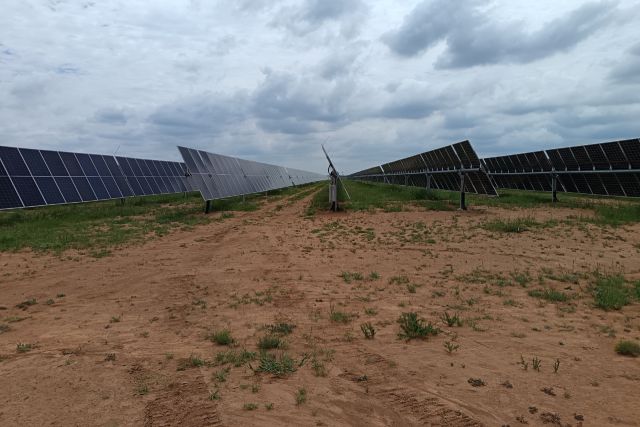
South African miner Sibanye-Stillwater (JSE: SSW, NYSE: SBSW) has taken another step in its decarbonization journey with the achievement of commercial operation at the Springbok solar photovoltaic project.

Situated in Free State Province, Springbok represents Sibanye’s first solar wheeling project, and the second renewable energy project supplying its mine operations to reach commercial operation this year.
The 150 megawatt alternating current (representing 195 MWp in peak direct current) solar project is developed and financed by the SOLA Group, a South African independent power producer. Sibanye is an anchor off-taker of the project and will procure 75MW (50%) of the plant’s capacity for a 10-year period, with an option to extend the duration through a power purchase agreement with SOLA.
Key benefits of the solar project, according to Sibanye, include cost savings relative to prevailing state-owned Eskom utility rates and escalating at consumer price index (CPI), resulting in expected yearly cost savings of more than R60 million across its South African operations.
In addition, the company expects the Springbok project to generate approximately 4% of its annual energy requirements in South Africa and result in the immediate reduction of 229,000 tonnes of carbon dioxide equivalent (3.6% of group Scope 1 and 2 emissions) each year.
The start of commercial operations at Springbok is a “further milestone in the establishment of its portfolio of privately developed renewable energy projects,” Sibanye stated in a press release.
“This is the second project to achieve commercial operation in our 407MW portfolio of contracted renewable energy projects, contributing to our goal of achieving carbon neutrality by 2040,” Richard Stewart, Sibanye’s CEO, said.
In April, the company also started operations at the 89MW Castle wind farm. Together, the two projects have brought 164MW of renewable energy projects involving Sibanye-Stillwater online in 2025, Sibanye said.

No comments:
Post a Comment