Star Wars Reimagined: Golden Dome And The Geopolitics Of Missile Defence – Analysis
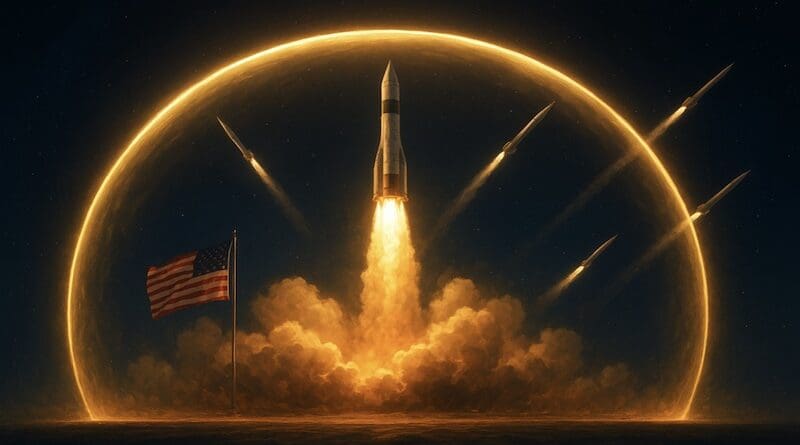
Stylised rendering of America’s ‘Golden Dome Missile Defense System’. (Visual concept by authors).
Golden Dome: Shield of Security or Spark of Instability?
The U.S. Golden Dome missile defence initiative has already begun generating ripple effects across the international system. Rival powers are exploring their own layered defence architectures, while experts warn this could trigger a new era of competitive missile development. What began as a homeland shield is evolving into a catalyst for a global arms race, with competitors striving to counter, replicate, or surpass U.S. capabilities.
Golden Dome is more than a defence programme; it symbolises technological ambition and strategic intent. Its conception has reignited debates among allies and adversaries alike about the future of deterrence, the militarisation of space, and the fragile equilibrium of strategic stability. Its implications are as political as they are technical—reshaping alliances, driving procurement priorities, and redefining doctrines of deterrence worldwide.
Yet the project carries significant risks. Technical hurdles, spiralling costs, and intensifying geopolitical rivalries may transform what is intended as a shield into a source of instability. Golden Dome therefore represents not only a defence initiative but also a statement of U.S. strategic reach and technological dominance in the global commons of space.
The U.S. Golden Dome missile defence initiative has already begun generating ripple effects across the international system. Rival powers are exploring their own layered defence architectures, while experts warn this could trigger a new era of competitive missile development. What began as a homeland shield is evolving into a catalyst for a global arms race, with competitors striving to counter, replicate, or surpass U.S. capabilities.
Golden Dome is more than a defence programme; it symbolises technological ambition and strategic intent. Its conception has reignited debates among allies and adversaries alike about the future of deterrence, the militarisation of space, and the fragile equilibrium of strategic stability. Its implications are as political as they are technical—reshaping alliances, driving procurement priorities, and redefining doctrines of deterrence worldwide.
Yet the project carries significant risks. Technical hurdles, spiralling costs, and intensifying geopolitical rivalries may transform what is intended as a shield into a source of instability. Golden Dome therefore represents not only a defence initiative but also a statement of U.S. strategic reach and technological dominance in the global commons of space.
Ghosts of Star Wars: Continuities in U.S. Defence Strategy
Golden Dome does not stand alone; it is the latest chapter in decades of U.S. missile defence pursuits, a pattern of strategic ambition that began during the Cold War. The most famous precursor was President Ronald Reagan’s Strategic Defence Initiative (SDI) of the 1980s—dubbed ‘Star Wars’—which envisioned orbital lasers and kinetic interceptors capable of rendering nuclear weapons ‘impotent and obsolete’. Although much of SDI remained conceptual, its announcement dramatically shifted the strategic landscape, fuelling fears of imbalance and sparking an incipient space-based arms race.
In subsequent decades, successive administrations pursued more modest but tangible systems. The Ground-Based Midcourse Defence (GMD) programme, initiated under George W. Bush, stationed interceptors in Alaska and California to guard against limited ballistic threats. The Aegis Ballistic Missile Defence (BMD) system, expanded through Aegis Ashore sites in Romania and Poland, extended coverage to Europe but provoked criticism from Moscow. More recently, layered approaches have included THAAD and Patriot PAC-3, combining regional and homeland defence into a flexible architecture.
Golden Dome revives the maximalist spirit of SDI but updates it for the 21-century through directed-energy weapons, hypersonic interceptors, and orbital kill vehicles. Conceptually, it reflects enduring debates in U.S. strategic doctrine: whether deterrence is best achieved by punishment—threatening devastating retaliation—or by denial—preventing adversaries from accomplishing their aims. While the latter reassures domestic audiences and allied states, adversaries often interpret it as destabilising. Golden Dome thus stands at the intersection of two enduring American impulses: the pursuit of technological invulnerability and the preservation of credible deterrence within a precarious balance of power.
Golden Dome does not stand alone; it is the latest chapter in decades of U.S. missile defence pursuits, a pattern of strategic ambition that began during the Cold War. The most famous precursor was President Ronald Reagan’s Strategic Defence Initiative (SDI) of the 1980s—dubbed ‘Star Wars’—which envisioned orbital lasers and kinetic interceptors capable of rendering nuclear weapons ‘impotent and obsolete’. Although much of SDI remained conceptual, its announcement dramatically shifted the strategic landscape, fuelling fears of imbalance and sparking an incipient space-based arms race.
In subsequent decades, successive administrations pursued more modest but tangible systems. The Ground-Based Midcourse Defence (GMD) programme, initiated under George W. Bush, stationed interceptors in Alaska and California to guard against limited ballistic threats. The Aegis Ballistic Missile Defence (BMD) system, expanded through Aegis Ashore sites in Romania and Poland, extended coverage to Europe but provoked criticism from Moscow. More recently, layered approaches have included THAAD and Patriot PAC-3, combining regional and homeland defence into a flexible architecture.
Golden Dome revives the maximalist spirit of SDI but updates it for the 21-century through directed-energy weapons, hypersonic interceptors, and orbital kill vehicles. Conceptually, it reflects enduring debates in U.S. strategic doctrine: whether deterrence is best achieved by punishment—threatening devastating retaliation—or by denial—preventing adversaries from accomplishing their aims. While the latter reassures domestic audiences and allied states, adversaries often interpret it as destabilising. Golden Dome thus stands at the intersection of two enduring American impulses: the pursuit of technological invulnerability and the preservation of credible deterrence within a precarious balance of power.
Building the Shield: Technology, Integration, and Limits
Extending from the Earth into orbit, Golden Dome is designed to detect and intercept missile threats at the earliest stages of flight. Through an integrated network of satellites, radars, interceptors, and directed-energy weapons, the system aspires to construct a seamless shield over the homeland. Announced in May 2025, it targets a wide spectrum of threats ranging from ballistic and hypersonic missiles to cruise missiles and drone swarms. Its aim is all-domain interception—a holistic architecture linking space-based sensors with ground-based interceptors, radar systems, and high-energy lasers.
Preliminary Pentagon assessments suggest the basic design has been finalised, with Lockheed Martin, Raytheon, and Boeing leading development. The system comprises four interlocking layers: orbital satellites and interceptors, long-range radars and THAAD batteries for midcourse defence, Aegis-launched Standard-6 missiles for high-altitude interception, and terminal-phase defences consisting of lasers and next-generation interceptors. In theory, redundancy between these layers enhances resilience and interception probability.
Integration, however, poses enormous challenges. Coordinating multiple subsystems into a coherent ‘kill chain’ requires split-second synchronisation; delays between sensors and interceptors could critically undermine effectiveness. Orbital interceptors must survive atmospheric re-entry and execute precise manoeuvres—capabilities that remain largely unproven. Financially, uncertainties are no less daunting. While initial estimates placed costs at US$175 billion, the space-based tier alone may exceed US$500 billion. Decisions regarding launchers, interceptor design, and basing infrastructure remain unresolved, raising the spectre of familiar cost spirals.
Extending from the Earth into orbit, Golden Dome is designed to detect and intercept missile threats at the earliest stages of flight. Through an integrated network of satellites, radars, interceptors, and directed-energy weapons, the system aspires to construct a seamless shield over the homeland. Announced in May 2025, it targets a wide spectrum of threats ranging from ballistic and hypersonic missiles to cruise missiles and drone swarms. Its aim is all-domain interception—a holistic architecture linking space-based sensors with ground-based interceptors, radar systems, and high-energy lasers.
Preliminary Pentagon assessments suggest the basic design has been finalised, with Lockheed Martin, Raytheon, and Boeing leading development. The system comprises four interlocking layers: orbital satellites and interceptors, long-range radars and THAAD batteries for midcourse defence, Aegis-launched Standard-6 missiles for high-altitude interception, and terminal-phase defences consisting of lasers and next-generation interceptors. In theory, redundancy between these layers enhances resilience and interception probability.
Integration, however, poses enormous challenges. Coordinating multiple subsystems into a coherent ‘kill chain’ requires split-second synchronisation; delays between sensors and interceptors could critically undermine effectiveness. Orbital interceptors must survive atmospheric re-entry and execute precise manoeuvres—capabilities that remain largely unproven. Financially, uncertainties are no less daunting. While initial estimates placed costs at US$175 billion, the space-based tier alone may exceed US$500 billion. Decisions regarding launchers, interceptor design, and basing infrastructure remain unresolved, raising the spectre of familiar cost spirals.
Golden Dome: Shield or Provocation?
Golden Dome represents Washington’s determination to maintain dominance in space and achieve near-absolute protection against missile threats. Yet this ambition risks fuelling instability. Undermining adversaries’ confidence in their nuclear deterrents, the system could spur a rush to develop countermeasures—hypersonic glide vehicles, penetration aids, and anti-satellite weapons—potentially driving the world back toward a level of strategic competition reminiscent of the Cold War.
Some U.S. allies, including Japan and Canada, have expressed interest in participation. While co-operation may strengthen capabilities and burden-sharing, it also reinforces perceptions of exclusive defence blocs. This risks deepening adversarial mistrust and undermining broader efforts at global stability. The system’s inspiration partly stems from Israel’s Iron Dome, which proved highly effective during Iran’s 2024 missile assault. Earlier this year, President Donald Trump stated that Canada would need to contribute US$61 billion to participate in the missile defence system ‘if they remain a separate, but unequal, Nation’. He further suggested that Canada should ‘become the 51st state’ to join Golden Dome without cost, underscoring how the programme raises complex questions of sovereignty, alliance obligations, and strategic dependence.
Golden Dome represents Washington’s determination to maintain dominance in space and achieve near-absolute protection against missile threats. Yet this ambition risks fuelling instability. Undermining adversaries’ confidence in their nuclear deterrents, the system could spur a rush to develop countermeasures—hypersonic glide vehicles, penetration aids, and anti-satellite weapons—potentially driving the world back toward a level of strategic competition reminiscent of the Cold War.
Some U.S. allies, including Japan and Canada, have expressed interest in participation. While co-operation may strengthen capabilities and burden-sharing, it also reinforces perceptions of exclusive defence blocs. This risks deepening adversarial mistrust and undermining broader efforts at global stability. The system’s inspiration partly stems from Israel’s Iron Dome, which proved highly effective during Iran’s 2024 missile assault. Earlier this year, President Donald Trump stated that Canada would need to contribute US$61 billion to participate in the missile defence system ‘if they remain a separate, but unequal, Nation’. He further suggested that Canada should ‘become the 51st state’ to join Golden Dome without cost, underscoring how the programme raises complex questions of sovereignty, alliance obligations, and strategic dependence.
Linking Technology and Strategy
Beyond engineering challenges, the capabilities envisioned for Golden Dome carry profound strategic consequences. The system’s potential to intercept missiles at multiple stages alters calculations of deterrence, both for allies and potential adversaries. Where traditional deterrence relied on the threat of retaliation, Golden Dome introduces the possibility of pre-emptive denial—an approach that reassures domestic audiences and partners but risks being perceived as destabilising by rival powers. Technical sophistication is thus inseparable from strategic impact: the architecture of the shield directly shapes the geopolitics it seeks to protect.
Beyond engineering challenges, the capabilities envisioned for Golden Dome carry profound strategic consequences. The system’s potential to intercept missiles at multiple stages alters calculations of deterrence, both for allies and potential adversaries. Where traditional deterrence relied on the threat of retaliation, Golden Dome introduces the possibility of pre-emptive denial—an approach that reassures domestic audiences and partners but risks being perceived as destabilising by rival powers. Technical sophistication is thus inseparable from strategic impact: the architecture of the shield directly shapes the geopolitics it seeks to protect.
From Homeland Shield to Global Flashpoint
The reverberations of Golden Dome extend across regions and great-power rivalries. Russia and China jointly condemned the initiative as ‘deeply destabilising’, warning it undermines the principle of mutually assured destruction. China described it as having ‘strong offensive implications’, while both powers view it as an attempt to negate the balance between offensive and defensive arms.
In response, China is accelerating its anti-satellite and hypersonic programmes, with reports of a planned ‘Chinese Golden Dome’. Russia, perceiving its midcourse and terminal deterrent phases at risk, may expand the use of mobile launchers, decoys, and hypersonic glide systems. India, though not directly targeted, is advancing its Sudarshan Chakra initiative, which National Security Adviser Anil Chauhan described in August 2025 as ‘India’s own Iron Dome or Golden Dome’. European allies may welcome enhanced coverage yet face growing entanglement in U.S.–Russia and U.S.–China tensions.
The reverberations of Golden Dome extend across regions and great-power rivalries. Russia and China jointly condemned the initiative as ‘deeply destabilising’, warning it undermines the principle of mutually assured destruction. China described it as having ‘strong offensive implications’, while both powers view it as an attempt to negate the balance between offensive and defensive arms.
In response, China is accelerating its anti-satellite and hypersonic programmes, with reports of a planned ‘Chinese Golden Dome’. Russia, perceiving its midcourse and terminal deterrent phases at risk, may expand the use of mobile launchers, decoys, and hypersonic glide systems. India, though not directly targeted, is advancing its Sudarshan Chakra initiative, which National Security Adviser Anil Chauhan described in August 2025 as ‘India’s own Iron Dome or Golden Dome’. European allies may welcome enhanced coverage yet face growing entanglement in U.S.–Russia and U.S.–China tensions.
The Space Dilemma
The militarisation of space presents profound risks for global security and long-term orbital sustainability. Absent robust governance frameworks, deploying armed systems in orbit erodes fragile norms, intensifies mistrust, and increases the danger of miscalculation. Dual-use technologies complicate verification, blurring the line between defensive and offensive deployments. Debris generated by weapons tests or intercepts threatens satellites vital to communications, navigation, and scientific research.
Mitigating these dangers requires co-operative governance, transparency measures, and new agreements on debris mitigation and rules of engagement. Without such measures, insecurity will fuel further militarisation, undermining both national security and the civilian benefits of space.
The militarisation of space presents profound risks for global security and long-term orbital sustainability. Absent robust governance frameworks, deploying armed systems in orbit erodes fragile norms, intensifies mistrust, and increases the danger of miscalculation. Dual-use technologies complicate verification, blurring the line between defensive and offensive deployments. Debris generated by weapons tests or intercepts threatens satellites vital to communications, navigation, and scientific research.
Mitigating these dangers requires co-operative governance, transparency measures, and new agreements on debris mitigation and rules of engagement. Without such measures, insecurity will fuel further militarisation, undermining both national security and the civilian benefits of space.
Strategic Risks and Operational Realism
Golden Dome confronts a host of risks. Adversaries may accelerate development of anti-satellite weapons, cyber capabilities, and countermeasures. Technology remains unproven at scale, and system integration may falter under the strain of complexity. Countermeasures such as manoeuvrable re-entry vehicles, hypersonics, or saturation strikes could overwhelm defences. Electronic warfare and cyberattacks threaten communications, while the high cost of replenishing satellites undermines sustainability. Above all, the enormous budget could drain resources from nuclear modernisation, conventional readiness, or emerging priorities such as cyber defence.
Golden Dome confronts a host of risks. Adversaries may accelerate development of anti-satellite weapons, cyber capabilities, and countermeasures. Technology remains unproven at scale, and system integration may falter under the strain of complexity. Countermeasures such as manoeuvrable re-entry vehicles, hypersonics, or saturation strikes could overwhelm defences. Electronic warfare and cyberattacks threaten communications, while the high cost of replenishing satellites undermines sustainability. Above all, the enormous budget could drain resources from nuclear modernisation, conventional readiness, or emerging priorities such as cyber defence.
Domestic and Political Dimensions
Domestically, Golden Dome’s trajectory will be shaped by politics as much as engineering. Major defence contractors—Lockheed Martin, Raytheon, and Boeing—stand to benefit from lucrative long-term contracts, while congressional lobbying will influence funding allocations. Public opinion may prove fickle: enthusiasm for security could wane in the face of ballooning costs or perceptions that domestic priorities are being neglected. Partisan divides remain stark, with Democrats likely to emphasise arms control and norms, while Republicans frame Golden Dome as a symbol of U.S. technological strength.
Domestically, Golden Dome’s trajectory will be shaped by politics as much as engineering. Major defence contractors—Lockheed Martin, Raytheon, and Boeing—stand to benefit from lucrative long-term contracts, while congressional lobbying will influence funding allocations. Public opinion may prove fickle: enthusiasm for security could wane in the face of ballooning costs or perceptions that domestic priorities are being neglected. Partisan divides remain stark, with Democrats likely to emphasise arms control and norms, while Republicans frame Golden Dome as a symbol of U.S. technological strength.
International Security Architecture
Golden Dome sits uneasily within the broader arms control framework. The U.S. withdrawal from the Anti-Ballistic Missile (ABM) Treaty in 2002 paved the way for ambitious missile defence projects but weakened the principle of strategic balance. The Outer Space Treaty of 1967 prohibits weapons of mass destruction in orbit but leaves conventional systems and missile defence platforms largely unregulated. Efforts such as the proposed Treaty on the Prevention of the Placement of Weapons in Outer Space (PPWT) have stalled, leaving a dangerous governance vacuum. NATO allies may welcome enhanced protection yet remain wary of being drawn more deeply into U.S.–China and U.S.–Russia competition.
Golden Dome sits uneasily within the broader arms control framework. The U.S. withdrawal from the Anti-Ballistic Missile (ABM) Treaty in 2002 paved the way for ambitious missile defence projects but weakened the principle of strategic balance. The Outer Space Treaty of 1967 prohibits weapons of mass destruction in orbit but leaves conventional systems and missile defence platforms largely unregulated. Efforts such as the proposed Treaty on the Prevention of the Placement of Weapons in Outer Space (PPWT) have stalled, leaving a dangerous governance vacuum. NATO allies may welcome enhanced protection yet remain wary of being drawn more deeply into U.S.–China and U.S.–Russia competition.
Escalation and Strategic Stability
Golden Dome could significantly undermine adversaries’ confidence in the survivability and effectiveness of their second-strike capabilities, a cornerstone of nuclear deterrence. By projecting the perception that U.S. missile defences could neutralise retaliatory forces, rivals may fear that their deterrent is vulnerable in a crisis, increasing the incentive to act pre-emptively to preserve strategic leverage. This mirrors classical security dilemmas: efforts to enhance one state’s defence can inadvertently intensify insecurity for others, raising the probability of miscalculation during tense standoffs.
The dual-use character of space-based assets—where sensors, satellites, and orbital platforms serve both civilian and military functions—further magnifies escalation risks. Attacks targeting these systems, even if intended as limited or defensive strikes, could be interpreted as offensive moves, triggering rapid and unpredictable responses. Civilian infrastructure essential for communications, navigation, weather monitoring, and commercial activities may become entangled in military conflict, complicating crisis management. The opacity of space operations, combined with the speed of orbital engagement and difficulty of attribution, could accelerate decision-making under uncertainty, leaving little room for de-escalation.
Golden Dome could significantly undermine adversaries’ confidence in the survivability and effectiveness of their second-strike capabilities, a cornerstone of nuclear deterrence. By projecting the perception that U.S. missile defences could neutralise retaliatory forces, rivals may fear that their deterrent is vulnerable in a crisis, increasing the incentive to act pre-emptively to preserve strategic leverage. This mirrors classical security dilemmas: efforts to enhance one state’s defence can inadvertently intensify insecurity for others, raising the probability of miscalculation during tense standoffs.
The dual-use character of space-based assets—where sensors, satellites, and orbital platforms serve both civilian and military functions—further magnifies escalation risks. Attacks targeting these systems, even if intended as limited or defensive strikes, could be interpreted as offensive moves, triggering rapid and unpredictable responses. Civilian infrastructure essential for communications, navigation, weather monitoring, and commercial activities may become entangled in military conflict, complicating crisis management. The opacity of space operations, combined with the speed of orbital engagement and difficulty of attribution, could accelerate decision-making under uncertainty, leaving little room for de-escalation.
Economic, Ethical, and Normative Dimensions
Golden Dome threatens to fundamentally reshape U.S. defence priorities. The sheer scale of the programme implies that vast resources would be dedicated to its development, testing, and deployment, potentially diverting attention and funding from other critical areas such as nuclear triad modernisation, cyber resilience, and the readiness of conventional forces. This raises difficult questions about strategic trade-offs: investing heavily in near-absolute missile defence may come at the expense of capabilities that underpin broader national security and deterrence.
Ethically, Golden Dome raises pressing questions about the militarisation of a shared global commons. The deployment of orbital weapons—even for ostensibly defensive purposes—sets dangerous precedents, normalising weaponisation of space and potentially triggering competitive escalation. Normatively, the initiative challenges existing international frameworks that govern responsible behaviour in space. Without sustained multilateral dialogue, codified rules of conduct, and confidence-building measures, Golden Dome risks eroding the principles that ensure space remains accessible, safe, and sustainable for all states and future generations. In effect, the project is as much a test of global governance and international responsibility as it is a demonstration of technological prowess.
Golden Dome threatens to fundamentally reshape U.S. defence priorities. The sheer scale of the programme implies that vast resources would be dedicated to its development, testing, and deployment, potentially diverting attention and funding from other critical areas such as nuclear triad modernisation, cyber resilience, and the readiness of conventional forces. This raises difficult questions about strategic trade-offs: investing heavily in near-absolute missile defence may come at the expense of capabilities that underpin broader national security and deterrence.
Ethically, Golden Dome raises pressing questions about the militarisation of a shared global commons. The deployment of orbital weapons—even for ostensibly defensive purposes—sets dangerous precedents, normalising weaponisation of space and potentially triggering competitive escalation. Normatively, the initiative challenges existing international frameworks that govern responsible behaviour in space. Without sustained multilateral dialogue, codified rules of conduct, and confidence-building measures, Golden Dome risks eroding the principles that ensure space remains accessible, safe, and sustainable for all states and future generations. In effect, the project is as much a test of global governance and international responsibility as it is a demonstration of technological prowess.
Shifting Regional Balances and Global Dependencies
Golden Dome’s implications extend far beyond the immediate interests of the U.S., Russia, and China, reshaping regional security dynamics and influencing strategic calculations across the globe. Its announcement signals a shift in the balance of power, compelling allies and adversaries alike to reassess their defence postures and long-term security strategies.
In the Middle East, Israel may become integrated into Golden Dome, joining a broader U.S.-led missile defence network and enhancing its already advanced capabilities while signalling alignment with American strategic priorities. Gulf states, notably Saudi Arabia, the UAE, and Qatar, may seek participation to counter Iran’s expanding missile and drone arsenal, deepening military interdependence with Washington. While such involvement could strengthen regional security for allies, it risks heightening tensions with adversaries and further entrenching competing security blocs.
On the Korean Peninsula, North Korea is likely to accelerate its missile and nuclear programmes, perceiving Golden Dome as a direct challenge to its deterrent and sovereignty, and as a destabilising initiative that could heighten the risk of nuclear confrontation extending into space. South Korea may consider closer integration with U.S. missile defence systems, including potential operational coordination with orbital sensors or joint deployments. This raises critical questions about strategic autonomy, alliance obligations, and entanglement in broader great-power rivalries.
Beyond these immediate theatres, states in the Global South confront profound asymmetries. Countries lacking the technological, economic, or industrial capacity to develop comparable missile defence systems may become increasingly dependent on U.S.-led protection arrangements. Such dependency could reinforce global hierarchies of security provision, amplifying debates over sovereignty, strategic reliance, and inequality. Perceptions of exclusion may also drive secondary effects, including regional arms buildups, pursuit of asymmetric deterrence strategies, or alignment with alternative security providers, further complicating the international strategic landscape.
Golden Dome’s implications extend far beyond the immediate interests of the U.S., Russia, and China, reshaping regional security dynamics and influencing strategic calculations across the globe. Its announcement signals a shift in the balance of power, compelling allies and adversaries alike to reassess their defence postures and long-term security strategies.
In the Middle East, Israel may become integrated into Golden Dome, joining a broader U.S.-led missile defence network and enhancing its already advanced capabilities while signalling alignment with American strategic priorities. Gulf states, notably Saudi Arabia, the UAE, and Qatar, may seek participation to counter Iran’s expanding missile and drone arsenal, deepening military interdependence with Washington. While such involvement could strengthen regional security for allies, it risks heightening tensions with adversaries and further entrenching competing security blocs.
On the Korean Peninsula, North Korea is likely to accelerate its missile and nuclear programmes, perceiving Golden Dome as a direct challenge to its deterrent and sovereignty, and as a destabilising initiative that could heighten the risk of nuclear confrontation extending into space. South Korea may consider closer integration with U.S. missile defence systems, including potential operational coordination with orbital sensors or joint deployments. This raises critical questions about strategic autonomy, alliance obligations, and entanglement in broader great-power rivalries.
Beyond these immediate theatres, states in the Global South confront profound asymmetries. Countries lacking the technological, economic, or industrial capacity to develop comparable missile defence systems may become increasingly dependent on U.S.-led protection arrangements. Such dependency could reinforce global hierarchies of security provision, amplifying debates over sovereignty, strategic reliance, and inequality. Perceptions of exclusion may also drive secondary effects, including regional arms buildups, pursuit of asymmetric deterrence strategies, or alignment with alternative security providers, further complicating the international strategic landscape.
Guardianship and Consequence
Golden Dome is both shield and spark: a testament to U.S. technological ambition and a potential catalyst for global instability. Its technical feasibility remains uncertain, yet its impact on strategic stability, arms control, and space governance is already profound. Whether the project stabilises or destabilises will depend on both engineering breakthroughs and deliberate political choices.
The U.S. and its allies must weigh the pursuit of near-absolute defence against the responsibility to preserve space as a stable, shared domain. Without genuine international engagement, Golden Dome risks repeating the historical cycle of ambitious, dazzling, but ultimately unsustainable missile defence schemes. The initiative underscores a broader lesson: in the high-stakes environment of space and advanced missile defence, technical brilliance cannot substitute for diplomacy, governance, or strategic foresight. Nations must balance the allure of invulnerability with the imperatives of stability, transparency, and collective responsibility in a domain that belongs to all.
About the authors:
- Scott N. Romaniuk: Senior Research Fellow, Centre for Contemporary Asia Studies, Corvinus Institute for Advanced Studies (CIAS), Corvinus University of Budapest, Hungary
- László Csicsmann: Full Professor and Head of the Centre for Contemporary Asia Studies, Corvinus Institute for Advanced Studies (CIAS), Corvinus University of Budapest, Hungary; Senior Research Fellow, Hungarian Institute of International Affairs (HIIA)
Golden Dome is both shield and spark: a testament to U.S. technological ambition and a potential catalyst for global instability. Its technical feasibility remains uncertain, yet its impact on strategic stability, arms control, and space governance is already profound. Whether the project stabilises or destabilises will depend on both engineering breakthroughs and deliberate political choices.
The U.S. and its allies must weigh the pursuit of near-absolute defence against the responsibility to preserve space as a stable, shared domain. Without genuine international engagement, Golden Dome risks repeating the historical cycle of ambitious, dazzling, but ultimately unsustainable missile defence schemes. The initiative underscores a broader lesson: in the high-stakes environment of space and advanced missile defence, technical brilliance cannot substitute for diplomacy, governance, or strategic foresight. Nations must balance the allure of invulnerability with the imperatives of stability, transparency, and collective responsibility in a domain that belongs to all.
About the authors:
- Scott N. Romaniuk: Senior Research Fellow, Centre for Contemporary Asia Studies, Corvinus Institute for Advanced Studies (CIAS), Corvinus University of Budapest, Hungary
- László Csicsmann: Full Professor and Head of the Centre for Contemporary Asia Studies, Corvinus Institute for Advanced Studies (CIAS), Corvinus University of Budapest, Hungary; Senior Research Fellow, Hungarian Institute of International Affairs (HIIA)

No comments:
Post a Comment