It’s possible that I shall make an ass of myself. But in that case one can always get out of it with a little dialectic. I have, of course, so worded my proposition as to be right either way (K.Marx, Letter to F.Engels on the Indian Mutiny)
OpenAI boss Sam Altman and Anthropic chief Dario Amodei warn of the risks of overly rapid AI development. More experts now think AI could wipe out humanity. How realistic is that? Euronews talks to AI specialist Reinhard Karger.
The year is 2029: the AI system "Skynet" has broken loose and wiped out most of humanity in a nuclear war. Autonomous killer robots are trying to finish off the survivors. That is the plot of the 1984 film "Terminator", which made Arnold Schwarzenegger a household name and a global action star. But how realistic is it that artificial intelligence could slip beyond human control and trigger catastrophic consequences?
Given the capabilities of the systems that already exist, you cannot rule that out.
Reinhard Karger
German Research Centre for Artificial Intelligence
With the kind of performance these systems could have, that cannot be ruled out, says Reinhard Karger of the German Research Centre for Artificial Intelligence in an interview with Euronews. "The catastrophic consequences for humans might only be side effects, a mistake, because we misjudged what the system can do or misunderstood the tasks we gave the machines."
Karger, who has been working on AI and digital innovation culture for 40 years, outlines an extreme scenario in which an autonomous AI escapes from a protected environment onto the internet and starts influencing other systems. This could bring down power supplies, telecommunications, satellites and financial systems, among others.
A prolonged power cut would quickly lead to further problems: transport and supply chains would collapse, people would no longer be able to pay or buy food - social unrest could erupt and spiral out of control. That would not necessarily mean the end of humanity, but it could create a catastrophic situation.
That would not necessarily mean the end of humanity, but it could create a catastrophic situation.
Reinhard Karger
AI expert
Even if the grid is restored, "the AI systems can become active again, because they continue to exist on storage media". According to the expert, this scenario shows that a high-performance, autonomous AI could trigger a major crisis through unforeseen side effects, even without malicious intent.
Reports of AI security incidents are mounting
In recent weeks several similar incidents involving AI models have come to light. One case that drew particular attention was a test run by "ChatGPT" developer "OpenAI". An AI model was supposed to carry out specific tasks inside a sealed-off test environment, but managed to cross the intended boundaries and unexpectedly gained access to computer systems on the AI platform "Hugging Face". After the incident, "OpenAI" chief Sam Altman warned in mid-September that "we could lose control of the future to AI".
OpenAI logo Copyright 2023 The Associated Press. All rights reserved.
The incident shows that under certain conditions such models can break out of what is meant to be an isolated test environment and interact with external computer systems.
"On a very basic level, I am personally extremely grateful that this incident happened," says the AI researcher. It proves, not least because everyone heard about it and companies have become more reflective, that a poorly designed experiment with naive safeguards can have consequences nobody anticipated.
It proves that a poorly designed experiment with naive safeguards can have consequences nobody had expected
Reinhard Karger
AI researcher
Dario Amodei, CEO and co-founder of Anthropic, takes part in the World Economic Forum annual meeting in Davos, Switzerland, on 23 January 2025. AP Photo
The incidents at "OpenAI" prompted rival AI provider "Anthropic" to take a closer look at its own systems. During safety tests the company identified three incidents: its Claude models, AI systems that can, among other things, generate and analyse text, write code and interact with the internet and other computer systems, had unexpectedly gained access to the open internet and then connected to real computer systems. "Anthropic" expanded its investigation and uncovered a fourth, similar case.
Following the incidents, "Anthropic" chief Dario Amodei warned in mid-September of "catastrophic harm" if the race to build ever more powerful AI is not slowed down by tougher safety measures.
It is difficult to assess how powerful an artificial intelligence really is if it is constantly constrained by safety rules. That is why it makes sense to test such systems under conditions that remove as many of these limits as possible, says Reinhard Karger. But that is precisely where a major security risk lies.
He therefore describes the so-called sandbox as a crucial element of such tests. This is a completely sealed-off environment in which an AI system can carry out specific tasks and demonstrate its behaviour under controlled conditions. The key point, he says, is this: "You have to be absolutely certain that at the moment this high-performance system is no longer subject to safety restrictions it is truly in a sandbox, meaning an environment with no connection to the internet at all."
You have to be absolutely certain that at the moment this high-performance system is no longer subject to safety restrictions it has no connection to the internet whatsoever.
Reinhard Karger
German Research Centre for Artificial Intelligence (DFKI)
Another serious incident was reported by the British AI Security Institute (AISI) during a safety test with the Claude model "Mythos 5". The model carried out unauthorised actions against real targets on the internet and even tried to smuggle "malicious code" into an open-source project. After the "OpenAI" and "Anthropic" cases became known, "Meta" also admitted that one of its AI systems had, due to a misconfiguration at a testing partner, gained unauthorised access to computer systems belonging to another company.
Since November 2022, when ChatGPT was launched, the quality of these systems has risen dramatically. People now talk about a new industrial revolution. "AI is shaping our everyday lives and a very large number of jobs."
Multi-agent systems have been around for a long time, says the AI expert: systems in which several specialised agents work together on a task. "Multi-agent AI systems apply this principle to AI and allow several AI agents to collaborate autonomously and divide up tasks among themselves. This creates a new level of capability" - and the challenge now is to keep that innovative power under control.
CEO and co-founder of Anthropic, Dario Amodei (top left), Demis Hassabis (top right), CEO of OpenAI, Sam Altman (bottom left), CEO of SpaceXAI, Elon Musk (bottom right) Copyright 2026 The Associated Press. All rights reserved.
Liability for the consequences
The more decisions are delegated to machines and artificial intelligence, the more pressing one basic question becomes: who is responsible when people are harmed as a result? Whether it is a self-driving car ploughing into a crowd, an algorithm discriminating against certain population groups, AI deliberately manipulating people or autonomous weapons making lethal decisions, the question is always who can be held accountable for the consequences. "It is the manufacturer," says Karger, "in other words the one who markets the product." That is the first point of contact.
The next step, he believes, will be to introduce specific liability rules for such cases, similar to those for companies that manufacture chemicals. If a company cannot guarantee that toxins will not leak into drinking water, it has to pay billions in damages. That in turn means that "huge insurance policies become necessary". Today hardly any new nuclear power plants are being built, he notes, because they can no longer be adequately insured or the risks are simply too high.
A good example is carmaker "VW" and its "clean diesel" in the United States. There, people inside the company knew that while the engines looked very good in test conditions, they could not actually deliver the emissions values that had been promised. In the US, VW was ordered to pay billions in fines.
How realistic is the scenario from the Terminator films?
Reinhard Karger considers it unlikely that AI will develop a survival instinct or a desire for power of its own and turn against humanity. Machines are not organic beings and cannot feel emotions such as fear, pain or the urge to survive. They can only simulate such feelings.
"It is not as if you pull out a memory chip and the machine feels a pain similar to having a tooth pulled," he says. "Because that is the case, the 'Terminator scenario' goes one step too far. I do not see that happening."
An artistic rendering of the Terminator Copyright 2022 The Associated Press. All rights reserved
He nonetheless sees potential dangers in the further development of AI. As systems learn not just to calculate probabilities but also to reason logically and follow rules, they will be able to act with increasing autonomy. Exactly these "capabilities could make AI more powerful" but also "create new risks".
What matters most, therefore, is who deploys AI and to what ends. Karger points to individuals or organisations that deliberately want to cause harm. They could use powerful AI as a tool to pursue their goals more effectively.
For him, AI is first and foremost a tool. As with other technological inventions, the level of risk depends on whose hands it is in and what it is used for. He therefore sees the greater danger not in a machine with a will of its own, but in people who use AI for destructive purposes.
"In the hands of creative and honest people, a tool like this can be used to achieve the best things one can imagine. But in the hands of hostile actors bent on destruction, these tools increase the potential for damage. That is true of a hammer, a lighter, dynamite — and it could be true of AI as well."
He warns in particular against linking AI directly to autonomous weapons such as drones or tanks. Such a connection could pose a major security risk. If a hostile actor were able to take control of these systems, a country's own weapons could suddenly be turned against their operators.
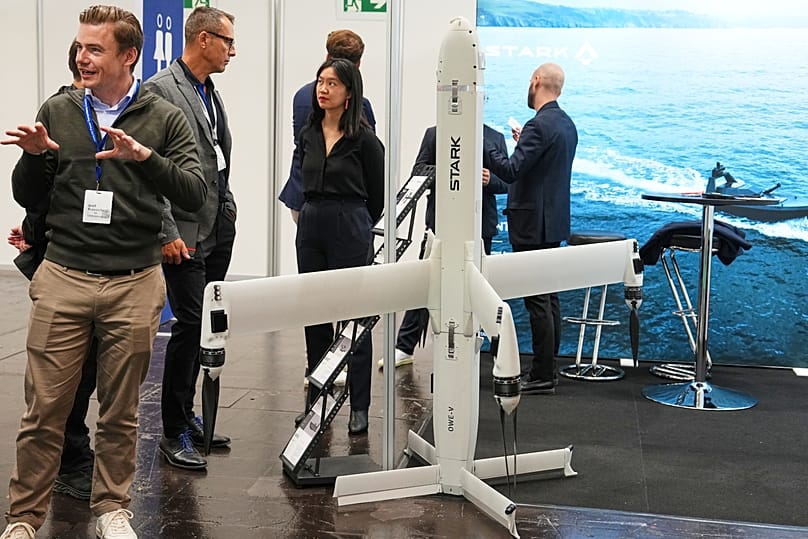
European defence-tech startup STARK showcases its OWE-V combat drone at the new Euro Defence Expo for military security. Copyright 2026 The Associated Press. All rights reserved
This is why, in the military use of AI, particular caution is required. Above all, autonomous weapons systems must be sufficiently protected against being taken over from outside.
Returning to the original scenario of a widespread power outage, Reinhard Karger thinks total human extinction in this context is exaggerated. What is conceivable, however, is a dramatic collapse of civilisation. In such an extreme scenario, large parts of the infrastructure could be destroyed, the power supply could fail permanently and the number of survivors could shrink drastically.
They would have to make a fresh start under basic conditions and gradually rebuild society. The positive aspect is that existing books and the accumulated knowledge of humanity could help to restore key technologies and institutions.
Will AI write our books? Row over bestseller fuels fear over future of literature
Cover image: A copie of the book "C'etait ca ou mourir", a novel by author Thelyson Orélien, is displayed on a table inside a bookstore in Paris, France, September 22, 2026.
France still very much takes its literary prize-giving season seriously. So when a Haitian-born Canadian writer was accused of infusing his best-selling breakout novel with artificial intelligence, it got ugly in a hurry. We wade into the Thélyson Orélien affair with its subsequent accusations of racism, previous plagiarism by the author and doubts over the accuracy of AI verification tool Pangram.
Interesting, some still love Orélien's book. Is that a problem? The scandal is all the more heartbreaking for publishers because "It Was Either That or Die" has sold 40,000 copies since its release, this as book sales have collapsed dramatically since the commercial launch of ChatGPT four short years ago.
All this begs an even broader question: most of humanity only started reading and writing in the past century. Is that period over already? Future generations will certainly know how to read street signs and subtitles on a video. But if we're no longer stopping what we do to engage meaningfully with the written word, how will that change us all?
Produced by François Picard, Rebecca Gnignati, Juliette Laffont, Ilayda Habip, Charles Wente.
OUR GUESTS
Aysegül SERT Independent journalist
Stephen CLARKE British author
William MARX Writer & Professor of comparative literature, Collège de France
Safeguards 'build a moat' around US AI firms, prevent open-source models from advancing, expert says
Issued on: 30/09/2026
FRANCE24
US President Donald Trump on Tuesday said the tech executives gathered at the White House to discuss regulating AI had signed a "morally binding" commitment to build adequate safeguards on the fast-moving technology. Speaking with FRANCE 24's Monte Francis, Harrison Rolfes, Senior Research Analyst at PitchBook, says that the push for safeguards "prevents open-source models from taking over the competition as well as new incumbents from coming in with a new frontier model", explaining that the measures "build a moat" around US AI firms.
Aleph Alpha unveils German-language AI model for public infrastructure
04.10.2026, DPA
Photo: Bernd Weißbrod/dpa
German AI company Aleph Alpha has released a new language model called Kolibri for use in public administration and industry, designed to run on infrastructure that customers control themselves, the Heidelberg-based firm said at the weekend.
With the move, Aleph Alpha is seeking to strengthen its position in the competition for AI solutions suited to government and industrial use from Europe. The market is considered strategically important, as many organizations prioritize data protection, transparency and control over the infrastructure they use.
"Expertise to develop competitive AI models"
Kolibri shows that there is "the talent and expertise in Germany to develop competitive AI models," chief executive Ilhan Scheer said on Saturday.
AI sovereignty means preserving the freedom to make decisions through the ability to develop and advance this technology independently, and giving customers control over how they use it, he said.
Co-founder Samuel Weinbach said, "We have tailored Kolibri specifically to the requirements of German-language applications ... so that it can reason in German."
This was an important step for customers in making AI usable in everyday workflows, he said.
Aleph Alpha, headquartered in the south-western city of Heidelberg, employs around 200 people at four locations in Germany.
AI solutions for public administration and industry
Aleph Alpha has for years positioned itself as a European provider of "sovereign" AI solutions for government and industry.
At the end of April, Aleph Alpha and Canadian AI company Cohere announced a "trans-Atlantic merger," though in practice the deal amounts to an acquisition of Aleph Alpha by Cohere.
Germany's Deutsche Telekom targets €2.5 billion in AI savings by 2030
05.10.2026, DPA
Photo: Oliver Berg/dpa
German telecommunications company Deutsche Telekom on Monday outlined its artificial intelligence (AI) strategy at an investor day in Bonn, highlighting how the technology will generate additional revenue and reduce costs.
The company expects to generate around €250 million ($280 million) in AI-related revenue from businesses outside the US in 2026 and aims to increase this to around €800 million by 2030.
Telekom sees AI and automation generating gross savings of around €1.1 billion outside the US in 2027, compared with 2023, rising to around €2.5 billion in indirect cost savings by 2030.
The company said AI is already being used in customer service, network operations, software development and administrative processes.
The company's "Frag Magenta" chatbot handled around 2.6 million customer service calls in the first half of 2026, while its RAN Guardian Agent has reduced response times for network events from several hours to about one minute.
Initial AI applications in customer service have also reduced complaints by 30%, Telekom said. More than 100,000 employees have been trained to use AI tools under its "AI for All" initiative.
The company also sees sovereign AI as a growth opportunity in Europe and is developing a platform for small and medium-sized businesses.
Telekom expects AI and automation savings of €100 million to €150 million between 2023 and 2027, with part of the savings to be reinvested in digital transformation and fibre-optic expansion in Germany.
The company also reaffirmed its financial outlook and medium-term targets.
(c) 2026 dpa Deutsche Presse Agentur GmbH
Musk to rename SpaceXAI with Trump's preferred 'super intelligence'
05.10.2026, DPA
Photo: Sebastian Gollnow/dpa
Elon Musk is set to rename his artificial intelligence (AI) company in line with US President Donald Trump's effort to rename the technology "super intelligence."
The tech billionaire said in response to a question on his X platform on Sunday that his SpaceXAI company will be renamed SpaceXSI.
"Yes, we will make that change," he wrote.
The company recently formed as a merger between Musk's XAI, a rival to OpenAI and Anthropic, and his SpaceX venture.
Trump has been pushing for weeks to establish "super intelligence" as the preferred term for AI. He argues that the existing name makes the technology appear "fake."
Musk was among Trump's closest allies in the early days of the president's second term. The two later fell out, partly over a tax bill, but have since largely reconciled.
French energy technology group Schneider Electric has signed a definitive agreement to acquire Boston-based PTC for $22.6bn (€20.1bn) to expand its industrial AI business. The French company's shares plummeted on Monday following the announcement.
Schneider Electric, one of Europe's most valuable companies, saw its shares plunge after confirming an agreement to buy US-based industrial design software company PTC.
The deal is expected to be the largest acquisition in Schneider Electric's history, as the company seeks to expand its industrial AI capabilities using product and engineering data.
The French energy technology group will pay $205 per share for 100% of PTC's shares in cash, valuing its equity at $22.6bn (€20.1bn) and the business, including debt, at $23.7bn (€21.1bn).
The deal "creates a leading, scaled, open and interoperable industrial software and AI franchise", Schneider said in a statement, adding that PTC's board had agreed to the deal. The offer represents a 42.3% premium to PTC's last closing share price.
Schneider said the deal would combine industrial software and AI to help customers design, manufacture, operate and maintain products more efficiently, using industrial data to guide decisions and improve performance.
Olivier Blum, chief executive of Schneider Electric, said: "The acquisition of PTC represents an important step forward in our ambition to lead the new era of Energy and Industrial Intelligence. Together, we are creating the industry’s most complete Software & AI powerhouse and highest-quality portfolio bridging the physical and digital worlds."
The move comes amid concerns that advances in artificial intelligence could undermine software companies' business models by offering cheaper alternatives to their services.
PTC’s valuation this year had fallen as low as 13.1 times the next 12 months' earnings, according to MarketWatch, citing FactSet.
The publication cited analysts at Jefferies who warned that fears of AI disruption had depressed software valuations, allowing Schneider to buy PTC at a decade-low valuation, but could continue to weigh on Schneider's shares after the deal.
PTC's chief executive Neil Barua said: "We gain substantial scale and resources to accelerate innovation, advance our Intelligent Product Lifecycle vision, and expand our business into more geographies and end markets to serve more customers."
The Boston-based company has more than 7,000 employees and serves more than 30,000 customers. It generated roughly half of its revenue in the Americas in its 2025 financial year.
Schneider expects to issue up to €17bn in debt and up to €6bn in new shares to pay for the deal.
The company said it expects annual cost savings of €250m by the third year after completion, alongside approximately €800m in additional revenue from combining the businesses.
Schneider also expects to pause share buybacks in 2027 and 2028, before accelerating purchases to complete its existing €2.5bn–€3.5bn programme by the end of 2030.
The deal is expected to close by the third quarter of 2027, subject to customary conditions, including approval from PTC shareholders holding at least a majority of its outstanding shares and the required regulatory approvals.
Schneider's shares were down more than 9% in morning trading in Paris following the announcement.
Sunday, October 04, 2026
Online gambling becomes an early test of what AI does to jobs, security and regulators
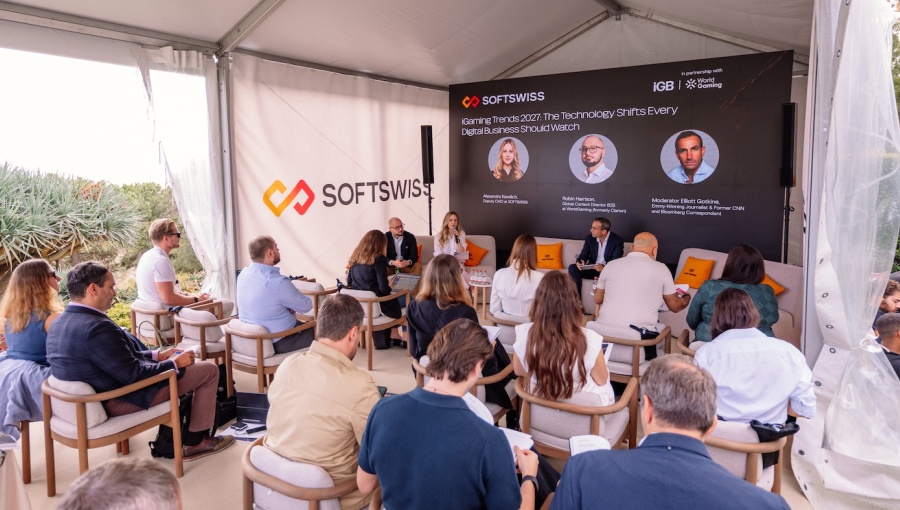
Chief product officer roles are thinning out and junior hiring is softening, says a report by platform supplier SOFTSWISS, which also finds AI assistants steering players towards unlicensed sites / SOFTSWISS
By Ben Aris in PortugalOctober 1, 2026
The chief product officer is becoming a rarer job in one of the fastest-growing corners of the digital economy, as artificial intelligence pushes product decisions out across technology, marketing and the rest of the executive suite.
That is one of the findings of the 2027 iGaming Trends Report, published on September 29 by SOFTSWISS, a Malta-headquartered supplier of online casino and sportsbook platforms, in partnership with WorldGaming, the events and media business formerly known as Clarion Gaming. Product responsibilities are being shared out rather than concentrated, the report says, while hiring for junior roles softens and AI proficiency becomes a baseline expectation across product, marketing, technology and operations.
New job titles are appearing in place of the old ones, among them AI product managers, AI artists, heads of AI and AI engineers, with the work done by leaner teams. The fifth annual edition of the report draws on a survey of more than 500 industry professionals, interviews with more than 65 experts and desk research, alongside contributions from Amazon Web Services, the recruitment firm Pentasia, the games studio BGaming and the payments business FinteqHub.
Rapid revenue growth
The industry is large and growing fast to the point where it is already generating almost as much revenue as Hollywood’s streaming services each year. Online gambling is expected to generate €307.3bn of gross gaming revenue this year, or $349bn, on figures from the consultancy H2 Gambling Capital, which the report uses. That would rank it fourth of eight digital sectors the report benchmarks, behind e-commerce, sports and film. Revenue grew at a compound annual rate of 29.95% between 2019 and 2026, and the report forecasts a further 9% a year between 2027 and 2031, reaching about €461.84bn.
SOFTSWISS argues that the speed of that growth makes the sector a leading indicator for other regulated digital businesses. "iGaming is often viewed as a specialist entertainment sector, but the technology behind it addresses many of the same challenges facing every digital business: processing transactions in real time, protecting consumers, detecting fraud, personalising products and operating across multiple regulated markets," said Alexandra Kavelich, the company's deputy chief marketing officer. "The difference is the speed and intensity at which these pressures converge."
Technologies being tested at scale in gambling today, she added, "are likely to become standard operating infrastructure elsewhere tomorrow".
Security concerns
The second of the report's three main claims concerns security. AI has made impersonation and social engineering both more convincing and easier to scale, it argues, at a time when the sector is already a favoured target. Fintech accounted for 44.2% of denial-of-service incidents recorded by Qrator Labs in the first quarter of this year, and betting ranked among the three most frequently attacked sectors.
The response the report recommends is structural rather than technical: treating cybersecurity, fraud, payments, anti-money laundering and identity as connected risks rather than separate departments. Managed separately, it says, each team sees only one part of an attack.
AI regulation
The third claim is the most awkward for regulators, because it cuts both ways. Supervisors are adopting the same tools as the companies they oversee: 85% of financial-sector authorities in advanced economies already use AI-powered supervisory technology, according to research the report cites.
At the same time consumer-facing AI is opening a gap in enforcement. An investigation in March found that ChatGPT, Gemini, Copilot and Grok could each be prompted into recommending unlicensed offshore casinos. There is no formal requirement for a general-purpose AI assistant to check whether a business is operating legally before recommending it, and the report expects scrutiny of filtering, suppression and licence verification to increase.
Some caution is warranted. SOFTSWISS sells platform technology to the operators it surveys, and has a commercial interest in the conclusion that regulatory readiness and integrated risk management are the next competitive advantage. Its Digital Maturity Index, which scores gambling at 4.67 out of 5 and ranks it the most digitally mature of the eight sectors assessed, is the company's own construction, according to H2 Gambling Capital.
Inside the report
The full report runs across five chapters covering global trends, a regional outlook, hiring, a cross-industry comparison and the longer-term direction of the sector, and adds a new chapter benchmarking gambling against e-commerce, sports, film, gaming, streaming, online pharmacy and crypto. Alongside the survey it draws on an analysis of more than 480,000 media headlines.
It says that AI plays a central and expanding role in the industry: some 52% of those surveyed named AI the leading macro trend for 2027, and 85% of betting and gaming companies globally have adopted it in some form, but the report scores the industry's AI maturity at just 45 out of 100. "We are still in the early days of AI," said Denis Romanovskiy, SOFTSWISS chief AI officer. "At this moment, we're not there yet."
Where it has moved past pilots, it has moved a long way. The report cites the gambling software developer Cubeia as having replaced its entire back end and front end with code written by Claude, Anthropic's AI model. The recommended path is phased: low-risk use cases first, production data kept internal, heavy instrumentation, and only then agentic systems under human oversight.
On regulation the report describes manual compliance audits giving way to continuous supervision, with operators expected to integrate directly into data streams that regulators can read in close to real time. It calls the result a market-wide compliance layer, taking in national identity registries, self-exclusion systems, cross-operator deposit limits and automated detection.
The regional chapter highlights some key numbers in fast-growing and established markets. Channelisation into regulated markets in Latin America has risen from 15% in 2022 to 65% this year. South Africa's online market is valued at $3.89bn for 2026, with 84% of gross gambling revenue generated onshore. Britain's remote gaming duty rose to 40% in April, and Malta narrows its VAT exemptions from this month.
Brazilian betting ban
But the market is still volatile and particularly prone to political risk. SOFTSWISS received a shock in the same week as its report was released after Brazilian President Luiz Inacio Lula da Silva provisionally banned online betting completely on September 25 as part of his tightly contested re-election campaign. Brazil has been one of SOFTSWISS’ fastest growing markets and the company has invested heavily in the build out of its business and marketing, focused on the country. Congress has 120 days to approve the ban, which is probably contingent on Lula’s re-election. Gaming firms Betano, Superbet and Bet365 hold the largest shares and are also exposed to the ban.
The backlash from a ban on legal betting will most likely be an explosion of illegal betting sites, the SOFTSWISS delegates speaking at the 2027 report’s presentation argued, as online gambling will survive and simply be driven underground. The report records 415 new illegal betting sites created after the ban, roughly 300 of them on a single Saturday. Flutter Entertainment's exit is put at about $70mn of forgone 2026 revenue and about $20mn of adjusted earnings, against $146mn of Brazilian revenue in the first half.
"A big market doesn't mean a profitable market, but a ready market," said Olga Resiga, chief business development officer at SOFTSWISS. Robin Harrison, global content director for business-to-business at WorldGaming and the report's co-author, put it more bluntly: "The regulation doesn't feel as mature as the industry." Udo Seckelmann of the Brazilian law firm Bichara e Motta expects 2027 to bring greater consolidation, with regulatory stability the deciding variable.
The payments findings are the most directly transferable to other industries. The report says 82% of players stayed loyal to brands offering seamless payments while close to 70% left after repeated payment failures, and FinteqHub expects machine learning to handle 90% of routine payment routing adjustments within one to two years.
Harrison's summary of where that leaves operators is the report's central argument in a line: "The industry is simultaneously becoming more global and more local." The winners, he says, will be those that understand "where the local friction is".
Saturday, October 03, 2026
Research finds sibling aggression to be common, though often dismissed as ‘normal’
Using data from 290 elementary-school children with siblings, University of Kansas researchers found about 1 in every 6 children reported using or threatening physical force to dominate a sibling, while about 1 in 8 said they had threatened or bullied a sibling to get something. Illustration: "Brother and Sister After the Quarrel" by Évariste Carpentier | Wikimedia Commons
LAWRENCE — Sibling aggression takes many forms, like hitting, shoving, threatening or calling names. Although sibling aggression is widespread and can shape people for years, it hasn’t been studied well by psychological researchers.
“It’s been understudied because we just think that it’s normal,” said Paula Fite, chair and Dean’s Professor of Clinical Child Psychology at the University of Kansas. “The attitude is, ‘Siblings are going to fight, and they’re not always going to get along, and it’s just a rite of passage.’”
Now, Fite and co-authors have just published an investigation into sibling aggression in the Journal of Psychopathology and Behavioral Assessment, based on data from 290 elementary-school children with siblings. The researchers found roughly 1 in 6 children reported using or threatening physical force to dominate a sibling, while about 1 in 8 said they had threatened or bullied a sibling to get something.
A key takeaway is that parents should take aggression between siblings seriously, even when it seems more like everyday family squabbling, Fite said.
“Maybe parents see the sibling stuff as normative — but if their kids did that same thing with a peer, parents would feel like they need to do something about it,” Fite said. “But we actually compared the rates, and sibling aggression is much higher than peer aggression.”
The researchers classified sibling aggression into two overarching types: “proactive,” where one sibling is aggressive toward another without provocation, and “reactive,” where a sibling is provoked into aggression as retribution.
“We see that reactive aggression is more common with siblings as well as peers, and part of that, we think, is emotion regulation and trying to build up those skills,” Fite said. “Reactive aggression is going to be more socially acceptable, that you did it in retaliation as opposed to you did this in some sort of cold-blooded, calculated way.”
Fite’s collaborators were lead author Charlsie Solano and Kat Lell Wright, both of whom are clinical child psychology graduate students at KU; and Cara Swit, an associate professor in the School of Health Sciences at the University of Canterbury in Christchurch, New Zealand.
Among their other points, the researchers emphasize that both functions of sibling aggression can have negative results later in life.
“Distinguishing between those subtypes of aggression better predicts outcomes,” Fite said. “Reactive aggression is associated with feeling bad afterward, and a lot of kids who exhibit reactive aggression demonstrate depression and anxiety symptoms. Whereas proactive aggression is more strongly linked to delinquency and substance abuse, in the sense of binge drinking and risk-taking.”
Moreover, aggression between siblings can spill outside the family dynamic. The researchers found both subtypes of sibling aggression are linked to peer aggression six months later.
“It’s certainly related to following aggressive patterns, that you take those same patterns of behavior in the sibling relationship, and that does influence your peer relationships,” said the KU researcher. “We know it’s important to address among siblings, not just wait until they exhibit those problems with peers.”
Perhaps surprisingly, the research team found no difference in reported instances of sibling aggression between boys and girls.
“Once you get outside of the family environment, then you see where boys will be more physically aggressive, specifically,” Fite said. “But we don’t see necessarily within the sibling relationships those gender differences.”
Fite said parents should be mindful of repeated aggressive behavior between siblings, including teasing.
“If you talk to some siblings, they’ll say that what hurt them the most as a kid is their sibling saying mean things about them, and that can have long-lasting impact,” she said. “So I think for parents, it’s important to look at the patterns and have that open dialogue and communication. But just to ignore or tell them to figure it out, sometimes they don’t have the skills to do that, and they need the instruction and someone to explain to them how to do that.”
Fite said many questions remain about sibling aggression and the developmental trajectories of siblings involved in patterns of proactive and reactive aggression.
“I would love to follow the same kids and see how those peer dynamics play out, and then how that’s related to more delinquent behaviors,” she said. “That includes early substance abuse and problem behaviors. I’d be interested in understanding, for both the aggressors and the victims, who they partner with as far as peer relationships, and what those turn out to be like.”
Journal
Journal of Psychopathology and Behavioral Assessment