America at 250: From a Contested Past to a Fascist Future?
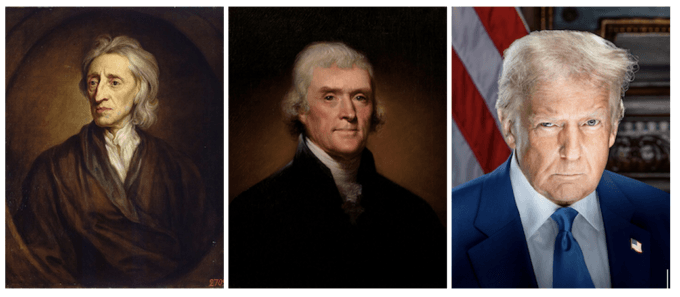
Locke, Jefferson and Trump. Collage: Jeffrey St. Clair.
When 56 representatives from the 13 colonies signed the Declaration of Independence from Britain in 1776, it was over nearly 300 years since America’s first contact with Europe took place, in 1492. Some 2.6 million impoverished European peasants had descended on the “New World” like locusts, escaping from Europe’s feudal regimes or the agrarian capitalism that was dispossessing them of land in England.
In the first 200 of those years, much of the action, or devastation, had taken place in Meso- America and the Southern Hemisphere, as the Spaniards destroyed the centralized Aztec and Incan empires and smaller indigenous groups and subjugated their populations to serve as slave labor or other forms of repressed labor, a process that, along with the diseases the European brought with them, decimated the Native American population by the millions.
The Founding as Cataclysm
The much less centralized indigenous peoples of North America had proved to be more resilient in dealing with the land hungry Europeans. In addition to fierce resistance, they learned to use the colonial regime against the settlers, with some success. The Proclamation of 1763 negotiated between Native American confederacies and the British Crown, for instance, banned white settlers from moving into land west of the Appalachian Mountains.
The successful American Revolution was, thus, a tragedy for Native Americans, since one of their key allies in checking the settlers’ advance on their lands was eliminated, and with this went all the treaties they had negotiated with the British Crown. The genocidal consequences of the Declaration of Independence were underlined early on, when, on the pretext they were British allies, General George Washington ordered the total destruction of Iroquois settlements in what is now central New York state, a deed that earned the future president the sobriquet “Town Destroyer” from the indigenous population.
The founding of the United States also had catastrophic consequences for black people, who had been arriving as slaves in the English colonies since the early seventeenth century. It had been in Latin America and the Caribbean that the slave-based plantation economy first took hold in the late sixteenth and seventeenth centuries, with millions of blacks kidnapped in Africa and put to work on the other side of the Atlantic, most of them in the backbreaking and hazardous task of planting and harvesting sugar.
But the founding and first seven decades of the Republic saw the full flowering of the American South’s plantation economy, one that was ruthlessly efficient in exploiting black labor. Integrated into the global capitalist economy with its production of cotton, the South was far wealthier than the North, and the prosperity made possible by slave labor was accompanied by the Southern planter aristocracy’s control of the presidency, two houses of Congress, and the judiciary of the infant republic.
Genocide of Native Americans and the intensification of the exploitation of black slave labor went hand in hand in the South. President Andrew Jackson’s Indian Removal Act saw five indigenous nations—the Choctaw, Seminole, Cherokees, Chickasaw, and Muscogee—forced out of their ancestral lands in the southeast between 1830 and 1850 to make way for cotton plantations.
Locke’s Twisted Legacy
Ideas, according to Marxists, have a dialectical relationship with material interests. On the one hand, they reflect interests. On the other, they relatively autonomously shape the pursuit of those interests. As I wrote in an earlier essay, the dynamic interaction of revolution, expansion, genocide, and racism in the American enterprise cannot be understood without considering the massive influence exerted by the ideas of the seventeenth-century English philosopher John Locke. The thinker most associated with the American revolution, the founding of the U.S. state, and the U.S. Constitution, Locke is mainly remembered for his justification of the right to rebel if the sovereign or government violated the terms of its “social contract” with the people.
But equally influential on the settlers of America was Locke’s related theory of the origins of private property. Locke said that what transformed a person’s relationship to land from non-ownership to ownership was his mixing his labor with it. This is the foundational social relation, one that was forged in the “state of nature” before the creation of political society via the famous “social contract.” Indeed, the defense of this primordial relationship is the centerpiece of the contract between the sovereign and society.
Locke’s account of the origins of private property captured the psychology of the white settler. Escaping from the rigid agrarian class structures of Europe, the settler wanted, like a small peasant, to carve out and secure some land in what was regarded as “virgin territory.” As the famous scholar of liberalism, Louis Hartz, noted, the settler had a petty bourgeois mentality, one that was anxious to make ownership of land secure rather than to accumulate it. “Living in the world’s closest approximation to a Lockean state of nature,” the smallholder settler, asserted Hartz, “economically…fears loss more than he cherishes gain.”
This attachment to individual ownership of small property is deeply embedded in the collective cultural psyche of America—so much so that Hartz asserted that the ideology of Americans could be described as “irrational Lockeanism.” In the United States, he wrote, Lockeanism “swallowed up both the peasantry and proletariat into the ‘petty bourgeois’ scheme,’” and this would have consequences for the development of class consciousness of Americans during the period of rapid industrialization in the late nineteenth and twentieth centuries.
But Locke’s influence went beyond serving as foundational for capitalism and the regime of private property. The Lockean notion of labor creating private property rights is intertwined with another equally deeply embedded Lockean legacy: the unequal racial access to property and liberty.
“In the beginning, all the world was America,” Locke famously wrote, imagining what he called the “state of nature” before the creation of political society. In advancing his theory that it was the mixing of one’s labor with land that created private property, Locke saw the Native Americans as creatures who could not be considered property owners since they merely inhabited the land and forests but did not cultivate the soil.
To Locke, in fact, the Native American could be equated with “one of those wild savage beasts with whom men can have no society nor security” and who “therefore may be destroyed as a lion or a tiger.” While Locke may not have foreseen the consequences of his words, they provided a potent ethical justification for racial genocide as whites breached the eastern beachhead to which the Native Americans had tried to confine them and swept westward.
Likewise, slavery had Lockean moorings, in the English philosopher’s distinction between the relationship that a master had with a servant and with a slave: he saw the first as a free contract between the master and the indentured servant from Europe while the relationship of the slave from Africa and the master was one of the former being subject to the “absolute dominion” of the latter.
Locke’s liberalism was, in short, riddled with a basic contradiction. On the one hand, he championed “the natural liberty of man…to be free from any superior power on earth, and not to be under the will or legislative authority of man, but have only the law of nature for his rule.” On the other, he considered the Native American as being outside the pale of civilized society and the “negro” as subhuman and denied him the right to rebel against his state of slavery.
Locke’s theoretical inconsistency was reflected in his practice. In his capacity as secretary to the Earl of Shaftesbury, a key figure in the transatlantic slave trade, Locke helped write the Constitution of the Carolinas, a blueprint for absolutist rule that not only contradicted his theory of sovereignty as residing with the people but also consigned blacks to hereditary chattel bondage.
The Worm in the Apple
The Lockean contradiction of celebrating human freedom while legitimizing racial exclusion stalked the very heart of the American enterprise from its very beginning. Key leaders like Washington and Jefferson championed the Lockean right to rebel against tyranny and the “rights of man” for white people even as they denied these rights to their black slaves and Native Americans. The British did not fail to notice this contradiction, as when the famous man of letters Samuel Johnson asked, “How is it that we hear the loudest yelps for liberty from the drivers of negroes?” Indeed, of the 56 signatories of the Declaration of Independence, only 15 were not slaveowners, and of those 15, one recent study reveals, seven “directly profited by trading enslaved people, buying and selling goods produced by enslaved people, or supplying food and other provisions to slavery camps throughout the Atlantic world.”
To historian Robert Parkinson, the document was as much, if not more, about racial fear and exclusion as it was about inalienable rights. The heart of the declaration lay in the 27 accusations against King George III, the most important of which was the twenty-seventh: “He has excited domestic insurrections amongst us, and has endeavored to bring on the inhabitants of our frontiers, the merciless Indian savages, whose known rule of warfare is an undistinguished destruction of all ages, sexes and conditions.” In the context of the eighteenth century, Parkinson writes, “’domestic insurrections’ refers to rebellious slaves. ‘Merciless Indian savages’ doesn’t need much explanation.”
As the late black political philosopher Charles Mills saw it, “[I]nsofar as the modern world is shaped by European expansionism (colonialism, imperialism, white-settler states, racial slavery),” Locke’s social contract “could…be regarded as founded on an exclusionary intrawhite ‘racial contract’ that denies equal moral, legal, and political standing to people of color.” The success of the American Revolution of 1776 ushered in a period where “the self-government of civil society triumphed, waving the flag of liberty and the struggle against despotism,” even as “it stimulated the development of racial chattel slavery and created an unprecedented, unbridgeable gulf between whites and peoples of color.” The astute Italian historian of liberalism Domenico Losurdo agrees: “Between these two elements, which emerged together during a twin birth, a relationship full of tensions and contradictions was established.”
Class, Race, and Civil War
The Civil War had a number of complementary causes. Although many in the North were motivated by the moral imperative of abolishing slavery, much more consequential was the threat posed by the expansion of the slave-based plantation economy to the aspirations of settlers to acquire land that was freely owned and farmed by free labor. This accounted for the ambivalence northern whites felt towards blacks. On the one hand, they were seen as a threat as uncompensated labor; on the other, they were treated as allies against a land-hungry, insatiable Southern slavocracy.
Thus, as the preeminent historian of the rise of American democracy in the first half of the nineteenth century, Sidney Wilentz, saw it, the basic difference between the South and the North in the lead-up to the Civil War was between “the South, largely committed to racist democracy with slavery as its foundation, and the North, committed to white male democracy and divided over Black male participation but hostile to slavery.” Both were variants of what Pierre van den Berghe called “master race democracy.”
Class Consciousness Versus Racial Solidarity
Master race democracy of the second type came to reign after the Civil War. Though shorn of slavery, it was thoroughly suffused with white supremacy—where informal denial of political rights and state-cum-civil society terrorism directed at blacks was the norm in the Post-Reconstruction South and fragile tolerance of the franchise for blacks in the North was accompanied by systematic social and economic discrimination.
Rapid industrialization drew some 16 million immigrants from Europe in the second half of the nineteenth century, creating strong tensions between a predominantly white Anglo-Saxon capitalist class and a multinational and multiracial working class. However, transmitted across generations, the foundational Lockean psychology had a twofold effect: petty bourgeois consciousness weakened solidarity based on class even as its unstated but very real assumption among whites that freedom and democracy were rights exclusive to them strengthened solidarity based on race. Flexible as always, the country’s ascendant capitalist economy adjusted to white supremacy, stratifying the work force by race, and union organizing as well largely proceeded along racial lines. Segregation was the rule in the armed forces until shortly before the Korean War, though blacks had shown, as early as the War for Independence, that they were as capable of fighting and dying for their country as whites, as did Japanese-Americans, at great cost, during the Second World War.
Weak class solidarity and strong racial solidarity would be the two poles between which the tortured history of American working class would unfold between the Civil War and the Civil Rights Movement in late fifties and early sixties.
It was during this period that the United States expanded its reach beyond North America, and as it did so, it also exported its Lockean contradiction. It engaged in expansionist, imperial wars in the Philippines, the Pacific during the Second World War, Korea, and Vietnam. Most of these wars were genocidal in their intensity. But testifying to the strength of their racial blinders, American decision-makers saw no contradiction between genocide (euphemized as “technology-intensive warfare”) and their stated mission of exporting U.S.-style democracy since their unstated assumption was that only white people were capable of and entitled to the full exercise and enjoyment of democratic rights. Democracy was a useful fiction, one often imposed on their peoples by authoritarian allies and friendly elites.
The “Southern Strategy”
The Civil Rights mobilization in the 1960s was a direct assault on master race democracy. Forced to retreat for a spell, it rebounded in the 1970s and 1980s to dispute the evolution of American politics in the form of the infamous “Southern Strategy,” whereby the Republican Party, using both overt racism and “dog-whistle politics,” reshaped its image and character to appeal to southern whites who felt betrayed by the Democratic Party’s alliance with the civil rights movement. Far-right Republicans also skillfully exploited the economic insecurities of northern workers triggered by the Democratic Party leadership’s embrace of neoliberal policies, blaming their loss of jobs and stagnant incomes on the party’s “coddling” of minorities and migrants. By the turn of the century, the Republican party was well on its way to becoming the party of white supremacy. This process has seen its culmination under Donald Trump, who placed a lock on a solid majority of white voters, with 54-55 percent of them going for him in the elections of 2016, 2020, and 2024.
As with the Republican Party, the social counterrevolution has resulted in other political institutions of the United States becoming so racialized that there is, as Mills put it, an “ongoing system of white domination in the absence of an overtly white-supremacist ideology and overt rules of de jure subordination.”
Accelerants
In recent years, white fears have been stoked by three incendiary elements.
The election of Barack Obama as president in 2008 was probably the greatest single accelerant to white nationalism. Also critical was the sense of many white males that they were adrift in a world where traditional gender hierarchies were being shaken, the binary gender classification was being abandoned, women were gaining control over their bodies, and the traditional norm of the “heteropatriarchal family” was being put into question by new domestic arrangements.
Immigrants have always been treated with suspicion, but the arrival of great numbers of people of color in recent decades made many whites susceptible to the “Great Replacement Theory,” popularized by the French far-right thinker, Renaud Camus, that immigration from the Global South is a plot by liberal elites to make the white majority a minority by the 2040’s.
All this set the stage for the ascendancy of Donald Trump, whom CIA political analyst Barbara Walter has called “the biggest ethnic entrepreneur of all.” According to her, “No Republican president in the past fifty years had ever pursued a more racist platform, or championed white, evangelical Americans at the expense of everyone else.”
The Fight for the Future
I was in San Francisco when the United States marked its bicentennial in 1976. Widespread then was a sense of relief, a feeling that the nation was leaving behind the divisions of the civil rights era, the Vietnam War, and Watergate. As the United States marks its semiquincentennial, pessimism and anger dominate. According to a Gallup poll, only 31 percent say that they are “very or extremely proud to be American,” down from 78 percent in 2015.
A great number of citizens, ranging from Senator Chris Murphy (D-CT) and the actor Robert De Niro, seriously doubt that Trump and the Republicans will yield power peacefully should they lose in 2028. Others, like entertainers Ellen DeGeneres and Rosie O’Donnell, have not waited to find out, opting to flee to other countries (though in many cases disgust with Trump has been happily joined to a desire to escape paying taxes).
The liberal consensus on the character of the United States as a melting pot that, despite its flaws, provides the world with a model of democratic governance has not been able to withstand critical scholarship from the left. And from the right, diversity, the word Donald Trump hates most, is being eliminated in a retelling and refurbishing of America’s history as an exclusively white creation that was the dominant narrative in the 1950s, when Trump was growing up.
This narrative was in full display in Trump’s acceptance speech as presidential candidate at the 2020 Republican National Convention, where he said that what was unique to America was the spirit of conquest of the land and the West by “ranchers and miners, cowboys, sheriffs, farmers, and settlers,” a victorious enterprise that was made possible “by the likes of Wyatt Earp, Anne Oakley, Davy Crockett, and Buffalo Bill.” There is no overt reference to the word “white,” but Trump’s dog whistle code is sufficient to drive his MAGA audiences wild.
It is not, however, the threat of a far-right capture of the American historical narrative that is the greatest crisis facing the American Republic as it turns 250. It is the determined subversion of what every schoolboy and schoolgirl is taught as the jewel of the “American experiment”—the separation of powers—by a man who has made no secret of his desire for absolute power, with little opposition from the Republican-dominated Congress, with the complicity of the Supreme Court, and with the fervent support of a MAGA base that will gleefully march lockstep with him towards fascism.
Yet, the republic is not without hope. This hope is embodied in progressives like New York Mayor Zohran Mamdani and the young radicals who swept the late June primaries—people who do not look back for guidance to the “wisdom of the Founding Fathers” but to a democratic, socialist, and truly egalitarian and multiracial future.

