Showing posts sorted by date for query PKK. Sort by relevance Show all posts

Sunday, April 12, 2026

Source: Drop Site News

SULEYMANIYAH, KURDISTAN REGION OF IRAQ—On April 5, during an interview with Fox News journalist Trey Yingst, President Donald Trump apparently confessed to trying to foment an armed uprising by dissidents inside Iran earlier this year, suggesting that the effort had only failed due to the betrayal of unnamed Kurdish groups. The U.S. government had, Trump said, “sent guns to the protesters, a lot of them. We sent them through the Kurds, and I think the Kurds took the guns.”

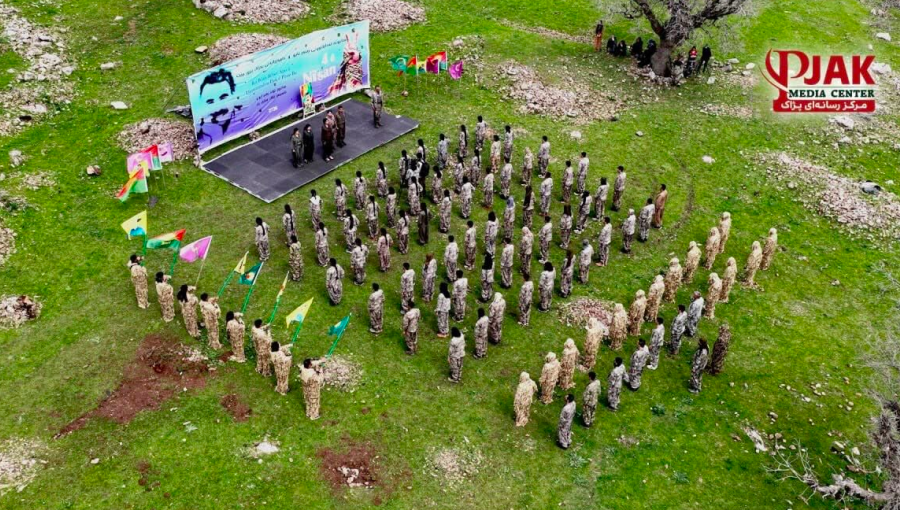
The claim of an ill-fated Kurdish role in attempting to topple the Iranian government triggered immediate denials by all major Iranian Kurdish parties. In comments to Drop Site, the Free Life Party of Kurdistan (PJAK), one of the largest and most organized Kurdish parties, denied Trump’s claim that they or other Kurdish groups—six of whom had formally announced the formation of a new alliance days before the start of the war—had received U.S. weapons to fight or transfer to other opposition factions in the country.

“No, we have never received weapons or assistance from the United States or any other country. As far as we know, all Kurdish parties have rejected Trump’s statements and are not aware of such claims,” said Zegrus Enderyarî, a member of the PJAK External Relations Committee. “It is possible that Trump intended to do such a thing or wanted to test the reaction of Iran and other regional countries. However, the time he referred to was when thousands of protesters in Iran were killed by the regime, and at that time, this alliance had not yet been formed.” (Drop Site could verify neither Trump’s claim he sent weapons nor the Kurds’ denial.)

The Alliance of Iranian Kurdistan Political Parties—involving six out of the seven active Kurdish parties in Iranian Kurdistan—was announced on February 22, six days before the start of the war. The timing of the pact has led many to suggest that it was intended as preparation for an alignment with Israel and the U.S. in the coming conflict. Enderyarî, without directly refuting that narrative, pointed out that the relevant discussions between the parties had started in the aftermath of the 2022 anti-government “Woman, Life, Freedom” movement in Iran—significantly predating the current war. “Although political conditions also played a role, the formation of this alliance was a historical necessity, and it can even be said that it was delayed,” said Enderyarî.

Regardless, Iranian Kurds quickly found themselves thrust into the forefront of the U.S. and Israeli war against Iran. In the first week of fighting, the U.S. and Israel bombed numerous government positions in Kurdish regions of Iran, while making public calls to Kurdish groups to launch an uprising against the government. That uprising, intended to drain the resources and attention of the Iranian military, while potentially causing the ethnic dissolution of the country, did not come to pass.

Other Iranian Kurdish groups who spoke to Drop Site expressed suspicion over attempts to maneuver them into a conflict at the behest of foreign powers.

Ebrahim Alizadeh, General Secretary of Komala (CPI), also known as the Kurdistan Organization of the Iranian Communist Party, the only party of the seven that didn’t join the alliance, stated that one of the reasons his group had not joined the February 22 announcement was out of belief that the alliance had been hastily formed in the shadow of U.S. and Israeli war plans.

“We asked to have a trial period of collaboration…but we realized that there was external pressure to do it faster. Afterwards we understood that this pressure was related to the war that started,” he said. ”When the war started, the Americans and Israelis asked them to enter Iran to liberate a region and put pressure on the central state. The plan didn’t work and they withdrew from it, partly because Turkey convinced them.”

The Iranian portion of Kurdistan, where Israel and the U.S. have tried to encourage revolt, has several distinctive features setting it apart from the other three parts. Unlike Kurdish regions in Turkey, Iraq, and Syria—all once part of the Ottoman Empire—Iranian Kurdistan has been under continuous Iranian rule for at least four centuries, with the Safavid Empire dismantling Kurdish principalities far earlier. Most Iranian Kurds are also Sunni in an emphatically Shia state, making them a double minority.

The failure to trigger a Kurdish uprising was one of many factors that contributed to transforming the war into a quagmire for the U.S. By early April, Trump’s frustrations over the war had begun publicly boiling over, leading to public accusations of betrayal by Kurdish groups.

On April 6, Trump fulminated that U.S. arms “were supposed to go to the people so they could fight back against these thugs. You know what happened? The people that they sent them to kept them because they said, ‘What a beautiful gun. I think I’ll keep it.’ So, I’m very upset with a certain group of people and they’re going to pay a big price for that.”

Trump’s references to “the Kurds,” as well as, “a certain group of people,” has led to confusion about whether his allegations are leveled against a specific Iranian Kurdish party, factions based in Iraqi Kurdistan, or the Kurdish people in general.

“He has still not clarified which Kurds he was referring to: the Kurds of Iraq or the Kurds of Iran?” Alizadeh told Drop Site. “All Iranian Kurdish parties have denied it. We reject cooperation with the American project in Iran. Other parties, by contrast, have sought weapons from the United States and are saying that they did not receive them. Were those weapons given to the Kurdish parties in Iraqi Kurdistan? They have remained silent on this matter. In the end, someone here is clearly lying.”

“Leave the Kurds alone”

Trump’s claims, which have been treated with disbelief by several regional journalists and experts, come amid intensified attacks on Iranian Kurdish parties and other targets within Iraqi Kurdish territory by Iran and its proxies. The attacks reflect a recurring tendency by the U.S. and Israel to “out” the Kurds and expose them to violent Iranian retaliation. This portrayal of Iranian Kurds as a perpetual fifth column working at the behest of foreign states has been devastating for Iranian Kurdish parties, who operate across the border in Iraq where many have been hosted by the autonomous Iraqi Kurdish government.

On March 4, false reports began circulating from journalists and others that thousands of Kurdish fighters had already crossed the border into Iran to begin a ground operation against the Iranian government.

The next day, Shanaz Ibrahim Ahmed, the wife of Iraqi President, Abdul Latif Rashid, as well as a long-standing Kurdish politician and a senior figure of the Patriotic Union of Kurdistan (PUK), denounced the idea of an intervention egged on by Tel Aviv and Washington. In a public statement decrying the effort to involve Kurds in the war, Ahmed said, “Leave the Kurds alone, we are not guns for hire.”

Ahmed’s statement, celebrated by many Kurds in the region, was released on the anniversary of Raperin, another famous Kurdish uprising against Saddam Hussein in 1991. That rebellion, which had also been tacitly encouraged by the U.S., was brutally suppressed by the Iraqi military, adding another chapter to a long history of perceived betrayals by Western powers.

When asked about the influence of Ahmed’s intervention, PJAK’s representative Enderyarî told Drop Site that despite a history of betrayals, Kurdish groups were still ultimately divided on the broader issue of foreign support. “The statements made by Shanaz Ibrahim Ahmad received wide attention among Kurds and others. However, not all political groups share the same view. Some believe that without foreign support—especially from the United States—it is not possible to change the regime in Iran, and therefore they support external intervention to some extent,” he said. “However, we, as a force based on grassroots organization and public awareness, believe that change must come from within society.”

Enderyarî added, “We do not see ourselves as part of this war. For us, this is a conflict between two hegemonic forces: one at the global level, the United States, seeking to maintain its dominance, and the other at the regional level, such as Iran and Israel, seeking regional hegemony. We do not choose either of these paths. Instead, we choose a third path based on self-governance and peaceful coexistence among the peoples of the region.”

This idea of the “Third Path” is not new, nor a product of the latest developments. PJAK belongs to the same political ecosystem as the Kurdistan Workers Party, or PKK. The historical Kurdish leader and founder of PKK, Abdullah Ocalan, has long expressed concern about the possibility of the Kurdish movement falling into Israel’s sphere of influence and being weaponized by it. Other top leaders of PKK such as Duran Kalkan have recently been explicit about it as well, stating in a recent interview that Israel and the U.S. were merely seeking a new, undemocratic hegemony in the region, and “preparing a new Shah” to replace the Islamic Republic.

Despite this stance from most of the leadership, there seems to be a real current among the base as well as some senior figures that see potential benefits in aligning with Israel.

“It is true Reber Apo and Duran Kalkan said those things, but there are indeed a lot of people within the movement that see Israel favorably,” Kawa, a 32-year-old construction worker in Suleymaniyah who’s ideologically aligned with PKK/PJAK told Drop Site. “If you ask me, is Israel good? No it isn’t. But it looks like Israel wants to give some respect to the Kurds—that’s why people think like that.”

The discourse around potential Kurdish involvement in the war is happening in the aftermath of recent developments in northeastern Syria, where a Kurdish-led project in autonomous governance known as the the Democratic Autonomous Administration of North and East Syria (DAANES) was dissolved by force in a military offensive by the new Syrian government based in Damascus. Despite working for years with U.S. forces as a counterterrorism partner, the Kurdish-led Syrian Democratic Forces (SDF) found itself abandoned at this critical moment—an episode viewed by many Kurds around the region as the latest chapter in a long history of betrayals.

The forcible integration of the DAANES into central government control came about after numerous Arab tribes that had previously fought alongside the SDF switched sides and pledged allegiance to Damascus. That decision has helped trigger a renewed sense of unity among Kurds across different factions, alongside sentiments of ethnic nationalism and resentment towards Arabs.

“I can’t, I’m done. I’m done with the Arabs,” said Marwan, a seasoned Kurdish fighter of the SDF, who spoke to Drop Site in the Syrian city of Haseke this February. The veteran of the historical Kobane battle against the Islamic State emphasized the sense of betrayal many Kurds felt from their former Arab partners. “It was not the government forces that attacked us in Shedadi and killed so many friends. It was our formerly allied Arab tribes that stabbed us in the back. How can we trust them any more?”

In the Kurdish-majority Syrian cities of Haseke and Qamislo, the Kurdish national flag is now everywhere—something which until recently was forbidden by the SDF because of policies stressing ethnic inclusion. Banners featuring Ocalan, together with Iraqi Kurdish leaders Massoud Barzani and Jalal Talabani, or of SDF chief Mazlum Abdi and Massoud Barzani, have become visible in some areas.

A sense of newfound ethnic unity and resentment has become particularly prevalent in Iraqi Kurdistan , where recent developments in Syria have been seen as a vindication of the nationalist conservative politics that dominate the regional government.

“Before, in my social group there were Arabs and Kurds and we were all just friends, but after all this we became Arabs and Kurds” said Sevak, a 24-year-old metal worker who spoke to Drop Site in Erbil. “Now the Kurds are united, before they were divided along party lines, ‘You are with Ocalan, or you are with Barzani.’ Now they are one.”

The increasing debates about the future of the Kurdish liberation movement comes as Iraqi Kurdistan has faced hundreds of missile and drone attacks from Iran and pro-Iranian militia groups in Iraq. In one of the latest incidents, a drone strike killed a Kurdish civilian couple in a rural agricultural village with no military presence—Musa Anwar Rasool and his wife Mujda Asaad Hassan, leaving behind two orphaned daughters.

The attacks, many of which are believed to have been carried out by groups associated with the Popular Mobilization Forces, an official part of the Iraqi security establishment, have further raised tensions between Iraqi Kurdistan and Baghdad. For the time being, the tentative ceasefire in Iran may give time for the Kurdish movement to reassess its future. The events of the past months will not soon be forgotten.

Tuesday, March 31, 2026


BEYOND THE BOSPORUS: Turkey builds house for PKK leader Ocalan on prison island Imrali

BEYOND THE BOSPORUS: Turkey builds house for PKK leader Ocalan on prison island Imrali
An image of what Ocalan’s house on Imrali might look like as AI-generated by Gemini. / Gemini, AIFacebook
By Akin Nazli in Belgrade March 30, 2026

The Turkish government has built a house for Abdullah Ocalan, the leader of the militant-politico Kurdistan Workers’ Party (PKK), imprisoned for life after he was abducted by intelligence agents in Nairobi, Kenya 27 years ago.

The dwelling was constructed on Imrali prison island, in the Sea of Marmara, south of Istanbul, where Ocalan was incarcerated, Tuncer Bakirhan, co-chair of Turkey’s pro-Kurdish DEM Party, said on March 28.

Prior to the confirmation of the residence provided by Bakirhan during a televised interview on Medya Haber TV, a Belgium-based broadcaster operated by the PKK, there were rumours of the development in Turkish media.

Spit it out

“A place, a building or a house has been built for Ocalan on Imrali. Actually, there's a complex there, but what is its name, what is its status?” Bakirhan said, struggling to spit it out.

“The issue of what we will say when we go there, how we will describe it, needs to be clarified. I think there may be developments on this matter soon,” he added.

“Imrali delegation”

On March 27, three members of the DEM Party’s “Imrali delegation”, namely Pervin Buldan, Mithat Sancar and Faik Ozgur Erol met with Ocalan.

“There was a meeting lasting longer than five hours, attended by our delegation, the state delegation and Mr Ocalan,” Bakirhan also said.

“We know that this meeting focused on addressing the setbacks and discussing the steps that need to be taken for the progress of this [peace] process [with the Turkish government], which we call the second phase,” he also said.

PKK? No. “The PKK”

DEM, with substantial representation in the Turkish parliament, is the legal political wing of the political movement of Turkey’s Kurds, with the latter loosely referred to in general as “the PKK”.

The PKK, founded in 1978, waged low-intensity warfare against Turkey from 1984. It was actually abolished in 2002 after the CIA handed over Ocalan to Turkey’s intelligence agency, MIT, in Kenya in 1999.

Main arms of the KCK

The current umbrella organisation of the political movement of Turkey’s Kurds is in fact called the KCK.

There are dozens of combinations of three letters that operate under the KCK. The KCK has militia in the Qandil mountains, located on the border of Iraq and Iran, that occasionally target Turkey (in attacks commonly ascribed to “the PKK”) and Iran (attacks are described as mounted by “PJAK”). The KCK also runs a state-like enterprise covering territory in northern Syria and a network in Europe.

The contesting of elections in Turkey by the Kurdish political movement’s legal political form (the current party is called DEM) results in a significant number of victories. DEM thus wins control of certain municipalities – but the Turkish government often seizes municipalities won by the Kurds and installs state “trustees” to run them.

New cycle, new peace concept

Since the 1980s, governments in Turkey and the political movement of the country’s Kurds have entered into cycles where, in coordination, war and peace concepts are addressed.

Currently, a ceasefire prevails. It was initiated in October 2024.

This affair has a complex structure and long history. It is coupled with heavy manipulation from multiple sides (foreign players in addition to different power groups within the various parties involved in the conflict) as well as the courage of ignorance that dominates media coverage. In fact, relying on media reports for the sake of understanding developments is not advisable.

In July, bne IntelliNews wrote: “Make no mistake. What we have here is an Erdogan, PKK coalition.” Why so? You can read about it here.

The coalition process that holds sway in Turkey is conducted by the powers that be. Erdogan pulls the strings. When the time comes to sell a sharp U-turn in bilateral rhetoric, the masses are always, step by step, subject to thorough preparation.


US-Israel plan for Kurdish incursion into Iran collapses

US-Israel plan for Kurdish incursion into Iran collapses
A joint plan by the US and Israel to support a Kurdish ground incursion into Iran has collapsed after two failed attempts to cross the border into Iran. / bne IntelliNewsFacebook
By Ben Aris in Berlin March 30, 2026

A joint plan by the US and Israel to support a Kurdish ground incursion into Iran has collapsed following leaks and regional opposition, according to The Times of India, which reported on March 28 that the proposal had been under development for several years.

The plan envisaged tens of thousands of Kurdish fighters entering Iran from neighbouring Iraq, backed by US and Israeli air support, with the objective of stretching Iranian military forces and potentially triggering internal unrest. The proposal was presented “at the highest levels”, the report said, as part of a broader effort to destabilise the Iranian regime.

As IntelliNews reported, in the first week of the war Kurdish fighters, backed by the CIA, massed on the border with the intent to stretch Iran's security forces thin. The Kurdistan Freedom Party (PAK) said some of its forces had moved to areas near the Iranian border in Sulaymaniyah province and were on standby. However, the operation failed.

According to the report, the operation was abandoned after details were disclosed in the media before execution, allowing Iran to reposition forces and coordinate with Iraqi authorities to block potential entry routes. The exposure of the plan is said to have significantly reduced the feasibility of any rapid incursion.

Regional dynamics also contributed to the breakdown. Turkey opposed the initiative, reflecting its longstanding concerns over Kurdish military movements, while Gulf states expressed reservations about the potential for wider instability. Kurdish groups themselves reportedly hesitated amid doubts over the level of sustained ground support and lingering mistrust of US commitments.

Two separate launch windows were ultimately cancelled, the report said, with the plan now considered off the table. The collapse has also introduced friction between Washington and Jerusalem, according to the same account, although no official statements have been issued by either government.

The reported episode highlights the complexity of coordinating multinational operations involving non-state actors in a region marked by competing strategic interests and sensitivities over sovereignty.

The plan had aimed to “push toward Tehran, stretch regime forces, and ignite internal uprising”, according to The Times of India.


Monday, March 30, 2026

Decapitation And The End Of Politics

Source: Originally published by Z. Feel free to share widely.

Israel in particular, but also the United States, have been breathing new life into the concept of decapitation as a weapon of political violence. Needless to say, this weapon violates all contemporary international conventions on warfare. The international legal order that governed the world with relative effectiveness after World War II was buried after September 11, 2001, when the legal authorities at Harvard proclaimed the fatwa declaring it legitimate to torture alleged enemies beyond the limits previously established by the dominant doctrine of human rights. From then on, once the enemy is declared a terrorist, the destruction of their life ceases to be a matter of legitimacy and becomes a matter of opportunity and effectiveness. Terrorism is any threat to national security that cannot be combated diplomatically, that is, by peaceful means. Having the privilege of naming who is a terrorist, or who threatens whose security, has become the principle of politics. Tragically, this principle of politics is also the end of politics.

Decapitation, both literal (severing the head) and figurative (the radical elimination of an individual who symbolizes a collective struggle, an organization or an idea), has a long tradition. It uniquely combines the horror of elimination with the orgy of triumph, victory, or revenge. Freud wrote in 1922 that decapitation signifies castration; it is the way the unconscious presents itself in a transformed manner to the individual’s consciousness. His analysis focuses on the mythology of the head of the Gorgon Medusa, severed by the demigod Perseus. Political leaders or others who resort to decapitation manipulate this unconscious drive to convey the idea of unlimited power (reducing the enemy to utter impotence) and equally unlimited efficacy (individual extermination, which is also collective).

The cultural tradition of decapitation finds its highest expressions in art and literature. John the Baptist’s head is severed at the request of Salome’s mother, Herodias, because he had opposed the incestuous relationship between Herodias and Herod. Judith, the Jewish widow, saves her city of Bethulia from the Assyrian invasion by seducing and beheading Holofernes, the Assyrian general of Nebuchadnezzar. Goliath, the heavily armed Philistine giant, was defeated by the stone fired from David’s sling. David, upon seeing Goliath on the ground, cut off his head with the giant’s own sword. In a variation of this tradition, Samson, the all-powerful Israelite judge, lost all his strength and was captured by the Philistines when Delilah, a Philistine infiltrator, seduced him and cut his hair, after discovering that Samson’s strength lay in the hair he had never cut.

The fascination with decapitation was irresistible to Renaissance painters. With his penchant for realistic violence, Caravaggio immortalized many of these decapitations in his paintings: Medusa in 1597, Holofernes in 1599, John the Baptist in 1608, and Goliath in 1609–10. Other Renaissance painters captured the political and cultural symbolism of decapitation in beautiful paintings. For example, Donatello, in 1408–9, and Michelangelo, in 1508–12, immortalized David’s victory over Goliath; Artemisia Gentileschi, the beheading of Holofernes in 1612–21; Francesco Cairo, in 1625–30, the beheading of John the Baptist. It is not the aim of this text to analyze the erotic dimensions or psychoanalytic interpretations of decapitations or of the painters who immortalized them (the actions of women in the cases of Salome, Judith, and Delilah; the homosexuality of Caravaggio or Donatello)[1]. Rather, I intend to analyze the role that decapitation plays in contemporary struggles and wars.

Decapitation as an instrument of contemporary violence

As I mentioned, decapitation consists of the elimination/neutralization of an individual as a means – simultaneously spectacular and economical – of eliminating/neutralizing the struggles, organizations, or ideas that this individual represents. Etymologically, decapitation derives from the Latin word caput, meaning head. Figuratively, it was used to signify chief, leader, or leadership, a source. It is in this sense that it is used today in the irregular and illegal wars waged by Israel and the U.S. Decapitation means eliminating an individual considered an enemy who represents, in a special way, a collective enemy threat. To the extent that it is possible and effective, decapitation is a valuable shortcut because it allows one to strike a target in a single blow that, if attacked collectively, would require many blows and many resources. The specter haunting decapitation is the Lernaean Hydra. In Greek mythology, the Lernaean Hydra was a monster with the body of a dragon and multiple serpent heads. According to some versions of this myth, whenever a head was cut off, two grew in its place.

Decapitation is always linked to violent struggle. It is war and the metonymy of war. The scope of decapitation has been expanding to the same extent that the concept of war has come to encompass more types of violent struggles: war between countries, civil war, cultural war, religious war, family war, trade war. Today we can distinguish three types of decapitation: assassination (physical death), imprisonment (political death), and cancellation (civic death). All three types involve death, but deaths of different kinds. Physical death is irreversible public and private disappearance, with the exception, in the Catholic world, of those who are beatified or canonized posthumously. Political death is illegal public disappearance, whether irreversible or not, and the maintenance of private life under more or less precarious and undignified conditions. The case of Lula da Silva, President of Brazil, is the most recent and significant example of reversible public disappearance. Civic death implies neither assassination nor imprisonment; just as in political death, it implies the maintenance of private life under more or less precarious and undignified conditions, but, unlike political death, public disappearance tends to be irreversible.

In all these types, individual death is targeted to bring about the collective death of a struggle, organization, or idea. In recent times, we have witnessed several cases of these three types of decapitation. The most recent and well-known are: the assassination of Ali Khamenei and other religious leaders in Iran; the capture and imprisonment of Nicolas Maduro, President of Venezuela; the cancellations of left-wing intellectuals produced by so-called “cancel culture” or, more accurately, “cancel barbarism.”

The expansion of modes of decapitation signifies the increase and diversification of violence in contemporary societies, which, in turn, is associated with the growth of far-right political forces, whether secular or religious.

Decapitation as a political phenomenon

Like any other political phenomenon, decapitation generates a dominant discourse that must be analyzed according to the procedure I call the sociology of absences. Whether as discourse or as practice, decapitation creates an analytical field that promotes certain discussions and omits others. The dominant discourse asserts itself to the extent that the concept of omitted discussion is itself omitted, and consequently public opinion is led to believe that there is nothing more to discuss beyond what has already been discussed. This discourse, in addition to being dominant, is also hegemonic when the idea that there is nothing else to discuss is endorsed by the classes that would benefit most from discussing the topics that are not discussed. Let us see how a sociology of absences works in this field.

Legitimacy or effectiveness

What has been published in the academic world regarding decapitation as a political instrument focuses almost exclusively on the effectiveness of decapitation.  For example, there is debate over the effectiveness of the assassination of Osama bin Laden on Al-Qaeda’s activities, of the leaders of Hamas and Hezbollah on the activities of their organizations, or of the arrest of Abimael Guzmán on the actions of Shining Path, or of the arrest of Abdullah Öcalan on the Kurdish struggle organized by the Kurdistan Workers’ Party (PKK).

The question of effectiveness came to dominate studies on decapitation from the moment official documents produced in the U.S. after September 11 (namely, the National Strategy for Combating Terrorism, 2003) asserted that decapitation was an effective tool because the terrorist leader tended to be the catalyst for terrorist action. The assassination of the leader would, sooner or later, lead to the collapse of the organization. Immediately after the assassination of Abu Musab al-Zarqawi, George W. Bush announced that Al Qaeda had suffered a fatal blow. Over time, the question of the effectiveness of decapitation was extended to regimes and organizations considered particularly hostile. For example, organized crime in drug trafficking. How effective was the assassination of Pablo Escobar? On the other hand, over the past few decades, dozens of regimes and organizations have been designated as terrorist by the U.S. The most recent example is, as we know, Iran, where the decapitation of political, military, and scientific leaders has been a common practice. Artificial Intelligence from certain companies (for example, Palantir) and new lethal technologies are now being put to use for decapitation.

The idea of decapitation is an old one, especially when it comes to charismatic leaders. In the most recent period, following World War II, decapitation has been a tool of political violence widely used against political or religious leaders. From Patrice Lumumba to Aldo Moro, from Indira Gandhi to Olof Palme, from Yitzhak Rabin to Benazir Bhutto, from Oscar Romero to Martin Luther King, from Mahatma Gandhi to John F. Kennedy. It is estimated that, between 1959 and 2000, Fidel Castro was the target of more than 600 assassination attempts organized by the CIA and Cuban exiles, some of them quite bizarre, such as poisoned cigars or pens.

 The widespread use of decapitation and the frustration of the perpetrators—who, in most cases, failed to achieve their objectives—have led to the need for more rigorous analysis, a task undertaken primarily by security and counterterrorism experts. For example, Jenna Jordan analyzed 298 cases of leader decapitation between 1945 and 2004 and used various variables to reach a relatively pessimistic conclusion regarding the effectiveness of decapitation [2]. In short, the specter of the Lernaean Hydra haunts decapitation and its proponents.

The Sociology of Absences

How is it possible that in democratic societies the discussion of decapitation is reduced to its effectiveness? A sociology of absences reveals that almost nothing has been written about the ethical and political legitimacy of decapitation, especially when it is practiced by agents of states that claim to be democratic. This absence is disturbing because, for those outside the closed world of security and counterterrorism, the ethical-political question is the one that deserves the most attention. Especially if we consider that decapitation is an increasingly normalized instrument of violence and the capacity to decapitate successfully is growing due to advances in artificial intelligence and lethal technologies.

Furthermore, the scope of decapitation targets is expanding ever wider to include all those who stand out for their opposition to established political, religious, or ideological violence – even if disguised as democracy – whether they are political leaders, military figures, scientists in strategic fields, or opinion leaders. Finally, keep in mind that decapitation is multifaceted and capable of killing physically, politically, and civically. The social distribution of these three types of death within countries and in relations between countries must be a growing concern for democratic politics. And what is most serious is that any of these deaths contains fragments of the others.

Class Struggle, Democracy, and Decapitation

Decapitation is the type of class struggle that best disguises the existence of class struggle. By targeting specific individuals, decapitation shifts the political arena from social conflicts between classes or social groups to the individual political entrepreneurship of leaders conceived as metonyms for collective enemies. It thus has the effect of disarming those who believe in collective struggles against inequality, discrimination, and injustice, with the conviction that leaders only lead to the extent that they obey those who participate in the struggles. The mandate of Latin American indigenous leaders is of crucial importance in this context: to lead by obeying.

But the disarming reaches an even deeper level: it is the disarming of peaceful and democratic struggle, based on regulated conflict between adversaries rather than savage conflict between enemies or extremist conflict between Good and Evil.

The normalization of the use of decapitation presupposes that those who employ it have the privilege of designating as a terrorist or enemy any country, regime, or organization that opposes their interests. In a perversion of Carl von Clausewitz’s famous phrase (“war is the continuation of politics by other means”), decapitation is today, according to the dominant (and hegemonic?) thinking, war continued by other means. It is the end of politics and diplomacy – in short, of international relations, norms, and institutions. Contrary to what Clausewitz proposed, war is no longer the last resort after diplomacy fails. Now, the failure of diplomacy is intentionally produced by decapitation so that war becomes the only means of prevailing. Israel-U.S. relations with the Arab world in the Middle East are a glaring demonstration of this. The end of democracy follows from the end of politics, just as the end of politics follows from the end of democracy.

[1] Among many others, Laurie Schneider “Donatello and Caravaggio: The Iconography of Decapitation”. American Imago,1976, Vol. 33, 76-91; Bronwen Wilson “The Appeal of Horror: Francesco Cairo’s “Herodias and the Head of John the Baptist”. Oxford Art Journal, 2011, Vol. 34, No. 3, 355–372; Allie Terry, “Donatello’s Decapitations and the Rhetoric of Beheading in Medicean Florence.” Renaissance Studies, 2009, Vol. 23, No. 5, 609–638.

[2] Jenna Jordan, “When Heads Roll: Assessing the Effectiveness of Leadership Decapitation”, Security Studies, 18:4, 2009, 719-755. Other studies express similar reservations regarding the decapitation of drug trafficking leaders, for example in Mexico. Brian J. Phillips, “How Does Leadership Decapitation Affect Violence? The Case of Drug Trafficking Organizations in Mexico.” The Journal of Politics, Vol. 77, No. 2, 2015, 324–336.Email

avatar

Boaventura de Sousa Santos is the emeritus professor of sociology at the University of Coimbra in Portugal. His most recent book is Decolonizing the University: The Challenge of Deep Cognitive Justice.

Wednesday, March 18, 2026


Is Trump’s Iran War the US Version of the Suez Crisis?

The crisis saw Britain’s aura of imperial power had evaporated, and its global empire headed for extinction. Trump may have similarly hastened US decline.


Iranian military personnel take part in an exercise titled “Smart Control of the Strait of Hormuz,” launched by the Naval Forces of the Islamic Revolutionary Guard Corps, which is being carried out in the Persian Gulf and the Strait of Hormuz on February 16, 2026.
(Photo by Press Office of Islamic Revolutionary Guard Corps / Handout/Anadolu via Getty Images)

Alfred W. Mccoy
Mar 17, 2026
TomDispatch


In the first chapter of his 1874 novel The Gilded Age, Mark Twain offered a telling observation about the connection between past and present: “History never repeats itself, but the… present often seems to be constructed out of the broken fragments of antique legends.”

Among the “antique legends” most helpful in understanding the likely outcome of the current US intervention in Iran is the Suez Crisis of 1956, which I describe in my new book Cold War on Five Continents. After Egyptian leader Gamal Abdel Nasser nationalized the Suez Canal in July 1956, a joint British-French armada of six aircraft carriers destroyed Egypt’s air force, while Israeli troops smashed Egyptian tanks in the sands of the Sinai Peninsula. Within less than a week of war, Nasser had lost his strategic forces and Egypt seemed helpless before the overwhelming might of that massive imperial juggernaut.

But by the time Anglo-French forces came storming ashore at the north end of the Suez Canal, Nasser had executed a geopolitical masterstroke by sinking dozens of rusting ships filled with rocks at the canal’s northern entrance. In doing so, he automatically cut off Europe’s lifeline to its oil fields in the Persian Gulf. By the time British forces retreated in defeat from Suez, Britain had been sanctioned at the United Nations, its currency was at the brink of collapse, its aura of imperial power had evaporated, and its global empire was heading for extinction.

Historians now refer to the phenomenon of a dying empire launching a desperate military intervention to recover its fading imperial glory as “micro-militarism.” And coming in the wake of imperial Washington’s receding influence over the broad Eurasian land mass, the recent US military assault on Iran is starting to look like an American version of just such micro-militarism.

Washington’s fading influence across Eurasia will undoubtedly prove catalytic for the emergence of a new world order, which is likely to move far beyond the old order of US global hegemony.

Even if history never truly repeats itself, right now it seems all too appropriate to wonder whether the current US intervention in Iran might indeed be America’s version of the Suez Crisis. And should Washington’s attempt at regime change in Tehran somehow “succeed,” don’t for a second think that the result will be a successfully stable new government that will be able to serve its people well.
70 Years of Regime Change

Let’s return to the historical record to uncover the likely consequences of regime change in Iran. Over the past 70 years, Washington has made repeated attempts at regime change across the span of five continents—initially via CIA covert action during the 44 years of the Cold War and, in the decades since the end of that global conflict, through conventional military operations. Although the methods have changed, the results—plunging the affected societies into decades of searing social conflict and incessant political instability—have been sadly similar. This pattern can be seen in a few of the CIA’s most famous covert interventions during the Cold War.

In 1953, Iran’s new parliament decided to nationalize the British imperial oil concession there to fund social services for its emerging democracy. In response, a joint CIA-MI6 coup ousted the reformist prime minister and installed the son of the long-deposed former Shah in power. Unfortunately for the Iranian people, he proved to be a strikingly inept leader who transformed his country’s oil wealth into mass poverty—thereby precipitating Iran’s 1979 Islamic revolution.

By 1954, Guatemala was implementing an historic land reform program that was investing its mostly Mayan Indigenous population with the requisites for full citizenship. Unfortunately, a CIA-sponsored invasion installed a brutal military dictatorship, plunging the country into 30 years of civil war that left 200,000 people dead in a population of only 5 million.

External intervention, whether covert or open, seems to invariably be the equivalent of hitting an antique pocket watch with a hammer and then trying to squeeze all its gears and springs back into place.

Similarly, in 1960, the Congo had emerged from a century of brutal Belgian colonial rule by electing a charismatic leader, Patrice Lumumba. But the CIA soon ousted him from power, replacing him with Joseph Mobutu, a military dictator whose 30 years of kleptocracy precipitated violence that led to the deaths of more than 5 million people in the Second Congo War (1998-2003) and continues to take a toll to this day.

In more recent decades, there have been similarly dismal outcomes from Washington’s attempts at regime change via conventional military operations. After the September 2001 terrorist attacks, US forces toppled the Taliban regime in Afghanistan. Over the next 20 years, Washington spent $2.3 trillion—and no, that “trillion” is not a misprint!—in a failed nation-building effort that was swept away when the resurgent Taliban captured the capital, Kabul, in August 2021, plunging the country into a mix of harsh patriarchy and mass privation.

In 2003, Washington invaded Iraq in search of nonexistent nuclear weapons and sank into the quagmire of a 15-year war that led to the slaughter of a million people and left behind an autocratic government that became little more than an Iranian client state. And in 2011, the US led a NATO air campaign that toppled Colonel Muammar Gaddafi’s radical regime in Libya, precipitating seven years of civil war and ultimately leaving that country divided between two antagonistic failed states.

When Washington’s attempts at regime change fail, as they did in Cuba in 1961 and in Venezuela last year, that failure often leaves autocratic regimes even more entrenched, with their control over the country’s secret police strengthened and an ever-tighter death grip on the country’s economy.

Why, you might wonder, do such US interventions invariably seem to produce such dismal results? For societies struggling to achieve a fragile social stability amid volatile political change, external intervention, whether covert or open, seems to invariably be the equivalent of hitting an antique pocket watch with a hammer and then trying to squeeze all its gears and springs back into place.
The Iran War’s Geopolitical Consequences

By exploring the geopolitical implications of Washington’s latest intervention in Iran, it’s possible to imagine how President Donald Trump’s war of choice might well become Washington’s very own version of the Suez crisis.

Just as Egypt snatched a diplomatic victory from the jaws of military defeat in 1956 by shutting the Suez Canal, so Iran has now closed off the Middle East’s other critical choke point by firing its Shahed drones at five freighters in the Straits of Hormuz (through which 20% of global crude oil and natural gas regularly passes) and at petroleum refineries on the southern shore of the Persian Gulf. Iran’s drone strikes have blocked more than 90% of tanker departures from the Persian Gulf and shut down the massive Qatari refineries that produce 20% of the world supply of liquafied natural gas, sending natural gas prices soaring by 50% in much of the world and by 91% in Asia—with the price of gasoline in the US heading for $4 a gallon and the cost of oil likely to reach a staggering $150 per barrel in the near future. Moreover, through the conversion of natural gas to fertilizer, the Persian Gulf is the source for nearly half the world’s agricultural nutrients, with prices soaring by 37% for urea fertilizer in markets like Egypt and threatening both spring planting in the Northern Hemisphere and food security in the Global South.

The extraordinary concentration of petroleum production, international shipping, and capital investment in the Persian Gulf makes the Straits of Hormuz not only a choke point for the flow of oil and natural gas but also for the movement of capital for the entire global economy. To begin with the basics, the Persian Gulf holds about 50% of the world’s proven oil reserves, estimated at 859 billion barrels or, at current prices, about $86 trillion.

Time is not on Washington’s side if this war drags on for more than a few weeks.

To give you an idea of the scale of capital concentration in the region’s infrastructure, the national oil companies of the Gulf Cooperation Council invested $125 billion in their production facilities in 2025 alone, with plans to continue at that rate for the foreseeable future. To keep the global oil tanker fleet of 7,500 vessels that largely serves the Persian Gulf afloat, it costs nearly $100 million for a single large “Suezmax” tanker—of which there are about 900 normally on the high seas, worth a combined $90 billion (with frequent replacements required by the corrosion of steel in harsh maritime conditions). Moreover, Dubai has the world’s busiest international airport at the center of a global network with 450,000 flights annually—now shut down by Iranian drone strikes.

Despite all the White House media hype about the terrible swift sword of America’s recent airstrikes, the 3,000 US-Israeli bombing runs against Iran (which is two-thirds the size of Western Europe) in the war’s first week pale before the 1,400,000 bombing sorties over Europe during World War II. The striking contrast between those numbers makes the current US air attacks on Iran seem, from a strategic perspective, like shooting at an elephant with a BB gun.

Moreover, the US has limited stocks of about 4,000 interceptor missiles, which cost up to $12 million each and can’t be rapidly mass-produced. By contrast, Iran has an almost limitless supply of some 80,000 Shahed drones, 10,000 of which it can produce each month for only $20,000 each. In effect, time is not on Washington’s side if this war drags on for more than a few weeks.

Indeed, in a recent interview, pressed about the possibility that Iran’s vast flotilla of slow, low-flying Shahed drones might soon exhaust the US supply of sophisticated interceptor missiles, Pentagon leader General Dan Caine was surprisingly evasive, saying only, “I don’t want to be talking about quantities.”
Whose Boots on the Ground?

While economic and military pressures build for a shorter war, Washington is trying to avoid sending troops ashore by mobilizing Iran’s ethnic minorities, who make up about 40% of that country’s population. As the Pentagon is silently but painfully aware, US ground forces would face formidable resistance from a million-strong Basij militia, 150,000 Revolutionary Guards (who are well-trained for asymmetric guerrilla warfare), and Iran’s 350,000 regular army troops.

With other ethnic groups (like the Azeris in the north) unwilling or (like the Baloch tribes in the southeast, far from the capital) unable to attack Tehran, Washington is desperate to play its Kurdish card, just as it has done for the past 50 years. With a population of 10 million astride the highland borders of Syria, Turkey, Iraq, and Iran, the Kurds are the largest ethnic group in the Middle East without their own state. As such, they have long been forced to play the imperial Great Game, making them a surprisingly sensitive bellwether for larger changes in imperial influence.

Since the rise of Donald Trump’s America First foreign policy in 2016, major and medium powers along that entire Eurasian rimland have been actively disengaging from US influence.

Although President Trump made personal calls to the top leaders in Iraq’s Kurdistan region during the first week of the latest war, offering them “extensive US aircover” for an attack on Iran, and the US even has a military airbase at Erbil, Kurdistan’s capital, the Kurds are so far proving uncharacteristically cautious.

Indeed, Washington has a long history of using and abusing Kurdish fighters, dating back to the days of Secretary of State Henry Kissinger, who turned their betrayal into a diplomatic art form. After he ordered the CIA to stop aiding the Iraqi Kurdish resistance to Saddam Hussein in 1975, Kissinger told an aide, “Promise them anything, give them what they get, and f… them if they can’t take a joke.”

As Iraqi forces fought their way into Kurdistan, killing helpless Kurds by the hundreds, their legendary leader Mustafa Barzani, grandfather of the current head of Iraqi Kurdistan, pleaded with Kissinger, saying, “Your Excellency, the United States has a moral and political responsibility to our people.” Kissinger did not even dignify that desperate plea with a reply and instead told Congress, “Covert action should not be confused with missionary work.”

Last January, in an amazingly ill-timed decision, the Trump White House betrayed the Kurds one time too many, breaking Washington’s decade-long alliance with the Syrian Kurds by forcing them to give up 80% of their occupied territory. In southeastern Turkey, the radical Kurdish PKK Party has made a deal with Prime Minister Recep Erdoğan and is actually disarming, while Iraq’s Kurdistan region is staying out of the war by respecting a 2023 diplomatic entente with Tehran for a peaceful Iran-Iraq border. President Trump has called at least one leader of the Iranian Kurds, who constitute about 10% of Iran’s population, to encourage an armed uprising. But most Iranian Kurds seem more interested in regional autonomy than regime change.

As Trump’s calls upon the Kurds to attack and the Iranian people to rise up are met with an eloquent silence, Washington is likely to end this war with Iran’s Islamic regime only furthe

r entrenched, showing the world that America is not just a disruptive power, but a fading one that other nations can do without. Over the past 100-plus years, the Iranian people have mobilized six times in attempts to establish a real democracy. At this point, though, it seems as if any seventh attempt will come long after the current US naval armada has left the Arabian Sea.
From the Granular to the Geopolitical

If we move beyond this granular view of Iran’s ethnic politics to a broader geo-strategic perspective on the Iran war, Washington’s waning influence in the hills of Kurdistan seems to reflect its fading geopolitical influence across the vast Eurasian land mass, which remains today the epicenter of geopolitical power, as it has been for the past 500 years.

For nearly 80 years, the United States has maintained its global hegemony by controlling the axial ends of Eurasia through its NATO alliance in Western Europe and four bilateral defense pacts along the Pacific littoral from Japan to Australia. But now, as Washington focuses more of its foreign policy on the Western Hemisphere, US influence is fading fast along the vast arc of Eurasia stretching from Poland, through the Middle East to Korea that scholars of geopolitics like Sir Halford Mackinder and Nicholas Spykman once dubbed the “rimland” or “the zone of conflict.” As Spykman put it succinctly once upon a time, “Who controls the Rimland rules Eurasia; who rules Eurasia controls the destinies of the world.”

Just as Sir Anthony Eden is remembered ruefully today in the United Kingdom as the inept prime minister who destroyed the British Empire at Suez, so future historians may see Donald Trump as the president who degraded US international influence.

Since the rise of Donald Trump’s America First foreign policy in 2016, major and medium powers along that entire Eurasian rimland have been actively disengaging from US influence—including Europe (by rearming), Russia (by challenging the West in Ukraine), Turkey (by remaining neutral in the present war), Pakistan (by allying with China), India (by breaking with Washington’s Quad alliance), and Japan (by rearming to create an autonomous defense policy). That ongoing disengagement is manifest in the lack of support for the Iran intervention, even from once-close European and Asian allies—a striking contrast with the broad coalitions that joined US forces in the 1991 Gulf War and the occupation of Afghanistan in 2002. With Trump’s micro-militarism in Iran inadvertently but clearly exposing the limits of American power, Washington’s fading influence across Eurasia will undoubtedly prove catalytic for the emergence of a new world order, which is likely to move far beyond the old order of US global hegemony.

Just as Sir Anthony Eden is remembered ruefully today in the United Kingdom as the inept prime minister who destroyed the British Empire at Suez, so future historians may see Donald Trump as the president who degraded US international influence with, among other things, his micro-military misadventure in the Middle East. As empires rise and fall, such geopolitics clearly remains a constant factor in shaping their fate–a lesson I try to teach in Cold War on Five Continents.

In difficult times like these, when events seem both confused and confusing, Mark Twain’s “broken fragments of antique legends” can remind us of historical analogies like the collapse of the power and influence of Great Britain or of the Soviet Union that can help us understand how the past often whispers to the present—as it indeed seems to be doing these days in the Straits of Hormuz.

© 2023 TomDispatch.com


Alfred W. Mccoy
Alfred W. McCoy is professor of history at the University of Wisconsin-Madison is the author of "In the Shadows of the American Century: The Rise and Decline of U.S. Global Power". Previous books include: "Torture and Impunity: The U.S. Doctrine of Coercive Interrogation" (University of Wisconsin, 2012), "A Question of Torture: CIA Interrogation, from the Cold War to the War on Terror (American Empire Project)", "Policing America's Empire: The United States, the Philippines, and the Rise of the Surveillance State", and "The Politics of Heroin: CIA Complicity in the Global Drug Trade".
Full Bio >