Showing posts sorted by date for query QUEBEC NATIONALISM. Sort by relevance Show all posts

Thursday, February 26, 2026

Trade without accountability, pollution without borders
February 25, 2026
RABBLE.CA


No executive — in Washington, Ottawa or elsewhere — should have the unilateral power to dismantle protections, bypass accountability and impose dangerous consequences on people beyond their borders.
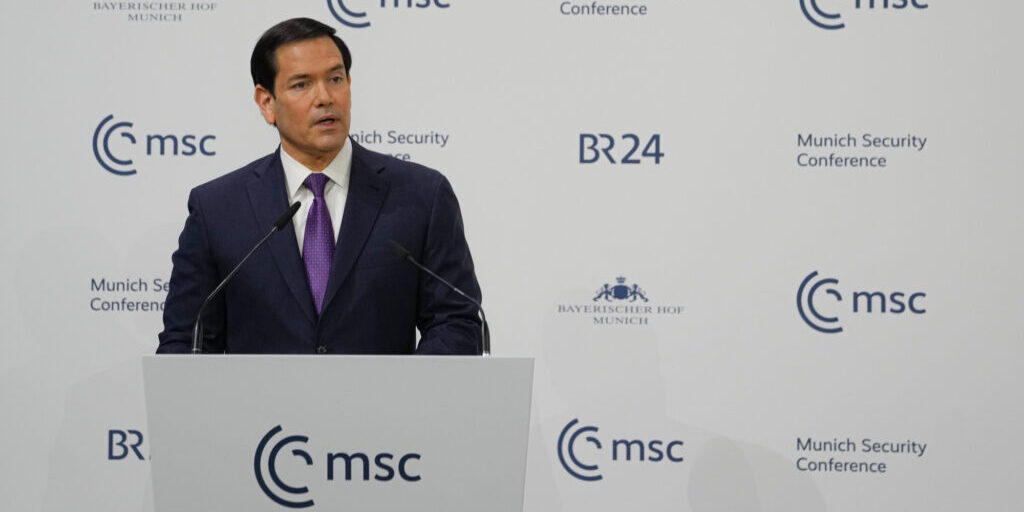

Secretary Marco Rubio speaking at the Munich Security Conference in Munich, Germany, February 14, 2026. Credit: US State Department.


A new international order is emerging, according to representatives at this year’s World Economic Forum in Davos, Switzerland, and at the Munich Security Conference — one of fragmented states acting in their own self-interest, sovereign fortresses sliding toward economic nationalism.

A Munich conference statement places much of the blame on Canada’s neighbour: “The international order is ‘under destruction’ because the country that has long shaped and defended it, namely the United States, is now governed by actors who prefer sweeping demolition over incremental reform and repair.”

The political fiction of fortresses hides the fact that dismantling the rule of law in one state shreds environmental, health and human rights accountability across borders, particularly where markets remain deeply integrated.

Canada, the United States and Mexico are bound by one of the world’s most integrated economic systems. Supply chains, energy systems, food production and manufacturing operate across borders that don’t recognize chemical pollution, toxic emissions and other ecological harms.

Yet the forthcoming review of the countries’ trade agreement is unfolding in a context in which one party — the U.S. — is rapidly breaking down environmental, health and safety regulations while demanding deeper market access.

In light of the recent repeal of the U.S. “endangerment finding” — the legal determination that greenhouse gases threaten public health and welfare — Canada and Mexico must defend science as the foundation of trade and regulation.

An integrated market with a rogue deregulatory state will inflict damage on the whole continent. Meaningful accountability regarding the human rights, ecosystem and public health impacts of trade is already lacking in the Canada-Mexico-U.S. agreement. Environmental provisions are weak, enforcement is constrained and climate obligations are absent.

As the U.S. accelerates deregulation — allowing factories to pollute more and exempting industries from rules that safeguard air, water, land and human health — any renewed trade agreement will export harm to people in Canada, Mexico and globally.

This is the reality of integration under deregulation. Carbon pollution, contaminated air and toxic water move through connected, borderless ecosystems. Supply chains predictably distribute toxic exposure to workers, Indigenous and other historically marginalized communities, children and the elderly. When environmental standards collapse in one jurisdiction on a continent with contiguous borders, everyone absorbs the costs.

Yet trade negotiations are framed as matters of national security and economic necessity — arguments used to justify secrecy, speed and public exclusion. Governments insist on prioritizing competitiveness over environmental and health safeguards. This political strategy is designed to shield trade governance from transparency, accountability and scrutiny.

The result is a black box: trade agreements are negotiated behind closed doors, insulated from democratic participation and ratified with little opportunity for meaningful challenge. Once in force, they restructure economies, lock in regulatory trajectories and leave future policy spaces without mechanisms capable of responding to the detriments they produce. This model is intensifying globally.

In the face of the U.S. threat, corporate executives are consolidating control over trade and investment policy. Legislatures are being sidelined and accountability mechanisms are being weakened or quietly abandoned. National security language has become the most powerful tool for normalizing this shift. In its shadow, environmental protection and public health are being reframed as expendable.

Canada and Mexico must urgently break the chain of deepened integration with the U.S., as the latter has proven to be driven by violence, openly hostile to regulation, dismissive of international norms and indifferent to the deleterious cross-border consequences of its policies. The only certainty is the increased pollution and regulatory chaos that can’t possibly be contained within U.S. borders.

No executive — in Washington, Ottawa or elsewhere — should have the unilateral power to dismantle protections, bypass accountability and impose dangerous consequences on people beyond their borders. Yet this is the model being normalized: centralized authority, minimal transparency and the erosion of public recourse, all in the name of trade and security.

The global public must wake up to this reality. Trade and investment agreements determine water and air quality. They govern decisions about whose land will be sacrificed and who will bear the long-term health costs. Treating trade governance as a sealed domain governed by security imperatives is reckless.

People across borders must reject the lies of securitized trade, demand transparency and insist that economic integration can’t come at the cost of life itself.


David Suzuki is a scientist, broadcaster, author and co-founder of the David Suzuki Foundation. Written with David Suzuki Foundation Director-General for Quebec and Atlantic Canada Sabaa Khan.

Learn more at davidsuzuki.org.


David Suzuki

David Suzuki is co-founder of the David Suzuki Foundation, an award-winning scientist, environmentalist and broadcaster. He is also a renowned rabble-raiser. The David Suzuki Foundation works... More by David Suzuki

Wednesday, February 18, 2026

Canada launches huge defence plan to curb reliance on US

Ottawa formally joined the EU’s Security Action for Europe (SAFE) program — making Canada the only non-European member of the bloc’s defence financing scheme.


By AFP
February 17, 2026


Canadian Prime Minister Mark Carney launching Canada's defence industrial strategy in Montreal - Copyright AFP Robin MILLARD


Marion Thibaut with Ben Simon in Toronto

Prime Minister Mark Carney on Tuesday launched a multi-billion dollar plan to strengthen the Canadian military and rely less on the United States.

Carney’s announcement of Canada’s first defence industrial strategy built on themes he has emphasized throughout his 11-month tenure as President Donald Trump rips through traditional US alliances.

The prime minister says Canada has not done nearly enough to defend itself in an increasingly dangerous world and counting on US protection is no longer viable.

“We’ve relied too heavily on our geography and others to protect us,” Carney said.

“This has created vulnerabilities that we can no longer afford and dependencies that we can no longer sustain,” he added.

Carney has become one of the most prominent global voices criticizing Trump’s administration, notably after his speech at the World Economic Forum last month where he said Trump had triggered a “rupture” in the rules-based global order.

On Tuesday, Carney also addressed US Secretary of State Marco Rubio’s speech last week to the Munich Security Conference, highlighting what the Canadian leader sees as the widening gap between US and Canadian values.

Carney, addressing reporters after giving a speech on the defence plan, pivoted to Rubio’s speech without being asked about it. He cautioned that Trump’s top diplomat had spoken of Washington’s desire to defend “Christian nationalism.”

“Canadian nationalism is civic nationalism” and Ottawa’s mandate was to defend the rights of everyone in a vast and diverse country, Carney said.

“There is a rivalry taking place between Canadian nationalism and other forms of nationalism,” he added, speaking in French.

In Munich, Rubio said “Western Civilization” was defined by “Christian faith, culture, heritage, language, ancestry, and the sacrifices of our forefathers.”


– Never be ‘hostage’ –


Carney’s office said the defence industrial strategy amounts to a investment of “over half a trillion dollars (US$366 billion) in Canadian security, economic prosperity, and our sovereignty.”


That includes CAN$180 billion in defence procurement and CAN$290 billion in defence and security related infrastructure, Carney said.

The plan — which calls for enhanced defence capacity on land, at sea and in the air — also aims to generate 125,000 high-paying careers.

For Carney, the increasingly fragile security relationship with the United States does not mean Canada should go it alone on defence.

His government has pursued closer military ties with the European Union and, at the Munich conference, Ottawa formally joined the EU’s Security Action for Europe (SAFE) program — making Canada the only non-European member of the bloc’s defence financing scheme.

The prime minister on Tuesday also talked about hopes for new defence export opportunities in Asia, notably with South Korea.

The goal is to “be strong enough to be a partner of choice,” the prime minister said.

Canada should build “a domestic defense industrial base so we are never hostage to the decisions of others when it comes to our security,” he said.

Carney also re-emphasized the need to enforce Canadian sovereignty in the Arctic, where warming temperatures caused by climate change are thawing the ice, opening a new era of competition for critical minerals.


Carney rolls out plans to build up domestic defence sector, add 125,000 jobs

ByThe Canadian Press
Published: February 17, 2026 

Prime Minister Mark Carney makes an announcement as he visits CAE Inc., in Montreal, on Tuesday, Feb. 17, 2026. THE CANADIAN PRESS/Christinne Muschi

Canada has failed both to adequately fund its military and to build up the domestic defence industry, Prime Minister Mark Carney said Tuesday as he rolled out an ambitious new plan to grow the defence sector.

Canada’s first-ever defence industrial strategy, unveiled Tuesday by Carney in Montreal, sets new guidance on procurement and funding decisions, looks to hike Canadian firms’ share of federal defence contracts to 70 per cent and vows to add 125,000 defence sector jobs over the next decade.

“Over the last few decades, Canada has neither spent enough on defence nor invested enough in our defence industries and we have relied too heavily on our geography and other countries to protect us,” Carney said. “This has created vulnerabilities we can no longer afford and dependencies we can no longer sustain.”

The $6.6-billion plan, which bills itself as a “paradigm shift” for how government engages with industry, will prioritize building military gear domestically — especially to cover “sovereign capabilities” critical to national defence or Canada’s commitments to allies.

If Ottawa cannot build at home, it will partner with allies or buy directly from them under “strong conditions that spur reinvestment into the Canadian economy,” the strategy document says.

The strategy warns of a need to “mitigate” the risk of Canada getting locked into advanced military systems owned and controlled by foreign governments that can exert control over their intellectual property.

Christyn Cianfarani, president of the Canadian Association of Defence and Security Industries, called the introduction of the defence industrial strategy a “historic turning point.”

“For the first time, we can see a clear, accountable vision for the defence sector” that comes with specific targets to grow Canada’s sovereign industrial capabilities, she said.

The document states that Ottawa will select certain Canadian defence firms as “key strategic partners” and enter into formal partnerships with them to build “world-leading champions that can meet Canada’s needs.”

The strategy seeks to increase Canada’s defence exports by 50 per cent within a decade — just as the European Union looks to massively scale up defence spending in response to Russia’s war on Ukraine.

“We will be very deliberate and open in terms of defence and security partnerships we sign with allies throughout the world and what opportunities that opens up, and be clear about what the guardrails are around … the types of exports we would envision with those countries,” Carney said.

“We will be broadening our partnerships. We’re deepening with our closest allies.”

The document also promises a suite of policy shifts to come — such as planned legislative changes to the new Defence Investment Agency to make it an independent office.

The agency is currently housed within Public Service and Procurement with a staff compliment of just 85 people, which is set to expand to roughly 400.

But the strategy cautions that “even with more efficient defence procurement, Canadian companies will still need to engage with multiple agencies.”

Conservative Leader Pierre Poilievre dismissed the document as a “salad bowl of buzzwords” and called on Ottawa to instead cut bureaucracy and streamline its purchasing decisions.


The government pledges in the document to advance a package of reforms early this year to its industrial technological benefits policy, which sets out how procurement projects get graded in terms of how they contribute to the domestic economy.

It promises a new strategy on expanding production of critical minerals tied to defence and the creation of a new program to support domestic production of ammunition and explosives.

The strategy said by 2029, Ottawa will stand up a new plant to produce nitrocellulose, which is a propellant used in munitions.

Also on Tuesday, the government set new serviceability targets for its fleets — the percentage of military vehicles ready to be deployed.

The government set deployment-ready targets of 75 per cent for the maritime fleet, 80 per cent for land vehicles and 85 per cent for aerospace — targets that national defence officials called ambitious but achievable. According to publicly released figures from National Defence, the last reported serviceability levels were 59.6 per cent for the maritime fleet, 51 per cent for land vehicles and 42.3 per cent for aerospace.

The department cited personnel shortages, past underfunding, aging vehicles and other supply chain issues as factors affecting the availability of military platforms.

This report by The Canadian Press was first published Feb. 17, 2026.

Kyle Duggan, The Canadian Press.


Industry leaders point to potential barrier in PM Carney’s defence industrial strategy


ByGenevieve Beauchemin
February 18, 2026 

Prime Minister Mark Carney makes an announcement as he visits CAE Inc., in Montreal, on Tuesday, Feb. 17, 2026. THE CANADIAN PRESS/Christinne Muschi

MONTREAL — Workers at the Quebec-based CAE greeted Prime Minister Mark Carney on Tuesday as he officially launched Canada’s first-ever defence industrial strategy, an ambitious policy aimed at building a robust domestic industry to reduce Canada’s reliance on foreign suppliers to arm the Canadian Armed Forces.

CAE president and CEO Matthew Bromberg applauded the government’s new strategy, saying it shows the country is committed to developing a defence industrial base in this country.

“Having seen how this works in other countries around the world, having spent 25 years in aerospace and defence, I think this is the right move for Canada, for Quebec and for CAE,” said Bromberg.


Prime Minister Mark Carney tours the facilities of CAE Inc., in Montreal, on Tuesday, Feb. 17, 2026. THE CANADIAN PRESS/Christinne Muschi

About half of CAE’s contracts are now linked to the military, with 90 per cent of its flight simulators now exported around the world.

The Canadian Association of Defence and Security Industries (CADSI) says companies like CAE, as well as several smaller manufacturers, could benefit.


“It’s landmark, it’s historic, it is a very big deal for the defence industry to say that they are going to start preferencing Canadian firms in the procurement regime,” said CADSI president and CEO Christyn Cianfarani.

“They’re expecting to add 125,000 new jobs, which is basically two-and-a-half times the size of the sector: that is real growth. That is a magnitude we have not seen since basically the 1950s.”

But industry leaders warn those ambitions will not be realized if the procurement process is not streamlined. Cianfarani called it the “Achilles heel” of the strategy.

“They will have to make significant changes to the procurement system and they will have to start moving contracts. I can’t stress how much faster it needs to be than how the current system functions today,” Cianfarani said.

“If that happens, it is completely doable. If it doesn’t happen, it could undermine the entire strategy that we just heard about today.”

Prime Minister Mark Carney, flanked by Industry Minister Melanie Joly, left and Minister of National Defence David McGuinty, makes an announcement at CAE Inc., in Montreal, on Tuesday, Feb. 17, 2026. THE CANADIAN PRESS/Christinne Muschi

Carney says the centrepiece of the new approach is the Defence Investment Agency, or DIA.

“The DIA will streamline and speed procurement, will cut red tape, and it will expand domestic production,” he said.

Quebec’s Manufacturers and Exporters, or the Manufacturiers et Exportateurs du Quebec in French (MEQ), also focused on the importance of ensuring the procurement system aligns with the government’s stated priorities.


“There’s good intentions in this strategy, but I hope it works,” said MEQ president and CEO Julie White. “ And we’re going to be there to help the government make those links with the small- and medium-sized businesses.”

Prime Minister Mark Carney stands with Chief of the Defence Staff Gen. Jennie Carignan (centre left) and Minister of National Defence David McGuinty at Fort York Armoury in Toronto on Monday, June 9, 2025. THE CANADIAN PRESS/Chris Young

White also noted that there needs to be more clarity as to what the government means when it refers to Canadian manufacturers. Several military contractors are subsidiaries of foreign companies, and represent thousands of jobs in the country. Those, she says, cannot be left out of the process.

“Our goal is to revitalize our sector, put it back into shape and grow our business,” White said.

CAE, formerly Canadian Aviation Electronics, is a manufacturer of simulation technologies, and was founded by R. Patrick, an ex-Royal Canadian Air Force officer, nearly 80 years ago. The company says it has the capacity to ramp up to answer Canada’s call.

“You are standing in the single-largest facility in the world that develops and produces simulators,” said Bromberg. “We can absolutely support all the demands of Canada and the export market.”

Genevieve Beauchemin

CTV National News Quebec Bureau Chief


Thursday, January 22, 2026

Canada's Carney fires back at Trump after Davos speech

ROB GILLIES
Thu, January 22, 2026 


Prime Minister Mark Carney speaks at the beginning of a Cabinet Planning Forum at the Citadelle in Quebec City, Thursday, Jan. 22, 2026. (Jacques Boissinot /The Canadian Press via AP)(ASSOCIATED PRESS)

Prime Minister Mark Carney, right, and Bonhomme Carnaval raise their legs together in a traditional carnival kick, at the beginning of a Cabinet planning forum at the Citadelle in Quebec City, Thursday, Jan. 22, 2026.(Jacques Boissinot /The Canadian Press via AP)(ASSOCIATED PRESS

TORONTO (AP) — Canadian Prime Minister Mark Carney responded to U.S. President Donald Trump comment that “Canada lives because of the United States” on Thursday by saying Canada thrives because of Canadian values.

Carney said Canada can show the world that the future doesn’t have to be autocratic after returning from Davos where he gave a speech that garnered widespread attention.

In Davos at the World Economic Forum, Carney condemned coercion by great powers on smaller countries without mentioning Trump's name.

Upon returning home to Canada, Carney responded to Trump directly by referencing Trump’s remarks in Davos.

“Canada lives because of the United States,” Trump said. “Remember that, Mark, the next time you make your statements.”

“Canada doesn’t live because of the United States. Canada thrives because we are Canadian,” Carney responded Thursday.

Carney said Canada and the U.S. have built a remarkable partnership in the areas of economy, security and rich cultural exchange, but said “we are masters in our home, this is our own country, it’s our future, the choice is up to us.”

Trump later revoked his invitation to Carney to join his Board of Peace.

“Dear Prime Minister Carney: Please let this Letter serve to represent that the Board of Peace is withdrawing its invitation to you regarding Canada’s joining, what will be, the most prestigious Board of Leaders ever assembled, at any time,” Trump posted on social media.

Carney left Davos before Trump inaugurated his Board of Peace to lead efforts at maintaining a ceasefire in Israel’s war with Hamas.


Trump has talked about making Canada the 51st state and posted this week an altered image of a map of the U.S. that includes Canada, Greenland, Venezuela and Cuba as part of its territory.

Trump said in Davos that Canada gets many “freebies” from the U.S. and “should be grateful.” He said Carney’s Davos speech showed he “wasn’t so grateful.”

Trump said Canada wants to participate in “Golden Dome” — a multibillion dollar missile defense system that he says will be operational before his term ends in 2029.

In a speech before a cabinet retreat in Quebec City, Carney said staying true to Canada’s values is key to maintaining its sovereignty.

“We can show that another way is possible, that the arc of history isn’t destined to be warped toward authoritarianism and exclusion; it can still bend toward progress and justice,” Carney said.

Carney said “Canada must be a beacon — an example to a world at sea.”

Carney said in a time of rising populism and ethnic nationalism, Canada can show how diversity is a strength, not a weakness.

“There are billions of people who aspire to what we have built: a pluralistic society that works," Carney said.

He said Canada delivers shared prosperity and has a democracy that chooses to protect the vulnerable against the powerful.

"It’s a great country for everyone. It is the greatest country in the world to be a regular person. You don’t have to be born rich, or to a landed family. You don’t have to be a certain color or worship a certain god,” he said.

U.S. Commerce Secretary Howard Lutnick earlier complained about Carney’s speech at the World Economic Forum.

“Give me a break,” Lutnick said on Bloomberg TV. “They have the second best deal in the world and all I got to do is listen to this guy whine and complain."

Canada has been shielded from the worst impacts of Trump’s tariffs by the Canada-U.S.-Mexico Agreement on trade, known as USMCA, but the agreement is up for a mandatory review this year.

California Gov. Gavin Newsom, a potential Democratic presidential candidate in 2028, told the forum that multiple leaders in the United States sent him transcripts of Carney’s speech.

“I respect what Carney did because he had courage of convictions. He stood up and I think we need to stand up in America and call this out with clarity,” Newsom said.

“We can lose our republic as we know it. Our country can become unrecognizable."

Newsom said that fact that Carney came back from China with a deal to introduce low, cost high quality electric vehicles into Canada, not made from Michigan, but from overseas shows how reckless Trump’s foreign policy is.

“It’s a remarkable thing to break down 80-plus years of alliances,” he said.


Trump revokes Canada's invitation to join Board of Peace

REUTERS
Thu, January 22, 2026


FILE PHOTO: U.S. President Donald Trump speaks during a reception with business leaders at the 56th annual World Economic Forum (WEF), in Davos, Switzerland, January 21, 2026. REUTERS/Jonathan Ernst/File Photo


By Jasper Ward and Ismail Shakil

WASHINGTON/OTTAWA, Jan 22 (Reuters) - U.S. President Donald Trump withdrew on Thursday an invitation for Canada to join his Board of Peace initiative ​aimed at resolving global conflicts.

Trump's aboutface follows Canadian Prime Minister Mark Carney's speech at ‌the World Economic Forum in Davos, where he openly decried powerful nations using economic integration as weapons and tariffs as ‌leverage.

"Please let this Letter serve to represent that the Board of Peace is withdrawing its invitation to you regarding Canada’s joining, what will be, the most prestigious Board of Leaders ever assembled, at any time," Trump wrote in a Truth Social post directed at Carney.

Neither Carney's office nor the White ⁠House immediately responded to Reuters requests ‌for comment on Thursday evening.

Last week, Carney's office said he had been invited to serve on the board and planned to accept.

Carney received a rare ‍standing ovation in Davos after the speech, in which he urged nations to accept the end of a rules-based global order.

Canada, which recently signed a trade deal with China, can show how "middle powers" might act together ​to avoid being victimized by American hegemony, he added.

Trump retorted that Canada "lives because of the United ‌States," and told listeners in Davos that Carney should be grateful for the United States’ previous largesse.

"Remember that, Mark, the next time you make your statements," he added, addressing Carney directly.

The withdrawal of Canada's invitation came hours after Trump officially launched the board, which was initially meant to cement a Gaza ceasefire.

Permanent members must help fund the board with a payment of $1 billion each, ⁠according to Trump.

"Once this board is completely formed, we ​can do pretty much whatever we want to do," Trump ​said in Switzerland on Thursday. "And we'll do it in conjunction with the United Nations.

The board's establishment was endorsed by a United Nations Security Council resolution as ‍part of Trump's Gaza peace ⁠plan, and U.N. spokesperson Rolando Gomez said on Thursday that U.N. engagement with the board would only be in that context.

Member nations include Argentina, Bahrain, Morocco, Pakistan and Turkey. ⁠Other U.S. allies, such as Britain, France and Italy, have indicated they will not join for now.

(Reporting by Jasper ‌Ward in Washington and Ismail Shakil in Ottawa; Additional reporting by Kanishka Singh; Editing ‌by Muralikumar Anantharaman, Sergio Non and Clarence Fernandez)


Thursday, December 11, 2025

Trump, Infantino, and the FIFA Peace Prize


Perfectly Appropriate


He craves it, and, to some extent, his desire was satisfied. President Donald Trump did get a peace prize. Not the peace prize picked out by self-important Norwegian non-entities, but the inaugural curiosity of FIFA, an organisation famed for opacity, corruption and graft. What the critics missed in all of this was its sheer appositeness.

In a two-hour ceremony held on December 5 at Washington’s Kennedy Center, which included the World Cup draw for participants at next year’s games, Trump was presented with a prize few FIFA officials seem to know existed. Last month, FIFA president Gianni Infantino announced the award, expressing the view that Trump also deserved that other coveted gong, the Nobel Peace Prize. One senior FIFA official boldly told BBC Sport that the football organisation’s prize deserved serious attention: “Why can’t this be bigger than the Nobel Peace Prize? Football has huge global support, so it’s right that it recognises extraordinary efforts to bring about peace every year.”

That football – grand sport of sublimated aggression, contest and rivalries – is an agent of peace, is one of those shibboleths sporting administrators feed. Go through the records of any famous club rivalry, and peace is found wanting. Violence and politics, however, can be found in abundance. But Infantino did not become FIFA President on his mastery of such details. His formula was simple if hypocritical: athletes should play and shut up about politics, leaving it to the administrative class to do the rest.

With fawning relish, he heaped high praise on the winner. “This is what we want from a leader; a leader who cares about the people. We want to live in a safe world, in a safe environment. We want to unite – that’s what we do here today, that’s what we’ll do at the (FIFA) World Cup, Mr President.” Trump, in deserving the inaugural award, could count on Infantino’s support and that “of the entire football community – or ‘soccer’ community – to help you make peace and make sure the world prospers all over the world.”

Infantino has never been a strict observer of the dusty ethics clause stating that the organisation maintains neutrality “in matters of politics and religion” and that “all persons bound by the code remain politically neutral … in dealings with government institutions.” He has hobnobbed with the leaders of Qatar, Saudi Arabia and Russia, ostensibly pursuing the footballing cause. He was the only sports leader present at the Egyptian “Summit for Peace” held in October, when a clutch of significant figures, marshalled by Trump and Egyptian President Abdel Fatah El-Sisi, agreed to implement the first phase of the Gaza peace plan. (There was much personal gratitude for Trump, praised as “absolutely fundamental and crucial in the [peace] process.) He has gathered a swag of awards and accolades from governments, hardly an affirmation of neutrality in any strict sense.

In keeping with the mood, Trump spoke about everything other than football. He was in the business of saving lives, and peace prizes did not matter much. (You need to get one in order to dismiss its merits.) For good measure, he had also “saved a lot [of lives], millions even.”

In keeping with the absurd occasion was the furious criticism of the choice, when its absurdity was most apt. Infantino, derided over his stance on not suspending Israel over its military operations in Gaza, was now receiving rebukes for eschewing neutrality. “Not satisfied with two years of FIFA complicity in genocide in Palestine, Infantino and his cronies have now invented a ‘peace prize’ in order to curry favour with Donald Trump,” fumed former UN official Craig Mokhiber and campaigner against Israeli’s membership of FIFA.

Andrea Florence, Executive Director of the Sports & Rights Alliance, acknowledged that the World Cup had been the political plaything of states in rinsing stained human rights records. “But FIFA is now doing the sportswashing itself. Giving this so-called FIFA ‘Peace Prize’ to US President Donald Trump with no clear criteria or process – and despite his administration’s violent detentions of immigrants, crackdowns on freedom of expression, and militarization of US cities – it’s sportswashing on steroids.”

This grumbling was bound to take a more formal shape, and it came in the form of an eight-page letter of complaint from the non-profit advocacy organisation, FairSquare. Unfortunately for the organisation, it was sent to FIFA. In the letter, the organisation demands that the ethics committee (the joke keeps giving) “investigate the circumstances surrounding the decision to introduce and award a FIFA Peace Prize and their conformity with FIFA’s procedural rules.” It makes reference to various remarks of Infantino’s, including those in an Instagram post from Trump’s inauguration on January 20 declaring that, “Together we will make not only America great again, but also the entire world”.

Studiously referencing FIFA statutes – not that this will get them far – the group goes on to state that awarding such a prize “to a sitting political leader is in and of itself a clear breach of Fifa’s duty of neutrality”. Infantino lacked the power to unilaterally determine “the organisation’s mission, strategic direction, policies and values”.

As with most things relevant to that organisation, the complaint is unlikely to get far. Politics and sport do mix, as they have always done. Infantino, chief of the world’s foremost unchallenged sporting mafia, may claim otherwise, but his tenure shows that he knows that crude reality all too well.

Binoy Kampmark was a Commonwealth Scholar at Selwyn College, Cambridge. He lectures at RMIT University, Melbourne. Email: bkampmark@gmail.comRead other articles by Binoy.


Trump’s Draconian Border Policies Are Menacing the 2026 World Cup


World Cup athletes, fans, and personnel fear Trump’s anti-immigration policies may disrupt the tournament’s operation.


By Nora Loreto , 
December 5, 2025

Donald Trump receives the FIFA Peace Prize from Gianni Infantino, president of FIFA, during the FIFA World Cup 2026 Official Draw at John F. Kennedy Center for the Performing Arts in Washington, D.C., on December 5, 2025.
Jia Haocheng - Pool / Getty Images

On Saturday, December 6, soccer fans around the world will find out where their favorite teams will be playing in the 2026 FIFA World Cup. Players and staff from 48 countries and territories will play 104 games across North America — and for the first time in history, Canada is hosting some of the games. Together, Toronto and Vancouver will host 13 matches.

In addition to the matches, 84 training sites and 178 practice fields will be spread across Canada, the U.S., and Mexico. Plus, tens of thousands of broadcasters from around the world will cover the games for their home countries.

Holding the games in three countries means that ease of crossing borders is a fundamental part of the World Cup going smoothly. Hundreds of thousands of players, staff, and fans will need to move across the U.S.-Mexico border and the Canada-U.S. border multiple times in order to attend the matches over the course of six weeks in June and July 2026. But already, months before the games begin, concerns are mounting over whether attendees will be able to enter the host countries at all

“Trump has made clear that U.S. restrictions on immigration visas, travel bans, and ongoing ICE kidnappings apply to World Cup fans and, in several cases, to athletes’ delegations as well,” Harsha Walia — the author of Border and Rule: Global Migration, Capitalism, and the Rise of Racist Nationalism — told Truthout.

“The fact that FIFA is continuing to host the World Cup as planned and has not at all leveraged their business relationship to advocate for human rights commitments signals FIFA’s capitulation to growing authoritarianism and protection of capitalist interests,” added Walia, who lives in Vancouver.

Related Story

FIFA Announces New “Peace Prize,” Weeks After Trump Fails to Win Nobel Award
The award comes as FIFA is under fire for refusing to sanction Israel and Saudi Arabia for their human rights abuses.  By Chris Walker , Truthout  November 6, 2025

It isn’t exactly easy to cross the Canada-U.S. border under the Trump administration. Cross-border travel has dropped as Canadians seek out other destinations for travel, scared off by images and stories of people being caught up in immigration enforcement, or even disappeared. ICE has been given a green light to continue its worst practices, Truthout has previously reported. With 20 new Canadian-built armored vehicles on their way into ICE’s possession, oppression from ICE will continue and likely get even worse.

Earlier this year, several countries issued travel warnings to their citizens, telling people to be careful in the United States due to immigration enforcement agents’ increasingly brazen tactics. Some refugees who have crossed into Canada have been turned away by Canadian border agents only to then be placed into ICE custody and face deportation. Sixty thousand people are currently in ICE detention, the highest number in many years, and the number of fatalities in ICE custody is the highest it has been in 20 years.

On November 28, 2025, Donald Trump announced on Truth Social that he would prevent migration to the United States by people who are from, in his words, from “the Third World.” One month earlier, he announced that the United States would only accept 7,500 refugees per year, a shockingly low number given that the United Nations High Commissioner for Refugees estimates there are 117.3 million forcibly displaced people on the planet.

The U.S. administration has signaled that staff from Iranian and Haitian teams, like player analysts, kinesiologists and other technical staff, won’t be allowed to enter the U.S. for the games.

These conditions have the potential to make crossing borders for the World Cup more dangerous for personnel and fans. Errors in documents or visa delays could each put someone at risk of detention, deportation, or disappearance.

To facilitate entry to the United States to watch the games, the U.S. has created a special FIFA visa for World Cup ticket holders, the U.S. State Department announced in November, which will give fans priority appointments for their visa requirements, or give fans from certain countries access to visa waivers.

Even so, athletes and fans may find it difficult to move across borders to attend the event. In October, a star of the international mountain biking world, Jolanda Neff, arrived at the Lake Placid World Cup just 45 minutes before her race started due to visa issues. Coach and veteran of the sport Steve Peat was denied entry entirely. In Canadian MTB magazine, Terry McCall wrote, “to be very clear, both Peaty and Neff are very experienced professionals with solid team backing. This isn’t a couple juniors winging it on their first trip overseas,” warning that fans, athletes, and team staff may face similar struggles at future U.S.-based sporting events.

Foot Africa reports that already, the U.S. administration has signaled that staff from Iranian and Haitian teams, like player analysts, kinesiologists, and other technical staff, won’t be allowed to enter the U.S. for the games. Iranian citizens who are part of that support staff, for example, will likely be rejected.

Meanwhile, Canada has not announced a special program for the World Cup. FIFA ticket holders have been asked to apply for their visas as soon as possible, as there are no guarantees that they will be allowed entry into Canada. Of the 48 teams playing in the tournament, more than half represent countries where Canada requires a visa for its travelers to be allowed to enter the country. Documents can range from CA$7 for a visa waiver to CA$100 for a visa. The Government of Canada advises applicants to mention that they’re coming to Canada for the World Cup in their application.

Toronto Star sports columnist Bruce Arthur notes that while Brazil required ticket holders from some countries to hold visas at the 2014 World Cup, they waived the fees. Ticket holders didn’t need visas to attend the World Cup in Russia in 2018 or Qatar in 2022.

Simon Black, professor of labor studies at Brock University, says that by increasing the number of teams at the World Cup from the usual 32 teams to 48, there are many more teams from small countries in the Global South where, “under ‘normal’ circumstances, it would probably be difficult to get in [to Canada] regardless.”

Entering Canada is difficult for people from countries outside of Europe or the United States. Processing times vary wildly: the Government of Canada website posts an estimated 469 days for Côte d’Ivoire, 162 days for Iran, 37 days for Colombia, 23 days for Jamaica, and no time estimate at all for Cabo Verde — all countries that have teams in the World Cup.

A spokesperson from the Department of Immigration, Refugees and Citizenship Canada said in an email statement: “Canada is excited to welcome hundreds of thousands of visitors for the FIFA World Cup 2026, including athletes, coaches, officials, medical staff, media, corporate sponsors and fans from around the world. Immigration, Refugees and Citizenship Canada (IRCC) is working closely with FIFA and federal partners to make travel to Canada as simple and smooth as possible without compromising security.”


To head off some of these issues, the Canadian government issued a temporary policy to exempt people who carry a FIFA invitation from work authorization requirements.

Canada’s visa problems might be overshadowed by an erratic U.S. president who has made immigration enforcement and deportations a key part of his administration’s work, but they have increasingly plagued large-scale international events. When the International Symposium on High-Performance Computer Architecture was held in Montreal in 2023, a quarter of conference attendees had their visas denied. In a joint letter signed by 76 computer scientists, they wrote “In order to advocate for the best interests of our academic communities, we can only recommend a moratorium in selecting Canada as a destination for such events.” In July 2024, the International Health Economics Association decided to relocate their 2025 conference to Indonesia, asserting they could not process the visas fast enough. Conference organizers had anticipated 1500 people would attend from all over the world.

To head off some of these issues, on November 14, 2025, the Canadian government issued a temporary policy to exempt people who carry a FIFA invitation from work authorization requirements that usually apply to foreign nationals who enter Canada.

The exemption started on December 1 and will expire on the last day of July, or just after the World Cup ends. To be eligible, individuals must apply for a visa and have a letter of invitation from FIFA. It will cover athletes and team staff, as well as some vendors, but not fans.

Vancouver city councilor Sean Orr lived in Vancouver during the 2010 Vancouver Olympics. In advance of the World Cup, his attention has been on how the city’s most vulnerable will be treated while the matches are played in his city. The city council hasn’t considered immigration or refugee issues; generally, they fall within the jurisdiction of the federal government. But he points to the detention of Democracy Now!’s Amy Goodman when she crossed the border for an event just before the 2010 Olympics as a warning sign that things might get more difficult for critics of the Canadian or U.S. governments who cross the border closer to the World Cup.

In an ideal world, Orr would like to see FIFA place personnel needs at the center of planning the World Cup. “I expect that there be a robust human rights framework attached to FIFA, and I know the city is working on it, but what does that mean when it comes to enforcement? What does that mean, on the ground, to protect people, sex workers, fans and residents? FIFA is in control of so much,” Orr told Truthout.

Black says that given the problems that so many people have had with immigration enforcement in the United States, “I can’t not see there being some sort of issue,” during the games. Ultimately, he believes that all governments hosting the World Cup need to center the rights and freedoms of the people whose jobs rely on their freedom to travel to matches. What’s needed most is “free movement of labor, which is what this is, across borders … without fear of harassment from immigration authorities, without fear of deportation, without fear of detention.”

Walia echoed this sentiment, calling on FIFA to take responsibility to protect human rights.

“FIFA should firmly require all host countries to safeguard migrant rights, end unlawful immigration enforcement at least during the tournament, end the displacement of unhoused communities in the lead up to and during the games, and protect journalists, activists and workers,” Walia said.


Truthout’s December fundraiser is our most important of the year and will determine the scale of work we will be able to do in 2026. Please support us with a tax-deductible donation today.

This article is licensed under Creative Commons (CC BY-NC-ND 4.0), and you are free to share and republish under the terms of the license.


Nora Loreto is a writer and activist based in Quebec City. She is also the president of the Canadian Freelance Union.


Wednesday, September 24, 2025

Back to the Future: NDP Must Debate Capitalism again


No CCF Government will rest content until it has eradicated capitalism and put into operation the full programme of socialized planning which will lead to the establishment in Canada of the Cooperative Commonwealth.

— 1933 Regina Manifesto

During two months of campaigning to lead the NDP we’ve questioned the foundation of our economic system more than all branches of the party over the past few years. But our position has deep roots in the NDP/CCF and is more relevant than ever as capitalism destroys the prospect for human survival.

In a recent hit piece labelling me a “perennial gadfly” National Post columnist John Ivison mockingly noted, “Engler is campaigning on a platform to abolish capitalism.” At the more liberal end of the corporate press, Toronto Star reporter Mark Ramzy buried my candidacy in a long piece devoting significant attention to the more capital friendly contestants, simply noting I was running “for the leadership on an anti-military and anti-capitalist platform.” The Western Standard, Queen’s Journal, Rebel, Left of the Box and others have all described me as an anti-capitalist candidate and hundreds of thousands have read or watched my launch commentary, releases and videos saying I’m running to challenge capitalism. In recent days thousands of “capitalism can’t be fixed” leaflets and posters for the Toronto launch of a ten-city national tour have been distributed.

Aside from this recent flurry of anti-capitalist rhetoric, it’s remarkable how little discussion in NDP circles there has been of our wealth-concentrating, ecologically destructive economic system. But challenging capitalism is more important than ever.

Capitalism is a system of minority and class rule that is based on the private ownership of the means of livelihood. Capitalist collectives (corporations) have socialized labour while operating as privately owned workplace dictatorships that centralize power in the hands of a small elite.

Capitalism is a threat to humanity. The system’s need for constant profit maximization and growth is imperilling human survival. The last three years were the hottest in 100,000 years and CO2 levels are the highest in millions of years. Canadians have among the highest per capita GHG emissions, yet Canadian capital continues to expand its heavy GHG emitting tar sands extraction.

It’s not just the climate crisis. The search for corporate profits is driving mass species extinction, soil depletion, ozone layer thinning, loss of arable land, freshwater depletion and other ecological crises.

Capitalism is imperilling our ability to live on the planet but it’s also destroying our health. The growing health impact of plastics, a late twentieth century corporate invention, is a case in point. Researchers have found that most of us now have as much as a small spoon worth of plastic particles in our brains.

Capitalism also damages our mental health. Incessant messages to buy this and buy that are destabilizing. A staggering amount of resources and ingenuity are devoted to convincing us we need this or that (always more) to be satisfied.

At the same time as it wages a war on our psyche, capitalism alienates us from our labour. It devalues work, generally paying the hardest working people the least. In recent years Canadian capital has waged an unrelenting war on working class organizations, driving Canada’s private sector unionization rate to its lowest level in 80 years.

As capitalists attack unions, the system concentrates wealth in the hands of an ever-smaller elite few. Canada’s wealthiest family, the Thompsons, have nearly $100 billion. Canada has about 75 billionaires, who control more wealth than millions of Canadians. According to data from the Parliamentary Budget Officer, the richest 1% of Canadians hold 24% of the country’s total net wealth while 53% of all wealth is held by the top 10%.

Wealth concentration is a threat to democracy. Through their ownership of shares, large shareholders have an excessive amount of power within the political system. They buy political parties, own the media, fund think tanks, organize themselves in business lobby groups, amongst other things. In short, they try to mould societies’ political, cultural and economic structure to their benefit.

But my campaign does not just criticize capitalism. It offers an alternative.

One dollar one vote capitalism should be replaced with one person one vote economic democracy. Wherever there’s social labour, there should be community ownership and workplace democracy.

As my late uncle Allan Engler argued in Economic Democracy: The Working Class Alternative to Capitalism the required social change should “be based on workplace organizations, community mobilizations and democratic political action; on gains and reforms that improve living conditions while methodically replacing wealthholders’ entitlement with human entitlement, capitalist ownership with community ownership and master-servant relations with workplace democracy.” (You can watch my father’s series of videos called Economic Democracy or No Democracy — An Anti Oligarchy Manifesto seeking to popularize the themes.)

And these ideas are clearly growing in popularity.

In its first ten days of fundraising my bid to lead the NDP on an anti-capitalist platform has raised over $55, 000. Additionally, we’ve more than doubled the nomination threshold to participate in the leadership race with over 1,000 party members, covering all the party’s regional, equity and age requirements, signing my nomination form.

Despite fulfilling the nomination and financial criteria, there’s a possibility the party brass will block me from the race. But even those who don’t plan to vote for me should reject this type of anti-democratic manipulation. All but the most reactionary party members should want capitalism to be on the agenda in the NDP leadership race.

This is the CCF/NDP tradition. According to the 1933 Regina Manifesto, the aim of the party is to “REPLACE the present capitalist system” while the 1969 Waffle manifesto says, “Capitalism must be replaced by socialism.”

If I’m not allowed to participate in the race don’t expect much discussion of capitalism. If I’m allowed to run expect everyone in the race to be questioning the odious economic system by the end of it.

https://yvesforndpleader.ca/

Full text: The CCF’s Regina Manifesto

The Regina Manifesto was the founding programme of the CCF


Co-operative Commonwealth Federation  PREDECESSOR OF THE NDP


CANADIAN DIMENSION/ May 7, 2018 / 

Socialism


CCF Founding Convention, Regina 1933

Adopted by the founding convention in Regina, Saskatchewan, July, 1933.

The CCF is a federation of organizations whose purpose is the establishment in Canada of a Co-operative Commonwealth in which the principle regulating production, distribution and exchange will be the supplying of human needs and not the making of profits.

WE AIM TO REPLACE the present capitalist system, with its inherent injustice and inhumanity, by a social order from which the domination and exploitation of one class by another will be eliminated, in which economic planning will supersede unregulated private enterprise and competition, and in which genuine democratic self-government, based upon economic equality will be possible. The present order is marked by glaring inequalities of wealth and opportunity, by chaotic waste and instability; and in an age of plenty it condemns the great mass of the people to poverty and insecurity. Power has become more and more concentrated into the hands of a small irresponsible minority of financiers and industrialists and to their predatory interests the majority are habitually sacrificed. When private profit is the main stimulus to economic effort, our society oscillates between periods of feverish prosperity in which the main benefits go to speculators and profiteers, and of catastrophic depression, in which the common man’s normal state of insecurity and hardship is accentuated. We believe that these evils can be removed only in a planned and socialized economy in which our natural resources and principal means of production and distribution are owned, controlled and operated by the people.

The new social order at which we aim is not one in which individuality will be crushed out by a system of regimentation. Nor shall we interfere with cultural rights of racial or religious minorities. What we seek is a proper collective organization of our economic resources such as will make possible a much greater degree of leisure and a much richer individual life for every citizen.

This social and economic transformation can be brought about by political action, through the election of a government inspired by the ideal of a Co-operative Commonwealth and supported by a majority of the people. We do not believe in change by violence. We consider that both the old parties in Canada are the instruments of capitalist interests and cannot serve as agents of social reconstruction, and that whatever the superficial differences between them, they are bound to carry on government in accordance with the dictates of the big business interests who finance them. The CCF aims at political power in order to put an end to this capitalist domination of our political life. It is a democratic movement, a federation of farmer, labour and socialist organizations, financed by its own members and seeking to achieve its ends solely by constitutional methods. It appeals for support to all who believe that the time has come for a far-reaching reconstruction of our economic and political institutions and who are willing to work together for the carrying out of the following policies:

1. Planning

The establishment of a planned, socialized economic order, in order to make possible the most efficient development of the national resources and the most equitable distribution of the national income.

The first step in this direction will be setting up of a National Planning Commission consisting of a small body of economists, engineers and statisticians assisted by an appropriate technical staff.

The task of the Commission will be to plan for the production, distribution and exchange of all goods and services necessary to the efficient functioning of the economy; to co-ordinate the activities of the socialized industries; to provide for a satisfactory balance between the producing and consuming power; and to carry on continuous research into all branches of the national economy in order to acquire the detailed information necessary to efficient planning.

The Commission will be responsible to the Cabinet and will work in co-operation with the Managing Boards of the Socialized Industries.

It is now certain that in every industrial country some form of planning will replace the disintegrating capitalist system. The CCF will provide that in Canada the planning shall be done, not by a small group of capitalist magnates in their own interests, but by public servants acting in the public interest and responsible to the people as a whole.

2. Socialization Of Finance

Socialization of all financial machinery–banking currency, credit, and insurance, to make possible the effective control of currency, credit and prices, and the supplying of new productive equipment for socially desirable purposes

Planning by itself will be of little use if the public authority has not the power to carry its plans into effect. Such power will require the control of finance and of all those vital industries and services, which, if they remain in private hands, can be used to thwart or corrupt the will of the public authority. Control of finance is the first step in the control of the whole economy. The chartered banks must be socialized and removed from the control of private profit-seeking interests; and the national banking system thus established must have at its head a Central Bank to control the flow of credit and the general price level, and to regulate foreign exchange operations. A National Investment Board must also be set up, working in co-operation with the socialized banking system to mobilize and direct the unused surpluses of production for socially desired purposes as determined by the Planning Commission.

Insurance Companies, which provide one of the main channels for the investment of individual savings and which, under their present competitive organization, charge needlessly high premiums for the social services that they render, must also be socialized.

3. Social Ownership

Socialization (Dominion, Provincial or Municipal) of transportation, communications, electric power and all other industries and services essential to social planning, and their operation under the general direction of the Planning Commission by competent managements freed from day to day political interference.

Public utilities must be operated for the public benefit and, not for the private profit of a small group of owners or financial manipulators. Our natural resources must be developed by the same methods. Such a programme means the continuance and extension of the public ownership enterprises in which most governments in Canada have already gone some distance. Only by such public ownership, operated on a planned economy, can our main industries be saved from the wasteful competition of the ruinous overdevelopment and over-capitalization which are the inevitable outcome of capitalism. Only in a regime of public ownership and operation will the full benefits accruing from centralized control and mass production be passed on to the consuming public.

Transportation, communications and electric power must come first in a list of industries to be socialized. Others, such as mining, pulp and paper and the distribution of milk, bread, coal and gasoline, in which exploitation, waste, or financial malpractices are particularly prominent must next be brought under social ownership and operation.

In restoring to the community its natural resources and in taking over industrial enterprises from private into public control we do not propose any policy of outright confiscation. What we desire is the most stable and equitable transition to the Cooperative Commonwealth. It is impossible to decide the policies to be followed in particular cases in an uncertain future, but we insist upon certain broad principles. The welfare of the community must take supremacy over the claims of private wealth. In times of war, human life has been conscripted. Should economic circumstances call for it, conscription of wealth would be more justifiable. We recognize the need for compensation in the case of individuals and institutions which must receive adequate maintenance during the transitional period before the planned economy becomes fully operative. But a CCF government will not play the role of rescuing bankrupt private concerns for the benefit of promoters and of stock and bond holders. It will not pile up a deadweight burden of unremunerative debt which represents claims upon the public treasury of a functionless owner class.

The management of publicly owned enterprises will be vested in boards who will be appointed for their competence in the industry and will conduct each particular enterprise on efficient economic lines. The machinery of management may well vary from industry to industry, but the rigidity of Civil Service rules should be avoided and likewise the evils of the patronage system as exemplified in so many departments of the Government today.

Workers in these public industries must be free to organize in trade unions and must be given the right to participate in the management of the industry.

4. Agriculture

Security of tenure for the farmer upon his farm on conditions to be laid down by individual provinces; insurance against unavoidable crop failure; removal of the tariff burden from the operations of agriculture; encouragement of producers’ and consumers’ cooperatives; the restoration and maintenance of an equitable relationship between prices of agricultural products and those of other commodities and services; and improving the efficiency of export trade in farm products.

The security of tenure for the farmer upon his farm which is imperilled by the present disastrous situation of the whole industry, together with adequate social insurance, ought to be guaranteed under equitable conditions.

The prosperity of agriculture, the greatest Canadian industry, depends upon a rising volume of purchasing power of the masses in Canada for all farm goods consumed at home, and upon the maintenance of large scale exports of the stable commodities at satisfactory prices or equitable commodity exchange.

The intense depression in agriculture today is a consequence of the general world crisis caused by the normal workings of the capitalistic system resulting in: (1) Economic nationalism expressing itself in tariff barriers and other restrictions of world trade; (2) The decreased purchasing power of unemployed and under-employed workers and of the Canadian people in general; (3) The exploitation of both primary producers and consumers by monopolistic corporations who absorb a great proportion of the selling price of farm products. (This last is true, for example, of the distribution of milk and dairy products, the packing industry, and milling.)

The immediate cause of agricultural depression is the catastrophic fall in the world prices of foodstuffs as compared with other prices, this fall being due in large measure to the deflation of currency and credit. To counteract the worst effect of this, the internal price level should be raised so that the farmers’ purchasing power may be restored.

We propose therefore:The improvement of the position of the farmer by the increase of the purchasing power made possible by the social control of the financial system. This control must be directed towards the increase of employment as laid down elsewhere and towards raising the prices of farm commodities by appropriate credit and foreign policies.
Whilst the family farm is the accepted basis for agricultural production in Canada the position of the farmer may be much improved by: (a) The extension of consumers’ cooperatives for the purchase of farm supplies and domestic requirements; and (b) The extension of cooperative institutions for the processing and marketing of farm products.
Both of the foregoing to have suitable state encouragement and assistance.
The adoption of a planned system of agricultural development based upon scientific soil surveys directed towards better land utilization, and a scientific policy of agricultural development for the whole of Canada.
The substitution for the present system of foreign trade, of a system of import boards to improve the efficiency of overseas marketing, to control prices, and to integrate the foreign trade policy with the requirements of the national economic plan.

5. External Trade

The regulation in accordance with the National plan of external trade through import and export boards

Canada is dependent on external sources of supply for many of her essential requirements of raw materials and manufactured products. These she can obtain only by large exports of the goods she is best fitted to produce. The strangling of our export trade by insane protectionist policies must be brought to an end. But the old controversies between free traders and protectionists are now largely obsolete. In a world of nationally organized economies Canada must organize the buying and selling of her main imports and exports under public boards, and take steps to regulate the flow of less important commodities by a system of licenses. By so doing she will be enabled to make the best trade agreements possible with foreign countries, put a stop to the exploitation of both primary producer and ultimate consumer, make possible the coordination of internal processing, transportation and marketing of farm products, and facilitate the establishment of stable prices for such export commodities.

6. Co-operative Institutions

The encouragement by the public authority of both producers’ and consumers’ cooperative institutions

In agriculture, as already mentioned, the primary producer can receive a larger net revenue through cooperative organization of purchases and marketing. Similarly in retail distribution of staple commodities such as milk, there is room for development both of public municipal operation and of consumers’ cooperatives, and such cooperative organization can be extended into wholesale distribution and into manufacturing. Cooperative enterprises should be assisted by the state through appropriate legislation and through the provision of adequate credit facilities.

7. Labour Code

A National Labour Code to secure for the worker maximum income and leisure, insurance covering accident, old age, and unemployment, freedom of association and effective participation in the management of his industry or profession

The spectre of poverty and insecurity which still haunts every worker, though technological developments have made possible a high standard of living for everyone, is a disgrace which must be removed from our civilization. The community must organize its resources to effect progressive reduction of the hours of work in accordance with technological development and to provide a constantly rising standard of life to everyone who is willing to work. A labour code must be developed which will include state regulation of all wages, equal reward and equal opportunity of advancement for equal services, irrespective of sex; measures to guarantee the right to work or the right to maintenance through stabilization of employment and through unemployment insurance; social insurance to protect workers and their families against the hazards of sickness, death, industrial accident and old age; limitation of hours of work and protection of health and safety in industry. Both wages and insurance benefits should be varied in accordance with family needs.

In addition workers must be guaranteed the undisputed right to freedom of association, and should be encouraged and assisted by the state to organize themselves in trade unions. By means of collective agreements and participation in works councils, the workers can achieve fair working rules and share in the control of industry and profession; and their organizations will be indispensable elements in a system of genuine industrial democracy.

The labour code should be uniform throughout the country. But the achievement of this end is difficult so long as jurisdiction over labour legislation under the B.N.A. Act is mainly in the hands of the provinces. It is urgently necessary, therefore, that the B.N.A. Act be amended to make such a national labour code possible.

8. Socialized Health Services Publicly organized health, hospital and medical services

With the advance of medical science the maintenance of a healthy population has become a function for which every civilized community should undertake responsibility. Health services should be made at least as freely available as are educational services today. But under a system which is still mainly one of private enterprise the costs of proper medical care, such as the wealthier members of society can easily afford, are at present prohibitive for great masses of the people. A properly organized system of public health services including medical and dental care, which would stress the prevention rather than the cure of illness should be extended to all our people in both rural and urban areas. This is an enterprise in which Dominion, Provincial and Municipal authorities, as well as the medical and dental professions can cooperate.

9. B.N.A. Act

The amendment of the Canadian Constitution, without infringing upon racial or religious minority rights or upon legitimate provincial claims to autonomy, so as to give the Dominion Government adequate powers to deal effectively with urgent economic problems which are essentially national in scope; the abolition of the Canadian Senate

We propose that the necessary amendments to the B.N.A. Act shall be obtained as speedily as required, safeguards being inserted to ensure that the existing rights of racial and religious minorities shall not be changed without their own consent. What is chiefly needed today is the placing in the hands of the national government of more power to control national economic development. In a rapidly changing economic environment our political constitution must be reasonably flexible. The present division of powers between Dominion and Provinces reflects the conditions of a pioneer, mainly agricultural, community in 1867. Our constitution must be brought into line with the increasing industrialization of the country and the consequent centralization of economic and financial power–which has taken place in the last two generations. The principle laid down in the Quebec Resolution of the Fathers of Confederation should be applied to the conditions of 1933, that “there be a general government charged with matters of common interest to the whole country and local governments for each of the provinces charged with the control of local matters to their respective sections”.

The Canadian Senate, which was originally created to protect provincial rights, but has failed even in this function, has developed into a bulwark of capitalist interests, as is illustrated by the large number of company directorships held by its aged members. In its peculiar composition of a fixed number of members appointed for life it is one of the most reactionary assemblies in the civilized world. It is a standing obstacle to all progressive legislation, and the only permanently satisfactory method of dealing with the constitutional difficulties it creates is to abolish it.

10. External Relations

A Foreign Policy designed to obtain international economic cooperation and to promote disarmament and world peace

Canada has a vital interest in world peace. We propose, therefore, to do everything in our power to advance the idea of international cooperation as represented by the League of Nations and the International Labour Organization. We would extend our diplomatic machinery for keeping in touch with the main centres of world interest. But we believe that genuine international cooperation is incompatible with the capitalist regime which is in force in most countries, and that strenuous efforts are needed to rescue the League from its present condition of being mainly a League of capitalist Great Powers. We stand resolutely against all participation in imperialist wars. Within the British Commonwealth, Canada must maintain her autonomy as a completely self-governing nation. We must resist all attempts to build up a new economic British Empire in place of the old political one, since such attempts readily lend themselves to the purposes of capitalist exploitation and may easily lead to further world wars. Canada must refuse to be entangled in any more wars fought to make the world safe for capitalism.

11. Taxation And Public Finance

A new taxation policy designed not only to raise public revenues but also to lessen the glaring inequalities of income and to provide funds for social services and the socialization of industry; the cessation of the debt-creating system of Public Finance

In the type of economy that we envisage, the need for taxation, as we now understand it, will have largely disappeared. It will nevertheless be essential during the, transition period, to use the taxing powers, along with the other methods proposed elsewhere, as a means of providing for the socialization of industry, and for extending the benefits of increased Social Services.

At present capitalist governments in Canada raise a large proportion of their revenues from such levies as customs duties and sales taxes, the main burden of which falls upon the masses. In place of such taxes upon articles of general consumption, we propose a drastic extension of income, corporation and inheritance taxes, steeply graduated according to ability to pay. Full publicity must be given to income tax payments and our tax collection system must be brought up to the English standard of efficiency.

We also believe in the necessity for an immediate revision of the basis of Dominion and Provincial sources of revenues, so as to produce a coordinated and equitable system of taxation throughout Canada.

An inevitable effect of the capitalist system is the debt creating character of public financing. All public debts have enormously increased, and the fixed interest charges paid thereon now amount to the largest single item of so-called uncontrollable public expenditures. The CCF proposes that in future no public financing shall be permitted which facilitates the perpetuation of the parasitic interest-receiving class; that capital shall be provided through the medium of the National Investment Board and free from perpetual interest charges.

We propose that all Public Works, as directed by the Planning Commission, shall be financed by the issuance of credit, as suggested, based upon the National Wealth of Canada.

12. Freedom

Freedom of speech and assembly for all; repeal of Section 98 of the Criminal Code; amendment of the Immigration Act to prevent the present inhuman policy of deportation; equal treatment before the law of all residents of Canada irrespective of race, nationality or religious or political beliefs

In recent years, Canada has seen an alarming growth of Fascist tendencies among all governmental authorities. The most elementary rights of freedom of speech and assembly have been arbitrarily denied to workers and to all whose political and social views do not meet with the approval of those in power. The lawless and brutal conduct of the police in certain centres in preventing public meetings and in dealing with political prisoners must cease. Section 98 of the Criminal Code which has been used as a weapon of political oppression by a panic-stricken capitalist government, must be wiped off the statute book and those who have been imprisoned under it must be released. An end must be put to the inhuman practice of deporting immigrants who were brought to this country by immigration propaganda and now, through no fault of their own, find themselves victims of an executive department against whom there is no appeal to the courts of the land. We stand for full economic, political and religious liberty for all.

13. Social Justice

The establishment of a commission composed of psychiatrists, psychologists, socially minded jurists and social workers, to deal with all matters pertaining to crime and punishment and the general administration of law, in order to humanize the law and to bring it into harmony with the needs of the people

While the removal of economic inequality will do much to overcome the most glaring injustices in the treatment of those who come into conflict with the law, our present archaic system must be changed and brought into accordance with a modern concept of human relationships. The new system must not be based as is the present one, upon vengeance and fear, but upon an understanding of human behaviour. For this reason its planning and control cannot be left in the hands of those steeped in the outworn legal tradition; and therefore it is proposed that there shall be established a national commission composed of psychiatrists, psychologists, socially minded jurists and social workers whose duty it shall be to devise a system of prevention and correction consistent with other features of the new social order.

14. An Emergency Programme

The assumption by the Dominion Government of direct responsibility for dealing with the present critical unemployment situation and for tendering suitable work or adequate maintenance; the adoption of measures to relieve the extremity of the crisis such as a programme of public spending on housing, and other enterprises that will increase the real wealth of Canada, to be financed by the issue of credit based on the national wealth

The extent of unemployment and the widespread suffering which it has caused, creates a situation with which provincial and municipal governments have long been unable to cope and forces upon the Dominion government direct responsibility for dealing with the crisis as the only authority with financial resources adequate to meet the situation. Unemployed workers must be secured in the tenure of their homes, and the scale and methods of relief, at present altogether inadequate, must be such as to preserve decent human standards of living.

It is recognized that even after a Cooperative Commonwealth Federation Government has come into power, a certain period of time must elapse before the planned economy can be fully worked out. During this brief transitional period, we propose to provide work and purchasing power to those now unemployed by a far-reaching programme of public expenditure on housing, slum clearance, hospitals, libraries, schools, community halls, parks, recreational projects, reforestation, rural electrification, the elimination of grade crossings, and other similar projects in both town and country. This programme, which would be financed by the issuance of credit based on the national wealth, would serve the double purpose of creating employment and meeting recognized social needs. Any steps which the government takes, under this emergency programme, which may assist private business, must include guarantees of adequate wages and reasonable hours of work, and must be designed to further the advance towards the complete Cooperative Commonwealth.

Emergency measures, however, are of only temporary value, for the present depression is a sign of the mortal sickness of the whole capitalist system, and this sickness cannot be cured by the application of salves. These leave untouched the cancer which is eating at the heart of our society, namely, the economic system in which our natural resources and our principal means of production and distribution are owned, controlled and operated for the private profit of a small proportion of our population.

No CCF Government will rest content until it has eradicated capitalism and Put into operation the full programme of socialized planning which will lead to the establishment in Canada of the Cooperative Commonwealth.

The CCF and Canada's Socialist Streak

Main Article Content

Damian John McCracken

Abstract

In the early 20th Century Canada saw the rise of a prominent socialist movement led by the Co-operative Commonwealth Federation (CCF). The CCF's influence on Canadian politics was essential to the creation of Canada's modern political ideology, which can be described as reform liberal. This ideology took hold due to the pressure that the CCF exerted on the two major federal parties, which could both be characterized as classical liberal. Due to the settlement pattern of the prairies and the actions of the federal government in response to the Great Depression, the CCF was able to secure a strong support base that propelled it to federal politics and allowed it to form a provincial government in Saskatchewan. Though it never formed a federal government, the CCF pushed for old age pension, reforms of corporate taxation, and Medicare. As a provincial actor and a "third force" upon the two ruling federal parties, the CCF and its successor the New Democratic Party’s contributions to Canadian identity and policy are beyond dispute.

Article Details

Issue
A 'REFORM LIBERAL' IS A SOCIAL DEMOCRAT BY ANY OTHER NAME