Showing posts sorted by date for query ROBBIE BURNS. Sort by relevance Show all posts

Sunday, February 15, 2026

“Tales of Ordinary Madness”: Warren Haynes, Charles Bukowski, and the Darkness of the American Dream

 February 13, 2026

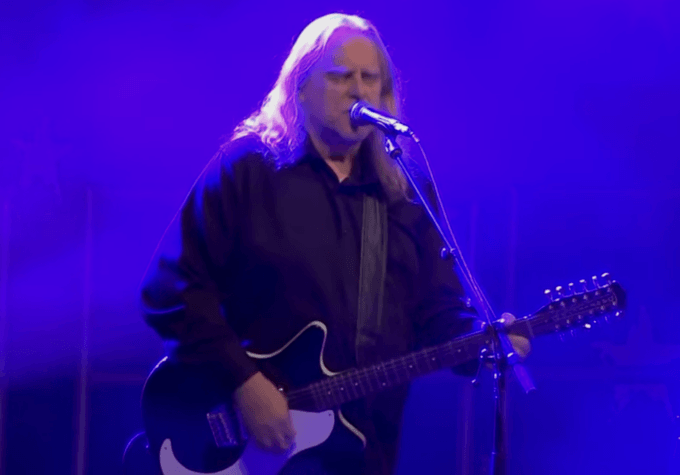
Warren Haynes performing at South Farms in Morris, Connecticut. Still from video posted to YouTube.

Warren Haynes had just moved to the East Village of New York in the summer of 1988. “Born on the edge of a lonely town,” as he described his Asheville, North Carolina upbringing in a song, Haynes would first follow the call of music to Nashville. After touring with The Dickey Betts Band, but before joining the Allman Brothers, and before launching the hard rock jam band, Gov’t Mule, Haynes found himself in his new home on the eleventh floor of an apartment building in what both jingoistic boosters and tough critics have called the heart of the American Empire. With the possible exception of LA, there is no city more associated with the “American dream” than New York. “If you can make it here, you can make it anywhere,” the anthem boasts, but those who don’t make it are often the target of exploitation, abuse, harassment, and hatred. They don’t navigate the bright lights of the dream, but instead live in the shadow side of its nightmare.

“I was looking out from the balcony of my apartment, and I was watching people demonstrate, coming up Houston Street,” Haynes remembered when I interviewed him, “It was a protest after all the homeless people got kicked out of Tompkins Square Park, and they had nowhere else to go.”

The August 6th rally heightened the anger of city officials, who sent Police Captain Gerald McNamara and reinforcements of eighty police officers to the park. The clear attempt at intimidation failed, as the relatively small group of protestors, roughly two hundred homeless and their advocates, street musicians, and youth activists, refused to leave. In response to the demonstrator’s defiance, the police called in the calvary, eventually swelling to the force of four hundred armed officers. Still relentless, the crowd remained stationary; chanting, shouting, and waving placards with messages like, “Gentrification is Class Warfare.”

Radical theorists have often written about how, from the slave patrols to the ICE assault against Latino neighborhoods, law enforcement does not act in the interest of public safety, but instead to guard the economic and racial boundaries of society, ensuring that undesirables stay out while those on the inside remain untouchable. The Tompkins Square Park riot is a perfect illustration. It wasn’t the protestors who rioted, but by the admission of New York’s own police commissioner in a subsequent report, the cops themselves. 38 people sustained injuries so severe that they required hospitalization, over 100 filed police brutality complaints, and even journalists faced the wrath of a maniacal, outlaw police force. Jeff Dean Kuippers, a reporter for Downtown magazine, was there with his Black girlfriend. After a police officer called her a “n****er bitch,” he clubbed Kuippers over the head. The poet Allen Ginsburg witnessed the riot, and later said, “The police panicked” and “started beating people who did nothing wrong.”

“I was relatively new to the New York scene,” Haynes said during our conversation, “It was a heavy moment. Where were all these people going to go?”

As he was “looking out from the balcony,” Haynes wrote the heavy song, “Fire in the Kitchen.” Its thunderous blast of rock music opens Haynes’s debut solo record, Tales of Ordinary Madness. With a voice that shouts in the keys of southern soul, rides down the gravely roads of the blues, and amplifies prophetic rage, Haynes sings of a scene that is Biblical in its depiction of the rich versus poor, but all too modern in its iteration: “Bedlam spreading like a rumor / Can’t take people and push them out on the street.” His voice screams in anger over the sight of a “child with a gun…stranded no place left to turn.”

“Fire in the Kitchen” greets the listener like an inferno, telegraphing Haynes’s musical and lyrical commitment. With Steve Holly, of Wings fame, on drums, the opening songs acts as a bridge between the blues-inflected jams of The Allman Brothers and the harder rock of Gov’t Mule. The musical interlude in the middle deconstructs twice only to come roaring back each time. With fitting ferocity, the music punches behind the protest lyrics of Haynes, who had set out to chronicle the condition of American life that he describes as “The realization that no matter what you achieve, there’s always going to be this wall that’s impossible to penetrate. That wall is built and run by corporate greed.”

Tales of Ordinary Madness was originally released in 1993, and is now available in a stunning new remix that, along with the increasingly relevant sociopolitical lyrics, make it sound and feel as if it is brand new. When I asked Haynes about the decision to remix and rerelease his debut record, he said, “Records that were being made in the late ‘80s and early ‘90s were slicker. There was more reverb, more processing and production. It sounded good in accordance with everything that was going on in that time period, but a couple of years later, people started making records more old school with less gloss. I always wanted to hear what it would sound like mixed that way. We got Tim Scott to remix it, and now it sounds much more like I always envisioned it sounding.”

The new version has a rawness that complements Haynes’s blues-inspired guitar playing and Memphis-soul style vocal performances. It also has greater instrumental clarity. The basslines and the keyboards, whether from Chuck Leavell, a Rolling Stones and Allman Brothers Band alum, or Parliament-Funkadelic’s Bernie Worell, snap out of the speaker, helping to create a rich musical universe to support Haynes’s dynamic guitar solos and powerful singing.

The updated sonic quality better aligns with the songs themselves, as Haynes is providing a musical tour of a tattered America, the underside of an empire in decay. It is an America far removed the “gloss” of suburban mansions, high priced car dealerships, and supermarket fashion magazines.

In the middle of the record, there is a funky and jazzy groove that opens the song, “Invisible.” Singing over a steady beat and bassline that sounds straight out of a Family Stone or James Brown records, Haynes introduces the subject of the song: “See these cans / These worn out shoes / This old shopping cart / Full of rusty blues / It’s plain as day / So why do I feel invisible?”

“‘Invisible’ was inspired by an encounter I had on the street in the city not too long after moving there,” Haynes told me, “A guy who appeared to be homeless and was asking for handouts looked at me and said or just implied with his facial expression, ‘Don’t act like you don’t see me.’” The song is from the vantage point of that man, one in a million who pedestrians, like the wealthiest institutions in the most powerful country in the world ignore as a matter of routine, acting as if they are out-of-the-way stationary objects, rather than human beings. The funk and jazz characteristics of “Invisible” allow it to act as a soundtrack of the motion, pace, and rhythm of the multicultural city corner; a motion, pace, and rhythm that the homeless fall into, even as they endure profound alienation.

In the second verse, Haynes turns the man against himself, singing the lines, “If you can’t spare a dime / Brother, can you spare a smile / Instead of looking right through me / Like I was invisible.”

Musically, the song foreshadowed the eclectic, unpredictable, and intense exploration that Haynes would lead as founder and leader of Gov’t Mule. “Invisible” charges through its jazz and funk influences, incorporating elements of blues and rock, as Haynes plays a wild, yet controlled slide guitar. There are moments when he finds new mid-song chord progressions, lending even more dynamism to the composition, and others when he is playing with abandon and fury.

The album closing, “Broken Promised Land,” originated with its title. Haynes said that after the titular phrase entered his mind, the rest of the song came “pouring out.” An emotional, slow burning ballad, Haynes’s voice has the primal passion of Wilson Pickett as he sings of “A boy on the corner selling rock to get you high” and how the poverty, sights of people sleeping on the street, and police violence from “town to burning town” form something far removed from the patriotic promises of July 4th parades and rose-red-white-and-blue colored presidential and senatorial speeches. “This sure don’t taste like freedom / In broken promised land…” Haynes sings before beginning a lengthy guitar solo to end the song. As his blues-soaked notes coagulate with tears, a backup singer cries out; her soulful singing registering the sounds of desperation.

Haynes’s extraordinary musical navigation of America rides on the engine of unpredictable and raucous rock and roll energy. His ability to play guitar solos with escalating rage capture a country where flag-waving promises operate as a cruel taunt to the dying poor. The songs fall into two categories: Those, like “Invisible,” “Fire in the Kitchen,” and “Broken Promised Land,” that place the listener behind the eyes of the Americans who live among the debris of shattered hopes and expectations, and those that adopt the voice of the powerful; the “movers and shakers” who build their empires on the blood, sweat, and tears of the dispossessed; those whose palaces cast a cold shadow over the squatters in Tompkins Square Park, the teenagers selling crack rocks, and the single parents pushing shopping carts through the street.

The aptly named “Movers and Shakers” is a seven-minute piece of rock-soul that takes as its immediate subject the “legendary assholes,” to use Haynes’s phrase, within the record business, but the subject enlarges to encompass a system of severe stratification. It could apply to nearly any major industry: Silicon Valley, oil and gas, or health insurance. A CEO sits in a garish office overlooking life on the street far below. “It used to be your world / I guess you got your tired of that…” Haynes sings. The chorus sketches a different world for the wealthy magnate: “Movers and shakers / Big dealmakers / Acres of corruption in this little big town…”

The song offers the hope of justice: “The Titanic was unsinkable,” Haynes shouts in the style of a blues preacher, “Nobody’s too big to fall.”

Any sense of hope is long gone in “Sister Justice,” an angry rock song sung from the perspective of a power elite who dictates to his audience of common workers and middle class strivers, “Instead of masquerading as someone who cares / I’ll be there when they push you down those golden stairs…Do your dirty work / But don’t come crying to me.” In “Sister Justice,” Haynes’s voice takes on menacing tones, especially as it becomes clear that the confessor is not lamenting, but celebrating the conditions that he describes: “Tears in your coffee, dirt in your dreams / The rich get richer while the poor man screams / Got the boys in battle / Face down in the mud / On foreign soil trading oil for blood.”

In “Power and the Glory,” Haynes enlists three legendary keyboard players – Chuck Leavell on organ, Bernie Worell on clavinet, and Johnny Neel of The Allman Brothers Band on Wurlitzer – and saxophonist Randall Bramblett, who had played with, among others, Bonnie Raitt and Robbie Robertson. The low bass line, eclectic keyboard extravaganza, and doubling of sax and guitar create a rich, dramatic musical universe ideal for the story of the song. Beginning with a “party in the valley,” the “gracious host” asks, in what Haynes describes as the key line of the song, “How many judges are in your pocket, cause that’s what separates the men from the boys?” It all ends with someone being “crude” and someone else being “crushed.” The act of sexual harassment doesn’t worry the wealthy perpetrator who orders his “boys” to “clean it up” before “riding into the sunset in his trusty limousine.”

“It’s about how people behave with unnecessary levels of wealth and power,” Haynes told me. It moves with an irresistible groove, and yet Haynes’s voice returns to dark, malevolent form when he sings in the voice of the cruel character, “Place no others before me / They might get chewed up, used up / That’s the way it goes / Up here in the power and the glory…”

There is a mid-album break in the chronicle of the nightside of America for lust and romance with “I’ll Be the One,” a sweeping six minute ballad that features a beautiful vocal over poetic lyrics, and the newly added, “Tear Me Down,” a funk-rock number that Haynes would later repurpose for Gov’t Mule. The rest of the album’s songs of rage and despair fall into the classification of the album’s title, Tales of Ordinary Madness, a phrase that Haynes borrowed from a short story collection of the late Charles Bukowski.

“I had just read his book, and it’s pretty dark,” Haynes said during our discussion, “Of course, song lyrics and literary writing are completely different, but there was a strong overlap there, especially in the exploration of the human psyche and the aforementioned ‘wall’ of corporate greed.”

Charles Bukowki began as an underground writer within the Los Angeles literary scene and alternative press, writing poems, short stories, and novels that chronicled the fleeting highs and fatal lows of residents of Skid Row, all night bar flies, drug addicts and alcoholics, habitual gamblers, petty criminals, and characters cast into permanent exile on the bloody edges of American experience. The brutality of his work invited accusations of misogyny and misanthropy, and some of it, particularly the later novels that descended into self-parody, fit the bill, but his artistic triumphs, whether in narrative or verse, build a world that is uniquely his own, casting light on those that TV ads and mayoral speeches prefer to keep in the dark, all in a voice that, like Haynes’s lyrics of social conscience, manages to combine compassion with anger.

Bukowski’s Tales of Ordinary Madness opens with “A .45 to Pay the Rent,” a glimpse into the life of a family living in destitution. After allowing his daughter to fill his shopping cart with too many items in the grocery story, a young father returns home to a dingy apartment only to get into an argument with his girlfriend, the young girl’s mother, about their emptied-out finances. Their argument is obscene, crackling with the threat of violence. Then, the man grabs his gun, declaring that “This is the only justice in America. This is the only thing anybody understands.” She begs him not to “go out,” but he insists that he has no choice. The story ends with the mother reading her daughter a bedtime story, while the father scouts liquor stores and gay bars to rob.

“A Dollar and 20 Cents” places the reader beside a “bum at 60,” a man who had a “hell of a childhood and hell of a manhood,” but lost everything in recent years. He wanders the beach early in the morning, gazing out at water that looks “dirty and deathly.” After enduring disrespect from teenagers, he counts the money to his name – the same amount in the story’s title – and goes home to a flophouse. The landlady brings him a cup of “piss-yellow” chicken soup “without the meat.” He waits until she leaves, and dumps it outside in an attempt to spare her feelings. He lays down, listens to the ocean, takes a “large sigh,” and dies.

There is a countercultural kinship between Haynes and Bukowski, and their respective “Tales.” They both use artistic powers, whether it is Bukowski’s economy of language or Haynes’s vocal strength and guitar virtuosity, to give humanity to those who America’s competitive, consumer-based society has often deemed less than human. Their “tales of ordinary madness” emphasize that much the of experiences and travails that surround us are truly insane, but because much of politics, the press, and pop culture have reacted to them with dismissal or self-serving propaganda, they’ve become ordinary. The “fire in the kitchen” that burns while the police assault street musicians to empty out a public park, like the lonely death of a hungry, 60 year old man in a wealthy nation, should outrage everyone, but under the cover of official and unofficial lies, these episodes are just life in the big city.

Art can combat complacency. Haynes and Bukowski enlisted their efforts into that mission, but they also had crucial networks of support. City Lights Books, the publishing arm of the countercultural bookstore in San Francisco, where the Beat poets and Jerry Garcia hung out between the stacks, published Bukowski’s “Tales,” while Megaforce Records put out Haynes’s debut. Megaforce is the label that first offered a contract to Metallica, and many other thrash bands. Haynes recalls the “passion” of everyone involved with the company, and that he was happy to join a company that sponsored bands like King’s X and Living Colour. Companies like Megaforce and City Lights were not in the mainstream, but they had the ability to break through to the heart of commercial culture. Charles Bukowski became something of a literary folk hero, with the adaptation of his work in two American films and three foreign films. Haynes’s Tales of Ordinary Madness would receive favorable reviews from the Chicago Tribune and Rolling Stone, and his next project, forming the band of Gov’t Mule, would lead to over thirty years of success in the jam and blues-rock music worlds.

The infrastructure necessary to support artists of the counterculture is now in later stages of decay. Although Megaforce and City Lights are still operational, many small publishers, labels, and alternative newspapers have shuttered. The internet promised a proliferation of diverse voices, but instead it helped to concentrate more power in the hands of fewer moguls. Even major newspapers, like the Washington Post, cannot withstand the onslaught of high tech raiders. In 2010, there were dozens of independent publishers in Chicago. Now, there is one.

Fittingly enough, one of the most intense and impactful musical moments on Haynes’s record deals with the death of independent media and genuine artistry. “Blue Radio,” an eight minute epic, opens with a reggae rhythm and ends with an explosive guitar solo. In between, Haynes sings of the greed, degradation of culture, and cost cutting that suffocated the spirit of rock and roll, and cheapened the beauty of America’s greatest cultural export. “Where did you go, blue radio?” Haynes cries out before eventually concluding, “There’s too much green in between me and you…”

“Those golden dreams, why did they have to go?” Haynes sings. It is a question that, listening to the new remix Tales of Ordinary Madness, 23 years after the record’s initial release, haunts all of the songs. On the shortest song of the record, the blazing rock number, “Kiss Tomorrow Goodbye,” Haynes shouts out in anger over how xenophobia and short term, shallow thinking are killing the future. Years later, the late philosopher, Mark Fisher, would write about how we live in a world haunted by lost futures – the lost futures of broken promises, the lost futures of the dreams of social justice and progress that did not come true.

With extreme income inequality, homelessness rising as rents increase to exorbitant levels, and ICE, the goon squad of the Trump junta, abducting, assaulting, and even killing innocent people, Haynes’s artistic advancement of protest against the madness of the American experience has grown only more relevant and more powerful.

David Masciotra is the author of six books, including Exurbia Now: The Battleground of American Democracy and I Am Somebody: Why Jesse Jackson Matters. He has written for the Progressive, New Republic, Liberties, and many other publications about politics, literature, and music. His Substack is Absurdia Now.

Monday, January 13, 2025

LA WILDFIRES UPDATES

The scramble to rescue thousands of animals as Los Angeles wildfires rage


02:06
Horses at the Los Angeles Equestrian Center. © AFP

Issued on: 13/01/2025 - 
Video by: Sam BALL

As wildfires raging around Los Angeles force tens of thousands to flee their homes, activists, vets and volunteers across the region are scrambling to shelter thousands of animals that have been left homeless by the blazes, some in need of treatment after suffering injuries. At one LA equestrian center, hundreds of horses, along with donkeys, pigs and ponies, have already been taken in.

ATF hones in on new theory as to what ignited massive California wildfire: report

Daniel Hampton
January 13, 2025
RAW STORY


A firefighter works as the Palisades Fire, one of several simultaneous blazes that have ripped across Los Angeles County, burns in Mandeville Canyon, a neighborhood of Los Angeles, California, U.S., January 12, 2025. REUTERS/Ringo Chiu

Federal authorities were reportedly looking at a new theory as to what may have ignited one of several massive wildfires in California.

NBC News correspondent Liz Kreutz spoke with MSNBC anchor Nicolle Wallace on Monday about the latest reporting into the California wildfires, which have left at least two dozen dead and scorched more than 38,000 acres.

Kreutz told Wallace that while wildfire investigations can take weeks or months — or even a year — to determine the exact cause of a blaze, investigators with the Bureau of Alcohol, Tobacco, Firearms and Explosives, or ATF, are in the Los Angeles area trying to do just that.

And they may have a lead.

"They're not ruling anything out but their line of investigation is going towards that it could be human-caused," said Kreutz. "Something that's indicating that is that there was actually a fire on New Year's Day in that exact same area where it's believed the Palisades Fire began. The thought is that maybe that fire was never fully put out and then when those winds came last week, it sort of re-ignited it. And that could potentially be what led to this fire."

Kreutz added investigators are looking into what caused that blaze, including fireworks or an encampment.

The Eaton Fire, she said, may have been a power issue, which has sparked other wildfires in the state, including the deadly Camp Fire.

Watch the clip below or at this link.


Wildfire relief tied to debt ceiling? Trump, GOP spark outrage after Mar-a-Lago meeting


Donald Trump gestures, as he attends a press conference on "Trump Will Fix It", at Mar-a-Lago, in Palm Beach, Florida, U.S., October 29, 2024. REUTERS/Marco Bello

David Badash
January 13, 2025
ALTERNET

House Republicans, especially the California delegation, are facing sharp criticism after spending portions of the weekend with President-elect Donald Trump at his Mar-a-Lago resort and residence. They reportedly discussed ways to take the unprecedented approach of tying passage of relief funds—for the Golden State’s historic wildfire disaster—to raising the debt ceiling, as the fires continue to burn and the death toll rises to 24 people.

“Of the nearly two dozen House Republicans who attended the Sunday dinner at Mar-a-Lago, where this option was discussed, several are caucus leaders and appropriators with major influence in upcoming budget reconciliation and government funding negotiations,” Politico reports. “Trump also discussed the wildfires Saturday night with a group of House Republicans from California, New York and New Jersey.”


According to J.D. Wolf of MeidasTouch News, the California GOP members of Congress “chose to leave the state at its most vulnerable moment,” and “have drawn criticism for abandoning their … state during the crisis, opting instead to join Donald Trump at Mar-a-Lago.”

“California [GOP] Representatives Jay Obernolte, Tom McClintock, Kevin Kiley, Doug LaMalfa, Darrell Issa, Ken Calvert, Vince Fong, and Young Kim were spotted in a photo with Trump this weekend when they could have been back home seeking ways to help even if the fire isn’t in their district,” he declared. “Instead, these lawmakers have prioritized meeting with Trump over exercising leadership in their home state. Their absence sends a troubling message to their state.”

In a stern rebuke, Wolf added: “In doing so, they have not only abandoned their duty to Californians but also cast doubt on their priorities and dedication as elected officials.” He also wrote: “Californians are left wondering if these leaders will ever prioritize their needs over political maneuvering.”

One House Republican from California was “not invited,” according to Politico’s Meredith Lee Hill.

“But all the talk of unity at Mar-a-Lago this weekend only went so far – Trump did not invite David Valadao (R-Calif.), 1 of the 10 House Rs who voted to impeach after Jan. 6, to the mtg of CA, NY and NJ GOP members.”

Valadao’s presence would have made sense. Hill reports he is a caucus chief and senior appropriator.

Trump, who has a history of trying to withhold relief aid to California, has been accused of politicizing the tragedy, which Politico notes, “could become the costliest natural disaster in U.S. history.”

It may become even more costly.

The Associated Press reports, “firefighters are preparing for a return of dangerous winds that could again stoke the flames on Monday.”

Over the weekend, on his social media website, Trump reposted this:

View the social media post above or at this link.


'They don't deserve anything': GOP senator says CA wildfire victims shouldn't get aid

Daniel Hampton
January 13, 2025 
RAW STORY

Remains of a Tesla electric car, destroyed by the Palisades Fire are seen, at the Pacific Palisades neighborhood in Los Angeles, California, U.S. January 13, 2025. REUTERS/Mike Blake

A firebrand Republican senator said Monday that California wildfire victims don't deserve federal aid because they elected Gov. Gavin Newsom

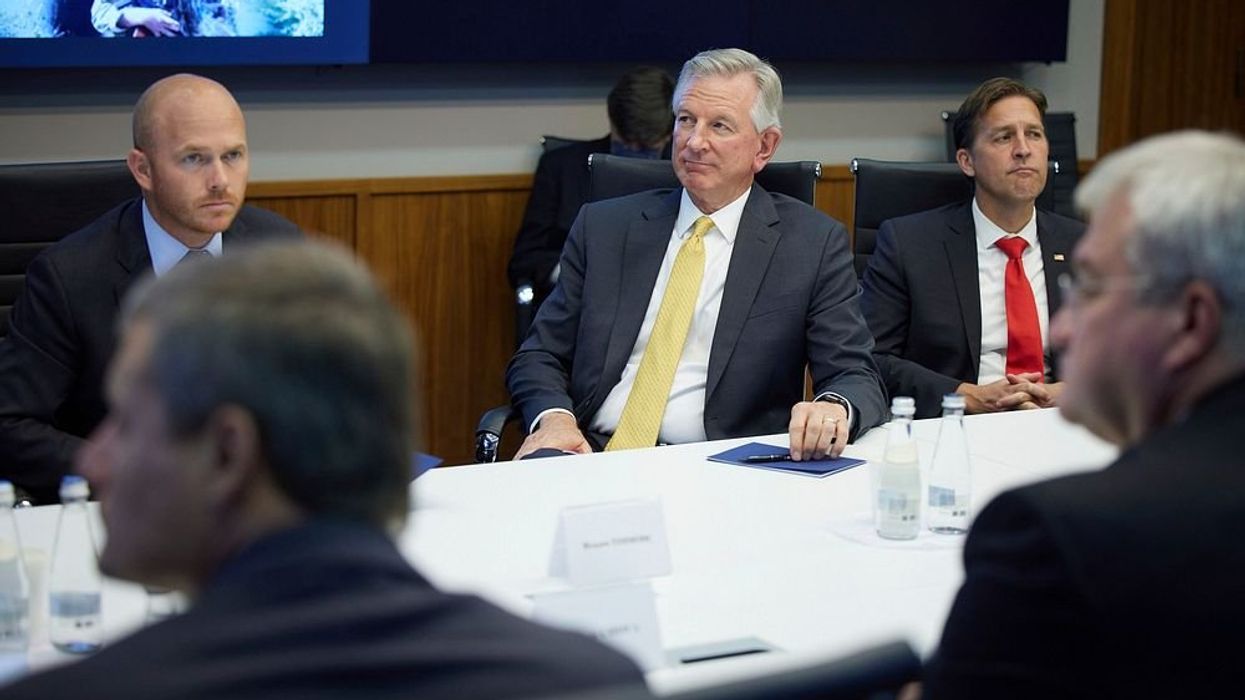
Sen. Tommy Tuberville (R-AL) joined the right-wing Newsmax network with host Chris Salcedo on Monday afternoon to talk about the fires, which have left at least two dozen dead.

"Speaking of flushing money down the toilet, California Democrats are asking the 49 other states for a bailout after Democrat policies destroyed Los Angeles in these latest wildfires," Salcedo said. "Gavin Newsom has said it's going to take billions just to rebuild California after these wildfires that have been devastating because of Democrat policies. This after California lawmakers drove insurers out of the state, leaving homeowners unprotected."

After the long wind-up, Salcedo finally asked Tuberville his question: "Why should taxpayers in your home state of Alabama and my home state of Texas continue to bail out states that continue to vote for Democrats time and time again despite their continued record of failure?"

Before allowing his guest to answer, Salcedo pointed to the earnings of Los Angeles' fire chief: $750,000, higher than the president and governor combined.

In response, Tuberville flatly rejected the idea of sending aid to wildfire victims.

"We shouldn't be. They got 40 million people in that state and they vote in these imbeciles in office and they continue to do it. And there's a very small part of them in that state that's doing it," said Tuberville.

He added that California has many Republicans who are "good people" and that he "hate[s] it for them."

"They are just overwhelmed by these inner-city, woke posses with the people that vote for them. I don't mind sending them some money, but unless they show that they're going to change their ways and get back to building dams and storing water, doing the maintenance with the brush and the trees — everything that everybody else does in the country and they don't do it — they don't deserve anything, to be honest with you unless they show us they're going to make some changes," said Tuberville.

Watch the clip below or at this link

.

'California helps fund Tuberville’s Alabama': Senator blasted over saying state doesn’t 'deserve' aid


Image via RawPixel/Creative Commons.

ALTERNET
January 14, 2025

Senator Tommy Tuberville (R-AL) was blasted over his comments during an interview with the conservative news outlet, Newsmax, on Monday about California's need for government aid as fires continue to rage across LA, leaving residents homeless, and without basic necessities.

Newsmax host Chris Plante asked Tuberville, "Why should other states be bailing out California for choosing the wrong people to run their state?

The Alabama lawmaker replied, "We shouldn't be. They've got 40 million people in that state, and they've voted these imbeciles in office, and they continue to do it. If you go to California, you run into a lot of lot of Republicans — a lot of good people, and I hate it it for them. But they are just overwhelmed by these inner city, woke policies, with the people that vote for them."

He added, "And I don't mind sending them some money, but unless they show that they're gonna change their ways, and get back to building dams, and restoring water and everything everybody else does in the country, and they refuse to do it, they don't deserve anything to be honest with you unless they show us they're gonna make some changes."

Former US attorney Joyce Vance replied, "In 2020, Alabama got $2.17 for every $1 paid in fedl taxes," and included a link to the report for proof.

She added, "In 2023 the fedl govt sent over $64 billion through direct payments, contracts, grants & other forms of financial assistance to Alabama, making putting it among the most federally dependent states in the nation."

Former MSNBC host Mehdi Hasan added: "California helps fund Tuberville's Alabama."

Crooked Media founder and former speechwriter for ex-President Barack Obama, Jon Favreau, commented: "We've already got multiple Republicans in Congress - including the Speaker of the House - on record saying that Republican-controlled Washington will only help Republican-controlled states."

Ahmed Baba, a columnist for the Independent, added: "Trump is 100% going to withhold aid from blue states in an effort to force them to comply with parts of his agenda. And apparently a lot of Republican lawmakers will help him do it."


'It will never end': Dem condemns House speaker's desire for 'conditions' on CA fire aid

Jennifer Bowers Bahney
January 13, 2025 4:51PM ET
RAW STORY

(Philip Yabut / Shutterstock)

Florida Democrat Rep. Jared Moskowitz called out House Speaker Mike Johnson's (R-LA) assertion that he wants "conditions" put on federal aid to the blue state of California.

Johnson told CNN's Manu Raju on Monday, "Obviously, there's been water resource mismanagement, forest management mistakes, all sorts of problems. And it does come down to leadership. And it appears to us that state and local leaders were derelict in their duty in many respects, so that's something that has to be factored in."

Johnson added, "I think there should probably be conditions on that aid. That's my personal view, we'll see what the consensus 

Republicans, including President-elect Donald Trump, have been deeply critical of Gov. Gavin Newsom's (D-CA) handling of the blazes that have reportedly killed 24 people and destroyed or damaged an estimated "12,000 houses, businesses, schools and other structures."

Moskowitz warned Johnson on social media that the tit-for-tat of involving politics in allocating relief aid would have dire consequences.

"This is a Mistake. If you start this, it will never end. When Dems retake the House, they will condition aid to Florida and Texas. Disaster Aid must stay non partisan. I would fight democrats should they try and do this. The Speaker can find many other ways to hold people accountable."

Politico reported Monday that a "group of House Republicans and President-elect Donald Trump talked about tying wildfire aid to a debt ceiling increase Sunday night, as the fires spreading across huge swaths of Los Angeles are estimated to become one of the costliest natural disasters in U.S. history."

Johnson was not present at the Mar-a-Lago dinner where the debt ceiling increase was reportedly discussed, but he was asked about the possibility by Raju.

"There's some discussion about that but we'll we where it goes," Johnson answered.

Watch the clip below or at this link.


California governor spars with Musk over wildfire ‘lies’


By AFP
January 13, 2025


California is battling a spike in online misinformation about the Los Angeles wildfires - Copyright GETTY IMAGES NORTH AMERICA/AFP MARIO TAMA


Anuj CHOPRA

California Governor Gavin Newsom has accused tech billionaire Elon Musk of spreading “lies” about the state’s response to deadly wildfires ravaging Los Angeles, escalating their online row over swirling misinformation.

President-elect Donald Trump and Musk — the Tesla and SpaceX owner poised to play a key role advising the incoming administration –- have stepped up criticism of the governor’s handling of the devastating blazes that have killed at least 24 people and displaced tens of thousands.

In a post on his social media platform X, Musk blamed the huge loss of homes in Los Angeles on “bad governance at a state and local level that resulted in a shortage of water.”

“(Musk) exposed by firefighters for his own lies,” Newsom posted late Sunday, alongside a video clip showing the tycoon asking a firefighter whether water availability was an issue.

The firefighter replied there was water in “several reservoirs,” and added that battling large-scale fires required supplementing the effort with water trucks.

In a separate spat over the weekend, Newsom accused Musk of “encouraging looting by lying,” after the billionaire amplified a post on X that falsely claimed the governor and his fellow Democrats had “decriminalized looting.”

“It’s illegal — as it always has been,” Newsom responded, amid concerns of a looting spree in areas where people were forced to flee the fires.

“Bad actors will be arrested and prosecuted,” he added.


– Viral, misleading videos –


Musk’s personal account on X, which has more than 212 million followers, has become increasingly influential and has often courted criticism for amplifying misinformation.

The platform — previously called Twitter, which Musk purchased in 2022 for $44 billion dollars — has seen an explosion of right-wing misinformation about the deadly wildfires, researchers say.

Even though months of dry weather and strong winds created optimal conditions for the wildfires, narratives on X have singled out the state policies such as practices to increase diversity in the Los Angeles fire force as a culprit.

One viral video debunked by the misinformation watchdog NewsGuard had falsely claimed fire department officials were desperately using women’s handbags to fight the flames because their resources had been diverted to “woke causes” and war assistance to Ukraine.

But the water-filled pouches seen in the video were actually “canvas bags,” carried by firefighters because they were easier to use to extinguish small sets of flames than having to hauling out a hose, the entertainment news site TMZ cited local officials as saying.

Wildfire misinformation was also swirling on other platforms including the Meta-owned Facebook.

Authorities recently warned of a false Facebook post urging people to travel to California to join a clean-up crew in areas affected by the wildfires.

“We would like to clarify that there is no such opportunity available,” the state’s fire protection department wrote on its website.

Meta triggered a global backlash last week after it announced it was scrapping third-party fact-checking in the United States and introducing a crowd-sourced moderation method similar to X.

Disinformation researchers have criticized Meta’s policy overhaul, which came less than two weeks before Trump takes office, warning that it risked opening the floodgates for false narratives.

Facebook currently pays to use fact checks from around 80 organizations globally on the platform, as well as on WhatsApp and Instagram. AFP currently works in 26 languages with Facebook’s fact-checking scheme.

Devastating LA fires prompt 2028 Olympics debate


By AFP
January 13, 2025


Wildfires ravaging Los Angeles have sparked debate over the city's hosting of the 2028 Olympics - Copyright AFP Georges BENDRIHEM
Rob Woollard

The Los Angeles wildfire disaster has cast a shadow over preparations for the 2028 Olympics, raising questions over whether the city can deliver a safe and successful Games.

So far, none of the more than 80 venues due to stage Olympic competition in Los Angeles have been directly affected by the infernos that have left at least 24 people dead and reduced entire neighborhoods to smouldering ruins.

But experts say the ongoing disaster has underscored the challenges of staging the world’s largest sporting event in a region increasingly under threat of wildfires.

“The situation is clearly grave and given the prospect of significant climate change, you do have to wonder whether the current situation might be repeated, possibly even during the Games,” Simon Chadwick, professor of sport and geopolitical economy at Skema Business School in Paris told British daily The iPaper.

“This raises very serious questions, not least about insurance, and whether Los Angeles’ big-ticket 2028 attraction might be about to become an uninsurable mega-event.”

While the flames that razed Pacific Palisades came uncomfortably close to the Riviera Country Club — which will host 2028’s Olympic golf tournament — the overwhelming majority of venues are situated outside what would be regarded as high-risk fire zones.

Historical data, meanwhile, indicates that the chances of a similar disaster erupting during the 2028 Olympics are highly unlikely.

Prior to last week, no fire in Los Angeles County had appeared on a list of the 20 most destructive fires in California history, according to statistics provided by CalFire, the state’s fire agency.

The 2028 Olympics will also be taking place in July, a time of year when there are no Santa Ana winds, the powerful seasonal gusts widely seen as the biggest factor behind the unprecedented scale and scope of last week’s carnage.

And Los Angeles has already staged the Olympics successfully on two occasions — in 1984 and 1932.

– ‘Wake-up call’ –

Nevertheless, Dan Plumley, sports finance expert at Sheffield Hallam University, said the fires would have set alarm bells ringing among Olympic organizers.

“Organising committees will have factored these events into their planning but you’re very much working on a contingency basis — how much do you reasonably budget for this and how cautious or not cautious are you going to be?” Plumley told the iPaper.

“How much risk they want to build in, we’ll have to wait and see but these fires will have acted as an enormous wake-up call.”

Pennsylvania State University professor Mark Dyerson meanwhile floated the idea of the Olympics being moved to 2024 hosts Paris if LA was unable to deliver the games.

“They could go back to Paris,” the academic told the New York Post. “It would be unfortunate, but I’m sure they have some kind of committee — the IOC is a huge bureaucracy — that allegedly looks at contingencies.”

California Governor Gavin Newsom however told NBC’s “Today” morning program that planning for the 2028 Olympics and the FIFA World Cup in 2026 — where eight matches take place in Los Angeles — was on track.

Newsom said the flurry of major sporting events in Los Angeles over the next few years — the city will also host the Super Bowl in 2027 — should be seen as an opportunity.

“My humble position, and it’s not just being naively optimistic, (is) that only reinforces the imperative (of) moving quickly, doing it in the spirit of collaboration and cooperation,” Newsom told NBC.

Conservative pundits however have wasted no time in demanding that Los Angeles be stripped of the Olympics.

“The Los Angeles Olympics should be cancelled,” right-wing provocateur Charlie Kirk wrote on X last week.

“If you can’t fill a fire hydrant, you aren’t qualified to host the Olympics. Move them to Dallas, or Miami, so the world’s athletes can compete in a place capable of actually safely building and running something.”

Los Angeles 2028 organizers did not immediately respond to requests for comment.

Los Angeles fires deliver latest blow to embattled Hollywood


By AFP
January 13, 2025


The wildfires raging around Los Angeles have also disrupted the economy as awards shows and film production have ground to a halt. — © AFP Patrick T. Fallon
Andrew MARSZAL

As Los Angeles is gripped by wildfires that resemble a Hollywood disaster movie, the city’s vast entertainment industry is already counting the costs of yet another drastic setback that its workers can ill-afford.

Actors, crew, writers and producers have lost their homes; film and television productions have been temporarily halted; and calls are mounting for Hollywood’s award season to be canceled.

At least five people have been confirmed killed in the fires. — © AFP

It comes with Los Angeles’s entertainment sector — worth $115 billion to the region’s economy — already in dire straits, as some film and TV productions abandon the city over high costs. The Covid-19 pandemic and recent labor upheavals have also taken their toll in recent years.

“Hollywood, as everyone, was hit by the pandemic with severe consequences. The strikes, obviously, affected the industry, probably forever,” said Marc Malkin, senior culture and events editor for trade magazine Variety.

“Add the fires to that, and Hollywood is just being hit over and over again.”

Stars including Anthony Hopkins, Mel Gibson and Billy Crystal have lost their homes to the past week’s blazes.

But that is only the tip of the iceberg, with thousands of houses destroyed across a city that is home to 680,000 people employed in the entertainment industry or service jobs directly supporting it.

“Grey’s Anatomy,” “NCIS,” “Hacks” and “Fallout” are among more than a dozen Los Angeles-based TV productions that have seen their sets go dark since the fires broke out.

Parts of the city where major soundstages are located, including Burbank, were threatened by the fires, but have so far been spared.

But Film LA, which handles permissions for outdoor movie and TV shoots, warned producers working in or near evacuation zones to “expect to have your permit canceled,” and advised others that on-set safety supervisors would be in short supply.


Smoke and flames from the Palisades Fire burn toward the Encino neighborhood of Los Angeles, California – Copyright AFP AGUSTIN PAULLIER

With dense smoke and soot cloaking the entire region, even productions hoping to film further afield are affected.

“If you’re shooting outside in Los Angeles right now, not great. The air quality is that bad,” said Malkin.

– ‘Glitz-and-glamor’ –

There is no word yet on when productions will resume. Aside from the many logistical issues, the industry must consider the optics of returning to normal while swaths of Los Angeles are aflame.

Nowhere is this issue more delicate than with Hollywood’s ongoing award season — an endless series of swanky premieres, galas and prize-giving ceremonies that is currently on hold.

Events including the Critics Choice Awards show have been delayed, and Los Angeles premieres for films like Pamela Anderson’s “The Last Showgirl” and the Robbie Williams biopic “Better Man” were scrapped last week.

The cancellations even extended to New York, where a premiere for hit Apple TV show “Severance” was aborted.

“The studios, the streamers, are having the right response by canceling or postponing glitz-and-glamor events,” said Malkin.

“For people to walk the red carpet, all glitzy and glamor-y, while Los Angeles is literally and figuratively burning… it would be a little disconcerting to hear people either talking about their fashion or that ‘silly story from set.'”

Even the televised announcement of this year’s Oscars nominees has been delayed.

“So many of our members and industry colleagues live and work in the Los Angeles area, and we are thinking of you,” Academy CEO Bill Kramer wrote in a message to members.

“Hacks” actress Jean Smart has advocated going a step further, and scrapping the entire season.

“With ALL due respect, during Hollywood’s season of celebration, I hope any of the networks televising the upcoming awards will seriously consider NOT televising them and donating the revenue they would have garnered to the victims of the fires and the firefighters,” Smart wrote on Instagram.

While few in Tinseltown are in the mood for celebrating, Malkin warned that canceling the entire season would have devastating ripple effects on hair-and-makeup artists, waiters, drivers and security staff.

“Yes, the celebrities are going to be okay, financially,” he said.

“But when you think about all the people who staff these various award shows, these are gig workers who rely on these paychecks… it would have a devastating effect.”