Showing posts sorted by date for query RWDSU. Sort by relevance Show all posts

Saturday, August 02, 2025

Indonesian Fishers Respond to Bumble Bee's Attempt to Dismiss Forced Labor Suit


Friday August, 01 2025
Greenpeace
San Diego, California -


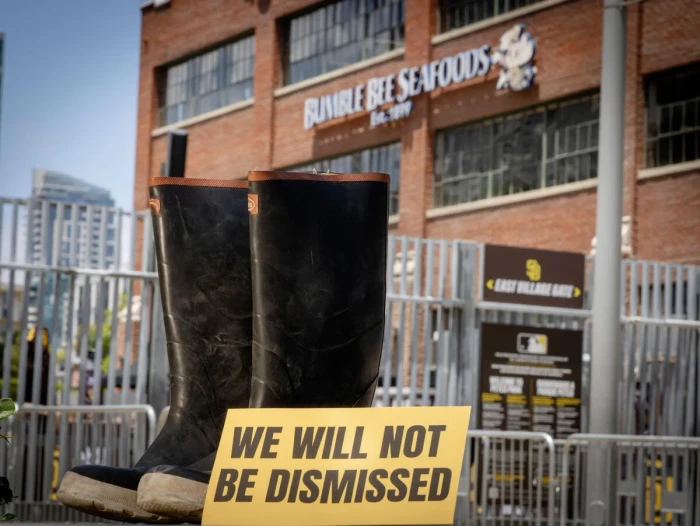
Indonesian fishers who sued Bumble Bee, alleging years of forced labor while catching fish sold by the U.S. tuna brand, responded to the company's motion to dismiss their suit, arguing in the U.S. legal filing on July 31 that they have a right to have their allegations heard in court. This image was taken by Greenpeace USA activists in solidarity with these fishers. (Photo: Sandy Huffaker/Greenpeace)

On July 31, Indonesian fishers who sued Bumble Bee, alleging years of forced labor while catching fish sold by the U.S. tuna brand, responded to the company’s motion to dismiss their suit, arguing that they have a right to have their allegations heard in court.

The reply contends that, the plaintiffs plausibly allege, and Bumble Bee does not dispute, that the plaintiffs were forced to labor by the vessel owners and argues the company was long specifically aware of such abuses in its supply chain, asserting this meets the Trafficking Victims Protection Reauthorization Act (TVPRA) standard. The reply also defends the plaintiffs’ negligence claims, stating Bumble Bee’s actions created both risk of forced labor and incentive for the vessel owners to abuse the plaintiffs.

The fishers filed suit against Bumble Bee in March under the TVPRA, one of the first times the seafood industry has been challenged under this Act in a U.S. court. The four fishers allege conditions of forced labor: that they were held in debt bondage, denied fair wages, isolated at sea for months, and subjected to both physical and psychological abuse while catching tuna that was sold by Bumble Bee in the U.S.

Sari Heidenreich, senior human rights advisor at Greenpeace USA, said: “The plaintiffs’ reply is clear — their case meets the high standards required by U.S. law and should be heard by the court. I am confident they will prevail.”

According to the reply, Bumble Bee sources 95% to 100% of its albacore through its Taiwanese parent company, Fong Chun Formosa (FCF), and a ‘trusted network’ of vessels. The reply argues that many of the vessels in that network, including those “the plaintiffs were forced to work” on, fish exclusively for Bumble Bee. The plaintiffs argue their experiences reflect a broader pattern, partially enabled by Bumble Bee’s continued use of transshipment — a practice widely criticized by experts and increasingly abandoned by other major seafood companies due to its links to forced labor.

Heidenreich continued: “Rather than act to ensure that workers in their supply chain are protected from forced labor and abuse, Bumble Bee has attempted to sweep them aside through a procedural motion. This move is more than just a legal strategy; it is an attempt to avoid accountability, silence vulnerable workers, and protect corporate interests over human dignity. Without attempting to remedy any harms that occurred on these vessels and improving that workplace for current and future workers, this is akin to the practice of ‘cut and run’, which experts agree is irresponsible and leaves workers in an even more vulnerable situation.

“In response to consumer demand, Bumble Bee has allowed customers to trace each can of tuna they buy back to the boat that caught it. But in its Motion to Dismiss, it attempted to distance itself from these same suppliers. Bumble Bee cannot have it both ways. The TVPRA and trade law make clear that corporate responsibility doesn’t stop at the U.S. border. Companies that cannot take responsibility for the products they sell have no business profiting from them.

“A just and sustainable seafood industry must prioritize the well-being of all its stakeholders — from the migrant fishers working under dangerous conditions to the American consumers who have made it clear: they do not want seafood tainted by modern slavery or environmental destruction.”

A letter expressing solidarity with these individuals was released today by 45 organizations from eight countries. The signers, which include the International Transport Workers’ Federation (ITF), the Retail, Wholesale and Department Store Union (RWDSU), Friends of the Earth, and Freedom United, condemn human trafficking, while expressing support for the right of all individuals to seek justice and demand accountability. They also highlight the essential and inseparable relationship between healthy oceans and decent work.

Greenpeace USA continues to call for decisive action from every actor in the seafood supply chain to help end isolation at sea. This includes mandating: Free, accessible, and secure wifi on all fishing vessels to allow fishers to have contact with their families, unions, and governments;
Capping time at sea at three months to reduce the risk of human rights abuse, forced labor, and human trafficking; and
100% human or electronic observer coverage to ensure vital data on catch composition, bycatch, interactions with protected species, and overall fishing practices are reported by independent and impartial parties.

In addition, unionization and the right of association are essential to empowering workers across all parts of the seafood supply chain. Accessible, secure, and responsive grievance mechanisms — available both on land and at sea — must become a standard in the industrial fishing industry. These tools are critical not just for addressing abuses when they occur but also for preventing them in the first place.

At least 128,000 fishers worldwide are victims of forced labor, which is strongly connected to other fisheries-related crimes, such as illegal, unreported, and unregulated (IUU) fishing. These activities significantly contribute to the worsening of the ocean and climate crises.

Thursday, June 05, 2025

US labor unions fight to contain AI disruption

By AFP
June 4, 2025


As artificial intelligence threatens to upend entire sectors of the economy, American labor unions have been scrambling to protect workers - Copyright GETTY IMAGES NORTH AMERICA/AFP/File MARIO TAMA


Thomas URBAIN

As artificial intelligence threatens to upend entire sectors of the economy, American labor unions are scrambling to protect workers, demand corporate transparency, and rally political support—an uphill battle in a rapidly changing world.

“As laborers, the ability to withhold our labor is one of our only tools to improve our lives,” explained Aaron Novik, a key organizer with Amazon’s ALU union.

“What happens when that disappears (to AI)? It’s a real existential issue,” he added.

Automation has already transformed most industries since the 1960s, typically reducing workforce numbers in the process.

But the emergence of advanced “physical AI” promises a new generation of intelligent robots that won’t be limited to repetitive tasks — potentially displacing far more blue-collar workers than ever before.

The threat extends beyond manufacturing.

The CEO of Anthropic, which created Claude as a competitor to ChatGPT, warned last week that generative AI could eliminate half of all low-skilled white-collar jobs, potentially driving unemployment rates up to 10-20 percent.

“The potential displacement of workers and elimination of jobs is a significant concern not just for our members, but for the public in general,” said Peter Finn of the International Brotherhood of Teamsters, America’s largest union.

– Vetoes –

The Teamsters have focused their efforts on passing legislation limiting the spread of automation, but face significant political obstacles.

California’s governor has twice vetoed bills that would ban autonomous trucks from public roads, despite intense lobbying from the state’s hundreds of thousands of union members.

Colorado’s governor followed suit last week, and similar battles are playing out in Indiana, Maryland, and other states.

At the federal level, the landscape shifted dramatically with the change in the White House.

Under former president Joe Biden, the Department of Labor issued guidelines encouraging companies to be transparent about AI use, involve workers in strategic decisions, and support employees whose jobs face elimination.

But US President Donald Trump canceled the protections within hours of taking office in January.

“Now it’s clear. They want to fully open up AI without the safeguards that are necessary to ensure workers’ rights and protections at work,” said HeeWon Brindle-Khym of the Retail, Wholesale and Department Store Union (RWDSU), which represents workers in the retail sector.

– Rush to AI –

Meanwhile, companies are racing to implement AI technologies, often with poor results.

“By fear of missing out on innovations, there’s been a real push (to release AI products),” observed Dan Reynolds of the Communications Workers of America (CWA).

The CWA has taken a proactive approach, publishing a comprehensive guide for members that urges negotiators to include AI provisions in all collective bargaining agreements.

The union is also developing educational toolkits to help workers understand and negotiate around AI implementation.

A handful of unions have successfully negotiated AI protections into their contracts.

Notable examples include agreements with media company Ziff Davis (which owns Mashable) and video game publisher ZeniMax Studios, a Microsoft subsidiary.

The most significant victories belong to two powerful unions: the International Longshoremen’s Association, representing dock workers, secured a moratorium on full automation of certain port operations, while the Screen Actors Guild (SAG-AFTRA) won guarantees that actors must be consulted and compensated whenever their AI likeness is created.

These successes remain exceptional, however.

The American labor movement, as a whole, lacks the bargaining power enjoyed by those highly strategic or publicly visible sectors, said Brindle-Khym.

“Smaller contract-by-contract improvements are a long, slow process,” she added.

Despite frequent accusations by corporate interests, the unions’ goal isn’t to halt technological progress entirely.

“Workers are usually not seeking to stop the march of technology,” noted Virginia Doellgast, a Cornell University professor specializing in labor relations.

“They just want to have some control.”

As AI continues its rapid advance, the question remains whether unions can adapt quickly enough to protect workers in an economy increasingly dominated by artificial intelligence.

Wednesday, April 23, 2025

Balancing Union Support and Worker Control


BOOK REVIEW
By Jaz Brisack
04.19.2025
JACOBIN


To capture the surging pro-union spirit across the United States, unions must be prepared to support worker-led organizing without attempting to control it, writes former Starbucks rank-and-file organizer Jaz Brisack.


Starbucks workers strike outside a Starbucks coffee shop on November 17, 2022, in Brooklyn, New York. (Angela Weiss / AFP via Getty Images)


Review of We Are the Union: How Worker-to-Worker Organizing Is Revitalizing Labor and Winning Big by Eric Blanc (University of California Press, 2025).


This review is part of a series of reviews of Eric Blanc’s We Are the Union. You can read additional reviews in the series here and here. You can read an outline of Blanc’s argument in the book here.

There is no doubt that the “worker-to-worker organizing” model outlined by Eric Blanc in his new book, We Are the Union, is key to union organizing success. Since 2018, my organizing mentor Richard Bensinger, the former AFL-CIO organizing director who has since helped workers organize at companies ranging from Starbucks to Canada Goose, has been kicking off Inside Organizer School trainings by declaring that there are two components to every successful campaign: a strong, representative organizing committee within the workplace; and a hammer — the leverage to force a company to recognize workers’ right to organize. Blanc’s book provides a deep dive into aspects of the former: how workers can take the lead on building vibrant and dynamic union campaigns at their workplaces.

Blanc writes, “Three things in particular define the new model: 1) Workers have a decisive say on strategy, and 2) Workers begin organizing before receiving guidance from a parent union, and/or 3) Workers train and guide other workers in organizing methods.” At times, this definition seems not only expansive but also paradoxical, encompassing everything from the Industrial Workers of the World (IWW)–affiliated Burgerville campaign in the Pacific Northwest to the new leadership of the United Auto Workers (UAW), who came to power through the efforts of a reform movement within the union. The terminology folds in just about every iteration of the recent labor upsurge, despite the significant differences between unions, campaigns, and approaches.

My own experiences as a union organizer — both as an external staff organizer on campaigns as varied as Tesla and Ben & Jerry’s, and as a salt at Starbucks, where I got a job as a barista to help start a union drive — have underscored the crucial importance of worker leadership, local autonomy, and harnessing the camaraderie of the workplace in order to withstand fierce union-busting campaigns. They have also highlighted the need for principled and strategic unions prepared to support worker-led organizing without attempting to control it, while helping win the right to organize through mobilizing the rest of the labor movement and the public around the fight.

Blanc’s book uses case studies to illustrate what worker-to-worker organizing can look like in different contexts and with varied levels of union support. At Colectivo Coffee, workers interviewed unions and found that the International Brotherhood of Electrical Workers would give them the backing to pursue their goal of organizing the entire company; at Burgerville, IWW members got jobs to help kick off a union campaign, then ended up filing for union elections and winning a first contract after other workers pushed to change tactics.

Blanc vividly captures what workers are seeking through unionizing. From Chipotle to Starbucks to Tesla, workers see unions as a path to improving their lives, transforming dead-end and alienating jobs into something better, and making the world a better place. Further, many workers who are passionate about issues ranging from trans liberation to a free Palestine to racial justice see the labor movement as a force that — unlike corporate virtue-signalers or government and nonprofit actors — brings all of these issues together, unites people around class and mobilizes against those responsible for systemic injustices, and is accountable to workers.

In Buffalo, I worked with data analysts at Tesla who wanted to unionize the company’s autopilot division. They were interested in organizing for many reasons, from the fact that they were so monitored (down to the keystroke) that it was often impossible to both meet productivity demands and take a bathroom break, to concerns about CEO Elon Musk’s increasing hostility toward trans workers and other marginalized groups. In choosing a union, they wanted an institution that would devote itself to fighting, while also providing them with the local autonomy that would ensure that Tesla workers were the ones making decisions about campaign and bargaining strategy and that the union did not become a “third party.”

As I write in my forthcoming book, Get on the Job and Organize: The Making of a New Labor Movement, the organizing committee was able to withstand Musk’s retaliatory union-busting actions, including the firing of almost forty workers the day after the campaign went public. But the campaign was stifled by top union leaders who were more interested in questions of credit, control, and jurisdiction than in supporting worker organizing. The new union that took over the campaign didn’t allow the workers to continue self-organizing.The question of balancing institutional support with worker control is a fundamental one for worker-to-worker organizing.

Up to that point, the organizing committee’s internal operations — from managing the union Slack channel to running meetings to deciding on talking points for press conferences — were incredibly democratic and vibrant: workers were having organizing conversations at birthday parties and video game sessions, and coworkers were joining the union as a way to make friends in their often-alienating workplace. Had the labor movement truly embraced worker-to-worker organizing at Tesla, there would likely be a union fighting back against Musk’s actions from within his own company.

Blanc devotes the longest and most detailed case study in his book to Starbucks Workers United, the campaign that I helped launch by getting a job at a Buffalo cafĂ©, recruiting a team of fellow salts, and coordinating our means of holding organizing conversations, moving the campaign as quickly as possible as we began approaching workplace leaders. His analysis of the campaign gets many things right, from the way that we tried to build camaraderie in the workplace to the original scale of the campaign (building union density in the coffee industry in Upstate New York) to the unforeseen nature of the campaign’s exponential growth in the winter of 2021–22.

Other details are less accurate. For example, we didn’t choose to “come out as salts” to our coworkers but were instead outed by union staffers trying to seize control of the campaign. Blanc takes many of the union staffers’ statements at face value, which obscures the more complicated nature of the campaign. In the end, we did not “end up having a union that trusted the workers enough to fund a campaign without trying to control it,” in the words of one of the Workers United staff Blanc quotes.

The question of balancing institutional support with worker control is a fundamental one for worker-to-worker organizing, and Starbucks Workers United is a case study both in how to achieve grassroots empowerment at scale and how unions are often threatened by that very empowerment.

Keeping David From Becoming Goliath

Unions’ approach to organizing often varies greatly by region or by local. We could not have launched the Starbucks campaign without the support of Workers United in Upstate New York and Vermont, where union leader Gary Bonadonna Jr gave us the necessary resources and support to run an experimental, industry-wide campaign without stifling the creativity, spontaneity, and freedom that the campaign needed to thrive.

As the campaign grew, however, the top leadership of Workers United and then of its parent union, the Service Employees International Union (SEIU), were unable to stop themselves from trying to gain control, to the detriment of the campaign. It demonized organizers, both workers and staff, who advocated for consumer boycotts, changes to bargaining strategy, or other deviations from what became the union’s official position. It simply didn’t understand that the union’s independence was a strength, both from the standpoint of organizing new workers and in terms of public messaging.

At a national gathering of Starbucks worker leaders in early 2023, a prominent Workers United leader told the rank-and-file members that “David vs. Goliath” made for a nice story. But, she continued, to be effective, you needed to fight Goliath with Goliath. Ignoring the fallacies of this argument (this biblical match-up led to Goliath’s defeat), it also underscores the extent to which union leadership often tries to squelch the individuality and chaotic nature of worker organizing in the interest of control and centralization

.
A woman holds up a sign as she joins Starbucks workers and other protesters at a rally against union-busting tactics outside a Starbucks in Great Neck, New York, on August 15, 2022. (Thomas A. Ferrara / Newsday RM via Getty Images)

Workers should not have to battle on two fronts to win the right to organize: employer opposition is more than enough of an obstacle. Unions must become better at giving worker-organizers and the unorthodox staff members who support them more freedom to run campaigns, while also committing to the pressure campaigns that will help win first contracts and curb corporate union busting. The very boycotts that Blanc notes helped bring Starbucks back to the bargaining table — the Cornell student activism that caused the university to kick Starbucks off campus and the Palestine solidarity movement that boycotted Starbucks after the company retaliated against the union for standing with Palestine — were met with hostility from the union’s top leadership. In order to scale the Starbucks Workers United model, we need unions that aren’t afraid of true worker power.

Throughout the book, Blanc mentions some of the limitations of the worker-to-worker model, which he writes “will almost always translate into a less tightly run ship.” Salting — the practice of getting a job to help launch a union campaign — can help resolve some of these contradictions. The greatest threat to any organizing campaign is employer opposition: many companies react quickly, by firing workers in retaliation for organizing in an effort to squash the drive before it has a chance to take hold. Speed is critically important in helping campaigns overcome the company’s reaction: historically, staff-intensive approaches like house-call blitzes have helped build organizing committees quickly, to limit the time that a company has to prepare their union-busting onslaught.

On just about every campaign I’ve ever worked on, workers had previously discussed organizing before getting in touch with a union. Sometimes there were prior attempts; often the idea was dismissed as unrealistic. Salting can help provide the needed urgency to turn a conversation into action and to move a campaign quickly.

The role of a salt is often a background one: mapping the workplace and identifying workplace leaders who can carry the campaign to victory, building relationships, and having organizing conversations that make coworkers believe organizing is possible. In other words, a salt can provide a spark that ignites interest that was already present in the workplace. Salting helps overcome corporate union-busting by increasing the likelihood that the campaign can stay underground until workers are ready to quickly begin building an organizing committee. Salting is an invaluable tactic that works across sectors and industries and that can be used to scale campaigns and help ensure victories.

While “autonomous salts” — motivated individuals who decide to take jobs in order to organize but aren’t connected with a union already — have helped kick off many organizing campaigns, undertaking this endeavor without the backing of a committed and strategic union can lead to stagnation and a lack of effectiveness. Choosing an achievable target, joining or recruiting a salt team, and receiving training on effective organizing (from sequencing campaigns to holding organizing conversations) all boost a salt’s chances of organizing their workplace.

Worker-to-worker organizing works best when workers are in collaboration with experienced organizers who can both weigh in with helpful advice and give workers the freedom to make independent decisions, like Richard Bensinger and Adam Obernauer at the Retail, Wholesale and Department Store Union (RWDSU). Thus Blanc’s recommendation that a “young person looking to change the world” should be “getting a job at Amazon to help unionize it” is a good one. However, that person might be better served by looking beyond Amazon and identifying which unions offer the best support and training to salts and worker-organizers, including by committing to a genuine plan to bring the hammer down on the targeted corporation and win the right to organize.

Labor Law to the Rescue


In the book’s final chapters, Blanc credits several factors with helping propel the explosion of worker organizing. He writes that digital tools like Zoom and other online platforms have made it easier for workers and organizers to connect across geographies, explores the progressive attitudes of young workers he surveys, and analyzes government policies that helped create a tight labor market during the pandemic as well as the Biden administration’s attitudes toward labor.

Blanc is certainly correct that reactionaries in government can make it much more difficult to organize. However, when it comes to finding the hammer and forcing companies to respect the right to organize, the Biden administration didn’t provide magic leverage to bring Starbucks (or anyone else) to the bargaining table.

Blanc praises Jennifer Abruzzo and the Biden National Labor Relations Board (NLRB) for allowing store-by-store elections at Starbucks (consistent with decades of legal precedent), increasing workplace access for worker-organizers during nonworking times, and advocating for stronger enforcement of the law. As someone who organized during their tenure, however, I saw many instances where the board allowed companies to get away with egregious actions. Abruzzo declined to pursue many unfair labor practices, including Musk’s mass firing of Buffalo Tesla workers. The regional director of the NLRB in Buffalo — who happened to be married to a corporate-side lawyer — consistently sided with companies, delaying Starbucks stores from filing for elections and declaring nearly a quarter of the bargaining unit at a local grocery store “management” despite all evidence to the contrary.

A Barnes & Noble bookstore in New York, on February 8, 2024. (Angus Mordant / Bloomberg via Getty Images)

Despite his praise for Abruzzo and the board, Blanc correctly acknowledges that even the best-case scenario of an extremely labor-friendly NLRB would still lack the enforcement power to hold companies accountable, due to the extremely weak nature of US labor law. As Donald Trump’s NLRB and its new general counsel reverse what gains labor did make during the previous administration, looking beyond the board for leverage is more important than ever. As we’ve seen recently, companies from Starbucks to Barnes & Noble have proved to be susceptible to boycotts and other pressure campaigns, thanks largely to the public’s growing support for unions. Underscoring this point, Ben & Jerry’s set aside its past anti-union practices and agreed to voluntarily recognize the workers’ union — “Scoopers United” — because the company realized its customer base supported labor and that its social-justice marketing strategy was incompatible with union busting.

Like Blanc, I believe that the labor movement is the only way to meaningfully challenge the rising authoritarian and fascist tendencies within our government, our workplaces, and our society, and to create a more just, equitable, and free world. Blanc’s book, with its wealth of examples and worker voices, contains many crucial lessons that we can carry into this struggle — from the big picture, like encouraging unions to take risks and support organizing efforts that may not result in immediate contract victories but that have the potential to reshape the narrative around union organizing, to the smaller details, like the nuts-and-bolts of avoiding common campaign pitfalls. Few lessons could be more important in this moment.

Contributor
Jaz Brisack is the author of Get on the Job and Organize: Standing Up for a Better Workplace and a Better World. They are a cofounder of the Inside Organizer School, which trains workers to unionize, and a founding member of Starbucks Workers United.

Friday, February 28, 2025


Organized US Labor’s Anticommunism


On December 2, 2024, MLToday posted Ruth Needleman’s review of Jeff Schuhrke’s outstanding book, Blue Collar Empire: The Untold Story of US Labor’s Global Anticommunist Crusade (London:  Verso). Without taking anything away from either the reviewer or the author, I would like to make a few supplementary points.

Needleman credits Schuhrke with providing “a clearly written, comprehensive and meticulously documented account of the AFL-CIO’s decades of subversive actions aimed at dividing, replacing or just destroying labor federations and movements throughout the world.” In the name of fighting communism, this campaign began before the Cold War, peaked during the Cold War and continues after the Cold War  under the auspices of the AFL-CIO’s Solidarity Center. By undermining militant trade unionism and pro-labor political leaders in Europe and the Third World, the AFL-CIO not only palpably worsened the wages and conditions of workers abroad but also injured American workers by diverting resources that could have been used for domestic organizing to the pursuit of the government’s foreign policy objectives and by making these countries more attractive for American capital investment  encouraged the deindustrialization that began in earnest in the 1980s.

All that Needleman says is true, but it leaves out part of the story, namely why did labor play this role?

One could come away from Needleman’s review as well as many other accounts by thinking that labor’s anti-communism just represented a kneejerk response to the Cold War or a kind of psychological disturbance, a form of paranoia. Of course, labor’s anticommunism did reflect the times and had an exaggerated and irrational aspect. Schuhrke, however, explains that  labor’s anti-communism was  rooted in the dominant ideology of the labor movement that emerged under AFL leader Samuel Gompers in the 1890s. This was the ideology of class collaboration. This ideology posited that labor would benefit by cooperating with employers to increase production, productivity and profits and by eschewing strikes and other conflicts and by avoiding  political involvement with any radical movements or parties. This ideology reflected the interests of what Karl Marx called the “labor aristocracy,” the most well-placed members of the labor movement.

The ideology of class collaboration did not reign uncontested. Throughout the history of American labor, another ideology opposed it, namely the ideology of class struggle. His ideology reflected an analysis by Karl Marx and others that under capitalism the interests of workers and capitalists were inherently and inevitably in conflict. Demands for better wages, shorter hours, and safer conditions inevitably conflicted with the capitalists’ desire for greater profits. In this situation, workers could advance only by using strikes, slowdowns, and other means of force to wring concessions from the capitalists.  Early in his career as leader of the Cigarmakers, Samuel Gompers read Marx and more or  less agreed with his analysis and its implications for trade unions. At a time when the Knights of Labor, the largest labor organization of its time, welcomed workers and nonworkers and relied on education and cooperatives to improve the workers’ lot rather than strikes,  Gompers argued that workers needed an organization  exclusively of workers, and one that defended the workers’ right to strike. By the end of the 19th century, as President of the AFL, Gompers changed beliefs and came to embody the ideology of class collaboration, and while not opposing strikes in principle, opposed them in practice.

In opposition to Gompers, the ideology of class struggle gained adherents.  Before World War I the ideology of class struggle was embraced by the William Haywood and the Western Federation of Miners,  Elizabeth Gurley Flynn and the Industrial Workers of the World, the Syndicalist League of North America, and leftwing Socialists like Eugene V. Debs.  In the 1920s and early 1930s, the class struggle  ideology found expression in William Z. Foster and the Communist Party and the Communist-initiated Trade Union Education League, and later the Trade Union Unity League.  From the mid-1930s to the end of the 1940s, militant class struggle ideas served as  the ideology of the Communists and other militants who organized the industrial unions of  the CIO. After the expulsion of the so-called Communist-led unions by the CIO in 1949, the ideology of class conflict was largely confined to those unions that had been expelled and to pockets of Communists and leftists in other unions. George Meany and the leaders of the AFL-CIO trumpeted the dominant ideology of class collaboration.

Leading capitalists and politicians, at least among those not openly hostile to unions, supported the ideology of class collaboration. Promoting this ideology was the raison d’etre of  the National Civic Federation, an organization of capitalists and union leaders formed in 1900, whose first president was the capitalist Republican Mark Hanna and whose vice-president was Samuel Gompers, president of AFL. Thus, the ideology of class collaboration represented the ideology of the capitalists within the labor movement. This ideology did not result in any meaningful gains for workers or labor.  From 1900 until 1935,  most workers labored under subsistence wages, long hours, unhealthy conditions, and less than 10 percent of the workers (mainly skilled workers, and miners and garment workers) belonged to a union.

This situation did not change until the mid-1930s when Communists, Socialists and other militants with a class struggle orientation succeeded in organizing the workers in such mass production industries auto, rubber, steel and electrical, waged successful strikes, won union recognition and collective bargaining agreements, and became the leaders of these unions.

The scandalous foreign policy that mainstream labor pursued and that Schuhrke describes cannot be understood apart from the equally scandalous behavior that most labor leaders followed at home.  Needleman does not fully appreciate this connection. This is reflected by her neglect of Schuhrke’s discussion of the World Federation of Trade Unions (WFTU).

At the end of World War II, unions in the Allied countries formed the WFTU.  This move  was spearheaded by the Soviet trade unions and the CIO. Following  meetings of representatives of the Soviet trade unions and the CIO, the CIO issued a document calling for cooperation of all the trade unions in the allied countries and  the promotion of  peace, justice and prosperity for all workers.  In a preface, Phil Murray, President of the CIO, wrote, “I consider this document of first-rate importance, not only for American labor but for all who are interested in knowing the truth about the Soviet trade union movement and promoting friendship and understanding between the peoples of our two countries.”1

As constituted in October 1945 and headquartered in Paris, the WFTU represented unions in 56 countries, representing 67,000,000 workers.  The largest organizations were those of the USSR, Great Britain, the USA (CIO), Italy, France, and Latin America.  The preamble of its constitution stated that its purposes, among others,  were to organize and unite trade unions in the whole world, to assist workers in less developed countries in forming unions, to fight against fascism, to combat war and the causes of war, to support the economic, social and democratic rights of workers, as well as the worker security and full employment, the progressive improvement of wages, hours and working conditions, and social security for workers and their families.2  Underpinning the WFTU was a shared ideology of militant, class- struggle unionism.

Schuhrke points out that the WFTU and its affiliated unions became the major target of the AFL’s disruptive anticommunist campaign. In 1945, the AFL established a Free Trade Union Committee (FTUC)  which would serve in Schuhrke’s words as “its primary weapon for waging the Cold War.” Initially,  free trade unions referred to unions purportedly not dominated by a Communist state, but “by 1945 the term was being used by the AFL as a synonym for anticommunist unionism. In other words, even if a union were autonomous and democratic, the AFL would still consider it illegitimate and ‘unfree’ if it happened to be led or influenced by communists.” This included, for example, the French CGT (General Confederation of Labor), the largest labor federation in France, two thirds of whose affiliates were led by Communists. After 1949, when the CIO’s expelled its leftwing unions and acquiesced in the Taft-Hartley Act’s requirement that all union officers sign non-Communist affidavits,  the CIO leaders adopted the AFL’s “free trade unionism” position and rejected the WFTU. This meant not only the rejection of unions in Communist countries and unions anywhere led by Communists but also a rejection of the kind of class struggle unionism that these unions represented, that is to say a unionism rooted in the Marxist idea that the essential interests of labor and capital were in conflict, and that furthering the interests of labor required international cooperation and economic and political struggle on behalf of their interests and against the employers.

Support for “free trade unionism” meant that American labor leaders would become adjuncts of American foreign policy.   It also meant adherence to a class collaboration ideology at home. It meant that AFL leaders like George Meany and the UAW (United Automobile Workers) leader Walter Reuther (head of the CIO after 1952) opposed the kind of progressive, class struggle oriented unionism that the WFTU and the CIO had hitherto stood for and adopted  a unionism that prioritized class collaboration, the idea that the interests of workers was best served by cooperating with the employer and the foreign policy operations of the government. After World War II, Walter Reuther, who continues to enjoy an undeserved reputation as a progressive labor leader, actually spearheaded the class collaboration ideology. Schuhrke said, “Instead of a constant struggle for control of the workplace through strikes, slowdowns, and similar militant tactics, Reuther held that unionized workers would gain far more by behaving themselves on the shop floor and boosting production in exchange for getting to partner with government and industry in economic planning.”

Did the class collaboration bring workers and unions the benefits Reuther promised? It opened a spigot of government money to fund labor’s overseas operations, and gained leaders like Reuther a measure of respectability, but  in the main, it produced the exact opposite of what was promised. Labor organizing diminished. The CIO abandoned Operation Dixie, its stillborn campaign to organize the South, which remained ever since a bastion of the open shop and right-to-work laws. After expelling eleven leftwing unions like the United Electrical Workers (UE) and the Farm Equipment Workers (FE) in 1949, the CIO devoted resources to raiding the members of the expelled unions instead of organizing the unorganized. The Communist and other militant organizers of the CIO’s heyday were shunted aside. Reuther and his followers weakened the steward system, abandoned the right to strike between contracts,  extended the length of collective bargaining agreements (often to five years), introduced the idea that wage increases should be linked to productivity gains, initiated labor-management administered benefit programs,  and downplayed civil rights, and made labor a junior partner of the Democratic Party.  Meanwhile,  the percentage of organized workers peaked in the mid-1950s at about 33 percent and declined thereafter. Today less than 10 percent of workers belong to unions. Moreover, in  Left Out: Reds and America’s Industrial Unions, Judith Stepan-Norris and Maurice Zeitlin show, unions led by non-Communists, acted less militantly, gained worse contracts, and behaved less democratically than unions led by or influenced by Communists.

Moreover, by undermining militant trade unions abroad and cooperating with rightwing dictators who suppressed unions, the AFL-CIO contributed to the low wage environment in Latin America and Asia  that produced the offshoring and deindustrialization that has plagued the American working class since the late 1970s.

In the end, Schuhrke’s treatment of labor’s global anticommunist crusade provides a more trenchant and far-reaching critique of mainstream labor leadership than even such a discerning reviewer as Needleman recognizes.

Schuhrke’s book provokes a question that goes beyond his focus on labor’s foreign policy. After the expulsion of the leftwing CIO unions in 1949, what happened to the militant, class struggle ideology? The radical tradition remained alive in what remained of the left-wing CIO as UE, FE and the Westcoast Longshoremen. Schuhrke shows that an echo of this ideology manifested itself in dissent from the AFL-CIO’s foreign policy. In the 1960s and 1970s, opposition to the War in Vietnam developed in some sections of the labor movement, and in the 1980s a segment of labor supported the movement for democracy and human rights in El Salvador and the movement against South African apartheid.

Still, the real “untold story” was the persistence of labor activists who, even through the dark days of the Cold War and McCarthyism, upheld a militant class struggle ideology. These were mainly Communists and those who had been or remained close to them. Schuhrke does not mention them. Indeed,  he does not mention any Communist role after 1947. Of course, the ranks and influence of those who upheld the ideas of militant class struggle were greatly reduced by the persecution and ostracism of those times.   One has only to look at the fate of UAW Local 248 at Allis-Chalmers in Milwaukee and its leader Harold Christoffel to appreciate the sledgehammer that fell on such militant unionists. (See Stephen Meyer, Stalin Over Wisconsin.) Nevertheless, these ideas had a voice in such leaders as Mo Foner and Leon Davis of District 1199 of Hospital Workers, and David Livingston and Cleveland Robinson of District 65 of the Retail, Wholesale and Department Store Workers (RWDSU). It also had a voice in UAW Local 600 at Ford,  which with some 60,000 members in the 1950s was the largest local union in the world and which practiced what historians Stepan-Norris and Zeitlin (see above) called a “homegrown American workers’ version of “‘Communist ideology.’” It also continued in the ideas and practices of the Farm Equipment Workers (FE) at International Harvester. (See Toni Gilpin, The Long Deep Grudge: A Story of Big Capital, Radical Labor and Class War in the American Heartland.)

The main proponent of militant trade unionism and class struggle ideas after 1950 was the Communist Party and its affiliated organizations. Until 1960, William Z. Foster kept promoting class struggle unionism in his writings, and the Party kept his books, including American Trade Unionism and Pages from a Worker’s Life, in print. George Morris, labor editor of the Daily Worker, wrote a regular column on labor and several books including in 1967 one of the first accounts of American labor’s betrayals abroad, CIA and American Labor: The Subversion of the AFL-CIO’s Foreign Policy. Moreover, the International Publishers issued Philip Foner’s multi-volume The History of the Labor Movement in the United States, which recounted the contest between class collaboration and class conflict in the history of American labor. In 1971, Foner published American Labor and the Indo-China War: The Growth of Union Opposition. This book and Morris’s show that labor’s anticommunist crusade abroad was not completely, as Schurhrke would have it, an “untold story.” Plus, the Party-affiliated Labor Research Association produced a yearly fact book of working class conditions and labor struggles. Throughout the Cold War, the WFTU maintained an American presence through its representatives, Ernest DeMaio, Fred Gaboury and Frank Goldsmith, who promoted militant unionism and international solidarity. These figures remain heroes of an untold story.

In his recent book, The Truth About the ’37 Oshawa GM Strike in Canada, Tony Leah submits that the revival of American and Canadian labor will depend on absorbing an important lesson of that struggle, namely the need to transform unions into “organizations that are based on the interests of their members as part of the working class — on class struggle not class collaboration.” This transformation will involve learning the history that Schuhrke tells as well as the history he does not tell, namely the history of those who against all odds kept the ideas of Marxist class struggle alive to pass on to a new generation of activists.

  • First published at Marxism-Leninism Today.
  • Endnotes:

    Roger Keeran is now Professor Emeritus of the Empire State College at SUNY after retiring in 2013. He has taught at Cornell, Princeton, Rutgers, and the State University of New York. In 1980, he published The Communist Party and the Autoworkers UnionsRead other articles by Roger.


    Is USAID “a criminal organization?”


    In Nicaragua, the evidence suggests it was

    President Trump has just closed down USAID after Elon Musk branded it “a criminal organization,” adding “it’s time for it to die.” Is there any truth at all in Musk’s allegation?

    One “beneficiary” of USAID is Nicaragua, a country with one of the lowest incomes per head in Latin America. Between 2014 and 2021, USAID spent US$315,009,297 on projects there. Uninformed observers might suppose that this money helped poor communities, but they would be wrong. Most of it was spent trying to undermine Nicaragua’s government, and in the process gave lucrative contracts to US consultancies and to some of Nicaragua’s richest families.

    USAID has been working in Nicaragua for decades, but this article focuses on the period 2014-2021. The story is not a pleasant one. The key element is the agency’s role in the coup attempt against Nicaragua’s Sandinista government in 2018 and, later, in trying to disrupt the country’s general elections in 2021. Detailed information has been revealed by websites such as NicaleaksTortilla con Sal and Behind Back Doors, but after 2021 many of the local “non-governmental” organizations USAID funded were closed (voluntarily in some cases, in others following resolutions by Nicaragua’s parliament). In the last few years, the agency’s operations, in Nicaragua at least, have become more obscure.

    The last major operation that was exposed to the public gaze, via a leaked document, was called “RAIN” (“Responsive Assistance in Nicaragua”). If you ask Google’s AI assistant, Search Labs, what it is, you will be told that it provides rapid aid in response to natural disasters. But it does nothing of the sort. It started with a $2 million program in 2020-2022 to try to ensure that the Sandinistas were defeated in the 2021 elections. I described the project here and an article by Ben Norton went into further detail. The contract, active until recently, is now recorded as worth $5 million and was extended at least to April 2024.

    The RAIN contract was awarded to the Navanti Group, one of many large consultancies that have benefitted from USAID’s Nicaraguan projects. Binoy Kampmark recently noted in Dissident Voice that nine out of every ten dollars spent by USAID goes to a limited number of consultancies, mostly based in Washington. Back in 2023, New Lines Magazine commented that “USAID and its massive budget have spurred a network of firms, lobbyists, academics and logistics personnel that would cease to exist without government funding.”

    One such firm is Creative Associates International, a company described by Alan MacLeod in Mintpress News as “one of the largest and most powerful non-governmental organizations operating anywhere in the world,” its regime-change work has taken place in Cuba, Venezuela and elsewhere, mostly marked by failure. In Cuba alone it received $1.8 billion of USAID money. Then from 2018-2020, Creative Associates was awarded $7.5 million-worth of projects in Nicaragua. One, dubbed TVET SAY, was to train young opposition political leaders in towns on Nicaragua’s Caribbean coast so that they could engage more effectively with business leaders opposed to the government.

    Manuel Orozco, a Nicaraguan organizer of the 2018 coup attempt, later became a director of Creative Associates. Now based in Washington, when he last planned to visit Nicaragua in June 2021, he was advised by USAID to cancel his trip as he risked being arrested for his role in the coup. Shortly afterwards he was formally accused of conspiracy by the Nicaraguan prosecutor.

    Another large company, Dexis, which had $144 million of new contracts with USAID in 2024, ran a $9 million “Institutional strengthening program” in Nicaragua between 2013-2018. Its purpose was to help opposition leaders mobilize and to run media campaigns. In 2023, USAID audited Dexis contracts and found over $41 million of ineligible or unsupported costs.

    Dexis subcontracted the Nicaraguan work to another US firm, Chemonics, which has 6,000 employees (“teammates”) and is USAID’s biggest contractor. It received awards of well over $1 billion in both 2023 and 2024, despite heavy criticisms of its previous work, for example in Haiti. Chemonics’s founder told the New York Times in 1993 that he created the firm to “have my own CIA.”

    Two US consultancies had USAID contracts to promote anti-Sandinista opinion and instill antigovernment practices. DevTech Systems, a company awarded $45 million in USAID contracts in 2024, ran a $14 million education project on the Caribbean coast with these objectives, from 2013 to 2019. Global Communities, two-thirds of whose income ($248 million in 2023) comes from the US government, ran a similar, $29 million program.

    Yet another large consultancy, the International Research and Exchange Board (IREX), formed close ties with one of Nicaragua’s richest families, the Chamorros. IREX has a global staff of 760 and over 80% of its $155 million income comes from the US government. It ran “media strengthening” programs in Nicaragua worth $10,300,000. Ticavision, a Costa Rican TV channel, recently reported that USAID is investigating the misuse of $158 million allocated through IREX to Nicaraguan projects, including this one. The money went to a number of well-known Nicaraguan journalists, now based abroad, including Confidencial’s Carlos Fernando Chamorro.

    The Chamorro family, owners of the newspaper La Prensa and online outlet Confidencial, were the main beneficiaries of USAID in Nicaragua. The Violeta Barrios de Chamorro Foundation is named after a former president and run by her daughter, Cristiana Chamorro. It received $7 million in USAID funds to promote opposition media platforms, including those owned by the family. From this it disbursed smaller sums – typically $40,000 each – to other media organizations such as 100% Noticias and various radio and TV channels. But the bulk of the money stayed with the Chamorros.

    All the media that received money were openly anti-Sandinista. In 2018, the owner of 100% Noticias, Miguel Mora incited a violent arson attack against Sandinista-supporting Radio Ya, from which the journalists barely escaped alive. Later he told Max Blumenthal of The Grayzone that the US should have intervened militarily to remove the Nicaraguan government. Mora was later welcomed at the White House by then vice-president Mike Pence.

    Another Chamorro organization, the thinktank FUNIDES, was allegedly created by USAID and received $3,699,221 to run anti-government research projects. Its head was Juan Sebastián Chamorro (cousin of Cristiana and Carlos).

    Yet another Chamorro thinktank, CINCO, headed by Carlos Fernando and opposition activist SofĂ­a Montenegro, received $3,247,632. There is considerable evidence of close liaison between the Chamorros, Montenegro and US officials. For example, Montenegro received money directly from USAID and was also photographed at the US embassy; USAID representative Deborah Ullmer met Juan Sebastián Chamorro in October 2018 to discuss why the coup attempt had failed. Juan Sebastián was then head of one of the main opposition political parties, the Civic Alliance.

    In total, it is estimated that the Chamorros benefitted personally to the tune of $5,516,578 in US government money. In 2022, Cristiana Chamorro was found guilty of money laundering (her eight-year sentence was commuted to house arrest; after a few months she was given asylum in the US).

    Luciano GarcĂ­a MejĂ­a, a wealthy member of the family of the former dictator, Anastasio Somoza, was another beneficiary of Washington’s dollars. He ran another political pressure group, Hagamos Democracia (“Let’s make democracy”). This was funded partially by USAID but principally (with $1,114,000) by the CIA. Hagamos Democracia openly called for criminal acts during the coup attempt, recruited known criminals and directly threatened President Ortega to “look to his own and his family’s safety and leave without further repercussions.”

    Other affluent Nicaraguans to receive USAID money included MĂłnica Baltodano who, through her FundaciĂłn Popol Na was paid $207,762. Similarly, Violeta Granera’s Movement for Nicaragua was paid $803,154. Both were opposition leaders; Granera later called for US sanctions against Nicaragua.

    Not only did USAID fund and actively monitor the 2018 insurrection as it developed, but once it realized that the coup had failed, it began to undermine the 2021 elections. This was another failure, but the corporate media’s current depiction of Nicaragua as a “dictatorship” or an “authoritarian regime” is due in no small part to the work of the US government’s “aid agency.”

    Very little of USAID’s work over the past eleven years benefitted ordinary Nicaraguans. Instead, millions of dollars were creamed off by wealthy consultants in Washington and wealthy oligarchs in Nicaragua. Evidence of fraud comes mainly from Nicaraguan government investigations but, as noted in the examples in this article, it fits within a pattern of US-government largesse with limited accountability and plentiful evidence of bad practice.

    This is only a small part of the story in which the agency spent $315 millions in training and funding Nicaraguan opposition leaders who coordinated the violence and criminality of the 2018 coup attempt. In Nicaragua at least, the evidence arguably supports Musk’s contention that USAID is “a criminal organization.”FacebookTwitterRedditEmail

    John Perry is based in Masaya, Nicaragua and writes for the London Review of Books, Covert Action, Council on Hemispheric Affairs, Fairness & Accuracy in Reporting, Counterpunch, The Grayzone and other publications. Read other articles by John.
    Thursday, January 02, 2025

    The Teamsters’ Amazon “Strikes”: a Critical Assessment


     January 2, 2025
    Facebook

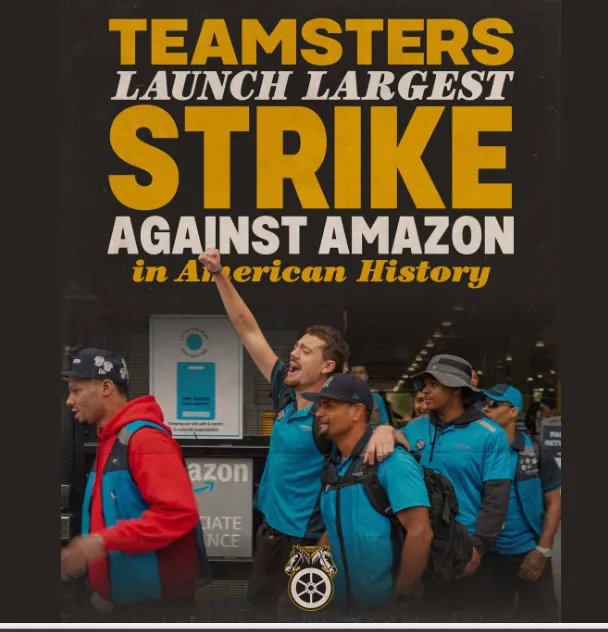
    Screen shot from the Teamsters Facebook page.

    The Teamsters’ five day long strike against Amazon ended inconclusively, but the union hinted at future actions with “Stay tuned.” Beginning on Thursday, December 19, the Teamsters called strikes in response to the failure of Amazon to meet the union’ s demand to come to the bargaining table four days earlier. The Teamsters declared that it was “the largest strike in Amazon’s history.” The union’s General President Sean O’Brien said in an official statement:

    “If your package is delayed during the holidays, you can blame Amazon’s insatiable greed. We gave Amazon a clear deadline to come to the table and do right by our members. They ignored it. These greedy executives had every chance to show decency and respect for the people who make their obscene profits possible. Instead, they’ve pushed workers to the limit and now they’re paying the price. This strike is on them.”

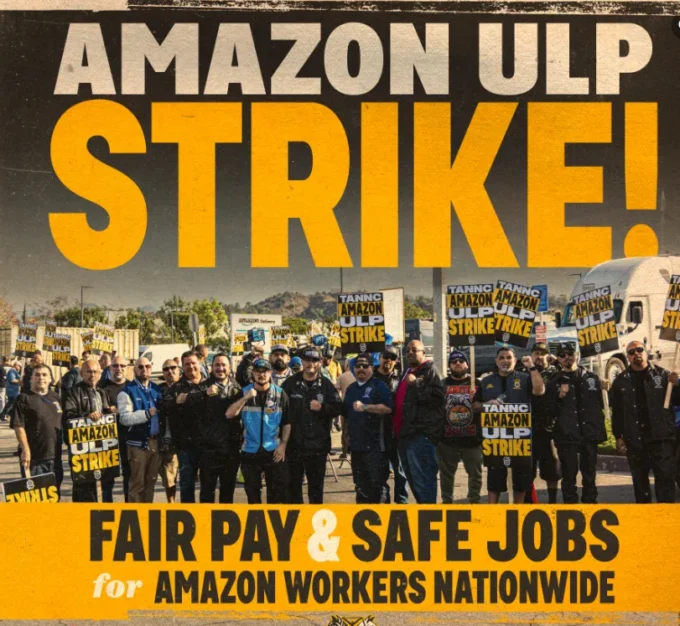
    The Teamsters called for strike action at eight locations across four states, that included Amazon centers in Queens and Staten Island New York, Atlanta, Southern California, San Francisco, and in Skokie, Ill, where they claim to represent the drivers or the warehouse workers through elections or card check.

    The Teamsters sent Unfair Labor Practice (ULP) pickets to scores of Amazon locations across the country, mostly made up of local officials and union stewards, with little or no connection to Amazon. The union has not publicly stated how many locations were picketed or what the results were. The Teamsters also called upon community supporters to join the picket lines across the country.

    On one level, the Teamsters actions were a bold move, but their sparse presence, possibly representing one percent of the company’s entire U.S. workforce, has raised some serious questions. Among them are whether there was any tangible goal beyond the Teamsters maintaining their franchise at Amazon, and left hanging what the next steps, if any, were in the organizing campaign.

    When I spoke to long time labor lawyer and negotiator, Joe Burns, the authorof many important books on strike strategy, about the Teamsters’ actions at Amazon and what his thoughts on it were. He told me:

    While it is hard to tell due to the lack of credible reporting. These “strikes” seem very similar to the approaches in fast food, rideshare and at Walmart over the last decade or so, where the union would put out press releases claiming a giant corporation had been struck. This would gather publicity and generate some excitement on the left but it did not impact production or even draw out more than a tiny fraction of the workplace.

    The actions are really more informational picketing with a media spin of a strike tacked on to it. The problem is we have over a decade of experience showing such efforts don’t really work. They gather press and at times can help liberal groups or unions pass labor legislation, but have shown little in the way of furthering permanent union organizing.

    It’s hard not to agree with Burns’ assessment. But, then why are the Teamsters recycling a failed strategy? Or is there something bigger and better coming down the road?

    An existential threat

    In 2021 at the thirtieth convention of the Teamsters, delegates overwhelmingly passed a series of resolutions to combat what then-General President James P. Hoffa called the “existential threat” that Amazon posed to the union. The Special Resolution: Building Worker Power at Amazon, which is worth quoting at length, declared:

    Amazon is changing the nature of work in our country and touches many core
    Teamster industries and employers such as UPS, parcel delivery, freight, airline, food distribution and motion picture, and presents an existential threat to the standards we have set in these industries;

    Leaning on its own history, it said:

    Whereas, Teamsters have been building power in the logistics industry since before

    a meaningful labor law was enacted in this country. We fought for workers’ rights to organize and build power any way we could, including shop floor strikes, city-wide strikes and actions in the streets;

    And it concluded:

    Finally, be it resolved, that building worker power at Amazon and helping those

    workers achieve a union contract is a top priority for the Teamsters Union and the Union commits to fully fund and support the Amazon Project, to supply all resources necessary and to ultimately create a special Amazon Division to aid Amazon workers and defend and protect the standards in our industries from the existential threat that is Amazon.

    An Amazon division of the Teamsters was created and California Teamster leader Randy Korgan was appointed as its first director by Hoffa, and then reappointed by his successor Sean O’Brien. So, it’s remarkable given that Amazon, which was declared an existential threat three and a half years — and probably a decade late at that point — how little the Teamsters have actually done.

    The biggest, initial breakthrough was accomplished by the independent and financially threadbare Amazon Labor Union (ALU) at Amazon’s JFK8 warehouse, which made international news and made ALU leader Chris Smalls into a celebrity. Despite an initial burst of interest in the ALU from Amazon workers across the country, it couldn’t reproduce its success at JFK8 elsewhere and soon went into crisis.

    Meanwhile, small groups of Amazon workers began to form organizing committees in other facilities but faced Amazon’s notorious union-busting operation. However, faced with the prospect of its victory in Staten Island dying through attrition, the ALU negotiated a merger with the Teamsters as an autonomous unit. I took no position on whether they should join the Teamsters, but cautioned that it wasn’t a silver bullet solution to their challenges. I wrote:

    Some ALU reformers and supporters argue that for the ALU to succeed at Amazon it needs a “big gun” to back it up. While you can understand the allure of being affiliated to a larger union after a series of defeats, is this a solution to the existential crisis of ALU? Even recent history at Amazon doesn’t suggest this is a silver bullet solution. Way back in April 2021, when the Retail, Wholesale, and Department Store Union (RWDSU), affiliated with the mammoth UFCW, lost two to one in a union election at Amazon in Bessemer, Alabama, despite having a successful record of organizing in the South.

    Now that the big gun has been fired, what were the results?

    The big strike?

    Screen shot from the Teamsters, Facebook page.

    “Understanding these strikes is made difficult because labor left reporting, including outlets like Labor Notes and Jacobin, does not cover key questions such as level of worker participation in these strikes, which should be a key aspect of labor reporting. However, from accounts online, mainstream sources such as the New York Times, it appears that participation is very low in these strikes,” Joe Burns wrote to me. “For example, at the main Staten Island facility of thousands of workers, the New York Times estimated 100 workers. Other accounts have been a very small percentage of the workplace and mainly outside Teamster officials or supporters picketing. I have not heard of any facility that had a large percentage of Amazon workers on strike. Good independent labor reporting would zero in on such questions and not merely parrot the official union press releases. ”

    While the Teamsters made an effort in the major media markets to have a larger number of people protesting at some of Amazon’s facilities, outside of those areas the lack of Amazon workers on the picket lines was more glaring. I asked several rank and file Teamsters and union activists who visited the Amazon picket lines for their observations. Most asked to be quoted anonymously or by a pseudonym. Kat from Florida, who is active with Teamsters Mobilize, reported:

    It was very weak and ineffective from the standpoint of actually interrupting Amazon’s production process. In the three hours I was there, we let through two union drivers and one UPS manager without any struggle at all. Apathy on the part of the local officials at the picket. Even short of blocking the road, there were very simple tactics we could have employed to try to talk to every trucker as they were coming in. The officials were utterly disinterested in doing that; they clearly saw this “picket” as a last-minute top-down order that they had to follow formally but not play any substantial role in. Except for myself, the few other workers who showed up basically followed this lead.

    Yet, Kat also reported:

    At one point, a woman who worked inside the warehouse we were stationed at pulled over and was very excited to hear what was happening and to learn whether there were any ongoing efforts to organize her building. Me and the other rank and file member were the only ones who spoke with her, which seemed like a huge missed opportunity.

    Alyx reported from Salem, Oregon on Friday, December 20th:

    There were two Teamsters retirees from Local 324 holding the line. From what they said, most shifts were being covered by retirees from their local and another. I don’t know how many current Amazon workers participated. From what I saw, this location didn’t seem to have much impact. The facility is fairly remote, so not a lot of public visibility. The picket spot was set closer to the entrance than the main street, so only drivers and warehouse workers saw us. Since turnout was low, picketers weren’t able to impact access.

    Joe from Southern California wrote to me after visiting the City of Industry picket line, his experiences were more positive, though the number of Amazon workers involved was still small. He wrote:

    Where I was at, I ‘d say around 45–50 Amazon drivers on the picket line. Some of the striking Amazon workers were well versed on how to talk to their Amazon driving coworkers. I did not see any cards getting signed. The local Teamster union played both a primary and secondary role. Primary role in, they were active in moving striking Amazon workers to the other locations of the picket lines. Some talked to leaving Direct Service Providers (DSP) drivers, but most of the talking was striking Amazon drivers to their fellow DSP Amazon driving coworkers. I have seen many of the striking Amazon workers being interviewed by various online publications, pages and social media accounts. These actions made a difference. It brought publicity to the efforts of the Amazon workers. The public is aware of their efforts. Where I’m at. It was a good start. I would say this was a structure test to really gauge where the IBT Amazon Division is at.

    Karl, a long-standing union steward in Oklahoma City, wrote me:

    We picketed 2 Amazon facilities next to each other. Approximately 20–30 workers talked with us over the course of 48 hours. This, out of a workforce of 4–6 thousand. None participated directly, though strongly indicated that they would be interested in organizing and participating in further union campaigns if the local ​union were to follow up. Many of these provided contact info and requested information on the local. The local’s role seemed to be restricted to one of an informational picket. Little effort had been expended towards contacting workers or establishing any prior inside organization with which an informational picket could reinforce. It remains to be seen whether the local ​union will squander or follow up with new contacts. I think that the actions can make a difference provided the local and international makes a concerted effort to consolidate organization in the picketed plants and follow up with escalating actions that invite increasing numbers of workers to participate.

    Despite Amazon’s insistence that there was no interference with their operations, the Christmas time actions proved to be a public relations black eye for Amazon. The largely favorable media coverage highlighted the poverty wages of drivers, the dangerous and humiliating working conditions. Yet, we have been here before. No amount of public shaming has changed Amazon’s ways. With barely one percent, and that’s being generous, of Amazon’s workers participating in the union’s action, there is certainly a long way to go on to organize a small fraction of Amazon’s workforce.

    Missed opportunity

    Screen shot from Reddit.

    “I certainly would not want to discount the organizing and the efforts of the workers who did go on strike. Hopefully, it will spur some more activity but the history of publicity strikes is not very good. I do think a serious analysis needs to be done of levels of participation. The tendency however, is to simply declare victory and learn nothing. But I also think we need a sober analysis of what kind of labor movement it would take to organize Amazon. I do not think we can talk about organizing giant employers without talking about the structure and ideology of our labor movement. In order to truly take on these giant employers, we would need a labor movement capable of employing picket line militancy and solidarity tactics capable of mobilizing the entire labor movement against corporate giants,” Joe Burns wrote to me.

    I do think the Teamsters missed an opportunity last year. The Teamsters raised expectations about last year’s UPS contract, the largest private sector contract in the country. A transformational strike was expected and could have been the lever to organize a behemoth like Amazon. Yet, the contract campaign ended on a flat note. As I wrote last year:

    The U.S. Left that repeated continually that we were on the eve of the biggest strike in modern U.S. history. This, of course, did not occur leading to the frustration and demoralization of the hundreds of young radicals — many identified with the Democratic Socialists of America, DSA — who went out and got jobs on some of the worst shifts at UPS to be part of this transformative campaign.

    We operate in the wake of failure of a transformational strike at UPS and its consequences at Amazon. We are also facing a much more difficult political environment with the incoming Trump administration that promises a full scale assault on trade union rights, including the Teamsters, despite the union being led by Trump-ally Sean O’Brien. The political terrain can shift quickly, but it will require a clear-eyed assessment of the recent events at Amazon and the creation of new left to take advantage of them.