‘F*ck the Consultants’: Free Advice Offered for Democrats in Need of a Position on AI
“Wild that candidates are avoiding an enormously consequential issue with broad bipartisan support among voters, for fear of unleashing attack ads from super PACs funded by a tiny handful of AI billionaires and corporations.”

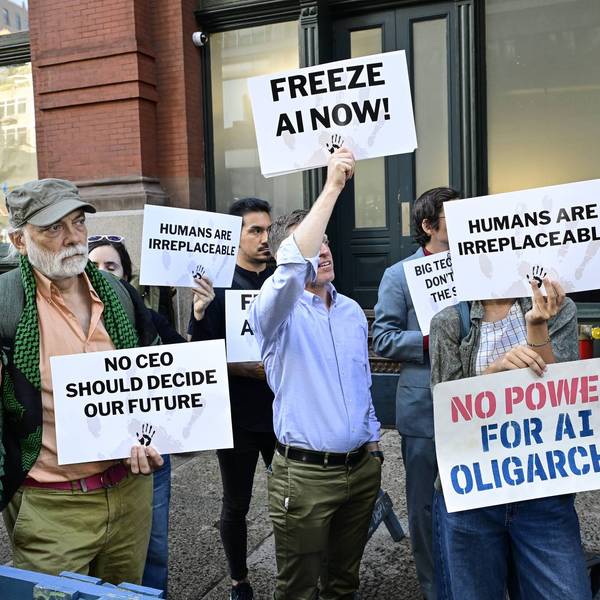
Protesters during a “Stop the AI Race” demonstration calling for a slowdown in the development of advanced artificial intelligence systems outside City Hall in San Francisco, California, on September 17, 2026.
(Photo by Karl Mondon / AFP via Getty Images)
Jon Queally
Sep 18, 2026
COMMON DREAMS
A veteran aide for Sen. Bernie Sanders (I-Vt.) has some choice advice for Democrats running for office in this year’s election, which is to ignore the guidance some of them are reportedly receiving from their political consultants on the question of regulating the artificial intelligence industry in the face of growing public concerns about runaway machine learning and the data center buildout that big tech companies are pursuing nationwide.
Warren Gunnels, who currently serves as the minority staff director for Sanders on the Health, Education, Labor and Pensions (HELP) Committee in the US Senate, issued his advice in response to a Politico article published Thursday, which had the headline “Democratic advisers are warning their candidates not to go too hard at AI.”
While the reporting noted that members of the Democratic Party’s consultancy class are “privately encouraging their battleground candidates to avoid talking about AI regulations out of fear that powerful tech groups will unleash a tidal wave of spending against them” ahead of this year’s midterm election, Gunnels offered a 9-word antidote to what he considered bad political advice and a failure to recognize where most voters are on the issue.
“Nine words,” said Gunnels in his post: “Fuck the consultants, End Citizens United, Ban super PACs.” Gunnels backed up his statement with recent polling data suggesting that a strong stance on AI and data centers would likely help, not hurt, those seeking elected office.
Gunnels wasn’t the only one to react negatively.
Brendan Fischer, director of strategic investigations at the Campaign Legal Center, said it’s “wild that candidates are avoiding an enormously consequential issue with broad bipartisan support among voters, for fear of unleashing attack ads from super PACs funded by a tiny handful of AI billionaires and corporations.”
The US Supreme Court’s 2010 ruling in the Citizens United case, which unleashed a tidal wave of dark money campaign spending, said Fischer, “promised unlimited political spending would mean more speech and a more robust marketplace of ideas. But instead, candidates are chilled from discussing issues voters care about for fear of angering wealthy interests capable of spending millions to defeat them.”
In July, Business Insider reported that the AI industry had already spent at least $65 million in midterm races, though other estimates have put that figure much higher. Meanwhile, Elon Musk, CEO of Space X and a major player in the AI space with his GROK model, has vowed to spend a $100 million help his preferred candidates and the Republican Party win.
At a summit on the need for robust regulation of the AI industry held earlier this week, Sanders said he had a message for leaders and executives running theses tech companies.
“My message to the AI CEO’s: If you truly care about the future of humanity,” said Sanders, “stop pouring hundreds of millions of dollars into super PACs to defeat Members of Congress and candidates who are fighting for serious guardrails on AI.”
As the debate over AI regulation has emerged as a major topic in Washington, DC, and on the campaign trail in recent weeks, a series of polls have confirmed public anxieties about the technology.
A poll from The Associated Press-NORC Center for Public Affairs Research and the Energy Policy Institute at the University of Chicago released Wednesday showed that more than half of US voters (53%) are “extremely” or “very” concerned about artificial intelligence’s environmental impacts, and the poll also found broader concerns about the negative impacts of data centers, especially on local water resources and utility rates.
“Change is scary, and I think some of that is being reflected here,” said Michael Greenstone, who directs the University of Chicago institute that collaborated on the survey, of the results.
The Politico reporting, which drew Gunnel’s fiery response, also acknowledged the public sentiment, but described how consultants working on various Democratic campaigns are trying to avoid provoking the ire of deep-pocketed tech giants:
Some top Democratic candidates and their campaigns are quietly trying to avoid crossing any red lines for tech super PACs — even as it’s unclear exactly what those lines would be, after Musk and two of the biggest AI CEOs called for more regulation on the technology last week.Democrats are especially wary of Leading the Future, a pro-AI industry super PAC that spent over $25 million in primary races this year and is backed by investors and executives of OpenAI. The rival super PAC network, Public First Action, pushes for AI regulation and is funded by OpenAI’s chief competitor, Anthropic.
While the fears of being targeted by the industry cash may not be unfounded, progressives like Gunnels suggest that a willingness to take a stand against powerful AI companies is exactly the kind of fight voters want to see from party candidates.
For the Politico article, Rep. Pramila Jayapal (D-Wash.), former chair of the Congressional Progressive Caucus in the House, explained how AI super PACs “come out and they say that they’re concerned, that they want regulation. But then they spend huge amounts of money on defeating anybody who wants legislative regulation.”
In a social media post Thursday night, however, Jayapal backed the congressional campaign of Will Lawrence, running as a Democrat to win an open seat in Michigan’s 7th Congressional District, by saying voters “need leaders who answer to their constituents, not the corporations that paid for their election.”
Following Gunnels advice that bucking the influence of corporate donors is actually a key component of a winning electoral strategy in the 2026 midterms, Jayapal said “electing fighters who don’t take corporate PAC money”—whether on the issue of AI, healthcare, housing policy, or broader concerns about economic inequality and affordability—is key for Democrats.
“Wild that candidates are avoiding an enormously consequential issue with broad bipartisan support among voters, for fear of unleashing attack ads from super PACs funded by a tiny handful of AI billionaires and corporations.”
Protesters during a “Stop the AI Race” demonstration calling for a slowdown in the development of advanced artificial intelligence systems outside City Hall in San Francisco, California, on September 17, 2026.
(Photo by Karl Mondon / AFP via Getty Images)
Jon Queally
Sep 18, 2026
COMMON DREAMS
A veteran aide for Sen. Bernie Sanders (I-Vt.) has some choice advice for Democrats running for office in this year’s election, which is to ignore the guidance some of them are reportedly receiving from their political consultants on the question of regulating the artificial intelligence industry in the face of growing public concerns about runaway machine learning and the data center buildout that big tech companies are pursuing nationwide.
Warren Gunnels, who currently serves as the minority staff director for Sanders on the Health, Education, Labor and Pensions (HELP) Committee in the US Senate, issued his advice in response to a Politico article published Thursday, which had the headline “Democratic advisers are warning their candidates not to go too hard at AI.”
While the reporting noted that members of the Democratic Party’s consultancy class are “privately encouraging their battleground candidates to avoid talking about AI regulations out of fear that powerful tech groups will unleash a tidal wave of spending against them” ahead of this year’s midterm election, Gunnels offered a 9-word antidote to what he considered bad political advice and a failure to recognize where most voters are on the issue.
“Nine words,” said Gunnels in his post: “Fuck the consultants, End Citizens United, Ban super PACs.” Gunnels backed up his statement with recent polling data suggesting that a strong stance on AI and data centers would likely help, not hurt, those seeking elected office.
Gunnels wasn’t the only one to react negatively.
Brendan Fischer, director of strategic investigations at the Campaign Legal Center, said it’s “wild that candidates are avoiding an enormously consequential issue with broad bipartisan support among voters, for fear of unleashing attack ads from super PACs funded by a tiny handful of AI billionaires and corporations.”
The US Supreme Court’s 2010 ruling in the Citizens United case, which unleashed a tidal wave of dark money campaign spending, said Fischer, “promised unlimited political spending would mean more speech and a more robust marketplace of ideas. But instead, candidates are chilled from discussing issues voters care about for fear of angering wealthy interests capable of spending millions to defeat them.”
In July, Business Insider reported that the AI industry had already spent at least $65 million in midterm races, though other estimates have put that figure much higher. Meanwhile, Elon Musk, CEO of Space X and a major player in the AI space with his GROK model, has vowed to spend a $100 million help his preferred candidates and the Republican Party win.
At a summit on the need for robust regulation of the AI industry held earlier this week, Sanders said he had a message for leaders and executives running theses tech companies.
“My message to the AI CEO’s: If you truly care about the future of humanity,” said Sanders, “stop pouring hundreds of millions of dollars into super PACs to defeat Members of Congress and candidates who are fighting for serious guardrails on AI.”
As the debate over AI regulation has emerged as a major topic in Washington, DC, and on the campaign trail in recent weeks, a series of polls have confirmed public anxieties about the technology.
A poll from The Associated Press-NORC Center for Public Affairs Research and the Energy Policy Institute at the University of Chicago released Wednesday showed that more than half of US voters (53%) are “extremely” or “very” concerned about artificial intelligence’s environmental impacts, and the poll also found broader concerns about the negative impacts of data centers, especially on local water resources and utility rates.
“Change is scary, and I think some of that is being reflected here,” said Michael Greenstone, who directs the University of Chicago institute that collaborated on the survey, of the results.
The Politico reporting, which drew Gunnel’s fiery response, also acknowledged the public sentiment, but described how consultants working on various Democratic campaigns are trying to avoid provoking the ire of deep-pocketed tech giants:
Some top Democratic candidates and their campaigns are quietly trying to avoid crossing any red lines for tech super PACs — even as it’s unclear exactly what those lines would be, after Musk and two of the biggest AI CEOs called for more regulation on the technology last week.Democrats are especially wary of Leading the Future, a pro-AI industry super PAC that spent over $25 million in primary races this year and is backed by investors and executives of OpenAI. The rival super PAC network, Public First Action, pushes for AI regulation and is funded by OpenAI’s chief competitor, Anthropic.
While the fears of being targeted by the industry cash may not be unfounded, progressives like Gunnels suggest that a willingness to take a stand against powerful AI companies is exactly the kind of fight voters want to see from party candidates.
For the Politico article, Rep. Pramila Jayapal (D-Wash.), former chair of the Congressional Progressive Caucus in the House, explained how AI super PACs “come out and they say that they’re concerned, that they want regulation. But then they spend huge amounts of money on defeating anybody who wants legislative regulation.”
In a social media post Thursday night, however, Jayapal backed the congressional campaign of Will Lawrence, running as a Democrat to win an open seat in Michigan’s 7th Congressional District, by saying voters “need leaders who answer to their constituents, not the corporations that paid for their election.”
Following Gunnels advice that bucking the influence of corporate donors is actually a key component of a winning electoral strategy in the 2026 midterms, Jayapal said “electing fighters who don’t take corporate PAC money”—whether on the issue of AI, healthcare, housing policy, or broader concerns about economic inequality and affordability—is key for Democrats.
Despite catastrophic warnings from AI industry insiders, Congress has adjourned until after the midterms without passing any laws to regulate the technology.

US Rep. Josh Gottheimer (D-NJ) participates in the Competing and Setting the Standards in the AI Era panel during The Hill & Valley Forum 2026 at Andrew W. Mellon Auditorium on March 24, 2026, in Washington, DC.
(Photo by Leigh Vogel/Getty Images The Hill & Valley Forum)
Stephen Prager
Sep 18, 2026
COMMON DREAMS
Despite increasingly urgent calls to regulate artificial intelligence, including from industry insiders who warn of potentially catastrophic consequences, the US Congress has continued to drag its feet on meaningful legislation.
A report released Friday by Sludge may shed some light on one potential roadblock. It found that 1 in 5 members of Congress has household investments in AI companies or those producing the infrastructure behind the technology.
Sludge revealed that:
At least 105 members of Congress have disclosed that they, their spouse, or their dependent children hold stocks or other investments in AI developers, chipmakers, cloud infrastructure providers, data center companies, and specialized AI firms, with a total value of between $75 million and $287 million.
Most of the money is invested in large tech companies like Nvidia, Meta, and Alphabet. But lawmakers also report their households holding and trading shares in smaller publicly traded AI companies like BigBear.ai, Tempus AI, and C3 AI, as well as little-known private startups whose shares are unavailable to ordinary investors.
Of the lawmakers reporting investments, at least 44 sit on committees with jurisdiction over legislation dealing with AI safety, consumer protections, semiconductor policy, and trade with China.
The report identifies several lawmakers in positions of influence over Congress’ AI policy whose households simultaneously have deep investments in the industry.
One of them is Rep. Josh Gottheimer (D-NJ), the co-chair of the House Democratic Commission on AI and the Innovation Economy—created to help direct the party’s legislative agenda around the emerging technology.
According to Sludge, Gottheimer’s household has investments in several key chipmaking and semiconductor companies, and he has regularly traded in AI stocks while in Congress.
The report draws attention to the “scores of sales” he made on April 9, 2025, when President Donald Trump announced a surprise 90-day pause on his “Liberation Day” tariffs, an announcement that led stocks for many AI companies to surge in value. Gottheimer has previously told Sludge that his investments are managed by a third party and that he does not make the decisions himself.
Gottheimer is one of the Democrats helping shape the party’s approach to regulating AI. Earlier this month, amid concerns about the growing capability of “superintelligent” AI agents that can exceed human capability, he joined with Rep. Mike Lawler (R-NY) to introduce the Stop Rogue AI Act.
This bill would direct the National Institute of Standards and Technology (NIST) to adopt a series of standards and best practices that AI companies could implement to track the behavior of agents. However, critics have argued that the bill’s voluntary guidelines fall short of what is necessary to rein in the industry.
Gottheimer’s proposal is one of several measures Democrats have proposed in recent weeks following warnings from Anthropic researchers Jacob Coxon and Evan Hubinger that AI systems could wipe out humanity if allowed to escape human control.
Others include a more muscular bill proposed earlier this month by Sen. Bernie Sanders (I-Vt.) and Rep. Greg Casar (D-Texas) that would permanently ban the development of superintelligent AI and pause the development of advanced AI until a federal regulatory body can be established.
Some members of Congress whose households are heavily invested in AI stocks have nonetheless supported stronger regulation. According to Sludge, Rep. Ro Khanna (D-Calif.) disclosed between $3.4 million and $8.4 million worth of stock owned by his wife in AI companies, including Nvidia and chipmaker Broadcom.
Khanna has said he does not personally trade stocks and has pushed for a congressional ban on stock trading. Despite his household’s millions of dollars worth of AI investments, he has also voiced support for blocking the development of superintelligent AI until stronger safeguards are in place, broadly aligning him with the Sanders-Casar proposal.
Sludge found that investments in AI stocks are not concentrated in either party. Among the lawmakers who reported AI-related investments, 62 were Republicans, and 43 were Democrats.
One of the largest portfolios is held by the husband of former House Speaker Nancy Pelosi (D-Calif.), who plans to retire at the end of the term.
Paul Pelosi, a venture capitalist, reported holdings in Alphabet, Amazon, Microsoft, Nvidia, Broadcom, and Tempus AI worth between $28.4 million and $134.9 million, while also buying an estimated $1.3 million to $2.6 million in Alphabet, Amazon, Nvidia, and Tempus shares in 2026 and up to $12 million in Bloom Energy, which stands to benefit from the AI data-center buildout.
On the Republican side, the report singles out Rep. Lisa McClain (Mich.), the chair of the House Republican Conference and the fourth highest-ranking member of House GOP leadership. Since December, her household has invested as much as $515,000 in AI companies, including private stakes in Elon Musk’s company xAI, as well as Apptronik and Saronic.
Rep. Diana Harshbarger (R-Tenn.), meanwhile, disclosed holdings in Alphabet, Amazon, Meta, Microsoft, Nvidia, and Oracle. She serves on the House Energy and Commerce Committee’s Energy Subcommittee, which has authority to legislate on energy issues related to the controversial buildout of data centers around the country.
The report comes as members of Congress head home for a seven-week recess that will last until after November’s midterm elections.
On Wednesday, more than 100 Democrats—including Gottheimer, Khanna, and Pelosi—sent a letter to House Speaker Mike Johnson (R-La.) urging him to postpone the recess until Congress passes AI safety legislation.
“AI experts and leading companies agree that the United States can lead the world in artificial intelligence while establishing reasonable safeguards that protect Americans and our national security. We can—and must—do both,” the lawmakers wrote. “While AI safety experts and Americans increasingly urge action to confront this conflagration of risk, Congress fiddles.”
“The House should remain in session until Congress advances meaningful, bipartisan AI safeguards,” the letter concluded. “To our children who will have read a post-apocalyptic history, ‘Why Congress Slept’—likely written by agentic AI—our inaction will be inexplicable and unforgivable.”
Johnson, who has rejected calls for AI regulation and said companies should be in charge of regulating themselves, ignored the request and adjourned the House on Wednesday.
