Showing posts sorted by date for query TURKEY GREY WOLVES. Sort by relevance Show all posts

Saturday, September 06, 2025

Turkey/Kurdistan

Türkiye: From the Kurdish movement to mass mobilizations


Saturday 6 September 2025, by Uraz Aydin

On the occasion of the agreement on the dissolution of the PKK, Uraz Aydin presents the history of this movement and the evolution of the protest against the Erdoğan regime.

Can you explain what the PKK is and its main orientations, and what differentiates it from other left-wing or nationalist political groups?

The founding of the PKK must be seen in a context of politicization and radicalization. The 1960s witnessed a development of the workers’ movement and revolutionary radicalization, particularly among the youth. But it was also a decade of awakening of Kurdish national consciousness. This Kurdish national politicization was largely achieved within the Workers’ Party of Turkey (TIP), which was the main political actor in the workers’ movement of that decade. It was towards the end of the 1960s, but especially after the amnesty of 1974, when the thousands of Turkish and Kurdish activists detained since the military intervention of 1971 were released , that Kurdish revolutionaries began to found their own independent organizations . [1]. The PKK was founded in the wake of this, but relatively late. Although the organization’s official history dates its origins back to 1973, the founding congress was not held until 1978. Before that, it was a core group of students and especially teachers gathered around Abdullah Öcalan. They called themselves the "Revolutionaries of Kurdistan" but were better known as "Apocu" ("Apo’s supporters" - short for Abdullah). Thus, from the very beginning, Öcalan’s personality had a central influence.

At the programmatic level, nothing specific differentiated it from the multitude of other Kurdish radical left organizations that advocated armed struggle for an "independent, unified, democratic and socialist Kurdistan" in a stagist perspective. [2]. But in the meantime, weapons were mainly used to defend against attacks by the fascist far-right "Grey Wolves" or in the fratricidal war that reigned within the revolutionary left. The PKK was one of the two main groups that did not hesitate to use weapons against other rival Kurdish (and Turkish) groups, but it was not alone in this. Thus, before the 1980 coup d’état [3], the PKK was a Kurdish revolutionary organization among others.


What justified the launch of an armed struggle strategy against the Turkish state in 1984?

In fact, it was mainly after 1984 that the PKK began to take root among the Kurdish plebeian and peasant population. Let’s go back a little. Öcalan left Turkey in 1979 during the state of emergency, but before the coup d’état. This was a decisive element in the construction of the organization. He thus had time to establish contacts with Palestinian resistance groups in Syria and Lebanon, to prepare the conditions of exile for his militants, conditions that would also be those of a real military apprenticeship. After the coup d’état of 1980, Apo thus called on his militants to return clandestinely to Syria. They were trained in the same camps as the Palestinians in the Bekaa Valley in Lebanon under Syrian occupation. Some would participate in the resistance against the Israeli invasion of Lebanon. The PKK lost several dozen members, which also gave it a certain legitimacy.

The PKK launched the armed struggle in August 1984… because Öcalan considered that his army was now ready. The question of military combat as a method for the liberation of Kurdistan had been justified, not by conjunctural conditions or relationships of forces, but on a programmatic level, since 1978.

The offensive against the Turkish state was planned as early as 1982 but was postponed several times. Moreover, Öcalan was operating in the Middle East, where alliances and adversities between various states and Kurdish national movements (from Iraq and Iran) constituted a highly shifting terrain. This unstable context also weighed on the conditions of the struggle. The alliance he formed with Barzani’s group, dominant in Northern Iraq, a movement he previously considered feudal and reactionary, was, for example, decisive in building his camps in the mountains on the Turkish border and thus being able to launch his guerrilla war. Thus, while all the other Kurdish and Turkish groups tried to preserve their forces in exile, in Syria but especially in Europe, the PKK was the only one to engage in a real armed struggle. The legitimacy it gained through its offensives allowed it to recruit more and more, despite the significant losses of fighters suffered in the field.

40 years later, does the announcement of the dissolution not appear to be a failure, on the military and political levels?


I think that military objectives had already been non-existent for several decades. If for the Öcalan of the party’s founding and of the 1980s, any objective short of independence (various forms of autonomy, federative entities, etc.) was reactionary, the leader of the PKK had begun to revise his ideas from the beginning of the 1990s, particularly after the fall of the bureaucratic dictatorships. As we know, he would eventually come to criticize the nation-state form.

Öcalan had already attempted negotiations in 1993. After his arrest in 1999, he began to advocate a completely new direction, much to the surprise of PKK leaders and activists who were preparing to escalate the war and suicide attacks. This new direction aimed to end the armed struggle in favour of a permanent ceasefire, to pave the way for a political solution. He thus unquestionably renounced the strategic objective of an independent Kurdistan. Two further negotiation processes followed in 2007-2009 and 2013-2015, which unfortunately failed. However, the creation of the autonomous zone of Rojava in northeastern Syria must also be interpreted within this military and political framework. The existence of an administrative structure linked to the PKK on the Turkish border constitutes an important achievement for the organization, against the Turkish state and vis-à-vis its historical competitor in northern Iraq, the Barzani clan and its Kurdistan Democratic Party.

Where are we today in the new talks?


It should be clarified that the Kurdish movement is not only an armed movement. The PKK has managed to form a massive movement of several million people, with various civil structures that have sometimes developed with autonomous dynamics, despite the authoritarianism of the organization. Today, the civil-democratic base seems to be much more important and effective in its fight than the armed structure in terms of the objectives to be achieved for the Kurdish people. So, while there are certainly highly questionable aspects such as its authoritarianism, its excessive fetishism of the leader, the arbitrary internal mass executions (especially at the turn of the 80s and 90s), the dozens of indiscriminate attacks... it must be recognized that this movement, over time, has very strongly contributed to the consolidation of a national consciousness of the Kurdish people, and has largely anchored it on the left, with feminist, egalitarian values, and fraternity between peoples. From a historical point of view, this is an important asset.

At the level of the negotiations, everything started with the unexpected call from the far-right leader and main ally of Erdoğan, Devlet Bahçeli , on October 22, 2024, for Abdullah Öcalan to come and speak in parliament to declare the end of the armed struggle and the dissolution of the PKK. After a period of very opaque negotiations between the Turkish state and Öcalan, with the participation of a delegation from the DEM Party (a left-wing reformist party from the Kurdish movement) and the leadership of the PKK, the founder of the organization, from his prison on the island of Imrali, in the Marmara Sea, announced in a letter on February 27, 2025, that the PKK was to dissolve.

We don’t know what the debates were within the organization. There had already been tensions between Apo and the organization’s Presidential Council in previous negotiations. Therefore, it is difficult to imagine that the PKK leadership would have quickly agreed on a process declared so abruptly. The organization’s leadership strongly emphasizes that the entire process must be led by Öcalan, which can be perceived as a desire not to take direct responsibility for it.

The disarmament of the PKK certainly constitutes an important basis for a demilitarization of the Kurdish question, even though the Erdoğan regime will undeniably try to steer this process according to its interests and in particular to break the alliance between the Kurdish movement and the bourgeois-democratic opposition led by the CHP [4] ,criminalized by the regime. However, we still do not know what democratic advances the Kurds will be able to benefit from with the dissolution of the PKK. A parliamentary commission will probably be formed to determine the measures to be taken. These should include, in a first step, the release of political prisoners (linked to the Kurdish movement), the withdrawal of the guardianship (kayyum) of Kurdish municipalities and the return of mayors to their functions, the reinstatement of "peace academics" to their work and the possibility for Öcalan to freely lead his movement, to be able to communicate with the outside world, to receive visits, etc.

According to the Kurdish movement, other, more structural reforms should follow, concerning the status of their national identity and culture within Turkish society, which would require a new constitution. Erdoğan is planning to change the constitution in order to be able to run in the next elections. Will it be a constitution that will guarantee rights to the Kurds while consolidating the autocratic nature of the regime? The question is controversial, but we are not there yet.

Another issue is the order in which the steps will be taken. Will the state wait until the complete surrender of arms is complete before implementing the supposed democratic reforms, or will the two processes overlap? It seems that Erdogan is opting for the first option—which is difficult for the PKK to accept—while Bahçeli seems more realistic on this point.

What political developments has Turkey experienced since the movement against the imprisonment of Istanbul Mayor İmamoğlu ?

After March 19, we witnessed a social mobilization the likes of which we hadn’t seen in a long time. Millions of citizens took to the streets to defend elected mayors, the right to vote, democracy, and freedom. Although the movement was extremely heterogeneous, there was a notable radicalization, particularly among university and high school students.

As is often the case after spontaneous outbursts, the movement’s momentum faded after a while. However, momentum persisted for a while thanks to boycott campaigns against certain capitalist groups that supported the AKP. But in the absence of sustainable social struggle bases, platforms, and coordination capable of prolonging resistance—aside from occasional calls for meetings launched by the CHP—it can be said that today the movement has lost its momentum in the streets, even though indignation remains very much present.


But the regime continues its crackdown on the CHP, with successive waves of arrests in various Istanbul municipalities. Eleven mayors are currently detained awaiting trial. A final "anti-corruption" wave has been launched against the former CHP mayor of İzmir and his staff (a total of 160 people in custody). Today is the hundredth day since İmamoğlu ’s arrest , and the indictment is still not ready. This clearly shows the extent to which the Erdoğan regime is acting in a completely arbitrary manner. Furthermore, there is also a legal attempt to split the CHP. A trial has been opened for alleged irregularities at the 2023 CHP congress, at which Özgür Özel , the new party chairman, was elected – a leader who, since İmamoğlu ’s arrest, has pursued an opposition policy of unusual firmness for the CHP.

However, Kemal Kilicdaroglu, the former party chairman (and former presidential candidate, who lost to Erdogan in 2023), has suggested, in a spirit of revenge, that he could take over the party leadership if the congress were to be cancelled. He also claims that he believes the mobilization that began on March 19 was pointless, that it is a matter between Imamoglu and the judiciary. Thus, there is a clear and public tension between Kilicdaroglu’s team and those of Özel and Imamoglu . For the time being, the trial has been postponed until September.


What is the state of the labour movement today?

The labour movement’s trade union organizations played virtually no role in this protest movement. The working class did not identify with the movement. A significant portion of it remains receptive to Erdoğan’s propaganda, despite a dramatic deterioration in purchasing power over the past several years. And so far, very little effort has been made (particularly by the radical, anti-capitalist, revolutionary left) to make people understand that the democratic question and the social question are intimately linked.

Democratic aspirations must be fertilized with class content. The "proletarian shock" of which Ernst Bloch spoke is still the main thing missing from the fight against the regime. This is the most important, historically decisive, and difficult strategic task facing the revolutionary left. It is about breaking the cultural-religious divide, the maintenance and deepening of which is the AKP’s main weapon, and replacing it with class polarization.

But to return to the weakness of unions in the movement, there are several reasons for this. First of all, the rate of unionization is low in Turkey, at only around 15 per cent. And it must be taken into account that this percentage only includes "declared " workers , therefore not those who work illegally. Thus, the actual level of unionization is even lower.

Moreover, the largest union confederations are conservative and right-wing nationalist. Some are fully in the AKP fold. So we shouldn’t expect any strikes from them, especially in the current political climate. DISK and KESK are the most left-wing confederations. But here, as elsewhere, the links between unions and their members are not always very organic, and there are serious doubts that workers will participate massively in these strikes. Especially since this can represent a serious risk of losing one’s job, given that the laws, and even the Constitution, no longer mean anything in this country. For several years, every strike has been banned ("postponed") because it would undermine national security.

However, in June 2025 there was a strike of 23,000 workers at the Izmir city hall, with a main, very legitimate demand: to obtain wage increases and equal pay with colleagues who do the same work. The strike was led by the Genel-Iş union linked to DISK, organized mainly in the CHP city halls and in strong collusion with them. The strike lasted only less than a week and the workers obtained significant gains at the end of it [5]. But the rank and file of the CHP and the "white collar" fraction of the working class reacted to this strike in a very negative way: "you are playing into the hands of the AKP by weakening our city halls", "why are garbage collectors demanding the same salary as doctors?" This reaction has shown us once again how solidarity and class consciousness always need to be rebuilt even (and perhaps especially) in times of mobilization against a dictatorial regime.

What is the mood among the population regarding the wars waged by Israel?

Anti-Zionism is, by all accounts, a position shared almost unanimously by the population. But there are some difficulties in building a united movement in support of Palestine and against the Israeli offensive against Iran. Erdoğan’s Islamist and nationalist regime naturally adopts an anti-Israeli stance and organizes large rallies in solidarity with Palestine. But it has been shown that trade with Israel and financial and military relations with Tel Aviv continue! Recently, Selçuk Bayraktar , Erdoğan’s son-in-law and manufacturer of the famous Turkish drones, announced the creation of a joint venture with Leonardo, an Italian company criticized for its arms sales to Israel and targeted by protests in several cities around the world. Moreover, the Kürecik radar system, in the NATO military base in Malatya province, is directly integrated into the Israeli defence network. Therefore, Erdoğan’s anti-Zionism is more rhetoric than concrete facts.

Another difficulty is that the Kurdish movement rarely mobilizes on the Palestinian issue. Relations between the Kurdish movement and the Palestinian resistance—whether Öcalan and Arafat, the PKK with the PLO, or Hamas—have been marked by tensions and disagreements since the 1990s. More recently, Cemil Bayık, one of the PKK leaders, had criticized Hamas’s methods during Operation Al-Aqsa Flood and declared that the Palestinian and Jewish peoples must find ways to live in brotherhood. But a more circumstantial reason undoubtedly lies in Washington and Tel Aviv’s support for the YPG (included in the SDF), [6] seen as an ally in Syria. Öcalan had also strongly criticized this situation. During his meeting with the DEM delegation on April 21, 2025, he stated, speaking of the SDF, that "Israel has formed its own Hashd al- Shaabi" (pro-Iranian militias operating in Iraq).

Can there be a new convergence between the Kurdish movement and the opposition, despite Erdoğan’s manoeuvres?

It should be remembered that the convergence between the Kurdish movement and the secular bourgeois opposition worked especially well for the elections. These two opposition forces needed each other to triumph over the regime’s forces, both at the municipal and presidential levels. Ultimately, this was not enough to overthrow Erdoğan in 2023. It is very difficult to predict what the relationships of forces and the dispositions of each of these elements will be by the next election, scheduled for 2028 but which will most likely take place earlier. Will the peace process continue with all the instability and atmosphere of war that reigns in the Middle East? What state will the CHP be in after this immense attempt to criminalize it? Ekrem Will İmamoğlus be free and, above all, eligible to unite the opposition against Erdoğan?

But I think the key is to forge structures capable of guaranteeing the continuity of struggles against the regime in various areas. Whether it is the fight against the opening of olive groves to mining, the women’s movement, the housing crisis – which has become a major problem – the LGBTI movement, or the mobilization of parents against the commodification and Islamization of education, the fundamental objective for the revolutionary left must be to create structures, coordinations and committees in all these fields, to be prepared for the next mass social and/or democratic mobilizations, to prevent this dynamic of combat from evaporating in the space of a few weeks.

4 July 2025

Translated by International Viewpoint from Inprecor.It is an updated version of the one conducted for the Swiss site SolidaritéS .

Attached documentsturkiye-from-the-kurdish-movement-to-mass-mobilizations_a9158.pdf (PDF - 903.5 KiB)
Extraction PDF [->article9158]

Footnotes


[1] The memorandum of March 12, 1971, marked a "Turkish-style" military coup, in which the army, without directly seizing power, imposed an authoritarian government under the pretext of restoring order. This intervention aimed to crush the burgeoning labour and student movements, establishing a brutal repression against the revolutionary left. However, with the rise to power of Bülent Ecevit in 1973, an amnesty was proclaimed, allowing the release of many left-wing activists imprisoned after the coup.


[2] Our current considers as "stagist" the idea that the revolution in dominated or feudal countries should be achieved in two stages: first the national or bourgeois revolution, which would constitute a democratic capitalism independent of imperialism, and secondly the social revolution. To this conception, we oppose the theory of permanent revolution, which indicates that the two stages must be combined to succeed.


[3] On September 12, 1980, the military seized power, citing clashes between left-wing and right-wing nationalist political groups. This coup d’état destroyed the gains of workers’ and popular struggles, established a bloody military dictatorship, and laid the foundations for authoritarian neoliberalism in Türkiye.


[4] Cumhuriyet Halk Partisi, Republican People’s Party, created in 1923 by Mustafa Kemal Atatürk, member of the Socialist International and associate member of the Party of European Socialists.


[5] A retroactive 30 per cent wage increase for the first six months of the year and a 19 per cent increase in July. Inflation is above 35 per cent a year in Türkiye, according to official figures.


[6] The People’s Protection Units (Kurdish: Yekîneyên Parastina Gel) form the armed wing of the Kurdish Democratic Union Party (PYD) in Syria. The SDF is the Syrian Democratic Forces, which includes the YPG.


Turkey
‘Well dug, old mole!": Mass resistance in Turkey
Kurdistan/Turkey: A Newroz of hope against a backdrop of coup d’état
Türkiye: Political Crisis and Democratic Movement
Turkey and the Neofascist Contagion
Turkey: a mass movement builds against Erdogan’s power grab
Kurdistan
Dissolution of the PKK and new perspectives
Kurdistan: ‘Turkey must choose between the status quo, endless war and peace with the Kurds’.
The Turkish State and the Kurdish Question: Contradictions and fragilities of a new hope
Syria: "The West is sacrificing dozens of peoples and faiths"
Kurds under attack on all fronts

Uraz Aydin
* Uraz Aydin is the editor of Yeniyol, the review of the Turkish section of the Fourth International, and one of many academics dismissed for having signed a petition in favour of peace with the Kurdish people, in the context of the state of emergency decreed after the attempted coup in 2016.

International Viewpoint is published under the responsibility of the Bureau of the Fourth International. Signed articles do not necessarily reflect editorial policy. Articles can be reprinted with acknowledgement, and a live link if possible.

Thursday, November 21, 2024

Turkey: What's behind Erdogan's outreach to Kurds?
DW
November 20, 2024

The Turkish government is sending ambiguous signals to the Kurds. Analysts believe it is hoping to garner some votes while also possibly splitting the opposition.


Political gestures of importance: Turkish President Recep Tayyip Erdogan (R) shakes the hand of Turkish Nationalist Movement Party (MHP) Leader Devlet Bahceli (L)
Image: DHA

When Devlet Bahceli, chairman of the ultra-nationalist Nationalist Movement Party, or MHP party, shook hands with politicians from the Peoples' Equality and Democracy Party (DEM Party), the gesture marked a political U-turn.

Up until October, Bahceli had claimed that the left-wing, pro-Kurdish DEM Party, just like its predecessor, the HDP, was an extension of the militant Kurdistan Workers' Party ( PKK) and should, therefore, be banned.

Even more surprising was Bahceli's next suggestion that PKK head Abdullah Ocalan could be released in exchange for announcing the dissolution of his party. Bahceli's party is considered the parent organization of the right-wing extremist group Grey Wolves and is known for its anti-minority ideology.

In the following days, the 76-year-old Ocalan received a visit from his family for the first time in 43 months. He has been in solitary confinement in a high-security prison since 1999.

A peace process with the PKK was put in place a decade ago already, but President Recep Tayyip Erdogan terminated it a year later in 2015.

After a few non-violent years, the bloody conflict flared up once more.

The Turkish government cracked down on Kurdish politicians in Turkey and launched military operations in northern Iraq and northeastern Syria.

The PKK has its headquarters in Iraq's Qandil Mountains. A de facto self-governing Kurdish state, known as Rojava, has established itself in northeastern Syria.
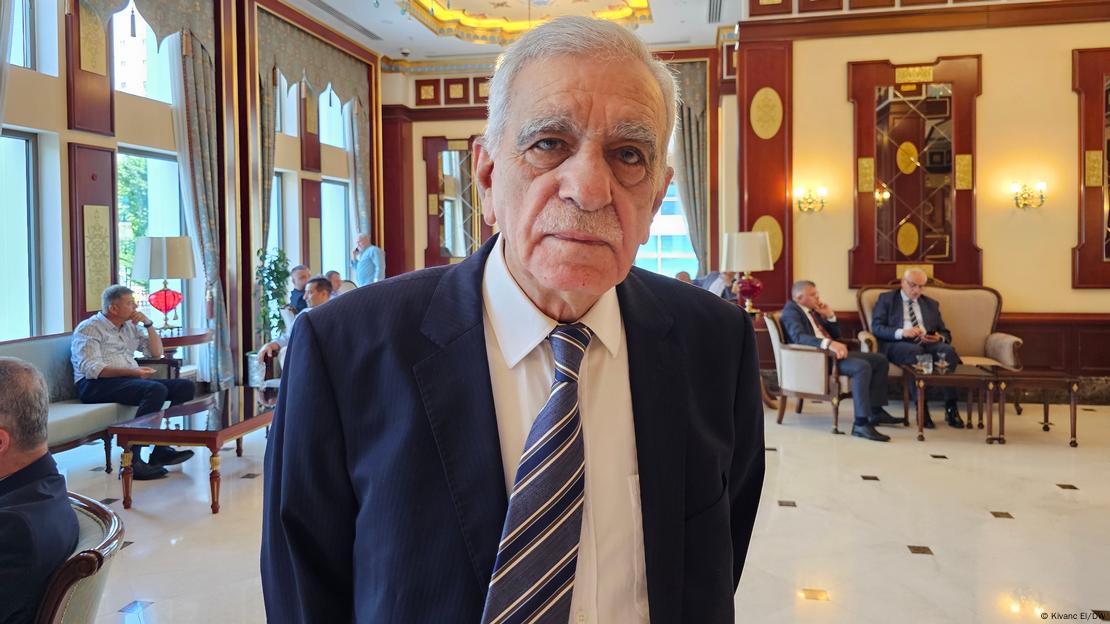
Ahmet Turk, a pro-Kurdish politician, was elected as mayor three times and also dismissed three times
Image: Kivanc El/DW

A carrot and stick approach?

Since Bahceli's push for Ocalan's potential early release, people in Turkey have been puzzling over what the government in Ankara is up to.

Why are its representatives seeking proximity to Ocalan at the same time as elected Kurdish local politicians are being removed from office?

In late October, Ahmet Ozer, the mayor of Istanbul's Esenyurt district and a member of the Republican People's Party (CHP), was arrested for alleged links to the PKK.

A few days later, three Kurdish mayors in southeastern Turkey were replaced by state officers.

This also happened to Ahmet Turk, an 82-year-old veteran of Kurdish politics. He has been elected and dismissed as mayor of the city of Mardin three times.

Observers agree that Erdogan is set on becoming the president of Turkey again.

However, a constitutional amendment would be necessary for a fourth term in office. As of now, Erdogan lacks the necessary majority in parliament.

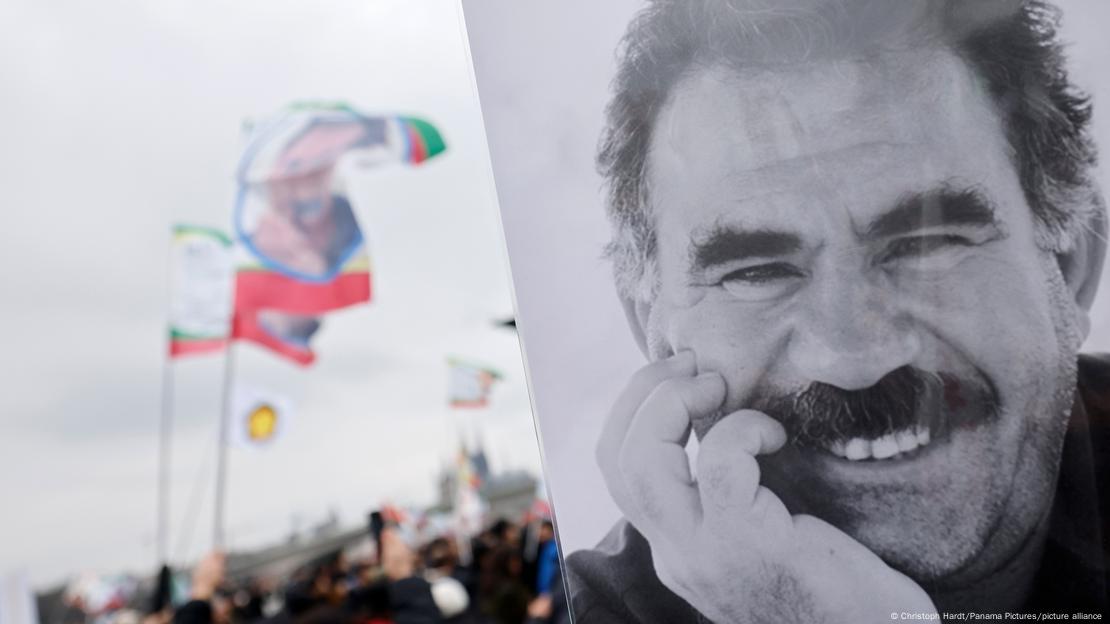
Analysts believe that his plan is to use the carrot and stick approach to bring the Kurds and pro-Kurdish DEM Party into line by offering concessions, such as softening Ocalan's sentence to house arrest or possibly ending the practice of imposing state officials in Kurdish regions.

Moreover, such moves could also split the opposition.


Could the Turkish government's hope be to offset Abdullah Ocalan's release for Kurdish votes?
Image: Christoph Hardt/Panama Pictures/picture alliance

Power shift in the Middle East?

Arzu Yilmaz, a political scientist at the University of Kurdistan Hewler in Iraq's city of Erbil believes that there are other reasons for the latest developments.

"First and foremost, the unstable situation in the Middle East and the US govenment's decision to withdraw US soldiers from Iraq and Syria by 2026," she told DW.

Given Donald Trump's re-election, this could happen sooner than expected, she added.

Around 2,500 US soldiers are still stationed in Iraq, and some 900 in Syria, where they cooperate closely with local Kurdish militias.

"The balance of power in the Middle East is shifting, but despite its ambitions, Turkey is not an important player," Yilmaz said, saying that Ankara might want to change that.

Bese Hozat, the co-chair of the Kurdistan Communities Union, an umbrella organization of several parties of Kurdistan, including the PKK, echoed these thoughts. "Turkey's geopolitical and geostrategic position and influence in the region is gradually weakening," she said in an interview, adding that this was "causing the Turkish government to panic."

In her view, this has pushed it to find a workaround and try to instrumentalize Kurdish leader Ocalan for its own purposes.

Military operations expected

Earlier this month, Erdogan announced that he would soon close the "security gaps on the southern borders".

This signals a new round of Turkish military operations in Syria and Iraq.

Arzu Yilmaz believes that the Iraqi Kurds have no reason to worry about the future as their status quo is enshrined in Iraq's constitution.

However, the future of the self-governing Kurdish region in northeastern Syria is more uncertain, she said, adding that so far the US had supported the Kurds but it remained to be seen what would happen after the withdrawal of US troops. It was unclear who would fill the resulting power vacuum.

A key factor would be how the Kurds in the various regions cooperated with each other, she said: "This will determine whether the Kurds ultimately emerge from this crisis stronger or weaker."

Sources close to the PKK say that an initial meeting of Kurdish parties from Iraq, Iran, Syria and Turkey took place in the Belgian capital Brussels in November, however, the result of the discussion remains unknown.

The Kurds are the largest ethnic group in the world without their own state. According to estimates, more than 12 million live in Turkey, around 6 million in Iraq and the same in Iran, and just under 3 million in Syria.

Germany boasts the largest Kurdish diaspora community, which numbers around 1 million.

This article was translated from German.

Sunday, September 01, 2024


For love of game, Turkey’s top Kurdish football club resists hatred

Many Kurds say they face significant discrimination in the country. Ankara denies the claims.
Sunday 01/09/2024
Amedspor’s fans cheer in the stands during the Trendyol League football match between Amedspor and Sakaryaspor at Necmi Kadooglu stadium in Esenyurt district of Istanbul, August 28, 2024. (AFP)

ISTANBUL –

The slurs shouted by the ultras of a football club in northwest Turkey at their Kurdish rivals is just one way that the decades-old feud opposing Turks and Kurds plays out in the sport.

While Amedspor is the most popular team among Turkey’s Kurds, who make up about a fifth of the country’s 85 million people, it is the most hated by the rest of the population.

“They are not a team, they are terrorists,” said Efe Kaan Ozkaya, a Sakaryaspor fan, standing with friends outside the Istanbul stadium hosting a second-division football match between his club and Amedspor.

Police officers and armoured vehicles flooded the Istanbul neighbourhood welcoming the southeast Turkish club.

As the national anthem played, Sakaryaspor supporters made the salute of the Grey Wolves, a far-right group accused of having killed several Kurdish and left-wing activists.

But the game is a precious opportunity for the 200 Amedspor lovers, guarded by 100 police officers, who came to watch their idols, a trip that is frequently banned by authorities over security concerns.

The club’s home city of Diyarbakir, also known as Turkey’s “Kurdish capital,” remains scarred by intense fighting between the army and the Kurdistan Workers Party (PKK) in 2015-2016.

The conflict opposing the government and the PKK, which is considered a terrorist organisation by Turkey, the United States and the European Union, has killed more than 40,000 people since 1984.

Many Kurds say they face significant discrimination in the country. Ankara denies the claims, insisting that it does not discriminate against Kurds as a minority but rather opposes the PKK.

‘A form of resistance’

The players sporting white jerseys with red and green stripes, the colours of Kurdistan, began kicking the ball, as fans chanted “Amed! Amed!”, Diyarbakir’s Kurdish name.

Support, and hatred, for the club exploded after 2015, when it changed its name to Amedspor.

Nine years later, “the existence of Amedspor, with its colours and its name, is a very strong and unprecedented form of resistance,” said Daghan Irak, a sports sociologist.

The Kurds, an ethnic minority who live in mountainous regions spread across Turkey, Syria, Iraq and Iran, have long fought for their own homeland.

The Diyarbakir-based club and its players have faced repeated sanctions, including over calling for the end of operations against the PKK, said Irak.

“Kurds in Turkey are free to live as Kurds privately, as long as they accept to be Turks publicly,” he said.

“Kurds are free to play as long as they do not play as Kurds.”

‘Kurdish national team’

The popular club played in the third division last year in front of crowds averaging 20,000, more than 17 of the 20 teams in the first division managed to attract.

It was promoted to second division at the end of last season, and still faces attacks with each away fixture.

Teams from Turkey’s Kurdish regions and their supporters have been involved in repeated fights during Turkish league matches.

At a match in the western conservative city of Bursa last year, Amedspor players had objects, including knives, thrown at them.

“Whichever team they face, Amedspor is almost always perceived as representing another country,” Reha Ruhavioglu, the director of the Centre for Kurdish Studies, said.

Although the team’s roster has several non-Kurdish players, identity is a key component of the club.

“Amedspor is to Kurds what Barcelona is to Catalans,” said Uygar Ozturk, 43, after a disappointing score (0-0).

“Amedspor is not just the Diyarbakir team, it is like a national Kurdish team,” said Azer Gunes, a 19-year-old waiter who arrived in Istanbul last spring.

Gunes said he wears his club’s colours everywhere he goes, even more so after Kurdish construction workers were beaten, with one shot, in central Turkey in August for refusing to take off their Amedspor shirts.

Seconds later, fellow fan Ugur Cetin railed at heavy policing.

“We were 200 fans for 2,000 police officers!” he said, adding that he was searched eight times.

“Why so many precautions? That’s because of our race.”


Saturday, July 20, 2024

German city of Bremen bans the silent fox gesture over links with far-right Turkish group


Copyright AP Photo

By Jonny Walfisz
Published on 19/07/2024 - 

What does the hand gesture say? A bit too much, according to authorities in the German city of Bremen who fear its links with a far-right Turkish nationalist movement.

Officials have banned the “silent fox” hand gesture from use in schools due to its association with the Turkish nationalist movement.

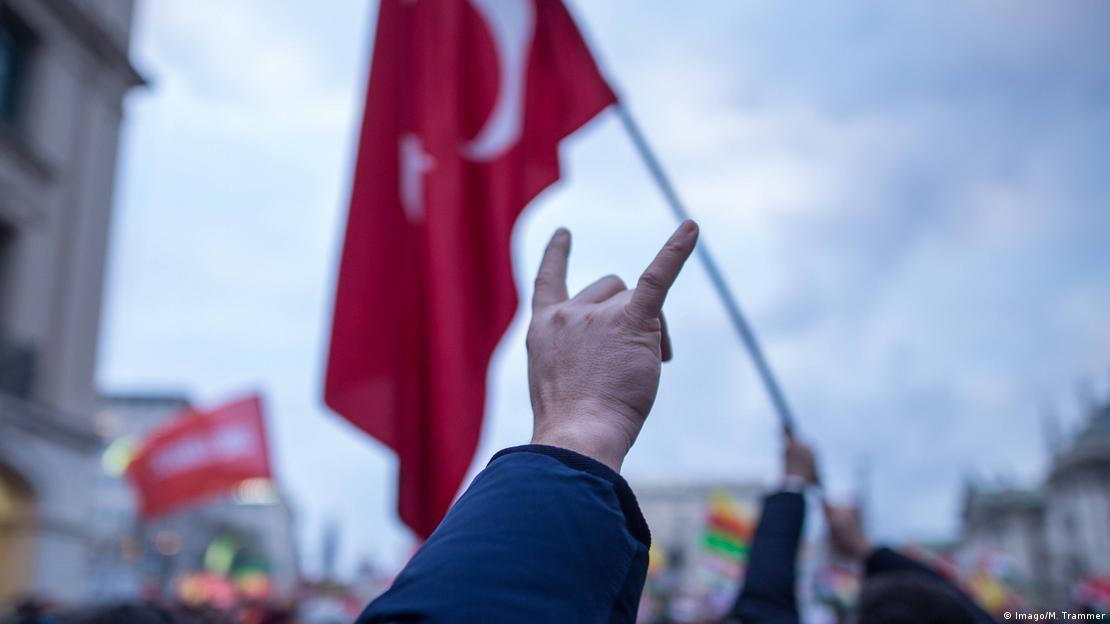
The silent fox gesture – made by lifting the index and little finger while pinching together the middle and ring finger with your thumb – has been used throughout Europe as a teaching method to quiet classrooms.

Greek singer Despina Vandi refuses to play on stage with Turkish flag

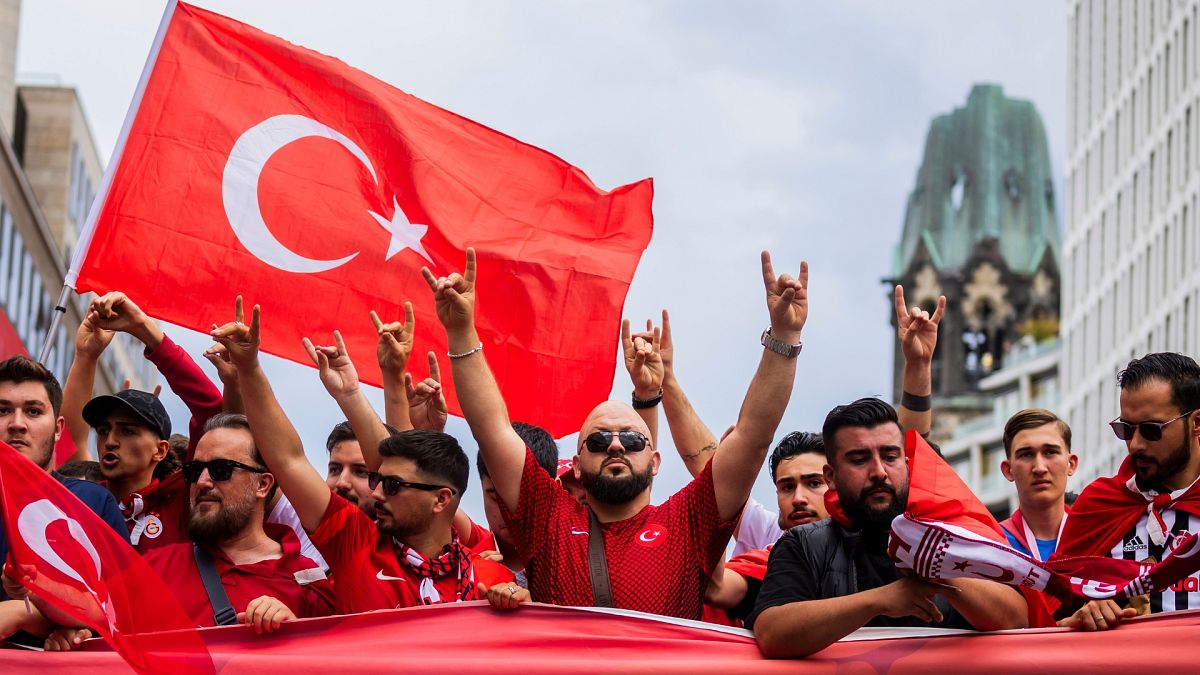
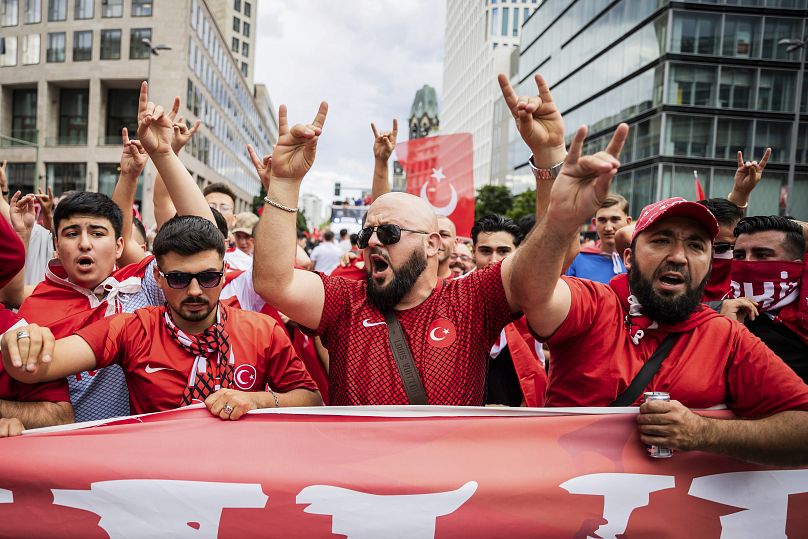
But the silent fox is to be phased out of use in day cares and schools in the German city of Bremen due to its visual similarity to the “wolf salute”, a political symbol of the Grey Wolves (Ülkü Ocakları) and the Nationalist Movement Party in Türkiye.

The controversial wolf salute gesture represents a combination of Turkishness and Islam by the Grey Wolves, a Turkish far-right political group that has been described as a “death squad” and “terrorist organisation” for its reported association with political violence.

Austria banned the wolf salute gesture in 2019, with France following suit. While the gesture hasn’t been outright banned in Germany, the move by Bremen authorities is a significant shift towards the approach of its neighbours.

Turkey fans show the 'wolf salute', the origin of which is attributed to a right-wing extremist movement, during a fan walk before the start of the Euro 2024 quarterfinal Christoph Soeder/(c) Copyright 2024, dpa (www.dpa.de). Alle Rechte vorbehalten

The wolf salute hit headlines earlier this month when Turkish footballer Merih Demiral was banned for two games by UEFA after he used the gesture to celebrate scoring against Austria in the Euros.

Demiral claimed it was an expression of Turkish pride while Germany’s interior minister Nancy Faesar said: “To use the football championships as a platform for racism is completely unacceptable.”

Turkish President Recep Tayyip Erdoğan responded to what he considered the hypocrisy of the ruling by UEFA: “Does anybody ask why the German national jersey has an eagle, or the French jersey a rooster?”.

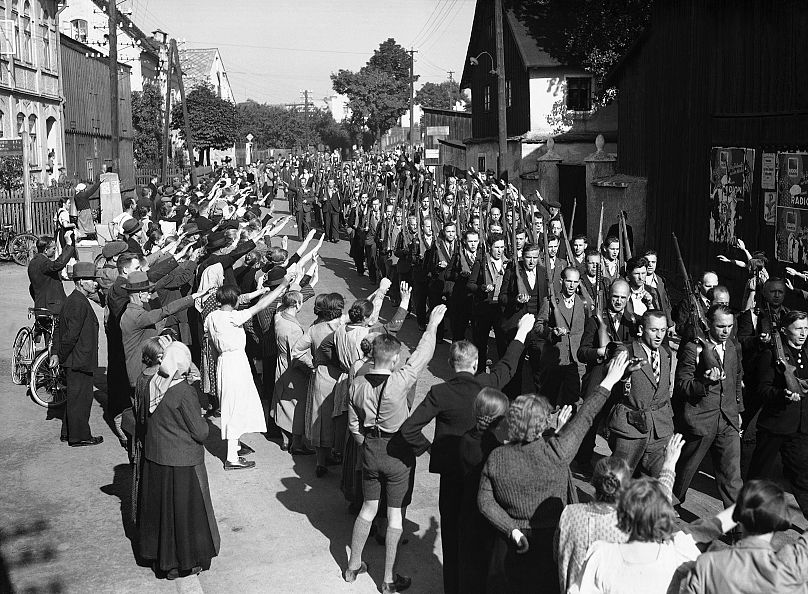
Sudeten Germans from the Free Corps receiving the Nazi salute as they pass through Haslow as they march back into Czechoslovakia on Sept. 22, 1938. Len PUTTNAM/AP

Erdoğan has been criticised for his own use of the wolf salute. In 2018, he briefly showed the gesture at a campaign rally in Mersin which political commentators viewed as an attempt to corral the far right nationalists to his voter base.

If the wolf salute were to be fully banned in Germany, it would join the Sieg Heil – the salute popularised as a show of obedience to Adolf Hitler – as an illegal gesture. It is also a criminal offence to use the Sieg Heil in Austria, Slovakia and Italy, with it constituting as hate speech in most of the rest of Europe.


Sunday, March 31, 2024


Turkey calls protesters of ultranationalist attack on Kurds ‘PKK militants’

ByTurkish Minute
March 27, 2024

Turkey labeled people protesting a racist attack on Kurdish families returning to their homes after Nevruz celebrations on Sunday as militants of the outlawed Kurdistan Workers’ Party (PKK), which is designated as a terrorist organization by Turkey and much of the international community.

Tensions have escalated since Sunday in Belgium and Germany as Kurds riot in protest of the racist attack, while Turks do the same, believing they are protesting against the PKK, which often deteriorates into a hunt for Kurds in the streets of Belgian cities, leading to a series of violent clashes and numerous injuries.

On Sunday, after Nevruz celebrations in Belgium, a Kurdish family was attacked by a group of nationalist Turks outraged by the presence of Kurdish symbols in a predominantly Turkish neighborhood. The attackers, armed with machetes and guns, attempted to storm the Kurdish family’s house in Heusden-Zolder, resulting in at least six Kurds being hospitalized, one in serious condition, as violence necessitated police intervention for protection of the 40 Kurds besieged in the house.


The Turkish Foreign Ministry published statements on Tuesday and Wednesday about the incidents in Europe.

In Tuesday’s statement, Kurds who protested the ultranationalist attack and opposed the subsequent search by people waving the Turkish flag and giving the “wolf” salute, a gesture of the ultranationalist Grey Wolves, were described as “PKK militants.”

The Grey Wolves is considered the paramilitary wing of Turkey’s far-right Nationalist Movement Party (MHP) and is banned in several countries.

“PKK militants gathered in Leuven, Belgium, carried out attacks targeting Turkish citizens living in the cities of Heusden-Zolder and Hauthalen. No lives were lost, but some of our citizens were injured,” the Turkish Foreign Ministry said.

President Recep Tayyip Erdoğan contacted 16-year-old Efe Tapmaz, one of the Turkish citizens injured in the riots, by phone to offer his well-wishes, claiming that he was injured by PKK sympathizers. Erdoğan said that his chief foreign policy and security adviser, Ambassador Akif Çağatay Kılıç, would follow the case closely and condemned the protesters as “immoral, heinous and despicable.”

On Tuesday protesters threw bricks at the Turkish Consulate General in Hannover, Germany, which prompted the Turkish government to immediately label the protesters as “supporters of the PKK.”


“On the night of 26 March, supporters of the PKK terrorist organisation attacked the entrance of the Consulate General of the Republic of Türkiye in Hannover,” the Turkish Foreign Ministry said in the statement.

It is common for Kurds in Turkey who are politically active in the Kurdish struggle for recognition to face terrorism charges due to their alleged links to the PKK.

Rights groups and international bodies routinely criticize Turkey for using its broad and vague anti-terror legislation to crack down on dissent.

The Democratic Alliance for Diversity and Awakening (DAVA), a new political association in Germany with alleged links to Erdoğan and his Justice and Development Party (AKP), has also entered the discourse.

A press release by DAVA condemned the violence and put the blame on “PKK symphatizers.”


The association has previously denied any connection to Erdoğan and his AKP and has positioned itself as representing a broader population group, including Turkish and other minorities in Germany. However, critics have raised concerns that DAVA has the potential to further fuel division and that it is linked to Erdoğan’s influence abroad.

An overwhelming majority of Germany and Belgium’s Turkish communities voted for Erdoğan and his AKP in the May general election.

Belgian Prime Minister Alexander De Croo called for calm on Wednesday, according to a report by Agence France-Presse.

“We are asking everyone to calm down, stop the provocations and continue living together [in harmony] as we have done for decades in our country,” De Croo was quoted as saying.

“Let’s stop … these demonstrations of support for organizations classified as terrorist,” he told reporters, referring to the PKK.

The public prosecutor’s offices in Limburg and Liege confirmed to AFP that they were investigating the violent incidents but would not provide more information.

Turkish Foreign Minister Hakan Fidan spoke to his Belgian counterpart, Hadja Lahbib, on Sunday night after the protests, his ministry said this week.

De Croo said Belgium was “following this closely because there are other key moments in the coming days,” referring to local elections in Turkey on March 31.


Saturday, December 23, 2023

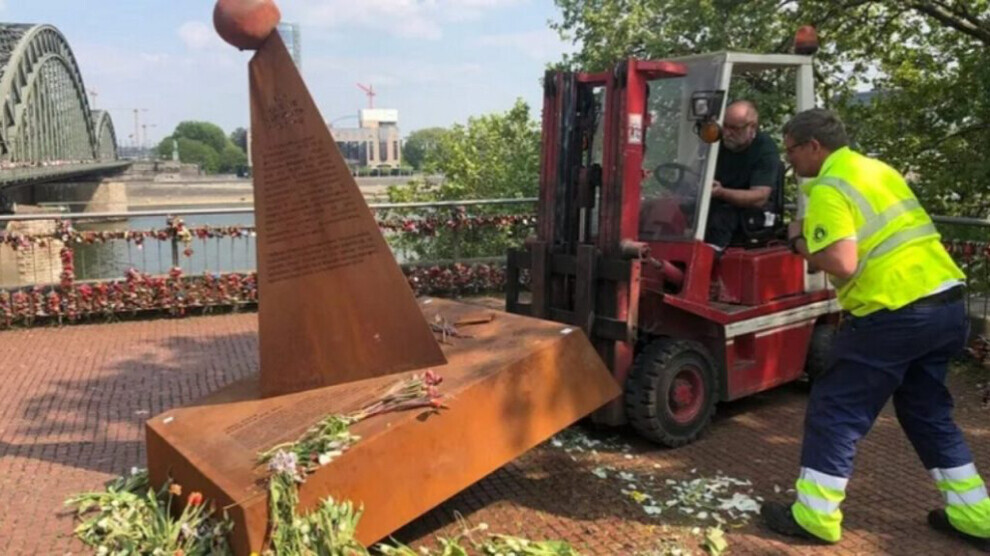
Cologne bows to Turkish racists, removes Armenian Genocide monument

The Armenian Genocide monument in Cologne was removed under pressure from racist organisations affiliated with the Turkish state.


ANF
COLOGNE
Thursday, 21 Dec 2023, 18:23

Having been the target of constant attacks for years, the Armenian Genocide monument in Cologne, Germany, was finally removed. While a small number of Armenians live in Cologne, the city has turned into the headquarters of the National Vision organisation affiliated to the Turkish state.

French journalist Guillaume Perrier wrote on his X account: "The city of Cologne is finally dismantling a monument commemorating the Armenian genocide. Cologne has a small Armenian community, but above all a large Turkish community".

Journalist Perrier added: "This is above all the result of pressure from the Turkish government and concessions from the German right (the CDU used, encouraged and supported the Grey Wolves and Milli Görüs against the influence of the left on Turkish immigrants)."

French senator Valerie Boyer wrote on her X account that "Cologne has bowed to the Turkish National Visionists who impose the denial of the 1915 Armenian genocide". Boyer said, "This is a direct consequence of Turkish immigration to Germany... It is a harbinger of bitter days in Europe".

The monument in Cologne symbolising the Armenian genocide, which Turkey does not recognise, has been erected and dismantled several times over the years following protests by Turkish nationalists.

The city had the statue removed, sometimes on the grounds of the construction of a cycle path and sometimes out of fear of "social unrest".

After a march in late October by Turkish nationalists, including supporters of the racist, far-right “Ülkü Ocakları” and DITIB associations, the city's final decision was "the monument must be removed".

Saturday, July 29, 2023

German soccer star Özil's tattoo: Who are the Gray Wolves?

Elmas Topcu
07/27/2023
DW

Former Germany midfielder Mesut Özil has made headlines with a picture of him showing a Gray Wolves tattoo. But who are the Turkish ultranationalists and why are they under observation by German authorities?

Former German national team player Mesut Özil has a tattoo with Gray Wolves symbols
Image: Instagram

Fitness coach Alper A. is fond of posting pictures of his clients on Instagram, typically the classic "before and after" shots that showcase his success stories. The most recent one, featuring Mesut Özil, a former Germany national football team star, has caused a stir. The two men stand side-by-side proudly flaunting their toned stomachs after an apparently successful training program.

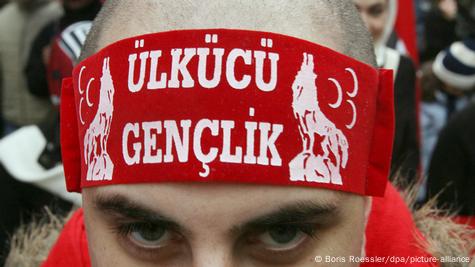
But it is the tattoo visible on the left side of Özil's chest that is at the center of discussions in Germany, where he was born and raised in a Turkish immigrant family. It shows the silhouette of a howling wolf and three crescent moons — typical symbols of the Turkish ultranationalist group the Gray Wolves, also known as the Idealist Hearths or Ulku Ocaklari.

The animal is an important symbol for Turkish right-wing extremists. In mythology, a gray wolf saved the ancestors of the Turkish peoples from their enemies and helped them ascend as a great power. For many, it therefore represents power. The wolf hand salute also comes from this myth.
The well-known gray wolf salute on display

Three crescents were found on the war flag of the Ottomans. Today, they form the party logo of the Nationalist Movement Party (MHP), which has beenthe largest ally of Turkish President Recep Tayyip Erdogan for years.

Gray Wolf ideology


German authorities characterise the group's ideology as nationalist-extremist, anti-Semitic and racist. Their stereotypical enemies include Kurds,Armenians, Jews and Christians, since they believe in the superiority of the Turkish nation. The Gray Wolves committed numerous acts of violence and murders in the past, particularly in the 1970s.

According to Germany's domestic intelligence services, the Office for the Protection of the Constitution, the aim of the Gray Wolves is to establish a homogeneous state of all Turkic peoples under Turkish leadership — from the Balkans to western China.

The logo of ultranationalist party MHP: three white crescents on a red background
I
There are two main currents within the Gray Wolves: the Nationalist Movement Party (MHP) and the Great Unity Party (BBP), the extremism researcher Kemal Bozay finds.

Of the two, the ultranationalist MHP is the original Gray Wolves organization, according to Germany's Office for the Protection of the Constitution.
Gray Wolves in Europe

Gray Wolves are organized throughout Europe. A regional umbrella organization, the Turkish Confederation in Europe, was founded in the German city of Frankfurt in 2007 to bundle the various European offshoots.

Across Europe, there have been repeated clashes involving Gray Wolves, particularly with Kurds. Austria prohibited Gray Wolves symbols in 2019 and France banned their offshoot in 2020. Late that same year, the German parliament resolved to consider a similar ban. So far, it has not come to fruition.

Security authorities in Germany believe there are some 11,000 Gray Wolves members, around 9,500 of them organized in associations, nationwide.

The association with the largest number of members is the "Türkisch Demokratischen Idealistenvereine in Deutschland" (Turkish Democratic Idealists Associations in Germany), known as ADÜTDF from Turkish-language acronym. It represents the interests of the ultranationalist MHP, Erdogan's ally. With over 7,000 members in Germany, ADÜTDF is the largest known umbrella organization within the Gray Wolves milieu. It is organized into 160 local associations.

The second biggest is ATIB, the "Union der Türkisch-Islamischen Kulturvereine in Europa" (the Union of Turkish-Islamic Cultural Associations in Europe). According to the Office for the Protection of the Constitution, it has 1,200 members and is organized into 25 local associations throughout Germany. It was founded in 1987 by a well-known member of the Ülkücü milieu, who is said to have provided the hitman's weapon and wages for the 1981 assassination attempt on Pope John Paul II.

The Gray Wolves are also known as the Idealist Hearths (Ulku Ocaklari)


Germany's third umbrella organization is the Federation of World Order in Europe (ANF). Nationwide, it has some 1,200 members in about 15 local chapters, according to German authorities. ANF represents the interests of the Islamic-ultranationalist Great Unity Party (BBP), which is also a member of Erdogan's electoral alliance. Numerous political murders in Turkey have been attributed to the BBP. Its members are also alleged to have been involved in the murder of the Armenian journalist Hrant Dink in Istanbul.

This article was originally published in German.

Friday, March 24, 2023

Dissident Selek says won't return to Turkey to stand trial

Issued on: 24/03/2023 - 


'I can't go to Turkey,' says Pinar Selek, who faces a March 31 court date
 © Valery HACHE / AFP

Nice (France) (AFP) – Pinar Selek, a Turkish-French dissident sociologist living in France, will not go to Turkey to face trial, the latest twist in 25-year legal battle with the authorities, she told AFP.

Turkey has accused Selek over a 1998 explosion that killed seven people and, even after four acquittals, wants her in the dock again after issuing an international arrest warrant in January.

In an interview with AFP in the southern French city of Nice where she teaches sociology, Selek said: "You never get used to injustice".

Although the successive trials, acquittals and retrials started well before President Recep Tayyip Erdogan came to power, she said they "are an illustration of both the continuity of the repressive regime, and the new tools of the regime".

Selek, now 51 and known for her critical studies of the Kurdish conflict in Turkey and her work with street children, was first arrested in 1998 and accused of belonging to the PKK, a Kurdish militant organisation considered by Turkey and its western allies -- including the United States and the European Union -- to be a terrorist organisation.

She was then accused of bombing a spice market popular among tourists in Istanbul, a charge she was informed of only "when I was already in my prison cell".

But then a witness, who had testified that she had been part of the plot, withdrew his statement. An expert report concluded that the explosion had been an accident. Selek was freed in 2000 with the court citing lack of evidence, but the trial was not over.

She moved to France and pursued her sociology research, first in the eastern city of Strasbourg and then in Nice in the south, and obtained the French nationality in 2017.
'Safe in France'

But back home, the judicial process against her ground on. She was acquitted in 2006, then again in 2008 and again in 2011. But each time, the supreme court cancelled the acquittals.

In 2012 a court in Istanbul decided on a retrial and, a year later, sentenced her to life imprisonment.

The supreme court overturned that verdict, too, and ordered another retrial which ended with yet another acquittal, in 2014.

Then, in June of last year, the supreme court intervened again, annulling all previous acquittals.

An international arrest warrant was issued, and a new court date set for March 31.

"I'm not going to my trial, I can't go to Turkey," she said in the interview. "I feel safe in France, my lawyers have advised me not to leave the territory."

But, she said, there would be "around a hundred people" to represent her. "Parliamentarians, academic colleagues and activists from several countries. There is an incredible mobilisation," she said.

Selek said she hoped to win her own fight against the judiciary, and also wished for Turkey to "enter a process of justice for everybody", including prisoners.

"That country has become a huge prison. People who were untouchable before are now behind bars, great filmmakers, writers, activists, Kurds and many women. I try to do what I can to be their voice," she said.

Her defence in the upcoming trial will be handled by her father, a 93-year-old lawyer, and her sister, a lawyer and former economist.

"She's a feminist, and very active in the social movements for democracy and freedom," Selek said of her sister. "Like my father, she doesn't want to leave Turkey because they want to change things from within."

Would she herself return home if Turkey had a different president? "I don't think the question of my return depends entirely on Erdogan," she replied.

She said her ordeal started because of the Grey Wolves, an ultra-nationalist organisation, which she said preceded Erdogan and is still influential in government.

© 2023 AFP

Monday, June 20, 2022


Electioneering in Turkey
Turkish right-wing populists on the rise


Right-wing radicalism and nationalism have dominated Turkish politics for decades. Now a new right-wing populist grouping is stirring things up: enter the "Victory Party". 

By Elmas Topcu

19 May is a bank holiday in Turkey. It is a day rich in symbolism, dedicated to Turkish youth by the country's founder Mustafa Kemal Ataturk. On 19 May 1919, the father of the country launched the war of liberation against Western powers, which lasted until the founding of the Republic in 1923 – or so it says in Turkish history books.

For Umit Ozdag, leader of the new Victory Party, 19 May provided the perfect opportunity to bang the nationalist drum. The 61-year-old visited the mausoleum of Ataturk in the Turkish capital Ankara with a group of supporters and posed with passers-by in front of the large monument. People who recognised him were keen to catch a selfie. A man walking past called out to him, "My teacher, it’s good you exist." One woman even kissed Ozdag on the forehead.

Umit Ozdag is the shooting star of recent weeks. Wherever he appears, a crowd quickly forms. Everyone wants to see him, many want to express their support. Because Umit Ozdag deliberately addresses the issues that are worrying many Turks: galloping inflation, dwindling purchasing power, existential fears and alleged "alienation" in their own country due to refugees.

Scapegoating the Syrian refugees


According to official figures, there are currently 3.8 million Syrian refugees registered in Turkey. How high the actual number is remains uncertain. In addition, there are refugees from Afghanistan, Iraq, Pakistan and other countries, whose number according to the UNHCR is said to be around 320,000. The number of unreported cases is suspected to be much higher.

"We don't want our people to struggle with hunger and poverty while our taxes are spent on Syrians, Afghans and Pakistanis," Umit Ozdag has been heard to rail at numerous events in recent weeks. Refugee bashing goes down well with many Turks. Because people are afraid. Inflation recently reached around 70 percent. The population is suffering under the enormous increase in prices. And there is no end in sight.


End of the welcome culture: Turkey, with its population of almost 85 million, currently hosts around five million refugees. More than 3.6 million of them are Syrians. They fled to their southern neighbour following the outbreak of civil war in 2011. In the wake of the severe monetary and economic crisis in Turkey, sentiment toward Syrian refugees in particular is intensifying. Last year saw violent attacks on Syrians, their homes and their businesses in the capital Ankara

Ideological proximity to the "Grey Wolves"

Actually, Umit Ozdag is no new " saviour" either, he has been part of the political establishment too long for that. But the tone he strikes is a new one.

Umit Ozdag comes from a politically active family. His father was a close confidant of Alparslan Turkes, founder of the Nationalist Movement Party (MHP). Better known in Germany for its "Grey Wolves" organisation, which also has boasts networks in Germany and is under surveillance by the German Office for the Protection of the Constitution. Ozdag's mother was also active in the MHP. She was the very first chairperson of the party’s women's branch.

Ozdag was born in Japan, where his father worked in the diplomatic service in the early 1960s. Ozdag studied political science, philosophy and economics at the Ludwig Maximilian University in Munich.

Ozdag was also a member of the MHP. First in the youth organisation, then in the executive committee. Until he was expelled from the party in 2016 after openly criticising its leadership. A year earlier, the MHP had entered into an alliance with Erdogan, enabling the AKP to gain a majority upon re-election. To Ozdag, the idea of propping up Erdogan's government was a source of serious displeasure.

He and a handful of other MHP dissidents subsequently founded the conservative-nationalist Iyi Parti, in English "the Good Party". Having fallen out with the leadership, he resigned in 2021 and ultimately founded his own party: the "Victory Party".
Right-wing agitation meets with widespread approval

His new party only really took off a few months ago, however, after he started issuing right-wing extremist, racist and anti-refugee statements. Since then, his approval ratings have improved dramatically. In the latest polls at the beginning of May, support for the party even exceeded the two-percent mark, which by Turkish standards is already quite high.


Zafer Partisi – " Victory Party ": Turkey’s new nationalist party borrows from the legacy and ideology of the Pan-Turkish-Turanian movement, which in the 1930s and 40s was still closely linked to the official national ideology of Kemalism in the youthful republic. The party's founder, Umit Ozdag, draws on these nationalist elements. Panturkism, and/or Panturanism play an important role in Ozdag’s ideology, confirms Turkey expert Kemal Bozay from the International University of Duesseldorf and Cologne


For Professor Kemal Bozay of the International University of Applied Sciences in Dusseldorf and Cologne, who has been observing the Turkish ultranationalists for years, the ideological colour of the Victory Party is clear: "Its party agenda is ultranationalist; its rhetoric and forms of presentation extremely right-wing populist," says Bozay in interview. Ozdag draws on certain folk-nationalist elements. Panturkism, or Panturanism, plays an important role for him, Bozay adds. For Turkish ultra-nationalists, Turan is the ideal of an ethnically homogeneous state of all Turkic peoples from the Balkans to Western China, to be established under the leadership of Turks.

According to expert Bozay, Ozdag also presents these historical folk-nationalist elements in his party manifesto. It is worth noting that, having founded his party, Ozdag immediately visited the grave of Alparslan Turkes, the former leader of the Grey Wolves, linking his party directly to the legacy of the latter.

Ozdag – scathingly critical of the AKP

Umit Ozdag pulls no punches when it comes to the ruling party, either. Most recently, he clashed with Turkish Interior Minister Suleyman Soylu. Soylu had strongly criticised Ozdag for his party’s financing of an anti-refugee film called "Silent Conquest". The situation between the two men came to such a head that Ozdag, to the amazement of the Turkish public, practically challenged the interior minister to a duel: were the interior minister man enough, he would come out, Ozdag threatened.

Thanks to such statements, Ozdag suddenly began to score points with many government critics, even those calling themselves social democrats. A heated debate broke out on social media. Ozdag was not racist at all, many said. He was defending the values of a healthy Turkish patriotism. As a result, Ozdag also received support from the largest opposition party, the Republican People's Party (CHP).


‎Turkish right-wing extremists dream of empire: Defending the state is the practical expression of the Gray Wolves' dream of "Turan": An empire that unites all Turkic peoples - from Asia to Europe to North Africa. People from different Turkish societies live there. This is not about the Republic of Turkey, but about the cultural and ethnic tribe of the Turks. Her distinguishing mark is the wolf, which is revered in the old Turkish, shamanic mythology as a magic helper. 

‎Difference to the MHP or BBP‎

‎Can Ozdag's Victory Party establish itself? For political scientist Berk Esen of Sabanci University, it is still too early to say. It will take a few years to assess the party's potential, once it has adopted policies in other areas. ‎

‎Historically, the Turkish ultra-nationalists have split once before. Their right-wing Islamist wing broke away in 1993 to found the "Great Unity Party" (BBP). To them, Islam is an essential part of Turkish identity. ‎

‎For Umit Ozdag and his party, this does not play a major role, says Kemal Bozay. Another difference to the ultra-nationalists is the Victory Party’s anti-government stance. While the MHP and BBP support Erdogan and the AKP government, Ozdag opposes the government, Bozay reminds us. ‎

‎Moreover, these old ultra-nationalists, the MHP and BBP, have always maintained close ties to the so-called deep state, Turkey's "state within a state" and its paramilitary underground structures. Umit Ozdag, on the other hand, has clearly distanced himself from them, Bozay notes. ‎

‎Similarities with European right-wing populists‎


‎For political scientist Berk Esen, the Victory Party displays ‎‎similarities with European populists‎‎. Not only because of the anti-refugee theses, he says, and goes on to explain: for Ozdag, Turkey consists of two camps; on the one side are the government and the opposition as the political elite, who tacitly accept Turkey being overrun by refugees. The rest are the people, whom Ozdag wants to save with his Victory Party. Indeed, it is surprising such a populist party took so long to emerge. ‎

‎Here, Esen is referring to the alliance between the ruling AKP and the ultra-nationalist MHP and BBP. Both have supported Erdogan since 2018 and go along with his refugee policy, despite the rumblings of dissent among their supporters. Whether they can continue to keep the party faithful in line or stand to lose them to the Victory Party is currently hard to tell. One thing however is certain: the issue of refugees will continue to preoccupy Turkish society. ‎

‎Elmas Topcu‎
‎© Deutsche Welle / Qantara.de 2022‎

‎You may also like:‎

‎Criticising Erdogan: Don't romanticise the Kemalist legacy!‎‎ ‎

‎Creeping authoritarianism: Turkeyʹs one man band‎

‎The Nazi glorification of Ataturk: Ankara's shining star‎

‎"The Turkish Malaise": Why is Erdogan gambling away Turkey's future?‎

Jul 3, 1983 — The Gray Wolves, said to number about 18,000 in Europe, serve as the ... Gray Wolf, Mehmet Ali Agca, before he shot Pope John Paul II in St.

Grey Wolves — On 13 May 1981, in St. Peter's Square in Vatican City, Pope John Paul II was shot and wounded by Mehmet Ali Ağca while he was entering the ...
In the 1970s, Agca joined a right-wing Turkish terrorist group known as the Gray Wolves. The group is held responsible for the assassination of hundreds of ...