Sunday, February 02, 2025

MAGMA MOVING

Greece’s ‘Instagram island’ hit by 200 earthquakes, sparking school closures and warnings to avoid indoor gatherings

Elinda Labropoulou and Billy Stockwell, 
CNN
Sun, February 2, 2025 

Schools will be closed Monday on the iconic Greek island of Santorini after a series of 200 earthquakes shook the popular tourist destination in recent days.

Authorities have also advised residents to avoid large indoor gatherings and steer clear of multiple ports, including the old port of Fira, just below the island’s capital.

Schools will also be shut in the nearby Aegean islands of Anafi, Ios and Amorgos, authorities said Sunday.

Between Friday and Sunday, more than 200 earthquakes were detected between Santorini and Amorgos, including a 4.6-magnitude quake, the most powerful so far, according to authorities.

Santorini is no stranger to earthquakes, sitting as it does on several fault lines. The risk of tremors doesn’t stop a reported 3.4 million people from visiting the island each year – far outnumbering Santorini’s 20,000 or so residents.

The holiday destination, famed for its crescent-shaped caldera, which was created by one of the largest known volcanic eruptions around 3,600 years ago, has been dubbed Greece’s “Instagram island” due to its photogenic golden light and sweeping scenery.


Tourists watch Santorini’s famed sunset from the Castle of Oia on July 25, 2024. - Alkis Konstantinidis/Reuters

An emergency committee met Sunday to assess the risks posed by the latest tremors, while another meeting is scheduled for Monday.

Santorini is part of the Hellenic Volcanic Arc, one of the most active volcanic fields in Europe, which has seen more than 100 eruptions over the past 400,000 years.

Authorities said current seismic activity is due to tectonic movements that do not appear related to volcanic activity. Similarly, increased seismic activity in 2011 and 2012 did not result in any eruptions, they noted.

The most recent large quake in Santorini struck on July 9, 1956. The 7.5-magnitude earthquake was followed by a 25-meter-high (around 80 feet) tsunami.

At least 53 people were killed and more than 100 injured, while at least one-third of the houses collapsed.


Greek island Santorini on earthquake alert after more than 200 tremors

Sky News
Sun, February 2, 2025 


More than 200 tremors near the island of Santorini have prompted Greek authorities to close schools and tell residents to avoid some ports and drain swimming pools.

Earthquake experts say the increase in seismic activity around the Aegean tourist island - known for its whitewashed buildings and black-sand beaches - is not related to volcanic activity.

Greek Prime Minister Kyriakos Mitsotakis chaired an emergency meeting in Athens, as Santorini authorities prepared for a potential evacuation.

Tents have been set up in an outdoor stadium, police and the fire brigade have been put on alert and special disaster response units with sniffer dogs are on standby.

Island residents have been advised to avoid large open-air events and to stay away from four small ports including the harbour of Fira, which mainly serves cruise ships.

Home and hotel owners have also been told to drain their swimming pools over concerns that large volumes of water could destabilise buildings in the event of a strong quake.

Schools will be closed on Monday in Santorini as well as on the nearby islands of Amorgos, Ios and Anafi.

More than 200 tremors have hit since early on Friday but there have been no reports of damage or casualties.

The strongest earthquake recorded was magnitude 4.6 on Sunday afternoon, while a few tremors of over magnitude 4 and dozens of magnitude 3 have followed.

Experts said it was impossible to predict whether the seismic activity could lead to a stronger tremor, but added that the area could potentially produce a 6-magnitude quake.

Greece sits on multiple fault lines and is often rattled by earthquakes.

Santorini is visited by about three million people annually, including many British tourists.

One of the largest volcanic eruptions in history, around 1600 BC, formed the island in its current shape, while the last eruption in the area occurred in 1950.


Multiple tremors near Greek island of Santorini shut schools and put residents on edge
DEMETRIS NELLAS
AP
Sun, February 2, 2025 


FILE - Ruins of a settlement, including a former Catholic monastery, lie on the rocky promontory of Skaros on the Greek island of Santorini, Wednesday, June 15, 2022. 
(AP Photo/Petros Giannakouris, File)


ATHENS, Greece (AP) — A series of earthquakes near the Greek island of Santorini have led authorities to shut down schools, dispatch rescue teams with sniffer dogs and send instructions to residents including a request to drain their swimming pools.

Even though earthquake experts say the more than 200 tremors that have hit the area since early Friday are not related to the volcano in Santorini, which once produced one of the biggest eruptions in human history, locals are on edge.

The strongest earthquake recorded was magnitude 4.6 at 3:55 p.m. Sunday, at a depth of 14 kilometers (9 miles), the Athens Geodynamic institute said. A few tremors of over magnitude 4 and dozens of magnitude 3 have followed. There were no reports of damage or casualties.

Earthquake experts and officials from the Ministry of Climate Crisis and Civil Protection and the fire service have been meeting daily and decided to close schools Monday on the island of Santorini as well as nearby Amorgos, Anafi and Ios.

After Sunday's meeting, they also advised residents and hotel owners in Santorini to drain their swimming pools over concerns that large volumes of water could destabilize buildings in case of a strong quake.

Another meeting was scheduled Sunday evening at the prime minister’s office with the chief of Greece’s armed forces and other officials.

The fire service sent a contingent of rescuers including a sniffer dog on Saturday, and dispatched more forces Sunday, as a precaution. The rescuers have pitched tents in open fields.

Island residents have been advised to avoid large open-air events and to move about the islands mindful of rockfalls. All four islands have steep cliffs and, in the case of Santorini, a large part on the main town is built on a cliffside.

Experts said it was impossible to predict whether the seismic activity could lead to a stronger tremor, but added that the area could potentially produce a 6 magnitude quake.

Mild earthquakes have also been recorded in Santorini’s volcano caldera, which is mostly undersea, since September. The strongest one with magnitude 3.8 occurred on Jan. 25. Since then, seismic activity inside the volcano has subsided, experts say.

The Santorini volcano eruption at about 1600 B.C. devastated the island, buried a town, and caused massive earthquakes and flooding that impacted the island of Crete and as far as Egypt. Experts estimate that up to 41.3 cubic kilometers (9.8 cubic miles) of rocks were ejected and 9-meter (29-foot) tsunamis hit Crete.

In the 1990s, the Santorini volcano was designated one of 16 volcanoes around the world that need to monitored because of past massive eruptions and proximity to dense population areas.

Santorini on alert as tremors rattle island

BBC
Sun, February 2, 2025 


[Getty Images]


Schools on the Greek island of Santorini have been told to close on Monday in response to an increase in seismic activity in recent days.

Authorities have also advised against "large gatherings in enclosed spaces" across the island - a popular tourist destination known for its whitewashed buildings and blue domed churches.

Tremors of up to 4.6 in magnitude have been recorded over the last couple of days - with quakes of 4.3 and 3.9 magnitude reported nearby on Sunday.

Santorini is on what is known as the Hellenic Volcanic Arc - a chain of volcanic islands created by plate tectonics - but the last major eruption was in the 1950s.
ADVERTISEMENT


Greek authorities said that the recent minor earthquares were related to tectonic plate movements instead of volcanic activity, and that activity in the Santorini caldera - the volcanic basin the island sits around - remains in decline.

The tremors recorded by geologists are considered minor or light, but authorities have recommended a number of preventative measures in addition to the school closures, including asking ships to avoid the ports of Ammoudi and Fira.

Big cruise ships often anchor near the Old Port of Fira, with passengers being brought to shore on smaller boats.

Schools were also told to close on the nearby islands of Anafi, Ios and Amorgos.

People were advised to avoid abandoned buildings and travelling on routes where landslides are likely to occur.

While the recent tremors are thought to be unlikely to be a precursor to an eruption, the possibility of a stronger eruption cannot be ruled out.

Kostas Papazachos, a professor of geophysics at Thessaloniki Aristotle University, told public broadcaster ERT that the precautionary measures were "precisely to limit the impact of a stronger earthquake".

He added: "When you have a sequence next to you that is so vivid, so intense, you have to be a bit careful, precisely because there is always the risk of something like that happening."

Prof Papazachos said that were a minor earthquake occur while people were gathered in large crowds, it could create panic that may lead to people being injured.

The South Aegean Regional Fire Department has been placed on general alert and rescue teams as well as the regional commander have been dispatched to Santorini.

Though the island has a population of around 15,500, it welcomes millions of tourists each year. The UK Foreign Office updated its advice to British tourists on Sunday reiterating the recent measures.

One of the largest volcanic eruptions in history, around 1600BC, created the island in its current crescent-shaped form - though there is evidence of human settlement dating back to the Bronze Age.

The island has been struck by several eruptions since, the most devastating occurring in 1956, killing at least 53 people.
DeepSeek's AI Would Like to Assure You That China Is Not Committing Any Human Rights Abuses Whatsoever Against Its Repressed Uyghur Population

Victor Tangermann
FUTURISM
Fri, January 31, 2025


China's DeepSeek, which threw Silicon Valley into chaos this week, makes no qualms about sending all of your sensitive data straight to the Chinese government.

It's also no secret that the hedge fund-owned startup is closely abiding by the country's extreme censorship rules. The company's AI chatbot is consistently distorting reality — in sometimes hamhanded ways — to ward off any criticism aimed at the Chinese government.

Users have already found that DeepSeek's app sloppily abides by these rules by replacing text with a generic error message, for instance refusing to explain what happened during the 1989 Tiananmen Square protests.

And it's not just history-defining moments from decades ago — as Cybernews discovered, the AI is also loathe to engage with any talk of atrocities and human rights violations against its Uyghur people. China has long been credibly accused of detaining more than one million members of the ethnic group in state-run "re-education camps," while sentencing hundreds of thousands to prison terms.
ADVERTISEMENT


"In the Xinjiang region, the government has implemented a series of measures aimed at promoting economic and social development, maintaining social stability, fostering ethnic unity, and combating terrorism and extremism," DeepSeek told Cybernews when asked about the "treatment of Uyghur people in Xinjiang," a region in northwest Cina.

"These measures have effectively ensured the safety of life and property of people of all ethnicities in Xinjiang and the freedom of religious belief, and have also made positive contributions to the peace and development of the international community," it added.

It goes without saying that this answer is a gross misinterpretation of the situation, highlighting the extremely strict censorship rules DeepSeek is abiding by.

Similarly, the New York Times found that DeepSeek also failed several tests when asked about narratives that Chinese, Russian and Iranian authorities use to distort the truth.

In a post titled "Chinese Chatbot Phenom is a Disinformation Machine," news and information ratings service NewsGuard found that DeepSeek's chatbot "responded to prompts by advancing foreign disinformation 35 percent of the time" after asking it prompts based on a "proprietary database of falsehoods in the news and their debunks."
ADVERTISEMENT


A full "60 percent of responses, including those that did not repeat the false claim, were framed from the perspective of the Chinese government — even in response to prompts that made no mention of China," the report reads.

Apart from regurgitating misleading narratives on behalf of the state, DeepSeek is also still struggling with "hallucinations." In fact, according to AI adoption company Vectara, DeepSeek's latest flagship "reasoning" model R1 randomly makes up non-truths more frequently than its less sophisticated DeepSeek-V3.

Meanwhile, Taiwan's Ministry of Digital Affairs announced that it's banning all government employees from using DeepSeek over concerns it could expose sensitive data to Beijing.

The app has remained adamant that "Taiwan has always been an inalienable part of China’s territory since ancient times," as The Guardian reports.


DeepSeek: Everything you need to know about the AI chatbot app

Kyle Wiggers
Fri, January 31, 2025 
TECHCRUNCH


This photo illustration shows the DeepSeek app on a mobile phone in Beijing on January 27, 2025. Chinese firm DeepSeek's artificial intelligence chatbot has soared to the top of the Apple Store's download charts, stunning industry insiders and analysts with its ability to match its US competitors.
 (Photo by GREG BAKER / AFP) 

DeepSeek has gone viral.

Chinese AI lab DeepSeek broke into the mainstream consciousness this week after its chatbot app rose to the top of the Apple App Store charts (and Google Play, as well). DeepSeek’s AI models, which were trained using compute-efficient techniques, have led Wall Street analystsand technologists — to question whether the U.S. can maintain its lead in the AI race and whether the demand for AI chips will sustain.

But where did DeepSeek come from, and how did it rise to international fame so quickly?
DeepSeek's trader origins

DeepSeek is backed by High-Flyer Capital Management, a Chinese quantitative hedge fund that uses AI to inform its trading decisions


AI enthusiast Liang Wenfeng co-founded High-Flyer in 2015. Wenfeng, who reportedly began dabbling in trading while a student at Zhejiang University, launched High-Flyer Capital Management as a hedge fund in 2019 focused on developing and deploying AI algorithms.

In 2023, High-Flyer started DeepSeek as a lab dedicated to researching AI tools separate from its financial business. With High-Flyer as one of its investors, the lab spun off into its own company, also called DeepSeek.

From day one, DeepSeek built its own data center clusters for model training. But like other AI companies in China, DeepSeek has been affected by U.S. export bans on hardware. To train one of its more recent models, the company was forced to use Nvidia H800 chips, a less-powerful version of a chip, the H100, available to U.S. companies.

DeepSeek's technical team is said to skew young. The company reportedly aggressively recruits doctorate AI researchers from top Chinese universities. DeepSeek also hires people without any computer science background to help its tech better understand a wide range of subjects, per The New York Times.
DeepSeek's strong models

DeepSeek unveiled its first set of models — DeepSeek Coder, DeepSeek LLM, and DeepSeek Chat — in November 2023. But it wasn't until last spring, when the startup released its next-gen DeepSeek-V2 family of models, that the AI industry started to take notice.
ADVERTISEMENT


DeepSeek-V2, a general-purpose text- and image-analyzing system, performed well in various AI benchmarks — and was far cheaper to run than comparable models at the time. It forced DeepSeek's domestic competition, including ByteDance and Alibaba, to cut the usage prices for some of their models, and make others completely free.

DeepSeek-V3, launched in December 2024, only added to DeepSeek's notoriety.

According to DeepSeek’s internal benchmark testing, DeepSeek V3 outperforms both downloadable, openly available models like Meta’s Llama and “closed” models that can only be accessed through an API, like OpenAI's GPT-4o.

Equally impressive is DeepSeek's R1 "reasoning" model. Released in January, DeepSeek claims R1 performs as well as OpenAI’s o1 model on key benchmarks.

Being a reasoning model, R1 effectively fact-checks itself, which helps it to avoid some of the pitfalls that normally trip up models. Reasoning models take a little longer — usually seconds to minutes longer — to arrive at solutions compared to a typical non-reasoning model. The upside is that they tend to be more reliable in domains such as physics, science, and math.

There is a downside to R1, DeepSeek V3, and DeepSeek's other models, however. Being Chinese-developed AI, they're subject to benchmarking by China’s internet regulator to ensure that its responses "embody core socialist values." In DeepSeek's chatbot app, for example, R1 won’t answer questions about Tiananmen Square or Taiwan’s autonomy.
A disruptive approach

If DeepSeek has a business model, it's not clear what that model is, exactly. The company prices its products and services well below market value — and gives others away for free.

The way DeepSeek tells it, efficiency breakthroughs have enabled it to maintain extreme cost competitiveness. Some experts dispute the figures the company has supplied, however.

Whatever the case may be, developers have taken to DeepSeek's models, which aren't open source as the phrase is commonly understood but are available under permissive licenses that allow for commercial use. According to Clem Delangue, the CEO of Hugging Face, one of the platforms hosting DeepSeek's models, developers on Hugging Face have created over 500 “derivative” models of R1 that have racked up 2.5 million downloads combined.

DeepSeek's success against larger and more established rivals has been described as "upending AI" and "over-hyped." The company's success was at least in part responsible for causing Nvidia's stock price to drop by 18% on Monday, and for eliciting a public response from OpenAI CEO Sam Altman.

Microsoft announced that DeepSeek is available on its Azure AI Foundry service, Microsoft's platform that brings together AI services for enterprises under a single banner. When asked about DeepSeek's impact on Meta's AI spending during its first-quarter earnings call, CEO Mark Zuckerberg said spending on AI infrastructure will continue to be a “strategic advantage” for Meta.

As for what DeepSeek's future might hold, it's not clear. Improved models are a given. But the U.S. government appears to be growing wary of what it perceives as harmful foreign influence.

This story was originally published January 28, and will be updated continuously with more information.


AI startups in the US see opportunity in DeepSeek's success

Lakshmi Varanasi
Updated Sat, February 1, 2025
BUSINESS INSIDER 


Chinese startup DeepSeek shocked markets this week after releasing a cheaper rival to OpenAI's o1.


Silicon Valley has reacted to DeepSeek's release with a mix of panic and awe.


Some AI startups see an opportunity in DeepSeek's open-source success.


In the tech industry, the tides can turn quickly, especially when it comes to AI.

Last week, OpenAI was the industry leader, developing what many saw as the most advanced AI models on the market, which led to a skyrocketing valuation.

This week, its standing was in question as Silicon Valley eyed a more cost-effective competitor: DeepSeek.

The Chinese company recently released a challenger to OpenAI's o1 reasoning model called R1. Users who've tested both said R1 rivals the capabilities of o1 and comes at a substantially cheaper cost.

The news shocked markets on Monday, leading to a stock sell-off that wiped almost $1 trillion in market cap. AI insiders said the frenzy is warranted: DeepSeek's methods are a game changer for the industry.

CEOs of startup companies facilitating the AI boom by supplying hardware, security services, and building agents told Business Insider that DeepSeek's success creates more opportunities for smaller companies to flourish.

Roi Ginat, the cofounder and CEO of EndlessAI, which develops the video AI assistant Lloyd, said DeepSeek's success could widen the pool of who can develop AI technology — and who can access it.

"DeepSeek's success represents a democratization of AI development, where smaller teams with limited resources can meaningfully compete with well-funded tech giants," Ginat wrote by email. "This has catalyzed a wave of innovation from startups and research labs previously considered peripheral to the field."

While OpenAI might not lose its standing in the industry, Ginat said its role could change. "The industry is witnessing a fascinating tension between two competing visions. One focuses on pursuing artificial general intelligence (AGI) through increasingly powerful and comprehensive models. The other emphasizes practical applications through efficient models and methods targeted at specific use cases and benchmarks," he said, comparing OpenAI and DeepSeek. "This tension drives innovation in both directions, and also exists within the big companies."

Pukar Hamal, the CEO of SecurityPal, which helps companies like OpenAI complete security questionnaires, said the industry should temper expectations of immediate change.

"If the DeepSeek team truly can cut training and inference costs by an order of magnitude, it could spark far broader deployment of AI than analysts anticipate," Hamal, told Business Insider. "On the flip side, it'll take more than a few tough earnings calls to make the biggest AI players reconsider the staggering GPU investments we're seeing for 2025."

Meta recently committed $60 billion to AI infrastructure investments. President Donald Trump also announced Stargate last month, a joint venture between OpenAI, Oracle, and SoftBank that will invest $500 billion into AI infrastructure across the country.

One of the biggest debates among AI innovators is whether open-source models, which the public can access and modify, are more likely to drive breakthroughs than closed-source models. OpenAI says it keeps its models closed for safety, while DeepSeek's models are open-source.

Satya Nitta, the cofounder and CEO of Emergence AI, a company developing AI agents, said that "DeepSeek R1 is a meaningful advance in broadening access to AI reasoning, spotlighting the power of open source and setting a new benchmark for reasoning."

Hamal said we should still approach open-source development cautiously — even if it'll eventually dominate the industry.

"An 'open source' model of unknown alignment invites serious public safety and regulatory questions. If DeepSeek's mobile app keeps climbing the charts, we could end up with a discussion similar to the recent calls to block TikTok in the US," he said. White House advisor David Sacks also raised concerns about DeepSeek's training methods when he told Fox News that it is 'possible' DeepSeek used OpenAI's models to train its own AI model.

Still, "openness typically wins in the long run," Hamal said. "If DeepSeek helps reset an increasingly closed foundational model market, that can be a net positive — so long as we maintain the guardrails that protect customers and the public at large."

If there's one lesson AI executives are taking away from this week, though, it's that it's possible to do more with fewer resources.

Matthew Putman, CEO of Nanotronics, which designs AI-controlled factories, said, "To me, the competition itself is less significant than the validation of a broader principle: AI models can be built more affordably and applied far beyond large language models."

Taiwan bans government agencies from using DeepSeek

AFP
Fri, January 31, 2025 


DeepSeek launched its R1 chatbot last month, claiming it matches the capacity of artificial intelligence pace-setters in the United States for a fraction of the investment (GREG BAKER) (GREG BAKER/AFP/AFP)


Taiwan has banned workers in the public sector and at key infrastructure facilities from using DeepSeek, saying it was a Chinese product and could endanger national security.

DeepSeek launched its R1 chatbot last month, claiming it matches the capacity of artificial intelligence pace-setters in the United States for a fraction of the investment.

Countries including South Korea, Ireland, France, Australia and Italy have raised questions about the Chinese AI startup's data practices.

Taiwan's Ministry of Digital Affairs said Friday all government agencies and critical infrastructure should not use DeepSeek because it "endangers national information security".

"DeepSeek AI service is a Chinese product," the ministry said in a statement.

"Its operation involves cross-border transmission and information leakage and other information security concerns."

Taiwan has long accused China of using "grey zone" tactics -- actions that fall short of an act of war -- against the island, including cyberattacks, as Beijing presses its claims of sovereignty over the island.

Since 2019, Taiwan has banned government agencies from using information and communication technology products and services that pose a threat to "national information security".

DeepSeek sparked panic on Wall Street this week with its powerful new chatbot that is thought to have matched US companies in its abilities but at a fraction of the cost.

That's despite a strict US regime prohibiting Chinese firms from accessing the kinds of advanced chips needed to power the massive learning models used to develop AI.

Taiwan's restriction came as data watchdogs in South Korea and Ireland said they would ask DeepSeek to clarify how it manages users' personal information.

Earlier this week, Italy launched an investigation into the R1 model and blocked it from processing Italian users' data.


Italy bans China's DeepSeek AI over data use concerns


UP[I
Fri, January 31, 2025 

The icon of the Chinese app DeepSeek is seen on a mobile phone, in Geneva, Switzerland, on Tuesday. Italian authorities ordered the app banned there on Thursday. Photo by Salvatore Di Nolfi/EPA-EFE


Jan. 31 (UPI) -- Italy's digital information watchdog called for the government to block DeepSeek, China's new artificial intelligence chatbot after it said its company failed to turn over operation information to regulators.

Italy's Data Protection Authority ordered Hangzhou DeepSeek Artificial Intelligence and Beijing DeepSeek Artificial Intelligence on Thursday to stop processing data of Italians immediately. Italian authorities said it has started an investigation into the companies.

"The limitation measure -- adopted to protect the data of Italian users -- follows the communication from the [Chinese] companies received today, the content of which was deemed completely insufficient," the authority said in a translated statement.

"Contrary to what the authority found, the companies declared that they do not operate in Italy and that European legislation does not apply to them."

DeepSeek AI is China's entry into the artificial intelligence market to go head-to-head with OpenAI's ChatGPT, Gemini by Google and other leading AI services.

Italy demanded more information on DeepSeek along with Ireland earlier this week. The Irish Data Protection Commission told Tech Crunch it sent a note to DeepSeek requesting data over data it is collecting.

The European Commission's spokesperson for Tech Sovereignty Thomas Regnier warned DeepSeek about operating in Europe but said it was too soon to call for a probe.

"The [DeepSeek] services offered in Europe will respect our rules," Regnier said earlier this week, according to TechCrunch. "These are very early stages. I'm not talking about an investigation yet. Our framework is solid enough to tackle potential issues if they are here."


What Is DeepSeek? Everything to Know About the New Chinese AI Tool

Barbara Pazur
CNET
Fri, January 31, 2025 

James Martin/CNET


We have a breakthrough new player on the artificial intelligence field: DeepSeek is an AI assistant developed by a Chinese company called DeepSeek. Thanks to social media, DeepSeek has been breaking the internet for the last few days.

Earlier in January, DeepSeek released its AI model, DeepSeek (R1), which competes with leading models like OpenAI's ChatGPT o1. What sets DeepSeek apart is its ability to develop high-performing AI models at a fraction of the cost.

It has a user-friendly design. It's built to assist with various tasks, from answering questions to generating content, like ChatGPT or Google's Gemini. But unlike the American AI giants, which usually have free versions but impose fees to access their higher-operating AI engines and gain more queries, DeepSeek is all free to use.

It also quickly launched an AI image generator this week called Janus-Pro, which aims to take on Dall-E 3, Stable Diffusion and Leonardo in the US.

So what makes DeepSeek different, how does it work and why is it gaining so much attention?

The founding of DeepSeek


Founded in 2023 by a hedge fund manager, Liang Wenfeng, the company is headquartered in Hangzhou, China, and specializes in developing open-source large language models.

Because it is an open-source platform, developers can customize it to their needs. Little known before January, the AI assistant launch has fueled optimism for AI innovation, challenging the dominance of US tech giants that rely on massive investments in chips, data centers and energy.

How DeepSeek works


DeepSeek operates as a conversational AI, meaning it can understand and respond to natural language inputs. You can ask it a simple question, request help with a project, assist with research, draft emails and solve reasoning problems using DeepThink.

DeepSeek offers two LLMs: DeepSeek-V3 and DeepThink (R1). DeepSeek-V3 works like the standard ChatGPT model, providing fast responses, generating text, rewriting emails and summarizing documents. DeepThink (R1) provides an alternative to OpenAI's ChatGPT o1 model, which requires a subscription, but both DeepSeek models are free to use.

They can be accessed via web browsers and mobile apps on iOS and Android devices. In fact, by late January 2025, the DeepSeek app became the most downloaded free app on both Apple's iOS App Store and Google's Play Store in the US and dozens of countries globally.

DeepSeek uses advanced machine learning models to process information and generate responses, making it capable of handling various tasks.

Also setting it apart from other AI tools, the DeepThink (R1) model shows you its exact "thought process" and the time it took to get the answer before giving you a detailed reply.


Screenshot by Barbara Pazur/CNET

Screenshot by Barbara Pazur/CNET

Perplexity now also offers reasoning with R1, DeepSeek's model hosted in the US, along with its previous option for OpenAI's o1 leading model.


Perplexity now offers DeepSeek R1.

Self-censoring, data privacy and other concerns

Trust is key to AI adoption, and DeepSeek could face pushback in Western markets due to data privacy, censorship and transparency concerns. Similar to the scrutiny that led to TikTok bans, worries about data storage in China and potential government access raise red flags.

There's also fear that AI models like DeepSeek could spread misinformation, reinforce authoritarian narratives and shape public discourse to benefit certain interests.

For example, when asked about sensitive topics like the Tiananmen Square massacre in 1989, the status of Taiwan or other politically charged issues, DeepSeek initially provided accurate responses but self-censored within seconds, replacing them with a generic message: "Sorry, that's beyond my current scope. Let's talk about something else."

Sometimes, it skipped the initial full response entirely and defaulted to that answer. Another common deflection was: "Let's chat about math, coding and logic problems instead!"


DeepSeek's deflection when asked about controversial topics that are censored in China.

US-based AI companies have had their fair share of controversy regarding hallucinations, telling people to eat rocks and rightfully refusing to make racist jokes. The problem with DeepSeek's censorship is that it will make jokes about US presidents Joe Biden and Donald Trump, but it won't dare to add Chinese President Xi Jinping to the mix.


DeepSeek tells a joke about US Presidents Biden and Trump, but refuses to tell a joke about Chinese President Xi Jinping.

DeepSeek didn't immediately respond to a request for comment about its apparent censorship of certain topics and individuals.

Innovative technology and cost-efficiency


DeepSeek is making headlines for its performance, which matches or even surpasses top AI models. Its R1 model outperforms OpenAI's o1-mini on multiple benchmarks, and research from Artificial Analysis ranks it ahead of models from Google, Meta and Anthropic in overall quality.

Aside from benchmarking results that often change as AI models upgrade, the surprisingly low cost is turning heads. The company claims to have built its AI models using far less computing power, which would mean significantly lower expenses. However, these figures haven't been independently verified.

DeepSeek-R1 was allegedly created with an estimated budget of $5.5 million, significantly less than the $100 million reportedly spent on OpenAI's GPT-4. This cost efficiency is achieved through less advanced Nvidia H800 chips and innovative training methodologies that optimize resources without compromising performance.

However, some experts and analysts in the tech industry remain skeptical about whether the cost savings are as dramatic as DeepSeek states, suggesting that the company owns 50,000 Nvidia H100 chips that it can't talk about due to US export controls. DeepSeek didn't immediately respond to a request for comment.

Market disruption and global impact


These claims still had a massive pearl-clutching effect on the stock market. Forbes reported that Nvidia's market value "fell by about $590 billion Monday, rose by roughly $260 billion Tuesday and dropped $160 billion Wednesday morning." Other tech giants, like Oracle, Microsoft, Alphabet (Google's parent company) and ASML (a Dutch chip equipment maker) also faced notable losses.

DeepSeek's rapid rise has disrupted the global AI market, challenging the traditional perception that advanced AI development requires enormous financial resources. Marc Andreessen, an influential Silicon Valley venture capitalist, compared it to a "Sputnik moment" in AI.

While DeepSeek has earned praise for its innovations, it has also faced challenges. The company experienced cyberattacks, prompting temporary restrictions on user registrations.

While Trump called DeepSeek's success a "wakeup call" for the US AI industry, OpenAI told the Financial Times that it found evidence DeepSeek may have used its AI models for training, violating OpenAI's terms of service. White House AI adviser David Sacks confirmed this concern on Fox News, stating there is strong evidence DeepSeek extracted knowledge from OpenAI's models using "distillation." It's a technique where a smaller model ("student") learns to mimic a larger model ("teacher"), replicating its performance with less computing power.

Despite the controversies, DeepSeek has committed to its open-source philosophy and proved that groundbreaking technology doesn't always require massive budgets. As we have seen in the last few days, its low-cost approach challenged major players like OpenAI and may push companies like Nvidia to adapt. This opens opportunities for innovation in the AI sphere, particularly in its infrastructure.


US reportedly investigating whether China's DeepSeek used restricted AI chips

Breck Dumas
FOX NEWS
Fri, January 31, 2025 

U.S. officials are investigating whether Chinese artificial intelligence (AI) startup DeepSeek, whose latest models sent the tech world into a frenzy this week, has been using advanced Nvidia semiconductors that are restricted from being shipped to China, according to multiple reports.

DeepSeek's release of new AI models that it claims rival those made by leading U.S. tech firms but at a fraction of the cost roiled markets on Monday and prompted concerns about American firms losing their edge in the AI race to Chinese rivals.

A chatbot app developed by the Chinese AI company DeepSeek

Reuters reported that, according to a person familiar, the Commerce Department is now probing whether DeepSeek was able to access AI chips that the U.S. has banned from Chinese access, adding that chip smuggling to China has been tracked out of countries including Malaysia, Singapore and the United Arab Emirates.

Bloomberg also reported that the department is investigating whether DeepSeek was able to access high-performance Nvidia chips through third parties in Singapore.

Tech Mogul Doubts Deepseek Claims, Says Us Media Fell For ‘Ccp Propaganda’

An Nvidia spokesperson told FOX Business that many of its customers have business entities in Singapore and use those entities for products destined for the U.S. and the west

"Our public filings report ‘bill to’ not ‘ship to’ locations of our customers," the spokesperson said in a statement. " We insist that our partners comply with all applicable laws, and if we receive any information to the contrary, act accordingly."

The Commerce Department did not immediately respond to FOX Business' request for comment. DeepSeek was unable to be reached for comment.

Nvidia Ceo Jenses Huang To Meet With Trump At White House

The reports come as President Donald Trump is scheduled to meet with Nvidia CEO Jensen Huang at the White House on Friday.

Huang and Trump are expected to discuss AI, as well as chips and the power needed to train AI models and semiconductor manufacturing facilities.


Jensen Huang, co-founder and CEO of Nvidia Corp., holds up the company's AI accelerator chips for data centers.

DeepSeek has said it used Nvidia's H800 chips, which it could have legally purchased in 2023. Reuters could not determine whether DeepSeek has used other controlled chips that are not allowed to be shipped to China.

DeepSeek also apparently has Nvidia's less powerful H20s, which can still lawfully be shipped to China. The U.S. considered controlling them under the Biden administration and newly appointed Trump officials are discussing that as well.

The CEO of AI company Anthropic, Dario Amodei, said earlier this week that "it appears that a substantial fraction of DeepSeek's AI chip fleet consists of chips that haven't been banned (but should be), chips that were shipped before they were banned; and some that seem very likely to have been smuggled."
ADVERTISEMENT


The U.S. has put in place a raft of restrictions barring exports of AI chips to China and plans to cap their shipments to a host of other countries.

FOX Business' Eric Revell and Reuters contributed to this report.


Experts say the surprising success of DeepSeek is a ‘validation of Apple Intelligence’

Beatrice Nolan
FORTUNE
Updated Fri, January 31, 2025


Apple CEO Tim Cook delivers remarks at the start of the Apple Worldwide Developers Conference (WWDC) on June 10, 2024 in Cupertino, California.

Analysts and tech leaders say Apple has a strong strategic position in the AI sector as DeepSeek disrupts the tech industry.

Apple is well-positioned with its AI strategy as DeepSeek rocks the tech world, analysts and tech leaders told Fortune.

The company, which reports after the bell on Thursday, could stand to benefit from the potential for cheaper AI models DeepSeek offers. Apple's stock was largely unaffected this week after the Chinese startup spooked tech investors and sent some tech stocks plummeting.

“There has been much talk about the impact of DeepSeek’s model on big technology firms. Contrary to Google, Meta, or Microsoft, Apple primarily has a consumer play, and its short-term profitability is not tied quite so closely to generative AI," Forrester’s VP principal analyst Thomas Husson told Fortune.

"If anything, DeepSeek’s smaller model is more of a validation of Apple Intelligence since it will rely more heavily on a local on-device AI approach increasingly based on edge technology," he said.

Apple has focused on integrating AI models into its hardware rather than investing in building its own. However, the company's lack of investment in AI infrastructure, especially in comparison to competitors like Meta and Google, has left the company battling a narrative that it is lagging behind in the AI race.

Husson said that while there was a perception that Apple was late in the AI game versus some of the big platforms, critics ignored the fact that "Apple's business is primarily consumer-centric."

Box CEO Aaron Levie told Fortune that DeepSeek could be "fantastic" for Apple's AI strategy.

"Apple wasn't in the business of training their own models," he said. "So Apple wants as many breakthroughs to happen in the open-source space as possible because they can just run those on their phones and then deliver...intelligence to all their users without them having to have the kind of capital expenditures of the other companies."

Analysts say they are largely optimistic about Apple's prospects in the AI sector, but undecided on the exact impact Apple Intelligence will have on hardware sales.

William Kerwin, a senior equity analyst at Morningstar, said Apple was in a "good position to productize AI essentially by putting it on a device and into apps."

"We think it's a natural fit with them," he said. "We are a little bit less bullish on the impact it'll have on their actual hardware sales."

He said Apple's strong performance in comparison to a lot of hardware names in the wake of DeepSeek is "just a reflection that longer term, if there is this trend to smaller, more efficient models that require less hardware to get a similar performance — that goes well with Apple's strategy, because they're very much focused on smaller models that can go on device, run at the edge and be efficient."

Apple is still facing problems in China, however, which analysts say could affect overall smartphone sales.

"China is now a significant headwind to iPhone revenue growth, and it used to be a pretty significant tailwind," Kerwin said. "It was an emerging growth market. Now there are more ramped-up competitive options from Huawei or Xiaomi...We still think they'll be able to grow in China, but it's no longer that high-growth outlet."

This story was originally featured on Fortune.com
Opinion - ‘Forest management’ misdirection worsens community wildfire threats


Chad Hanson, opinion contributor
THE HILL
Sun, February 2, 2025 


After the devastation of Los Angeles communities in recent wildfires, our national wildfire policies must focus on saving lives and neighborhoods from future fires, and rebuilding in a fire-safe way that prevents it from happening again.

This is not just about Los Angeles, or California. It is about vulnerable communities across the nation, from the arid regions of the western U.S. to parts of Florida, Appalachia, the New Jersey Pine Barrens and many at-risk communities in between.

The problem is that, as a society, we cannot seem to have that essential conversation. There is a sort of cultural anomaly, like a spell, that inexorably steers the discussion and the funding for wildfire policies toward “forest management.” This misdirection is putting lives and communities at risk.

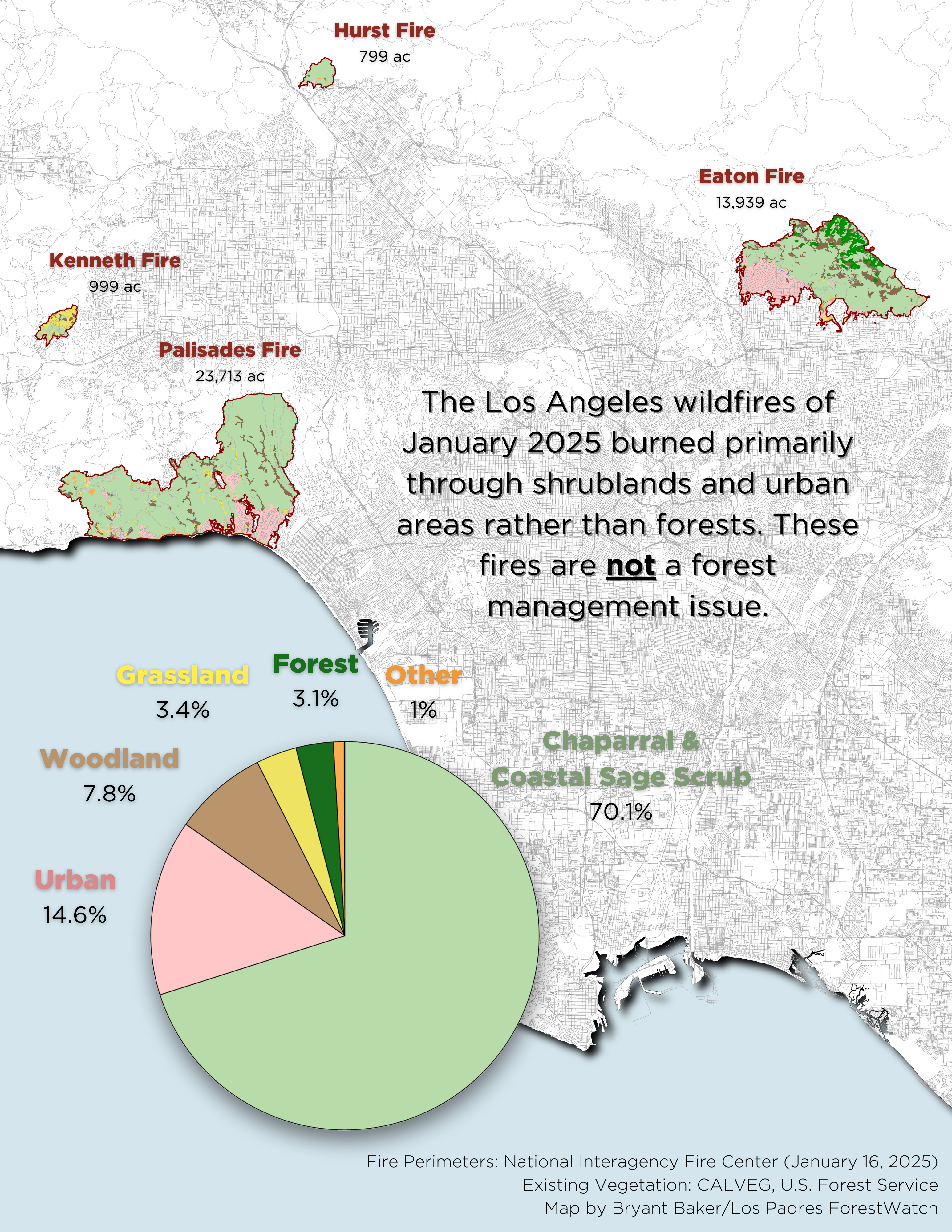
The Eaton and Palisades fires that destroyed communities and killed at least 28 people in Los Angeles were not forest fires. The fire that destroyed Lahaina in Maui in 2023, and killed at least 102 people, was not a forest fire. In fact, most of the wildfires that have had the worst impacts on lives and homes have not been forest fires.

Yet every time another town is destroyed by a wildfire, usually nowhere near a forest, politicians shift the conversation and the funding away from creating fire-safe communities and instead focus on “forest management.” Congress and President Biden did this when they passed the Infrastructure Act in 2021, and again when they passed the Inflation Reduction Act in 2022. Billions of taxpayer dollars were allocated for forest management, supposedly to save vulnerable communities from wildfires.

President Trump and the current Congress are also doing it. As Trump toured the Palisades fire in Los Angeles on Jan. 24, 2025, with the nearest forests dozens of miles away, he once again suggested that the community devastation was somehow about the lack of forest management.

House Republicans recently claimed that, in order to protect communities in Los Angeles and elsewhere from wildfires, we must “aggressively increase the pace and scale of our forest management” on federal lands by passing the “Fix Our Forests Act.” This is a bill that would override and weaken environmental laws to facilitate a huge increase in taxpayer-subsidized logging of mature and old-growth trees on federal lands under euphemisms like “thinning” and “fuel reduction.”

On Jan. 23, 2025, House Republicans passed this backcountry logging bill, joined by 64 Democrats. This was the response of the House to the tragic losses of entire communities in Los Angeles, and at least 28 deaths, nowhere near forests.

Why is this misdirection so dangerous? Because it diverts attention and resources away from the only actions that are scientifically proven to effectively protect communities from wildfires: home hardening; defensible space pruning within 100 feet of homes and other structures; and evacuation planning and preparedness, including better early warning systems. This community-based approach really work

In contrast, science shows that vegetation management and removal activities beyond about 100 feet from homes provide no additional benefit to home protection. Moreover, while politicians keep talking about forest management, they are not talking about building, and post-fire rebuilding, with fire-resistant materials that, unlike wood, don’t easily burn, such as recycled light-gauge steel, structural hempcrete blocks and 3-D printed homes.

Even in forested areas, abundant scientific evidence shows that removing trees reduces wind resistance and allows gusts to dramatically increase the speed of wildfires, giving people less time to safely evacuate, and first responders less time to help save lives and homes.

In recent years, large fires have rapidly swept through “thinned” forests before burning down towns, as we saw tragically with the towns of Paradise, Grizzly Flats and Greenville in northern California in recent years. Nor would mastication or other removal of native chaparral have helped in the Los Angeles fires, as such actions only cause chaparral to be replaced by highly combustible invasive grasses, which spread flames and embers even faster.

Moreover, “thinning” and other logging activities contributes to the global cycle of climate chaos by increasing carbon emissions more than threefold per acre relative to fire alone, worsening climate change and the extreme weather that drives big fires.

Politicians of both parties: Knock it off with this dangerously misdirected narrative about forest management. People need your help. If you don’t change course, and focus on helping create fire-safe communities, the heartbreaking impacts that we just witnessed in the Los Angeles fires will happen again, and again, across the country.

Chad Hanson, based in Kennedy Meadows in the southern Sierra Nevada mountains, is a wildfire scientist with the John Muir Project of Earth Island Institute, and the author of the book “Smokescreen: Debunking Wildfire Myths to Save Our Forests and Our Climate.”

Copyright 2025 Nexstar Media, Inc. All rights reserved. 
MSNBC Host Tears Apart Right-Wing DEI Obsession With Brutal Reality Check

MSNBC's Ali Velshi looked back at a time when there were "far more plane crashes" after Donald Trump's bonkers claim.


By Ben Blanchet
HUFFPOST
Feb 2, 2025, 

MSNBC host Ali Velshi scorched conservatives on Saturday over their fixation on diversity, equity and inclusion, or DEI, initiatives after President Donald Trump’s claim that such efforts were to blame for the deadly midair collision in Washington, D.C., this past week.

His comments arrived after Melissa Murray, an MSNBC legal analyst and law professor at New York University, argued that the attacks on DEI are “about rolling back the gains of the Civil Rights Movement” and “reestablishing, reentrenching a form of racial and gender hierarchy.”

Velshi chimed in and noted that there were “far more plane crashes” prior to the beginnings of DEI.

“Before we had diversity in the federal workforce, before there were any pilots other than the Tuskegee Airmen — there were no commercial, there were virtually no commercial Black pilots, there were no women,” Velshi said.

“Planes crashed a lot more and that has a lot more to do with technology and where we are and safety. We didn’t blame white people for the crashing of planes, nor should we have. We learned how to investigate plane crashes carefully and properly and come up with recommendations,” he continued.

Velshi added that conservatives have now made plane crashes about “something else” by pointing toward standards and diversity because there’s a “more equitable federal workforce.”

Eddie Glaude Jr., an African American studies professor at Princeton University, said people need to “understand that shift for what it is” while speaking with Velshi and Murray.

“It is a decidedly racist and sexist and masculinist agenda,” argued Glaude, who referred to elements of white nationalism showing up in the president’s policies.

“We’re relitigating the mid-20th century, we’re relitigating the Black freedom struggle, we’re relitigating the women’s movement, we’re relitigating the gay liberation movement, we need to understand what’s motivating it,” he added.

He later continued, “Every time the country tires of the quest for racial justice, it falls into this illusion, this fantasy of trying to get rid of us, of trying to move us to the margins, of trying to banish difference. That’s the only way a notion of American identity can cohere is that ... whiteness and maleness must be its anchor, so we’re right back to where we have always been.”

Many on the right have sought to blame several other issues on DEI over the past year.

The Trump administration has sung a similar tune as well, with plans to fire federal DEI staff and hopes to crack down on “DEI-related discrimination.”


Idled DEI Employee Tells All Amid Trump Purge

Tim Dickinson
ROLLING STONE
Sun, February 2, 2025 


The Trump administration is on a crusade against diversity, equity, and inclusion (DEI) programs within the federal government. The administration sees such programs — designed to make opportunities in federal government hiring and contracting accessible to qualified candidates regardless of their background — as intolerable.

One of Donald Trump’s first acts in his second term as president was to place members of DEI teams within federal agencies on paid administrative leave, with the clear aim of dismissing them from the federal workforce.

Rolling Stone was contacted by a member of one of these teams on Signal. She asked that her name and department be withheld for fear of retribution. But she shared what the experience of the past two weeks has been like and what she believes underlies the anti-DEI push — namely racism.
ADVERTISEMENT


What is life like on leave?

I hate it. Wish I could get back to work.

What was your role?

Comms.

Are you at home?

Yep.

Not like shoved in a no-windows office without a computer?

I’m a fully remote worker. But it’s been total silence since we were put on leave. We didn’t even get that awful “buyout” offer. I would not have done it.

Interesting that it was not extended to you…

We have no government email accounts. They were suspended when we were put on administrative leave.

Do you have any clarity on the future for your team? I don’t know how job protections might work in your case.

None. I might personally have more RIF [Reduction in Force; i.e. layoff] protection than my teammates. But I don’t think it will matter. I honestly expect they will treat us all the same — and try to cut us.

Are you able to move to another government job?

I was told we could not be transferred or detailed, even within our department.

Are you looking for new employment? Or taking a breather?

I’m using the time to regroup. I’ve got 20-plus years in government, and I’ve always been proud to serve my country and the American people. I want to be able to retire, and do not intend to leave voluntarily.

What did your DEI job involve?

Amplifying the work done by the team and crafting materials and talking points that highlight opportunity to underserved and underrepresented communities. We’ve also done some great work developing ERGs [Employee Resource Groups, usually known as “affinity groups” in the private sector]. I am so proud of this work.

What would you like folks to know about the value of DEI work?

I see and hear people talk about DEI as if it’s divorced from merit. But that couldn’t be further from the truth. DEI is about making opportunities available to everyone eligible. There is so much DEI that’s celebrated in our society without folks realizing it’s DEI: alternative work schedules, autism support in schools, the list goes on.

DEI has been reduced to a headline, and Americans have been misled to believe it creates privilege when actually it combats unfair advantages — intentional or not. I wish more people asked questions and looked at data points, instead of relying on “charismatic” leaders.

What does the crusade against DEI say about the people who are enacting it?

As a white woman, I believe with my whole heart that the core motivator for anti-DEI folks is racism. They want to keep doors shut to minimize competition and keep a low-wage class. The American people deserve the opportunity to thrive and contribute to the prosperity of our nation. They can’t do that if they are omitted or overlooked.

 Rolling Stone


Trump’s DEI purge targets federal workers who did not work in DEI

Laura Meckler,Hannah Natanson and Julian Mark,
 (c) 2025 , The Washington Post
Sat, February 1, 2025


At least 50 employees at the Education Department have been put on leave in recent days after President Donald Trump ordered federal agencies to eliminate all positions related to diversity, equity and inclusion. But almost none of them worked in jobs directly related to DEI, according to union officials and interviews with affected workers.

Instead, most all were involved in some sort of DEI initiative in the past, such as diversity training, an affinity group, or other programs inside the department aimed at creating a more inclusive workplace.

The purging underway suggests that the agency is not just seeking to eliminate DEI but also to remove people who have expressed interest or participated in programs related to it.

The effort is not limited to the Education Department. In Trump’s first two weeks in office, the drive to rid the federal government of anything associated with diversity or equity has ricocheted throughout federal agencies. Of the changes to federal agency websites the Trump administration has made in its first days, removing DEI language was the most common alteration, a Washington Post analysis of webpages within 14 Cabinet-level agencies has found.

Late Friday, newly confirmed Defense Secretary Pete Hegseth ordered the agency to stop commemorating cultural celebrations such as Black History Month. The message to staff was headlined: “Identity Months Dead at DoD.”

On Thursday, the FBI directed janitorial staff at Quantico to paint over a multicolored mural that once featured the words “FAIRNESS,” “LEADERSHIP,” “INTEGRITY,” “COMPASSION” and “DIVERSITY.”

Some government agency websites with information about equal employment opportunity - which allows employees to make complaints about workplace discrimination - were taken down for days before being restored. The one for NASA remained down as of midday Saturday. A NASA spokeswoman pointed to the DEI executive order as the reason.

Some employment experts worry such moves will hamper enforcement of civil rights laws that protect people from discrimination and provide equal access to the law. “I’m very concerned that the administration’s attack on DEI [will] handicap the EEO process itself,” Larry Stein, a federal employment attorney.

At the Energy Department, more than a dozen employees in one of the agency’s regional “culture” offices were put on administrative leave, but only three of them held DEI roles, according to three Energy Department staffers and personnel logs obtained by The Post.

And at the Office of Personnel Management, several employees who had previously taken part in DEI initiatives but who were not doing DEI work when Trump’s executive order was issued were also put on leave, according to a person familiar with the workings at OPM, speaking on the condition of anonymity to protect the identities of those dismissed.

The person believed that the employees were targeted because of their prior work - such as being part of a fellowship program that rotates participants through various parts of the agency including the DEI office.

An Education Department spokeswoman declined to comment. The Energy Department, the Office of Personnel Management and the White House did not immediately respond to requests for comment Saturday.

Sheria Smith, president of American Federation of Government Employees Local 252, which represents 2,825 Education Department employees, said the union is aware of only two of the 50 people they know were affected who are in jobs tied to diversity. They worked on presidential initiatives in the Biden administration that Trump rescinded in his anti-DEI executive order. Smith and others at the department believe that the total number of employees put on leave so far is more than 100.

Smith speculates that the goal is to shrink her agency in any way possible, given Trump has said he wants to abolish the Education Department altogether.

“I think the American people should be worried,” Smith said. “They’re trying to eliminate the Education Department and they know … it would be difficult to get the American public and Congress to sign off. So instead of eliminating it on their own, I believe they are trying to make it uncomfortable for employees to continue to work here in the hopes that those employees will eliminate themselves.”

- - -

‘Are you a diversity change agent?’

Although a few employees whose jobs were directly tied to DEI received notes in the opening days of the administration, a crush of notices began arriving around Thursday morning, according to union officials and affected employees. The emails informed workers that they had been put on administrative leave.

Employees were told that their pay and benefits would continue but that they were not to work and that their email access was suspended “pursuant to the President’s executive order on DEIA and further guidance from OPM.”

No other rationale was given. DEIA stands for diversity, equity, inclusion and accessibility - a term that has become a pejorative for any program or policy that seeks to provide equal access for people color, women and other underrepresented groups.

When Donna Bussell got the notice, she was confused. Her job is to help administer grants to support Native American students as part of the Office of Indian Education within the Education Department. It has nothing to do with DEIA, she said.

Then she thought back. Last year, she was asked to serve on an agency Diversity and Inclusion Council, though she said she barely participated because her actual job kept her busy. Before Trump was elected, she was president of an affinity group for Native American and Alaskan workers at the agency. It had met exactly once over lunch and, as soon as she saw the executive order, Bussell shut the group down and deleted its meeting notices and records online.

Bussell, a citizen of the Apache Tribe of Oklahoma, does not know if it was one of these factors - or that she works with Native American programs - that got her targeted.

“The people who are going after DEI have no idea that Indian education is not DEI,” she said.

At first she was upset. Now she’s angry. “The people who know me at the department and know my work ethic all value me,” Bussell said.

The move prompted several of her supporters around the country to write letters of protest to the Education Department. Several accused the agency of mistakenly conflating Indian education with DEI.

Another Education Department employee placed on leave has a job giving school districts guidance on educational issues, said the staffer, who spoke on the condition of anonymity for fear of retaliation. That work has nothing to do with DEI, the staffer said.

This person recalled volunteering to serve as part of a “diversity change agents” group, which promoted an inclusive workplace.

Still another person at the agency who was put on leave said she was informed Friday night by her supervisor, who assured her the move was not related to her work performance.

“Did you do anything related to DEI?” he asked. “Are you a diversity change agent?”

The employee had been part of the diversity change agent program, and both she and her supervisor wonder if that was the reason for being put on leave.

Of the 50 employees the local union knows have been placed on leave, the majority were part of the diversity change agents program, said Smith, the local’s president.

“That was something that was offered to all employees, a volunteer training for people who were interested,” she said. “Most of those people never did anything beyond attending the training.”

The language of Trump’s DEI order - signed on his first day as president - was aggressive in scope. But the order does not call for eliminating employees who had merely participated in DEI programs, though Trump has spoken expansively about his disdain for anything related to diversity and equity.

A similar dynamic appeared to be at work at the Energy Department, where more than a dozen people on one team were put on leave, but only three held roles titled “diversity and inclusion specialist,” according to personnel logs reviewed by The Post.

One employee was tasked with analyzing the results of quarterly federal well-being surveys. Another focused on employee engagement and retention. Others were charged with outreach to Indigenous tribes to help maintain federal treaties on water and dam use. One person worked on veterans’ initiatives.

“None of those folks in culture do anything with DEI,” said the local union chief, speaking on the condition of anonymity out of fear of retaliation. “Most of those people have 20-plus years of service with the government and now they’re on admin. leave. For no reason.”

- - -

Nixing holidays, affinity groups, websites

The DEI movement had grown in popularity after the 2020 murder of George Floyd by Minneapolis police. DEI efforts proliferated in corporate America, the nonprofit world, schools and politics, as well as inside the Biden administration. A backlash followed, which Trump seized to further his political agenda.

DEI “would have ruined our country, and now it’s dead,” Trump said in comments to reporters in the Oval Office on Friday.

In recent days, agencies including the Defense Intelligence Agency and the Cybersecurity and Infrastructure Security Agency canceled employee “affinity groups,” gatherings of people of a certain identity for bonding and support. That included a “Military Veterans Resource Group” at the Energy Department, according to a copy of the email reviewed by The Post.

On Thursday, the Defense Intelligence Agency paused all workforce celebrations of holidays including Martin Luther King, Jr.’s birthday, Black History Month, Women’s History Month, Holocaust Remembrance Day, Pride Month, Juneteenth and National Disability Employment Awareness Month.

Some federal employees who remain say the efforts have cast a pall over the workplace.

An Energy Department staffer wonders if he’ll be put on leave for attending a Martin Luther King Jr. celebration shortly before Trump’s inauguration. His colleagues, he said, are guarded in how they talk to one another, worried their words might be interpreted as touching on diversity, equity or inclusion. Gone are mentions of spouses, children, pets.

“Talking to people now,” he said, “the human aspect is not there.”

Trump Is Trying To Make The Federal Workforce Whiter

AND STR8 MALE

Trump’s war on the federal workforce will disproportionately affect workers of color.


By Nathalie Baptiste
Jan 31, 2025, 

The policy was horrible and the politics was even worse.

Less than 24 hours after a midair collision between a passenger jet and a military helicopter left dozens of people dead on Wednesday night, President Donald Trump pointed the finger at the right’s favorite boogeyman: diversity efforts.

After briefly offering condolences to the victims’ loved ones, Trump quickly blamed “DEI” — diversity, equity, and inclusion — efforts for the tragedy. The investigation had barely begun, yet Trump falsely claimed that the Obama administration had decided the Federal Aviation Administration was “too white” and subsequently had hired scores of unqualified people of color.

When reporters asked him for evidence of his claims, Trump responded, “Because I have common sense.”

Since his return to the White House on Jan. 20, Trump has sought to purge government agencies of employees who do diversity work.

He fired National Labor Relations Board officials in a move the president of the AFL-CIO labor federation told HuffPost was “illegal.” Trump also fired two Democratic-appointed commissioners at the Equal Employment Opportunity Commission, an agency tasked specifically with combating discrimination at work. And he also revoked a 1965 executive order from Lyndon B. Johnson that banned federal contractors from discriminating based on race, sex, religion and sexual orientation.

Trump’s war on the “diverse” hires within the federal workforce will disproportionately affect workers of color. In many cases, “DEI” has become a barely disguised euphemism for Black people.

The federal government has long been a reliable source of economic security for Black people and other people of color who have been historically discriminated against in the private sector. Over the last 100 years, the federal government has hired Black people at a higher rate than the public sector. Stable government jobs have been one of the keys to upward mobility for Black families and other workers of color, thanks to the government’s robust anti-discriminatory practices.

In June 2021, then-President Joe Biden signed an executive order that would make the federal government an even more diverse workplace. The Government Accountability Office later released a report on the diversity of the federal workforce, concluding that there had been small increases of representation of racial minority groups and that the federal workforce had a higher percentage of people of color than the civilian one.

Trump took efforts to roll back that progress as soon as he was in office. On his first day, he signed an executive order that called the Biden administration efforts an “infiltration.”

“The Biden Administration forced illegal and immoral discrimination programs, going by the name ‘diversity, equity, and inclusion’ (DEI), into virtually all aspects of the Federal Government, in areas ranging from airline safety to the military,” the order said.

The Trump administration went on to set up an email account where federal workers could report their colleagues for doing DEI work (it was, unsurprisingly, flooded with jokes and spam) and workers were not allowed to change their titles to remove DEI-related terms in order to avoid being fired.

The anti-DEI orders sent a shockwave through the federal workforce — and left officials scrambling to figure out how they should be interpreted and implemented.

Government agencies understood the order to mean that even the mention of diversity or equity was to be banned. The Smithsonian Institution, which oversees many of the popular museums in Washington, D.C., and gets the bulk of its funding from the federal government, shut down its diversity office.

The U.S. Air Force announced that it would stop using videos about the Tuskegee Airmen, the first Black military pilots, in courses for new recruits in order to comply with Trump’s order. (It later reversed its decision after backlash.)

Targeting DEI programs is not the only way Trump has been looking to shrink the government. Project 2025, the Heritage Foundation’s policy planfor the administration, calls for drastically reducing headcount at many agencies.

This week, the Office of Personnel and Management offered a “buyout” to the vast majority of employees that amounts to eight months of pay. Federal workers unions are urging workers to not take the deal because it’s unclear if OPM has the authority to make such deals.

There’s evidence that such massive cuts will disproportionately harm workers of color. During government shutdowns, when the federal government ceases operations because Congress could not come to an agreement on funding, Black people and other workers of color frequently bear the brunt of being furloughed.

In the wake of Trump’s orders, conservatives have been calling out federal workers of color and even advocating for them to lose their jobs.

Rep. Eric Burlison (R-Mo.), posted to his X (formerly Twitter) account a photo of a Black woman employed at the Bureau of Alcohol, Tobacco, Firearms and Explosives, alleging that she changed her title in order to evade the DEI ban. (He also called for the agency to be abolished.) It’s not clear why Boykin’s title was changed.

Chaya Raichik, who attacks teachers, immigrants and liberals on her Libs of TikTok X account — which has more than 4 million followers — posted a photo of a Black National Weather Service employee, calling for her termination.

“Patricia Brown is the DEI director at the National Weather Service,” Raichik said in a post last week. “Has she been fired yet? This page is still up.” The website was taken down on the same day.


CLARIFICATION: This article has been updated to note that the website listing Patricia Brown as the acting team lead of diversity, equity, inclusion and accessibility at the National Weather Service was removed on Jan. 25.