It’s possible that I shall make an ass of myself. But in that case one can always get out of it with a little dialectic. I have, of course, so worded my proposition as to be right either way (K.Marx, Letter to F.Engels on the Indian Mutiny)
Friday, April 18, 2025
Elton John and Brandi Carlile vs Trump administration’s cuts to HIV/AIDS relief
“Without prompt action, decades of progress in the global fight against HIV could be reversed, creating a global health crisis that we have both the power and the tools to prevent,” said Elton John in a statement for the new joint-venture.
After his inauguration in January, Trump passed an executive order slashing the funding for the United States Agency for International Development (USAID), which has resulted in major setbacks for many HIV/AIDS programs that rely on USAID funding.
The World Health Organization (WHO) said: “A funding halt for HIV programmes can put people living with HIV at immediate increased risk of illness and death and undermine efforts to prevent transmission in communities and countries,” warning that Trump's prolonged pause on foreign assistance could take “the world back to the 1980s and 1990s when millions died of HIV every year globally”.
Now, Elton John has teamed up with American singer-songwriter Brandi Carlile to launch a campaign to offset the Trump administration’s cuts to HIV / AIDS funding.
Sir Elton and Carlile, who released their collaborative album ‘Who Believes In Angels’ on 4 April, are now working together on a joint-venture between the Elton John AIDS Foundation and Carlile’s Looking Out Foundation.
Sir Elton said in a statement: “Without prompt action, decades of progress in the global fight against HIV could be reversed, creating a global health crisis that we have both the power and the tools to prevent.”
“Our mission is more important than ever – we refuse to leave anyone behind – and I’m so fortunate that Brandi is not only a wonderful collaborator and artist, but a dear friend who shares my vision of a world where HIV care is prioritised and protected.”
Carlile said: “It was a lifelong dream come true for me to come together with my hero and friend Elton John to make our album ‘Who Believes in Angels?’, and now, we’re excited to announce that our foundations are also partnering to make our music mean even more.”
She added: “Elton’s activism and work with the Elton John AIDS Foundation was what led me to Elton before I even heard a note of his music. It’s an incredible honour to launch this partnership and raise funds for the life-saving work of the Elton John AIDS Foundation and the Rocket Response Fund at a time when support is needed the most.”
The Elton John AIDS Foundation, which was launched in 1992 and is reported to have raised more than $500million over the past three decades, has worked with USAID to co-fund HIV prevention and treatment programs around the world. In response to the cuts, the Foundation launched the Rocket Fund and Rocket Response Fund in an attempt to fill the gaps left by Trump’s actions.
Carlile’s Looking Out Foundation has committed to matching every donation up to $100,000, claiming it will “double the impact to protect HIV prevention and care services across the US and around the world”.
Carlile and her wife Catherine Shepherd were honored amongst People’s 2023 Women Changing the World for their work with the Looking Out Foundation.
Elton and BrandiLooking Out Foundation
Elsewhere, the Elton John AIDS Foundation was recently banned by Russia, who accused it of taking a negative stance towards countries like Russia and claiming the charity undermines “traditional spiritual and moral values”.
The Elton John AIDS Foundation said it was "devastated" by the decision, which it said would prevent it from providing lifesaving care to people living with HIV in Russia.
"For more than two decades, we have worked in collaboration with federal and non-governmental partners in Russia to provide hundreds of thousands of people with vital HIV services, including testing, treatment, and care," it said in a statement.
“This work is urgent: in 2024, there were over 1.2 million people living with HIV in Russia, with over 430,000 not receiving treatment. Today’s decision by the Russian Federation will undoubtedly endanger lives and disrupt critical HIV prevention efforts for ordinary Russian citizens. At a time when we have the tools and knowledge to defeat HIV, it is heartbreaking to be unable to support them.”
WE HAVE GOOD NEWS AND BAD NEWS
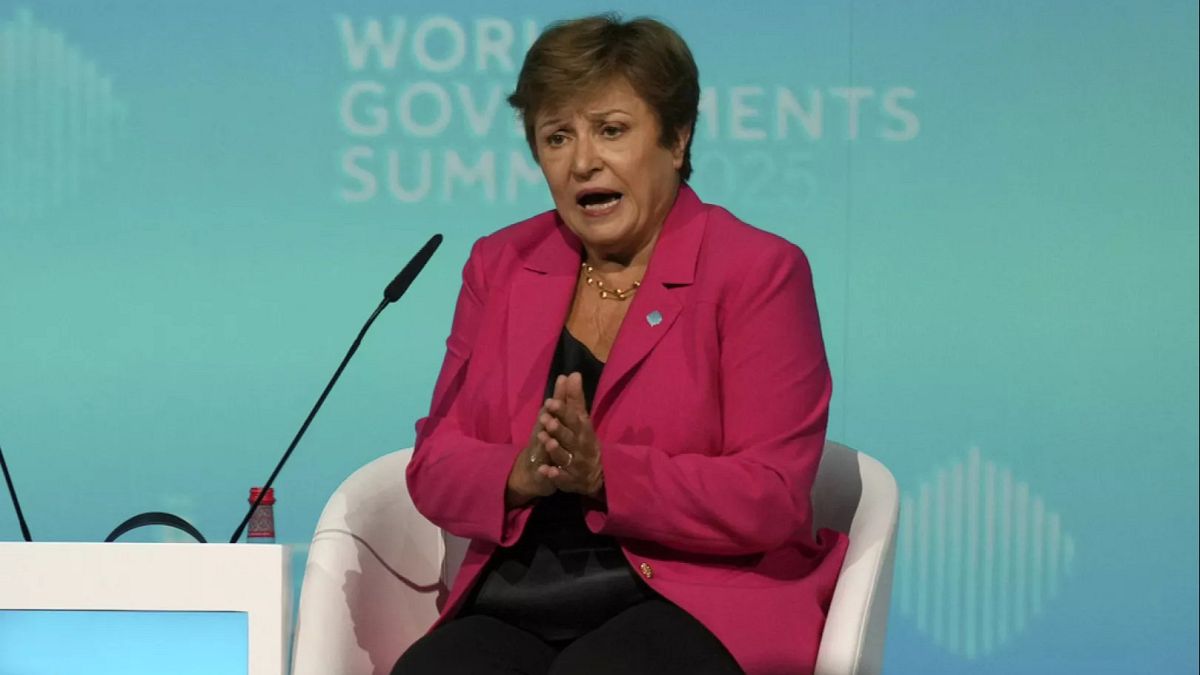
US tariffs will not spark global recession but will weaken economy, IMF says Copyright Altaf Qadri/Copyright 2025 The AP. All rights reserved.
Surging US tariffs will weaken the global economy and push up inflation this year, according to the International Monetary Fund.
The Trump administration's sharp increases in duties have caused global uncertainty to spike, the IMF's Managing Director, Kristalina Georgieva, said on Thursday. The import taxes will slow global growth, but not cause a worldwide recession, she added.
The world economy's resilience is being tested "by the reboot of the global trading system" that threatens to cause turbulence in financial markets, Georgieva said.
That turbulence has been playing out in financial markets for weeks now, especially on Wall Street, which has experienced wild swings from day-to-day and often even hour-to-hour.
The IMF chief also echoed some Trump administration concerns. She called on countries to reduce their tariffs and lower other barriers to trade, a process that she said had stalled out in the past decade after making steady progress for many years after World War II.
"Trade distortions — tariff and nontariff barriers — have fed negative perceptions of a multilateral system seen to have failed to deliver a level playing field," she said. "This feeling of unfairness in some places feeds the narrative: we play by the rules while others game the system without penalty."
Georgieva added that tariffs cause uncertainty, which can be costly. Due to the complexity of supply chains, the cost of a single item can be affected by tariffs in dozens of countries, she said.
Increased trade barriers also tend to immediately impact growth, and while it can lead to more domestic production, that takes time to implement, she added.
In its most recent projections issued in January, the IMF forecast the world economy to grow nominally faster and for inflation to come down, though it warned that the outlook was clouded by President Donald Trump's policies, including tax cuts and increased tariffs on foreign imports.
The Washington-based lending agency said at the time that it expected the world economy to grow 3.3% this year and next, up from 3.2% in 2024.
Global inflation, which had surged after the COVID-19 pandemic disrupted global supply chains and caused shortages and higher prices, was forecast to fall from 5.7% in 2024 to 4.2% this year and 3.5% in 2026.
However, in a blog post that accompanied those projections, the fund's chief economist, Pierre-Olivier Gourinchas, wrote that the policies Trump has promised to introduce "are likely to push inflation higher in the near term.''
Those forecasts from January are expected to change — possibly significantly — as Trump's trade war has escalated in recent months, particularly with the US's biggest trade partner, China.
Trump has paused or pulled back on many of his tariff threats — leading to more volatility in the stock market — but has been in a tit-for-tat tariff battle with China and has shown no sign of backing down. Each time Trump has raised tariffs on China, Beijing has retaliated with tariffs on US imports.
The IMF will release the details of their global economic outlook on Tuesday.
Deep snow, thick ice and zero delays: Inside the Arctic Circle airports that never cancel a flight
Where most airports would close for a few centimetres of snow, some battle-hardened Arctic Circle airports refuse to close for anything.
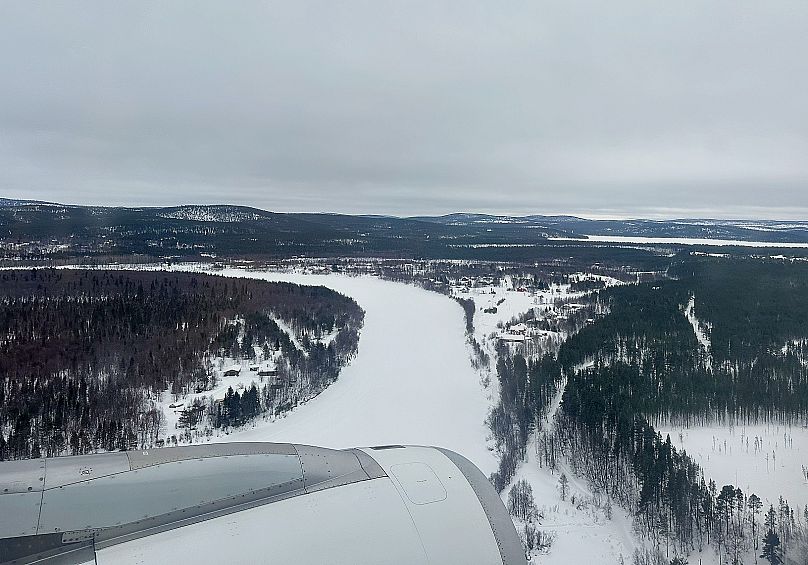
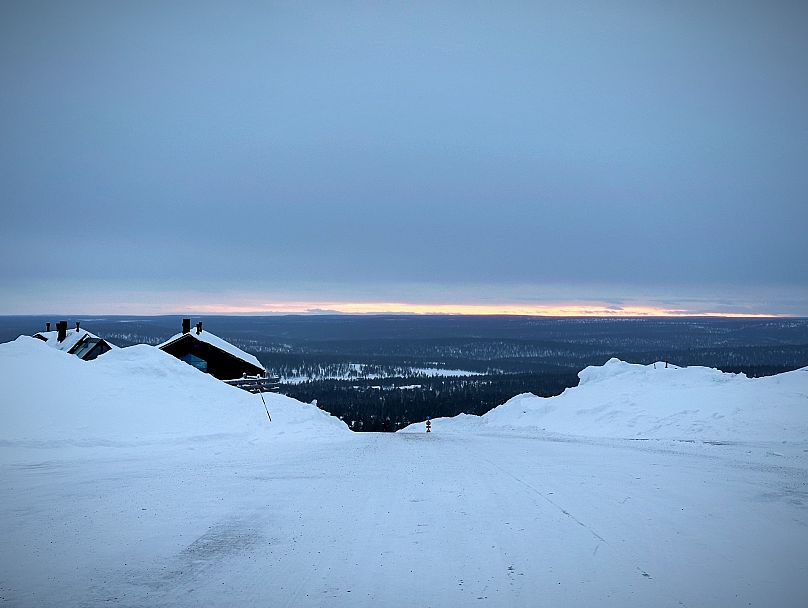
Flying into Inari in the far north of Finland felt like landing at the end of the world.
In every direction, trees and snow. Now and then, we got a glimpse of warmly lit cabins, and occasionally sprawling resorts, dotted amongst the trees.
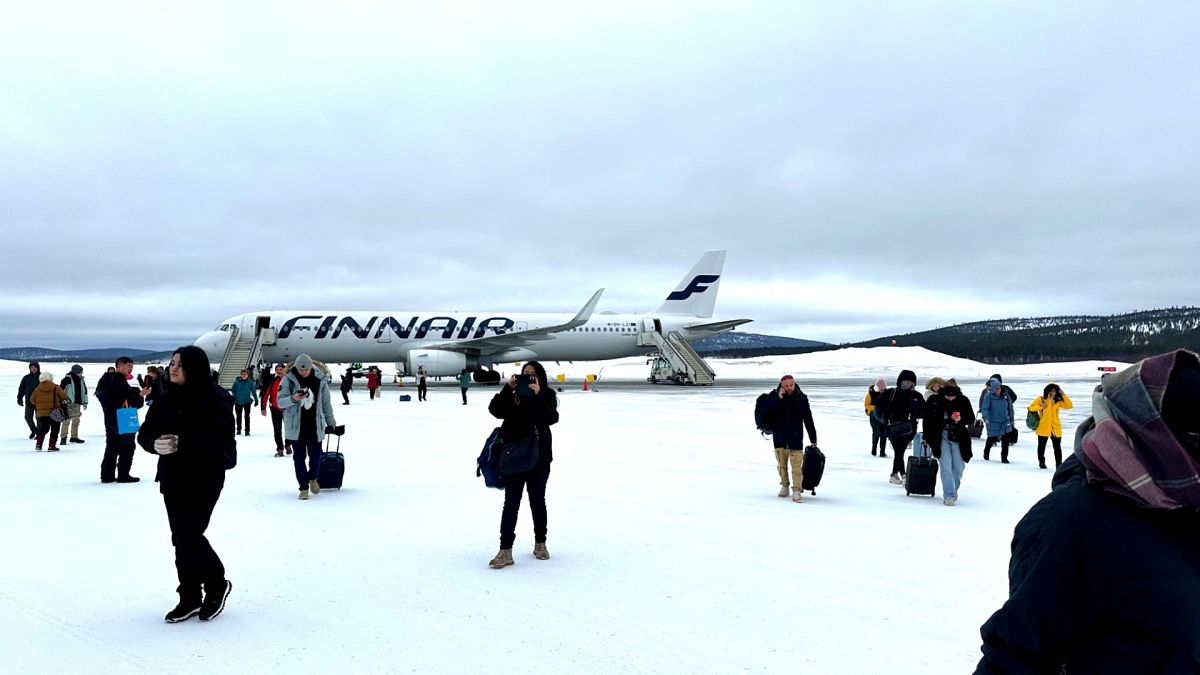
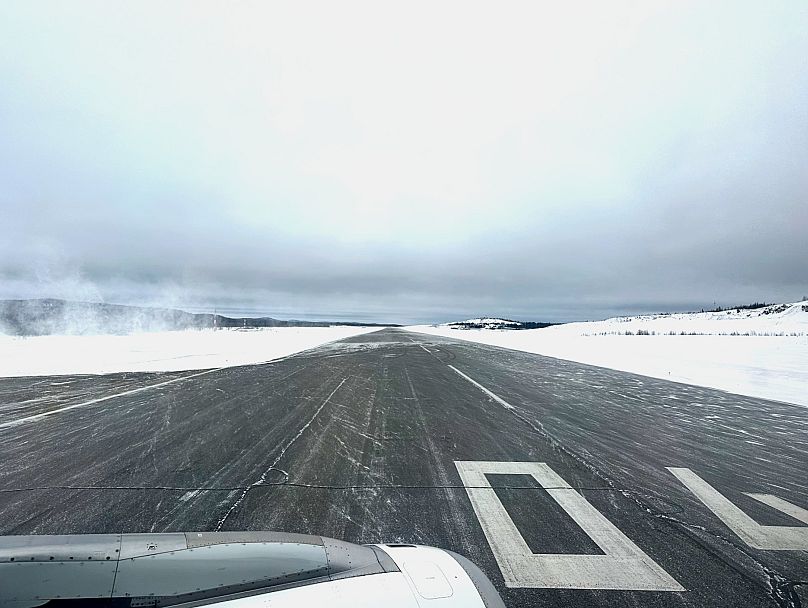
It was snowing, and the temperature hovered around five degrees below zero. As we touched down on the icy runway, I’ll admit I felt a flicker of concern about the stopping power of the Finnair Airbus A321 that had brought us up from Helsinki.
Descending into Ivalo Airport, the outlook was bleak to say the least. Joanna Bailey
But Ivalo Airport was well prepared, and the landing was smooth and uneventful. We rolled gently to the end of the 2,500-metre runway, slowing steadily as the pilots avoided heavy braking in the snowy conditions.
An up-and-coming destination
Ivalo Airport is the gateway to Inari, Finland’s largest municipality by area, but also the most sparsely populated. Part of Finnish Lapland, it offers a wealth of winter experiences, just without the elves or the man in red.
This is a winter wonderland for the more discerning traveller: fantasy-level snowfall, breathtaking landscapes, and endless possibilities for activity—or inactivity. Husky sledding, snowmobiling, skiing, snowboarding, reindeer herding—Inari has it all, and then some.
If you love a bit of snow fun, Inari is an undiscovered gem that lacks the overcrowding of many other resorts. Joanna Bailey
If you prefer to relax and simply soak up the scenery, you’re in luck. Saunas abound in this frozen land. At the beautiful Star Arctic Hotel, where we stayed, some cabins featured private saunas, while others had full glass ceilings for aurora watching right from your bed.
Here in Saariselkä, accommodation options are plentiful, but the Star Arctic is super convenient for the ski slopes and for the entrance to the longest toboggan run in the country. Plummeting down Kaunispää hill, it descends 1.8 km deep into the forest, dropping around 180 metres.
However you choose to get out of your resort, as soon as you do, the landscape will take your breath away. Inari is wild, exhilarating, bleak, terrifying and jaw-droppingly beautiful all at once.
The sunset in Inari was shrouded in low cloud, signalling we wouldn’t be lucky enough to see the aurora on this visit.Joanna Bailey
Unlike more popular Lapland destinations like Rovaniemi, it has not suffered from overtourism. In fact, it’s probably one of the most unspoiled places left in Western Europe.
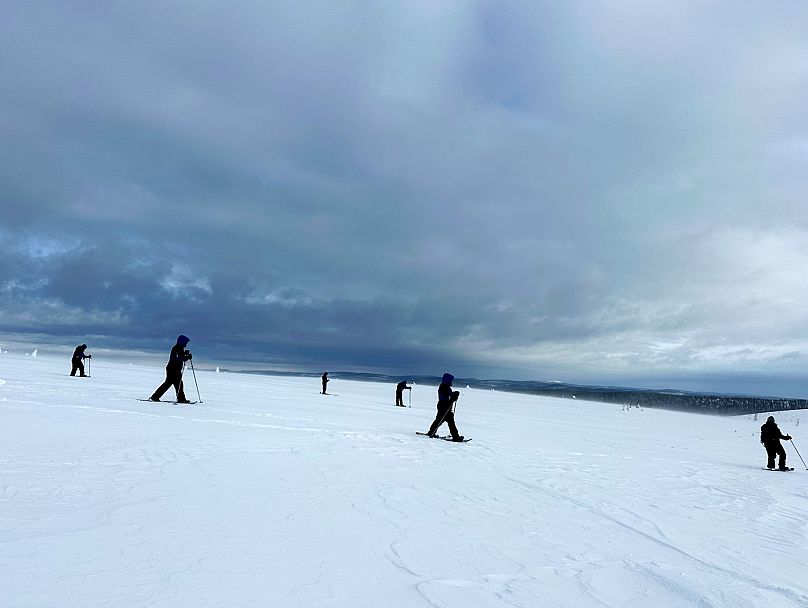
“That’s Russia over there,” my snowshoeing instructor noted, pointing at the endless sea of pine trees stretching as far as the eye could see. “Of course, you can’t see the borders from here,” she chuckled.
Remote wilderness is closer to you than you think.Joanna Bailey
Inari has become a rising star for adventure seekers wanting to experience the real Lapland. Last winter, nine international airlines operated seasonal services to Ivalo Airport, including a new route from British Airways - its most northerly destination to date.
Finnish Lapland, in general, is becoming increasingly popular year on year. Across the Finavia-managed airports of Rovaniemi, Kittilä, Ivalo, Kuusamo, and Kemi-Tornio, 1.8 million passengers arrived in 2024, up almost 20 per cent on the year before. How do they keep the runways clear?
With average temperatures plummeting as low as -18 degrees and around 200 days of snow a year, how can these airports safely handle all these flights?
Back in Helsinki, I caught up with Finavia’s Pyry Pennanen, head of airfield maintenance, to find out more about what goes into keeping airports operating in such extreme conditions.
“We basically promise summer-like conditions in our runways year-round,” says Pennanen. “But in Helsinki, winter is a very real thing.”
Pyry has worked in Finavia for almost 14 years, and has been head of airfield maintenance at Helsinki for seven. Joanna Bailey
Helsinki is a different proposition from Ivalo. Handling an average of 350 departures a day, it’s an important international hub, with several flights landing and taking off every hour. With around 100 days of snow a year, keeping the runway clear is essential to maintaining Helsinki’s reputation as an airport that runs like clockwork.
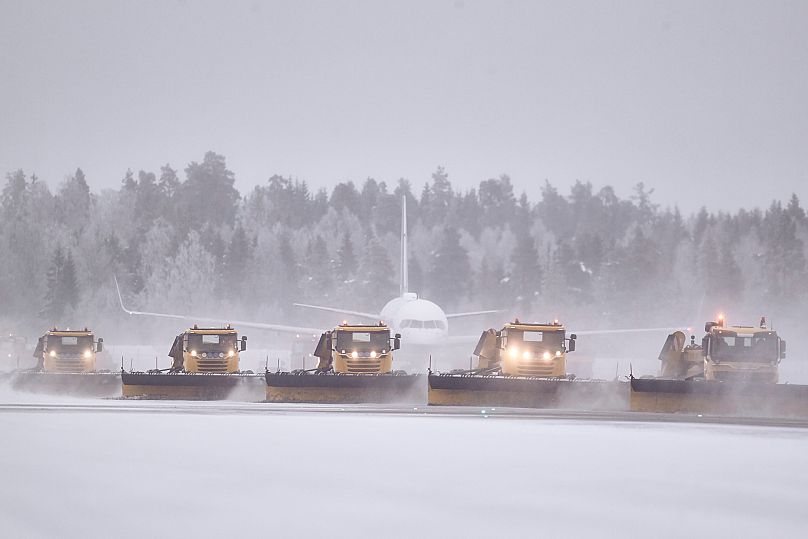
“To keep the aircraft on schedule, we have 13 minutes to clear the runway, but we can do it in 11,” Pennanen explains. “The most we have to do is around once per hour if it’s really snowing, but on the worst days, it can be once every 20 minutes.”
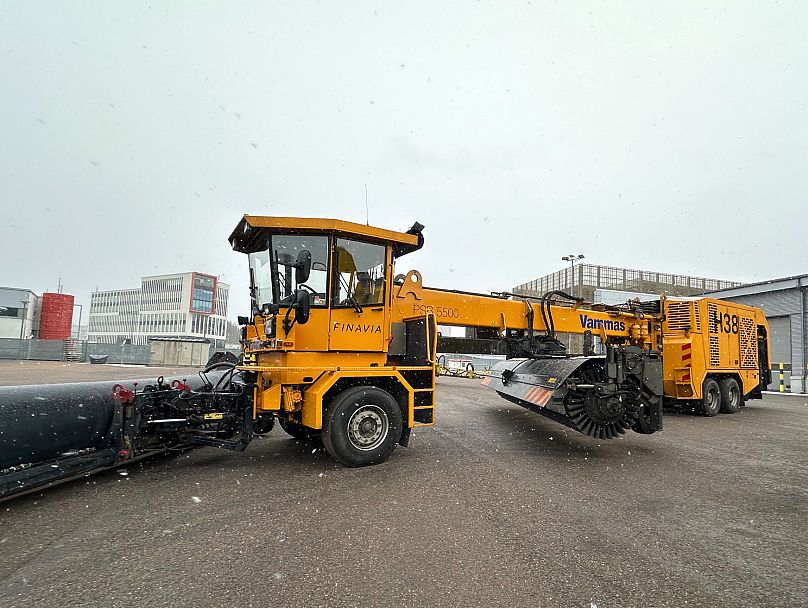
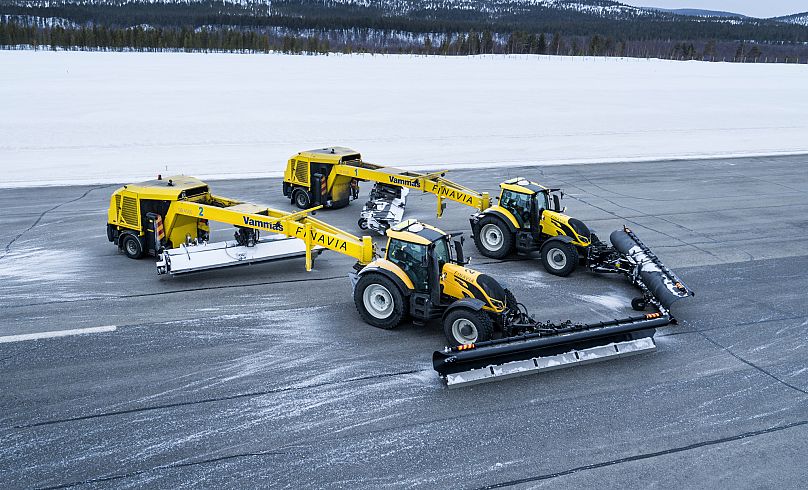
Delivering this speedy clearance is a team of around 15 machines that all head out together to make the 3,500-metre runway safe. The crown jewels of this bizarre ballet of beasts are the Vammas PSB 5500 sweeper blowers, developed in partnership with Helsinki Airport.
The PSB machines will go out in teams of eight, clearing the entire runway in 11 minutes. Joanna Bailey
These 31-tonne monsters stand 3.7 metres tall and stretch a massive 25 metres long. They can clear a 5.5 metre span of runway in just 11 minutes, thanks to their unique trifecta of snow-clearing features.
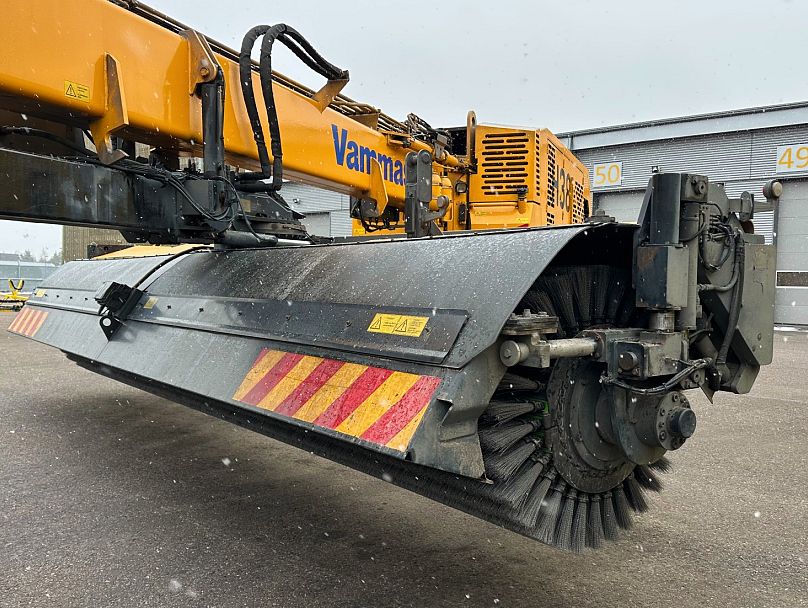
Designed to plough, sweep and blow (hence the PSB in the name), the process begins with a spring-loaded cutting edge on its nine metre plough, keeping contact firm on uneven surfaces. Behind that, a dense broom made of stiff metal bristles sweeps up any stubborn ice on the ground. Finally, the powerful jet air blower shoots loose snow and ice away from the runway at speeds of more than 400 km an hour.
The ‘brush’ is not one you’d want to use on your hair! Joanna Bailey
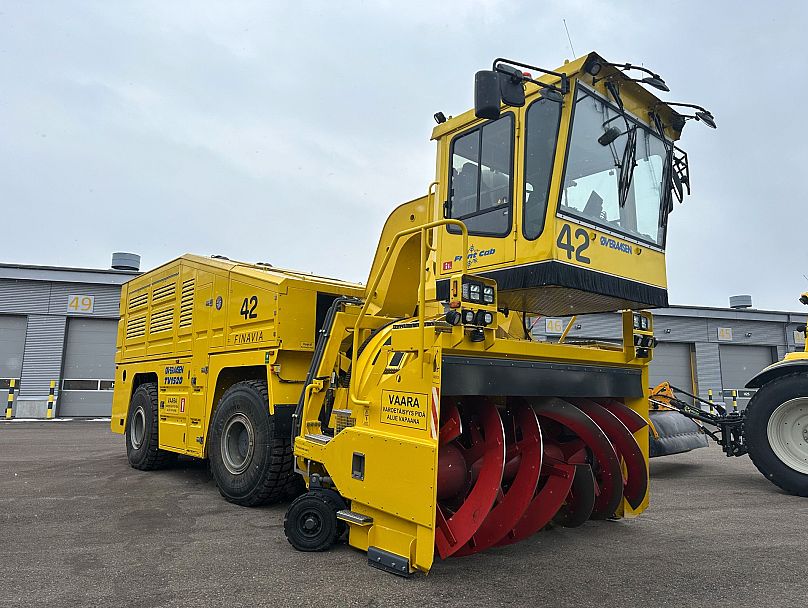
Joining the convoy is a terrifying-looking machine, a self-propelled snow blower made by Overaasen in Norway. A towering 4.5 metres tall, this 1,500-horsepower behemoth can smash even the most stubborn ice off surfaces, clearing up to 10,000 tonnes an hour and casting the snow 35 metres away from the runway.
The towering snow blower looks like a combine harvester, but with sharper teeth.
Joanna Bailey
“The most challenging conditions are when we have freezing rain,” says Pennanen. “When it’s minus ten and the freezing rain is still falling, it’s very difficult to deal with.”
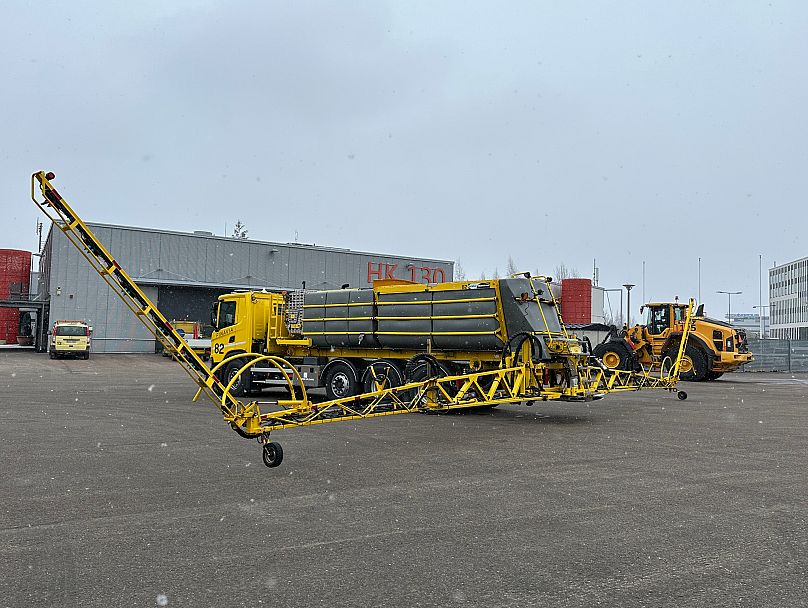
In these conditions, the expansive de-icer comes into play. Spraying potassium formate on the runway surface will melt the ice in under an hour, and keep the surface ice-free for several hours beyond. The chemical is readily decomposed and contains no nitrogen, making it safe for the environment.
Finnavia has opted for eco-friendly potassium formate to melt stubborn ice.
Joanna Bailey
Smaller beasts like wheel loaders, tractors, lorries and chemical sprayers also help keep the runways clear. In all, Finnaiva’s fleet in Helsinki spans around 200 vehicles that work from October to May. In the months in between, the team carries out essential maintenance on the vehicles to keep them mission-ready for the coming winter. In the Arctic Circle, conditions are even more extreme
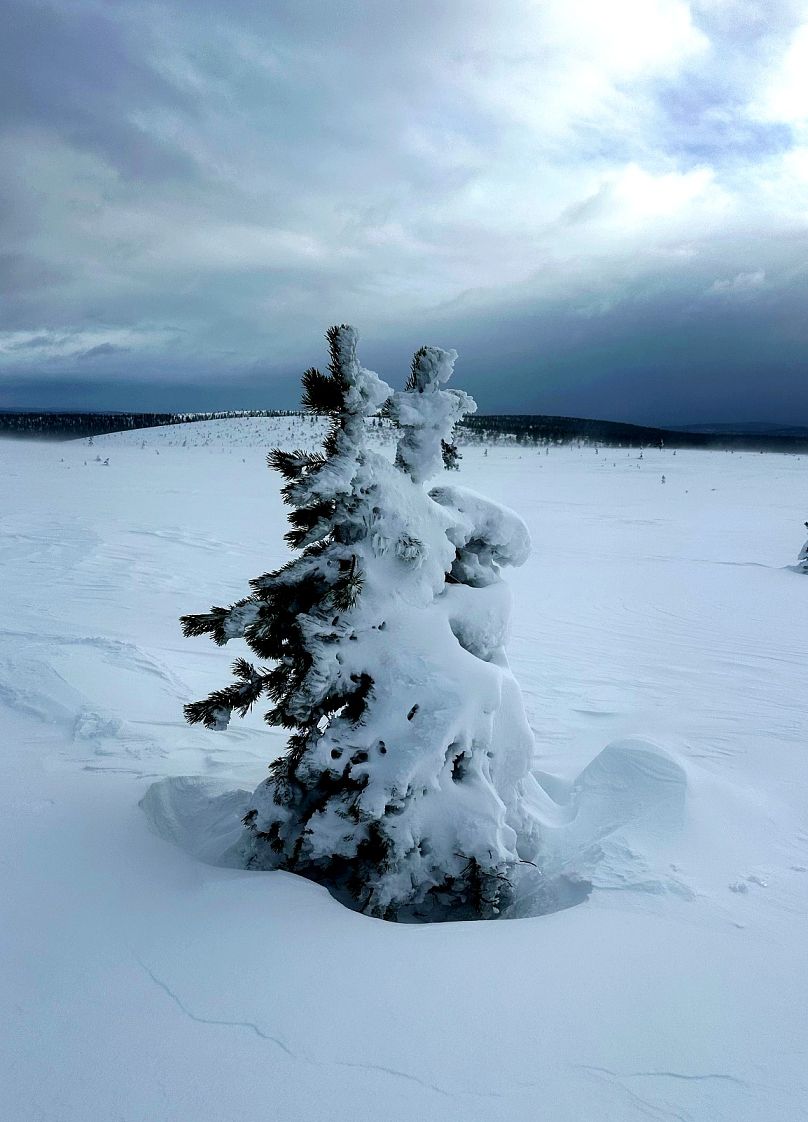
In Finnish Lapland, snow usually covers the ground from early November to late May (although it was worryingly late to arrive in some parts last winter). Across the region, you can expect from 25 cm to as much as a metre of snow on the ground throughout the winter.
With over 200 days of snow in a typical year, Finavia’s Lapland airports have their work cut out. Yet, as a company, Finavia has never had to close an airport due to inclement weather, and the number of cancelled or delayed flights is minimal.
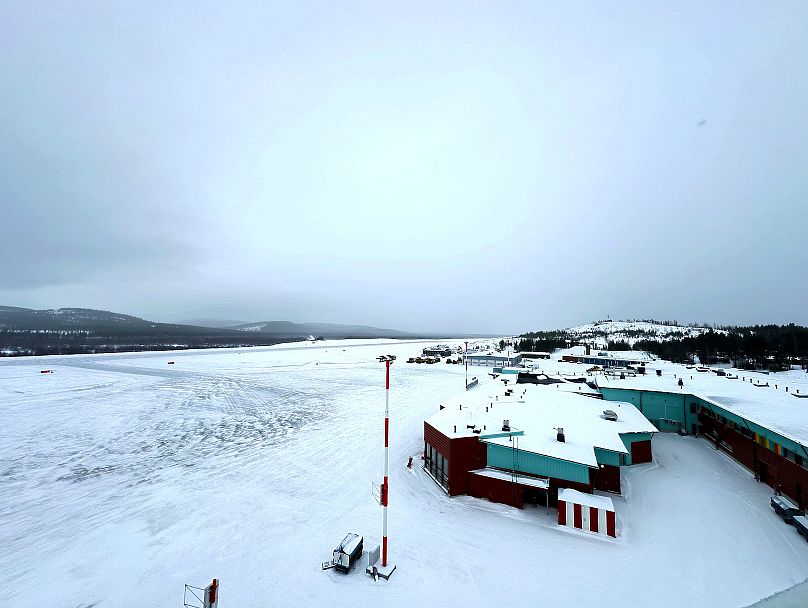
Up in the Arctic Circle, Ivalo Airport sees more snow than most.
Ivalo airport is tiny, employing just 25 people during the summer months.
Joanna Bailey
“We operate in winter conditions for seven months,” says Jarmo Pyhäjärvi, Ivalo Airport manager. “We are the most northerly airport in the European Union, and we operate in Arctic conditions.”
Because the airport is so small, its staff headcount is low. In the winter, it doubles from its summer level of 25 employees to around 50. Fifteen of these people will be trained to work on maintenance, keeping the airport clear of ice and snow.
“Many of the staff will have a double role,” says Finavia’s communications manager Elina Suominen. “One minute they might be checking in a bag, the next they’re doing security, or driving a snow plough.”
Employees at Ivalo will be trained to do several jobs, often swapping job roles during their shift. Joanna Bailey
Seeing these big snow-clearing beasts in action was astounding. The sheer power of the vehicles and the incredible volume of snow they move is incredible, with clearing operations performed not at a slow plod, but at speeds of 40 to 50 km an hour.
Across all its airports, Finavia uses sunken sensors to monitor the conditions on the runway. Tiny changes can be tracked, giving the operator early warning of incoming weather, sometimes six to eight hours in advance.
As with Helsinki, it is not so much the snowfall that’s a problem, but rather the temperature itself. When the freezing rain hits in Ivalo, the lower number of flight arrivals means their strategy for clearance is slightly different.
When we visited, the runway was beautifully clear, despite the inclement weather. Joanna Bailey
“We do what we call precision management maintenance, which means that the runway is cleared just before the flight comes in,” explains Suominen. “The snow protects the runway from the freezing rain, and we let it work as a shield and only take it off at the last moment. This way we don't need to use any chemicals.”
Pyhäjärvi recalls a winter in 1999 when the temperature dropped to an eye-watering minus 50 degrees. The most recent extreme temperature event, in 2023, saw the mercury drop to minus 35. Even then, the airport cancelled just one solitary flight, maintaining all other operations as normal.
Amazingly, Ivalo Airport does all this with net-zero emissions. In the last 10 years, the airport has cut its emissions by 98 per cent through the use of renewable energy. The remaining two per cent is offset through approved programmes. Its snow-clearing machinery all runs on biofuels. Innovating for even safer Arctic Circle flights
Companies like Finavia are essential in developing the technologies and equipment required to keep the world’s most extreme airports open all year round.
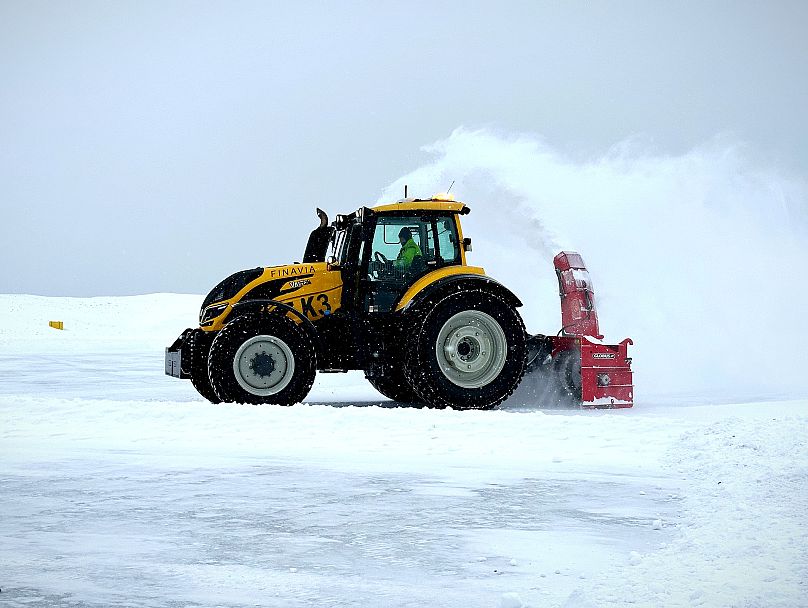
Most recently, Ivalo Airport has worked with a number of Finnish companies to test autonomous snow-clearing operations. Working with Nokian Tyres, snow removal equipment manufacturer Vammas (Fortbrand), energy company Neste and machinery manufacturer Valtra, they developed a new concept for optimising snow removal at remote airports.
The vision is that, when airports like Ivalo are closed for the night, or running on a skeleton crew, and the snow starts to fall, an autonomous tractor will spring to life. Using optimised, predefined waylines, the tractor will clear the runway of snow, making it safe for the next plane to land. If it’s running low on fuel, it will refuel itself using low-emission biodiesel.
Finavia has been testing autonomous snowploughs to improve efficiency at its airports. Finavia
Pilot projects have been very promising, although the autonomous tractors aren’t being used yet. Nevertheless, Finavia is confident of success in the longer term.
“We are still in the testing phase, but this winter we have made major steps forward,” says Ali Sadeghi, chief asset officer of facilities and systems at Swedavia Airports. “These additions to our snow clearance fleet are a strategic step and will help us make Swedavia’s snow clearance more safe, efficient and predictable as well as climate friendly.”
Like Finavia, Swedavia has not had to close an airport because of bad weather for a very long time. “Stockholm Arlanda Airport has an excellent record of dealing with snow,” adds Sadeghi. “We have never closed the airport due to snow or bad weather in over 60 years.”
In Oslo, autonomous snow clearing is already underway.
Avinor
Next door in Norway, Oslo Airport undertook intensive testing of autonomous ploughs for over a year, deploying them in daily operations in 2021. Up to six enormous machines move simultaneously, all with no driver onboard, controlled either from a command vehicle or from the comfort of an office desk.
Powered by cloud-based software known as the Yeti Autonomy Service Platform (YASP), developed by Yeti Move, the vehicles are connected so that they know where to go and what to do. There are high hopes that such advancements could make snow clearance operations even more eco-friendly in the future.
“YASP ultimately cuts fuel consumption and emissions,” John Emil Halden, COO of Yeti Move, tells Business Norway. “Our solution optimises power use by ensuring operations are consistent at all times. Also, well-planned operations with autonomous vehicles will reduce the driving needed to complete the job, and fewer vehicles are needed overall.”
As a traveller, I remain in awe of these incredible airports and their ability to keep flying regardless of the conditions. And I am thankful, because without airports like Ivalo, it wouldn’t be so easy to discover the wonders of the truly unspoilt corners of the world.
Palestinian photographer Samar Abu Elouf wins 2025 World Press Photo of Year
A portrait of a young Gazan boy who lost both arms in an Israeli airstrike has been named World Press Photo of the Year for 2025.
A moving portrait of nine-year-old Mahmoud Ajjour, a young Gazan boy who lost both arms in an Israeli airstrike, has been named World Press Photo of the Year 2025.
The image, taken by Palestinian photographer Samar Abu Elouf for The New York Times, shows Mahmoud bathed in warm light, facing a window in quiet contemplation.
The photograph is not only a powerful act of photojournalism, but a personal story too. Abu Elouf, who was evacuated from Gaza in December 2023, now lives in the same apartment complex as Mahmoud in Doha. There, she has been documenting the stories of Gazans who made it out for treatment, including Mahmoud, who was injured while fleeing an Israeli attack in Gaza City in March 2024. As he turned back to urge his family to run, an explosion severed one arm and mutilated the other.
Today, in Qatar, Mahmoud is learning to navigate his new life — playing games on his phone, writing, and even opening doors with his feet. His dream? To get prosthetics and live life as any other child.
The war in Gaza has taken a disproportionate toll on children, with the United Nations estimating that by December 2024, Gaza had the highest per capita number of child amputees in the world.
“This is a quiet photo that speaks loudly,” said Joumana El Zein Khoury, Executive Director of World Press Photo. “It tells the story of one boy, but also of a wider war that will have an impact for generations. Looking at our archive, in the 70th year of World Press Photo, I am confronted by too many images like this one."
She added: “I remain endlessly grateful for the photographers who, despite the personal risks and emotional costs, record these stories to give all of us the opportunity to understand, empathise, and be inspired to action.”
Global jury chair Lucy Conticello, Director of Photography for M, Le Monde’s weekend magazine, echoed this sentiment:
“This young boy's life deserves to be understood, and this picture does what great photojournalism can do: provide a layered entry point into a complex story, and the incentive to prolong one's encounter with that story. In my opinion, this image by Samar Abu Elouf was a clear winner from the start.”
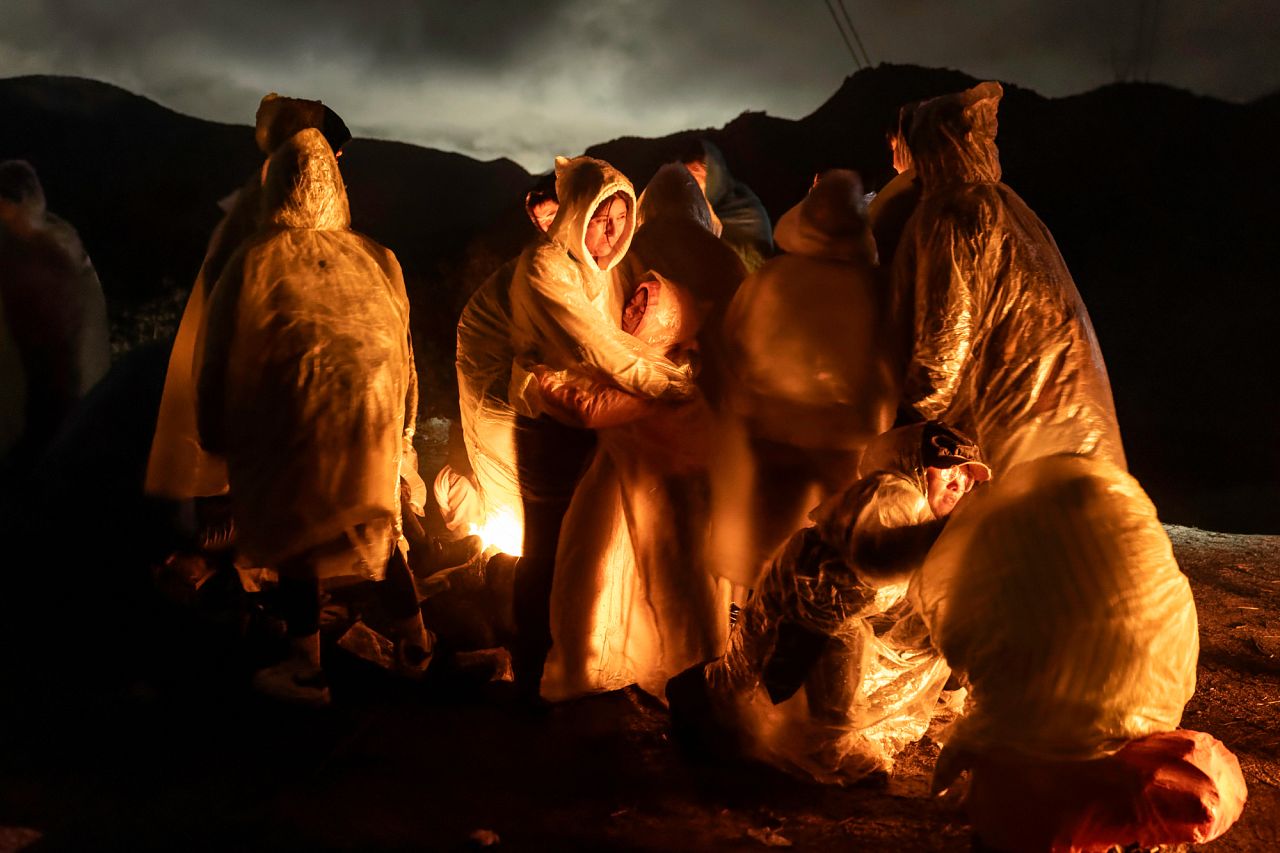
Night Crossing John Moore, United States, Getty Images
Two finalists were also honoured alongside the winning image: Night Crossing by John Moore for Getty Images, and Droughts in the Amazon by Musuk Nolte for Panos Pictures, Bertha Foundation.
In Night Crossing, Chinese migrants are seen huddling for warmth during a cold rain after crossing the US–Mexico border — an intimate glimpse into the often-politicised realities of migration.
In Droughts in the Amazon, a young man carries food to his mother in the village of Manacapuru, once accessible by boat. He now walks two kilometres along a dry riverbed — a haunting vision of the world’s largest rainforest in crisis.
Droughts in the Amazon Musuk Nolte, Peru/Mexico,
Panos Pictures, Bertha Foundation
These stories were selected from over 59,000 images submitted by nearly 3,800 photographers across 141 countries.
The winning works will be showcased at the World Press Photo Exhibition 2025, which opens at MPB Gallery at Here East in London from 23 May–25 August. The travelling exhibition will visit over 60 locations around the world.
Almost exactly 30 years ago, Canadian Bacon depicted a U.S. president picking on his neighbor to the north to boost his sagging approval ratings. Starring Alan Alda, John Candy, and Rhea Perlman, the film was supposed to be a comedy. Director Michael Moore was trying to satirize the U.S. penchant for invading other countries. Taking that notion to its absurd limit, Moore chose to depict a skirmish with Canada.
Ah, the good old days, when you could laugh about such things.
Marx once wrote, with regard to the return of a Bonaparte, that “history repeats itself, first as tragedy, then as farce.” Obviously, Marx couldn’t have anticipated the rise of Donald Trump, who has made a political career of turning Marx on his head by transforming farce into tragedy. Just compare his first term (hah-hah!) to his second term (uh-oh!).
When it comes to Canada, Trump hasn’t yet sent the U.S. army across the border. But don’t rule it out—or the more likely possibility that he’ll dispatch military forces to Mexico to battle narcotraffickers (or stop Central American migrants in their tracks).
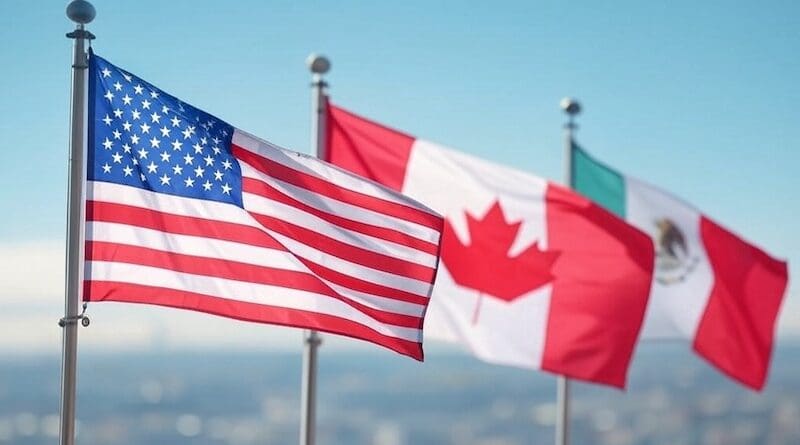
In the meantime, Trump has managed to use his beloved tariffs to disrupt economic relations with both Canada and Mexico. Amid boycotts of U.S. products and a steep decline in tourists heading south, Canadian Prime Minister Mark Carney declared that the U.S.-Canadian relationship, “based on deepening integration of our economies and tight security and military cooperation, is over.”
Mexico’s Claudia Sheinbaum, while talking tough on Mexican sovereignty, has taken a different tack by negotiating mano a manowith Trump. But disputes over water, drugs, and migrants nevertheless are pushing relations to a breaking point. Trump has already rushed U.S. troops to take control of land near the southern border. It wouldn’t take much for him to push them over the line.
The trade agreement that replaced NAFTA and that Trump himself touted so much when he signed it into law in 2020 is coming up for revision. It’s hard not to anticipate that the rancor Trump has stirred up to the north and south will doom this effort before it even begins.
Perhaps like a Silicon Valley entrepreneur, Trump sees North America as a model that needs disruption. But usually such entrepreneurs have an alternative in their back pockets to substitute for the supposedly flawed status quo—Uber replacing taxis, say, or iPhones superseding flip phones.
What alternative could Trump possibly be proposing for North America?
Spheres of Influence
It’s popular in some circles to imagine that Donald Trump is a geopolitical strategist. Here, too, it’s a case of farce being overtaken by tragedy. Trump a foreign policy expert? What a joke. Oh, wait, it’s actually worse than that…
Consider, for instance, the notion that Trump is executing a “reverse Kissinger” with his policy toward Russia. Half a century ago, Richard Nixon, guided by his advisor Henry Kissinger, executed a rapprochement with China to put pressure on the Soviet Union. Today, according to this fanciful theory, Trump is pushing a détente with Russia in order to put pressure on China.
There’s no such hidden calculus in Trump’s wooing of Putin. The two leaders share ideological obsessions—love of territorial expansion and autocratic control, hatred of liberals and “woke” constituencies—and Trump wants to end the war in Ukraine by any means necessary. China occupies a different part of his mind: an economic competitor with little to no ideological overlap.
Now let’s consider another attempt to impose geopolitical sense on an otherwise disparate set of administration policies: that Trump wants to reestablish an older world order based on spheres of influence.
According to this notion, Trump would be happy to allow China to preside over an Asia-Pacific sphere. Russia would then administer the territory of the former Soviet Union. Europe would have to give up on Ukraine but it would get in return North Africa and perhaps all points south. Israel, as a kind of representative of Europe, would divide up the Middle East with the Saudis.
And the United States would reign supreme in North America—plus, according to the Monroe Doctrine, all of Latin America. Throw in Greenland and Trump would be looking to make the Americas great again.
Such a division of the world might well appeal to Trump’s business mentality, with countries substituting for corporate empires that control clearly demarcated markets.
But Trump is not withdrawing the United States from the Pacific theater any time soon. His administration is doubling down on its containment of China—through alliances, expansion of Pacific bases, and increased Pentagon spending. Perhaps he’s willing to tolerate Chinese control over the territory it claims, including Taiwan. But even that is not clear, given recent U.S.-Philippine combat drills in the South China Sea and the sanctions slapped on Hong Kong officials for facilitating the suppression of that territory’s democracy movement. Moreover, he hasn’t given up on other parts of the world—Ukraine, Africa—where he wants what’s underneath the ground.
Trump’s tariffs point to a different strategy, not spheres of influence so much as anti-globalization, pure and simple. Trump is suspicious of any international effort that puts the United States at a table of equals, and he’s deaf to the reality that the United States was always first among equals when it came to globalization. Trump doesn’t like the UN, the IMF, the ICC. He doesn’t like the nervous system of economic globalization with its multilateral trade deals and regulatory superstructure. He much prefers bilateral relations where the United States can throw its weight around and intimidate weaker countries. He despises the EU because its gives smaller nations like Denmark the power to stand up to the United States.
Which brings us back to North America.
The Tariffs that Divide
Tariffs against Mexico and Canada don’t make any economic sense. It’s not just that they piss off friends, boost prices at home, and fail to raise the revenue that Trump fantasizes about.
It’s the nature of the economic relationship between the countries that render these tariffs self-defeating.
Consider the example of medical devices. Mexico is the third largest exporter of medical instruments in the world, and it sends nearly $12 billion worth of these instruments to the United States. Tariffs on these imports will raise the costs for U.S. hospitals and, by extension, the patients in these hospitals.
Ah, but guess what: those devices made in Mexico are heavily dependent on U.S. microchips. And the CHIPS Act under the Biden administration sought to tighten that relationship in order to reduce dependence on semiconductors produced in Asia. So, imposing tariffs on Mexican manufacturers will also penalize American companies that produce components for those medical devices. That means the disappearance of U.S. jobs and the U.S. competitive edge in high-tech exports. And that’s only one industry.
The same perverse economic logic applies to U.S. car manufacturing, since there is no such thing as a completely American-made car. About 40 percent of car parts are made overseas, with Mexico supplying last year about 42 percent of those parts and Canada 10 percent. Trump, apparently unaware of the reality of supply chains, stepped back recently to consider a temporary waiver on tariffs for car parts to help Detroit make the transition to U.S.-made parts. But why would anyone make those huge investments into car-part manufacturing plants in the United States if a future president—or the ever-mercurial Trump himself—might change economic policy and strand those assets?
So, forget about the advantages of creating a North American market that relies on comparative advantages (more hydroelectric power in Canada, a longer growing season in Mexico). Trump sees a trade deficit and believes that the country is ripping off the United States. (Wait, didn’t he go to the Wharton School? Did he skip Econ 101?)
Yes, there are problems with globalization, from a race to the bottom around labor and environmental standards to the ridiculous carbon emissions associated with the modern equivalent of sending coals to Newcastle. But Trump’s tariffs are not designed to address any of these defects.
Instead, Trump’s moves will simply reorient global trade around the United States, just like it’s a huge, stupid rock in the middle of a river. At the moment, fully three-quarters of Canadian and Mexican exports go the United States (and around a third of U.S. exports go to Canada and Mexico). Despite the convenience of exporting to a neighbor, Canada and Mexico are going to start looking elsewhere to sell their products. Other countries—China, Germany—are going to reap the advantages of Trump’s economic idiocy.
The Future of North America
Canada is not going to become the fifty-first American state. Even if Canadians favored such a move—and 80 percent strongly oppose it—the Republican Party would ultimately vote to keep Canada out. Republicans don’t even want to make Washington DC a state, for fear of adding two more Democrats to the Senate. They’re obviously not going to welcome all those left-of-center Canadians into the U.S. Congress.
Instead, Trump is pushing Canada further away. It will move closer to Europe. Despite current trade tensions with China, it might mend fences and form a stronger economic bond there as well.
U.S. relations with Mexico may also go south, very quickly. The Trump administration has been considering drone strikes against Mexican drug cartels. Although the two countries are coordinating surveillance of these cartels, Trump is reserving the right to strike unilaterally. “We reject any form of intervention or interference,” Claudia Sheinbaum has responded.
Ordinarily, the three countries would handle their disputes—the economic ones at least—through the revision of the U.S.-Mexico-Canada Agreement, the replacement of NAFTA that Trump himself supported. But Trump’s unilateral actions throw into question whether the USMCA will survive. The U.S. president might well threaten to withdraw from the agreement if Mexico and Canada don’t make future concessions, especially around keeping China out of their markets. Trump might aim for two bilateral treaties instead.
Bullying, alas, does often produce results. Trump can strong-arm weaker parties—Colombia, Columbia University—into making agreements. But that only works in the short term. Over time, the weak find stronger allies so that they can eventually stand up to the bullying.
China and the European Union are patiently watching Trump’s destruction of North America. Sure, they’ll suffer some collateral damage. But the opportunities that Trump’s disruptions are producing will turn Liberation Day for America into a Christmas bonanza for everyone else.








.jpg)
