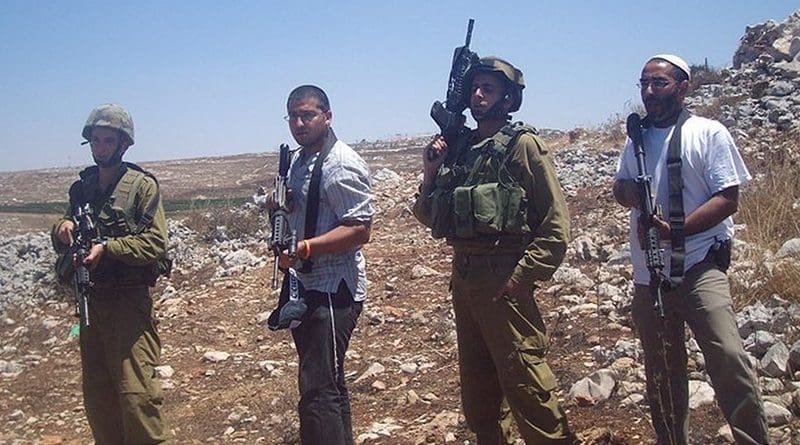
IDF soldiers and Israeli settlers. File Photo by ISM Palestine, Wikimedia Commons.
October 23, 2025
By Arab News
Saudi Arabia’s Foreign Ministry condemned the preliminary approval by the Israeli parliament on Wednesday of two draft laws, one of which seeks to legitimize an illegal settlement in the occupied West Bank, and another attempting to impose Israeli sovereignty over the entire territory.
The Kingdom said it firmly rejected all settlement and expansionist activity by Israeli occupation authorities in the West Bank, and reaffirmed its support for the right of Palestinians to establish an independent state based on pre-1967 borders, with East Jerusalem as its capital, in line with international resolutions.
The ministry reminded the international community of its responsibility to implement UN resolutions and halt Israeli encroachments on Palestinian territory, and called for a peace process that results in a two-state solution to achieve security and stability in the region, the Saudi Press Agency reported.
Earlier, Israeli lawmakers voted in the Knesset to advance two bills related to annexation of the West Bank, a goal promoted by far-right ministers. The drafts will have to go through three additional votes in the parliament to become law.
The first bill, which passed by 32 votes to 9, proposes annexation of a large Israeli settlement east of Jerusalem. The second, which proposes annexation of the entire West Bank, narrowly passed by 25 votes to 24.
World Court Says Israel Obliged To Let Aid Flow Into Occupied Palestinian Territory
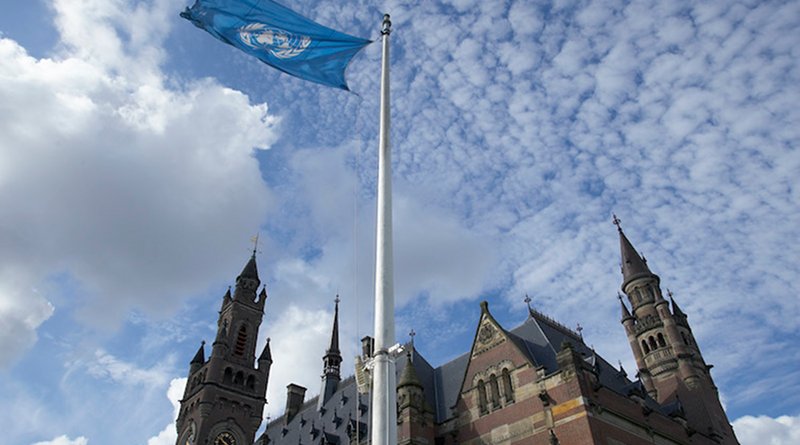
The Peace Palace in The Hague (Netherlands), seat of the International Court of Justice. Credit: Jeroen Bouman - Courtesy of the ICJ.
October 23, 2025
By UN News
The International Court of Justice (ICJ) says that Israel must uphold its responsibilities as the “occupying power” by ensuring aid can flow freely and by respecting the rights of the UN and other humanitarian agencies working in the Occupied Palestinian Territory.
In a detailed advisory opinion requested by the General Assembly, the UN’s top court found that Israel is required to “ensure that the population of the Occupied Palestinian Territory [OPT] has the essential supplies of daily life, including food, water, clothing, bedding, shelter, fuel, medical supplies and services.”
The court called on Israel to also “respect and protect” all aid workers, medical personnel and facilities.
By ten votes to one, judges also held that Israel “has an obligation” to cooperate in good faith with the UN, “providing every assistance in any action it takes in accordance with the Charter of the United Nations,” including the Palestine refugee relief agency, UNRWA.
UN Secretary-General António Guterres described the ICJ opinion as “very important”, adding that it came at a moment when the UN is doing all it can to surge aid into Gaza following the ceasefire.
The opinion – requested in December 2024 – addresses Israel’s obligations in relations to the UN and other international organizations and countries vested in humanitarian operations in Palestine.
In a sign of the level of international engagement in the case, 45 States and organizations filed written statements, and 39 presented oral arguments during hearings held from 28 April to 2 May 2025.
Why the court matters
The ICJ, based in The Hague, is the principal judicial organ of the United Nations.
It settles legal disputes between States and gives advisory opinions at the request of UN bodies.
The opinions are not legally binding, but they carry significant moral and legal authority and often guide international policy and practice.
Bound by international law
The ICJ held that Israel is bound by international humanitarian law and human rights law to respect and protect civilians in the OPT, ensuring that aid workers and medical facilities are safeguarded and that no civilians are forcibly transferred or deprived of food.
Ten of the eleven judges agreed that Israel must respect the privileges and immunities of the UN and its officials, in accordance with the UN Charter. This includes “the inviolability” of all UN premises – including those managed by UNRWA.
Vice-President Julia Sebutinde of Uganda cast the sole dissenting vote in several sections.
The ICJ also reaffirmed Israel’s obligation to allow the International Committee of the Red Cross (ICRC) access to detainees in the OPT and to “respect the prohibition on the use of starvation of civilians as a method of warfare.”
Israel’s Foreign Ministry said in a social media post that it “categorically rejects” the ICJ’s advisory opinion, describing it as “yet another political attempt to impose political measures against Israel.”
October 23, 2025
By Arab News
By Dalia Al-Aqidi
The world watched in awe as US President Donald Trump’s peace deal last week brought an end to the devastating war in Gaza. After two years of bloodshed, hostage crises and humanitarian suffering, the guns finally fell silent. Arab leaders, world powers and millions of ordinary people celebrated a long-awaited moment of relief and hope.
Yet, as much of the world celebrated this long-awaited step toward peace, the reaction within the US exposed a deeper truth about the nation itself — it is so polarized by partisanship that even the promise of peace could not bridge its political divide.
From Cairo to Riyadh and Jerusalem to Washington, the agreement was welcomed as a turning point. Arab leaders praised Trump’s leadership for restoring diplomacy to a region that had lost faith in it. Egyptian President Abdel Fattah El-Sisi called the deal “a historic, defining moment.” Leaders from Saudi Arabia, the UAE, Jordan and Morocco hailed the ceasefire as a long-overdue step toward regional stability and humanitarian recovery.
Even long-time skeptics admitted that this deal achieved what countless attempts before it could not: it brought an end to the war and opened a path to stability. It did not emerge in a vacuum but was grounded in the legacy of the Abraham Accords. Those accords changed the Middle East’s diplomatic map by proving that peace and partnership could replace endless hostility.
While much of the world celebrated, America’s response was deeply divided. Republicans across the country praised the agreement as a landmark achievement in diplomacy and a testament to the president’s leadership. They argued that Trump had once again delivered what others only spoke of: real progress toward peace through strength, resolve and a clear understanding of the region’s realities. To them, the deal was not just a political win but proof that principled leadership could accomplish what years of cautious diplomacy had failed to do.
But the Democratic Party, instead of joining the world in celebrating this historic moment, chose silence and, in some cases, open doubt. Many of its leaders downplayed the importance of the agreement and were unwilling to acknowledge what had been achieved. Rather than recognize a rare victory for peace, they focused on politics. Some even dismissed the deal as “temporary” or “election-driven,” as if stopping the bloodshed and saving innocent lives were not reason enough for gratitude. Their reaction showed how deeply politics has divided America, even when peace should have united everyone.
Progressive figures such as Rep. Alexandria Ocasio-Cortez and her allies could not bring themselves to welcome the simple fact that the war had finally stopped. Instead of showing relief that lives were being saved, they used the moment to attack the administration by accusing it of hypocrisy and of ignoring what they called “injustice.” Their response made it clear that ideology, not humanity, guides much of today’s political debate. By refusing to see peace as a good thing simply because it came from the other side of the political aisle, they showed how deeply partisanship has replaced both common sense and compassion in America’s public life.
It was a powerful and revealing moment. While Arab, Jewish and Western leaders stood side by side to welcome a long-awaited peace, some of America’s loudest progressive voices chose to stay divided. At a time when the world was coming together to celebrate hope and an end to violence, they focused instead on blame and politics. Their reaction showed how wide America’s political divisions have become, when even peace is seen through a partisan lens and unity becomes something to resist rather than embrace.
The reaction of the mainstream liberal media was no better. Rather than celebrate the diplomatic breakthrough, many networks and newspapers sought to minimize it. Coverage focused on doubts, whether the ceasefire would last, who might benefit politically or what Trump’s “motives” were. The humanitarian relief and release of hostages received only limited attention.
In contrast, conservative media outlets and many independent journalists described the agreement for what it truly was: historic and hopeful. They focused on the bigger picture, recognizing that, when diplomacy works, the entire world benefits, no matter which political party happens to be in power. To them, peace itself was the real victor.
But for much of the mainstream press, admitting that Trump had played a role in ending the war seemed harder than recognizing that the suffering had finally stopped. Instead of celebrating the lives saved and the violence halted, many chose to minimize the achievement because it did not fit their political narrative. It was a reminder that, in today’s America, media bias can sometimes overshadow truth, even when the story is one of peace.
This pattern is not new. When the Abraham Accords were signed in 2020, normalizing relations between Israel and the UAE, Bahrain, Morocco and Sudan, many of the same media outlets treated it as a minor story. Yet those accords reshaped the region, inspired economic cooperation and opened new channels of dialogue that eventually paved the way for the current Gaza peace.
Refusing to recognize these historic milestones does not harm Trump; it harms America’s moral image in the eyes of the world. When peace is viewed as a political win instead of a human victory, it sends the wrong message about what America stands for. It suggests that saving lives and ending wars only matter if they bring political benefit. This attitude weakens the credibility of US diplomacy and makes it harder for other nations to trust America as a fair and consistent partner. True leadership means celebrating peace, no matter who achieves it, because the goal should always be stability, security and hope, not political points.
For nearly two years, America’s streets overflowed with protests demanding peace in Gaza. College campuses turned into arenas of anger and slogans. Then came silence.
When the peace deal was announced, the same voices that had shouted for a ceasefire disappeared. There were no celebrations, no gratitude, no joy that the war had ended.
That silence revealed something deeper; many protests were never about peace but about politics. Once Trump achieved what they said they wanted, their outrage lost purpose. When activism turns into a habit of anger, real solutions become inconvenient.
When peace is achieved, it should be celebrated by everyone, Republicans, Democrats and independents alike. Ignoring or downplaying peace just because of political differences goes against the values America stands for. The world looks to Washington for moral leadership, not for small-minded politics or division. True strength is shown when a nation can rise above partisanship to recognize what is right and just.Dalia Al-Aqidi is executive director at the American Center for Counter Extremism.
The Peace Palace in The Hague (Netherlands), seat of the International Court of Justice. Credit: Jeroen Bouman - Courtesy of the ICJ.
October 23, 2025
By UN News
The International Court of Justice (ICJ) says that Israel must uphold its responsibilities as the “occupying power” by ensuring aid can flow freely and by respecting the rights of the UN and other humanitarian agencies working in the Occupied Palestinian Territory.
In a detailed advisory opinion requested by the General Assembly, the UN’s top court found that Israel is required to “ensure that the population of the Occupied Palestinian Territory [OPT] has the essential supplies of daily life, including food, water, clothing, bedding, shelter, fuel, medical supplies and services.”
The court called on Israel to also “respect and protect” all aid workers, medical personnel and facilities.
By ten votes to one, judges also held that Israel “has an obligation” to cooperate in good faith with the UN, “providing every assistance in any action it takes in accordance with the Charter of the United Nations,” including the Palestine refugee relief agency, UNRWA.
UN Secretary-General António Guterres described the ICJ opinion as “very important”, adding that it came at a moment when the UN is doing all it can to surge aid into Gaza following the ceasefire.
The opinion – requested in December 2024 – addresses Israel’s obligations in relations to the UN and other international organizations and countries vested in humanitarian operations in Palestine.
In a sign of the level of international engagement in the case, 45 States and organizations filed written statements, and 39 presented oral arguments during hearings held from 28 April to 2 May 2025.
Why the court matters
The ICJ, based in The Hague, is the principal judicial organ of the United Nations.
It settles legal disputes between States and gives advisory opinions at the request of UN bodies.
The opinions are not legally binding, but they carry significant moral and legal authority and often guide international policy and practice.
Bound by international law
The ICJ held that Israel is bound by international humanitarian law and human rights law to respect and protect civilians in the OPT, ensuring that aid workers and medical facilities are safeguarded and that no civilians are forcibly transferred or deprived of food.
Ten of the eleven judges agreed that Israel must respect the privileges and immunities of the UN and its officials, in accordance with the UN Charter. This includes “the inviolability” of all UN premises – including those managed by UNRWA.
Vice-President Julia Sebutinde of Uganda cast the sole dissenting vote in several sections.
The ICJ also reaffirmed Israel’s obligation to allow the International Committee of the Red Cross (ICRC) access to detainees in the OPT and to “respect the prohibition on the use of starvation of civilians as a method of warfare.”
Israel’s Foreign Ministry said in a social media post that it “categorically rejects” the ICJ’s advisory opinion, describing it as “yet another political attempt to impose political measures against Israel.”
The Gaza Deal And The Missed Opportunity For US Unity – OpEd
October 23, 2025
By Arab News
By Dalia Al-Aqidi
The world watched in awe as US President Donald Trump’s peace deal last week brought an end to the devastating war in Gaza. After two years of bloodshed, hostage crises and humanitarian suffering, the guns finally fell silent. Arab leaders, world powers and millions of ordinary people celebrated a long-awaited moment of relief and hope.
Yet, as much of the world celebrated this long-awaited step toward peace, the reaction within the US exposed a deeper truth about the nation itself — it is so polarized by partisanship that even the promise of peace could not bridge its political divide.
From Cairo to Riyadh and Jerusalem to Washington, the agreement was welcomed as a turning point. Arab leaders praised Trump’s leadership for restoring diplomacy to a region that had lost faith in it. Egyptian President Abdel Fattah El-Sisi called the deal “a historic, defining moment.” Leaders from Saudi Arabia, the UAE, Jordan and Morocco hailed the ceasefire as a long-overdue step toward regional stability and humanitarian recovery.
Even long-time skeptics admitted that this deal achieved what countless attempts before it could not: it brought an end to the war and opened a path to stability. It did not emerge in a vacuum but was grounded in the legacy of the Abraham Accords. Those accords changed the Middle East’s diplomatic map by proving that peace and partnership could replace endless hostility.
While much of the world celebrated, America’s response was deeply divided. Republicans across the country praised the agreement as a landmark achievement in diplomacy and a testament to the president’s leadership. They argued that Trump had once again delivered what others only spoke of: real progress toward peace through strength, resolve and a clear understanding of the region’s realities. To them, the deal was not just a political win but proof that principled leadership could accomplish what years of cautious diplomacy had failed to do.
But the Democratic Party, instead of joining the world in celebrating this historic moment, chose silence and, in some cases, open doubt. Many of its leaders downplayed the importance of the agreement and were unwilling to acknowledge what had been achieved. Rather than recognize a rare victory for peace, they focused on politics. Some even dismissed the deal as “temporary” or “election-driven,” as if stopping the bloodshed and saving innocent lives were not reason enough for gratitude. Their reaction showed how deeply politics has divided America, even when peace should have united everyone.
Progressive figures such as Rep. Alexandria Ocasio-Cortez and her allies could not bring themselves to welcome the simple fact that the war had finally stopped. Instead of showing relief that lives were being saved, they used the moment to attack the administration by accusing it of hypocrisy and of ignoring what they called “injustice.” Their response made it clear that ideology, not humanity, guides much of today’s political debate. By refusing to see peace as a good thing simply because it came from the other side of the political aisle, they showed how deeply partisanship has replaced both common sense and compassion in America’s public life.
It was a powerful and revealing moment. While Arab, Jewish and Western leaders stood side by side to welcome a long-awaited peace, some of America’s loudest progressive voices chose to stay divided. At a time when the world was coming together to celebrate hope and an end to violence, they focused instead on blame and politics. Their reaction showed how wide America’s political divisions have become, when even peace is seen through a partisan lens and unity becomes something to resist rather than embrace.
The reaction of the mainstream liberal media was no better. Rather than celebrate the diplomatic breakthrough, many networks and newspapers sought to minimize it. Coverage focused on doubts, whether the ceasefire would last, who might benefit politically or what Trump’s “motives” were. The humanitarian relief and release of hostages received only limited attention.
In contrast, conservative media outlets and many independent journalists described the agreement for what it truly was: historic and hopeful. They focused on the bigger picture, recognizing that, when diplomacy works, the entire world benefits, no matter which political party happens to be in power. To them, peace itself was the real victor.
But for much of the mainstream press, admitting that Trump had played a role in ending the war seemed harder than recognizing that the suffering had finally stopped. Instead of celebrating the lives saved and the violence halted, many chose to minimize the achievement because it did not fit their political narrative. It was a reminder that, in today’s America, media bias can sometimes overshadow truth, even when the story is one of peace.
This pattern is not new. When the Abraham Accords were signed in 2020, normalizing relations between Israel and the UAE, Bahrain, Morocco and Sudan, many of the same media outlets treated it as a minor story. Yet those accords reshaped the region, inspired economic cooperation and opened new channels of dialogue that eventually paved the way for the current Gaza peace.
Refusing to recognize these historic milestones does not harm Trump; it harms America’s moral image in the eyes of the world. When peace is viewed as a political win instead of a human victory, it sends the wrong message about what America stands for. It suggests that saving lives and ending wars only matter if they bring political benefit. This attitude weakens the credibility of US diplomacy and makes it harder for other nations to trust America as a fair and consistent partner. True leadership means celebrating peace, no matter who achieves it, because the goal should always be stability, security and hope, not political points.
For nearly two years, America’s streets overflowed with protests demanding peace in Gaza. College campuses turned into arenas of anger and slogans. Then came silence.
When the peace deal was announced, the same voices that had shouted for a ceasefire disappeared. There were no celebrations, no gratitude, no joy that the war had ended.
That silence revealed something deeper; many protests were never about peace but about politics. Once Trump achieved what they said they wanted, their outrage lost purpose. When activism turns into a habit of anger, real solutions become inconvenient.
When peace is achieved, it should be celebrated by everyone, Republicans, Democrats and independents alike. Ignoring or downplaying peace just because of political differences goes against the values America stands for. The world looks to Washington for moral leadership, not for small-minded politics or division. True strength is shown when a nation can rise above partisanship to recognize what is right and just.Dalia Al-Aqidi is executive director at the American Center for Counter Extremism.


.jpeg)