It’s possible that I shall make an ass of myself. But in that case one can always get out of it with a little dialectic. I have, of course, so worded my proposition as to be right either way (K.Marx, Letter to F.Engels on the Indian Mutiny)
Tuesday, October 28, 2025
Systematic review reveals psilocybinreduces obsessive-compulsive behaviors across clinical and preclinical evidence
Landmark synthesis by Mr. James Gattuso and colleagues examines 13 studies spanning clinical trials and validated animal models, identifying consistent anti-compulsive effects
MELBOURNE, Victoria, AUSTRALIA, 28 October 2025 -- A systematic review published today in Psychedelics by Mr. James Gattuso and colleagues at the Florey Institute of Neuroscience and Mental Health synthesizes clinical and preclinical evidence on psilocybin's effects on obsessive-compulsive behaviours, revealing consistent therapeutic potential across human patients and validated animal models. The comprehensive analysis examined 13 eligible studies identified through systematic database searches, including four clinical trials involving patients with obsessive-compulsive disorder and body dysmorphic disorder, alongside nine preclinical investigations using established behavioural paradigms. The synthesis reveals a compelling pattern: single doses of psilocybin led to rapid symptom reductions in clinical populations, while in the SAPAP3 knockout mouse model, a validated genetic model of compulsive behaviour, psilocybin produced robust reductions in excessive grooming that persisted for weeks after a single administration.
The Ambitious Scope of Synthesis
The research team conducted systematic searches of PubMed using carefully constructed search strings that captured studies examining psilocybin, psilocin, or psilocybin-containing mushrooms in relation to obsessive-compulsive symptoms or behaviours. Their search, conducted in March 2025 with an updated search in September 2025, initially identified 370 articles, which after applying rigorous exclusion criteria yielded 13 studies meeting inclusion standards. The synthesis followed Preferred Reporting Items for Systematic Reviews and Meta-Analyses guidelines, ensuring transparent and reproducible methodology. What makes this review particularly timely is the growing recognition that psilocybin's therapeutic applications may extend beyond mood disorders to conditions characterized by repetitive, ritualistic behaviours. While previous reviews have examined psilocybin's potential for obsessive-compulsive disorder, none employed systematic methodology or extended the discussion to the full obsessive-compulsive and related disorders spectrum.
The studies analyzed span diverse methodological approaches, from open-label clinical trials to randomized pharmacological challenges, and from acute behavioural assessments in wild-type rodents to longitudinal studies in genetic knockout models. The clinical studies involved patients with treatment-resistant obsessive-compulsive disorder and body dysmorphic disorder, conditions that share core features of distressing intrusive thoughts and repetitive behaviours. Preclinical investigations employed multiple behavioural paradigms, including marble-burying tests in wild-type mice and excessive grooming assessments in SAPAP3 knockout mice, which lack a postsynaptic protein crucial for striatal function and display compulsive behaviours analogous to human obsessive-compulsive disorder. This breadth of evidence, spanning species and methodologies, strengthens confidence in the patterns identified through synthesis.
The review team acknowledged important limitations in the existing literature, including small sample sizes in clinical studies, absence of placebo controls in several trials, and limited mechanistic investigations of how psilocybin produces its anti-compulsive effects. These gaps informed the review's recommendations for future research directions, transforming identified limitations into opportunities for advancing the field.
Clinical Evidence: Rapid Symptom Relief Across Obsessive-Compulsive Spectrum
The clinical trials synthesized in this review demonstrate consistent reductions in obsessive-compulsive symptoms following psilocybin administration, albeit with methodological limitations that temper interpretation. In the earliest study examined, conducted by Moreno and colleagues in 2006, nine patients with treatment-resistant obsessive-compulsive disorder received escalating doses of psilocybin ranging from 25 to 300 micrograms per kilogram orally. Marked decreases in symptom severity, measured by the Yale-Brown Obsessive-Compulsive Scale, were observed in all participants during one or more sessions, with reductions ranging from 23 to 100 percent. The effects manifested between four and 24 hours after ingestion, demonstrating rapid onset. Intriguingly, the therapeutic response showed no significant dose-dependent relationship, suggesting that lower doses may retain efficacy.
More recent investigations have expanded the evidence base to related conditions within the obsessive-compulsive spectrum. Schneier and colleagues in 2024 examined psilocybin's effects in 12 adults with body dysmorphic disorder who had not responded adequately to serotonin reuptake inhibitor treatment. A single 25-milligram oral dose produced significant reductions in symptom severity at one, two, three, six, and 12 weeks following administration, with large effect sizes persisting throughout the follow-up period. At the 12-week endpoint, seven participants met response criteria, with four also achieving remission. Body dysmorphic disorder, characterized by distressing preoccupation with perceived appearance flaws and repetitive behaviours such as mirror checking and excessive grooming, shares neurobiological features with obsessive-compulsive disorder and is classified within the same diagnostic cluster. This finding suggests psilocybin's therapeutic potential extends across the obsessive-compulsive and related disorders spectrum, not merely to obsessive-compulsive disorder.
A retrospective online survey by Buot and colleagues in 2023 gathered data from 135 participants who had consumed psilocybin-containing mushrooms and met criteria for obsessive-compulsive disorder through either professional diagnosis or validated screening scores. Participants reported significant improvements in obsessive-compulsive symptomatology following psilocybin use, with approximately 30 percent of users reporting persistent benefits lasting more than three months. Individuals who consumed psilocybin-containing mushrooms or lysergic acid diethylamide on multiple occasions reported stronger symptom improvements than single-use individuals, suggesting potential for repeated dosing strategies.
The preclinical evidence synthesized reveals a crucial distinction between transient effects in wild-type rodents and sustained therapeutic responses in validated disease models. In wild-type mice, psilocybin acutely decreased marble-burying behaviour, a commonly used measure of compulsive-like digging. Studies by Matsushima, Odland, and Singh demonstrated that psilocybin administration 15 to 30 minutes before testing reduced the number of marbles buried, indicating decreased repetitive digging. However, these effects were time-limited and did not persist beyond the first day after administration. Singh and colleagues specifically noted that when they assessed marble-burying behaviour seven days after psilocybin administration, the acute reduction had not persisted.
The marble-burying test has faced criticism regarding its validity as a model of compulsive behaviour, as the digging response in wild-type mice may reflect exploratory behaviour rather than pathological compulsion. This interpretive challenge underscores the importance of employing validated genetic models that more faithfully recapitulate the neurobiological underpinnings of obsessive-compulsive disorder.
The SAPAP3 Knockout Model: A Window Into Sustained Therapeutic Action
The most compelling preclinical evidence comes from studies using SAPAP3 knockout mice, which lack the SAPAP3 postsynaptic scaffolding protein highly expressed in the striatum. These mice display excessive grooming behaviour that, if untreated, causes skin lesions, mimicking the compulsive, harmful repetitive behaviours seen in obsessive-compulsive disorder. The human ortholog of this gene has been implicated in patients with obsessive-compulsive disorder and pathological grooming, and the mice exhibit corticostriatal circuit dysfunction that parallels abnormalities observed in human patients. Importantly, the excessive grooming in these mice responds to frontline pharmacological treatments used clinically, validating the model's predictive validity.
Two independent laboratories, Brownstien and colleagues and Gattuso and colleagues, both published findings in 2024 demonstrating that single doses of psilocybin produced enduring reductions in excessive grooming behaviour in SAPAP3 knockout mice. Brownstien's team administered 4.4 milligrams per kilogram intraperitoneally and observed significant reductions in grooming duration at 12 and 21 days following treatment, with effects persisting in some animals for 42 days. Gattuso's research group used a lower dose of one milligram per kilogram and found significant reductions in compulsive grooming in SAPAP3 knockout mice lasting a week post-injection. The independent replication across laboratories using different doses and assessment timepoints strengthens confidence that psilocybin produces genuine, lasting anti-compulsive effects in this validated model.
These sustained effects in a genetic model of compulsive behaviour suggest that psilocybin may induce lasting neurobiological changes that normalize the aberrant neural circuits underlying compulsive behaviours. The persistence of therapeutic effects for weeks after a single dose stands in stark contrast to traditional pharmacological approaches, which require continuous daily administration.
Mechanistic Mysteries: Beyond the 5-HT2A Receptor
One of the most intriguing patterns emerging from this synthesis involves the receptor mechanisms mediating psilocybin's anti-compulsive effects. Upon human ingestion, psilocybin rapidly metabolizes to psilocin, which acts as a potent serotonin 5-HT2A receptor agonist. This receptor activation underlies the acute psychoactive properties of psilocybin and has been linked to neuroplastic processes. However, multiple preclinical studies reviewed found that psilocybin's effects on compulsive-like behaviours persisted even when 5-HT2A receptors were pharmacologically blocked with antagonists.
Odland and colleagues demonstrated that psilocybin's reduction of marble-burying behaviour was not prevented by the selective 5-HT2A antagonist M100907 or the 5-HT2C antagonist SB242084, suggesting a mechanism independent of these classical serotonergic pathways. Singh and colleagues similarly found that neither 5-HT2A nor 5-HT1A receptor antagonism prevented psilocybin's anti-compulsive effects in the marble-burying paradigm. This finding raises a provocative question: if the therapeutic effects are independent of the receptor responsible for hallucinogenic experiences, could non-hallucinogenic psilocybin analogues retain anti-compulsive efficacy?
The review highlights structure-activity relationship research by Sard and colleagues, who identified psilocybin analogues with selective 5-HT2C receptor agonist properties and minimal 5-HT2A receptor activity. One compound, 1-methylpsilocin, demonstrated robust anti-scratching effects in a mouse model while exhibiting an inverse agonist profile at 5-HT2B receptors, potentially offering improved safety profiles. Such findings suggest that rational modification of psilocybin's chemical structure could yield compounds with greater receptor selectivity and superior therapeutic characteristics.
Could psilocybin's anti-compulsive effects arise through mechanisms entirely distinct from its psychedelic properties? This question has profound implications for therapeutic scalability. If hallucinogenic experiences are unnecessary for therapeutic benefit, treatments could circumvent the need for intensive clinical supervision during dosing sessions, dramatically reducing costs and improving accessibility. However, this hypothesis requires direct experimental testing through studies administering highly selective 5-HT2A receptor antagonists before psilocybin dosing in validated compulsive behaviour models, followed by similar investigations in clinical populations.
Chronic Dosing: Mixed Results Across Species
While most studies reviewed examined single-dose psilocybin administration, two investigations assessed repeated dosing regimens, yielding divergent results across species. Kiilerich and colleagues administered low-dose psilocybin to Long-Evans rats every other day for three weeks at a dose that did not induce hallucinogenic-like behaviour. This repeated low-dose regimen reduced self-grooming frequency by 14 percent in a familiar environment and increased expression of synaptic markers in the paraventricular thalamus, including 5-HT7 receptors and synaptic vesicle protein 2A. These findings suggest that chronic sub-hallucinogenic psilocybin may promote synaptic plasticity in brain regions implicated in obsessive-compulsive disorder pathophysiology.
However, when Gattuso and colleagues administered chronic psilocybin at doses of 0.1 and one milligram per kilogram orally to SAPAP3 knockout mice five days per week for five weeks, they observed no amelioration of excessive grooming or anxiety-like behaviours. The absence of therapeutic effects was unlikely due to tolerance development, as the head-twitch response, a marker of 5-HT2A receptor activation, did not diminish across repeated administrations. This negative finding in a validated genetic model suggests that acute psilocybin administration may hold greater therapeutic promise than chronic dosing regimens, at least for compulsive behaviours. The discrepancy between species warrants careful consideration when translating findings from wild-type rodents to disease models and ultimately to clinical populations.
The Neuroplasticity Hypothesis: Molecular to Behavioural Levels
Although few studies directly investigated cellular mechanisms underlying psilocybin's anti-compulsive effects, converging evidence suggests neuroplasticity as a plausible mediator. At the molecular level, acute psilocybin robustly upregulates immediate early genes including c-Fos, Junb, and Nr4a1, alongside plasticity-related transcripts such as Sgk1 and PSD-95 in the prefrontal cortex. These rapid transcriptional changes engage molecular programs associated with synaptic remodelling. At the cellular level, psilocybin promotes neuronal proliferation, differentiation, and maturation in hippocampal regions, processes that support long-term circuit modifications.
Most compellingly, psilocybin increases dendritic spine density in the medial prefrontal cortex and enhances excitatory neurotransmission in layer five pyramidal neurons, as evidenced by elevated miniature excitatory postsynaptic current frequency. These structural and functional synaptic modifications may underpin the sustained behavioural improvements observed weeks after single-dose administration.
The review authors hypothesize that psilocybin normalizes aberrant striatal plasticity through coordinated molecular, cellular, and synaptic mechanisms, thereby restoring balanced corticostriatal circuit function. SAPAP3 knockout mice exhibit disrupted postsynaptic scaffolding that destabilizes glutamate receptor anchoring and impairs synaptic plasticity. Psilocybin may compensate for these deficits by enhancing expression of scaffolding proteins such as PSD-95 and promoting structural spine remodeling. However, direct experimental validation of this hypothesis through measurement of prefrontal and striatal synaptic markers following psilocybin treatment in SAPAP3 knockout mice, coupled with assessment of whether observed synaptic changes correlate with behavioural improvements, remains an essential future direction.
Recent evidence suggesting psilocybin may act as a positive allosteric modulator of TrkB signaling, independent of 5-HT2A receptor activation, provides another potential mechanism. However, subsequent studies have called this interaction into question, and the precise role of neurotrophic signaling in psilocybin's therapeutic effects remains unresolved. What molecular cascades mediate psilocybin's lasting anti-compulsive effects? Do these pathways overlap with those engaged by traditional selective serotonin reuptake inhibitors, or do they represent fundamentally distinct mechanisms?
Critical Gaps: What the Synthesis Reveals We Do Not Know
This systematic analysis illuminates substantial gaps in our understanding, gaps that paradoxically represent the field's greatest opportunities for advancement. First, the clinical studies reviewed universally suffered from small sample sizes, with participant numbers ranging from nine to 19 patients. Such limited samples preclude definitive conclusions about efficacy and prevent examination of moderating factors such as symptom subtypes, comorbidities, or demographic characteristics. Furthermore, most clinical trials lacked placebo controls, a particularly problematic limitation given that psilocybin's intense subjective effects make blinding challenging even in nominally double-blind designs.
The absence of neuroimaging data in clinical trials represents another critical gap. Patients with obsessive-compulsive disorder exhibit hyperactivity in fronto-striatal circuits, particularly involving the orbitofrontal cortex, anterior cingulate cortex, and caudate nucleus. Does psilocybin normalize this circuit hyperactivity? Do individuals showing greater neural changes experience superior symptom improvements? One ongoing trial by Ching and colleagues plans to address this gap through functional magnetic resonance imaging assessments of how psilocybin alters frontostriatal connectivity in patients with obsessive-compulsive disorder, comparing neural changes to symptom trajectories.
At the preclinical level, mechanistic investigations remain sparse. While multiple studies documented behavioural improvements following psilocybin administration, few examined which neurotransmitter receptors mediate these effects, whether neuroplastic changes occur, or how psilocybin interacts with the disrupted molecular pathways in disease models. Do the sustained anti-compulsive effects in SAPAP3 knockout mice depend on structural synaptic changes? Can these effects be prevented by targeted blocking of protein synthesis in key brain regions such as the prefrontal cortex and striatum? Such experiments would directly test the neuroplasticity hypothesis.
Another understudied area involves sex differences. Only two of nine preclinical studies comprehensively analyzed sex as a biological variable, and only one clinical study was adequately powered to examine sex differences. Gattuso and colleagues found that psilocybin reduced grooming in male SAPAP3 knockout mice at multiple timepoints, whereas effects in females were more transient. Given that obsessive-compulsive disorder shows sex differences in symptom presentation and treatment response, understanding how biological sex modulates psilocybin's therapeutic effects represents a research priority.
From Evidence to Clinical Translation: Navigating the Path Forward
The synthesis presented in this review carries significant implications for multiple stakeholders, from researchers designing the next generation of clinical trials to clinicians considering experimental treatments for patients with severe, treatment-resistant obsessive-compulsive and related disorders. The consistent pattern of symptom reduction across clinical trials, despite methodological limitations, suggests genuine therapeutic potential warranting rigorous investigation through adequately powered, randomized, placebo-controlled trials. The authors specifically recommend trials comparing single high doses versus repeated low doses, examining whether microdosing regimens retain efficacy while avoiding intense psychoactive experiences.
For patients with treatment-resistant obsessive-compulsive disorder who have exhausted conventional therapeutic options, psilocybin-assisted therapy may eventually offer hope. However, the review emphasizes that current evidence, while promising, remains insufficient to support widespread clinical implementation outside of carefully monitored research contexts. The absence of long-term safety data, optimal dosing protocols, and validated patient selection criteria necessitates cautious advancement.
The finding that psilocybin's anti-compulsive effects may be independent of 5-HT2A receptor activation opens intriguing possibilities for developing non-hallucinogenic analogs. Such compounds could retain therapeutic benefits while eliminating the need for intensive clinical supervision during acute effects, dramatically improving treatment scalability and accessibility. Pharmaceutical development efforts should prioritize structure-activity relationship studies identifying analogues with selectivity for therapeutic pathways while minimizing psychoactive properties and 5-HT2B receptor agonism.
Policy implications extend beyond clinical medicine to research funding priorities. The review's identification of critical gaps provides a roadmap for resource allocation. Funding agencies should prioritize large, well-controlled clinical trials with neuroimaging components, mechanistic preclinical investigations in validated disease models, and studies examining long-term outcomes and relapse rates. International collaboration will prove essential, as pooling data across research groups can overcome the sample size limitations that have plagued individual studies.
Methodological Strengths and Synthesis Limitations
The review team employed rigorous systematic methodology, including pre-specified search strategies, transparent inclusion and exclusion criteria, and adherence to PRISMA reporting guidelines. This systematic approach distinguishes their work from previous narrative reviews of psilocybin's potential for obsessive-compulsive disorder, which did not employ systematic literature search methods. The inclusion of both clinical and preclinical evidence allows for cross-validation of findings across species, strengthening confidence in identified patterns.
However, the synthesis faces inherent limitations stemming from the nascent state of the field. The small number of eligible studies precluded meta-analytic quantitative synthesis, forcing reliance on qualitative narrative synthesis. The heterogeneity of outcome measures across studies, ranging from clinician-rated symptom scales to behavioural counts in animal models, complicates direct comparisons. The predominance of open-label designs in clinical trials and the absence of standardized dosing protocols further limit the certainty of conclusions.
The review authors transparently acknowledge these limitations while framing them as reflections of a young field rather than fatal flaws in the synthesis itself. Their systematic approach maximizes transparency and reproducibility, allowing future investigators to update the synthesis as new evidence emerges. Indeed, the identification of knowledge gaps represents one of the review's most valuable contributions, transforming uncertainty into research opportunities.
The Broader Context: Obsessive-Compulsive and Related Disorders Spectrum
An underappreciated strength of this synthesis lies in its expansion beyond narrowly defined obsessive-compulsive disorder to the full spectrum of related conditions. The demonstration that psilocybin reduces symptoms in body dysmorphic disorder, coupled with preclinical evidence that it diminishes tic-like behaviours in SAPAP3 knockout mice, suggests transdiagnostic therapeutic potential. Body dysmorphic disorder, trichotillomania, excoriation disorder, and hoarding disorder share core features of repetitive, ritualistic behaviours and distorted cognitions, often co-occur with obsessive-compulsive disorder, and show overlapping patterns of frontostriatal dysfunction.
This transdiagnostic perspective aligns with contemporary psychiatric frameworks emphasizing dimensional approaches to psychopathology rather than strict categorical diagnoses. If psilocybin targets core neurobiological mechanisms underlying compulsivity rather than disorder-specific symptoms, its therapeutic applications may extend across diagnostic boundaries. Future clinical trials should recruit patients across the obsessive-compulsive and related disorders spectrum, examining whether baseline symptom dimensions predict treatment response better than traditional diagnostic categories.
The review also notes intriguing evidence that psilocybin-containing mushroom extracts may produce superior therapeutic effects compared to isolated psilocybin, likely through entourage effects mediated by additional bioactive compounds such as baeocystin and norbaeocystin. If confirmed through direct comparative trials, this finding would have implications for whether pharmaceutical development should focus on synthesizing single-molecule psilocybin analogs or standardizing whole-mushroom preparations.
The Research Agenda: Priorities for the Next Decade
Building on the patterns and gaps identified through systematic synthesis, the review authors propose a comprehensive research agenda spanning the next decade. At the clinical level, the highest priority involves conducting adequately powered, randomized, placebo-controlled trials with active placebo controls such as niacin or methylphenidate that produce somatic effects potentially confused with psilocybin in psychedelic-naive participants. These trials should incorporate functional neuroimaging to assess whether psilocybin normalizes the frontostriatal hyperactivity characteristic of obsessive-compulsive disorder and whether neural changes predict symptom improvement trajectories.
Dosing strategy comparisons represent another research priority. Should clinicians aim for single high doses that produce intense mystical experiences, repeated moderate doses, or chronic microdosing regimens below the perceptual threshold? Each approach carries distinct risks and benefits regarding efficacy, safety, scalability, and patient acceptability. Head-to-head comparative trials examining these strategies while measuring both short-term symptom relief and long-term relapse rates will inform optimal treatment protocols.
At the preclinical level, mechanistic investigations should employ validated genetic models such as SAPAP3 knockout mice to dissect the molecular and cellular pathways mediating sustained anti-compulsive effects. Critical experiments include receptor antagonism studies determining whether therapeutic effects require 5-HT2A receptor activation, protein synthesis inhibition experiments testing the neuroplasticity hypothesis, and synaptic marker quantification establishing whether dendritic spine changes correlate with behavioural improvements. Advanced techniques such as optogenetics and chemogenetics could identify the specific neural circuits through which psilocybin exerts therapeutic effects, potentially revealing novel intervention targets.
The role of psychological support and integration represents another understudied area. Current clinical trials provide substantial psychological preparation before dosing and integration therapy afterward, raising questions about how much of the therapeutic benefit derives from psilocybin's pharmacological effects versus the supportive context. Factorial designs that systematically vary the intensity of psychological support while holding psilocybin dosing constant could disentangle these components. If psychological support proves essential, structured protocols for integration therapy must be developed and validated.
The Expertise Behind the Synthesis
Dr. Thibault Renoir, the corresponding author and senior investigator on this review, holds a Ronald Philip Griffiths Fellowship from the University of Melbourne and has been supported by a National Health and Medical Research Council Boosting Dementia Research Leadership Fellowship in the past. His research program focuses on environmental and pharmacological modulators of neuroplasticity in preclinical models of neuropsychiatric disorders. Prof. Anthony Hannan, a senior author, holds a Principal Research Fellowship from the National Health and Medical Research Council and leads a laboratory investigating gene-environment interactions in neurological and psychiatric conditions. The team at the Florey Institute of Neuroscience and Mental Health brings together expertise in behavioural neuroscience, psychopharmacology, and translational psychiatry.
The collaborative nature of this synthesis, involving researchers with complementary expertise in clinical phenomenology, preclinical modeling, and neuropharmacology, strengthens the integration of evidence across methodological approaches. The team invested months conducting systematic database searches, screening hundreds of articles, extracting data from eligible studies, and critically evaluating the quality and implications of the evidence. This rigorous process exemplifies how systematic reviews serve the scientific community by organizing scattered findings into coherent frameworks that guide future investigation.
This systematic review article represents a critical synthesis of the current state of knowledge on psilocybin's effects across the obsessive-compulsive and related disorders spectrum, providing researchers, clinicians, and policymakers with a comprehensive framework for understanding both established findings and critical gaps. By systematically analyzing and integrating findings from 13 studies spanning clinical trials in treatment-resistant populations and validated animal models, the authors offer both a historical perspective on how this nascent field has evolved and a roadmap for future investigations. The synthesis reveals patterns that were invisible in individual studies, particularly the consistency of anti-compulsive effects across diverse methodological approaches, reconciles apparent contradictions regarding acute versus sustained therapeutic effects, and highlights the most promising avenues for advancing the field. Such comprehensive reviews are essential for translating the accumulated weight of evidence into actionable insights that can improve practice and policy. The rigorous methodology employed, including systematic database searches following PRISMA guidelines and transparent inclusion criteria, ensures the reliability and reproducibility of the synthesis. This work exemplifies how systematic analysis of existing literature can generate new understanding and guide the allocation of research resources toward the most critical unanswered questions.
The Review in Psychedelics titled "Psilocybin's effects on obsessive-compulsive behaviours: A systematic review of preclinical and clinical evidence," is freely available via Open Access on 28 October 2025 in Psychedelics at the following hyperlink: https://doi.org/10.61373/pp025i.0044.
An accompanying editorial, titled "From compulsive behaviors to psychedelic therapeutics: When mice and man speak the same circuit language," is published in the same issue of Psychedelics on 28 October 2025. The editorial contextualizes the systematic review's findings within the broader landscape of psychedelic research, examining the translational significance of cross-laboratory replication in animal models and discussing future research directions needed to advance psilocybin-based treatments for obsessive-compulsive and related disorders. The editorial is freely available via Open Access at: https://doi.org/10.61373/pp025d.0047.
About Psychedelics: Psychedelics: The Journal of Psychedelic and Psychoactive Drug Research (ISSN: 2997-2671, online and 2997-268X, print) is a peer reviewed medical research journal published by Genomic Press, New York. Psychedelics is dedicated to advancing knowledge across the full spectrum of consciousness altering substances, from classical psychedelics to stimulants, cannabinoids, entactogens, dissociatives, plant derived compounds, and novel compounds including drug discovery approaches. Our multidisciplinary approach encompasses molecular mechanisms, therapeutic applications, neuroscientific discoveries, and sociocultural analyses. We welcome diverse methodologies and perspectives from fundamental pharmacology and clinical studies to psychological investigations and societal-historical contexts that enhance our understanding of how these substances interact with human biology, psychology, and society.
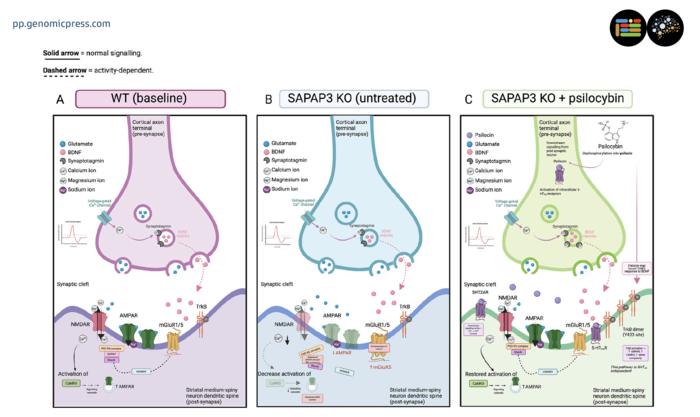
Synaptic structure and function in WT, SAPAP3 KO, and psilocybin-treated SAPAP3 KO mice. (A) Wild-type (WT) mice: At the presynaptic terminal, action potentials open voltage gated calcium channels (VGCCs), allowing Ca2+ influx. Calcium binds to synaptotagmin, triggering vesicle fusion and the release of brain-derived neurotrophic factor (BDNF) and glutamate into the synaptic cleft. Glutamate activates postsynaptic AMPA and NMDA receptors (AMPAR and NMDAR). AMPAR-mediated Na+ influx depolarizes the dendritic spine, relieving the Mg2+ block on NMDAR’s and allowing Ca2+ entry. These receptors are anchored by the postsynaptic scaffold composed of PSD-95, SAPAP3, Shank, and Homer proteins which play a crucial role in synaptic plasticity. BDNF bind to TrkB receptors, activating CaMKII and supporting synaptic plasticity. mGluR5 modulates additional metabotropic signaling. (B) SAPAP3 knockout (KO) mice (untreated): There is no direct evidence that BDNF release is reduced in SAPAP3 KO mice, but changes to the postsynaptic structure may affect how BDNF signals through its receptor, TrkB. Without SAPAP3, the scaffold that holds key receptors like AMPARs and NMDARs together becomes unstable due to the poor receptor anchoring. This increases mGluR5 activity and weakens AMPAR signaling. As a result, this could lead to impaired synaptic plasticity and behavior. (C) Psilocybin treated SAPAP3 KO mice: Psilocybin normalizes presynaptic Ca2+ influx and restores glutamate release via synaptotagmin-dependent exocytosis. In the synaptic cleft, psilocin may bind directly to TrkB dimers, stabilizing them in a conformation that enhances responsiveness to endogenous BDNF, however, evidence is mixed. Psilocin also accesses both surface and intracellular 5-HT2A receptor pools. 5-HT2A receptors mediate hallucinogenic responses and contribute to structural plasticity. Despite this, psilocybin-induced plasticity may occurs independently of the 5-HT2A receptor via direct TrkB activation. Postsynaptically, TrkB signaling re-engages CaMKII and promotes AMPAR trafficking, potentially rescuing aspects of the disrupted postsynaptic scaffold and potentially mediating long-term therapeutic behavioral outcomes
Dr. Loren Miller presents oral late breaker at IDWeek 2025 of a first-of-its-kind clinical trial that shows efficacy of bacteriophage therapy for Staphylococcus aureus bacteremia
Bacteriophages are virus-like particles that infect bacteria. Bacteriophages may have advantages over traditional antibiotics in that they address the problem of increasing antibiotic resistance among bacteria by attacking with a novel mechanism. Additionally, bacteriophages target a single pathogenic bacteria and thus have minimal or no disruption of the healthy human microbiome.
The diSArm study evaluated AP-SA02, a high-purity, pathogen-specific bacteriophage cocktail developed by Armata Pharmaceuticals, in combination with best available antibiotic therapy (BAT) compared to placebo plus BAT. Results showed that AP-SA02 was safe and demonstrated encouraging efficacy in patients with complicated S. aureus bacteremia, one of the most serious and difficult-to-treat bacterial infections. At each multiple time points after treatment, patients receiving the AP-SA02 had higher clinical success than those who received placebo.
Dr. Miller played a pivotal role in the execution of the diSArm trial and presented results of the trial at IDWeek 2025 in Atlanta as a late breaker oral abstract. IDWeek 2025 only accepts highly competitive, novel, and timely abstracts as late breakers, highlighting the importance of the trial’s findings.
“The results of the diSArm study confirm, for the first time, the efficacy of intravenous phage therapy for S. aureus bacteremia,” said Dr. Miller. “These findings provide strong rationale for a Phase 3 study and signal a potential paradigm shift in how we treat antibiotic-resistant infections. High-purity, phage-based therapeutics like AP-SA02 may one day become a new standard of care for patients facing this life-threatening condition.”
Armata Pharmaceuticals’ CEO, Dr. Deborah Birx, recognized Dr. Miller and the clinical team for their contributions: “The positive results from the diSArm study represent another significant achievement as we advance AP-SA02 toward a pivotal Phase 3 trial,” said Dr. Birx. “We extend our gratitude to Dr. Miller and the other investigators for their leadership and commitment to bringing innovative therapies to patients with severe bacterial infections.”
The diSArm study was conducted with support from the U.S. Department of Defense and Innoviva, Armata’s major shareholder, both of whom have played critical roles in enabling the development of phage-based therapeutics as a potential solution to the global challenge of antimicrobial resistance.
Data Highlights
The Phase 2a study enrolled and dosed 42 patients, with 29 randomized to AP-SA02 in addition to BAT and 13 to placebo (BAT alone). Methicillin-resistant S. aureus (“MRSA”) was the causative pathogen in ~38% of both the AP-SA02 and placebo groups.
Clinical response was assessed in the intent-to-treat (ITT) population at Test of Cure (“TOC”) on day 12, one week post-BAT, and End of Study (“EOS”) four weeks after BAT completion. Safety analysis also included data from the Phase 1b portion of the trial (n=8).
Day 12 clinical response rates were higher in the AP-SA02 group — 88% (21/24) versus 58% (7/12) in the placebo group as assessed by blinded site investigators (“PI”) (p = 0.047), and 83% (20/24) in the AP-SA02 group versus 58% (7/12) in the placebo group as assessed by the blinded Adjudication Committee (“AC”).
Non-response/relapse rates were evaluated at the two later timepoints — one week post-BAT and EOS. No patients in the AP-SA02 group experienced non-response or relapse (0%) by either PI or AC assessment. In contrast, the placebo group showed 25% non-response/relapse at both timepoints reported by the PI (p = 0.017) and 22% non-response/relapse at one week post-BAT (p = 0.025) and 25% at EOS (p = 0.02) by the AC.
Patients treated with AP-SA02 showed trends toward rapid normalization of C-reactive protein, shorter time to negative blood culture, quicker time to resolution of signs and symptoms at the infection site, shorter intensive care unit and hospital utilization.
AP-SA02 was well-tolerated with no serious adverse events related to the study drug. Treatment-emergent adverse events occurred in 6% (2/35) and 0% (0/15) in the AP-SA02 and placebo groups, respectively: one patient with transient liver enzyme elevation and one patient with hypersensitivity that resolved with discontinuation of vancomycin.
New findings demonstrate that the defined and reproducible genomic variants present in AP-SA02 Drug Product may provide an immediate advantage, enabling rapid, strain-specific response to each patient’s S. aureus isolate. These characterized variants can expand from as little as 2% to dominance when infecting certain patient isolates in vitro, highlighting that these variants are favored for their enhanced ability to infect those strains and the importance of integrating this diversity into Armata’s phage cocktail from the outset. This inherent flexibility may be central to achieving optimal therapeutic efficacy.
Conclusions
AP-SA02, combined with BAT, had a higher and earlier cure rate compared to placebo in patients with complicated SAB at day 12 as assessed by both blinded site investigators and independent adjudicators.
No patients who received AP-SA02 demonstrated non-response or relapse at one week post-BAT or at EOS, as assessed by both blinded site investigators and the independent adjudication committee, compared with approximately 25% in the placebo group.
AP-SA02 appears safe with clinical efficacy against both MRSA and methicillin-sensitive S. aureus (“MSSA”) and trends toward earlier resolution and shorter hospitalization, with no evidence of relapse four weeks post-therapy.
Defined phage variants in AP-SA02 Drug Product ensure an intrinsic adaptive mechanism — a flexibility that may be key to achieving effective phage therapy from patient to patient.
These results strongly support advancement into a pivotal Phase 3 trial that Armata plans to initiate in 2026, subject to review and feedback from the U.S. Food and Drug Administration (the “FDA”). The Company is engaged with the FDA regarding a potential superiority trial design.
About AP-SA02 and diSArm Study
Armata is developing AP-SA02, a fixed multi-phage phage cocktail, for the treatment of complicated bacteremia caused by Staphylococcus aureus (S. aureus), including methicillin-sensitive S. aureus (MSSA) and methicillin-resistant S. aureus (MRSA) strains.
The diSArm study (NCT05184764) was a Phase 1b/2a, multicenter, randomized, double-blind, placebo-controlled, multiple ascending dose escalation study of the safety, tolerability, and efficacy of intravenous AP-SA02 in addition to best available antibiotic therapy (BAT) compared to BAT alone (placebo) for the treatment of adults with complicated S. aureus bacteremia. The results from the diSArm study are an important step forward in Armata’s effort to confirm the potent antimicrobial activity of phage therapy and the completion of the study represents a significant milestone in the development of AP-SA02, moving Armata one step closer to introducing an effective new treatment option to patients suffering from complicated S. aureus bacteremia.
The Phase 1b/2a clinical development of AP-SA02 was partially supported by a $26.2 million Department of Defense (DoD) award, received through the Medical Technology Enterprise Consortium (MTEC) and managed by the Naval Medical Research Command (NMRC) – Naval Advanced Medical Development (NAMD) with funding from the Defense Health Agency and Joint Warfighter Medical Research Program.