It’s possible that I shall make an ass of myself. But in that case one can always get out of it with a little dialectic. I have, of course, so worded my proposition as to be right either way (K.Marx, Letter to F.Engels on the Indian Mutiny)
Tuesday, December 09, 2025
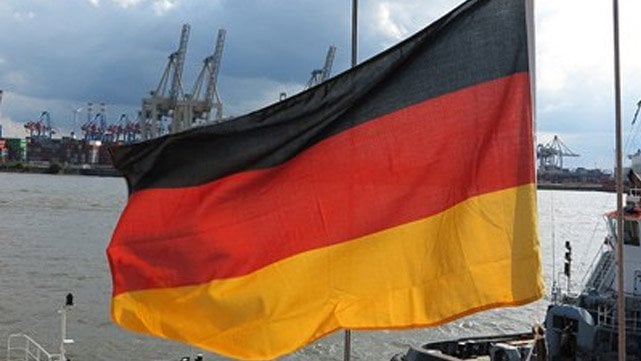
German Seafarers Agree to New 30-Month Contract with Real Wage Increases
German seafarers agreed on wage increases in a new 30-month contract (Deutsche Flagge)
German shipowners, the association for the industry, and the trade union ver.di are all saying that a fair agreement has been reached for a new contract for German seafarers. They concluded an agreement during the second round of talks, which took place on December 4, and will apply to all seafarers sailing on German-flag ships that are members of the collective bargaining association.
The two sides had been far apart during their first negotiations in November, raising the possibility of disruptions to German-flag shipping. The union opened the negotiations by calling for a 9.5 percent pay increase with a 12-month contract. They highlighted that real wages had decreased 6.5 percent over the past five years due to inflation. The shipping companies started with a position offering a 2.1 percent increase for 2026 and 2 percent for 2027.
German seafarers had demonstrated their dissatisfaction with the offers by staging demonstrations at the offices of the major companies, including Hapag-Lloyd, Fairplay. TT-Line, BLE, and the pilot association. Members said that if ver.di called for actions or strikes, they would participate.
German shipowners highlighted that it is a challenging time for the industry with many uncertainties. The German Shipowners’ Association (VDR) said its focus was to ensure the long-term economic stability and viability of the sector. They called the terms of the agreement “reasonable” and said it recognizes the contributions of seafarers.
The agreement provides for a 3 percent wage increase in 2026 and a further 2.8 percent starting on January 1, 2027. The contract runs till June 30, 2028.
“We were able to achieve a real wage increase for seafarers,” said a ver.di negotiator. Steffen Wanke, a member of the collective bargaining commission and employee of Fairplay Towage Group, said the agreement was “The maximum that could be achieved.” He said with falling freight rates and other pressures, there had not been “much room to raise wages.”
Ver.di said it would use the 30-month contract term to become stronger in the shipping sector. It predicted that it would be able to mount more resistance in future negotiations.
HMS Lancaster Sails Into The Sunset After Nearly 35 Years of Service
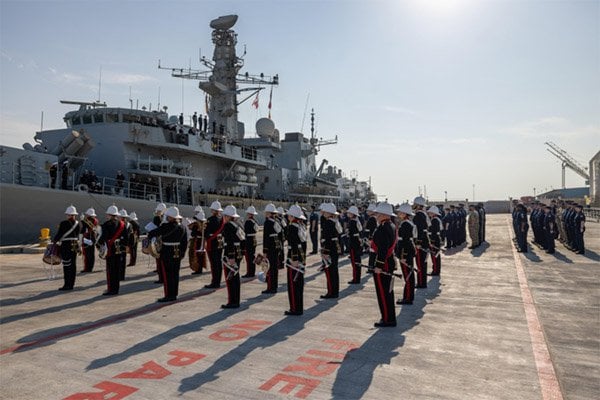
HMS Lancaster is saluted as she comes into Bahrain for the last time (UK MoD)
The UK Ministry of Defence has broken its silence and confirmed that the Type 23 frigate HMS Lancaster (F229) is within days of retirement, having been forward-deployed in Bahrain since 2022.
After a period when it was unclear where HMS Lancaster was or what it was doing, Vice Admiral Steve Moorhouse, the Royal Navy's Fleet Commander and a former commanding officer of HMS Lancaster, broke the news that the ship is to be retired shortly, and is to be disposed of from Bahrain without returning to the UK.
The period of silence may be accounted for by a last-minute review of whether the frigate could be further extended in service, given that the operational need for a ship of HMS Lancaster's capabilities in the Gulf region is still acute, and contingencies are arising that warrant having a Royal Navy warship close at hand. For example, there is currently considerable unrest in Tanzania after the recent disputed results of the presidential election. The situation in Iran is also particularly unstable, with it highly likely that the internal security situation there will deteriorate even further over the next 12 months.
Lancaster, however, is already the oldest Type 23 frigate in the Royal Navy, and has served for nearly 35 years against a designed operational life of 18 years. She has had an extraordinary record of service, particularly in the Gulf region, and has had particularly effective crews, enhanced because of the full-spectrum operational experience they have been exposed to, ranging from drug-interception operations to countering Houthi threats in the Red Sea and Gulf of Aden. Rather than being hidden away for the last months of her service by dint of Ministry embarrassment, she deserves a splendid send-off, and it seems she is now getting one.
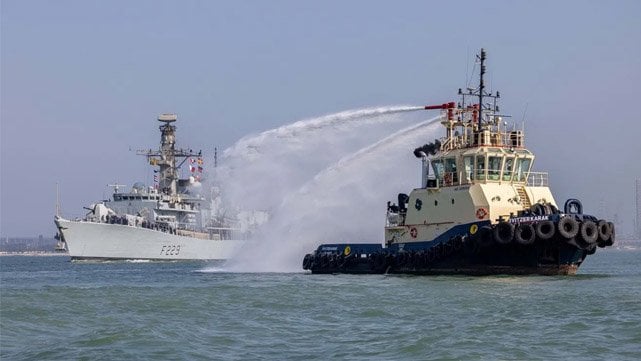
Welcome home for HMS Lancaster in Bahrain for the last time on December 5 (UK MoD)
On her return to HMS Juffair on December 5, she was greeted by a fire-boat salute and a full Royal Marines band on the dockside. A 35-gun salute marked the end of a career that the Royal Navy said encompassed completing 4,097 days at sea and travelling 816,000 nautical miles. The Royal Navy confirmed the 4,500-tonne warship powered down her engines,
No announcement has been made as to how the gap left by Lancaster's retirement is to be filled, but the first replacement Type 31 frigate, HMS Venturer, is not due into service until 2027. One of the few possibilities the Royal Navy has is to redeploy to Bahrain one of the two offshore patrol boats, HMS Tamar (P233) or HMS Spey (P234), which are currently forward-based in the Indo-Pacific region. Until a replacement is assigned, the Royal Navy will be represented in Bahrain and the region by the Hunt-class minesweeper HMS Middleton (M34).
Historic Liverpool Waterfront Vessels Undergo Vital Preservation Repairs
Efforts are underway in Liverpool to preserve two historic vessels that are a familiar sight in the city’s waterfront, a move that is aimed at ensuring they continue attracting visitors for years to come.
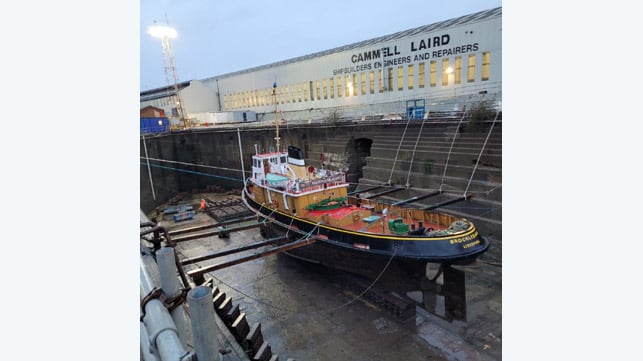
The National Museums Liverpool is undertaking a £200,000 ($267,000) conservation project to preserve the future of tugboat Brocklebank and pilot boat Edmund Gardner, both of which have come under threat due to years of decay.
A national heritage, Brocklebank is a tug that was launched in 1964 and was mainly used for ship handling in the city, but had occasional duties at Heysham, Larne, and Barrow. Historical accounts indicate that she was one of five motor tugs built by W. J. Yarwood & Sons between 1962 and 1965 for Alexandra Towing Company.
During her service years, the tug is famed for escorting the Royal yacht Britannia when Queen Elizabeth II visited Liverpool to review the tall ships in 1982. Following retirement in 1989, the tug was purchased by the Merseyside Maritime Museum and chartered to the Brocklebank Preservation Society, which has been maintaining and operating the vessel.
Normally berthed in the Albert Dock next to the museum, a recent inspection revealed serious corrosion across the steel hull of the vessel, prompting the need for restoration. The repair work comprises a high-pressure clean and the application of a repair coating to fill all the pitting affecting the ship. When completed, the vessel is expected to continue attracting visitors at the waterfront for another decade.
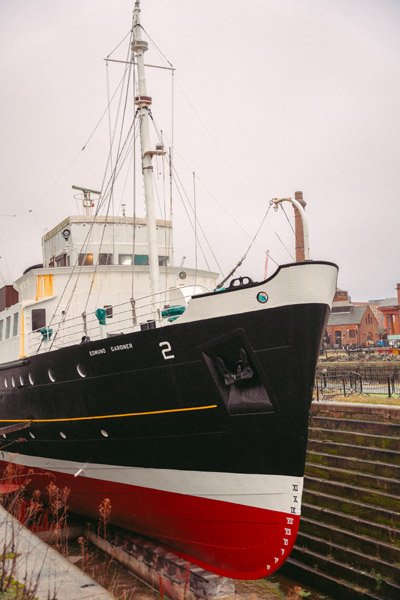
Edmund Gardner looking smart with its new paint (KieranIrvine photo, courtesy of National Museums Liverpool)
Also undergoing preservation works is the Edmund Gardner, which resides in Canning’s north dry dock and is the largest object in the museum’s collections. The boat was built in 1953 by Philip and Sons for Mersey Docks and Harbor Board and was the second of a new generation of large diesel-electric powered cutters to replace the pre-war steam cutters.
Together with her two sister ships, Edmund Gardner performed the task of guiding the steady stream of ships entering and leaving the Mersey docks during the 1950s-1980s. Historical accounts show that during her career in the pilotage service, she carried out her duties without major incidents and was considered a particularly good ship in heavy weather. Apart from pilotage, she also provided assistance for injured seamen on incoming ships and for yachtsmen on several occasions.
Apart from being a workhorse in the Mersey docks, Edmund Gardner is also remembered for the 1963 collision with the ore carrier Iron Horse. A steering gear failure caused the carrier to hit the Edmund Gardner on the starboard side, rolling the ship over heavily and damaging the bridge deck and hull plating.
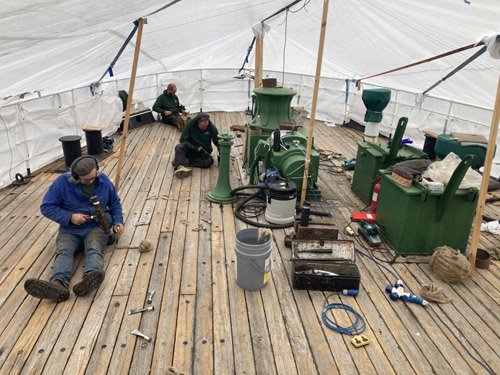
Edmund Gardner decking recaulked - National Museums Liverpool
The boat was purchased by the Maritime Museum in 1982 and is today one of only two large pilot boats preserved worldwide, with the other being in Australia. The boat contains many of the original features, including the control and navigation equipment on the bridge and is part of the National Historic Fleet.
To ensure the boat continues to be an attraction at the Mersey waterfront, it recently underwent specialist treatment of its wooden deck and caulking to prevent it against water ingress into the vessel’s interior, something that is key to its long-term preservation.
The UK’s Public Bodies Infrastructure Fund, a government capital investment program for the essential maintenance of museum estates, is funding the conservation project of the two ships.
Rosneft Oil Cargo Wanders for Weeks as Sanctions Mount
A cargo of crude oil from sanctioned Russian giant Rosneft has made an 11-week-long meandering trip around Europe and Asia in search of buyers and although it has anchored off a sanctioned Chinese import port, it’s not certain it has reached its final destination yet.
The Fortis tanker with about 700,000 barrels of now sanctioned Russian oil dropped anchor near the Chinese port of Rizhao on the east coast on Tuesday, tanker-tracking data compiled by Bloomberg showed.
The Fortis did not make the entire trip from Russia’s western port on the Baltic Sea. The crude cargo from Rosneft began the journey on the Ailana tanker from the Russian export terminal of Ust-Luga at the end of September.
Following a trip around Europe into the Mediterranean, and through the Suez Canal, the Ailana arrived near India at the end of October.
But by then the U.S. had already slapped sanctions on top Russian oil producer Rosneft and the second-largest, Lukoil, to force Russia to genuine talks about ending the war in Ukraine.
India stopped importing any crude known to have originated from or handled by affiliates of Rosneft and Lukoil to avoid angering the Trump Administration further.
So the Ailana idled off Mumbai for two weeks, according to Bloomberg’s ship-tracking. Then most of the cargo was transferred onto the Fortis tanker which had shown destinations in India and South Korea before anchoring off the Rizhao port, which the U.S. Treasury also sanctioned in October as part of the pressure campaign on China over its purchases of Iranian crude.
Despite being very close to the Rizhao port, it’s not certain the Fortis would offload the cargo there, according to Bloomberg.
The three-month long trip and the ship-to-ship (STS) transfer suggest that buyers, especially in India, are steering clear of the sanctioned Russian companies and their cargoes.
The U.S. sanctions on Rosneft and Lukoil upended all previous plans by Indian refiners, who hastened to withdraw from the spot market for Russian crude in December.
India’s Bharat Petroleum and India Oil Corporation have bought Russian crude from non-sanctioned companies for January delivery, at a discount of $6-$7 to Brent crude, reports emerged last week.
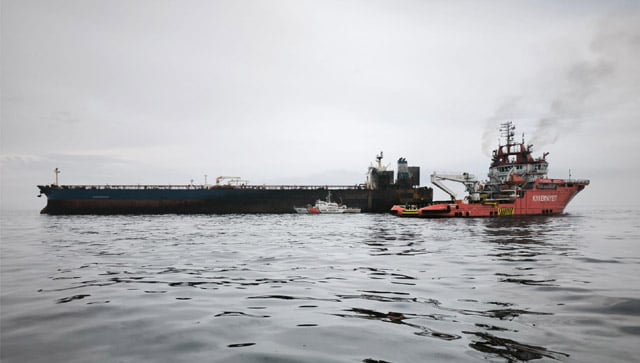
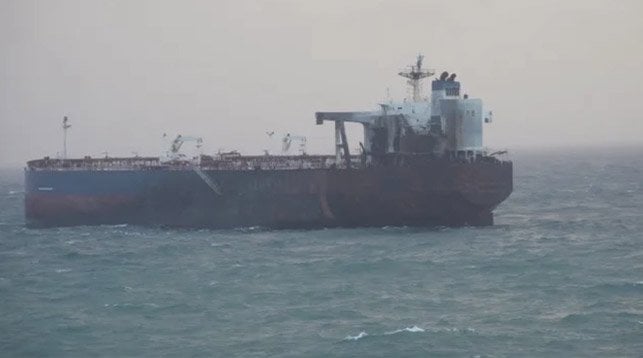
The mystery around the sanctioned tanker Kairos (149,989 dwt) is continuing to grow as the vessel, which was attacked with a drone last week, is now reported drifting off Bulgaria. The Bulgarian authorities are seeking to assure the population that there is no immediate danger while they continue to monitor the vessel, which is now requesting an evacuation.
Kairos was the first of two tankers attacked by the Ukrainians off Turkey on November 28. The tanker, which is sanctioned by the West for its involvement in the Russian oil trade, was set on fire. Turkey reported it evacuated 25 crewmembers. At last report, Turkey said it was discussing towing operations with the vessel’s owners.
The ship, which was built in 2002, is reported to be owned by Chinese interests. It reports being registered in Gambia, but that is believed to be a false flag.
Kairos drifting off the Bulgarian shore (Facebook)
Midday on Friday, December 5, Bulgarian authorities observed a vessel entering their waters and tried to contact the ship, but received no response. They issued a warning to passing ships and were later able to confirm it was the tanker Kairos. In the early afternoon, they received a request from the 10 people aboard the ship for an evacuation. At that point, the ship was reported to be seven nautical miles from the Bulgarian coast and drifting.
The Bulgarian Maritime Administration was later advised that the crew had been able to drop the starboard anchor in an attempt to stop the tanker. They were working on releasing the port anchor as well. Residents were writing on social media that the ship was approximately 700 to 800 meters from shore and in danger of grounding.
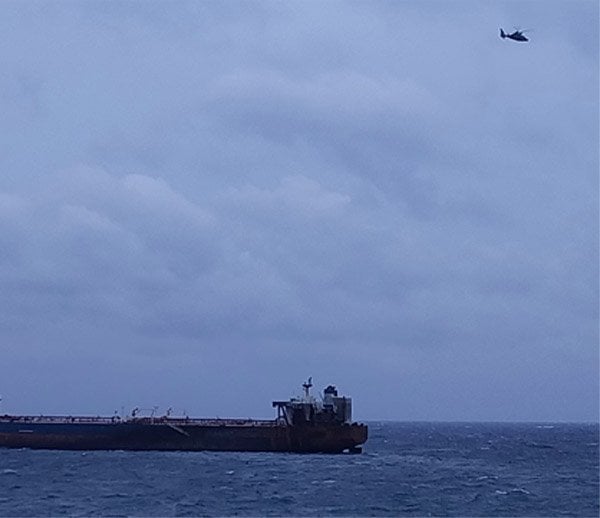
The Bulgarian Navy dispatched a helicopter to survey the situation and is coordinating with the Border Police and maritime authorities. An emergency center has also been activated.
The sea is very rough with high waves and strong winds. The media reports are saying the crew aboard the tanker is in protective gear, but the authorities determined that it is too dangerous at night, with the current conditions, to attempt a rescue.
It is unclear what happened to get the tanker from just north of Turkey across the Black Sea to a position off Ahtopol in southern Bulgaria. Unconfirmed reports are that the tanker had started a tow on December 3, bound for Tuzla, Turkey, but then turned toward Bulgaria. It is unclear where the towing vessel is and how the two ships became separated.
Bulgaria’s Maritime Administration Agency says the tanker is under constant surveillance, and they have been in contact with the crew on board
Shadow Tanker Mystery Continues as Crew Waits for New Tow off Bulgaria
Karios is sitting less than 1,000 yards off the coast of Bulgaris with 10 people aboard waiting for a tow (Bulgarian Ministry of Transport)
Bulgarian authorities are still trying to understand the situation with the fire-damaged tanker Kairos, which washed up on their shores on Friday, December 5, during a storm in the Black Sea. The vessel was heavily damaged by an attack a week ago by the Ukrainians while it was underway near Turkey, and now it is on the Bulgarian shores with a skeleton crew aboard.
Contact has been established with the 10 people aboard the vessel, and after initially requesting an evacuation on Friday, they are now saying they will remain aboard the vessel and wait for a tow. The Bulgarian authorities report they attempted to question the crew but were told the captain and other senior officers had left the ship. The crew aboard says they are safe and have at least three days of food and water.
An attempt to reach the ship on Saturday, December 6, with a launch from the border police was unsuccessful due to the high winds and rough seas, which also hampered the operations on Friday. Reports indicate the winds are over 29 knots (33.5 mph) and seas are at least three to five feet. Once the winds subside, the Bulgarian Border Police plan to board the tanker, likely using a helicopter. They will also be able to ferry additional supplies to the crew with a helicopter.
After drifting in the storm, the tanker came to rest approximately 700 to 800 meters (less than 1,000 yards) offshore near Ahtopol in southern Bulgaria. The Bulgarian Ministry of Transport reports “the reasons for the ship’s entry into Bulgaria’s territorial waters are yet to be clarified.”
The Turkish authorities said last week that they were working with the vessel’s representatives to arrange for a tow after putting out the fires on the tanker. The fire had been started after an explosion from a drone attack for which Ukraine took credit. The Bulgarians report the ship’s condition as “smoky,” while pictures showing the accommodation block and bridge are likely heavily fire-damaged.
It is unclear when or how the tanker and its tow detached on Friday. Some reports are saying the tug towing the tanker released it on Friday morning, about six miles south of Bulgaria, and headed back to Turkey.
The Kairos has been sanctioned by the West for its involvement in the Russian oil trade and was reported bound for Russia when it was attacked. Equasis reports the flag as “unknown,” while some reports have said Gambia, which was believed to be a false flag. The Bulgarian authorities are saying the vessel reported being registered in Benin.
Bulgarian officials said they have not made contact with the vessel’s owners and were not notified before the vessel entered the country’s waters. The crew did not respond to the initial calls from the Bulgarian maritime authorities as the tanker began to drift toward shore. Someone identifying as a representative of the Chinese owners contacted the maritime control center on Saturday, but for now, the Bulgarians report the incident remains under investigation.
The crew aboard the Kairos (149,989 dwt) was able to release the starboard anchor on Friday afternoon, and the reports said the anchor is so far holding the 274-meter (899-foot) vessel. The authorities emphasized that there is no crude oil cargo aboard, reducing the environmental danger. They expect the tanker will be towed to “a safe place” within the next few days.
Monday, December 08, 2025
What lies beneath Greenland could change what we know about rising seas
A new study led by researchers at the University of Ottawa provides a series of highly detailed 3-D models of the Earth’s temperature beneath Greenland and northeastern Canada, providing insights into the region’s geological history and the response of the ice sheet to past and future climate change.
“Our new regional temperature models reveal significant lateral variations in the Earth's thermal structure beneath Greenland, which provide important information on the island’s passage over the Iceland hotspot,” explains uOttawa’s PhD graduate Parviz Ajourlou, the study’s first author. “These variations help us better interpret Greenland's tectonic history and the influence of this history on the geophysical properties of the underlying rocks.”
Glenn Milne, Chair and Full Professor within the Department of Earth and Environmental Sciences at uOttawa and the principal investigator, emphasizes the implications: “This research advances our understanding of the Earth’s internal structure beneath Greenland. Temperature variations directly influence the interaction between the ice sheet and the bedrock, which must be quantified to interpret observations of land motion and gravity changes. These observations tell us how the ice sheet is responding to recent climate warming.”
Modeling the future of sea levels
The innovative approach involved processing multiple geophysical data sets such as seismic velocities, gravity anomalies, and heat flow to develop a comprehensive 3D temperature model. The findings not only clarify Greenland’s geologic past and the current state of the ice sheet but also improve the ability of scientists to simulate future changes of the ice sheet and its contribution to global sea level rise.
“This work is a good illustration of how our knowledge of the solid Earth enhances our ability to understand the climate system,” says Ajourlou. “By improving how we model ice-earth interactions, we can better forecast future sea level rise and plan accordingly.”
The negative health impacts from contamination by so called "forever chemicals" in drinking water costs the contiguous U.S. at least $8 billion a year in social costs, a University of Arizona-led study has found.
The study, published in the Proceedings of the National Academy of Sciences, builds on previous research into how PFAS – per- and polyfluoroalkyl substances – can negatively impact health when the chemicals contaminate drinking water. The research team studied all births in New Hampshire from 2010-2019, focusing on mothers living near PFAS-contaminated sites.
The research shows that mothers receiving water from wells that are "downstream" (in groundwater terms) of PFAS-contaminated sites, as opposed to comparable mothers receiving water from "upstream" wells, had higher first-year infant mortality, more preterm births (including more births before even 28 weeks), and more births with infants weighing less than 5.5 pounds (including more births with weights less than even 2.2 pounds). These findings build on earlier laboratory and public health research but offer new evidence from real-world exposure across a large population.
Extrapolating to the contiguous U.S., PFAS contamination imposes costs of at least $8 billion on the babies born each year, which encompasses medical care, long-term health impacts and reduced lifetime earnings. The results indicate that the potential health benefits of PFAS cleanup and regulation may be substantial.
"If we compare costs we're finding versus the cost of cleaning up PFAS, the answers are obvious," said study coauthor Derek Lemoine, a professor of economics and director of graduate studies in the U of A Eller College of Management. "Removing PFAS from drinking water not only results in drastically improved health outcomes. It also produces a significant long-term economic benefit."
Lemoine and fellow Eller economics professor Ashley Langer collaborated on the research with Bo Guo, an associate professor of hydrology and atmospheric sciences, in the College of Science, after meeting at an event hosted by the Arizona Institute for Resilience to foster collaborative research across disparate fields of study. Lemoine and Langer took an immediate interest in Guo's years-long research into PFAS, while Guo was fascinated by the economists' research into long-term health and economic impacts.
Eller economics alumnus Robert Baluja and former AIR-funded postdoctoral researcher Wesley Howden also contributed to the study.
PFAS were originally developed to make protective coatings for goods to resist heat, oil and water, and are used in a range of products and in firefighting activities. They earned the label "forever chemicals" because they take much longer to break down naturally in the environment. Researchers have long suspected that exposure to PFAS poses health risks, especially to infants, who can suffer from low birth weight or even die from PFAS exposure via their pregnant mothers. But prior work had not found a way to make PFAS exposure effectively random.
"We found really substantial impacts on infant health, which expanded on what others before us had found," Langer said. "What we then do is calculate how these negative birth outcomes follow these children throughout their lives. The numbers we found represent the lowest end of the economic impact – we suspect it is even more."
The U of A study focuses on two "long-chain" PFAS – PFOA and PFOS – that are no longer manufactured in the U.S. but remain in soils and therefore are still percolating into groundwater.
"Whatever PFAS we see in groundwater is only a tiny fraction of the PFAS that has been dumped in the environment," Guo said. "The majority of PFAS is still in the soil and migrating downward."
The authors highlight opportunities for future research, including understanding the effects of newer PFAS and the role of long-term exposure. They also note that activated carbon filters, whether used by water utilities or installed in homes, can remove these long-chain PFAS from drinking water.
"These chemicals may be everywhere, but we still find that drinking water matters for pregnant women. Installing and maintaining home water filters could be prudent for them," Lemoine said.