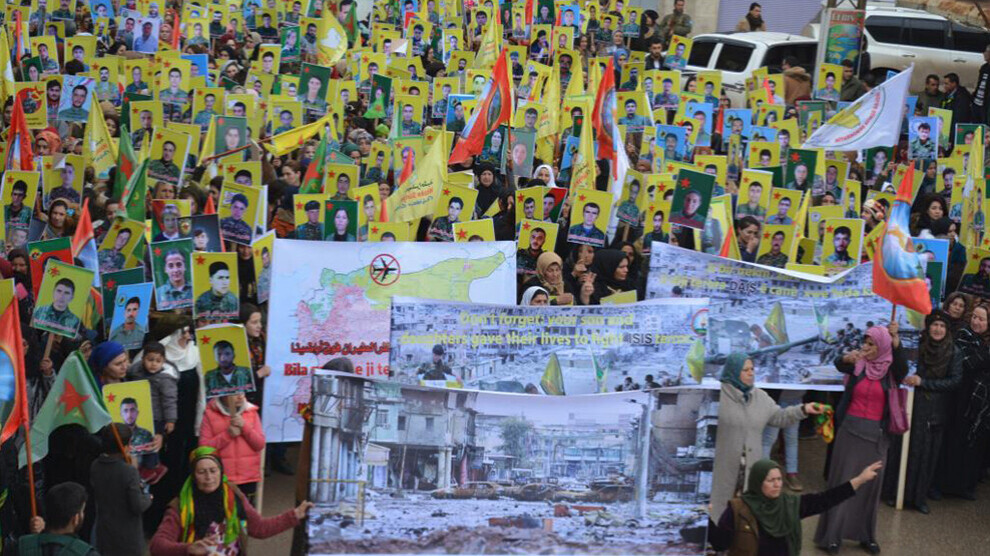
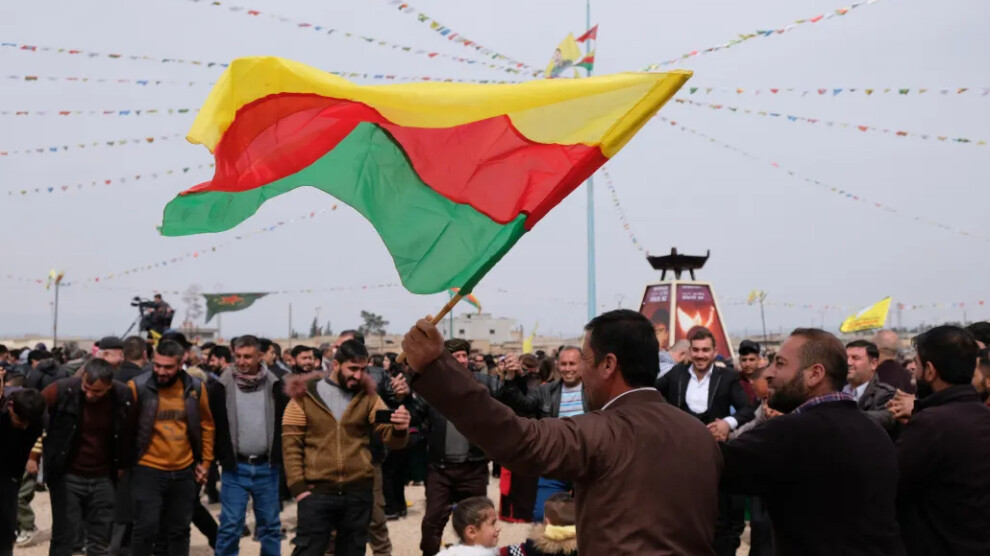
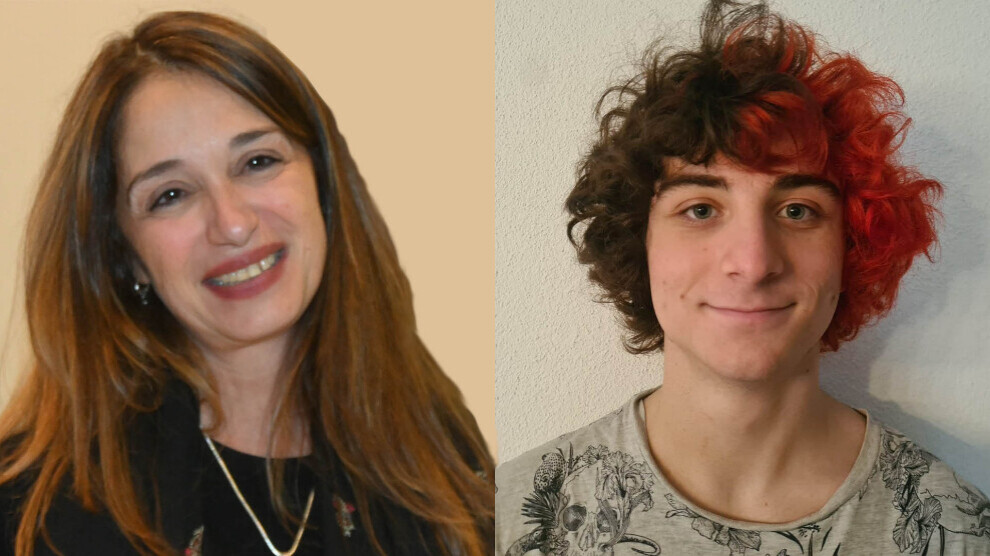
Showing posts sorted by relevance for query ROJAVA. Sort by date Show all posts

Saturday, December 28, 2024

'All Kurds should support Rojava and ensure national unity'

Representatives of the Kurdistan Alliance parties called on all Kurds to support Rojava and ensure national unity.


ANF
AMED
Thursday, 26 December 2024

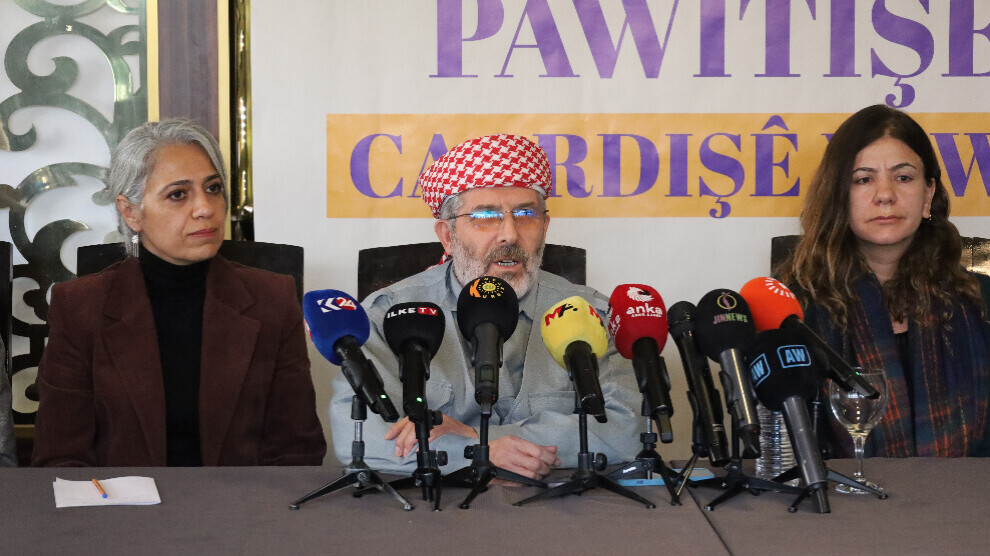
The Kurdistan Alliance parties made a joint statement at the Southeastern Journalists’ Association in Amed (tr: Diyarbakır) on Tuesday highlighting the need for Kurds to ensure national unity against the attacks on Northern and Eastern Syria.

'We must look at the Kurd and Kurdistan issue together'

Speaking here, Ayetullah Aşitî, Chairman of the Azadi Party, said that he wanted to clarify the issue from a religious perspective since they are a religious party. Stating that Allah sent the Qur'an to the oppressed peoples, Aşitî said that Islam in the Middle East is not characterized by peace but by events and wars. He continued, "While Islam emerged for the freedom of the peoples, we have a misconception and put all the blame on the enemy. There is a verse in the Qur'an that says, 'The good is my blessing and the bad is your deeds'. The enemy is our test. But we also need to think about why our problems are not solved, why we cannot produce solutions. It is not because we do not know, it is because we cannot tolerate each other. We must act in unity. If we achieve unity, we will gain. Ideologies are not important in patriotism. We must look at the Kurd and Kurdistan issue together. If we do not create our national unity, we will remain in this situation for another two hundred years. The solution to the Kurdish question depends on the unity of Kurds. A concrete example of this is Rojava. If the Kurdish people act together on the Rojava issue, the world will recognize them as interlocutors and the Kurds will achieve liberation."

Journalists killed in Rojava remembered

Speaking on behalf of the Communist Party of Kurdistan, Yasin Yetişgen commemorated journalists Nazım Daştan and Cihan Bilgin who were killed in a Turkish drone attack in Rojava on 19 December. Yetişgen said he was a friend of Cihan Bilgin from her university years, adding: “She never lost her belief in truth and reality and lost her life for this cause. Their friends will not leave their pen unclaimed."

‘The risks can be eliminated through national unity’

Yetişgen stated that HTS set out from Idlib and reached Damascus to pave the way for global and regional powers, adding: "A new situation has emerged for the peoples and beliefs, especially the Kurds. It is very clear that this situation determines the risks and gains. Rojava Kurdistan must take advantage of the opportunities that it has created for itself at great cost. The risks can be eliminated through national unity. Kurds can only get out of this situation by ensuring their national unity. All peoples can take their place in the new Syria, and the way to do this is federation. Although the Turkish state considers federation as division, everyone knows very well that federation is actually a path to unity. The Turkish state's policy against the Kurds is now bankrupt. Peace in the Middle East is not possible without the Kurds. The Turkish state must stop labeling Kurds as 'terrorists', meet with the SDF, and solve the problem in the region through peaceful and democratic means."

'We must defend the status of Rojava'

Abdulhey Okumuş, spokesperson for the Revolutionary Democratic Kurdish Association (DDKD), stated that a series of developments have been taking place in the Middle East. Okumuş stressed that the most important thing is how the Kurdish people will protect their rights amid the current developments that are now at their doorstep, just like the Treaty of Lausanne: “This opportunity does not knock every day, but once in 100 years. Kurds should use this opportunity correctly. They must form their national unity and become the interlocutor. In this way, they can be a hope for the Kurds in the other parts as well. We must defend the status of Rojava so that it is officially recognized in the world. The new Syrian regime does not have a strong base. Kurds can increase their success by dealing with them and voicing their demands. They could also have the world accept this."

‘Let 2025 be the year of peace, freedom and liberation of Kurds’

Azad Zal, a member of the Şêx Sêid Association, said: "Every Kurdish person should ensure peace and tranquility for themselves. If everyone is at peace with themselves, they will be at peace with those around them, their neighbors and those in their country. The politics done on behalf of the Kurds has willpower. There is always war. There has been war since the world was shared. What is important is the interests of the peoples, first and foremost the interests of the Kurdish people because they did not submit to oppression. The Kurdish people deserve this the most. Let 2025 be the year of peace, freedom and liberation of Kurds."

‘We will protect Rojava more from now on'

Democratic Regions Party (DBP) Co-Chair Çiğdem Kılıçgün Uçar started her speech by commemorating Nazım Daştan and Cihan Bilgin. Underlining that the current process is of importance for the recognition of Kurdish rights and status, Uçar said, "The future of the Kurds is in danger. Rojava is home to Arabs, Kurds and Syriacs. Against the oppressive understanding, the people made a revolution there and established a democratic system. We will protect this system. Turkey cannot intervene in it. Only the peoples can build their own system in Syria. The people of Syria are acquainted with authoritarian and despotic regimes and they don't want that. Not only Kurdistan, but the whole world owes Rojava. Let us pay our debt to Rojava by protecting it. Rojava is like ivy to us, and we hope that this ivy will wrap around all sides. We have only Rojava left. Either we will build this system or the authoritarian regime will suffocate us. We will protect Rojava even more from now on."

Kongra Star: All women must defend the Rojava Revolution

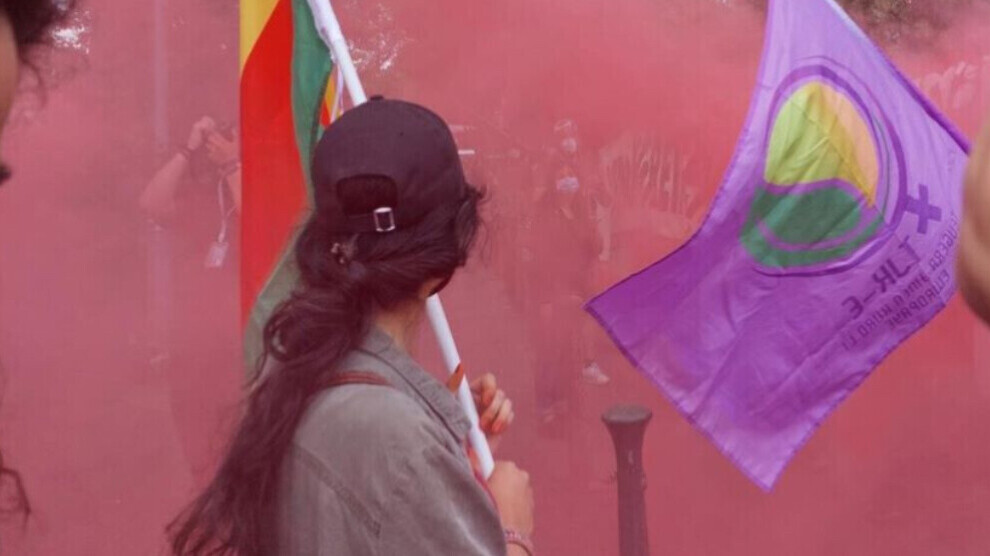
Kongra Star European Coordination called on all women to defend the Rojava Revolution.


ANF
NEWS DESK
Saturday, 28 December 2024

Kongra Star European Coordination issued a written statement on the developments in Syria after the fall of Bashar al-Assad regime.

The statement underlined that Hayat Tahrir al-Sham (HTS) came to power after Bashar al-Assad's regime collapsed and added: "Assad fled to Moscow, leaving behind a destroyed country and millions of people deprived of their basic rights. After what happened, the Turkish state launched an attack against our people who had already been displaced, as they were forced to flee from Afrin to Shehba, in 2018 after Turkey invaded the region."

The statement added: "After the attacks by gangs affiliated to the Turkish state, our people were forced to migrate once again and moved to the safe regions of North-East Syria. The attacks by the fascist Turkish state and its affiliated gangs continue. The security chaos in the Manbij region, the torture of civilians, including women and children, the plundering of people's property, the targeting of important areas in the region such as the Tishrin Dam and Karakozak Bridge, the violation of the basic rights of the peoples of Syria show that the incoming government is as dangerous as the oppressive, cruel, racist Baathist regime, especially for women. On the other hand, Western countries are trying to present the new regime as the best alternative in line with their own interests."

The statement said that "the Kurdish people is the main component of Syria's diverse demography. As a result of a long struggle and great costs, we have carried out the Rojava Revolution, which is a women's revolution. After the revolution, a Democratic Autonomous Administration system based on justice, equality, democracy and coexistence was established. Today, these gains are in danger. The Turkish army and its gangs are attacking us from all sides, from Manbij, Ain Isssa, Til Temir to Kobanê. They want to eliminate the women's revolution and to prevent the peoples of the region from living together. We need to show a common attitude and fight against the enemy with the awareness of national unity."

The statement underlined the need to expose the circumstances of the women abducted by the gangs and said: "As Kongra Star European Coordination, we may not be at the direct centre of events, but wherever we are, we continue our social, political and diplomatic struggle. We will struggle to fulfill our role in this process and to convey the women's revolution and the voice of all women in Syria to international organisations and the women of the world. We do not forget the abducted and disappeared women all over Syria.”

Kongra Star called “on international organisations and human rights institutions to no longer remain silent on this atrocity and act in accordance with human rights and international agreements. Uncover the circumstance of the abducted women and hold those responsible to account. We condemn the closure by the Kurdistan Democratic Party (KDP) of the Semalka-Fishabur border gate, through which humanitarian aid should pass to civilians living in the autonomous regions, at a time when we need unity and solidarity among Kurds the most. We call on the KDP to put aside their personal and party profits and stop being enemies to their people. All women, especially Kurdish women and Syrian women, democratic, socialist and revolutionary women's movements should join forces and fight together to build a free future. The Rojava Revolution must be supported against the Turkish state that aims to destroy women's gains. With the unity of women, we will transform all living spaces into areas of struggle and resistance."


SMJÊ calls for action against massacres in North-East Syria: Rojava is the honour of humanity


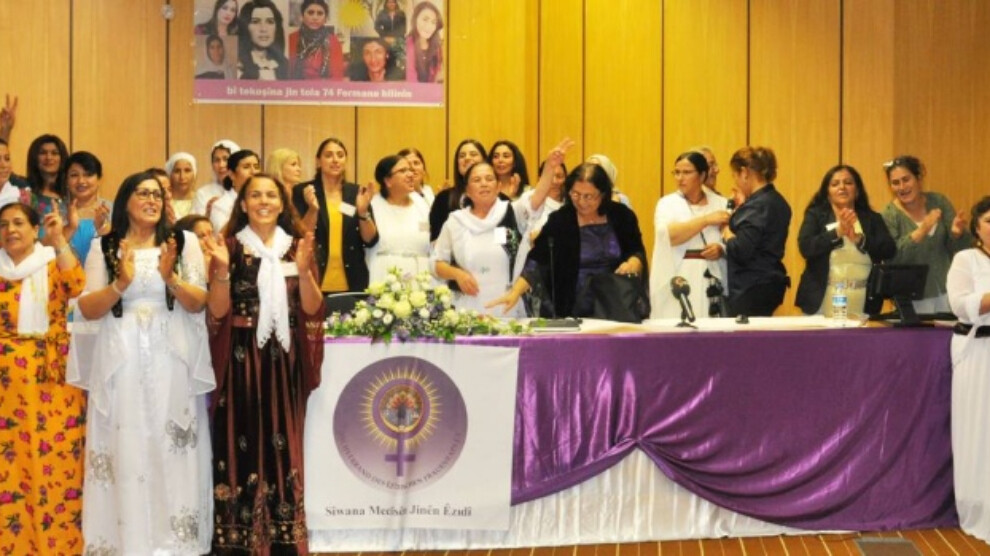
“Today is the day to protect the human dignity of Rojava,” said the umbrella organization of Yazidi Women's Councils, calling for action against massacres in North-East Syria.

ANF
NEWS DESK
Saturday, 28 December 2024, 17:19

The umbrella organization of Yazidi Women's Councils (SMJÊ) released a statement calling for action against the massacres committed by the occupying Turkish state and its gangs in North-East Syria.

The SMJÊ statement on Saturday said: “Today is the day to protect our honour, dignity, identity and existence. Once again, we call out to all democratic, revolutionary, libertarian, pro-peace and human rights forces: Rojava is the honour of humanity.”

The statement pointed out that the AKP-MHP government continues the ideological legacy of ISIS through gang groups such as HTS and SNA, and Turkey sees this chaotic environment as an opportunity.

“The Turkish state fears that the people of Northern Kurdistan will also rise up with the demand for freedom," SMJÊ said and made the following call: “If you miss this historic opportunity and do not unite, it means complicity in the crimes committed against the Kurdish people. Today is the day to protect the human dignity of Rojava. Everyone must act swiftly against the massacres of women and human beings and fulfil their historical responsibility by taking part in the ranks of the hundred-year-old resistance.”

Vigil at Suruç-Kobanê border on day 6: We must defend Rojava

During the vigil at the Suruç-Kobanê border, activists called for solidarity with Rojava, saying, “It is our duty to defend the system established in Rojava.”


ANF
URFA
Saturday, 28 December 2024

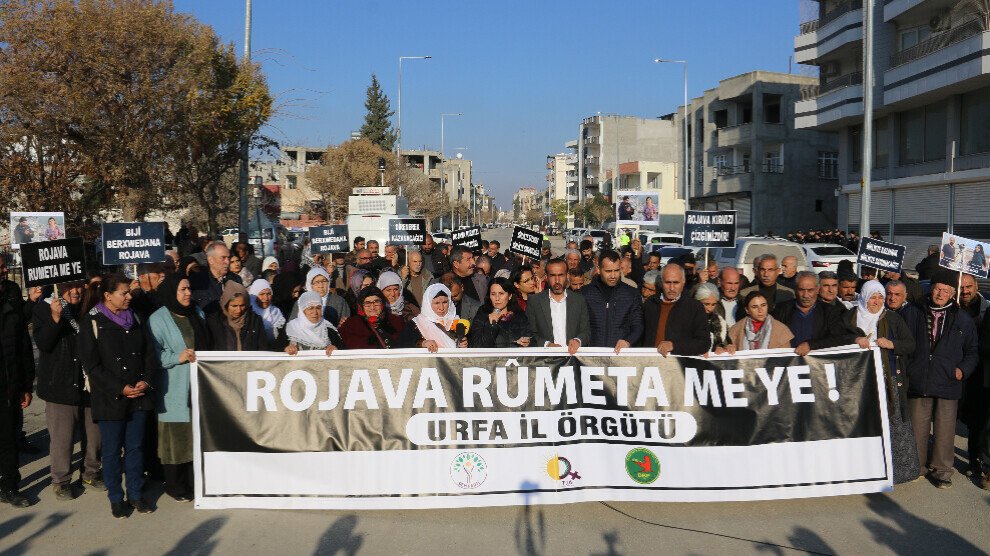
The vigil started in the Suruç district of Urfa on the border of Kobanê in protest at the invasion attacks against North and East Syria continues on its 6th day. The vigil was launched under the leadership of the Democratic Regions Party (DBP), Peoples' Equality and Democracy Party (DEM Party) and Free Women's Movement (TJA).

Activists on Saturday paid tribute to Kurdish journalists Cihan Bilgin and Nazım Daştan, who were killed in a Turkish drone attack in Rojava on 19 December, and the victims of the Roboski massacre, which claimed the lives of 34 people, mostly minors, in the countryside of Şırnak province on 28 December 2011.

Speaking here, Democratic Regions Party (DBP) Party Assembly (PM) member Celalettin Erkmen said, "They continue to turn the Middle East into a bloodbath. The imperialist powers do nothing but engage in destruction, denial and ignoring. Against this war, there is a state of democratic life that we call the 3rd Way, and it is currently being built in Rojava. Rojava is a land that was won with the prices paid by young people of great value. Our democratic struggle against attacks will continue. It is our duty to defend the system established in Rojava. If peace is to be achieved in this country, conditions for Mr. Öcalan's freedom must be ensured. Rojava is our achievement. Rojava is us.”

DEM Party Yenişehir District Co-Chair Ramazan Demir said, "Rojava was built based on the paradigm put forward by Mr. Öcalan and it is being targeted today. We must protect this achievement."

Thursday, December 26, 2024


Vigil at Kobanê border: We will not accept a life without status


During the vigil at the Suruç-Kobanê border, activists emphasized that the Kurdish people will not remain silent against the attacks on Rojava and will not accept a life without status.


ANF
URFA
Wednesday, 25 December 2024

The vigil started in the Suruç district of Urfa on the border of Kobanê in protest at the invasion attacks against Northern and Eastern Syria continues on its 3rd day. The vigil, launched under the leadership of the Democratic Regions Party (DBP), Peoples' Equality and Democracy Party (DEM Party) and Free Women's Movement (TJA), was attended by DEM Party Urfa MP Ferit Şenyaşar as well as many party members and members of the Peace Mothers Assembly on Wednesday.

Masses gathered in the district today, singing and dancing to Kurdish songs. A banner reading “Rojava rûmeta me ye” (Rojava is our honour) was unfurled and banners reading “Rojava is our red line” and “Bijî berxwedana Rojava” (Long live the struggle of Rojava) were carried.

‘Resistance will continue’

TJA activist Edle Fidan protested the prevention of the activists from making a press statement at the Kobanê border on the pretext of “security” and said, “Rojava's security is our security”.

Commemorating Kurdish journalists Nazım Daştan and Cihan Bilgin who were killed in a Turkish UCAV attack in Rojava last week, Edle Fidan said, “These attacks are meant to leave the Kurds without status and destroy the gains in Rojava. But no one can leave the Kurds without status in the Middle East. We will continue our resistance against this. We do not accept a life without status. The life in Rojava is a life established by the women's revolution. We, as women, will embrace this life.”

'The attacks are directed against Kurdish gains'

DEM Party Adıyaman Provincial Co-Chair Hüseyin Coşkun said, “Everyone is watching the events in Syria and North-East Syria with great concern. These attacks are directed against Kurdish gains.”

DEM Party Bismil District Co-Chair Mustafa Kurt called for unity against the attacks and said, “An attack is currently carried out by mercenaries. We reject the attacks against the people of Rojava.”

'We will always be in solidarity with the people of Rojava'

“The people of Suruç and the people of Kobanê are friends and relatives,” said MP Ferit Şenyaşar of the DEM Party: “We do not accept the attacks on the people of Rojava by ISIS remnant terrorist organizations. I hereby commemorate our journalist friends Nazım and Cihan who were killed in a combat drone attack. We condemn this genocidal mentality. As long as these attacks continue, we will not remain silent against these attacks, because to remain silent is to act against human dignity. The people of Rojava have been recognized by the international community for their struggle against ISIS. The people of Rojava are not a threat to Turkey. We will always be in solidarity with the people of Rojava.”

The demonstration ended with the slogan “Bijî berxwedana Rojava” (Long live the struggle of Rojava).


Wednesday, February 19, 2020

Syria’s Kurdish Contradiction


OCTOBER 8, 2017

A KURDISH RADICAL LEFT movement influenced by anarchism is, improbably, now receiving Pentagon support in the war for northern Syria. This movement, in fact, is now the United States’s closest partner among the indigenous forces fighting to take the Islamic State’s capital at Raqqa. This paradox is examined in a profusion of new books about the role of the Kurds in the world’s most confusing ongoing war.

Supporters of the Kurdish movement, which has established an autonomous zone in its region of Rojava, see it as a utopian experiment in direct democracy, and were inspired by its women fighters successfully resisting the ISIS invasion of its territory. The movement’s detractors, in contrast, call it an authoritarian one-party state in league with the Assad regime. There has been growing tension between the Rojava Kurds and the main Syrian opposition.

Meredith Tax in her openly enthusiastic A Road Unforeseen: Women Fight the Islamic State traces the development of Rojava’s militant feminism to roots in Turkey’s Kurdish rebel movement. This story begins with the founding of the separatist and socialist Kurdistan Workers Party (PKK) in 1978 and its subsequent guerilla war against the Turkish state. This set off a brutal round of CIA-backed counterinsurgency that cost thousands of lives.

Tax acknowledges that the PKK began as an authoritarian movement, and received some support from the Hafez al-Assad dictatorship in Syria. But she sees the movement growing more democratic, especially after its Fifth Congress in 1995. The PKK became part of a broader struggle for Kurdish cultural rights long denied by Turkey’s nationalist state, dramatically exemplified by Leyla Zana, the parliamentarian imprisoned in 1991 for speaking Kurdish on the chamber floor.

The decisive turn in the PKK’s transformation came after the capture of its leader Abdullah Öcalan in 1999, who rethought his politics in prison, taking inspiration from late American anarchist writer Murray Bookchin and from Mexico’s Zapatista rebel movement, which has sought local autonomy for indigenous peoples rather than secession.

Öcalan reformulated the PKK’s goal as “democratic autonomy” in the Kurdish East of Turkey rather than a separate state, and (despite the paradox that this was a diktat coming down from him as leader) a new model based on power flowing up from local councils.

This movement began to spread to the Syrian Kurds after the spontaneous 2004 uprising in the north Syrian town of Qamishli. This led to the establishment of the Rojava autonomous zone in 2012, under leadership of the Democratic Union Party (PYD), an entity in the PKK’s political orbit. Two years later, Rojava was invaded by ISIS, and Kurdish resistance at the Battle of Kobani became a global meme.

Tax portrays Turkey as conniving with ISIS forces, allowing them to use Turkish territory as a staging area for attacks on Rojava. She notes that while ISIS has launched attacks in Turkey, the most deadly of these have targeted Kurds and their leftist supporters — not the Turkish state. But she is not completely uncritical of the Rojava movement, noting its “cult of personality” around Öcalan.

In one note of hope, Tax writes that the Local Coordination Committees (LCCs), which launched Syria’s pro-democracy struggle in 2011, “resembled Rojava communes in many ways,” with their ethic of council-based democracy. But she uses the past tense, even while acknowledging that these committees continue to function amid the profusion of ruthless armed actors. She doesn’t note that they have become the de facto local government in some areas where other authority has broken down.

In the even more partisan Revolution in Rojava, co-authors Michael Knapp, Anja Flach, and Ercan Ayboga provide an in-depth look at the self-governance system in the region, but show less sensitivity about the divisions between Syria’s Kurdish movement and Arab-led opposition.

In their introductory historical overview, they refer to the past “Syrian occupation” of Rojava — actually surpassing the line of the Rojava leadership in implying that the region is not really part of Syria. They credit the Assad dynasty with “going beyond Alawite circles” to fill the state apparatus. This is a reversal of reality; after seizing power within the ruling Ba’ath Party in 1971, Hafez al-Assad began systematically favoring his own Alawite people, a practice continued by son Bashar.

They predictably show greater acumen in describing oppression of the Kurds under Arab nationalist rule in Syria, documenting how large numbers were systematically stripped of citizenship, and quoting one official who unsubtly referred to the country’s “Kurdish question” as a “malignant tumor.”

The authors detail the uprising in which the PYD took over Rojava in July 2012 — contrary to claims that the regime simply abandoned the territory. “The state had no substantial military force” when the uprising began, the authors admit, making for a quick victory. Still — it was an uprising.

The authors see little hope for unity between the PYD’s autonomous zone and Syria’s general (Arab-led) opposition. They dismiss the main opposition body, the Syrian National Council, as “dominated by the Muslim Brotherhood.”

The authors acknowledge Pentagon support for the PYD’s militia, the People’s Protection Units (YPG). But they emphasize that the United States did not recognize Rojava’s declaration of autonomy and “does not support the Rojava project politically.” They add that the United States “averts its eyes from the war crimes of the Turkish government in North Kurdistan.”

Like Tax, the authors cite the LCCs as having “ideas that are compatible with Democratic Autonomy.” But they see the Rojava zone as their ideal, concluding that its survival is “also the survival of hope for a free, communal life and a gender-liberated, ecological society.”

A similarly idealistic account is found in Struggles for Autonomy in Kurdistan, by authors Eliza Egret and Tom Anderson, who made trips to both Turkish Kurdistan (Bakur) and Rojava. Tracing the movement’s trajectory “from Marxism-Leninism to Democratic Confederalism,” they first detail the autonomous system in Bakur. Neighborhoods, towns, and provinces each have their own rebel assemblies, forming a system of parallel power. A similar council-based system now governs Rojava.

This book emphasizes the “culpability of the U.S.” in the counterinsurgency in Turkey’s east. For instance, the Turkish government used Lockheed Martin F-16 warplanes for airstrikes on the village of Roboski in December 2011 that left 34 residents dead. Other American, British, and Turkish arms companies are named as complicit in the repression.

These companies certainly deserve criticism. But the authors’ failure to express any outrage at the far greater Russian and Assad regime bombardment of civilians in Syria undermines their moral authority. They also fail to grapple with the reality that the Rojava Kurds are now being assisted by US warplanes.

Janet Biehl, the American writer and activist who translated Revolution in Rojava from the German, also translated an earlier account by the Hamburg-based TATORT Kurdistan (“Crime-scene Kurdistan”), Democratic Autonomy in North Kurdistan.

A report from a delegation to Turkey’s east, it also describes the system of dual power. It emphasizes the professed multi-ethnic character of the autonomous structures (with participation from minority peoples, such as the Qizilbash), and its repudiation of ethnic nationalism. Leaders of civil organizations are interviewed, such as the Peace Mothers, made up of mothers of Kurdish guerillas who have organized to press both sides for a political solution to the conflict. So are leaders of agricultural and light industrial collectives. One in the town of Colemerg is growing a local cucumber variety to make “resistance pickles.”

Biehl also contributes to an anthology on Rojava produced by an activist collective in New York, A Small Key Can Open a Large Door. This book also offers a discussion of the precarious role of the Kurds in the “Great Game” of geopolitics. Many foreign powers have sought to exploit the Kurds for their own aims, while “ultimately thwarting the Kurdish dream of freedom across a unified Kurdistan.”

The authors see US support for Rojava as “simply a matter of pragmatism.” They warn leftists in the West against the “essentialist” error of dismissing the Rojava movement because of this support, rather than understanding the pressures that have led the revolutionary Kurds to accept it.

The Small Key writers are clearly anarchist in their politics. They don’t try to impose their own ideology on the movement, but see the autonomous administration in Rojava as a “stateless government,” with a vision that “draws heavily from contemporary anarchist, feminist, and ecological thought.”

Janet Biehl was the longtime companion of Murray Bookchin before his death in 2006, and is today a torch-bearer for his theoretical legacy of “social ecology.” Bookchin initially styled himself as formulating a new anarchist movement for the post-industrial age, with an emphasis on community and harmony with the natural world. But late in life he repudiated anarchism for what he called “communalism” or “libertarian municipalism” (libertarian in its original sense of anti-authoritarian, definitely not its more contemporary sense of laissez-faire capitalist), which sees the municipality as the highest level at which direct self-government is possible.

The Next Revolution, a posthumously published collection of Bookchin’s late essays, makes clear that he sought to “replace the nation-state with a confederation of municipalities.” He still advanced a model in which decision-making power flows up from below. This can be seen as a kind of compromise between a pure anarchist position and a more pragmatic conception of power.

One essay explores a critical antecedent for such thinking — the anarchist uprising in Barcelona during the Spanish Civil War in 1936. Bookchin faults the anarchists for rejecting a seizure of power at a public plenum after the workers’ insurrection had crushed the fascist military rising of General Francisco Franco in the city. “If we are to learn anything from this crucial error,” Bookchin wrote, “it is that power cannot be abolished […] Power that is not in the hands of the masses must inevitably fall into the hands of their oppressors.”

The Rojava leadership clearly accepts this principle. But this opens the anarchist critique of power as inherently subject to abuse, even when delegated from below through an organic participatory process.

The idealistic views of Rojava are sharply contrasted by those of partisans of the general (Arab-led) Syrian revolution. Khiyana (Arabic for betrayal) is an anthology by supporters of the Syrian opposition movements, accusing large elements of the Western left of making a paradoxical peace with the fascistic Assad.

Such icons of the left as Julian Assange, Cynthia McKinney, Slavoj Žižek, and The Nation magazine are refreshingly lambasted for loaning propaganda cover to Assad’s regime and painting the opposition as monolithically jihadist. But some of the contributors — themselves mostly on the Marxist left — are contemptuous of both the Rojava revolution and its leftist supporters.

Sam Charles Hamad, for example, is dismissive of the perception (advanced by Tax) of Turkish state connivance with ISIS: “Daesh [ISIS] is not allied with Turkey but has declared war on it.”

Leila al-Shami has an open challenge for the leftists now mobilizing to support Rojava but remaining equivocal, uninterested, or hostile regarding the general Syrian revolution. Writing during the ISIS siege of Rojava, she asks

whether international solidarity for Kobani arises from the Kurdish ethnicity of its defenders (i.e. they’re not Sunni Arabs), from support for the political position of a party (the PYD/PKK), or from the principle that all people have the right to defend themselves from terror, whether in the form of religious or nationalist fascism, and to determine for themselves how to organize their lives and communities. If it arises from the latter principle, then the same solidarity extended to the Kurds must be extended to all revolutionary Syrians.

Conflict, Democratization, and the Kurds in the Middle East is an anthology exploring the interaction between Kurdish ethnic struggles and the pro-democracy movements in Turkey, Syria, Iraq, and Iran alike. Eva Savelsberg’s entry on Syria will make difficult reading for those enthused by the Rojava project. She portrays the PYD as an arm of the PKK that sees Turkey as the enemy and has sought “to prevent the Kurdish population from effectively participating in the revolution.” She dismisses talk of “federalism” and “democracy” as “buzzwords.” She mentions a disturbing 2013 incident at the Rojava town of Amuda, in which YPG fighters fired on protesters, leaving eight dead.

But other of Savelsberg’s claims may be dubious. She writes that Rojava’s constitution “has never been officially published” — yet it appears as an appendix in A Small Key. She concludes with arrogance: “[I]t is currently unrealistic to think that the Kurds will play any meaningful role in democratizing Syria — or even their own society.” This assessment is almost surreally at odds with the portrayals of Tax, Biehl, and fellow enthusiasts of the Rojava model.

The challenge for those wrestling with Syria’s Kurdish question is to seek a middle path between the cynicism of Savelsberg and the idealism of the Rojava experiment’s ideological proponents. It is more evident each day that the defeat of ISIS in northern Syria could only open an Arab-Kurdish ethnic war, which could also be exploited as a proxy war by regional rivals Turkey and Russia. This would not serve the interests of anyone but the jihadis, despots, and imperialists. It will take some honest grappling by the partisans on both sides in order to avoid it.

¤

Tuesday, December 03, 2024

To defend Rojava is to defend humanity

The situation is serious, the danger is great. If effective resistance is not put up, the values of the revolution may be lost. To defend Rojava is to defend Kurdistan. To defend Rojava is to defend women's freedom. To defend Rojava is to defend humanity!


SELAHATTİN SORO
NEWS DESK
Monday, 2 December 2024,

UK Defence Minister John Healey arrived in Ankara on 14 November and visited TUSAŞ (Turkish Aerospace Industries Incorporated Company) together with Yaşar Güler. Mark Rutte, the new Secretary General of NATO, arrived in Ankara on 25 November, and he also chose TUSAŞ as the place of his visit.

Ronen Bar, the head of Israel's domestic intelligence agency Shin Bet, had a secret meeting with Ibrahim Kalın, the head of the Turkish National Intelligence Organisation (MIT), on 18 November.

In my opinion, this traffic may be quite sufficient to give us some clues and the codes of the developments.

In the light of all these developments, while Kurds and their friends around the world were celebrating the 46th anniversary of the PKK with great enthusiasm and excitement, in the UK capital London, the homes, workplaces and institutions of Kurdish patriots, which have been operating under British law for years, were raided by the police at around 03.00 in the morning on 27 November. While this practice is still going on, and the detained patriots are still in custody, Kurds and their friends continue their resistance outside.

Another interesting and strategically important event is the sudden attack launched by the Idlib-based terrorist organisation Hayat Tahrir al-Sham (HTS), also known as al-Nusra or Jabhed-ul-Nusra, the Syrian al-Qaeda, under the leadership of Mohammed Colani, against the city of Aleppo, and the new and critical situation on the Syrian ground.

As we all know, ‘political and fundamental Islam’ is a British creation. Al-Qaeda, which was formed in Afghanistan, Turkey and Pakistan on the basis of the Green Belt Project based on ‘Political Islam’ against the Soviets, was trained by intelligence organisations, and after the collapse of the Soviet Union, these movements took on new names and forms and still continue their existence effectively. In the last stage of this process, HTS, as a radical element of the Ikhwan-ı Muslim line, has organised and developed itself as a small Islamic emirate in the Idlib region of Syria under the auspices and supervision of the Turkish state. Idlib and neighbouring areas have turned into a small Afghanistan through the Turkish state. In addition to these groups, the Turkish state has occupied the areas of Afrin, Azaz, Bab, Jarabulus, Serêkaniyê and Girê Spî and has embarked on a relentless genocidal war against the Autonomous Administration of North and East Syria together with the so-called ‘Free Syrian Army-FSA’, which consists of terrorist elements under its control. Both the Turkish Republic itself and these terrorist groups have been developing continuous genocidal attacks since 2018 and have been using all kinds of war technology unlimitedly to eliminate all living spaces.

On 27 November, at a time when the Turkish Republic was preparing for a comprehensive genocidal attack against the Autonomous Administration of North and East Syria, the HTS launched a comprehensive attack on Aleppo and, at the same time, FSA groups attacked the Shehba-Til Rifat line. After the Assad army surrendered Aleppo without resistance, the HTS advanced on the cities of Hama and Homs, while the FSA gangs, terrorist groups authorised by the Turkish Republic, launched brutal attacks on the areas of Shehba, Sheikh Maqsoud, Ashrafiyah and Manbij. These attacks cannot be considered and evaluated as ordinary and localised attacks. Syria and Rojava are the red line of the Kurds and must be protected and embraced in any case and whatever price is necessary must be paid. In this respect, the process that has started is as vital and important as the ‘Arab Spring’ that started in Tunisia in 2010. HTS's move is very strategic, and although the aim here is to liquidate the Assad administration, the main goal is to liquidate the Autonomous Administration of North and East Syria-Rojava and to eliminate Kurdish gains, and this is definitely planned and carried out by the fascist AKP-MHP government of the Turkish Republic.

Undoubtedly, both Iran, Russia and their partners and the USA, the EU and their partners will handle this process for their own interests and determine their positions, and terrorist groups will use this process to complete their goals left unfinished by ISIS. Just as the ISIS war and process turned into a great revolution in favour of the Rojava-based peoples, now the same situation can lead to a much greater revolution and gain. But the situation is serious, and the danger is great. If the right attitude and effective resistance is not demonstrated, the revolutionary values gained at great cost may be lost in the face of the fascist attacks of the Turkish Republic.

The protection and safeguarding of these values is undoubtedly the fundamental and primary duty of the Autonomous Administration of Rojava-North and East Syria. But this is the most urgent task of all Kurdistan and especially of our people living in Europe. Our people in every part, especially the youth of Kurdistan, must join the Rojava resistance and play their role.

The game being played is not a simple and ordinary one. On 9 October 1998, Leader Abdullah Öcalan was taken out of Syria by a conspiracy and was wanted to be liquidated as a movement and a people. Leader Abdullah Öcalan and the Kurdish people responded to this conspiracy by creating the spring of the peoples with the great and historic Rojava Revolution. Now, while the revolution and its values, the Democratic Self-Government System, created on the basis of Leader Abdullah Öcalan's paradigm, are intended to be liquidated by the conspirators, the unfinished and failed Kurdish genocide is wanted to be completed. Against this, every Kurdish individual and their friends must actively participate in the process with the spirit of mobilisation against this genocide process.

To defend Rojava is to defend Kurdistan!

To defend Rojava is to defend women's freedom!

To defend Rojava is to defend humanity!

KNK calls on everyone to defend Rojava

The Kurdistan National Congress called on everyone to defend Rojava.


ANF
BRUSSELS
Monday, 2 December 2024, 09:55

The Kurdistan National Congress (KNK) issued a statement about the attack and threat of massacre by the Salafist and jihadist gangs called Hayat Tahrir al-Sham (HTS) supported by the Turkish state against Syria and Rojava, and called on everyone to defend Rojava.

The KNK statement drew attention to the fact that the regions of Aleppo, except for the Kurdish neighborhoods, fell into the hands of the jihadist Salafist gangs without meeting any resistance by the Syrian regime.

The KNK statement said: "Five days ago, under the coordination of the Turkish state, HTS (Hayat Tahrir al-Sham, a Salafist organization that is the remnants of Al-Qaeda and ISIS) and the SNA (Syrian National Army), which is mostly composed of Salafist forces and is also affiliated with Turkey, attacked the Syrian regime forces. Interestingly, the Syrian army did not resist and withdrew. On the sixth day, they entered the city of Aleppo and Aleppo was captured without a fight, except for the Kurdish neighborhoods. They attacked from other fronts and went to the city of Hema. Since early this morning, Turkish state forces (Syrian National Army) have been attacking the Kurdish regions and the Autonomous Administration of Northern and Eastern Syria. The war is currently ongoing on all fronts, and the biggest attack is in the Shehba region and the town of Tall Rifaat, where most of the refugees from Afrin are located. The Democratic Autonomous Administration of Northern and Eastern Syria includes all ethnic and religious groups, and is led by women."

Erdoğan threatened Rojava

The KNK statement drew attention to the connection between the HTS and SNA groups and the Turkish state. The relationship between the current attacks and Turkish President Erdoğan’s threat against Rojava was also underlined. "HTS is an international jihadist force and includes tens of thousands of Uyghur, Chechen, Turkmen jihadists, among others. HTS is located on the Turkish border and gets its logistics from Turkey. The SNA is completely dependent on Turkey and acts in accordance with the orders and instructions of the Turkish state. The attacks of these forces are planned with the knowledge and coordination of Turkey. The attacks on the Kurdish regions and the regions run by the Autonomous Administration of Northern and Eastern Syria clearly demonstrate this situation. In fact, Turkish President Erdoğan has been openly saying for some time that he will not allow the Autonomous Administration to exist and that we will completely occupy the north of Syria."

Rojava is facing a massacre

The KNK statement added: "It is clear that the Turkish state is behind these attacks. The neo-Ottoman mentality is behind these attacks and the Turkish state wants to occupy these regions. This is not the first time that the Turkish state has attacked regions run by the Autonomous Administration of Northern and Eastern Syria. The Turkish state has been involved in all kinds of dirty plans and attacks against the Kurds of Rojava since the beginning of the Syrian revolution (2011). It was Turkish state officials who directed ISIS towards the city of Kobanê ten years ago. This attack is similar to the attack carried out by ISIS on Kobanê in 2014. The Kurds of Rojava are facing another massacre."

Do not leave the Autonomous Administration alone

The KNK continued: "We are drawing the attention of all world powers interested in Syria to these attacks and want everyone to see what is really happening and take a stance accordingly. The victory of HTS and SNA would mean being faced with a situation similar to that of ISIS. This situation must be prevented. We call on all relevant powers and world's public opinion to act to stop the attacks by the Turkish state and its affiliated forces and not to leave the Autonomous Administration of Northern and Eastern Syria alone."

Kurds and people of Kurdistan: Let’s defend Rojava!

The statement ended with a call. "In Rojava in general, and especially in Shehba near Aleppo, the refugees from Afrin and our people in that region are under attack and facing massacre. All Kurds and their friends need to follow this situation carefully and take action. We call on all Kurds to take to the streets, and defend our people in Rojava and the Autonomous Administration, as they did during the Kobanê siege."


TJK-E calls on all those in favour of humanity to defend Rojava

TJK-E pointed out that a global plan is being implemented against the Middle East and Syria and called on all Kurdish people, especially women, and all those in favour of humanity to fight together against the occupying and genocidal Turkish state.


ANF
NEWS DESK
Sunday, 1 December 2024

The Kurdish Women's Movement in Europe (Tevgera Jinên Kurd ên Ewrupa-TJK-E) stated that a global occupation plan has been put into action by the gangs guided by the Turkish state against Syria and North and Eas Syria and called for defence against the threat of genocide that the peoples will face.

The written statement released by the Kurdish Women's Movement in Europe is as follows:

The fascist Turkish state and reactionary fascist gangs aim to deepen the chaos and conflicts in Syria by attacking the Rojava autonomous region. For this purpose, the gangs that Turkey feeds, protects and guides aim to eliminate the gains that the peoples, and especially the Rojava Women's Revolution, have achieved at great cost. Starting on 29 November, they first attacked Aleppo and then advanced towards Hama and other cities. Simultaneously, an invasion attack was launched against Shehba. On the other hand, there are attacks against all of North and East Syria. Unfortunately, the Syrian state failed to put up a will in the face of the attacks, did not adopt a stand for the defence of the people, and abandoned all the places where the gangs headed for. This situation has left all Syrian peoples face to face with the danger of massacre.

A global plan is being implemented against the Middle East and Syria. The Turkish state is taking advantage of this situation to realise its genocidal, colonialist, racist and expansionist aims. On this basis, it wants to eliminate the gains of the Kurdish people, peoples and women and to realise the Kurdish genocide. The Turkish state is behind the attacks launched by the gangs. It is clear that this will bring about further massacres and genocide to Syria and the Middle East.

As TJK-E, we call on all our people, especially women, our friends and all those in favour of humanity to defend Rojava.”


Heyva Sor calls for emergency aid for Rojava

The Kurdish relief organization Heyva Sor a Kurd in Rojava continues its efforts to meet the needs of the displaced people, move them to safe places and provide health services.


ANF
NEWS DESK
Tuesday, 3 December 2024

The Kurdish Red Crescent Heyva Sor a Kurdistan issued an urgent appeal calling for humanitarian aid for the victims of the war of aggression by Turkish and jihadist groups.

The Heyva Sor a Kurdistan statement on Tuesday includes the following:

"On November 27, 2024, jihadist groups supported by Turkey attacked Aleppo, one of the largest cities in Syria. Fighters from the Turkish-led SNA are terrorizing the local population, arbitrarily arresting people and using targeted violence.

In 2018, Turkey and jihadist groups invaded the Kurdish city of Afrin and displaced hundreds of thousands of Kurds to the Shehba region.

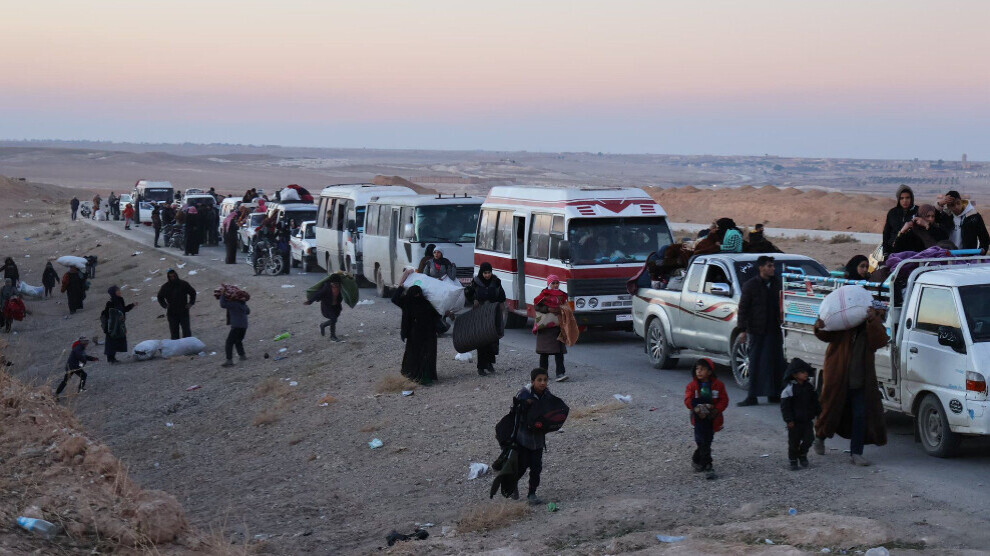
The Democratic Autonomous Administration of North and East Syria (DAANES) decided to evacuate the surrounded population and bring them to safe areas. This decision paved the way for a large wave of migration, but was intended to prevent a massacre of tens of thousands of people.

Undoubtedly, this process will bring much suffering, and tens of thousands of children, women and elderly people will be exposed to the harsh winter temperatures.

The Kurdish relief organization Heyva Sor a Kurd in Rojava continues its efforts to meet the needs of the displaced people, move them to safe places and provide health services.

For these reasons, we urge you to donate to the people of Rojava through Heyva Sor a Kurdistanê."

Details for donations are as follows

"Heyva Sor a Kurdistanê e.V.

Kreissparkasse Köln

IBAN: DE49 3705 0299 0004 0104 81

BIC/SWIFT: COKSDE33XXX

Reference: Rojava

PayPal: heyvasorakurdistan@gmail.com

(Note: Due to an order by the ADD Rheinland-Pfalz, we are currently unable to accept donations from the federal state of Rheinland-Pfalz.)"

Monday, July 25, 2022

PKK: The revolution of Rojava will continue to grow and expand

On the occasion of the 10th anniversary of the Rojava revolution, the PKK said: "We are convinced that the revolution will continue to grow and develop in the coming period."

ANF
NEWS DESK
Tuesday, 19 Jul 2022, 12:49

19 July marks the tenth anniversary of the start of the Rojava revolution. The Rojava Revolution is a globally incisive event, as it represents the first and most radical democratic awakening of the 21st century, combining democratisation with ecology and women's liberation. This is happening on the basis of the philosophy of the Kurdish leader Abdullah Öcalan. The PKK is the expression and core of the Apoist philosophy and therefore has a close ideological connection to Rojava. On the anniversary of the revolution, the PKK has published a message of greeting, stating the following:


"THE REVOLUTION WILL GROW"


"We welcome 19 July as the tenth anniversary of the Freedom Revolution. We congratulate all the people of North and East Syria and their freedom forces for creating this revolution, which has become a beacon of hope for humanity. It has continued for ten years at the sacrifice of thousands of martyrs. We remember with respect and gratitude all the heroic martyrs in the person of comrades Şilan Kobanê and Xebat Dêrik. We firmly believe that the revolution will continue to deepen and expand in the second decade.

"THE PERIOD OF MASTERY AND PROFESSIONALISM HAS BEGUN"

In every revolution, the beginning, the first week, the first month, the first year and the first ten years are important because they are associated with great difficulties. The historical process of the freedom revolution in Rojava was, accordingly. However, all the peoples of northern and eastern Syria, especially the Kurdish, overcame the difficulties and obstacles by believing in each other and standing shoulder to shoulder. They succeeded in bringing the revolution to its present level. Now, the period of inexperience and dilettantism of the freedom revolution has been overcome and the period of mastery and professionalism has begun. We believe that the revolution will grow and develop even further in the coming period.


"THE APOIST PARADIGM WILL BE IMPLEMENTED EVEN MORE EFFECTIVELY"


The freedom revolution in Rojava is the first area where Rêber Apo's [Abdullah Öcalan] theory of democratic modernity was implemented to this extent and depth. It developed successfully on the basis of the educational and organising work that Rêber Apo had carried out in the region between 1979 and 1998. Despite mistakes and shortcomings, the paradigm of a free, ecological and democratic society of women was insisted upon. It is certain that if we learn the lessons of the past decade, the Apoist paradigm will be implemented even more clearly and effectively in the coming period.

In the last ten years, the Freedom Revolution of Rojava has been most successful in implementing the line of the democratic nation. In a region where all kinds of nationalist conflicts turned life into a bloodbath, the peoples of northern and eastern Syria, mainly Kurds and Arabs, but also Syriacs, Armenians, Turkmen and Circassians, have come together on this line and created a free life and a democratic administration together. They have shown and proved to the whole world that it is possible to live a free life in brotherhood without bloodshed and conflict. They did this in an environment of attacks, provocations, incitement and provocations of all kinds. We once again congratulate and commend the people of northern and eastern Syria for this.


"WOMEN'S LIBERATION - REVOLUTION WITHIN REVOLUTION"

It is clear that the freedom revolution in Rojava is, above all, also a freedom revolution of women. In this area, where revolutions take place within revolutions, great changes have been realised in the last ten years that might otherwise have taken a century to create. Women, who in the previous period could hardly participate in life outside the home and family, have become equal and pioneering participants in all areas of social and political life on the basis of a great deal of educational and organising work. The woman who has liberated herself on the basis of consciousness-raising and organising is both the creator and guarantor of a free society and democratic self-government. Despite some revolutionary developments, there is undoubtedly still much to be done and overcome in this area. We are convinced that with planned and organised efforts, these developments can be brought to fruition in the second decade.


"THE AKP-MHP REGIME IS BEHIND THE ATTACKS OF MERCENARY FORCES"

Although the Rojava Freedom Revolution began bloodlessly, it is well known that since its first anniversary it has been subjected to a multi-layered and very intense attack by fascist mercenary forces. Many of these groups, especially the ISIS, the FSA and al-Nusra, the Syrian offshoot of al-Qaeda, attacked the revolution and tried to stifle it. Moreover, the AKP/MHP regime in Turkey has openly and decisively participated in these attacks. This is absolutely certain. The Turkish state even launched its attack on Afrin in January 2018 and occupied the canton directly after the defeat of ISIS in Raqqa in October 2017. Nine years of revolution were therefore put into the defensive war against the fascist mercenary forces and the AKP/MHP regime.

"RESISTANCE OF ROJAVA BECAME THE FREE HUMANITY RESISTANCE"


The peoples of North and East Syria and the freedom forces of the YPG and YPJ have bravely resisted for nine years in defence of the revolution and the country, with more than ten thousand martyrs. This resistance represents the hope of humanity and has extended beyond the borders of northern and eastern Syria to the whole world. It has become a free humanity resistance. Hundreds of young people from all over the world, from Asia to Europe to America, came to North and East Syria and joined the resistance, fought bravely and fell. This situation has further developed and deepened the internationalist character of Rojava. On this occasion, we once again commemorate with respect and gratitude the internationalist martyrs of the defence of the revolution of Rojava and declare that their memory will live on in the worldwide struggle for freedom and democracy.

"OCCUPIED TERRITORIES WILL BE LIBERATED"


The peoples of North and East Syria and their freedom forces have repelled all attacks by mercenaries, especially ISIS, east of the Euphrates and liberated humanity from this scourge. In view of the fact that even regular armies could not withstand ISIS and had to flee, the fact that the freedom forces of Rojava defeated ISIS on a line from Kobanê to Raqqa and ended its territorial rule is of historical significance. This has made the freedom revolution of Rojava a victorious revolution. We believe that the same attitude will be shown against the attacks of the AKP/MHP invaders and the occupied territories will be liberated.

Undoubtedly, the initiatives and efforts such as the building of communalist life, the development of democratic self-governments, the establishment and functioning of democratic confederalism through the revolution are also of historical significance and are exemplary experiences for all. The fact that the whole society, especially women, turned to self-defence training and organising to defend the revolution and the country is truly historic and very inspiring. We are convinced that all this will be successfully implemented in the coming period.


"THE REVOLUTION HAS JUST BEGUN"


Of course, the task is not yet finished and the revolution is not over. On the contrary, everything has just begun. Major difficulties and obstacles may arise again. Attacks and new threats of occupation by various forces, especially the Turkish state, continue. All this requires a multifaceted, creative approach and good preparation in every respect. We believe that the peoples of North and East Syria and their freedom forces will train and prepare themselves in awareness of all this; they will successfully carry out all tasks of construction and repel all kinds of occupation attacks. On this basis, the freedom revolution of Rojava will continue to be a beacon of hope for all oppressed humanity.

Within this framework, we congratulate once again the tenth anniversary of Rojava and wish the people of North and East Syria every success in their efforts to broaden and deepen the revolution. On this basis, we assure that all our people and humanity will stand by them and always provide the necessary support."


Rojava Information Centre publishes new report about the Rojava Revolution

History of the Revolution: Much Achieved, Still Much to be Done, is the title of the new report about the Rojava Revolution published by RIC.


ANF
NEWS DESK
Wednesday, 20 Jul 2022

The Rojava Information Centre (RIC) celebrated the 10th anniversary of the Rojava Revolution by publishing a new report called "History of the Revolution: Much Achieved, Still Much to be Done".

In the introduction of Part One, RIC wrote: "The ‘Rojava Revolution’ began exactly ten years ago, on July 19th 2012, when three predominantly Kurdish-inhabited areas of Syria declared their autonomy from the central government.

Since then, a democratic, autonomous administration has attempted to create a grassroots, gender-equal and ecological society in these areas. Communes and councils, the democratic representatives of the population, organize life and administer society.

The political model has thus established itself in decided opposition to the old Ba’ath regime. Numerous people within society are involved in a wide variety of local and social activities – from the communes and councils to working in the health sector, the women’s movement or in self-defence structures."

The introduction underlined that "Rojava has also been synonymous with the war against the Islamic State (ISIS), the occupation of Turkey, overcrowded refugee camps, water shortages, crop failures and widespread poverty. But against the backdrop of an ongoing war, occupation, an embargo due to the Syrian Civil War, and a precarious humanitarian situation that makes basic staples scarce, Rojava has held its ground for ten years. The areas controlled by the democratic ‘Autonomous Administration of North and East Syria’ (AANES) have grown since 2012 and now include a third of Syrian territory and nearly a fifth of its population.

A decade on, the continued existence of North and East Syria (NES) – the more inclusive name of the region, which encompasses Kurdish-majority Rojava and the Arab-majority areas on the banks of the Euphrates – is an achievement in and of itself. In the eleven years since 2011, the Rojava Revolution has remained committed to its former values and consolidated its achievements, even as all other gains of the so-called ‘Arab Spring’ uprisings were squashed or coopted by national governments. This revolution, however imperfect, thus has something to teach the world about staying power."

Monday, March 28, 2022

Internationalist Berxwedan: The experience of Rojava can be used also in Italy


The Rojava International Conference so the presence of internationalists speaking 27 different languages. Zeryan Berxwedan said that "this conference can be an inspiration not only for Rojava but also for my country, Italy."


MUSTAFA ÇOBAN
QAMISHLO
Sunday, 27 Mar 2022

VIDEO 10:00 MIN 

Internationalist Zeryan Berxwedan said that they are trying to carry the ideology of the revolution in Rojava to their countries and emphasized that ideological solidarity is extremely important to defend the revolution. Stating that the foundation of the Rojava revolution is the philosophy of Kurdish people's leader Abdullah Öcalan, Zeryan Berxwedan said: "As Leader Apo said, we have to analyze our societies and find humane solutions for our society. Therefore, Abdullah Öcalan's thought is that internationalist studies are as important as those in Rojava. It is extremely important for the continuation of our lands."

Zeryan Berxwedan, one of the delegates to the 1st Rojava Internationalist Conference, which saw the participation of all internationalist structures and institutions in Rojava, talked to ANF about the conference.

What did the first Rojava Internationalist Conference mean to you?

The conference was very emotional for me. First of all, because we came together as internationalists to talk about issues that are important here or in our countries. Another impressive thing was that you had friends speaking 27 different languages ​​at the conference. Personally, I have never met so many comrades from different parts of the world in Italy before.

This means that as society and comrades we need a stronger unity in the world to go beyond the system and create something else. The conference was definitely very emotional. It gave energy and strength on an emotional level to continue a work that is not only in Rojava but also in our countries. In contact with other countries in the world, we understand that the fundamental problem is always the same, the system that oppresses and kills various societies in different parts of the world.

What was discussed regarding the role of women in internationalism?

The role of women is extremely important. Because women have been oppressed by this system for 5,000 years. As a result, women experience this system much more severely than men. In internationalism, women can be pioneers both ideologically and practically. The role of women internationalists is very important to convey the values ​​of humanity and equality that we do not usually find in our countries.

What were the key points that emerged at the conference?

It was important that we got together. Because we deepened the internationalist work in Rojava. There are different plans. Here in Rojava there are more ideological formations; trying to connect more internationalists from various structures. But above all, one of the most important points for me is to try to understand how we will transfer the energy and ideology of the Rojava Revolution to our countries and how we will continue this work. Because most of the time, when we return to our countries, we feel lost and cannot understand how to continue this revolutionary work.

Because we change. We change our perspective; we change our personality. When we return to our world, to our societies, we often do not know how to continue revolutionary work. One of the important points of the conference, one of its plans, was how to continue the revolutionary work here and take it to our countries.

What kind of international revolution experience did the Rojava Revolution reveal?

The Rojava Revolution has had a great impact on internationalism and internationalist comrades. Because it is a new hope for a new society and a method of social organization. Not only that, but through the ideology of the Kurdish movement, as internationalists, we can work on ourselves to be better, more humane people, disconnected from the individualism and capitalism of our society.

The values ​​of internationalism are definitely one of the core values ​​of humanity, with the desire to create a better humanity, free from wars and repression. As a result, many internationalist comrades are trying to live together a new form of society, deciding to fight against the system we live in every day and, especially, to provide solidarity with oppressed peoples. The basic values ​​are to remain human, to be able to feel the pain of others, because the pain of oppressed peoples is also our pain. Because even if there is one person, the world is not free, a person cannot live freely but continues to live in a violent state.

We need to create international ideological solidarity

Of course, internationalism in Rojava defends the revolution not only with weapons, but with the most classical form of defense; but at the ideological level, we are trying to carry the ideology of this revolution to our countries and lands. Defense is, of course, physical, but also ideological. In order to defend this revolution, it is extremely important to create ideological solidarity not only in Rojava but also in our countries. Internationalist solidarity is very important in these times. Because, as we see in the world, the system renews itself against society and the peoples.

As you can see, a war broke out between Russia and Ukraine in Europe. Therefore, internationalism is extremely important to bring together the various existing ideologies and different societies around the world. Comrades must work on this, understand how we can create a new society free from wars, free from the state and capitalist powers, killing whole communities and people for economic and political interests, as we have seen better lately.

So where does this revolution come from and can it be applied everywhere?

Of course, the basis of this revolution is Abdullah Öcalan's thought, a revolutionary thought based on humanity and differences. It can be applied anywhere in the world, even in our societies. Of course, it should be applied with many differences. As Leader Apo said, we have to analyze our societies and try to find humane solutions for our society. Therefore, Abdullah Öcalan's thoughts are extremely important for the continuation of internationalist work here in Rojava as well as in our lands.

Could you feel your own international identity at this conference?

As an Italian, I felt that this conference was important. I started to think about how I could transfer the values ​​of this experience to Italy, to my comrades, friends and family. I think Italy is a country that is very open to change. This conference can be an inspiration not only for Rojava but also for my country. I definitely felt that the problems raised by many of the comrades present at the conference were my problems, as we came from similar places and from the same system.

Therefore, we can create something else. I have hope that we can create our own organization inspired by the Kurdish movement in Italy. Abdullah Öcalan's ideas are conveyed in a different geography, a different society, a different history, and we can.

Do you have a message for your country or the world public opinion?

I want to tell people around the world that there can be another society, another method of social organization. Here there is hope for everyone, because it is a humanistic organizational system based on differences, love of life, peace, a human ideology that starts with people and society, and is not based on power and the state. What I want to say is that in order to understand where we can find common ground, it is necessary to try to analyze our struggles, analyze our lives within the system, continue this struggle and continue to hope for a different world free from the violence of the world.

Sunday, February 20, 2022

Swiss MP Prezioso and activist Bucher: The PKK must be removed from list of terrorist organisations

EAG parliamentarian Stefanie Prezioso and activist Flurin Bucher said that the PKK's inclusion on the EU list of terrorist organisations is a wrong and unfair decision, and drew attention to the struggle of the PKK and the Kurdish people against ISIS.


ÖNER POLAT
BERN
Sunday, 20 Feb 2022, 11:24

The petition launched to remove the PKK from the EU list of terrorist organisations continues in Switzerland as well as in the rest of Europe. EAG parliamentarian Stefanie Prezioso and activist Flurin Bucher, who were among the signatories of the campaign, told ANF about the importance of the campaign and why they supported it.

Radical Left Coalition EAG parliamentarian Stefanie Prezioso said that "it is a great mistake and injustice that the PKK is included in this list. The main reason for the PKK's inclusion in this list is the PKK's representation and value. I will continue to demand the removal of the PKK from the list and the freedom of Kurdish people's leader Abdullah Öcalan, against the wrong and unjust decision of these states that cannot reconcile these values and representation with their so-called criteria."

Bucher: Rojava is an example for everyone

Activist Flurin Bucher spoke of his admiration for ecology, women's liberation and direct democracy in Rojava.

He said that he has supported the Kurdish people's struggle since he became aware of its struggle for existence and the revolution in Rojava. Bucher said that there are enough arguments for the PKK to be removed from the list of terrorist organisations and added that international institutions, non-governmental organizations and political parties should also support the petition.

He said that he met the struggle of the Kurdish people in an action held in Switzerland for the Morio Refugee Camp in 2021, and added that he was amazed by the Kurdish people's struggle against the oppression of the Turkish state and the barbarism of ISIS. "The first thing that caught my attention was the Make Rojava Green Again project. In 2021, we organised a panel on the climate movements in Switzerland and the ecology model created in Rojava.

Ever since I learned that this ecology model was created by Kurdish fighters who resisted the massacre committed by ISIS in Shengal in 2014, my interest and admiration for the Kurdish people has increased. With the struggle of the Kurdish people against ISIS, the European states were able to secure their own peace and tranquillity. All these reasons are sufficient to remove the PKK from the terrorist organisations list."


‘Rojava Alliance’ declared in St. Gallen

Activists declared the ‘Rojava Alliance’ during a protest march in St. Gallen, Switzerland against the Turkish attacks on Kurdistan.


ANF
ST. GALLEN
Sunday, 20 Feb 2022, 17:35

A march was staged in the Swiss city of St. Gallen on Saturday under the motto “The war begins here – Solidarity with Kurdistan” in protest at the Turkish attacks against Maxmur, Shengal and Rojava.

Activists declared the ‘Rojava Alliance’, which is made up of several groups from Switzerland, Austria and Germany. The alliance announced that their goal was to establish a cross-border network.

The voice message sent by an internationalist in Rojava was played during the demonstration where a speech in the name of Young Socialists (JUSO) pointed to the alternative model built in Rojava.

Demonstrators denounced the cooperation of European governments and companies with Turkey, recalling the latest waves of deadly attacks carried out by the Turkish state against Shengal and Maxmur in southern Kurdistan (northern Iraq) and Rojava (northern Syria) that directly target civilian settlements in violation of international law.

The alliance noted that three territories in Rojava have been occupied by the Turkish state since 2017, since when atrocities, exploitation and demographic changes have been executed.

Recalling the ISIS attack on al-Sinaa prison in Heseke on 20 January, the alliance said that the Turkish state carried out simultaneous air raids on Maxmur, Shengal and Rojava after this failed attempt. According to the alliance, this was an act of “retaliation” and greatly hampered the fight against ISIS.

The alliance put emphasis on the importance of solidarity with the people and the revolution of Rojava in order to protect the achievements.

The alliance listed their demands as follows:

1- The Turkish army and allies should immediately retreat from Kurdish autonomous regions.

2- Kurdish autonomous regions should be recognized and peace negotiations that include Kurdish representatives should be conducted.

3- Economic and military cooperation with Turkey should be ceased and all kinds of arms exports should be stopped immediately.

4- The criminalization of Kurdish activists in Germany, Switzerland and Austria should be brought to an end.