Report: Trump Seeks Allies Support to Penalize Chinese Shipbuilding
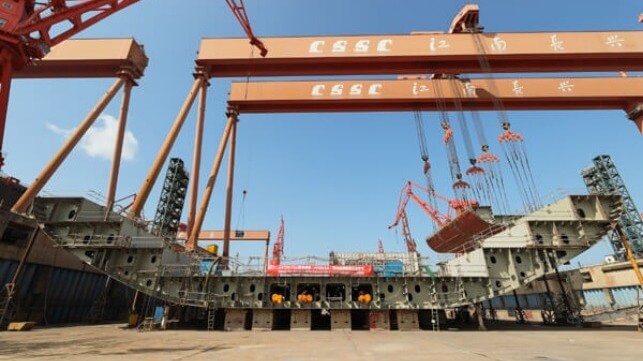
The Trump administration is reported to be building out its plans to penalize China for its subsidy of the shipbuilding industry by seeking international support while also linking it to the rebuilding of U.S. shipbuilding and breaking China’s monopoly on cargo cranes. Reuters and The Wall Street Journal have seen drafts of executive orders proposed to Trump that follow up on the recommendations of the U.S. Trade Representative’s Office and the announced White House office on shipbuilding.
Speaking to the U.S. Congress on Tuesday night, Trump said, “We used to make so many ships. We don’t make them anymore, very much. But we’re going to make them very fast, very soon.”
The Trade Representative in the last days of the Biden administration concluded an investigation into China’s shipbuilding policies. The report called for steps to reign in China’s unfair advantages in shipbuilding which it concluded were built through government subsidies and policies. Unconfirmed reports recently said the Trump administration had taken the Biden report and was looking at fees on shipping lines using Chinese-built ships and calling at U.S. ports.
In an exclusive report from Reuters, it said it has seen a draft of the executive order proposing fees on all ships entering U.S. ports from carriers that have Chinese-built ships in their fleets. The fees would be regardless of where the individual ship was built or registered.
"The national security and economic prosperity of the United States is further endangered by the People's Republic of China's unfair trade practices in the maritime, logistics, and shipbuilding sectors," the draft order says according to Reuters.
It highlights that the draft changes from the previous reports in that it widens the potential number of ships subject to the fees. It does not say how the fees would be calculated but drops previsions that limited the fees to fleets with 25 percent or more of the ships on order or for delivery from China.
The draft order according to Reuters also calls on the U.S. to “engage allies and partners” to enact similar fees. According to Reuters if they did not support the U.S. they could “risk retaliation,” which is emerging as one of the Trump administration's bargaining tactics. Retaliation has become a key piece of the emerging trade war and tariffs and Trump’s report that on April 2 the U.S. will enact reciprocal tariffs on any nation that imposes tariffs on U.S. goods.
The report highlights that the sweeping fees would reach beyond the major Chinese carriers including COSCO and its subsidiary Orient Overseas Container Lines (OOCL). By including all fleets with Chinese-built ships, it would impact all the major carriers including MSC Mediterranean Shipping, Maersk, CMA CGM, and others.
The draft also links to the separate issue that emerged over Chinese cargo-handling equipment according to Reuters. During the Biden administration, the dominance of China’s ZPMC (Shanghai Zhenhua Heavy Industries Company) was highlighted and accusations emerged that China controlled the cranes or was using them to spy on the United States. Biden moves to place tariffs on the large cranes used by ports to load and unload containers and to reshore a U.S. capability to build large cargo cranes.
Additional tariffs would be imposed on Chinese-made cargo equipment according to Reuters’ review of the draft executive order.
The draft on the response to Chinese shipbuilding subsidies comes after The Wall Street Journal reported the White House was also working on a sweeping executive order for the shipbuilding industry. It reportedly will order Elon Musk’s Department of Government Efficiency to review procurement as it relates to shipbuilding and proposes raising wages for shipyard workers involved with nuclear shipbuilding.
Trump during his meeting at the White House on Thursday with Chairman and CEO of CMA CGM Group Rodolphe Saadé alluded to major steps coming soon in the shipbuilding and shipping industries.
CMA CGM Group Plans $20 Billion Investment in U.S. Maritime and Logistics
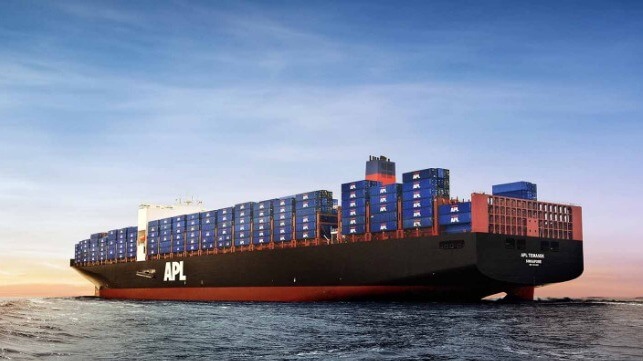
CMA CGM Group announced plans for a significant $20 billion investment into the U.S. maritime and logistics sectors expanding on its previous plans to expand its U.S. port terminals and logistics operations. The announcement came as Chairman and CEO of CMA CGM Group Rodolphe Saadé met with President Donald Trump and alluded to U.S. shipbuilding plans.
The French group currently owns seven terminals in the U.S. including in the Port of New York New Jersey and Los Angeles. It also owns APL, the former American President Lines, acquired in the 2016 acquisition of Neptune Orient Lines.
“Over the next four years, we will significantly grow our U.S.-flagged fleet, expand the capacity of key container ports on both coasts, develop state-of-the-art warehousing across the country, and establish a significant air cargo hub in Chicago,” said Saadé. “I am proud to build on our long-standing relationship with the United States through this commitment of $20 billion to the country’s maritime future and logistics capabilities.”
CMA CGM Group said its investments over the next four years would contribute to the development of American maritime capabilities and advance the U.S. administration’s recently announced priority to strengthen American shipbuilding capabilities. CMA CGM highlights it has been servicing U.S. markets for 35 years and reports it handles about 5 million TEU annually in the U.S. out of the 23 million TEU carried globally in 2024.
One element they highlighted would include “bolstering APL’s U.S. flag capacity.” Saadé told Trump the company would like to triple the size of its U.S.-flagged fleet to 30 ships. It was unclear however if these vessels would be used for APL or within the CMA CGM fleet. In 2020, CMA CGM transitioned APL’s express services into the CMA CGM branded operations refocusing APL to a niche operation servicing the United States Government, providing its U.S. flag service, and continuing its service to the Guam-Pacific trade.
The company did not detail the proportions of the other investments but reported it would include its terminal and logistics operations and its expanding air cargo business.
The group said it will develop port infrastructure in key locations across the U.S., including New York, Los Angeles, Dutch Harbor, Houston, and Miami to contribute to efficient operations and supply chains. It said the new investments would accelerate digitization, improve connectivity, and increase safety for port workers and cargo.
CMA CGM in 2023 reported plans to invest $600 million after it completed the acquisition of terminals in Bayonne, New Jersey, and Staten Island, New York from Global Container Terminals. At the beginning of 2022, CMA CGM also completed the acquisition of Fenix Marine Services (FMS), which operates a terminal at the Port of Los Angeles. It is reported to be the third largest terminal in the Los Angeles/Long Beach port complex.
The other planned investments will include improving U.S. logistics and supply chain infrastructure with new warehousing and automotive logistics platforms. As part of this investment, CMA CGM Group will also expand its American air cargo capacity including a new hub in Chicago and deploying five new Boeing 777 freighters. CMA CGM will open a new logistics R&D hub in Boston, focusing on advanced robotics and automation solutions.
The planned U.S. investments are part of a larger overall growth plan for CMA CGM Group. The carrier currently owns over 300 vessels and operates in total more than 650 with reports that it has an additional 94 on order in China and South Korea. The U.S. shipbuilding plan might help to earn some relief from the Trump administration which is reported to be planning fees on carriers calling in the U.S. that build or operate Chinese-built ships. Earlier this week, the carrier was linked to a $2.6 billion order placed with China State Shipbuilding Corporation (CSSC) for a dozen new containerships. The group said in 2023 that it had ordered more than 70 containerships to be built in China.

No comments:
Post a Comment