Polish supply chain gears up for country's first nuclear project
The Polish government expects a significant share of work on the country's first nuclear power plant to be awarded to local companies, but there are steps needing to be taken by the Polish supply chain, the World Nuclear Supply Chain conference in Warsaw heard.
_52327.jpg)
In November 2022, the then Polish government selected Westinghouse AP1000 reactor technology for construction at the Lubiatowo-Kopalino site in the Choczewo municipality in Pomerania in northern Poland. An agreement setting a plan for the delivery of the plant was signed in May last year by Westinghouse, Bechtel and Polskie Elektrownie Jądrowe (PEJ) - a special-purpose vehicle 100% owned by Poland's State Treasury. The Ministry of Climate and Environment in July issued a decision-in-principle for PEJ to construct the three-unit plant. The aim is for Poland's first AP1000 reactor to enter commercial operation in 2033. The total investment costs of the project are estimated to be about PLN192 billion (USD49 billion).
The government expects Polish companies to supply at least 40% of the components and services for the country's first nuclear power plant.
"We are starting our adventure [in nuclear power]," Andrzej Sidlo, counsellor at the Polish Ministry of Industry told the event, organised by World Nuclear Association. "However, we are not starting from scratch ... we don't yet have nuclear in our energy mix, however we have a lot of experienced nuclear companies because of export projects and because of international cooperation."
Monika Silva, Deputy General Director of IGEOS Nuclear - part of the Chamber of Commerce for Energy and Environmental Protection - told those attending that, overall, Polish companies have already supplied components and services to 44 nuclear power plant projects, two nuclear laboratories and two nuclear facilities in 26 countries around the world.
In March, international law firm Baker McKenzie - which acted as legal counsel to Korea Electric Power Cooperation in relation to all aspects of the development, financing and refinancing of the UAE's Barakah project - published a report assessing the current state of readiness of the Polish nuclear sector in respect of the construction of the country's first nuclear power plant. The report also describes the further actions needed to bring Poland closer to completing the project.
The report, using the Nuclear Energy Readiness Index, found that Poland was about 58% ready to start construction of the Choczewo plant, scoring the highest scores for the political (9/10), regulatory and social (8/10) aspects of the undertaking. The lowest score was in the technology field (3/10). Investment and systemic issues, which consist of finance, human resources, accompanying investments and preparation of public administration, received 4 points each.
"It's very surprising that we have a very high score on the Polish political readiness because we are a pretty divided country when it comes to politics," said Agnieszka Skorupinska, Partner, Head of Sustainability and Energy Transition at Baker McKenzie. "But here we all agree we need to have nuclear, so this is a very important development and very important conclusion."
However, the Baker McKenzie report found that the preparedness of the country's supply chain was low, with local companies particularly needing guidance on norms and standards.
"We did rate it rather low, but not in the sense of companies being not fit or not prepared, but simply where the first nuclear project is ... the problem they have is that they really don't know 100% what is expected from them," Silva said. "I think when the information is clear - we need you to do this and that and this will be our requirements for that product - then it will be much easier for the Polish companies to show their real potential."
She said that the Polish industry was quite divided into two distinct groups - one that is "already involved, very developed, very skilled, having all of the levels of the requirement fulfilled". The second group are those that for many years did not believe that the Polish nuclear power plant project would materialise, so now need to take steps to prepare for it.
According to a survey released earlier this year by the Polish Economic Institute, more than 70% of Polish companies said they have experience in the energy sector that can be used in a nuclear project. One-third of companies declare experience from other projects in the nuclear sector abroad. The survey questioned more than 100 Polish companies, including more than 30% of the sample from the Pomeranian Voivodeship, where the project of the first Polish nuclear power plant is being implemented. The study included companies from the construction sector (30%), engineering and construction (28%) and machinery (22%).
Most of the surveyed companies have experience in large infrastructure projects, of which almost half (45%) have worked on the construction of gas or coal-fired power plants, and almost one-third (29%) have experience in nuclear energy. The study also showed that as many as three-quarters of Polish companies have experience in implementing at least one project in the energy sector.
The factors most frequently mentioned among those attracting domestic entrepreneurs to the Polish nuclear project included the opportunity to enter the nuclear energy sector, the possibility of developing and increasing the scale of operations, increasing employee competences and obtaining valuable references, as well as the ambitious and demanding nature of the project.
The companies surveyed were also aware of possible difficulties in joining the project. They mainly indicate a lack of financial support, a competence gap, too high investment requirements and difficulty in recruiting suitably qualified employees.
Estonia starts planning process for SMR plant
The Government of Estonia has announced the start of the spatial planning process and Strategic Environmental Impact Assessment for Fermi Energia's proposed 600 MWe nuclear power plant.
_79657.jpg)
The company submitted its application to the country's Ministry of Economic Affairs and Communications to begin the state planning process for a plant based on GE Vernova Hitachi's BWRX-300 small modular reactor technology in January.
"The Estonian government's approval to begin planning for a 600MW nuclear power plant, following Fermi Energia's proposal using GE Hitachi's BWRX-300 small modular reactor technology, represents a significant step forward in Estonia's nuclear energy development," said Fermi Energia's CEO Kalev Kallemets.
"While planning and environmental impact assessments have historically been contentious issues in Estonia, Fermi Energia's extensive community outreach and the trust established with local municipalities - whose councils have already voted to support nuclear plant siting - provides reason for confidence that the planning process will proceed successfully," added Kallemets.
The planning area includes the rural municipalities of Viru-Nigula, Haljala, Rakvere and Vinni and the Rakvere city rural municipality in Lääne-Viru county; the Lüganuse and Toila rural municipalities and Kohtla-Järve city in Ida-Viru county; and the sea area from Kunda Bay to Narva Bay, covering some 1,285 square kilometres in total. This is significantly larger than the actual area where the nuclear power plant and the necessary facilities will be built, but ensures that the best location for the nuclear power plant can be thoroughly considered and assessed, the government said.
Minister of Economic Affairs and Industry Erkki Keldo said the preparation of the plan "does not mean that construction of a nuclear power plant will begin immediately" but is part of the necessary preparations "so that if an investor wishes to invest in the construction of a nuclear power plant and it is decided to build it, the state would already have a thoroughly considered and evaluated plan for this".
"If a decision is made to build a nuclear power plant, its construction will also create new high-paying jobs in the region, which in turn will support the consumption of local services and thereby the development of the local economic environment," Keldo added.
The planning process will involve the residents of the planning area, local governments, relevant authorities, and all other interested parties, the government said.
Several possible locations will be considered in the preliminary part of the spatial planning process, to identify the best location for the nuclear power plant and the infrastructure needed for its operation within the planning area. The designated spatial plan itself will only cover areas where the nuclear plant and its facilities are planned, and will provide "comprehensive and detailed spatial layout of the proposed nuclear power plant and its infrastructure in the best possible location, develop the necessary construction conditions, and resolve other issues related to the construction of a nuclear power plant", the government said. An overhead 330 kV power line, an extension of the existing 330 kV substation, and other electricity transmission facilities are expected to be planned alongside the nuclear power plant. Both Fermi Energia and the national nuclear energy working group have previously analysed the potentially suitable areas.
The first part of the phased planning process - site pre-selection - will take place between 2025 and 2027, focusing on promising areas near the village of Kunda in Viru-Nigula and the village of Aa in Lüganuse. Each location's strategic access to existing infrastructure, will be evaluated, alongside Environmental Impact Assessments, to identify the most viable and sustainable options for development. Fermi Energia said it will use the capital from an already-closed EUR2.3 million (USD2.6 million) funding round with participation from both existing and new investors to finance this phase, specifically the site pre-selection studies.
In 2027, the process will advance to detailed site confirmation, with in-depth studies - covering geology, hydrology, environmental monitoring, and grid connectivity - to ensure the selected site meets the stringent safety and performance standards required for deploying the BWRX-300 reactor.
Fermi Energia said the submission of the construction permit application is planned for 2029. According to Fermi Energia's application to the government, the first of the two planned BWRX-300 reactors could start operation in 2035 if all the processes go ahead smoothly.
Samsung C&T is being considered as a prospective engineering, procurement, and construction contractor for the project following the signature of a teaming agreement between Fermi Energia and the South Korean company in April.
Orano begins production of LEU+ transport cylinders
Orano has begun serial production of ten 30B-10 cylinders designed for the transport of LEU+ - uranium hexafluoride enriched up to 10% uranium-235.
_71059.jpg)
The company made the announcement at the World Nuclear Supply Chain conference taking place in Warsaw, Poland.
The Type 30B cylinders that are currently used to transport enriched uranium hexafluoride (UF6) between fuel cycle facilities around the world are only certified for uranium enriched up to 5% in the fissile uranium-235 isotope, known as low-enriched uranium, or LEU. This is the maximum enrichment level used in commercially operating nuclear power plants today. But nuclear fuels with higher enrichment levels which can enable commercial light water reactors to operate for longer, and more efficiently are being developed. Known as LEU+, such material contains enrichments of 5-10% uranium-235 - outside the certification of regular Type 30B cylinders.
New fuel designs - as well as the evolution of the small modular reactor market, which will require enrichments of up to 20% - mean new solutions will be required for the transport of uranium enriched to up to 20% - and these solutions are not currently available on the market, Orano said.
Supply chain issues relating to the transport solutions for high-assay low-enriched uranium (HALEU) have already been felt - in February 2024 US enrichment company Centrus said delays in the availability of suitable cylinders for the HALEU output from its plant in Ohio would affect its ability to deliver 900 kilograms of HALEU UF6 under a contract with the US Department of Energy.
For transportation, type 30B cylinders are used in conjunction with a protective structural packaging, or overpack, which offers protection against mechanical and thermal impacts due to possible accidents during transportation.
Orano's 30B-10 cylinder - which the company has also previously referred to as the 30B-X - equips the innovative DN30-X package which was licensed in March 2023 by the US Nuclear Regulatory Commission. The DN30-X package combines the properties of the existing DN30 overpack with the new 30B-10 cylinder, which contains a criticality control system using borated steel rods to prevent criticality and enable higher enrichments of UF6 to be transported safely.
Czech-EU agreement 'to act quickly' to clarify nuclear tender issues
The Czech Republic's Minister of Industry and Trade Lukáš Vlček held talks with French Energy Minister Marc Ferracci and European Commissioner Stéphane Séjourné about the new nuclear planned at Dukovany, and losing bidder EDF's objections to the tender process.
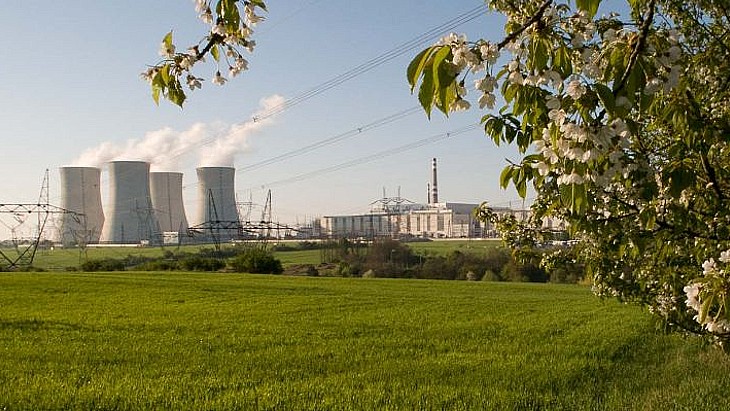
The Czech Republic is planning new nuclear capacity and in July last year announced Korea Hydro & Nuclear Power (KHNP) was the preferred bidder, ahead of France's EDF. EDF brought a case to the Czech competition authority challenging the tender process, which was dismissed last month. That cleared the way for the planned signing of the official contracts with KHNP on 7 May. However EDF succeeded in securing a last-minute court injunction in a Czech regional court on 6 May to stop the contract being signed until its case relating to the tender process has been heard in court.
On Monday the project development company Elektrárna Dukovany II appealed to the Czech Supreme Administrative Court to get the injunction lifted, with KHNP also filing an appeal on Tuesday. A court spokeswoman said on Wednesday: "At this moment, basic procedural steps are being carried out. The case file will be requested without delay and the cassation appeals will be sent to the parties to the dispute for their comments. The judges are already familiarising themselves with the case. The case is prioritised in the relevant chamber and, given its nature and importance, will be heard as a priority."
In addition to the court cases, it also emerged last week that Séjourné, European Commissioner for Industrial Strategy, had written on 2 May to ask for the contract signature to be postponed because the European Commission had already started a preliminary review "to assess whether potential foreign financial contributions received by the Party (KHNP) constitute foreign subsidies and, if so, whether those foreign subsidies distort the internal market with respect to the project". The Czech Ministry of Industry and Trade dismissed the request, calling it a "courtesy letter" that was not legally binding.
On Tuesday Vlček held virtual talks with Ferracci, saying afterwards: "During today's meeting with French Energy Minister Ferracci, we discussed the progress of the unsuccessful bidder EDF, where I expressed my concerns about the violation of the national interests of the Czech Republic. At the same time, I emphasised that energy security should come first, and that the implementation of the largest project in the history of the Czech Republic is in the interest of the entire European Union."
He added: "The tender was completely transparent, it was carried out according to rules based on the methodology of the International Atomic Energy Agency and agreed to by all bidders, and the offers were evaluated by hundreds of experts."
After his second meeting, with Séjourné, Vlček said: "Our discussions were constructive. We agreed that we must act quickly and that political discussions will always be preceded by expert discussions. The Ministry of Industry and Trade will continue to provide the European Commission with maximum cooperation so that the project continues and all issues are clarified."
He said there was an agreement to start consultations under the leadership of the Director General of the European Commission's Directorate-General for Internal Market, Industry, Entrepreneurship and SMEs, involving his ministry and the Czech competition office with the aim being to "clarify all legal and technical issues related to the EPC contract".
At the time of the selection of KHNP in July 2024, Prime Minister Petr Fiala said the aim was to reach the signing of contracts for the initial unit by the end of March 2025, with the target for test operation of the first new unit being 2036 and commercial operation in 2038. He said the winning tender "based on the evaluation of experts, offered better conditions in most of the evaluated criteria, including the price". The KHNP bid was for a cost of around CZK200 billion (USD8.6 billion) per unit, if two units were contracted.
It was announced at the end of April that the Czech state - which already owns 70% of CEZ - was going to purchase 80% of shares in the Elektrárna Dukovany II project, with CEZ retaining a 20% stake. The 80% stake was valued at CZK3.6 billion (USD163 million).
The Czech Republic currently gets about one-third of its electricity from the four VVER-440 units at Dukovany, which began operating between 1985 and 1987, and the two VVER-1000 units in operation at Temelín, which came into operation in 2000 and 2002.
First RITM-400 reactor unit manufactured for new generation icebreaker
The manufacture of the first RITM-400 reactor unit has been completed for the Rossiya, which is scheduled to feature two of the reactors and become the world's most powerful nuclear-powered icebreaker.
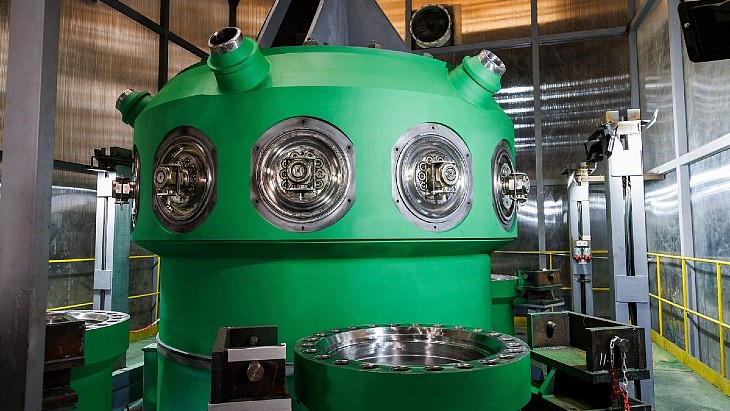
The Rossiya, which will be the first of the proposed Project 10510 nuclear-powered icebreakers, will feature two RITM-400 pressurised water reactors. It will be able to penetrate ice up to 4.3 metres thick and clear a channel up to 50 metres wide. The vessel is being built at a shipyard near Vladivostok in eastern Russia. The most recent reported construction target service date is 2030.
The RITM-400 is a development of the RITM-200 reactor design which already has variants for icebreakers, floating power plants and for use on land. As a scaled-up model, RITM-400 produces 315 MWt, with a propeller power of 120 MW, compared with RITM-200's 165 MWt, but uses the same technologies.
The RITM-400 reactor unit was manufactured at ZiO-Podolsk, Rosatom's machine-building division, with the completion coinciding with the Russian state corporation's events to mark the 80th anniversary of the nuclear industry.
Igor Kotov, head of Rosatom's machine building division, said the second reactor would be completed "in a couple of months" and "both units will be sent to the shipyard for installation on the Rossiya ... the completion of this project opens up new opportunities in developing the Northern Sea Route".
Alexey Likhachev, Director General of Rosatom said: "The completion of the RITM-400 reactor is a significant event for the icebreaker fleet, for Rosatom and for our entire country. The reactor units of the next-generation Rossiya nuclear icebreaker will allow it to break over 4 metres of thick ice."
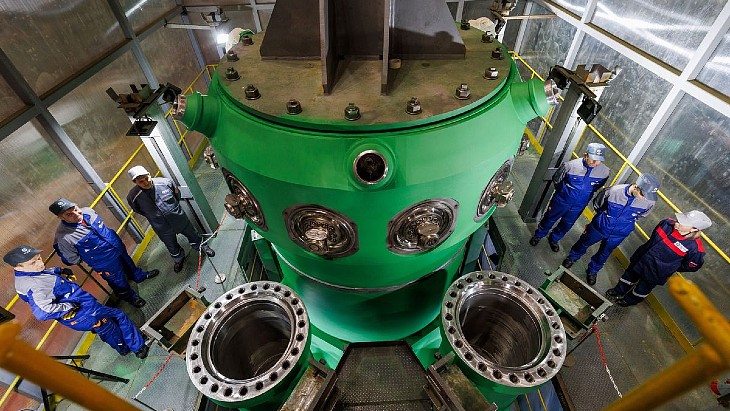
(Image: Rosatom)
Russia currently has eight operating nuclear-powered icebreakers: the 50 Let Pobedy, Vaigach, Yamal, Taimyr, and the Project 22220 vessels the Arktika, Siberia, Ural and Yakutia. There are also three more Project 22220 vessels in various stages of construction - the Chukotka, Leningrad and Stalingrad. Ten RITM-200 reactors have been manufactured for the Project 22220 vessels with a further 10 currently being manufactured for use in icebreakers or small modular reactor plants on land and sea.
The nuclear-powered icebreakers are a key part of Russia's plan to develop the Northern Sea Route, the shipping lane along its north coast, which can cut the distance and speed for shipping goods by sea from northern Europe to Asia. The 5600-kilometre route runs from St Petersburg and Kaliningrad to Vladivostock. Russia says the distance from Murmansk to Japanese ports is halved by using the Northern Sea Route rather than the Suez Canal, with the duration cut from about 37 to 18 days. Global warming has made large-scale navigation along the route more feasible, and it is being facilitated by the construction programme of nuclear-powered icebreakers.
Rosatom reported that in 2024 nearly 37.8 million tonnes of cargo traffic used the Northern Sea Route, 1.6 million tonnes above the previous high. There was also a record number of transit voyages - 92 - which helped set a record of 3 million tonnes of transit cargo. The nuclear icebreaker fleet provided 976 icebreaker escorts.
TVA submits first US BWRX-300 construction application
The Tennessee Valley Authority has submitted an application to the US Nuclear Regulatory Commission for a permit to build a GE Vernova Hitachi Nuclear Energy BWRX-300 small modular reactor at Clinch River.
_15992.jpg)
This makes the Tennessee Valley Authority (TVA) the first utility in the USA to submit a construction permit application for the BWRX-300 technology, and was described by TVA President and CEO Don Moul as "a significant milestone" for TVA, as well as for the region and the USA, accelerating the development of new nuclear technology, its supply chain and delivery model. "TVA has put in the work to advance the design and develop the first application for the BWRX-300 technology, creating a path for other utilities who choose to build the same technology," he said, adding that TVA "looks forward to working with the Administration to accelerate advanced nuclear technologies … we believe deploying new nuclear is essential to providing American families and businesses affordable and abundant electricity for decades to come".
TVA has invested in the standard design of the BWRX-300 as part of a technical collaboration agreement with Ontario Power Generation, Polish company Synthos Green Energy and GE Vernova Hitachi Nuclear Energy (GVH, formerly GE Hitachi Nuclear Energy, GEH). It is also also leading a coalition of utility companies and supply chain partners that has applied for a grant of USD800 million from the US Department of Energy to accelerate construction of the USA's first small modular reactor, and a USD8 million grant to support the cost of the licence review.
Small modular reactors - SMRs - are reactors with a smaller and more modular design than the USA's currently operating commercial nuclear fleet. As well as offering safety enhancements, their smaller footprint and modular design means they can potentially be built more quickly, are easier to operate and better fit into the landscape due to their compact size, TVA said.
TVA already holds an early site permit for SMRs at the Clinch River site, certifying that the site near Oak Ridge, Tennessee, is suitable for the construction of a nuclear power plant from the point of view of site safety, environmental impact and emergency planning. It has also completed and submitted an Environmental Report for the project to the Nuclear Regulatory Commission, and says site preparation for the SMR could begin as soon as 2026.
"TVA’s investment in the standard design of the BWRX-300 technology will accelerate its deployment, helping meet the rising demand for energy and enhancing energy security," GVH President and CEO Craig Ranson said. "This milestone, in addition to this month's decision by the Province of Ontario to build the western world's first SMR, demonstrates that this technology is advanced and real."
The BWRX-300 design is a 300 MWe water-cooled, natural circulation SMR with passive safety systems that leverages the design and licensing basis of the ESBWR boiling water reactor developed by GEH. Earlier this month, the Canadian province of Ontario approved OPG to start construction of the first of four BWRX-300 units planned at the Darlington New Nuclear Project site.
Indian regulator approves new nuclear site
India's nuclear regulator has given its consent to the siting of the four-unit Mahi Banswara Rajasthan Atomic Power Project in Rajasthan.
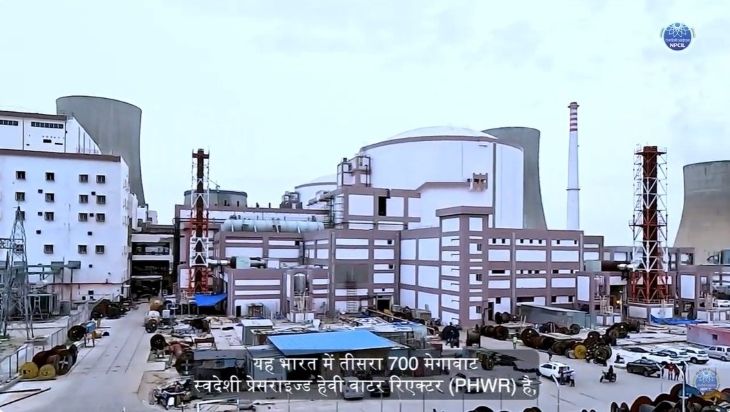
The Atomic Energy Regulatory Board (AERB) consent is for the siting of four Indian-designed 700 MWe pressurised heavy water reactors (PHWRs) at the site, near the village of Napla, in the Banswara district. The AERB's consent is valid for five years.
The AERB describes siting consent as the first major stage in its licensing of nuclear facilities, followed by construction, commissioning, operation and decommissioning. Consent for siting involves ensuring of the suitability of the site for the proposed facility, including from an engineering point of view, and includes reviews of the site itself, how the facility and the site will interact with each other, and the site's suitability for the implementation of emergency actions. The review process includes a range of studies depending what is applicable to that particular site and project, such as geotechnical, hydrogeological, radioactive impact assessment, baseline natural background, soil studies, and mapping of surrounding areas.
According to the siting consent issued by AERB, the Mahi Banswara site has undergone the reviews required under its regulations. It has consented to the siting of the four units - also known as MBRAPP - subject to satisfactory compliance with conditions including obtaining environmental clearance from the "relevant competent authority".
The four Mahi Banswara units are among ten units that the Indian government has sanctioned to be built under a "fleet" approach: the others are Kaiga units 5 and 6 (in Karnataka), Gorakhpur units 3 and 4 (Haryana), and Chutka units 1 and 2 (Madhyar Pradesh). Two 700 MWe PHWR units at Kakrapar, in Gujurat, are already in commercial operation. Another, Rajasthan unit 7, was connected to the grid in March, and construction is ongoing on Rajasthan unit 8.
The Mahi Banswara units are to be developed under Anushakti Vidhyut Nigam Ltd (Ashvini), a joint venture between Nuclear Power Corporation of India Ltd (NPCIL) and National Thermal Power Corporation (NTPC). Formation of the 51% NPCIL:49% NTPC joint venture set up to construct, own and operate nuclear power plants in India received approval from the government last year.
Under current Indian legislation, only two companies - NPCIL and Bharatiya Nabhikiya Vidyut Nigam Limited (Bhavini, set up to build and operate fast reactors) - are legally allowed to own and operate nuclear power plants in India, but a 2016 amendment to the 1962 Atomic Energy Act allows public sector joint ventures. In January, NPCIL signed an agreement to enable the transfer of the MPRAPP project from NPCIL to the Ashvini joint venture.
Article researched and written by WNN's Claire Maden
Reactor closure marks Taiwan's nuclear exit
Unit 2 of the Maanshan nuclear power plant - Taiwan's last operating reactor - has been disconnected from the grid and will be decommissioned following the expiry of its 40-year operating licence, in accordance with Taiwan's nuclear phase-out policy.
_48620.jpg)
The output of the 938 MWe pressurised water reactor (PWR) was gradually reduced from 13:00 (local time) on Saturday 17 May and was disconnected from the grid at about 22:00, according to the Ministry of Economic Affairs. The reactor was declared in a safe shutdown state about two hours later.
Construction of Maanshan 2 began in February 1979. The unit attained first criticality on 1 February 1985 and was connected to the grid later that month, entering commercial operation three months later.
In July 2021, state-run Taiwan Power Company (Taipower) submitted an application to the Atomic Energy Council to shut down the two-unit Maanshan plant. According to existing legislation, the utility must file an application to decommission the units at least three years prior to energy production stopping.
Unit 1 of the Maanshan plant - a 936 MWe PWR - shut down on 27 July last year on the expiry of its operating licence.
Phase-out policy
Taiwan's Democratic Progressive Party (DPP) was elected to government in January 2016 with a policy of creating a "nuclear-free" Taiwan by 2025. Under this policy, Taiwan's six operable power reactors would be decommissioned as their 40-year operating licences expire. Shortly after taking office, the DPP government passed an amendment to the Electricity Act, passing its phase-out policy into law. The government aims for an energy mix of 20% from renewable sources, 50% from liquefied natural gas and 30% from coal.
However, in a referendum held in November 2018, voters chose to abolish that amendment. The Ministry of Economic Affairs said the amendment was officially removed from the Electricity Industry Act on 2 December.
Nevertheless, then Minister of Economic Affairs Shen Jong-chin said in January 2019 "there would be no extension or restarts of nuclear power plants in Taiwan due to subjective and objective conditions, as well as strong public objection".
Unit 1 of Taiwan's oldest plant, Chinshan, was taken offline in December 2018, followed by Chinshan 2 in July 2019.
The 40-year operating licence for Kuosheng 1 was due to expire on 27 December 2021, when it was due to be shut down. However, in May of that year, Taipower announced it would only be able to operate the reactor until June owing to a lack of storage in the unit's used fuel pool. Unit 2 of the Kuosheng plant was shut down in March 2023.
The construction of two units at Lungmen began in 1999, but the project has been beset with political, legal and regulatory delays. The completed unit 1 was mothballed in July 2015, while construction of unit 2 was suspended in April 2014.
As Taiwan's last operating reactor, Maanshan 2 had been providing about 3% of its electricity.
"This year, four large gas-fired units with a capacity of nearly 5 million kilowatts, including Datan, Hsingda and Taichung power plants, and about 3.5 million kilowatts of wind and photovoltaic power will join the power supply ranks, ensuring that the people have no worries about electricity," the Ministry of Economic Affairs said.
Article researched and written by WNN's Warwick Pipe

No comments:
Post a Comment