New York Wind Project Revived With Natgas Quid Pro Quo
- A wind project in New York mothballed by the Trump administration is getting a new lease on life through a compromise.
- On his first day in office, Trump issued an executive order pausing new leasing and permitting of wind projects.
- The compromise includes the revival of an abandoned natural gas pipeline from Pennsylvania to New York.
A wind project in New York mothballed by the Trump administration is getting a new lease on life through a compromise that would also see an abandoned natural gas pipeline from Pennsylvania to New York revived.
Norway’s Equinor was three months into Empire Wind, a $5 billion offshore wind farm, when Trump came to power and set about dismantling the Biden administration’s wind power program.
On his first day in office, the second-term president issued an executive order pausing new leasing and permitting of wind projects, which he said are ugly, expensive and harmful to wildlife.
But Equinor, which recently shifted its focus to oil and gas from renewables, told Reuters that construction can resume on Empire Wind, which is expected to bring power to half a million homes after 2027, following the lifting of a one-month stop-work order.
The move comes amid industry challenges.
“The offshore wind industry is challenged in the short term with headwinds relating to supply chain, regulatory, and macroeconomic developments,” Orsted, the world’s biggest offshore wind project developer, said in its first-quarter press release on May 7.
Due to higher costs and interest rates, the Danish company announced it had decided to discontinue the development of the Hornsea 4 offshore wind project in the UK, ahead of the planned final investment decision (FID) later this year.
Earlier this month, Equinor said it is considering its legal options after the Trump administration ordered its Empire offshore wind project off New York halted. That of course will no longer be necessary.
Equinor is Norway’s largest oil and gas company, outputting about 70 percent of its total production, or 2 million barrels of oil equivalent per day. In February Equinor said it is reducing its renewable energy targets for 2030, citing challenges in the renewable energy sector.
Instead, the company is increasing its focus on oil and gas production, aiming to grow output by 10 percent from 2024 to 2027.
Norway’s energy market is experiencing turmoil due to increased energy exports to Germany and related political instability.
It appears Equinor’s Empire Wind project was only allowed to continue in exchange for the reinstatement of a stalled natural gas pipeline called Constitution. The Pennsylvania to New York line was canceled in 2020 after years of regulatory and legal battles over the environment, for one.
“Americans who live in New York and New England would see significant economic benefits and lower utility costs from increased access to reliable, affordable, clean American natural gas,” US Interior Secretary Doug Burgum wrote in a post on X on Monday.
Department officials reportedly said the former Biden administration had rushed the project's approval without sufficient environmental analysis.
Norwegian Finance Minister Jens Stoltenberg said the reversal was good news for investors in the U.S. as the stop-work order threatened to create uncertainty after permits had been granted by U.S. authorities.
Equinor had warned it stood to lose billions of dollars due to the order which sent shockwaves through the offshore wind industry, raising concerns that fully permitted developments representing billions in investment are not safe.
In May, 17 states and Washington D.C. filed a lawsuit against the Trump administration over the halting of permits for wind-energy projects. The lawsuit said that the government’s decision presents a threat to the burgeoning industry. “This administration is devastating one of our nation’s fastest-growing sources of clean, reliable and affordable energy,” said Attorney General Letitia James of New York, which is one of the plaintiffs. James said the move threatened “the loss of thousands of good-paying jobs and billions in investments” and was “delaying our transition away from the fossil fuels that harm our health and our planet.”
The United States currently has four operating offshore wind farms and four under construction, including Empire Wind.
By Andrew Topf for Oilprice.com
Lighting up a Unique Wind Farm Converter Platform in the North Sea
[By: Glamox]
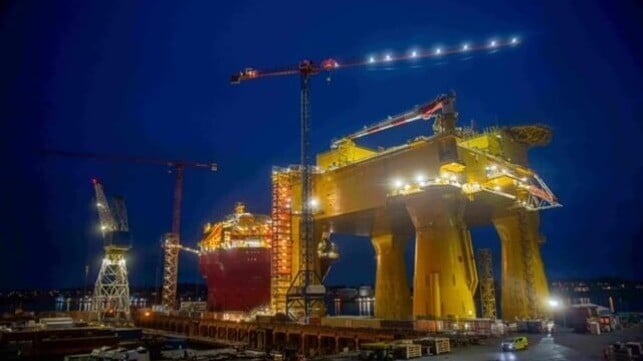
European grid operator TenneT is in the process of installing an offshore grid connection system in the North Sea, which will deliver electricity from three wind farms some 100 km off the German coast. The innovative DolWin 5 project eliminates the need for a wind farm substation, as the electricity generated will be transmitted directly as three-phase AC current to the giant DolWin epsilon converter platform.
A consortium consisting of Seatrium and Aibel is building and preparing DolWin epsilon, a High Voltage Direct Current (HVDC) offshore platform. Once operational, it will convert approximately 900 megawatts (MW) of green electricity from the wind farms, enough to power more than one million households.
Glamox has delivered lighting to the offshore converter platform DolWin epsilon. In total, it provided 2,084 marine-grade luminaires and the systems to remotely monitor and test emergency lighting via the platform’s SCADA system.
“Most of the time, this gigantic platform will be unoccupied, but the lighting is needed for remote inspection and for visiting crews and maintenance teams. It’s extremely costly to repair or swap out lighting when it’s offshore. Therefore, our certified marine luminaires must be long-lasting and able to cope with the harshest conditions of the North Sea. We know lives depend on it,” says Eirik Hagem, Head of Business Development for Glamox’s Offshore Wind business.
The product delivery includes a complete light package for the platform’s living quarters and the topside substation. Glamox products include MAX ex zone 1 (explosion-proof) linear luminaires and tough MIR linear luminaires. The installation also includes FL60 and FL70 marine floodlights, lighting for interior areas, E85-S escape route and anti-panic lights, and E20 exit/escapeway lighting.
The offshore converter platform DolWin epsilon is currently docked at Aibel’s yard in Haugesund, and later this year the company will commission, transport and install the complete converter platform offshore.
Powering more than one million households
The Dolwin epsilon offshore converter platform is unmanned, but provides accommodation for 50 people, a helipad, a crane and a lifeboat. The three-phase alternating current generated by the wind farms at sea is converted into direct current on the platform, before it is transported south to Hamswehrum near the river Ems in East Frisia via a 100-kilometre-long submarine cable. Next, a 30-kilometre-long land cable leads to the land converter station in Emden. The current is then converted back into three-phase alternating current and fed into the extra-high voltage grid on land.
“DolWin5 is the first offshore grid connection system in which TenneT connects the wind turbines directly via 66-kilovolt (kV) three-phase electric power cables to the offshore platform. From a macroeconomic perspective, this leads to enormous cost savings,” Tennet writes in its description of the project.
The products and services herein described in this press release are not endorsed by The Maritime Executive.
Vessel Concept Meets Challenges of Floating Wind Turbine Installation
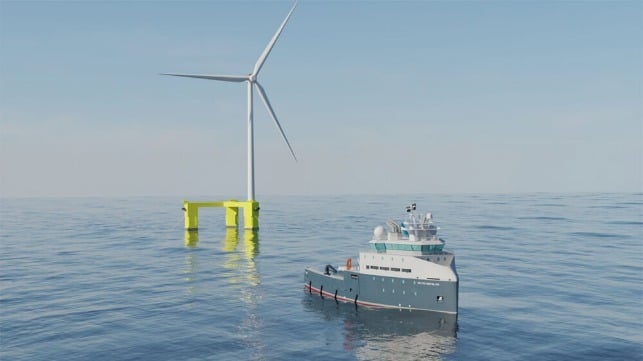
A consortium based in the UK is working on the designs for a new segment of the shipping industry specifically designed to support floating offshore wind installations. As the offshore wind energy industry moves toward its next phase, which will require floating turbines, it will also need a new type of vessel better suited to the challenges of positioning and anchoring turbines.
“At present, the global fleet falls far short of what is required for serialized installation of floating turbines and their infrastructure,” explains Ian Godfrey of Tope Ocean, an engineering firm involved in the project.
The vessel concept focuses on a section of the floating wind installation process that is yet to be optimized. According to the project partners, the vessel will work with any of the three main anchor types for floating wind turbines being considered by the industry. Drag embedment anchors, they highlight will require installation by high bollard pull anchor handling vessels, while suction piles and driven piles, which require large subsea cranes to install them into the seabed.
The first feasibility stage has been completed for the Future FLOW Installation Vessel. It will meet the requirements of the next phase by installing the mooring lines onto the installed anchors, enabling quick connection to floating foundations towed to the offshore site. The design also incorporates low-carbon fuels, providing fuel efficiency advantages, a hydrodynamically optimized hull, and expanded mooring capacity.
“We’ve reimagined the mooring installation process, designing a vessel focused on these new requirements,” says Simon Hindley of Solis Marine Engineering. “By combining an energy-efficient hull form with a low-emission powertrain, we can tackle high-duty construction tasks without relying on traditional, fossil fuel-powered vessels, improving the overall efficiency of the offshore construction activities.”
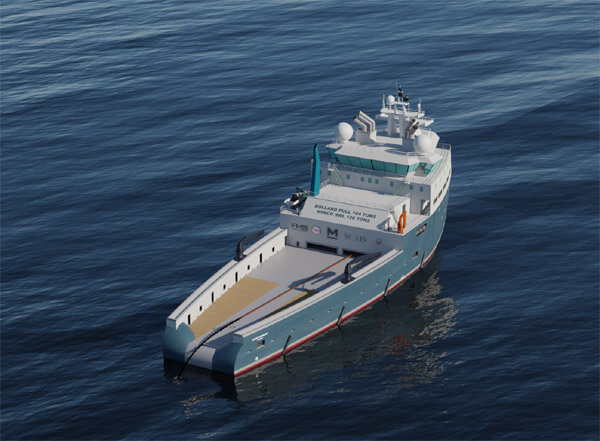
The vessel has been designed to maximize mooring line capacity while minimizing running costs. The selection of azimuth thrusters and reduced resistance to station-keeping and dynamic positioning efficiency is partnered with the alternative fuel choice of methanol. To maximize mooring line capacity, the vessel also has a large below-deck cable tank for synthetic mooring ropes as well as large chain lockers to hold the kilometers of chain expected for the floating wind industry.
The project is part of the Clean Maritime Demonstration Competition Round 4 (CMDC4), funded by the UK Department for Transport and delivered by Innovate UK. Consortium partners include naval architects Solis Marine Engineering, innovation specialists Tope Ocean, marine operations specialists First Marine Solutions, and Celtic Sea Power.
The consortium reports it is now advancing toward the next design stage, which will focus on the equipment for handling large quantities of synthetic ropes, weather-limit analyses, and regulatory and design challenges faced by methanol propulsion systems. The target is to secure an Approval in Principle from a major ship classification society by December 2025.

No comments:
Post a Comment